
The Great War
Published on 25 Aug 2018Chair of Wisdom Time!
August 26, 2018
Italians in AH Army – Military Missions I OUT OF THE TRENCHES
Comments Off on Italians in AH Army – Military Missions I OUT OF THE TRENCHES
The Wolseley Expedition and the making of Canada
The History Guy: History Deserves to Be Remembered
Published on 2 May 2018In the early days of the Canadian confederation, one of the greatest officers of the British Victorian Army takes 1000 soldiers on an impossible march through the wilderness that helps to define modern Canada.
All events are described for educational purposes and are presented in historical context.
Patreon: https://www.patreon.com/TheHistoryGuy
The History Guy: History Deserves to be Remembered is the place to find short snippets of forgotten history from five to fifteen minutes long. If you like history too, this is the channel for you.
Comments Off on The Wolseley Expedition and the making of Canada
QotD: Epicurus and the gods
… [Ludwig von] Mises ridicules the naïve anthropomorphism that consists in applying human characteristics to deities defined as perfect and omnipotent. How could such a being be understood to be planning and acting, or be angry, jealous, and open to bribing, as he is shown in many religious traditions? As he writes in Human Action again, “An acting being is discontented and therefore not almighty. If he were contented, he would not act, and if he were almighty, he would have long since radically removed his discontent.”
In an article on the implications of human action published on Mises.org two years ago, Gene Callahan discusses this and asserts that Mises’ insight into the relationship of praxeology to any possible supreme being is quite original, at least as far as he knows. Well, in fact, this insight is straight out of Epicureanism. Epicurus declared that since Gods were perfect and completely contented, they could not be involved in any way in human affairs. It was silly to be afraid of them, and useless to try to propitiate them. For this of course, he was suspected of being an atheist, and this is a major reason why he has been so vilified by Christian writers for centuries.
Martin Masse, “The Epicurean roots of some classical liberal and Misesian concepts“, speaking at the Austrian Scholars Conference, Auburn Alabama, 2005-03-18.
Comments Off on QotD: Epicurus and the gods
August 25, 2018
Swedish Antiaircraft Artillery: Bofors 40mm Automatic Gun M1
Forgotten Weapons
Published on 24 Aug 2018Note: In the video I mistakenly describe this as a two-stamp NFA gun. It is actually deactivated, and thus does not require a tax stamp. Sorry for the mistake!
http://www.patreon.com/ForgottenWeapons
The Swedish Bofors company developed their 40mm antiaircraft gun in the 1930s, and it would go on to be one of the most successful weapon designs in modern history. Used by both sides in WWII and in all theaters, improved versions of the 40mm Bofors gun continue to serve in military front lines to this very day. In the US, they comprise part of the armament on the AC-130 Spectre gunships, for example.
This particular gun is a WW2 vintage piece, made in Sweden. Most of the examples used by the United States were made under license by Chrysler, the car company. Something like 60,000 were produced during the war, mostly for naval use. These guns would be a mainstay of American vessels’ air defense against Japanese Kamikaze attacks.
If you enjoy Forgotten Weapons, check out its sister channel, InRangeTV! http://www.youtube.com/InRangeTVShow
Comments Off on Swedish Antiaircraft Artillery: Bofors 40mm Automatic Gun M1
Mediterranean trade in the Iron Age
Jan Bakker, Stephan Maurer, Jörn-Steffen Pischke, and Ferdinand Rauch look at the relationships between trade and economic growth around the Mediterranean during the Iron Age:
Economists often point out the benefits of trade, yet empirical evidence for these benefits has been hard to come by and tends to be recent. This column goes back to the first millennium BC to analyse the growth effects of one of the first major trade expansions in human history: the systematic crossing of the open sea in the Mediterranean by the Phoenicians. A strong positive relationship between connectedness and archaeological sites suggests a large role for geography and trade in development even at such an early juncture in history.
The effects of free trade inspire a lot of public debate these days, and policies to restrict trade are gaining in prominence. Economists since Adam Smith and David Ricardo have typically pointed out the benefits of trade. Yet empirical evidence for these benefits has been much harder to come by and is much more recent. In particular, empirical economists have tried to demonstrate that more open economies or more integrated markets see faster growth. The relationship between these two variables is not much disputed; the more difficult question is whether this is due to trade causing growth or richer economies being more open.
[…]
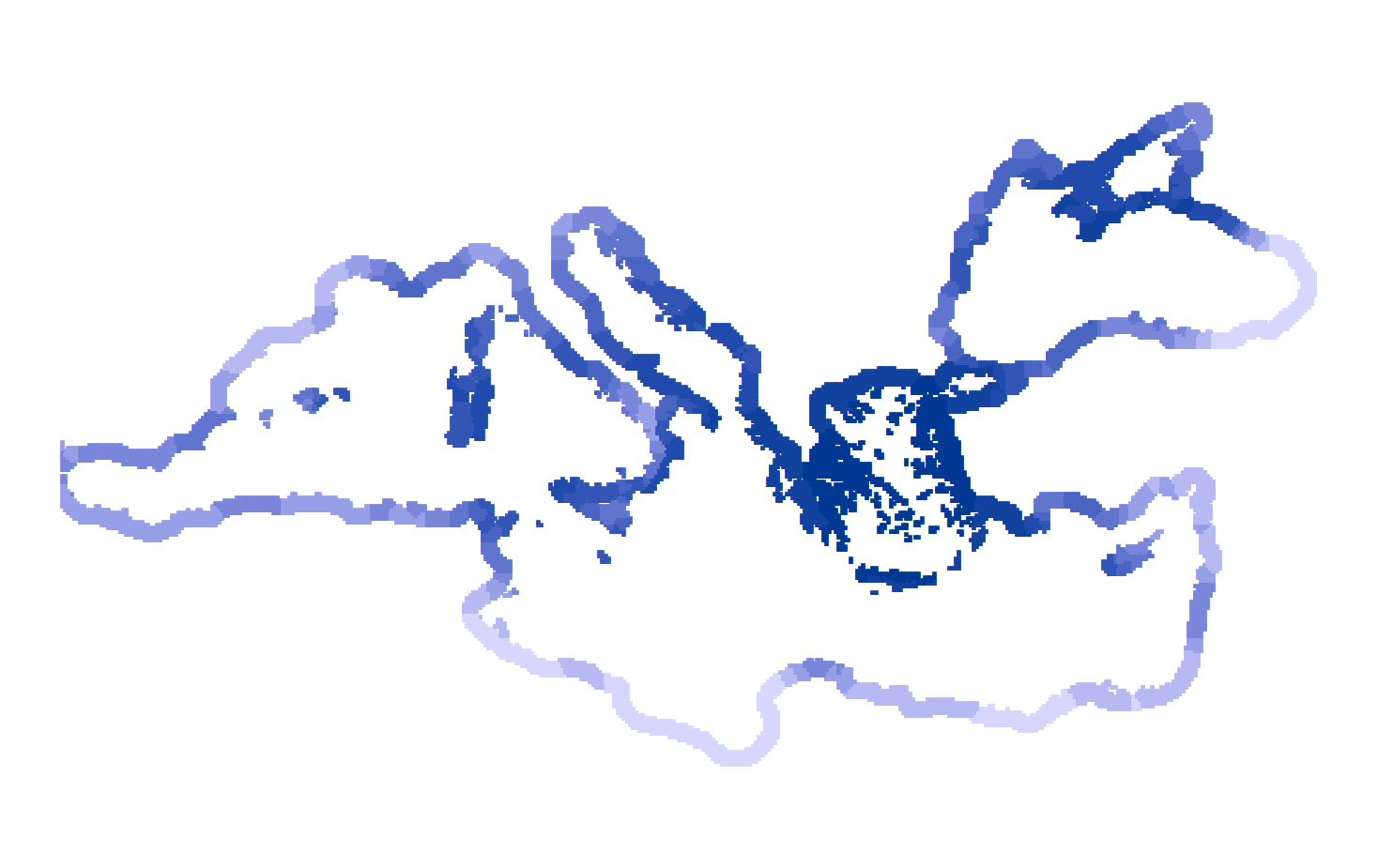
To analyse whether this increased trade also caused growth, we exploit the fact that open sea sailing creates different levels of connectedness for different points on the coast. The shape of the coast and the location of islands determineshow easy it is to reach other points, which might be potential trading partners, within a certain distance. We create such a measure of connectedness for travel via sea. Figure 1 shows the values of this measure on a map and demonstrates how some regions, for example the Aegean but also southern Italy and Sicily, are much better connected than others.
We use this measure of connectedness as a proxy for trading opportunities.
Figure 1 Log connectedness at 500km distance
Note: Darker blue indicates better connected locations.
Measuring growth for an early period of human history is more difficult as we have no standard measure of income, GDP, or even population. We quantify growth by the presence of archaeologic sites for settlements or urbanisations. While this is clearly not a perfect measure, more sites should imply more human presence and activity. We then relate the number of active archaeological sites in a particular period to our measure of connectedness.
We find a large positive relationship between connectedness and archaeological sites. The effect of connections on growth in the Iron Age Mediterranean are up to twice as large as the effects Donaldson and Hornbeck (2016) found for US railroads. Although these results are unlikely to be directly comparable, the magnitudes suggest a large role for geography and trade in development even at such an early juncture in history.
Comments Off on Mediterranean trade in the Iron Age
Why was Italy so Ineffective in WWII? | Animated History
The Armchair Historian
Published on 27 Jul 2018Potential History’s Video: https://youtu.be/QB2GINNs3Aw
Our Patreon: https://www.patreon.com/armchairhistory
Our Twitter: https://twitter.com/ArmchairHist
Sources:
The Rise and Fall of the Third Reich, William L. Shirer
Fascist Italy’s Military Struggles from Africa and Western Europe to the Mediterranean and Soviet Union 1935-45, Frank Joseph
Hitler’s Italian Allies: Royal Armed Forces, Fascist Regime, and the War of 1940-1943, MacGregor Knox
Comments Off on Why was Italy so Ineffective in WWII? | Animated History
QotD: India’s caste system
… Gandhi, born the son of the Prime Minister of a tiny Indian principality and received as an attorney at the bar of the Middle Temple in London, [began] his climb to greatness as a member of the small Indian community in, precisely, South Africa. Natal, then a separate colony, wanted to limit Indian immigration and, as part of the government program, ordered Indians to carry identity papers (an action not without similarities to measures under consideration in the U.S. today to control illegal immigration). The film’s lengthy opening sequences are devoted to Gandhi’s leadership in the fight against Indians carrying their identity papers (burning their registration cards), with for good measure Gandhi being expelled from the first-class section of a railway train, and Gandhi being asked by whites to step off the sidewalk. This inspired young Indian leader calls, in the film, for interracial harmony, for people to “live together.”
Now the time is 1893, and Gandhi is a “caste” Hindu, and from one of the higher castes. Although, later, he was to call for improving the lot of India’s Untouchables [Dalits], he was not to have any serious misgivings about the fundamentals of the caste system for about another thirty years, and even then his doubts, to my way of thinking, were rather minor. In the India in which Gandhi grew up, and had only recently left, some castes could enter the courtyards of certain Hindu temples, while others could not. Some castes were forbidden to use the village well. Others were compelled to live outside the village, still others to leave the road at the approach of a person of higher caste and perpetually to call out, giving warning, so that no one would be polluted by their proximity. The endless intricacies of Hindu caste by-laws varied somewhat region by region, but in Madras, where most South African Indians were from, while a Nayar could pollute a man of higher caste only by touching him, Kammalans polluted at a distance of 24 feet, toddy drawers at 36 feet, Pulayans and Cherumans at 48 feet, and beef-eating Paraiyans at 64 feet. All castes and the thousands of sub-castes were forbidden, needless to say, to marry, eat, or engage in social activity with any but members of their own group. In Gandhi’s native Gujarat a caste Hindu who had been polluted by touch had to perform extensive ritual ablutions or purify himself by drinking a holy beverage composed of milk, whey, and (what else?) cow dung.
Low-caste Hindus, in short, suffered humiliations in their native India compared to which the carrying of identity cards in South Africa was almost trivial. In fact, Gandhi, to his credit, was to campaign strenuously in his later life for the reduction of caste barriers in India — a campaign almost invisible in the movie, of course, conveyed in only two glancing references, leaving the audience with the officially sponsored if historically astonishing notion that racism was introduced into India by the British. To present the Gandhi of 1893, a conventional caste Hindu, fresh from caste-ridden India where a Paraiyan could pollute at 64 feet, as the champion of interracial equalitariansim is one of the most brazen hypocrisies I have ever encountered in a serious movie.
Richard Grenier, “The Gandhi Nobody Knows”, Commentary, 1983-03-01.
Comments Off on QotD: India’s caste system
August 24, 2018
Over By Christmas? – Growing Allied Confidence I THE GREAT WAR Week 213
The Great War
Published on 23 Aug 2018Get David Zabecki’s Book about the German 1918 Offensives: http://bit.ly/Zabecki1918
With the recent “Black Day of the German Army” and the success of the new strategy of Allied attacks along the Western Front and with the renewed offensives in Palestine, British Commander Sir Douglas Haig is confident the war can be won by the end of the year. Entente Generalissimo Ferdinand Foch is a bit more cautious but also thinks the war can be won by 1919.
Comments Off on Over By Christmas? – Growing Allied Confidence I THE GREAT WAR Week 213
From Software-as-a-Service to emerging Techno-Feudalism
The shift from selling software to selling software subscriptions was a major sea-change in the technology world. Here’s a bit of historical perspective from The Z Man to explain why this could be a very bad thing indeed for the average user:
Feudalism only works when a small elite controls the source of wealth. Then they can control the exploitation of it. In Europe, as Christianity spread, the Church acquired lands, becoming one of the most powerful forces in society. The warrior elite was exclusively Catholic, thus they had a loyalty to the Pope, as God’s representative on earth. Therefore, the system of controlling wealth not only had a direct financial benefit to the people at the top, it had the blessing of God’s representative, who sat atop the whole system.
That’s something to keep in mind as we see technology evolve into a feudal system, where a small elite controls the resources and grants permission to users. The software oligopolies are now shifting all of their licensing to a subscription model. It’s not just the mobile platforms. Developers of enterprise software for business are adopting the same model. The users have no ownership rights. Instead they are renters, subject to terms and conditions imposed by the developer or platform holder. The user is literally a tenant.
The main reason developers are shifting to this model is that they cannot charge high fees for their software, due to the mass of software on the market. Competition has drive down prices. Further, customers are not inclined to pay high maintenance fees, when they can buy new systems at competitive rates. The solution is stop selling the stuff and start renting it. This fits the oligopoly scheme as it ultimately puts them in control of the developers. Apple and Google are now running protection rackets for developers.
It also means the end of any useful development. Take a look at the situation Stefan Molyneux faces. A band of religious fanatics has declared him a heretic and wants him burned. The Great Church of Technology is now in the process of having him expelled from the internet. As he wrote in a post, he invests 12 years building his business on-line, only to find out he owns none of it. He was always just a tenant farmer, who foolishly invested millions in YouTube. Like a peasant, he is now about to be evicted.
How long before someone like this monster discovers that Google and Apple will no longer allow him to use any apps on his phone? Or maybe he is denied access to his accounting system? How long before his insurer cuts off his business insurance, claiming the threat from homosexual terrorists poses too high of a risk? Federal law prevents the electric company from shutting off his power due to politics, but Federal law used to prevent secret courts and secret warrants. Things change as the people in charge change.
Comments Off on From Software-as-a-Service to emerging Techno-Feudalism
Tank Chats #35 Centurion | The Tank Museum
The Tank Museum
Published on 14 Apr 2017The thirty-fifth Tank Chat, presented David Fletcher MBE, is the first of the videos on the Centurion series of tanks.
The Centurion is one of the most important tanks in the history of the British AFV and is one of the most significant post-war Western tanks. Introduced in the spring of 1945, a small number of the Beach Armoured Recovery Version (BARV) served with the British forces during the Iraq war of 2003, 58 years later.
To find out more, buy the Haynes Centurion tank manual. https://www.myonlinebooking.co.uk/tan…
Support the work of The Tank Museum on Patreon: ► https://www.patreon.com/tankmuseum
Or donate http://tankmuseum.org/support-us/donate
Comments Off on Tank Chats #35 Centurion | The Tank Museum
August 23, 2018
Lost model of the Avro Arrow found off Prince Edward County
Call me a cynic, but this is likely to kick off yet another round of myth-making about the Avro Arrow:
An iconic piece of Canada’s aviation history has been pulled out of the depths of Lake Ontario and the recovery team is hoping to find more beneath the waves.
Divers brought what is believed to be a model of the Avro Arrow to the surface last week off Prince Edward County and brought it to the Canada Aviation and Space Museum on Tuesday.
Since last September, a series of models have been found at the bottom of Lake Ontario.
The model is about three metres long — a 1/8 scale of the actual plane, according to Erin Gregory, assistant curator at the museum.
“It looks like a rocket with large triangular wings,” she said.
1/8 scale model of the Avro Arrow recovered from Lake Ontario off the shores of Prince Edward County
Photo by OEX Recovery Group, via CBC.The Canadian Conservation Institute and the aviation museum, will oversee the conservation and restoration of the test models.
What they found last week, is not the full replica of the Arrow, the search group was hoping to find. Instead they believe it is a smaller model, meant to test the delta wing design — the triangular shape the plane was known for.
“The delta wing was a relatively new concept at that point, so it required a lot of testing to determine whether or not it would perform well, particularly at supersonic speeds,” said Gregory.

The Avro Arrow holds a special place in the hearts of Canadian conspiracy theorists – it’s “artisanal Canadian myth-making, hand-woven, fair-trade, and 100% organic”. As I said back in 2004, this is the only truly Canadian conspiracy theory (Colby Cosh calls it our “Napoleon-hat” complex).
Comments Off on Lost model of the Avro Arrow found off Prince Edward County
QotD: Nietzsche’s idealised Übermensch
The solution, [Nietzsche] believed, was a new individualistic morality system in which the strongest, bravest men would become their own masters and creators, and in turn would become philosopher kings and oligarchs of the spirit. This new man was to be embodied in his infamous, hypothetical Übermensch, or Superman (as Über means above and beyond in German, Nietzsche’s word used to be also translated as the Beyond-Man or Overman, but today is usually not translated at all. The Übermensch goes above and beyond.)
The arch-individual, non-conformist Superman rises above the morality of the herd and harnesses all of his internal energies, all the energy within – his ‘will to power’, which consists of his sexual drive, survival drive, pleasure drive and other non-rational forces – to embrace life fearlessly, and with nobility and courage. The ultimate task of the Übermensch is to face life and live it as if he had lived it an infinite number of times in the past, and will do so an infinite number of times in the future. In so doing he will accept all of life’s horrors and sufferings in a kind of neverending Groundhog Day. Nietzsche ostensibly took this ‘eternal recurrence’ to be literally true, not just a metaphor.
All of these thoughts were developed by Nietzsche in the third stage of his writing. The first stage, from 1872 to 1878, was marked by a preoccupation with the pre-Socratic Ancient Greeks, and how they used art and theatre to make sense of human existence and all its capricious cruelties. The second stage, encompassing the books Human, All Too Human (1878), The Dawn (1881) and The Joyful Science (1883), was marked by experimental and doubtful musings on the notion of truth. While his third and final stage, taking us up to January 1889, when he was struck down by madness, is characterised chiefly by the question of morality, and how his idealised Übermensch would confront and overcome nihilism.
Patrick West, “Nietzsche and the struggle against nihilism”, Spiked, 2018-08-03.
Comments Off on QotD: Nietzsche’s idealised Übermensch
August 22, 2018
The History of Virtual Reality – A New Place to Call Home – Extra Sci Fi – #1
Extra Credits
Published on 21 Aug 2018From Aldous Huxley to Philip K. Dick, early references to virtual reality simulations abound in science fiction literature, and tremendously impacted consumer anticipation for VR technology available in the modern day. Many thanks to Oculus Rift for sponsoring the next two episodes of Extra Sci Fi and giving us a chance to explore our collective definition of virtual reality.
Comments Off on The History of Virtual Reality – A New Place to Call Home – Extra Sci Fi – #1
The 10 Worst British Military Aircraft
Hush Kit
Published on 5 Feb 2018Patreon – https://www.patreon.com/hush_kit
PayPal – https://www.paypal.me/HushKit
Blog – https://hushkit.net/
If you want something done slowly, expensively and possibly very well, you go to the British. While Britain created the immortal Spitfire, Lancaster and Edgley Optica, it also created a wealth of dangerous, disgraceful and diabolical designs. These are just ten plucked from a shortlist of thirty. In defining ‘worst’- we’ve looked for one, or a combination, of the following: design flaws, conceptual mistakes, being extremely dangerous, being unpleasant to fly, or obsolete at the point of service entry (and the type must have entered service). Grab a cup of tea, and prepare for ire as you read about ten machines they wanted your dad, grandad or great grandad to fly to war. I’d love to hear your opinions below. The original article can be found here: https://hushkit.net/2016/03/02/the-te…
Comments Off on The 10 Worst British Military Aircraft
August 21, 2018
Creating An American Army – John J. Pershing I WHO DID WHAT IN WW1?
The Great War
Published on 20 Aug 2018Check Out Desert Operations: https://desertoperations.gamigo.com/
John Pershing already had a long career in in the US forces when World War 1 broke out. When 1917 came around he was tasked with the monumental challenge of creating and expanding the American Expeditionary Forces and send them over to Europe.
Comments Off on Creating An American Army – John J. Pershing I WHO DID WHAT IN WW1?


