
Even if the USA picked up its toys and went home in a huff, which they won’t I might add, more’s the pity for the hapless US taxpayer, the effete dissipated welfare addicted gender quota apportioned peoples of Europe that dwell so prominently in the imaginations of Real Men From Texas (or wherever), are actually quite capable of keeping the Russian Hordes, in their rust covered jalopies with siphoned fuel tanks, from sweeping across the steppes and threatening to once again park themselves somewhere near the Fulda Gap, presumably out of nostalgia for a place with half decent food. Russia… big dick, but no shoes.
I have often said the difference between British and American arrogance is the Brits think they run the world, the Americans think they are the world. Yet somehow the world will bumble along even if either don’t get involved with spanking Putin. The US should just fixate the collective paranoia on China because that actually is something of a Good Old Fashioned Looming Threat, of the kind much loved by people like Boeing and Lockheed.
Perry de Havilland, “Russia… lets keep a sense of proportion”, Samizdata, 2014-04-06
April 6, 2014
QotD: “[T]he effete dissipated welfare addicted gender quota apportioned peoples of Europe”
March 31, 2014
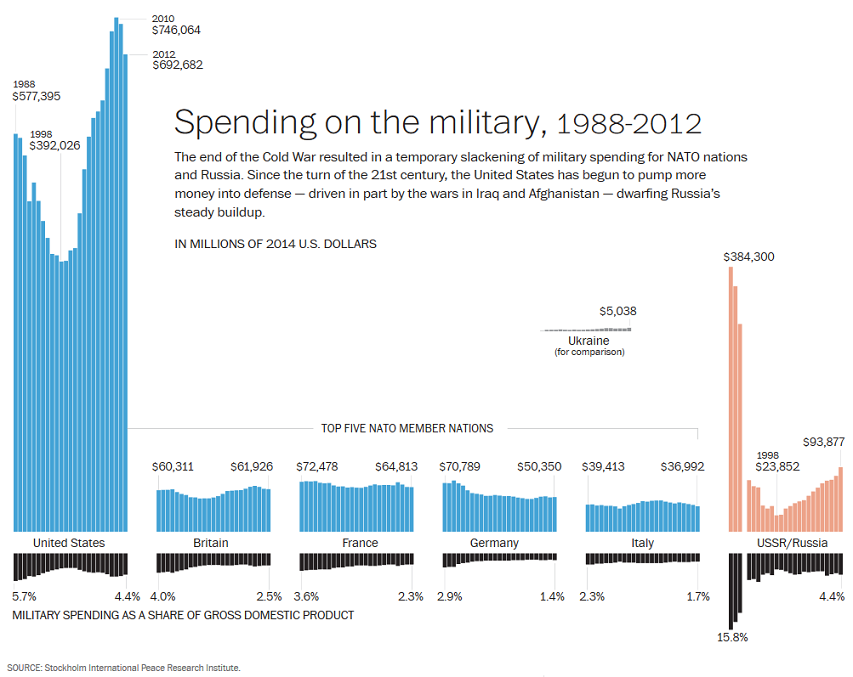
Comparing NATO and Russian military spending to 2012
Mark Collins links to this Washington Post graphic showing a comparison of military spending in the top five NATO countries and Russia (counting Soviet spending 1988-1991). Note that the United States and Russia now each spend the same proportion of GDP on their respective military forces:
Click to see full-size graphic
For reference, Canada’s military budget doesn’t crack the top 10 in NATO: we spend about US$16.5 billion per year (not even in the top 15). Mark also points out that Australia spends proportionally more than Canada … about 50% more, in fact. But it should also be noted that while Canada and Australia have a lot in common, our defence needs are significantly different: Oz is in a much more dangerous part of the world than Canada, and they don’t share a lengthy border with the world’s biggest military spender. You could probably make a viable case that Australia isn’t spending enough given the rough neighbourhood they’re in.
March 30, 2014
The rise of Vladimir Putin
BBC News charts the unlikely rise of Russian leader Vladimir Putin:
On 16 August 1999, the members of Russia’s parliament — the State Duma — met to approve the candidacy of a prime minister. They heard the candidate’s speech, they asked him a few questions, and they dutifully confirmed him in the position.
This was President Boris Yeltsin’s fifth premier in 16 months, and one confused party leader got the name wrong. He said he would support the candidacy of Stepashin — the surname of the recently sacked prime minister — rather than that of his little-known successor, before making an embarrassing correction.
If even leading Duma deputies couldn’t remember the new prime minister’s name, you couldn’t blame the rest of the world if it didn’t pay much attention to his speech. He was unlikely to head the Russian government for more than a couple of months anyway, so why bother?
That man was a former KGB officer, Vladimir Putin, and he has been in charge of the world’s largest country, as president or prime minister, ever since. Few realised it at the time, because few were listening, but that speech provided a blueprint for pretty much everything he has done, for how he would re-shape a country that was perilously close to total collapse.
Just 364 days previously, Russia had defaulted on its debt. Salaries for public sector workers and pensions were being paid months late, if at all. Basic infrastructure was collapsing. The country’s most prized assets belonged to a handful of well-connected “oligarchs”, who ran the country like a private fiefdom.
The once-mighty Russian army had lost a war in Chechnya, a place with fewer inhabitants than Russia had soldiers. Three former Warsaw Pact allies had joined Nato, bringing the Western alliance up to Russia’s borders.
Meanwhile, the country was led by Yeltsin, an irascible drunkard in fragile health. The situation was desperate, but Putin had a plan.
Russian President Vladimir Putin attends a meeting with members of the Council of the Federation on March 27, 2014 in Moscow, Russia. (Photo by Sasha Mordovets/Getty Images)
March 26, 2014
Russia has seized 80% of the Ukrainian navy so far
The Kyiv Post has a report including this graphic, showing the current state of Ukraine’s naval forces:
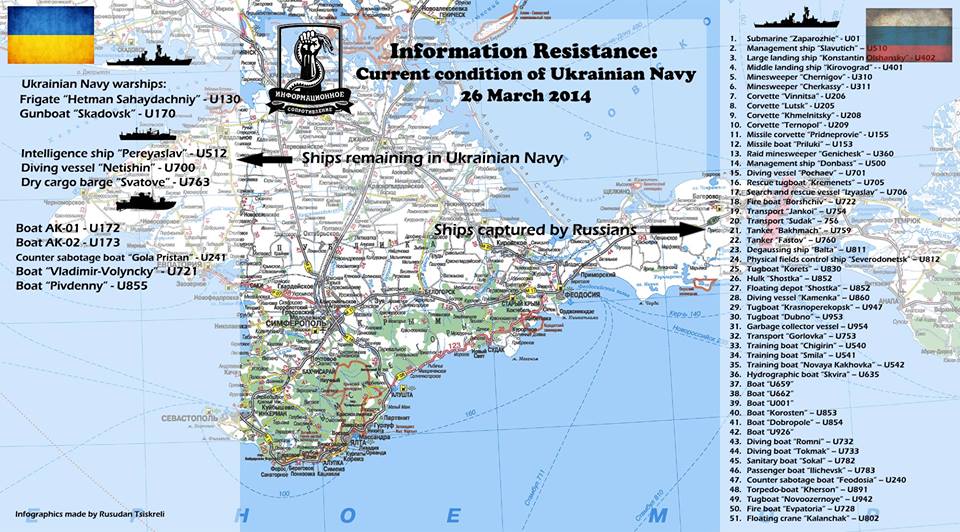
Among the Ukrainian vessels reportedly captured by the Russians are submarine Zaporizhia, management ship Slavutych, landing ship Konstantin Olshansky, landing ship Kirovohrad, minesweeper Chernihiv and minesweeper Cherkasy.
The Cherkasy was the last of the ships to have been overtaken following weeks of threats and ultimatums to surrender. It was finally chased down and overtaken by the Russian navy on March 25 after failing to slip past a blockade of two ships intentionally sunk by the Russians to trap it and other vessels in a narrow gulf, keeping them from escaping into the Black Sea.
H/T to Tony Prudori for the link.
March 25, 2014
NATO’s existential moment
In the Telegraph, Con Coughlin says that if NATO doesn’t stand up to Vladimir Putin’s aggressions, it’s done for:
For anyone who still takes the security of the West seriously — and I fear I am in a distinct minority — the manner in which Russian President Vladimir Putin has effortlessly achieved his audacious land grab in the Crimea should serve as a dramatic wake-up call for Nato.
And yet, to judge by the mood music coming from the meeting of Western leaders in The Hague this week, the likelihood of Nato doing anything to dissuade Moscow’s macho man from undertaking any further acts of military adventurism in central Europe or the Baltic states does not seem at all encouraging.
[…]
When faced with a crisis, the default position of Nato member states, as we have seen recently over Libya and Syria, is to bicker amongst themselves over how to respond, rather than coming up with an effective programme that safeguards its interests.
But if Nato leaders fail to come up with an adequate response to Putin’s new mood of military aggression, they might as well dissolve the alliance and start negotiating peace terms with Moscow.
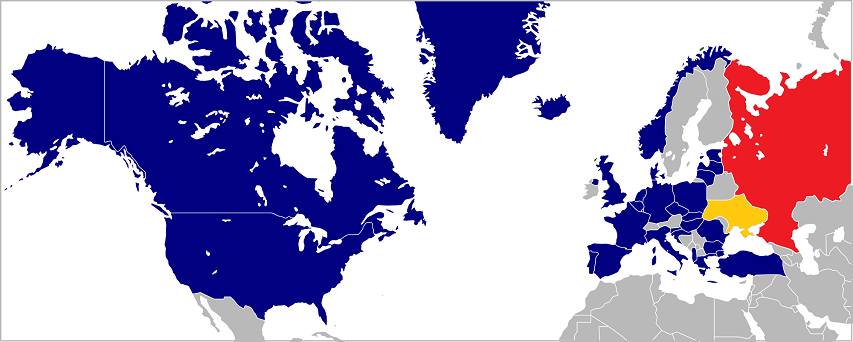
NATO member states in blue, Ukraine in yellow (including Crimea), Russia in red (for tradition’s sake)
Update: Poland is recalling reservists for military refresher training.
Next time you take a tray of tea and custard creams to the nice gang of Polish builders renovating your semi, they may seem a little distracted and anxious. Ask them why, and they will answer that some of them have in the last few weeks received call-up papers as army reservists.
This happened to a friend of mine in London at the end of last week. At least 7,000 reservists have been recalled to the colours for immediate exercises lasting between 10 and 30 days.
They’re told by the Polish authorities that the call-ups are “routine”: but the men say they haven’t been asked before and they’re well aware of the growing alarm in Warsaw at President Putin’s aggression. Three weeks ago, their Prime Minister, Donald Tusk, called a press conference to warn that “the world stands on the brink of conflict, the consequences of which are not foreseen… Not everyone in Europe is aware of this situation.”
My own view is that Putin was initially more concerned with righting a specific historical wrong in Crimea than starting a new Cold War. This is still probably the case despite the dawning truth that the EU/Nato Emperor really has no clothes at all.
But in the worst case scenario of a truly revanchist Russia, Poland certainly has the borders from hell. Starting from the top, it abuts Kaliningrad (the Russian exclave on the Baltic carved at the end of the war from East Prussia), Lithuania, Belarus and Ukraine.
March 19, 2014
This isn’t Cold War 2.0, it’s a return to historical norm
Jonah Goldberg asks everyone to stop talking about a new Cold War, because the old one was a unique event (or event-chain) and what we’re seeing now is more like history unfolded before the Cold War came along to freeze geopolitics for a few decades.
… the Cold War was far more than a conflict with Russia. Everyone should agree on that. Communism, anti-Communism, and anti-anti-Communism divided Americans for decades, particularly among academic and media elites. Right and Left may still argue over the merits of those divisions, but no informed person disputes that the topic of Communism — the real version and the imagined ideal — incited riots of intellectual and political disagreement in the West for a half-century.
Meanwhile, Putin’s ideology holds little such allure to Americans or the populations of the European Union. With the exception of a few cranky apologists and flacks, it’s hard to find anyone in the West openly defending Putin on the merits. And even those who come close are generally doing so in a backhanded way to criticize U.S. policies or the Obama administration. The dream of a “greater Russia” or a “Eurasian Union” simply does not put fire in the minds of men — non-Russian men, at least — the way the dream of global socialist revolution once did. And that’s a good thing.
[…]
Many have called the decade between the fall of the Soviet Union and the attacks of 9/11 a “holiday from history.” The truth is closer to the opposite. The Cold War years, while historic in a literal sense, were something of a great parentheses, a sharp departure from historical norms. Communism was a transnational ideology imposed on nationalist movements. That’s why every supposedly Communist movement eventually became nationalist once in power. Still, the rhetorical and psychological power of Communist ideology, combined with the fear of nuclear war, made international relations seem like a sharp break with how foreign affairs worked before 1945 — or 1917.
It turns out, the Berlin Wall wasn’t blocking us from a new world order, it was holding back the tide of history. Western Europe was especially slow to realize this. Its politicians and intellectuals persuaded themselves that they had created a continental “zone of peace” through diplomacy, when in reality they were taking U.S. protection for granted. They let their militaries atrophy to the point of being little more than ceremonial.
The end of the Cold War fostered the illusion that the “guns or butter” argument had been permanently settled and we “wouldn’t study war no more”. The peace dividend was always an illusion — a very attractive illusion to politicians who wanted to spend money on things that would get them re-elected — and voters rewarded them appropriately. It’s going to be psychologically difficult for the countries of the West to come to terms with the return of the traditional forces of history.
March 10, 2014
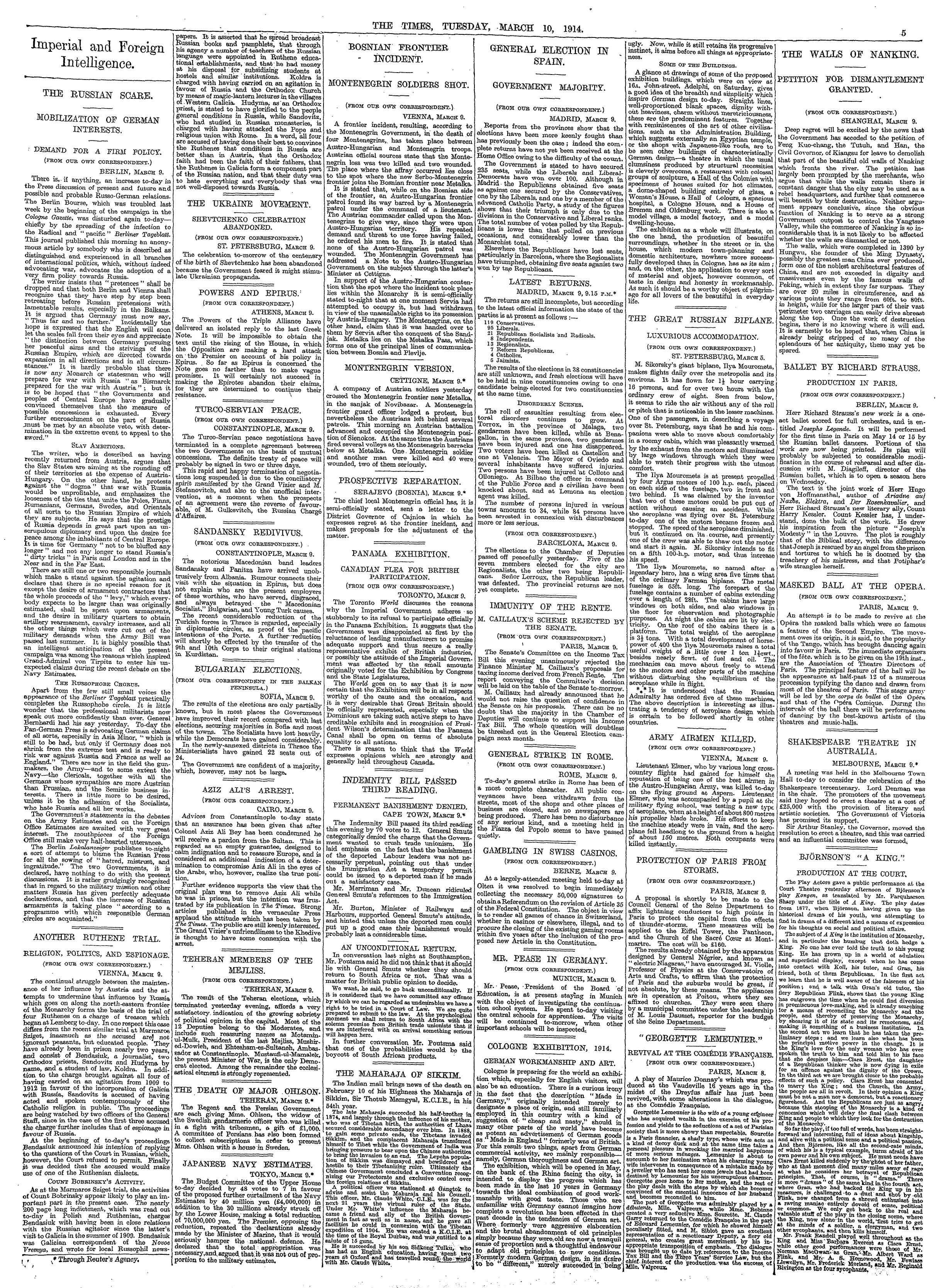
Remarkably modern headlines from 100 years ago
At Samizdata, Patrick Crozier talks about the situation in Europe exactly a century back, and the headlines might almost be run today:
Click to see full page
Over the last few days (this is 1914 we’re talking about just in case anyone was in any doubt) a large number of articles have appeared in the German press on the threat posed by Russia. And still they come:
There is, if anything, an increase to-day in the Press discussion of present and future and possible and probable Russo-German relations. The Berlin Bourse, which was troubled last week by the beginning of the campaign in the Cologne Gazette, was disturbed again to-day – chiefly by the spreading of the infection to the Radical and “pacific” Berliner Tageblatt. This journal published this morning an anonymous article by somebody who is described as distinguished and experienced in all branches of international politics, which, without indeed advocating war, advocates the adoption of a very firm policy towards Russia.
This is co-ordinated and there’s only one body that would be doing the co-ordination: the German government. They are preparing the population for war. The argument being used is precisely the argument being used in the corridors of power: the Russians are building up their forces and in a few years they will be too strong and it will be too late. In other words: it’s now or never.
It is not just the Russians the Germans are worried about. The Russians on their own would be fairly harmless (as indeed they proved to be) but they are in alliance with France. This leads to Germany’s worst nightmare: the prospect of a war on two fronts. This in turn leads to the development of the Schlieffen Plan with its aim to eliminate one of those fronts before the other one got going.
There is an alternative. Germany could return Alsace-Lorraine to France. At a stroke they would eliminate the one and only bone of contention in the Franco-German relationship and as a consequence break up the Franco-Russian alliance. But no.
There are good reasons why the German government isn’t so keen on such a move. By accepting self-determination in Alsace-Lorraine they would be accepting the principle of democracy. This is hardly the sort of thing that a monarchy can do. There would also be the element of losing face that weak regimes are very reluctant to do.
March 7, 2014
Gunboat diplomacy for the 21st century
680News reports that a US warship will be patrolling the Black Sea:
A U.S. Navy warship is heading to the Black Sea as tensions in Ukraine continue to divide world powers, according to multiple published reports.
Turkey has given the USS Truxtun permission to pass through the Bosphorus into the Black Sea.
U.S. officials say it is a “routine” deployment that was scheduled before the crisis erupted in Ukraine.
However, the show of military hardware is coinciding with NATO’s show of military support over Baltic countries with its use of air patrols and F-15 fighter jets.
Meantime, President Barack Obama’s warnings to Russia are being brushed aside by Russian President Vladimir Putin, who appears to only be speeding up efforts to formally stake his claim to Ukraine’s Crimean Peninsula.
The USS Truxtun is a new Arleigh Burke-class guided missile destroyer, commissioned in 2009.
While we may be relatively sure that the Truxtun is a powerful vessel (the Wikipedia article describes the class as “larger and more heavily armed than most previous ships classified as guided missile cruisers”), no single ship is going to be particularly effective in putting pressure on Russia over their Ukraine deployment. The Black Sea is a small body of water, geostrategically speaking, and is totally dominated by land-based airpower. Should the situation turn grave, Truxton isn’t likely to weigh heavily in the military balance. She’s there as a token, not as a military asset.
March 5, 2014
Vladimir Putin and the “vertical of power”
The BBC‘s Steve Rosenberg says that to understand what Russia is doing, you have to get into the mind of the man who controls it all:
One thing that makes Vladimir Putin mad is the feeling that he is being deceived. We saw that with Libya in 2011. Moscow was persuaded not to block a UN Security Council resolution on a no-fly zone to protect civilians. But Nato’s military action led to regime change and the death of Col Muammar Gaddafi — far beyond what Russia had expected. It helps explain why Russia has been quick to veto resolutions on Syria.
On Ukraine, too, President Putin feels the West has tricked him. Last month he sent his envoy to Kiev to take part in negotiations on a compromise agreement between President Viktor Yanukovych and the opposition. That deal, brokered by foreign ministers from Germany, France and Poland, envisaged early elections, constitutional reform and a national unity government.
The Kremlin’s representative did not sign the deal, but Russia appeared to accept it as the best solution in a bad situation. It remained words only. Less than 24 hours later, Mr Yanukovych was on the run, the parliament removed him from power and appointed a new acting president from the opposition. The pace of events took Moscow completely by surprise.
The world according to Vladimir Putin is one in which Western powers are plotting night and day to destabilise Russia (and him, personally).
He remembers the Rose Revolution in Georgia in 2003, the Orange Revolution in Kiev the following year; Russia suspected the West of planning both.
More recently the Kremlin accused the West of funding and fuelling anti-government street protests in Moscow.
For months, Russia has been accusing the US and EU of meddling in Ukraine for geopolitical gains. On Tuesday President Putin said Viktor Yanukovych’s refusal to sign an association agreement with the EU last autumn “was simply used as an excuse to back opposition forces in their battle for power… it’s not the first time our Western partners have done this in Ukraine”.
March 4, 2014
Not a science fiction story – “National Bolshevism” versus “Atlantis”
According to Robert Zubrin, a key advisor to Vladimir Putin and other Russian leaders has some really weird notions:
Putin is sometimes described as a revanchist, seeking to recreate the Soviet Union. That is a useful shorthand, but it is not really accurate. Putin and many of his gang may have once been Communists, but they are not that today. Rather, they have embraced a new totalitarian political ideology known as “Eurasianism.”
The roots of Eurasianism go back to czarist émigrés interacting with fascist thinkers in between-the-wars France and Germany. But in recent years, its primary exponent has been the very prominent and prolific political theorist Aleksandr Dugin.
[…]
Nazism, it will be recalled, was an abbreviation for National Socialism. National Bolshevism, therefore, put itself forth as an ideology that relates to National Socialism in much the same way as Bolshevism relates to Socialism. This open self-identification with Nazism is also shown clearly in the NBP flag, which looks exactly like a Nazi flag, with a red background surrounding a white circle, except that the black swastika at the center is replaced by a black hammer and sickle.
[…]
The core idea of Dugin’s Eurasianism is that “liberalism” (by which is meant the entire Western consensus) represents an assault on the traditional hierarchical organization of the world. Repeating the ideas of Nazi theorists Karl Haushofer, Rudolf Hess, Carl Schmitt, and Arthur Moeller van der Bruck, Dugin says that this liberal threat is not new, but is the ideology of the maritime cosmopolitan power “Atlantis,” which has conspired to subvert more conservative land-based societies since ancient times. Accordingly, he has written books in which he has reconstructed the entire history of the world as a continuous battle between these two factions, from Rome v. Carthage to Russia v. the Anglo Saxon “Atlantic Order,” today. If Russia is to win this fight against the subversive oceanic bearers of such “racist” (because foreign-imposed) ideas as human rights, however, it must unite around itself all the continental powers, including Germany, Central and Eastern Europe, the former Soviet republics, Turkey, Iran, and Korea, into a grand Eurasian Union strong enough to defeat the West.
In order to be so united, this Eurasian Union will need a defining ideology, and for this purpose Dugin has developed a new “Fourth Political Theory” combining all the strongest points of Communism, Nazism, Ecologism, and Traditionalism, thereby allowing it to appeal to the adherents of all of these diverse anti-liberal creeds. He would adopt Communism’s opposition to free enterprise. However, he would drop the Marxist commitment to technological progress, a liberal-derived ideal, in favor of Ecologism’s demagogic appeal to stop the advance of industry and modernity. From Traditionalism, he derives a justification for stopping free thought. All the rest is straight out of Nazism, ranging from legal theories justifying unlimited state power and the elimination of individual rights, to the need for populations “rooted” in the soil, to weird gnostic ideas about the secret origin of the Aryan race in the North Pole.
March 2, 2014
Why the EU hesitates to do anything about Ukraine
Extreme wealth, whether honestly or dishonestly acquired, seems these days to bring forth little new except in the form and genre of vulgarity. Mr. Ambani’s skyscraper tower home in Bombay is a case in point: His aesthetic is that of the first-class executive lounge of an airport. Mr. Ambramovich’s ideal is that of a floating Dubai the size of an aircraft carrier. Only once have I been invited to a Russian oligarch’s home, and it struck me as a hybrid of luxurious modernist brothel and up-to-date operating theater. I saw some pictures recently of some huge Chinese state enterprise’s headquarters, and it appalled me how this nation, with one of the most exquisite, and certainly the oldest, aesthetic traditions on Earth, has gone over entirely to Las Vegas rococo (without the hint of irony or playfulness).
But it was the luxury and not the taste of Yanukovych’s homes that outraged the Ukrainians, for if by any chance they had come into money they would have done exactly the same, aesthetically speaking. Yanukovych may have been a dictator of sorts, but when it came to taste he was a man of the people. A horrified Ukrainian citizen, touring one of his homes after his downfall, was heard to exclaim, “All this beauty at our expense!”
As to politics, the Ukrainian crisis has once again revealed the European Union’s complete impotence. Physiognomy is an inexact science, but it is not so inexact that you cannot read the bemused feebleness on the faces of people such as Van Rompuy, Hollande, and Cameron, the latter so moistly smooth and characterless that it looks as though it would disappear leaving a trail of slime if caught in the rain. Mrs. Merkel has a somewhat stronger face, but then she has the advantage of having spent time in the Free German Youth (the East German communist youth movement), which must at least have put a modicum of iron in her soul.
Be that as it may, Russia holds all the trump cards in this situation. It can turn off Western Europe’s central heating at a stroke, and for Europeans such heating is the whole meaning and purpose of life—together with six-week annual holidays in Bali or Benidorm. Therefore Europe will risk nothing for the sake of Ukraine, except perhaps a few billion in loans of no one’s money, a trifle in current economic circumstances. If Bismarck were to return today, he would say that the whole of Ukraine was not worth the cold of one unheated radiator.
February 28, 2014
“Reenactment’s for pussies”
The SCA or Western Martial Arts not macho enough for you? You might be interested in medieval combat with steel weapons:
Steel kisses steel. Actual sparks fly. An axe snaps in half as it dents a helmet. A municipal garbage bin, carelessly left at the fringes of the fight, implodes in a sorry mess of dented plastic as four armored men collapse onto it.
I’m witnessing, from the far side of a flimsy rope, something much more violent than your average historical battle reenactment. These men are engaging in full-contact medieval combat in an open training session for the U.K. iteration of a growing global society. More GBH than LARP, it substitutes foam weaponry for real steel and scripted acting for unpredictable scuffling, and despite the mayhem, operates under tightly controlled rules and regulations.
[…]
The team’s press officer, Nick Birkin, agrees. “Reenactors are used to dink, dink,” he says, mimicking the prissy swordplay anyone who’s sat through a retelling of Agincourt will no doubt cringe to recall. Another weekend warrior sums up the distinction more succinctly: “Reenactment’s for pussies.”
I first heard about the Russian origins of this new organization from a co-worker who was still upset he’d had to leave his chainmail and weapons behind when he came to Canada from St. Petersburg. It sounded like great fun … but was significantly more injury-prone than the SCA combat of my youth.
The Russian connection also brings with it some aspects that make Western practitioners uncomfortable:
The West’s notions of fair play and how an international tournament should be run are, it would seem, at odds with that of the East’s. Dissent has been stirring among the camps and honor was called into question on several sides, and complaints started to be raised about the Russian organizers. The first to percolate were stories about rule-changing and underhand tournament organization.
“They said that under no circumstances can you have a metal handle on your shield, and that you can’t wear titanium armor,” U.S. team captain Andre Sinou tells me later over the phone from his native New Jersey. Sinou is also the owner of an armory manufacturer called Icefalcon. “So I told my guys that. Then when we went out there, all the Eastern teams had metal handles. We complained, and they said, ‘Oh, we sent out a memo’, which none of the Western countries got.”
Many of the Eastern fighters were wearing Kevlar armor under their suits and came with lethal equipment — such as two-handled halberd axes — that was banned for anyone else. “The weapons that some of the Eastern teams were using were just dangerous,” Sinou says. “They were pointy, they didn’t follow the rules for sharpness. After 2013, we had puncture wounds — we had a meaty guy who got punctured all the way down to the bone on the shoulder. It hit his spine. He could have been paralyzed.”
Nick Birkin from Team U.K. echoes many of these complaints and adds his own stories of match fixing, detailing devious techniques that would put a Sochi figure-skating judge to shame and which apparently allowed Russian teams to progress further and enjoy longer rest breaks between contests. But the growing concerns of an increasing number of countries was met by a response almost laughably Kafkaesque.
H/T to Steve Muhlberger for the link.
February 27, 2014
Ukraine and the EU – why the easy answer won’t work
At the Adam Smith Institute website, Eamonn Butler explains why there won’t be an easy economic fix for the EU/Ukraine trading relationship:
The trouble with EU membership is that it is such a big deal. A country that wants to be part of the club, and enjoy its free trade benefits also has to accept a mountain of regulation and to sign up for the common currency. It is all or nothing.
That puts countries like Ukraine in a fix, just as it put the UK in a bit of a fix in the early 1970s. The UK did not want to raise tariff barriers and lose its trading relationships with its historic trading partners such as Canada, Australia and New Zealand, from which it imported a great many agricultural products — butter, lamb, fruit, bacon and much else. But thanks to the Common Agricultural Policy, it did not have much choice. Today, the UK is inside the EU’s tariff wall, which makes trade with the rest of the world more expensive, and naturally focuses UK trade on Europe.
[…]
As a logical matter, that does not have to be. If the EU allowed Ukraine the same sort of status enjoyed by (neutral) Switzerland, the country would be free to trade with the EU as part of its customs-union club – but would remain free to preserve trading links to other countries as well. It would also be free to retain its currency and its legal and regulatory structure. A free trade pact with the EU that would help grow the Ukrainian economy, without threatening Russia or the Russian-speaking Ukrainians that the country would be wholly swallowed up into a Western political alliance.
A genuine free-trade deal, rather than full membership. That would probably be ideal for Ukraine (and for other nearby countries not already in the EU), but it won’t be on offer, because too many existing members of the EU would also prefer to have that kind of trading relationship without all the legislative/regulatory overhead that full membership requires. In many ways, the EU cannot afford to offer Ukraine such a deal, for fear of undermining the basis of the current integrated model.
Update: Daniel Hannan on the possibility of partition in Ukraine.
These two views — Ukrainians as a historic people, Ukrainians as a strain of Russians — frame the present quarrel. Most Russian nationalists allow, albeit reluctantly, that Ukrainian national consciousness exists. Alexander Solzhenitsyn grumpily accepted that western Ukrainians, after the horrors of the Soviet era, had been permanently alienated from Mother Russia; but he insisted that the frontiers were arbitrarily drawn under Lenin. If Ukrainians claimed independence on grounds of having a separate national identity, he argued, they must extend their own logic to the Russian-speakers east of the Dnieper.
[…]
Plainly a pro-Russian regime can’t govern the whole country: the recent uprising has put that fact beyond doubt. If the Slavophiles can’t rule the West, might the Westernisers win the East? The way of life they propose ought to be more attractive. But we should not underestimate the importance, in such a region, of blood and speech. Nor should we underestimate how much more Ukraine matters to Moscow than it does to Brussels. Vladimir Putin has mobilised troops on the border. Does anyone imagine any EU government, with the possible exception of Poland’s, contemplating a military response?
If neither the Slavophiles nor the Westernisers can carry the entire territory, some kind of separation starts to look inevitable. Such a separation might come about as paramilitary groups establish local supremacy. Or it might happen as a result of Russian intervention, as in Armenia, Moldova and, later, South Ossetia. It is easy enough to imagine Russian security forces crossing the border at the request of local proxies and establishing a de facto Russophone state. The Trans-Dniester Republic still exists, unrecognised but very much in force, on Ukraine’s western border; why not a Trans-Dnieper Republic to its east?
February 22, 2014
Ukrainian President flees coup
The situation in Ukraine just got more fluid, as President Yanukovych is said to have fled from Kiev and the speaker of the Ukrainian parliament announced a vote to remove him from the presidency. James Marson, Alan Cullison and Alexander Kolyandr report for the Wall Street Journal:
Government authority appeared to melt away Saturday, leaving protesters in control of the capital’s center. President Viktor Yanukovych left the capital for a city in the country’s Russian-speaking east and vowed to remain in power.
In a television interview Saturday afternoon in Kharkiv, Mr. Yanukovych denounced the events in Kiev as a “coup d’etat” that he blamed on “bandits.”
“I have no plans to leave the country and I have no plans to resign. I am the legally elected president and all the international intermediaries I’ve talked to (over the last few days) have given me guarantees of security. We’ll see how those are fulfulled,” Mr. Yanukovych told a small TV station in Kharkiv.
Opposition leader Vitali Klitschko earlier had called on parliament to vote to oust Mr. Yanukovych and announce presidential elections in May, as police withdrew from the center of the capital Saturday.
Ukraine opposition leader and former Prime Minister Yulia Tymoshenko was expected to be released from prison within hours, according to a spokeswoman for the opposition.
Ukraine is divided politically and linguistically on almost the same line:
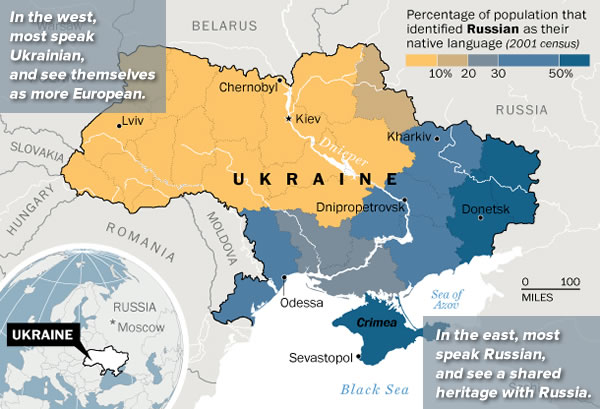
The BBC reports that new elections have been called for May 25:
Ukrainian MPs have voted to oust President Yanukovych and hold early presidential elections on 25 May.
Mr Yanukovych’s spokeswoman said he did not accept the decision.
Earlier on Saturday, protesters walked unchallenged into the president’s office and residential compounds.
Also on Saturday afternoon, prominent opposition leader Yulia Tymoshenko was freed from a hospital in the eastern city of Kharkiv where she was being held under prison guard.
A BBC correspondent saw Tymoshenko driven away in a car after leaving the hospital.
MPs had voted to pave the way for her release on Friday. She was sentenced to seven years in prison in 2011 for abuse of power.
Her supporters have always maintained this was simply Mr Yanukovych taking out his most prominent opponent, and her release has always been a key demand of the protest movement.
February 19, 2014
Euromaidan versus Berkut – it’s not a game
The situation in Ukraine is not getting the public attention it deserves in the West, and Zenon Evans provides a quick summary of the extent of the protests and government repression:
Violence between Ukraine’s opposition (known as Euromaidan) and the government’s SWAT-style police force (Berkut), has boiled over today. Fires are raging across protesters’ tent-towns and police stations in what is being described as “open warfare.” Estimates indicate that over 20 people are dead and over 1,000 are injured. The BBC reports that officers are using rubber bullets and stun grenades, while The Daily Beast says machine guns are their weapon of choice. Protesters are armed with an array of weapons, from bricks and molotov cocktails to firearms of their own.
Parliamentary member Lesya Orobets writes:
The war is here. A real fierce war. It is impossible to grasp this emotionally, although the mind is working precisely and quickly quite apart from emotions. We are being exterminated because of our desire to have dignity and decide our lives independently. This simply makes no sense. My fellow Ukrainians are being killed by the creatures that not only resemble us biologically, but also carry Ukrainian passports.
Russian news website Slon.ru explains that mayhem was sparked because police blocked opposition members and their representatives from entering Ukraine’s parliamentary building, where they planned on introducing constitutional reforms to limit the authority of President Yanukovych, who has been consolidating power.
For more background, Joey DeVilla has assembled a primer on Euromaidan at his blog:
I continue to be surprised with how many people I keep running into who don’t know what’s going on in Ukraine right now. For those of you who haven’t been following the news or who’d like to know more, this article’s for you!
For the most basic introduction, check out the above video by the Washington Post, Ukraine’s crisis explained in 2 minutes. It starts with a question that you might be asking: What is Ukraine? (If you live in the Bloor West Village area of Toronto, you have no excuse for not knowing about Ukraine.)


