
World War Two
Published 23 Dec 2023The German Ardennes Offensive, called by the Allies the Battle of the Bulge, is in full swing in Luxembourg and Belgium this week, and the Germans have the key junction town of Bastogne under siege. On the Allied side there comes a large American surrender, plans for counterattacks, and tension growing between British and American Commands. The fight in both Italy and the Philippines continues, and in Hungary the Soviets have nearly surrounded Budapest.
00:26 Intro
01:06 The Battle of the Bulge
03:54 The Malmedy Massacre
06:25 Bastogne
10:00 American Surrender on Schnee Eifel
12:06 Patton plans a counterattack
15:44 Bernard Montgomery and Omar Bradley
18:12 The Red Army advances around Budapest
21:39 Fighting in Italy and Greece
22:45 Leyte and Mindoro
25:07 Conclusion
(more…)
December 24, 2023
The Siege of Bastogne Begins – WW2 – Week 278 – December 23, 1944
December 22, 2023
Camouflage
World War Two
Published Dec 19, 2023Camouflage comes in many forms, shapes, disguises, and even processes, for there are indeed many ways to hide your soldiers, guns, tanks, and even ships at sea. Today we take a wee look at camouflage during the war.
(more…)
December 18, 2023
Battle Taxis | Evolution of the Armoured Personnel Carrier
The Tank Museum
Published 8 Sept 2023Tanks and infantry need to operate together. Tanks provide firepower and protection, the infantry support and protect the tanks. In this video, we look at that vital component of the equation, the Armoured Personnel Carrier and its transition into the modern Infantry Fighting Vehicle.
(more…)
December 17, 2023
The Battle of the Bulge Begins – WW2 – Week 277 – December 16, 1944
World War Two
Published 16 Dec 2023Adolf Hitler’s Ardennes counteroffensive finally goes off this week, and it does indeed catch the Allies by surprise, and they suspend other offensive operations in the west. They are still attacking in Italy, and the Soviets are still advancing in Hungary, trying to cut off Budapest. In the Far East, there are Allied landings on Mindoro, and they are also on the march in Burma, hoping to pin down the enemy.
0:00 Intro
0:55 Recap
1:22 Street fighting in Athens
04:07 Operation Queen ends
06:33 Autumn Mist Offensive plans
09:51 Allied intelligence failures
12:26 The Ardennes Offensive Begins
16:57 Allied attacks in Italy and Soviet plans to surround Budapest
20:07 The Allied offensive in Burma
22:10 Mindoro Landings
24:33 Summary
25:14 Conclusion
(more…)
December 15, 2023
How far are we from a final communiqué from Kiev saying that “the war situation has developed not necessarily to Ukraine’s advantage”?
Yeah, I stole the idea for the headline from Severian’s post from a few days ago. So sue me. But seriously, CDR Salamander considers what he calls the cold truth of the Russo-Ukrainian war:
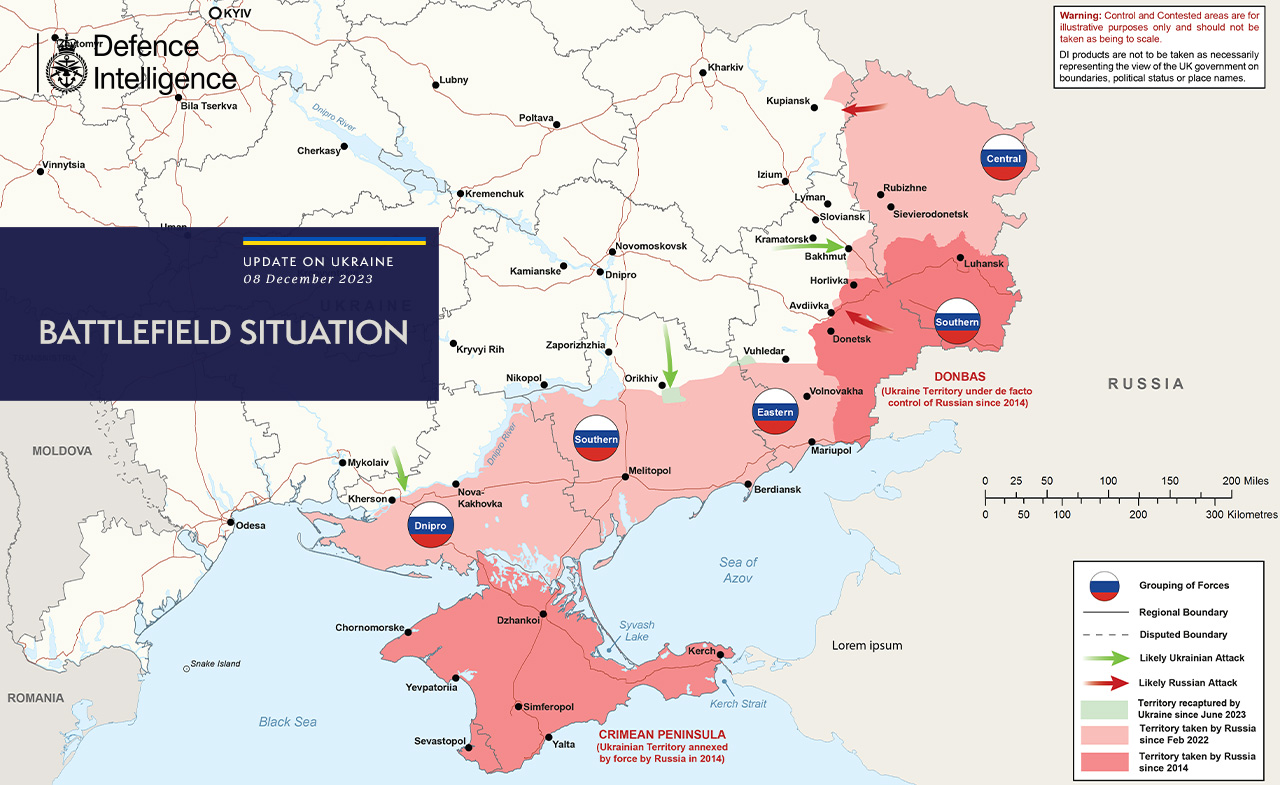
Well, history didn’t fold out as the Russians wanted. There was no 3-day war. No 3-week war. No 3-month war either. Kiev remains in Ukrainian hands … but what about a 3-year war?
Despite all the pre-war metrics, the “expertise” of the Smartest People in the Room™, every wargame that would have been run at all our war colleges would have told us that there would not be a conventional war in Ukraine is finishing up its second and going in to its third year, but here we are.
They were all wrong.
A common problem, one that well pre-dates the invasion of Ukraine, is that we have shockingly well credentialed people of influence from both parties who have an inability to understand that Russians are not Westerners. They don’t think like Westerners, though they may look like them.
The Russians have a distinct culture, history, and view of themselves and their place in history. The underperforming political, military, and diplomatic elite in the West — with few exceptions outside the former Warsaw Pact nations now in NATO — expect Russians to react in the same way and to the same degree to the incentives and disincentives that move needles and preferences in DC and Brussels.
Time is always on the side of Russia, which is one of the reasons the slow rolling of weapons to Ukraine has been an exercise of malpractice of the highest degree. You are either in or out.
Two years on, “we” still are not sending a clear signal. It is amazing, really; in military might, GDP, demographics and a whole host of other reasons, Russia should not be as resilient as they are … which is why DC & Brussels are being played so hard. They still do not understand Russia.
Even after 1,000 years of experience, we have Western leaders who refuse to believe that the Russians are fundamentally different than the West is in the 21st Century. You can’t put the cultural ability to absorb damage and brutal patience you cannot see in some metric that can go on a PPT slide.
What the Russians lack in so many other places, they make up for here. As such, this critical part of understanding Russian motivation keeps being missed. Yes to their economy and apocalyptic demographics. Yes to all that.
For all the reasons Russia continues to fight, so too do their Ukrainian brothers – demonstrating greater resilience and endurance that Western expectations.
The time for leaving Ukraine to its fate is long past. Yes, the West has a short attention span and is suffering under the dead hand of entrenched leaders with a defeatist mindset – but none of this is written.
Ukraine can still win – or at least something that can be called a win. It would help if the Russians had some internal issues that required more attention that Ukraine, but even then – all is not worth shrugging over.
Yes, I’ve seen the math — the metrics — but war is informed by math, but not defined within it.
At a relatively modest cost in our treasure and almost none of our blood, we are wearing down Russia’s ability to project power for a generation, perhaps two. Perhaps many more generations should demographic instability mate with political instability. The Ukrainians – facing the same economic and demographic challenges as the Russians – are up for the fight. There is no reason for more comfortable nations who have supported them so far to go wobbly at half-time.
Of course, as noted yesterday, this ship may already have sailed thanks to Hamas.
December 14, 2023
The West – “Ukraine? Ukraine? Do we know a ‘Ukraine’?”
In The Line, Andrew Potter notes just how quickly cross-partisan support has eroded since the summer, and especially since the Hamas atrocities in Israel on October 7th:
Well, you can’t say Volodymyr Zelenskyy didn’t try. With a new U.S. aid package for his country frozen by a Republican filibuster, the president of Ukraine made a last-ditch visit to Washington to plea, as he has done so often, for help against the Russian invasion. But unlike previous visits, he was treated more as yesterday’s annoyance than a global statesman fighting for the cause of freedom.
The wheels came off the bus of Western support for Ukraine gradually, then suddenly. The slow distancing from Ukraine has been underway since last summer, but it was finally pushed off the cliff in the wake of the barbarism of Hamas on October 7. Since then, the world’s attention, effort, and in important cases, arms, have been focused on the Middle East. But also, the intensely polarizing character of the Israel-Hamas war has hardened political divisions in almost every country, in a way that has largely destroyed what had been, in many countries, a cross-partisan consensus on Ukraine.
But for all its slow-motion inevitability, it is still shocking to see just how quickly support for Ukraine evaporated, how hollow the promises have been revealed to have been, how ugly the finger pointing has got, and how unprepared NATO, the EU, and the West as a whole are for the danger that is staring them in the face.
Let’s start with a basic fact: the Ukrainian counteroffensive, which began in early summer with so much dramatic hope, has failed. The goal was to drive to the Black Sea, split the Russian forces in half, and begin the work of retaking the sovereign Ukrainian territory that had been seized by Russia since 2014.
It didn’t happen, and it didn’t even come close. Why that is the case has been, and will be, the subject of intense scrutiny and analysis, but what seems clear is that the Russians were given too much time to dig in and lay minefields tens of kilometres deep across the front lines. In the absence of sufficient airpower to achieve air superiority over the battlefield, the attacking Ukrainian forces became sitting ducks to Russian artillery, helicopters, and drones.
So the fight is at a stalemate. The commander of the Ukrainian army, Valerii Zaluzhnyi, said as much in an article he wrote for The Economist at the beginning of November. President Zelenskyy has admitted it as well, as has the head of the Ukraine war cabinet.
This failure need not have been a disaster. Success in battle is never guaranteed, the enemy always gets a vote, and there is nothing stopping the Ukrainians from tending their wounds, burying their dead, and trying again.
Nothing, that is, except the fecklessness, the division, and the bad faith of Ukraine’s partners in the West. Instead of sitting down to figure out what went wrong, adjusting and increasing their aid accordingly, and recommitting to the fight, the whole so-called alliance has degenerated into infighting, blame shifting, and ass-covering. The Washington Post recently had a whole series devoted to giving anonymous American “senior officials” plenty of acreage to underbus the Ukrainians, who were, allegedly, too slow to start the counteroffensive, too cowardly when it finally began, too incompetent in their execution, and too stubborn to listen to the Americans advising them.
This all may be true. But something else is also true: The West, for all its promises to back Ukraine to the hilt, to stand by it through thick and thin, to do whatever it takes as long as it takes, has not done any of this. Support, in the form of arms deliveries, training, aid, ammunition, what have you, has been slow, grudging, performative, and inadequate to the task.
December 12, 2023
QotD: “Natural hierarchies” don’t work in distributed systems
This, I think, is a function of something like the Dunbar Number. There IS a “natural hierarchy”, but it only works in person – that is, in a group where everyone interacts face to face. Any given group of humans will naturally sort itself, and again, yeah yeah, I’m not a biologist, but I’ve been to a few bars in my time. If you doubt it, just head down to your local dive and pilot a barstool for a few hours, you’ll see enough basic primate behavior to give Jane Goodall a stiffie.
Politics, being a distributed system, doesn’t work like that. Neither does the corporate world, which is why both invariably end up dominated by sociopathic, sexually deviant shitweasels. Whereas the social interaction in a bar, in a pickup basketball game, in a church group, whatever, naturally bends towards a baboon troop, “social” interaction in a distributed power structure bends towards whoever has the time, energy, and sheer Wille zur Macht, as our friend above would put it, to dominate it.
Example: Even at the height of his power, when he really could have liquidated everyone in the room with a wave of his hand, Joe Stalin didn’t win arguments with his nomenklatura by threatening to have them all shot. Rather, he outworked them. Even when he exercised the most raw power any one human being is capable of wielding, Stalin’s work ethic was legendary – he spent a minimum of fifteen hours a day at his desk, every day, 365 days a year. He simply ground down all lesser men with the sheer force of his leather ass and cast-iron bladder … and compared to Stalin, when it came to paperwork, all men were lesser men.
That’s a cast of mind, reinforced by the habits of a lifetime. Stalin was also a dominant personality by the end, of course, but he certainly didn’t start that way – he was cringingly servile to Lenin, for instance, and even once to Trotsky, which is probably the main reason Trotsky had to die when you come right down to it.
Hitler was the same way, in his own special, bizarre way. While no one would ever accuse Hitler of an overactive work ethic when it comes to government – those who study these things still can’t get their heads around it, the fact that for long, critical periods the Third Reich basically didn’t have a government – but he could wear you down with the best of them when it came to party speeches, organizing, propaganda. No one worked harder at that stuff than Corporal Hitler … and no one knuckled under to authority faster, which is why he remained Corporal Hitler despite four years on the Western Front.
Combine them, and you get the Big Man On Campus thoroughly dominated by the deviant sociopathic shitweasels. The BMOC dominates every personal interaction; therefore, he thinks it’s the rules which get him where he is. Society is set up, he thinks, to produce people such as himself. And since that society is also set up such that the deviant sociopathic shitweasels (we should probably acronymize that; hereafter, DSS) do the boring shit like student government, when the DSS pass some bizarre law the BMOC just rolls with it …
Severian, “Bio-Marxism Grab Bag”, Founding Questions, 2021-01-21.
December 10, 2023
Can the Americans Stop the Kamikazes? – WW2 – Week 276 – December 9, 1944
World War Two
Published 9 Dec 2023This is a very busy week of the war. In the west, the Americans manage to reach the Roer River in force, but haven’t taken any of its dams; in Italy, the Allies liberate Ravenna; the Soviet advance in Hungary continues, and the Soviets even set up a new Hungarian government; martial law is declared in Greece; the Japanese make a corridor to Indochina; the fighting on Leyte continues, and the kamikaze menace becomes ever more worrisome.
00:00 INTRO
01:10 British intelligence failure
01:55 Allies reach the Roer River
05:35 Problems with Devers’ 6th Army Group
07:41 Allies liberate Ravenna
08:50 Soviet advances in Hungary
12:10 Soviets set up a new Hungarian government
13:47 A deadly demonstration and martial law in Greece
18:33 Japanese establish a corridor to Indochina
19:59 Leyte and kamikaze attacks
23:45 CONCLUSION
(more…)
December 3, 2023
Was Hürtgen Forest Worth it? WW2 – Week 275 – December 2, 1944
World War Two
Published 2 Dec 2023The bulk of the fight for Hürtgen Forest is now over, and today we look at the results. We also look at Soviet plans for their January offensive. In the field this week, the Red Army is still fighting in Hungary, the Allies are still trying to reach the Roer River in the west, and in the Pacific Theater the kamikaze menace is wreaking havoc with Allied scheduling.
00:00 INTRO
01:06 Soviet Offensive Plans for 1945
03:12 Red Army attacks in Hungary
06:19 The Port of Antwerp is clear for use
07:23 The Battle of Hurtgen Forest is Over
12:20 Allied advances to the Roer
14:19 Tension builds in Greece
15:32 The aerial situation in the Philippines
21:36 CONCLUSION
(more…)
December 2, 2023
NATO’s Ostfront
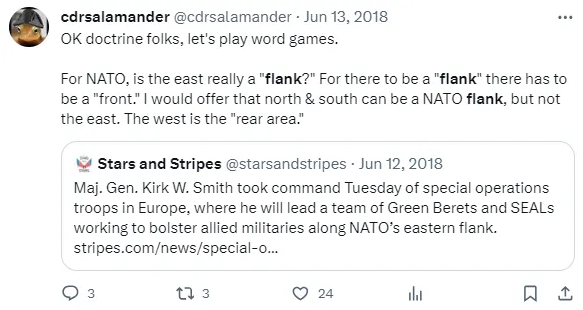
CDR Salamander doesn’t like the misunderstandings that cause commentators to identify NATO’s primary (but thankfully not militarily active) front as a “flank”:
For those who follow me on twitter/X, you are quite familiar with the meme I’ve been posting since long before the Russo-Ukrainian War, all the way back to at least 2018.
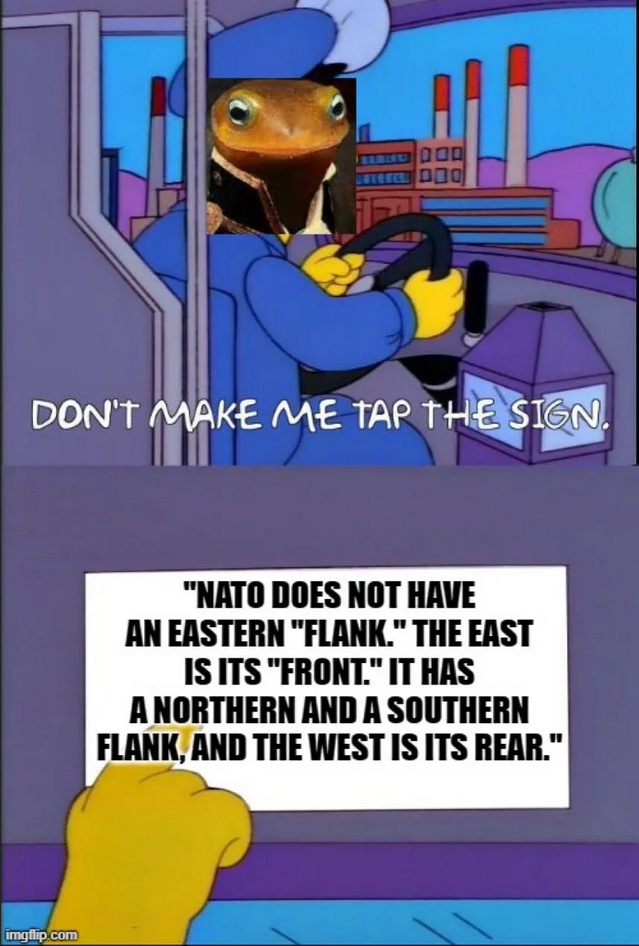
This misuse of the King’s English soon became a bur under my saddle as this error continued to be made. Seeing a trend, the following meme was generated by a friend;
This is not a new problem, and I know exactly where it comes from. In my years as a NATO Staff Officer, it did not take long to notice a twitch in the eye of many, not only Germans, to the mention of an “Eastern Front”. It seems silly, and in the 21st Century is it, but it is a reality.
I refused to play along. Yes, I understand how a very few highly emotional people can’t let go of their grandfather’s nightmares, but it is time for the adults in the room to just go around them. Anyway, this is the English language, and while there were French and Walloon Waffen SS units along with Hungarians, Romanians, Italians, and a few volunteer Spanish and others now on the NATO bench that fought on the Eastern Front in WWII, it doesn’t have the same impact with them as we don’t discuss such things in polite company.
Eastern Front, Front de l’Est, or Ostfront, we should all have moved along. History — and proper military terminology — have been around for centuries. In any event, it doesn’t bother the Russians one way or the other and you are fooling yourself if you think it does.
The use of “Eastern Flank” instead of “Front” where referring to real military threat to NATO, the Russian Federation, is just childish.
QotD: Western media and Putin’s war
Regarding [Vladimir Putin’s] Magical Mystery War, I’m going with the stoyak that the casualty counts peddled by the [western media] is part of a very very old playbook which various Western observers have peddled since 1905-that of Russian stupidity and indifference to casualties. Russia loses a war? They’re stupid gopniks who flung their soldiers into meat grinders until they rebelled (1905 or 1917). Russia wins a war? They’re stupid gopniks who flung their soldiers into meat grinders until they won (1945, 2023). Note that you can effortlessly pivot your propaganda when it becomes obvious in hindsight the outcome of the war. This becomes very important when [Putin] negotiates his 18th century kabiniettskreig ending to the war, since nobody in the West, especially AINO, understands how a cabinet war is fought, much less ends. They will claim that they foiled Putin’s plan for conquering all Ukraine (which he never has wanted) by killing hundreds of thousands of poor, oppressed, stupid, vodka-fueled gopniks used as cannon fodder who simply overwhelmed the valiant forces of good by sheer numbers. Not by superior strategy or tactics, or weapons, but the good ol’ Russian sledgehammer. Just like Hitler’s excuse in 1945, when Ivan was knock knock knockin’ on his bunker door. His generals who survived carried that piece of gospel West when the US Army started studying how to fight the Reds and asked the Germans how they did it. Their answer was happily embraced by the next generation of Very Clever Boys in the 1960s and carried forward to today’s Fistagon — Wunderwaffen.
Pickle Rick, commenting on “Friday Mailbag”, Founding Questions, 2023-12-01.
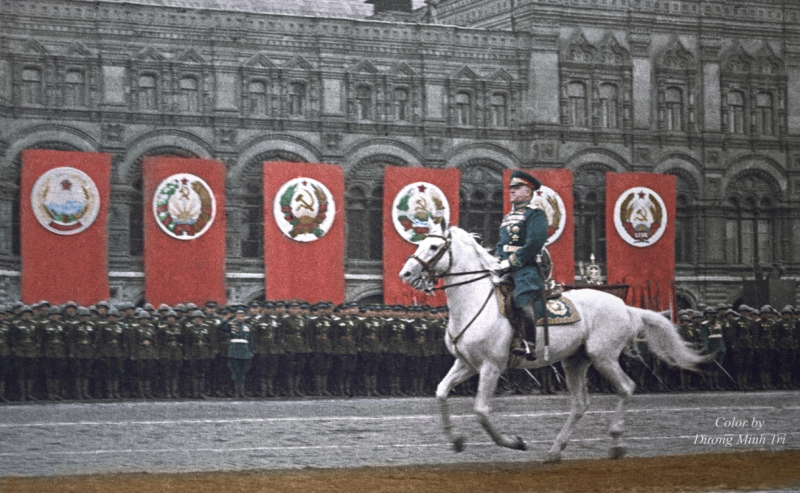
Rick agreed to me posting this quote as long as I included this colourized photo of Marshal of the Soviet Union Georgy Zhukov (“because it’s gangsta as FUCK”)
November 26, 2023
General Patton’s Metz Obsession – WW2 – Week 274 – November 25, 1944
World War Two
Published 25 Nov 2023Metz finally falls to Patton’s 3rd Army, but boy, it’s taken some time. To the south, the Allies also take Belfort and Strasbourg, and to the north Operation Queen continues trying to reach the Roer River. The Soviets complete their conquest of the islands in the Gulf of Riga and continue advancing in Hungary to the south, but it’s the Axis Powers — the Japanese — who are advancing in China, taking Dushan and Nanning.
01:15 Operation Queen Continues
04:49 9th Army attacks toward the Roer
05:54 Pattons 3rd Army takes Metz
09:22 Allies take Belfort, Mulhouse, and Strasbourg
13:56 8th Army Attacks in Italy
15:42 Soviet advances and German indecision
18:05 Japanese take Dushan and Nanning
19:21 The fight for Peleliu ends
21:43 Notes from all over
22:23 Conclusion
(more…)
November 24, 2023
The Man Who Started the Cold War
World War Two
Published 23 Nov 2023What if I told you that a new conflict will sweep the globe in less than a year? It will open not with gunshots but with silent, shadowy espionage. The man who will kick off the Cold War is a quiet Canadian pilot, millionaire, and spymaster. A trusted aide to Churchill and FDR. I bet you haven’t heard this name before: William Stephenson.
(more…)
November 19, 2023
How Himmler Learned to Love the Russians – WW2 – Week 273 – November 18, 1944
World War Two
Published 18 Nov 2023Heinrich Himmler wants to build an Army of Soviet POWs, but that has some problems; Patrick Hurley becomes US Ambassador to China, but even before that he’s in hot water with Chiang Kai-Shek; and in the field in the west, the Allies launch Operation Queen to try to cross the Roer River and reach the Rhine.
(more…)
November 18, 2023
World War Two’s most common tank
Lindybeige
Published 2 Aug 2023What click-bait title should I have used for this? “The tank that gave the Germans nightmares”? “The Commonest Communist tank?” “The tank of the teeming red hordes”? As I describe here, they made ever-so many of this type of tank, and that fact alone makes it an important tank.
(more…)


