Quotulatiousness

June 12, 2010

In this case, a tie is (kinda) okay

Filed under: Britain, Soccer, USA — Tags: , , — Nicholas @ 16:51

In international competitions, it’s always hard to watch when your first and second favourite teams play head-to-head. Had Canada made it to the World Cup, I’d be cheering for Canada first, England second, and USA third. Canada didn’t qualify (again), so I had to watch my other two preferred teams fight it out. A draw at least leaves both teams alive for advancing out of the group stage.

To see how the game unfolded according to the Twitterati, check this Guardian page, where it tracks the progress of the game against the hashtagged posts on Twitter.

June 11, 2010

QotD: British humour

Filed under: Britain, Humour, Quotations — Tags: — Nicholas @ 12:02

God we’re rude, aren’t we? The British are so rude. We’re obsessed with bums, tits, willies, lavatory humour, vicars, knickers, smells, foreigners, fat tummies, fat slags, Fat Les, fat wrestlers, Benny Hill, Carry On Up The Khyber, Viz, Private Eye, men dressed as laydeez, women dressed as anarchic schoolgirls, sitcoms that offer howling tsunamis of verbal abuse, from The Young Ones to The Thick Of It. We love to see an irate, fictional British hotelier smacking his Spanish waiter around the head. We admire the host of BBC2’s Newsnight when he roasts politicians with scarcely believable belligerence. We quiver when a middle-aged, redheaded quiz-show hostess tells her guests how thick, ugly and badly dressed they are. We lap up radio shows in which grouchily opinionated men insult members of the public who hold views contrary to their own. We celebrate Christmas by buying our loved ones “lavatory books” with titles like Is It Just Me Or Is Everything Complete Shit In Pants?

John Walsh, “Naughty by nature: Why has Britain become so rude?”, The Independent, 2010-06-10

June 10, 2010

Enough with the camel jokes!

Filed under: Europe, France, Military — Tags: , , — Nicholas @ 10:05

The French Foreign Legion has a storied history of bravery, endurance, and inappropriate relations with camels extraordinary fighting skills. They do, however, also have some less-savoury attributes:

The Legion has a lot of dirty laundry that almost never gets exposed due to the unit’s notoriously secretive nature. For one thing, desertion is, and always has been, rampant in the Foreign Legion. As far as modern, 21st century armies are concerned, the Legion has some of the worst desertion rates in the world. This is the reason why small arms and light weapons are ALWAYS kept under lock and key under the watch of armed guards 24/7 when they are not being used at the range, training, or combat. French Army authorities know that, given the high rates of desertion, it’s too much to risk having renegade soldiers running around the French countryside with loaded assault rifles.

Furthermore, substance abuse, particularly alcoholism, is even more of a problem in the Legion than in other armies. It is not hard to see why, considering that the Legion has often sent its men to isolated duty stations in some of the most inhospitable and violent regions on earth. Finally, unlike the U.S. Marine Corps, U.S. Army, or British Army, corporal punishment (e.g., punching) is still very much alive and in practice in the Legion, and often comes in the form of sometimes savage beatings administered by NCOs as a means of instilling “discipline”. The Legion’s notorious military police section possesses an even more sinister reputation for brutality and mistreatment. Much of this abuse is directed towards captured deserters and the grim reputation of Legion stockades is well-deserved indeed.

June 9, 2010

QotD: The transition curve of higher taxes

Filed under: Britain, Economics, Government, Quotations — Tags: , , — Nicholas @ 17:21

The point where things start to go wrong seems to be about 50%. Above that people get serious about tax avoidance. The reason is that the payoff for avoiding tax grows hyperexponentially (x/1-x for 0 < x < 1). If your income tax rate is 10%, moving to Monaco would only give you 11% more income, which wouldn't even cover the extra cost. If it's 90%, you'd get ten times as much income. And at 98%, as it was briefly in Britain in the 70s, moving to Monaco would give you fifty times as much income. It seems quite likely that European governments of the 70s never drew this curve.

Paul Graham, “Why Startups Condense in America”, 2006-05

Confused by international finance? Monty can help

Filed under: Economics, Europe, France, Germany, Government, USA — Tags: , , — Nicholas @ 11:35

If you’re finding the up-then-down-then-under-the-table performance of your investments unfathomable, you’re probably wondering who can explain it all in a way that makes perfect sense and allows you to figure out the best way to handle your personal finances. If you find such a savant, let me know.

For the “real” story about why the markets are doing an imitation of an unstable personality on conflicting medication, here’s Monty’s “Wednesday Financial Briefing”:

Nicholas Sarkozy and Angela Merkel are still waging war against “the speculators” who had the temerity to point out that Euorpean finances were a God Damn mess. A spokesmen for the holders of European sovereign bonds warned the leaders that they were “teasing the gorilla in the monkey-house”. Sarkozy was heard to say that he farted in their general direction and that their fathers smelt of elderberries. Chancellor Merkel only muttered darkly, “I will break you!”

Interbank loans at Spanish banks are drying up. This tightens credit and leads to busted bond auctions. “Fitch can kiss my ass!”, said an unnamed source at Banco Santander who blames the problems on Fitch’s recent downgrade of Spanish debt. Just to show how not-broke they are, Santander bought back their stake in their Mexican unit from Bank of America for $2.5 billion. When asked if this was a wise move given their weak balance-sheet, a Santander representative lowered his trousers and mooned the press-pool.

US debt will climb to 19.6 trillion by 2015, according to a Treasury report to Congress. Tim Geithner assured everyone that, in true Keynesian fashion, every dollar of debt translates directly into GDP growth. Somehow. When pressed on the issue, Mr. Geithner began to cry and had to be excused to the lavatory to pull himself together.

June 2, 2010

Litany of problems with new NH-90 helicopters

Filed under: Australia, Europe, Germany, Military, Technology — Tags: , — Nicholas @ 09:25

Strategy Page reports that new NH-90 helicopters delivered to Australia are showing similar problems to the laundry list of issues the Germans reported when their NH-90s went into service:

The German Army conducted an evaluation of their new NH-90 helicopters, and were not pleased. Their conclusion was that, for combat missions, another model helicopter should be used whenever possible. A particular problem was the lack of ground clearance. The NH-90 can’t land on a piece of ground with any obstacles higher than 16 cm (6.4 inches). That makes many battlefield landing zones problematic. That assumes you can even get on a NH-90 and find a seat. The passenger seats cannot hold more than 110 kg (242 pounds). Combat equipment for German troops weighs 25 kg (55 pounds), meaning any soldier weighing more than 85 kg (187) has to take stuff off, put it on the floor, than quickly put it back on before exiting. Then there’s the floor, it’s not very sturdy, and combat troops using the helicopter for a short while, cause damage that takes the helicopter out of action for repairs. Worse, there is the rear ramp. It cannot support troops carrying all their equipment, making it useless for rapid exits of combat troops. There is not enough room in the passenger compartment for door gunners. There are no strap downs for larger weapons, like portable rocket launchers or anti-aircraft missiles. The passenger compartment also does not allow for carrying cargo and passengers at the same time. The winch is not sturdy enough for commandoes to perform fast roping operations. And so on. The Germans were not pleased with the NH-90.

I’ve never specced out a new helicopter design, but these complaints sound like issues that should have come up during the initial design review, not things that appear once you’ve taken delivery. It sounds like the military equivalent of buying a new car without taking a test drive or checking the specifications for how well the vehicle matched your actual requirements.

Design fail, manufacturing fail, or ordering fail?

May 30, 2010

QotD: The first great back-to-the-land experiment

. . . the plundering, the lack of invention, the barbarians and above all Diocletian’s red tape did for Rome in the end. As the empire disintegrated under this bureaucratic burden, at least in the west, money lending at interest stopped and coins ceased to circulate so freely. In the Dark Ages that followed, because free trade became impossible, cities shrank, markets atrophied, merchants disappeared, literacy declined and — crudely speaking — once Goth, Hun and Vandal plundering had run its course, everybody had to go back to being self-sufficient again. Europe de-urbanised. Even Rome and Constantinople fell to a fraction of their former populations. Trade with Egypt and India largely dried up, especially once the Arabs took control of Alexandria, so that not only did oriental imports such as papyrus, spices and silk cease to appear, but those export-oriented plantations in Campania became the plots of subsistence farmers instead. In that sense, the decline of the Roman Empire turned consumer traders back into subsistence peasants. The Dark Ages were a massive experiment in the back-to-the-land hippy lifestyle (without the trust fund): you ground your own corn, sheared your own sheep, cured your own leather and cut your own wood. Any pathetic surplus you generated was confiscated to support a monk, or maybe you could occasionally sell something to buy a metal tool off a part-time blacksmith. Otherwise, subsistence replaced specialization.

Matt Ridley, The Rational Optimist: How Prosperity Evolves, p. 175

May 26, 2010

French and German troops play catch-up

Filed under: Europe, France, Germany, Military — Tags: , — Nicholas @ 07:47

Strategy Page looks at recent changes in the role of French and German troops in Afghanistan:

Since France and Germany loosened up their ROE (Rules of Engagement) in the last year, and allowed their troops to more readily engage Taliban gunmen, there has been a lot more combat for them. Before the ROE change, the Taliban generally ignored the German and French troops, knowing that these foreigners would not interfere with Taliban terrorism operations, and would not even fire unless the Taliban fired on the foreign troops first. But now that the French and Germans can go after any Taliban they spot (or suspect they’ve spotted), the Taliban have become much more aggressive against the French and Germans.

This led to the Germans and French discovering that they were not really equipped or trained to deal with the Taliban. The Americans, British, Canadians, Dutch and Australians made it all look so easy. But it isn’t, so now the French and Germans are hustling new equipment (especially armored vehicles, UAVs and sensors like night sights and thermals) to their troops in Afghanistan. But another shortcoming was training, and that was solved by borrowing training manuals (and some trainers) from their combat experienced allies, and starting to train troops back home, before sending them to Afghanistan. This meant having MRAPs back home, as well as realistic training exercises to get the troops ready.

May 25, 2010

The dangers of writing near-future SF

Filed under: Books, Britain, Media, Politics — Tags: , — Nicholas @ 10:17

Charles Stross gets sandbagged by the unforeseen:

Back in mid-2008 I mentioned that what I thought was a futuristic-circa-2023 technology for the next novel was too damn close. Slightly more recently, in Living through interesting times, I mentioned that it was becoming near-as-dammit impossible to write near-future SF; I was sore because Bernie Madoff had stolen the plot of my next novel.

Well, I picked myself up, dusted myself down, re-framed the novel in question, and I’m currently about 80% of the way through writing it when it all happened again. First of all, Lothian and Borders Police actually established a recognizable-as-the-embryonic-form version of the unit that one of my protagonists, circa 2023, manages. (Only I got the staffing level and departmental mission statement slightly off-whack …) Next, there’s just been another revolution in Kyrgyzstan (a country which, for reasons I’m not going to discuss here, plays a significant role in “Rule 34”).

But the worst thing? I’ve been sandbagged by an unanticipated event.

Of course, it’s quite understandable — after all these years, who knew there even was a “libertarian arm of the Conservative party” to mess up Charlie’s plot of the near-future?

May 24, 2010

Racy archaeology

Filed under: Economics, Europe, History — Tags: , , , — Nicholas @ 18:45

The theory is that these coins were created to ease language barriers between non-Latin speaking customers in brothels and the (often non-Latin speaking) prostitutes:

This is a spintria. They were used in ancient Rome to request and pay for different “services” in brothels and from prostitutes on the street. Since there were a lot of foreigners coming to the city that did not speak the language and most of the prostitutes were slaves captured from other places the coins made the transactions easy and efficient. One side of these coins showed what the buyer wanted and the other showed the amount of money to be paid for the act.

[. . .]

They may have been used to pay prostitutes, who at times spoke a different language. While this is subject to argument, the numbers on them line up with known prices for Roman prostitutes (University of Queensland reference). Some theorize them gaming tokens, and they may have been produced for only a short period, probably in the 1st century A.D.

So, either an innovative solution to an ongoing economic problem, or the Roman equivalent to the nudie card decks of the 1940s and 50s.

Images at the link. H/T to Radley Balko for the URL.

Why the Canadian political sphere lacks zest

Filed under: Britain, Cancon, Politics — Tags: , , — Nicholas @ 17:33

It’s a fundamental issue that prevents any form of excitement from being discussed, or acted upon:

In Britain, even post-Blair, many of the best and brightest still go into politics. Until the expenses scandal, there was something of a cache to being an MP, something which will probably return in time. The typical Canadian Cabinet is, by comparison, made of poorer quality timbers. The average minister of the crown, here in the Elder Dominion, might make it as a parliamentary secretary back in the Mother Country. Our best and brightest go into business, science and down South. In Canada, those who can’t do, teach, those who can’t teach, teach gym, and those who fail at that run for elected office. There are exceptions. Very few.

The other reason British parties are, relatively, more principled than their Canadian derivatives is national unity. Until about the mid-1990s, no one seriously talked about the break up of the United Kingdom. Even the bleeding ulcer of Ulster was unlikely to be resolved by uniting North and South. This is not the case in Canada. On pretty much every major national issue of the last century and a half — Catholic Schools, prohibition, conscription, foreign policy, Medicare, Afghanistan — English speaking Canada leans one way, and French Canada the other. Raise controversial issues and you might start reminding the Solitudes how much they dislike each other. Thus our national politics has the colour, consistency and firmness of oatmeal. It’s why Mackenzie King, the Great Equivocator, was our longest serving Prime Minister.

May 20, 2010

The root of the Greek economic crisis

Filed under: Economics, Europe, Government, Greece — Tags: , , , — Nicholas @ 12:07

No, it’s not the evil banks, the evil insurance companies, the evil oil companies, or even the evil manufacturing sector (take it as read that most media types think every corporation is, by definition, evil). No, in this case the reports are starting to identify the real culprit: the civil service. Mark Steyn summarizes handily:

They were not an “anti-government” mob, but a government mob, a mob comprised largely of civil servants. That they are highly uncivil and disinclined to serve should come as no surprise: they’re paid more and they retire earlier, and that’s how they want to keep it. So they’re objecting to austerity measures that would end, for example, the tradition of 14 monthly paycheques per annum. You read that right: the Greek public sector cannot be bound by anything so humdrum as temporal reality. So, when it was mooted that the “workers” might henceforth receive a mere 12 monthly paycheques per annum, they rioted. Their hapless victims — a man and two women — were a trio of clerks trapped in a bank when the mob set it alight and then obstructed emergency crews attempting to rescue them.

Unlovely as they are, the Greek rioters are the logical end point of the advanced social democratic state: not an oppressed underclass, but a pampered overclass, rioting in defence of its privileges and insisting on more subsidy, more benefits, more featherbedding, more government.

We’ve already seen that employees in the public sector have been outpacing their private sector equivalents handsomely, but the Greek civil service has it even better than most:

Greek public sector employees are entitled not only to 14 monthly paycheques per annum during their “working” lives, but also 14 monthly retirement cheques per annum till death.

Nice. I wonder how they got into that interesting arrangement? No matter, the private sector will ride to the rescue, right? Not likely:

According to the World Bank, when it comes to the ease of doing business, Greece ranks 109th out of 183 countries. If they were dramatically to liberate their business-killing economy, they might overtake Lebanon at big hit position 108, and Ethiopia at 107, and maybe Papua New Guinea at 102. And who knows? With even more radical reform, they might crack the Hot One Hundred and be bubbling under such favourable business environments as Yemen (99) and Moldova (94). Greece ranks 140th when it comes to starting a business, and 154th when it comes to protecting investors.

If it’s that difficult to start a new business, is it any wonder that so much of the Greek economy is in the underground/unreported/untaxed sector? Many media reports say that anywhere from 10% to 25% of Greek economic activity is “off the books”. A quick Google search will show a much higher range of estimates going up to 60% . . . and that might be an optimistic under-estimate.

If more than half of the nation’s economic activity is in the black market, it will take much more than adding a few auditors and inspectors to the tax department to fix the problem: an absolute majority of Greeks are actively hiding their business from the government, and any serious attempt to crack down on them will bring down the government. And that’s not even the biggest danger — the Greek government isn’t the most stable entity to start with. The government falling might be a safety valve, because the other alternative is literally revolution.

Talk about your destabilization!

May 19, 2010

The 2012 Olympic organizers want to give your children nightmares

Filed under: Britain, Media, Sports — Tags: , , — Nicholas @ 15:05

At least, that’s the only explanation that seems to make sense:

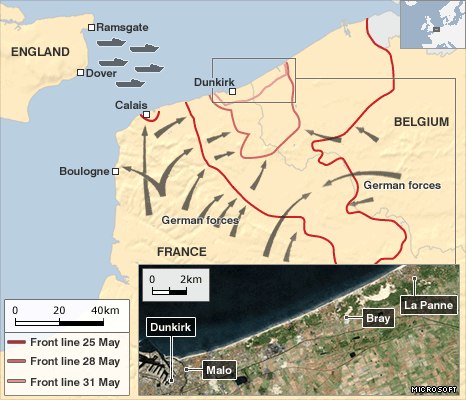
Remembering Dunkirk, 70 years on

Filed under: Britain, France, Germany, History, Military, WW2 — Tags: , — Nicholas @ 08:53

This is the 70th anniversary of the Dunkirk evacuation, where 338,000 British and French troops were carried out of the German encirclement by just about everything that could float.

“Without Dunkirk, Britain wouldn’t have had an Army and it’s extremely questionable whether Britain could have fought the war,” he explains.

Mr Hewitt gives the credit to the Royal Navy and Admiral Sir Bertram Ramsay, who led the operation, but also to all the civilians who helped.

“They thought they would bring back 30-40,000. In the end they rescued 338,000 British and French troops. It’s an extraordinary achievement.”

And this pulling together of civilians and the military meant an event that could have been seen as a failure became, in fact, a key turning point in World War II.

“Dunkirk was a military defeat, but it was a symbolic victory,” he adds.

May 17, 2010

Bureaucracy, Crimean War style

Filed under: Britain, Bureaucracy, History, Military, Russia — Tags: , — Nicholas @ 08:39

A. A. Nofi reminds us that no matter what the technology of the day, the bureaucracy is eternal:

One night a particularly exposed British redoubt suddenly found itself the object of a strong Russian attack. Although the British managed to hold the Russians, they were consuming ammunition at a prodigious rate.

Fearing that his position would soon be overrun, the officer commanding the post tore a leaf from a pocket note book. On it he scrawled “In great danger. Enemy pressing hotly. For Heaven’s sake send us some ammunition,” the officer signed his name, handed it to an orderly and sent the man to the rear.

The fighting grew more intense, and as ammunition began running low the officer awaited the return of his messenger. Time passed, as the situation seemed to grow ever more desperate. Then, almost as suddenly as it began, the Russian assault ebbed, even as the British troops were virtually down to their last rounds.

Just about then the orderly returned, bearing a message from the Ordnance officer. One wonders what went through the officer’s mind when he read, “All communications to this Department must be written on foolscap paper with a two-inch margin.”

« Newer PostsOlder Posts »

Powered by WordPress