Quotulatiousness

May 14, 2010

Remembering Henri le Grande

Filed under: Europe, France, History, Religion — Tags: , , — Nicholas @ 09:18

France is still fond of King Henri IV, who was assassinated 400 years ago:

“If we were to measure his approval ratings now, what result would we get?” wondered Nouvel Observateur magazine in a special report this week. “100% happy? 200%? At any rate a figure to make the late greats turn pale — even more so the not-so-greats who are still alive.” Nicolas Sarkozy, the subtext implied, would do well to watch and learn.

During his reign from 1589 to 1610, Henri le Grand was credited with turning a country torn apart by the wars of religion into a newly confident land where Catholics and Protestants were forced to tolerate, if not like, each other.

He converted from Calvinism to the faith of the vast majority of his subjects, but did not neglect the country’s long-persecuted Hugenot minority. In 1598, 26 years after thousands of people who had gathered for his wedding day died in the St Bartholomew’s Day massacre, he declared the Edict of Nantes, which guaranteed Protestants freedom of worship.

[. . .]

Aside from his political achievements, it is the amorous escapades of the “Green Gallant” which continue to titillate modern-day fans. Married twice but unimpeded by vows of fidelity, Henri had numerous affairs and flings. This week Francois Caviglioli, a journalist, summed him up by referring to a contemporary Italian bon vivant: “Henri seemed to be the Rocco Siffredi of the 16th century. A porn star who was said to never wash.”

Judging by the tributes being paid to him now, Henri IV seems to be working his magic from beyond the grave. Such was the impact of his reign — and the shock of his untimely death — that he has become a martyr who is viewed almost as the personification of good leadership.

A few years ago, I tried to find a good biography of Henri, but there didn’t appear to be anything currently in print (in English). For such an iconic leader, he is not well known outside France . . .
May 12, 2010

Technical snag delays further testing for EMALS

Filed under: Britain, Military, Technology, USA — Tags: , , , , — Nicholas @ 12:32

A minor directional error has caused a several month slip in the testing for a new aircraft carrier catapult design:

The so-called Electromagnetic Aircraft Launch System, or EMALS, is now under development in a shore-based test facility at Lakehurst naval air station in New Jersey. However, according to reports, the test mass-driver installation suffered serious damage earlier this year in a mishap blamed on a “software malfunction”. Apparently the “shuttle” — which moves along the catapult track to accelerate a plane to flying speed — went the wrong way in a test shot and smashed into important equipment.

The Newport News Daily Press, reporting on an interview with EMALS programme chief Captain Randy Mahr, says that the accident has delayed the shore-based testing by several months. It had been planned to commence launching aircraft — as opposed to test loads — this summer, but that will not now happen until autumn.

The next US supercarrier, CVN 78, aka USS Gerald R Ford, is now under construction and intended to join the fleet in 2015. Navy officials confirmed last year that it is now too late to amend the ship’s design and revert to steam catapults: EMALS must be made to work or the US Navy will receive the largest and most expensive helicopter carrier ever.

The EMALS development is of great interest to the Royal Navy’s Fleet Air Arm, as the two new carriers under construction (pending the new British government’s defence review) will not be equipped with catapults. Conventional catapults are steam operated, and the British carriers will have gas-turbine propulsion (unlike US and French carriers which use nuclear power plants, providing plenty of steam on demand). If EMALS works as designed, it could be fitted to the new carriers, allowing the Royal Navy to pass on the (ultra-expensive) new F-35B in favour of conventional carrier aircraft.

Welcome to the new British PM: “Dick Clameron”

Filed under: Britain, Government, Liberty, Politics — Tags: , , , , , — Nicholas @ 12:19

The Register‘s guide to the new British government:

The people have spoken — and party leaders Nick Clegg and David Cameron, henceforth to be known as Dick Clameron, have filled in the details.

A document released this afternoon reveals what Lib Dems and Tories have been talking about for the last four days, and what our new coalition overlords have in store for us over the next four years.

As with every political stitch-up, it’s going to be a Curate’s Egg, but there are some positive things being promised:

On civil liberties, there is much to please (most) Reg readers, including

A Freedom or Great Repeal Bill

* The scrapping of the ID card scheme, the National Identity register, the next generation of biometric passports and the Contact Point Database
* Outlawing the finger-printing of children at school without parental permission
* The extension of the scope of the Freedom of Information Act
* Adopting the protections of the Scottish model for the DNA database
* A review of libel laws to protect freedom of speech
* Safeguards against the misuse of anti-terrorism legislation
* Further regulation of CCTV
* An end to storing internet and email records without good reason
* A mechanism to prevent the proliferation of unnecessary new criminal offences

As with any coalition, there’s no guarantee that any of their announced plans will be carried through, but this list of improvements would be a very good thing.

The full text of the agreement between the Conservatives and the Liberal Democrats is at The Times. On reading through the document I’m actually rather pleasantly surprised: more of the sensible policies from each party appears to have slipped into the mix and rather fewer of the authoritarian (Tory) or redistributionist (Lib-Dem) ideas. Yes, it’s only a temporary agreement, but it’s better than I expected.

May 11, 2010

A trillion dollars doesn’t buy as much as you’d expect

Filed under: Economics, Europe — Tags: , , , — Nicholas @ 07:54

It doesn’t, for example, buy exemption from the laws of economics:

European Union President Herman Van Rompuy said European governments need to consider pooling their national powers and create a joint economic government.

“We can’t have a monetary union without some form of economic and political union and that is our big task for the coming weeks and the coming months,” he said.

He said he would draft tougher rules for EU leaders to discuss in October that go beyond current EU limits on debt and deficit.

The core problem is near-zero economic growth, high unemployment and governments unwilling to take painful steps to get people to work more and longer.

Simon Tilford, an economist at the Center for European Reform think tank, warned that EU governments so far haven’t come up with anything “game changing.”

“What Europe needs is a growth pact because without growth, public finances aren’t going to be sustainable,” Tilford said. “The bond markets are going to be forcing them to make those kind of changes.”

Even EU president Van Rompuy warned that the bloc risks irrelevance and the end of its expensive welfare programs if it can’t speed up economic growth, forecast to expand by just 1 percent this year.

“With 1 percent growth we can’t finance our social model any more. With 1 percent structural growth we can’t play a role in the world,” he told the World Economic Forum in Brussels. “We need to double the economic growth potential that we now have.”

So even with a trillion dollar injection, you still can’t spend more than you make, year after year, and hope to carry on as if there wasn’t a problem. Who knew?

May 9, 2010

“Canada sucks” says Heather Mallick

Filed under: Britain, Cancon, Politics — Tags: , , — Nicholas @ 11:18

Seeking to aid the poor folks in Britain currently struggling under the unaccustomed weight of a “hung parliament”, Heather Mallick advises them to avoid having anything to do with Canadian precedent:

Right now, Canada sucks, and all because we have a hung Parliament and no one’s done anything about it for years. We are ruled by Stephen Harper, a hard-right hick with a grudge who after serial elections cannot get a clear mandate from the voters.

When you have a hung Parliament, you try to form coalitions. We have formed none. We remain hanging, like a dry-aged haunch of venison out back of the garage. Our MPs hurl figurative faeces at each other in the House of Commons and then go to monkey sleep under their minute Parliamentary desks, dreaming of democracy.

Apparently, I was having delusions when the Liberals and NDP tried to team up with the support of the Bloc . . . didn’t happen. Sorry for any confusion I may have caused. I stand corrected.

Excellent campaigning. If only our hateful pseudo-human prime minister would meet a nice granny in Kamloops and hurt her feelings. Actually, Harper would knee her in the groin and block her hip replacement, he’s that personal in his hates.

Canada has a Conservative minority government right now that does have a core belief. It’s that Canadians deserve a good stomping, all of them. Conservatives can’t stand people, particularly if they’re female, or second-generation Canadian, or educated, or principled, or not from Alberta, which is the home of the hard-right belly-bulging middle-aged Tory male. Watch them at the G8, ostensibly fighting for women’s health internationally while blocking abortions for raped Congolese.

Harper cannot get a real majority. If the centre-right Liberals and the centre-left New Democrats would form a coalition, Harper would be toast and we’d get started on what we need: national day care, TGV trains, an economic strategy, a green strategy, oh a strategy for anything, a plan is all we seek.

Some lovely drive-by characterizations there. Of course, most Brits know little about Canada (and many of them know things that aren’t true), so this little diatribe isn’t likely to cause anyone to change their mind on any issue of substance. And just as well . . .

May 6, 2010

Possible oil discovery in the Falkland Islands

Filed under: Americas, Britain — Tags: , — Nicholas @ 12:11

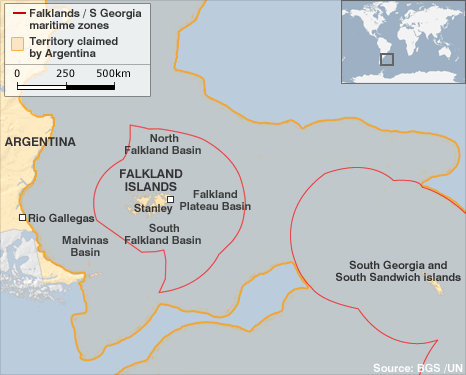
Expect an increase in sabre-rattling from Argentina, now that one of the exploration companies drilling in the North Falkland Basin claims to have struck oil:

Rockhopper Exploration said that initial data collected from one well “indicated an oil discovery”.

The find would be the first in North Falkland Basin, the area north of the islands currently being explored.

Earlier this year, another exploration company, Desire Petroleum, said its drilling programme had disappointed.

It is currently drilling further wells after it decided to abandon its first oil well.

UK-based Rockhopper said further tests now needed to be carried out on the well.

“We are extremely excited by the results of this well,” said Samuel Moody, managing director of Rockhopper.

Argentina disputes ownership of the islands with the British government, although not many seriously fear a second Falklands War (but not many expected the first one either).

May 4, 2010

Introducing the Greaves Underdog Strategy

Filed under: Britain, Media, Politics — Tags: , , , , , — Nicholas @ 07:04

Occasional commenter Chris Greaves sent me this link, saying

Read down towards the bottom:

“Duffy told the Mail she wasn’t impressed. “Sorry is a very easy word, isn’t it,” she was quoted as saying, adding that she would not be casting her vote for Brown — or anyone else — in the election.”

Herein lie the seeds for the Greaves Underdog Strategy:

* If you are the underdog, insult as many bigoted voters as you can reach; it inoculates them against voting, thereby reducing the overdog’s lead.

Gordon Brown is right on track . . .

May 3, 2010

The end of a monopoly

Filed under: Economics, Europe, Science, Wine — Tags: , , — Nicholas @ 12:00

Wine bottles have been sealed with natural cork for hundreds of years. It is an extremely good, natural product that has been used by almost all wine producers because it was better than every other economic sealant available. But cork has a problem that, as a natural product, it is subject to certain risks, the worst of which from a wine viewpoint was contamination with the chemical compound called 2-4-6 Trichloroanisole (usually abbreviated as TCA).

It only takes a tiny amount of TCA to ruin a bottle of wine: and it occurs naturally in the trees from which the cork is harvested. Wine producers and consumers were demanding a solution (wine writers have estimated that between 10% and 15% of all wines suffer from TCA tainting). As monopoly suppliers, however, the cork producers did very little — where else were wineries going to get their bottle closures?

Enter the competition:

By the 1990s, retailers and wineries were clamoring for a solution to wine taint but the cork industry didn’t respond. “No industry with 95% to 97% market share is going to see its propensity to listen increase —and that’s what happened to us,” says Mr. de Jesus from Amorim.

The outcry was just the opening needed by Mr. Noel, a Belgian immigrant who in 1998 began making what he calls “corcs,” he says in part to avoid lawsuits from cork producers, in his North Carolina plastics factory.

Mr. Noel, whose company had specialized in extruded plastics such as pool noodles, named the new business Nomacorc LLC. He eventually built a new, highly automated factory that does nothing but churn out the plastic stoppers, 157 million a month.

The business took off as wineries, desperate for closures that wouldn’t cause cork taint, lined up to buy his product. Nomacorc now has plants on three continents, which produce 2 billion corks a year.

I’m not a big fan of plastic corks — I’m starting to prefer modern Stelvin twist-off closures — but at least with a plastic cork, there’s almost no chance of TCA contamination. I don’t buy very expensive wines, so the most expensive wine I’ve lost to cork taint was only about $60, but that’s still more money wasted than I’m willing to put up with.

If you’ve ever had a glass of wine that smelled of mouldy cardboard, you’ve had TCA-contaminated wine.

April 30, 2010

European map, rationalized

Filed under: Britain, Europe, Humour — Tags: , , — Nicholas @ 09:02

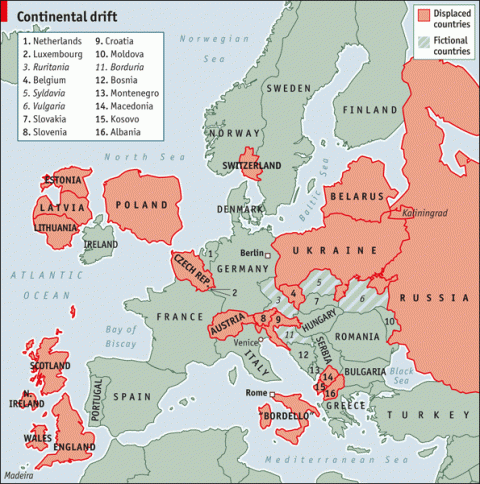
The Economist would like to redraw the map of Europe:

People who find their neighbours tiresome can move to another neighbourhood, whereas countries can’t. But suppose they could. Rejigging the map of Europe would make life more logical and friendlier.

Britain, which after its general election will have to confront its dire public finances, should move closer to the southern-European countries that find themselves in a similar position. It could be towed to a new position near the Azores. (If the journey proves a bumpy one, it might be a good opportunity to make Wales and Scotland into separate islands).

In Britain’s place should come Poland, which has suffered quite enough in its location between Russia and Germany and deserves a chance to enjoy the bracing winds of the North Atlantic and the security of sea water between it and any potential invaders.

April 29, 2010

All the spin that’s fit to print: Bigotgate

Filed under: Britain, Media, Politics — Tags: , , , , — Nicholas @ 07:52

After British PM Gordon Brown accidentally threw himself into the political woodchipper with a remark about a “bigoted woman”, the spin doctors are having a time with it:

Matthew Taylor, former chief adviser on political strategy to Tony Blair

“It is clearly disastrous and also a terrible thing to happen before the final leaders’ debate, which Gordon Brown has to win. He’s given Clegg and Cameron ammunition. The only thing is that expectations now will be so low. They won’t be on the floor, they will be in the cellar. Rock bottom. He’ll have to pull off the performance of the century.”

Olly Grender, former director of communications for the Lib Dems:

“This is the second electric moment in the campaign, the first being the first leaders’ debate. It is going to dominate every news bulletin and will be trailed particularly by the rightwing media. It was classic Gordon Brown, speaking to somebody, giving her a list of six things without asking her anything.

[. . .]

Iain Dale, Conservative political commentator and former political lobbyist

“I can’t remember any politician doing anything this crass. We’ve had this sort of thing before. Who would have thought that when Prescott punched someone it would do his reputation good? But he called a 66-year-old woman a bigot. If we call anyone a bigot who mentions immigration, then that covers thousands of people.

[. . .]

Charlie Whelan, former press secretary for Gordon Brown

“It’s all media clatter rubbish. What makes this story exciting is the media are involved. You’ve got human interest, then you fling in the media and, hey bingo: the wonderful moment the media have been looking for. It’s wonderful to talk about it and to Twitter about it, but normal people looking at it don’t see it in the same way.

Actually, Whelan may have the right idea: the whole situation has galvanized the British media, but it’s not yet clear if it will cause anything more than a temporary blip on the radar as far as the actual voting public is concerned.

April 27, 2010

Almost right

Filed under: Europe, Humour, Media, USA — Tags: , , , , , — Nicholas @ 09:43

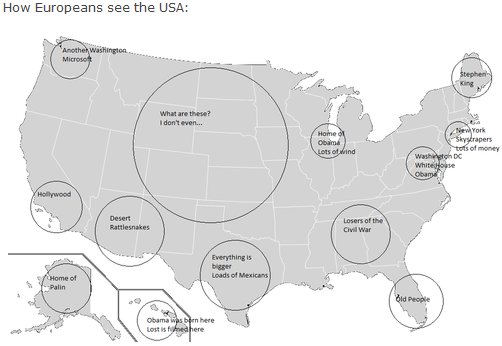
Kathy Shaidle linked to this map at Spleenville, showing an approximation of how Europeans (and implicitly the rest of the world) view the United States:


(Click map to see original image)

[. . .] As a matter of fact, from what I’ve garnered from across the pond, the rest of the world thinks the USA consists of one large metropolis — Newyorkangeles — with a sunny beach where only blond, tanned, perfectly-toned twenty-something models are allowed to go, and the rest of it is a desert wasteland full of racist white cowboys who wear big hats and shoot their guns in the air.

You forgot the teeth: Europeans all seem to believe that Americans all have identical “Hollywood” smiles. Oh, except for the gun-toting racist yahoos, who only have a few teeth each.

April 22, 2010

British Lib Dem leader on Britain’s “war guilt”

Filed under: Britain, History, Politics, WW2 — Tags: , , — Nicholas @ 12:20

The leader of Britain’s Liberal Democrats may have a lot of apologizing to do after an article he wrote as a member of the European parliament came to light:

A rattled Nick Clegg today sought to defend himself over his claim that the British people have a ‘more insidious cross to bear’ than Germany over World War II.

The Lib Dem leader attempted to laugh off criticism of his astonishing attack on our national pride — in which he said we suffered ‘delusions of grandeur’ and a ‘misplaced sense of superiority’ over having defeated the horrors of Nazism.

Campaigning ahead of tonight’s crucial second live TV showdown with party leaders, Mr Clegg said: ‘I must be the only politician who has gone from being Churchill to being a Nazi in under a week.’

Then again, despite the apparent anti-British taint, it might gain him votes in some crucial swing ridings where anti-British feelings are treasured and welcomed.

Update: Sorry about the original headline . . . must have started a cut-and-paste and then forgotten to fix it. Fixed now.

April 21, 2010

“The biggest defeat for internet freedom in the UK since it opened for business”

Filed under: Britain, Law, Media, Technology — Tags: , , , , — Nicholas @ 10:12

Andrew Orlowski looks at the overwhelming legislative victory for the music industry in the UK:

Back in January, a senior music business figure explained to me that Clause 17, which gave open-ended powers to the Secretary of State, was unlikely to survive the wash-up. But he didn’t much care; the other sections which compelled the ISPs to take action against infringers were good enough. Anything else was a bonus – possibly even a distraction. Yet to the amazement of the music business, web blocking is now legislation.

I think this is a watershed in internet campaigning. It’s not just a tactical defeat, it’s a full-on charge of the light brigade, and the biggest defeat for internet freedom in the UK since it opened for business. I’ve spent time talking to legislators and protagonists, and concluded that it was avoidable. Much of the argument was already lost when the Bill was introduced last November, admittedly, but campaigners’ tactics made a bad situation worse. This explodes the idea — sometimes called the ‘Overton Window’ in the jargon — that by adopting an extreme position, you pull the centre ground your way. The digital rights campaigners forced waverers into the music business camp, and hardened their support for tougher measures against file sharers.

In the end, the BPI wiped the floor with the Open Rights Group.

April 15, 2010

A very disturbing notion

Filed under: Economics, Europe, Government, Politics, USA — Tags: , , , — Nicholas @ 12:59

The Cato Institute’s Richard W. Rahn speculates about some very disturbing notions:

Politicians in developed countries have found that their citizens often get upset when inflation reaches high levels and then tend to vote out the culprits. You may recall that the less-than-astute Jimmy Carter lost his re-election campaign, in part, because inflation at one point reached 14 percent and the prime interest rate hit 21 percent.

An insightful European banker suggested to me over breakfast a couple of weeks ago that the European political class would use selective expropriation, rather than inflation, to avoid paying back all of the debt. The way this would be done would be that the political leaders would announce they would only pay back those bonds with full interest that were held by labor unions and other “politically correct” interest groups but not the bonds held by “greedy bankers” and rich people. Maturities would be extended and promised interest rates lowered – effectively reducing the value of the bonds.

My initial reaction was that, yes, such a selective expropriation might work in Europe, but not in the United States. As I thought more about it, however, looked at what was happening and heard President Obama’s rhetoric attacking “greedy” bankers and insurance companies, I began to think that not only was my European friend right about Europe, but his scenario was equally valid here.

The Obama administration has already indicated that it’s quite comfortable with protecting unions at the expense of other contracting parties (in the Government Motors case, at the very least), so it’s not much of a stretch to see this as a possibility in larger matters.

April 13, 2010

Expect to read more stories like this

Filed under: Britain — Tags: , , , , , , — Nicholas @ 12:01

Britain’s welfare support system was originally designed to provide temporary assistance — at barely-above-survival-levels — to workers and their families until the primary wage-earner could find new work. It wasn’t intended to provide this kind of support:

The Davey family’s £815-a-week state handouts pay for a four-bedroom home, top-of-the-range mod cons and two vehicles including a Mercedes people carrier.

Father-of-seven Peter gave up work because he could make more living on benefits.

Yet he and his wife Claire are still not happy with their lot.

With an eighth child on the way, they are demanding a bigger house, courtesy of the taxpayer.

Hard to blame ’em, really: if you can get substantially more through welfare support than you can by working, what’s the incentive to keep that job? Once upon a time, it was shame that would provide that extra spur to keep people in marginal economic circumstances from claiming welfare or other social benefits, as friends and neighbours would disdain them. These days? They’re probably envied by the next-door and down-the-street folks still dumb enough to get jobs.

At their semi on the Isle of Anglesey, the family have a 42in flatscreen television in the living room with Sky TV at £50 a month, a Wii games console, three Nintendo DS machines and a computer — not to mention four mobile phones.

With their income of more than £42,000 a year, they run an 11-seater minibus and the seven-seat automatic Mercedes.

But proof that material wealth does not translate directly into happiness, the Daveys still yearn for things they can’t yet have. But at least they’re not feeling burdened by feelings of guilt or shame:

She added: ‘I don’t feel bad about being subsidised by people who are working. I’m just working with the system that’s there.

‘If the government wants to give me money, I’m happy to take it. We get what we’re entitled to. I don’t put in anything because I don’t pay taxes, but if I could work I would.’

[. . .]

Mrs Davey, who spends £160 a week at Tesco, says she does not intend to stop at eight children. Her target is 14.

And she adds: ‘I’ve always wanted a big family — no one can tell me how many kids I can have whether I’m working or not.’

It’s true: in spite of all the other intrusions into everyday life by the British and European bureaucracies, there are still things they can’t tell you.

H/T to Jon (my former virtual landlord) for the link.

« Newer PostsOlder Posts »

Powered by WordPress