Quotulatiousness

July 13, 2010

Lacrosse team caught in international issue over passports

Filed under: Britain, Bureaucracy, Law, USA — Tags: , , , , , — Nicholas @ 07:24

This is a confusing situation, as Aboriginal tribes/nations are sometimes considered separate political entities from the country within which they live and other times are not. The Iroquois nation apparently has been issuing their own passports, but now the British and US governments don’t want to honour them as they have in the recent past:

The Iroquois team, known as the Nationals, represents the six Indian nations that comprise the Iroquois Confederacy, which the Federation of International Lacrosse considers to be a full member nation, just like the United States or Canada. The Nationals enter this year’s tournament ranked fourth in the world.

The Nationals’ 50-person delegation had planned to travel to Manchester, England, on Sunday on their own tribal passports, as they have done for previous international competitions, team officials said.

But on Friday, the British consulate informed the team that it would only issue visas to the team upon receiving written assurance from the United States government that the Iroquois had been granted clearance to travel on their own documents and would be allowed back into the United States. Neither the State Department nor the Department of Homeland Security would offer any such promise.

If the US government has allowed the use of Iroquois travel documents before, why are they now pretending they’ve never encountered them before? Is it a formal change in policy or just a bureaucrat flexing his or her ability to cause inconvenience and delay on a whim?

Update, 14 July: The New York Times reports that the team has been allowed to travel on their Iroquois passports:

The State Department’s blessing ends a five-day standoff between the Iroquois team and the federal government over whether the players could travel on their own documents instead of United States passports, as they have done in past international competitions.

Representative Louise M. Slaughter, Democrat of New York, said in a statement that Secretary of State Hillary Clinton personally intervened in the case on Wednesday morning and that the team would be able to depart on Wednesday afternoon.

“I am extremely grateful to Secretary of State Clinton, who responded to this glitch promptly and efficiently,” Ms. Slaughter said. “Going forward, we must find a way to balance homeland security concerns with some common sense and a border policy that does not create unintended consequences.”

Part of the reason appears to have been technical: “The Iroquois passports are partly hand-written and do not include any of the security features that make United States passports resistant to counterfeiting.”

July 12, 2010

Another ploy to save the British ID card system

Filed under: Britain, Bureaucracy, Government, Liberty — Tags: , , , — Nicholas @ 12:06

Even though they’re no longer in government, Labour is still trying to save their ID card system:

The latest group lucky enough to enter their sights just happens to be the transgendered. The Identity Documents Bill, which is intended to assert the Coalition’s new position vis-à-vis matters like identity cards is currently at the Committee stage in the House of Commons.

On Tuesday, Labour MP and one-time Identity Minister Meg Hillier was on her feet proposing an amendment, which stated: “Any ID card issued to a transgendered person, which is valid immediately before the day on which this Act is passed, shall continue to be valid until the Secretary of State has laid before both Houses of Parliament a report to the effect that the Secretary of State is satisfied that an identity document in the assigned gender is available for issue to a transgendered person.”

And the down side for transitioning transsexuals?

While the amendment was intended to prevent a particular group being “outed”, the fact that this amendment would make the transgendered the only group of UK citizens in the country still carrying identity cards would be a de facto outing by the government.

He also introduced an intriguing notion and marker for future debate, suggesting that maybe the simplest solution was not more bureaucracy, but the removal of gender identity from any documents unless it was absolutely necessary.

June 30, 2010

Coming to the small screen soon: “Modern Spies”

Filed under: Military, Politics, Russia, USA — Tags: , — Nicholas @ 12:59

It’s a perfect media pitch: modern spies in America! It’s bound to be a mid-season replacement on Fox in 2011!

Charles Stross wonders why this is a surprise:

The only thing I’m startled at is that anyone would find this surprising. Pre-Glasnost, the KGB was heavily into the economic and corporate espionage business — not simply trying to suborn politicians and penetrate rival intelligence and counter-intelligence agencies, but actively trying to gain competitive advantage for the Soviet Union’s big industrial enterprises. From the early 1980s on, it was a huge priority for them — and indeed, Vladimir Putin was allegedly employed by the KGB directorate concerned with economic espionage. And human intelligence operations, even long-term infiltration ones, are comparatively cheap to engage in — given that agents need to work to maintain a cover identity, it takes relatively little money to maintain them in the field and to maintain a management structure at HQ: the cost of a single spy satellite would cover a hundred spies and their controllers for a multi-decade mission.

Looking at this, it’s hard to disagree with Jim Geraghty “I hope some creative casting director is signing Jewel Staite to play the alleged Russian spy Anne Chapman.”

Here’s an example of a home that’s really a castle

Filed under: Architecture, Europe, France, History — Tags: , , — Nicholas @ 12:03

Chateau de Guedelon is a real 13th century castle, or at least, it will be when they finish building it:

The ­Chateau de Guedelon was started in 1998, after local landowner Michel Guyot wondered whether it would be possible to build a castle from scratch, using only contemporary tools and materials.

Today, the walls are rising gradually from the red Burgundy clay. The great hall is almost finished, with only part of the roof remaining, while the main tower edges past the 15m (50ft) mark.

Builders use sandstone quarried from the very ground from which the castle is emerging.

[. . .]

The Guedelon site was chosen because it contained all the necessary materials: plentiful oak from the forests, as well as clay and water. Stone from the quarry had actually been used in the building of real-life medieval chateaux.

June 28, 2010

Tackle the debt, reduce regulatory uncertainty to tackle economic woes

Filed under: Economics, Europe, Government, History — Tags: , , , , — Nicholas @ 08:59

In a difficult business environment, companies take precautions to avoid getting deeper into debt or engaging in risky new projects. Companies and individuals do this because the penalty for getting too deeply into debt is bankruptcy: at best, you survive financially but in much reduced circumstances. Governments, despite evidence to the contrary, seem to think they’re immune to this problem and pile on additional debt even when there’s no reasonable short-term hope of getting out of debt. They should learn from Margaret Thatcher’s approach:

A group of 346 noted economists had just written a scathing open letter to Prime Minister Margaret Thatcher, predicting that her tough fiscal policies would “deepen the depression, erode the industrial base, and threaten social stability.” Thatcher wanted to make absolutely certain her unpopular attack on huge deficits and rampant spending, in the face of high unemployment and a weak economy, was the right one.

So Thatcher summoned Meltzer, along with a group of trusted advisors, to explain why the experts were wrong. Even leaders of her own party advised Thatcher to make what they called a ‘U-Turn,’ and enact a big spending program to pull Britain out of recession. “Our job was to explain why lower deficits and spending discipline were the key to recovery,” recalls Meltzer.

Thatcher was regally unamused by arcane jargon. “Being right on the economics wasn’t enough,” intones Meltzer. “She made it clear that our job was to explain it so she could understand it. If we didn’t, she made it clear we were wasting her time. She’d say, ‘You’re not telling me what I need to know.'”

Thatcher stuck with draconian policies, invoking the battle chant “The Lady’s Not for Turning.” She launched Britain on years of balanced budgets, modest spending increases, falling joblessness, and extraordinary economic growth.

The classic Keynesian theory called for governments to run deficits during tough economic times in order to “prime the pump”: using government money to make up for the lack of private spending in the economy for a short period of time, until the private sector recovered. Governments worldwide grabbed on to this theory, but dispensed with the balancing notion that as soon as the economy recovered, the government had to pay off that debt to return to a balanced budget (or even go into surplus).

Politicians, as a class, love spending money. The more money, the better. They also have remarkably short timelines: the life of this parliament, the next election, pension eligibility date1. Anything that happens beyond that short window of time isn’t important. Spending money the government doesn’t have now is a good thing, to a sitting politician. Paying off the debt later can be left to some mythical future politician.

The other problem that individuals and companies have, but governments don’t, is uncertainty due to regulatory change. Governments don’t have that worry because they’re the ones making the rules (and ignoring them when it’s politically convenient). If you want to depress investment in a given area of your economy, a swift way of doing so is to start faffing with the rules governing that sector. Until you stop changing rules, no company in that sector is going to spend any more than they absolutely have to spend, because you’re creating regulatory uncertainty beyond normal operating levels.

Multiply this by the number of separate government branches involved in making (overlapping, and sometimes conflicting) rules and you can get most major companies to stop expansion, reduce sales, slow or even cease hiring staff until the regulatory environment settles out and the “real” new operating conditions become clear.

[1] Interestingly enough, today happens to be the day that 75 members of parliament qualify for their lifetime gold-plated pensions. I didn’t realize that when I posted this item. Thanks for the heads-up, Kevin Gaudet.

June 25, 2010

Internet access forces retirement of military TV network

Filed under: Europe, Germany, Media, Military, USA — Tags: , , , , — Nicholas @ 09:18

Strategy Page notes the imminent demise of two media staples: Armed Forces Network (AFN) broadcast television and the traditional base newspaper:

U.S. military television stations in Europe are halting the broadcasting of their signals. Not because so many American troops have left Europe since the end of the Cold War, but because everyone has cable. A few broadcasting towers will keep operating, for the few areas where barracks are not yet wired for cable. The big losers are American retirees and military families living off the base. In addition, a lot of locals enjoyed the availability of the “American Channel” and the military oriented content. It was something they could not find on the largest local cable plans. AFN often broadcast American TV shows before they were bought by local networks for broadcast in dubbed format. The dubbing is often poor, and many Europeans speak English, and like to get American TV shows as soon as they come out. But now that’s all history.

[. . .] the technology tidal wave is also destroying the oldest form of American military media; the base newspaper. Four years ago, U.S. Air Force bases began to scrap a century old tradition; the base newspaper. Some bases later brought the papers back, because they found there were a significant minority of base residents who did not use the Internet (which was supposed to replace the newspaper.) But that is not going to last long.

These weeklies were almost standard on military bases, mainly as a vehicle for getting out information of use to all those who lived or worked there. There were administrative announcements, as well as social ones. The base newspapers served a morale function, as well as a practical one. But the news papers cost money, some $3,000-$5,000 a week. The papers were distributed for free, and now there’s a trend towards eliminating the papers, and just putting out all the information on the base web site. All bases now have web sites, and troops, especially younger ones, find these more useful than newspapers. Surveys indicate that most junior troops don’t even read newspapers (nor do their civilian peers). But all these young troops rely on the web for news, and other information. The troops also note that, when they are deployed overseas, or just away from the base for a few days, they only way to stay in touch with what’s happening on the base is via the web site. But many older NCOs and officers, along with their spouses, do still read newspapers. It’s a generational thing, so the base newspaper is still doomed.

June 24, 2010

The unhinged are now running Spanish “green” tech companies

Filed under: Environment, Europe, Politics, Technology — Tags: , , , — Nicholas @ 18:12

As I read this, I kept hoping that it’d be fake:

Spain’s Dr. Gabriel Calzada — the author of a damning study concluding that Spain’s “green jobs” energy program has been a catastrophic economic failure — was mailed a dismantled bomb on Tuesday by solar energy company Thermotechnic.

Says Calzada:

Before opening it, I called [Thermotechnic] to know what was inside … they answered, it was their answer to my energy pieces.

Dr. Calzada contacted a terrorism expert to handle the package. The expert first performed a scan of the package, then opened it in front of a journalist, Dr. Calzada, and a private security expert.

The terrorism consultant said he had seen this before:

This time you receive unconnected pieces. Next time it can explode in your hands.

Dr. Calzada added:

[The terrorism expert] told me that this was a warning.

I have no idea what Spanish law says about this kind of blatant intimidation, but I hope there are charges laid and convictions resulting from those charges.

Spain, of course, recently announced that they were having to cut back on their plans to become the greenest country in Europe, as they couldn’t afford the additional costs, both up-front and in lost opportunities in other industries.

H/T to Ace for the link.

Update, 25 June: In the comments, Ed Darrell says I’ve been taken in and has a long post up with translations of the original article used by Ace and PajamasMedia: here. If Ed is right and I’ve been taken in, I’ll post a retraction. I’m sure he’ll do the same if it turns out to be true.

Update, 28 June: A clarification posted at Ace of Spades HQ makes it seem a bit less like a mock-bomb threat.

The Green company sending the package apparently had its actual package — a report — swapped with car parts at some point in the mailing. [. . .]

It didn’t look like, or feel like, a letter or report, so at that point Calzada got a security guard to scan it — and what was inside was a cylindrical object with wires attached. At that point, the security guard got an expert to examine it, with others in attendance. The contents were a container for diesel of some sort, and some other parts. The expert saw this as a bomb threat, based on a pattern used by, eg., ETA: “This one is a hoax bomb. The next one might not be.”

It’s a “Failure of its systems for monitoring”

Filed under: Economics, Europe, Greece, Politics — Tags: , , , — Nicholas @ 10:45

Austin Bay thinks he’s identified the elephant in the European parlour:

Greece teeters on the edge. The Wall Street Journal‘s Paul Hannon wrote this week that “the failure of its (EU) systems for monitoring and controlling build-ups in government debt” are why the bailout loans given to Greece by the International Monetary Fund (IMF) and fiscally disciplined EU members like Germany became necessary.

He’s right. “Failure of its systems for monitoring,” however, is a euphemism — economic diplo-speak for a very difficult word: corruption. Greek governments cooked the books (its actual deficit is twice as high as officially reported), violated fiscal agreements and borrowed money they could not repay.

Corruption lies at the dirty core of the Euro-zone’s trouble. Governmental corruption and its cohort, illicit business practices, are a pervasive, multicultural, global affliction.

Corruption coupled with systemic lack of accountability — to include personal accountability, where managers and workers let lackadaisical and lazy work practices slide — eventually produces more than anger, cynicism and financial turmoil. Even among economies in the developed world, it stunts economic productivity, robs the future and sows the seeds of armed conflict. In the developing world it undermines aid efforts, manacles fragile economies and as a result condemns millions to poverty.

The big remaining question is no longer “Will the Euro fail?” but rather “Who’ll bail out first?”

Tempest in a wine glass

Filed under: Europe, Law, Wine — Tags: , — Nicholas @ 09:47

The most recent issue of OntarioWineReview included a snippet from an article originally published in Decanter on the outcome of a legal tussle between Reidel and Eisch over the term “breathable glass”:

Austrian glassmaker Riedel has declared victory in its lawsuit against its rival Eisch Glasskultur over false claims for breathable glass.

Riedel, Nachtmann and Spiegelau filed suit in Munich, Germany alleging that Eisch’s advertisement boasting ‘breathable glass’ constituted false advertising.

On 19 January the two parties agreed to settle after Eisch’s claim that its ‘breathable’ glasses were made using a secret process that ‘opens bouquet and aromas within 2 to 4 minutes’ was not supported in court.

The court ordered Eisch to cease claiming its glass is ‘Breathable’ or ‘Opens bouquet and aromas within 2 to 4 minutes’, or face penalties of up to €250,000, or imprisonment of up to six months for senior directors.

A few years ago, Elizabeth and I bought a set of the Eisch “breathable glass” wineglasses and actually tested them. I doubted the claim, as I couldn’t think of a way that glass could be altered to allow air to pass through that would not also change other characteristics like clarity. Later that evening, we sat down with our friend Brendan and tried to determine if there was any difference between the “breathable” and ordinary glasses.

It may just have been our willingness to believe, but we each thought the wine in the breathable glass was better than the same wine in an ordinary wine glass. That being said, we didn’t think the degree of improvement was enough to justify replacing all our Riedel glasses.

June 22, 2010

UK photographers might want to pick up this magazine

Filed under: Britain, Law, Liberty — Tags: , , , , — Nicholas @ 10:02

BoingBoing advises that the July issue of Amateur Photographer is doing something to assist innocent photographers who are still encountering police and rent-a-cop harassment in public spaces:

The UK Amateur Photographer magazine is giving away free lenscloths silk-screened with the Photographers’ Bill of Rights with its July issue. UK anti-terror legislation gave the police sweeping powers to harass photographers for shooting in public places, and to compound matters, tabloid-driven hysteria over paedophilia has seen many photographers accused to paedophilia for taking pictures of (for example) public busses and empty playgrounds.

Between the anti-terror laws, the anti-pedophilia panic in the newspapers, and the general busy-bodiness of security guards, photographers in the UK are being treated like criminals. More on the anti-harassment campaign here.

QotD: He bestrides the G8 like a Colossus

Filed under: Cancon, France, Germany, Italy, Politics, Quotations — Tags: , , , — Nicholas @ 00:07

. . . things are pretty bad in the mother country when a self-described “Whig” calls Stephen Harper “a magnificent fiscal conservative.” It’s like calling Gordon Brown “a brilliant and charismatic leader,” or Jean Chretien “a visionary and articulate statesman.” In politics, at least practical politics, all truth is relative.

Compared to most G8 leaders Stephen Harper does look like a genius. This is, as you’ve guessed, damning by the faintest of praise. Barack Obama is an avowed socialist, who described his one real job in the private sector as working “behind enemy lines.” Japan has been governed by a series of interchangeable non-entities for the better part of the last decade. In most of Europe, and certainly the English speaking world, Silvio Berlusconi would be awaiting sentencing. Angela Merkel rivals Helmut Schmidt in the visionary department. Sarko is a living embodiment of every mistake the French have made since Diem Bien Phu: A domestic policy summed up by the quintessentially French term “dirigiste,” and a foreign policy consisting of German guilty tripping and sophomore anti-Americanism. If Stephen Harper looks taller than others, it is because he is standing on the shoulders of midgets.

Publius, “Well, at least someone likes him…”, Gods of the Copybook Headings, 2010-06-21

June 18, 2010

Royal charter granted

Filed under: Britain, History, Technology — Tags: , , — Nicholas @ 13:01

The most recent recipients of a royal charter are the Worshipful Company of Information Technologists:

The Worshipful Company of Information Technologists received its Royal Charter yesterday — its mark of approval from the Queen.

The Livery Companies were originally proto-trade unions or professional standards bodies, depending which you look at it, based in the City of London. The first, the Worshipful Company of Mercers, got its Royal Charter in 1394 but was in existence for an unknown time before that. Although some retain a regulatory role — assay marks to show the purity of gold and silver are still overseen by the Company of Goldsmiths — most are now social and charitable bodies.

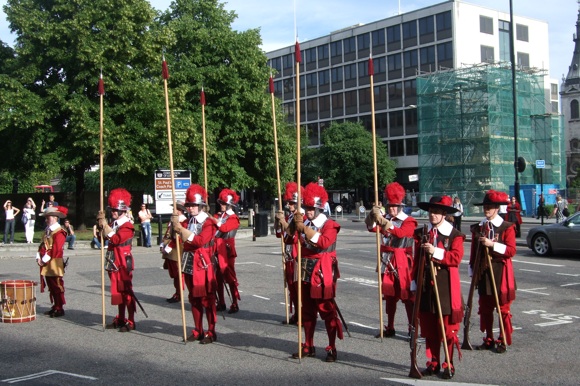
Yesterday’s ceremony was part of Evensong at London’s most beautiful building, St Paul’s Cathedral. The actual Royal Charter — a large vellum certificate — was blessed before freemen and livery men walked to Mansion House escorted by a ceremonial guard of Pikemen and Musketeers for a banquet with the Lord Mayor.

I was hoping that the recipients were the chaps with the morion helmets and the back-and-breastplates:

Another “daring” ad

Filed under: Britain, Religion — Tags: , , — Nicholas @ 09:54

If it was really “daring”, it wouldn’t be Christianity being mocked for commercial purposes:

A controversy-courting Italian ice-cream maker is in hot water for running an ad featuring a heavily pregnant nun with the strapline “immaculately conceived”, after a stream of complaints to the advertising watchdog that it is offensive to Christians because it mocks the birth of Jesus.

The ad, which is featured in magazines The Lady and Grazia, features a pregnant nun enjoying a pot of Antonio Fedirici ice-cream.

The Advertising Standards Authority has launched an investigation to see if the campaign breaks the advertising code on the grounds of taste and decency. The ASA has received about 40 complaints from members of the public that it is offensive to Christians, especially Catholics, “because it mocks the virgin birth of Jesus”.

It’s not only safe to poke fun at the religious beliefs of Christians, it’s rather expected in certain quarters. Just as a thought experiment, what are the chances that someone would do something similar mocking any other religion?

Update: Of course, there’s mockery and then there’s mockery.

June 17, 2010

Spain finds its “green” energy unsustainable

Filed under: Economics, Environment, Europe, Technology — Tags: , , , , — Nicholas @ 12:20

Spain can’t afford to subsidize all those “green” jobs anymore:

Dead broke Spain can’t afford to prop up renewables anymore. The Spanish government is cutting the numbers of hours in a day it’s prepared to pay for “clean” energy.

Estimates put the investment in solar energy in Spain at €18bn — but the investment was predicated, as it is with all flakey renewables, on taxpayer subsidies. With the country’s finances in ruins, making sacrifices for the Earth Goddess Gaia is an option Spain can no longer afford. Incredibly, Spain pays more in subsidies for renewables than the total cost of energy production for the country. It leaves industry with bills 17 per cent higher than the EU average.

[. . .]

“Sustainability” has been the magic word that extracted large sums of public subsidy that couldn’t otherwise have been rationally justified using traditional cost/benefit measures. Spain paid 11 times more for “green” energy than it did for fossil fuels. The public makes up the difference. The renewables bandwagon is like a hopeless football team that finishes bottom of the league each year — but claims it’s too special ever to be relegated.

Of course, the lesson won’t be learned by other countries or regions . . . Ontario recently signed on to a similar kind of deal with Samsung. But Ontario taxpayers are getting a bargain: the jobs being created under this scheme will only cost $303,472, compared with the eye-watering $774,000 the Spanish jobs cost.

June 16, 2010

Monty explains it all for you

Filed under: Economics, Europe, France, Humour — Tags: , , , , — Nicholas @ 12:02

Financial worries? Fiscal imbalance? Debt woes? No problem! Monty has the answers (well, answers to some questions, even if they’re not the ones you’re interested in):

And the good news just keeps coming! Slumping cattle and lean-hogs futures may have bottomed out. Screw gold, man; I’m buying swine! (Monty, The Wasteland Bacon Baron. It has a nice ring to it. The potentate of pork! The sultan of swine! The High Lord of ham! The chitlin Chieftain!)

I’m not sure whether this is good news or not: Cramer calls yesterday’s big gain a sucker’s rally and advises people to get out. My rule of thumb is to treat anything Cramer says as the ravings of a lunatic. I consider him a shill and a buffoon. And yet . . . is this a Strange New Respect I’m feeling? Or just the dying embers of that burrito I ate for lunch yesterday?

French financial group AXA experiences a blinding glimpse of the obvious and exclaims, “Ze Euro eez doomed!”. Zut alors! (And no, I don’t know why French guys would be speaking English with a French accent instead of French.)

Spain and Portugal submit their austerity plans to the ECB and IMF. Plans include selling shoelaces at the airport, dancing for nickels, graft, corruption, and murder-for-hire. The ECB and IMF remain skeptical, and suggest that Portugal and Spain might want to look into selling the family silver or something.

And if all of that isn’t enough to get you assembling your Financial Apocalypse Survival kit, how about this?

More bond issues are being denominated in Canadian Loonies and Swiss Francs as investor skittishness regarding the Euro spreads. When investors choose something called the “Loonie” over your currency because it just sounds more stable somehow, dude, you got problems.

« Newer PostsOlder Posts »

Powered by WordPress