Quotulatiousness

April 17, 2011

This is why the Finnish election matters to Portugal

Filed under: Economics, Europe, Politics — Tags: , , , — Nicholas @ 09:00

Unlike most other EU states, Finland has an option of putting the bailout to a vote:

Opinion polls suggest the True Finns have nearly quadrupled in popularity since the last election though they are unlikely to enter government.

Analysts see mainstream parties taking a harder line on the EU as a result.

Unlike other eurozone states, Finland can put requests for bail-out funds to a majority vote in parliament.

Since any bail-out must be approved unanimously by all 17 eurozone members, a hostile Finnish government could theoretically veto it.

The outcome of Sunday’s election may affect EU plans to shore up Portugal as well as impacting on stability in debt markets.

April 15, 2011

Finnish election still up for grabs

Filed under: Europe, Politics — Tags: , , — Nicholas @ 15:11

Remember I mentioned the “True Finns” party in passing last week? The election is this weekend and it looks like a four-way race:

Finland votes on Sunday in its most closely watched general election in years, with the campaign hijacked by a Eurosceptic maverick riding roughshod over the consensus that has long characterised the country’s politics.

Timo Soini has alarmed the European and Finnish elites by leading his True Finns party into a neck-and-neck position with the three mainstream parties that traditionally dominate Finnish politics.

The quadrupling of support for the True Finns since the last election in 2007 puts Finland firmly in line with the cardinal trend in politics across Europe in the past year — the emergence of the populist far right combining nostalgia for disappearing values and traditions with anti-immigrant and anti-EU appeal.

An opinion poll on Friday put the True Finns at around 16% in a coalition system, soaring from 4% in 2007 albeit sliding a little from their position in surveys last week. That put True Finns neck and neck with the Centre party of the prime minister, Mari Kiviniemi, and the opposition social democrats, and a few points behind the poll leaders, the National Coalition party led by the finance minister, Jyrki Katainen.

Arousing the voters, Menorcan style

Filed under: Europe, Media, Politics — Tags: , , , — Nicholas @ 09:45

It’s a perennial problem: how do you manage to get the voters interested in your candidacy? How can you get them excited? Sole Sánchez Mohamed has an answer for you:

A Menorcan political candidate has caused a bit of a rumpus ahead of Spain’s forthcoming municipal elections with a seriously in-your-face advert in the local press.

Sole Sánchez Mohamed, head of the Partit Democràtic de Ciutadella (PDC), posed with an evidently willing pair of male hands to make her point, or rather, pair of points. The caption declares: “Two great arguments.”

To further her election cause, the wannabe mayoress of Ciutadella appeared in monthly magazine Més Iris Menorca dressed only in her smalls while adopting “sadomasochistic poses”, as you can see here (NSFW).

And you folks complain about “attack ads” in Canadian elections.

RAF proves Eurofighter can take out stationary, unmanned, abandoned enemy tanks

Filed under: Africa, Britain, Military, Politics — Tags: , , , , — Nicholas @ 09:29

In a triumph of military daring and precision bombing public relations, the Royal Air Force has demonstrated the ground-attack capability of their Eurofighter Typhoon aircraft:

The RAF has blown up two apparently abandoned Libyan tanks using a Eurofighter Typhoon jet in a move which appears to have been motivated more by Whitehall infighting than by any attempt to battle the forces of dictator Muammar Gaddafi.

[. . .]

The video appears to show a T-72 tank neatly parked, stationary and unmanned: the target was plainly not in use. The Telegraph reports that the location struck was “an abandoned tank park”. Many Libyan armoured vehicles are old and not serviceable due to lack of parts and servicing. RAF sources admitted to the paper that the jets making the strike had had to spend “a long time” searching before they could find a valid target to hit, and that the timing of the strike was “no coincidence”.

So why is the RAF not only conducting unnecessary air attacks on useless hunks of metal? The answer is not so much military as it is political:

This hasty effort by the RAF to get Typhoons into ground-attack action took place just ahead of the scheduled release by the Parliamentary Public Accounts Committee of a damning report on the Eurofighter, titled Management of the Typhoon project. This report had been expected to be highly critical of the Typhoon, and indeed it is. It says:

In 2004, the Department decided to retire the ground attack Jaguar aircraft early and to spend £119 million to install ground attack upgrades on early Typhoons to cover the resulting capability gap. These upgrades were ready for use by 2008. A year later, the Department decided to retire the air defence Tornado F3 aircraft early to save money and therefore re-prioritised Typhoon away from ground attack missions to air defence tasks. It is now not using Typhoon’s ground attack capability.

So, absent some secret plan of the Libyan army to somehow put their abandoned equipment back into immediate use, this was a PR strike to rally public opinion against parliamentary interference.

April 14, 2011

“We have engineered a massive, unstoppable Essex. We should all be in jail”

Filed under: Britain, History, Humour — Nicholas @ 16:26

In this time of abject apologies of all sorts for historic wrongs, it’s time for England — East Anglia in particular — to acknowledge the sins of their past:

As David Cameron told Pakistan that its current balls-out craziness was actually the fault of the British empire, experts pointed to the giant, stupid, disgusting country founded by some people from East Anglia.

Julian Cook, author of America: What the Fuck Were We Thinking?, said: “When Harwich-born Christopher Jones captained the Mayflower in 1620 he began a process that would lead ultimately to genocide, the Ku Klux Klan and Grey’s Anatomy.

“Thanks to him and his insane passengers, the way was paved for a nation of heavily armed toddlers led around by an ever-changing roll-call of religious maniacs, grubby conmen and dead-eyed celebrities.

“It doesn’t understand anything more than 15 minutes old — except creationism — and is littered with strip malls and heavily branded cheese pumps.

“We have engineered a massive, unstoppable Essex. We should all be in jail.”

H/T to Johnathan Pearce for the link.

From supercar to superscrap

Filed under: Europe, Germany, Technology — Tags: , — Nicholas @ 12:15

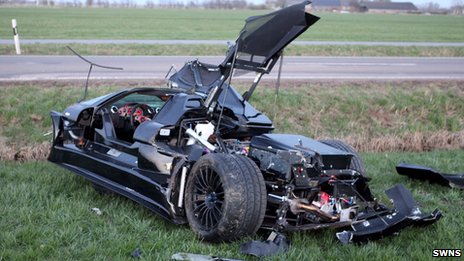
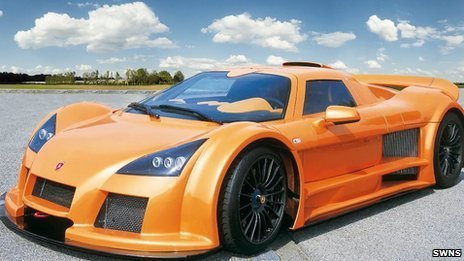
This is what it looked like before the owner’s son took it for a drive:

And this is after the drive got stopped a bit early:

The good news is that the driver and passenger were able to walk away from the wreck, leaving £275,000 of scrap metal behind.

British high court rules 2009 G20 “kettling” illegal

Filed under: Britain, Law, Liberty — Tags: , , — Nicholas @ 09:29

While I may disagree with the protesters and their messages, the police “kettling” technique has always disturbed me far more. Britain’s high court has now ruled that police broke the law while kettling G20 protesters in 2009:

In a landmark judgment on Thursday, high court judges found for protesters who had claimed police treated them unfairly. It also criticised the use of force by officers.

In the case, the court heard that officers used punches to the face, slaps and shields against demonstrators who police chiefs accept had nothing to do with violence. The judgment does not strike down the police tactic of kettling or mass detention, but it will be seen as a rebuff to the Met.

The judgment places limits on the use of kettling. It says: “The police may only take such preventive action as a last resort catering for situations about to descend into violence.”

More proof that you shouldn’t over-pay for wine

Filed under: Britain, Randomness, Wine — Tags: — Nicholas @ 08:58

I’ve discussed this before, but here’s another report on cheap versus expensive wine for the average person:

An expensive wine may well have a full body, a delicate nose and good legs, but the odds are your brain will never know.

A survey of hundreds of drinkers found that on average people could tell good wine from plonk no more often than if they had simply guessed.

In the blind taste test, 578 people commented on a variety of red and white wines ranging from a £3.49 bottle of Claret to a £29.99 bottle of champagne. The researchers categorised inexpensive wines as costing £5 and less, while expensive bottles were £10 and more.

The study found that people correctly distinguished between cheap and expensive white wines only 53% of the time, and only 47% of the time for red wines. The overall result suggests a 50:50 chance of identifying a wine as expensive or cheap based on taste alone — the same odds as flipping a coin.

While a more wine-oriented group of testers would probably do better, they’d do better in the sense of determining which of two similar wines was the more expensive — but not necessarily a lot better. We’re in a golden age for wine, as more and more producers of inexpensive wines adopt better techniques and equipment for even their vin extremely ordinaire.

Wine isn’t a simple product: people buy wine for lots of different reasons, and one of those reasons is to signal higher social status by buying more expensive wine. As you get above a certain price level, the quality increases more slowly but the “prestige” makes up the difference (for those interested in the social signalling, anyway).

I’ve discovered that my palate isn’t highly developed enough to detect and appreciate the additional quality that a $100 bottle of wine is supposed to display over a $40-$50 bottle. It may be that I lack the ability to discriminate sufficiently between the two . . . or it may be that the primary difference is in the “prestige” and not in the palate.

Earlier discussion of this topic here.

April 13, 2011

Delaying retirement: expect to see lots of articles like this

Filed under: Britain, Economics — Tags: , , , — Nicholas @ 07:57

This Guardian article is a pattern for lots to follow in the next few years, as would-be retirees discover that they can’t afford to retire when they’d hoped:

Two-fifths of people who intended to retire this year will have to work for an extra six years because they cannot afford to stop working, according to a study by Prudential.

The pension provider’s Class of 2011 report found that 38% of people are delaying their retirement, and 40% of those say they will have to work until they are 70 to have a comfortable income.

It also shows that 22% of those delaying retirement are doing so because they can’t afford to stop working, up from 15% last year. They had intended, on average, to retire at 62, but now believe they will be at least 68 before they can draw a pension.

Governments in the western world are slowly moving the mandatory retirement age (where it exists), but even in some unionized environments, the benefits workers depend on start to phase out before retirement age. The expectation is that government programs would be there to cover older workers, but governments have little chance of expanding programs during tough economic times.

April 11, 2011

Political grandstanding at the expense of Muslim women

Filed under: Europe, France, Law, Liberty, Religion — Tags: , , , , — Nicholas @ 09:22

Josie Appleton points out the logical inconsistencies of the various European “Ban the Burkha” movements:

In spite of the grave crisis of the Euro, the French cabinet will today (19 May[, 2010]) find the time to discuss a draft law banning the wearing of full-face veils in public places. Spain has just slashed public wages and is on the verge of economic collapse, yet the minister of work yesterday made the effort to visit Lleida and voice his support for the mayor’s plan to prohibit full Islamic facewear in the streets. Last month, Belgium’s coalition government had dissolved and there was talk of splitting up the country, yet the parliament managed to unite 136 out of 138 deputies to vote through a law banning the burqa and niqab.

How is it that European leaders, in such difficult times, have invested such energy in the matter of women’s facewear? Why was a Spanish schoolgirl who insisted on wearing a headscarf so fascinating as to draw the media’s attention away from government cuts? Why such detailed discussions on the intricacies of Islamic veils? Newspapers feature pullouts on the different forms of Islamic veil, and commentators explain why the niqab is so much worse than the shayla or the chandor, and indeed how the hijab is fine and even liberating for Muslim women.

The burqa-ban laws were introduced with such displays of speechmaking that anybody would think the fate of these countries hung on this single point of principle. One Belgian deputy admitted that ‘the image of our country abroad is more and more incomprehensible’, but said this near-unanimous vote banning the burqa and niqab rescued ‘an element of pride to be Belgian’. A French commission on the veil said the veil was ‘contrary to the values of the Republic’ and the parliament should make it clear that ‘all of France is saying “no” to the full veil’. The Spanish work minister said this clothing ‘clashes fundamentally with our society and equality between men and women. The values of our society cannot go into retreat.’

Lovely sounding stuff in front of the microphones, to be sure. Good photo ops for ambitious politicians, to a clamour of general approval and risking the loss of very little: there were so relatively few women wearing these articles of clothing — and few of them or their husbands/fathers/brothers likely have the vote anyway.

Now, pay heed to the Law of Unintended Consequences. Many of these women now have a choice: disobey the family head by going out in public without wearing the niqab/hijab/burkha (and risk beatings or even honour-killing), or follow the dictates of the family head and risk being arrested by the gendarmes.

How, exactly, is this going to benefit those poor women?

Update: The ban in France was passed in October and goes into effect today:

The centre-right government, which passed the law in October, has rolled out a public relations campaign to explain the ban and the rules of its application that includes posters, pamphlets and a government-hosted website.

Guidelines spelled out in the pamphlet forbid police from asking women to remove their burqa in the street. They will instead be escorted to a police station and asked to remove the veil there for identification.

[. . .]

In Avignon, Vaucluse, Reuters TV filmed a woman boarding a train wearing a niqab, unchallenged by police.

“It’s not an act of provocation,” said Kenza Drider. “I’m only carrying out my citizens’ rights, I’m not committing a crime … If they [police] ask me for identity papers I’ll show them, no problem.”

France has five million Muslims, but fewer than 2,000 women are believed actually to wear a face veil.

Many Muslim leaders have said they support neither the veil nor the law banning it.

April 10, 2011

Canada’s peaceful submarines

Filed under: Britain, Cancon, Military, Technology, Weapons — Tags: , , — Nicholas @ 11:02

Apparently, the navy’s purchase of used British submarines has still not been completed: the boats are in our hands, but they’re still unarmed:

The country’s stock of second-hand submarines — already beleaguered with repairs and upgrades — is incapable of firing the MK-48 torpedoes they currently own.

When Canada purchased its current fleet of four submarines from Britain in 1998, they were fitted for British torpedoes. At the time, Canada was heavily invested with the modern MK-48 torpedo system and did not want to abandon it.

Like any shopper trying to justify a second-hand purchase in the face of an obstacle, they figured it was still a good deal. They “Canadianized” the submarines, but, 13 year later, they still haven’t got around to the “weaponization” part.

“The Canadian Forces has always intended for the Victoria Class submarines to carry and fire the Mark 48 torpedo,” wrote Denise LaViolette, the director of navy public affairs, in an email. “Initial weapons certification will be progressed early in 2012 in HMCS Victoria for Pacific operations followed that year by HMCS Windsor for Atlantic operations.”

I noted the lack of torpedo armament on the Canadian sub fleet back in 2004. I had no clue that they’d still be unarmed in 2011!

Later that same year, I said:

As I’ve said in other posts, I’m not a former Navy person, so my knowledge of the situation is neither broad nor deep. I’m moderately well-read on naval mattters, but that’s the limit. On that basis, I thought the purchase of the Upholder subs was a brilliant solution for both the Canadian and Royal Navies: we got a heck of a deal and they got the subs off their inventory. It really did look like a win-win, and both sides thought they’d gotten the better of the bargain.

In the long run, this may still turn out to be true. I certainly hope so.

As several others have noted, until we find out exactly what happened on HMCS Chicoutimi, we can’t make any determination about whether the subs are going to be safe and effective vessels for our navy. And, as Bruce R. pointed out the other day, if we want to retain any claims of sovereignty over the coastal waters of this huge country, we need those subs in the water now.

Well, the subs have been in the water for several years, but without torpedoes, they’re not fully functional.

Update, 12 April: Strategy Page has a useful summary of the history of the Upholder/Victoria class submarines:

It all began in the 1990s, when Canada wanted to replace its 1960s era diesel-electric subs. This did not seem possible, because the cost of new boats would have been about half a billion dollars each. Britain, however, had four slightly used Upholder class diesel-electric subs that it was willing to part with for $188 million each. Britain had built these boats in the late 1980s, put them in service between 1990 and 1993, but then mothballed them shortly thereafter when it decided to go with an all-nuclear submarine fleet.

So the deal was made in 1998, with delivery of the Upholders to begin in 2000. Canada decommissioned its Oberons in 2000, then discovered that the British boats needed more work (fixing flaws, installing Canadian equipment) than anticipated. It wasn’t until 2004 that the subs were ready, and that one year one of them was damaged by fire, while at sea. This boat is to be back in service next year. By the end of this year, three boats should be back in service. Maybe.

[. . .]

The problem is that the subs were bought without a through enough examination. It was later found that most major systems had problems and defects that had to be fixed (at considerable expense). Thus these boats have spent most of their time, during the last decade, undergoing repairs or upgrades. The final fix will be to get the torpedo tubes working. In any event, a Canadian [submarine] has never fired a torpedo in combat, mainly because the Canadian Navy did not get subs until the 1960s. Lots of Canadian surface ships have fired torpedoes in combat, but the last time that happened was in 1945. The sole operational Victoria class boat is on patrol in the Pacific, listening for trouble which, if found, will be reported to the proper authorities.

A world always at war

Filed under: Africa, Americas, Asia, Europe, History, Military, Pacific — Tags: , , , — Nicholas @ 10:38

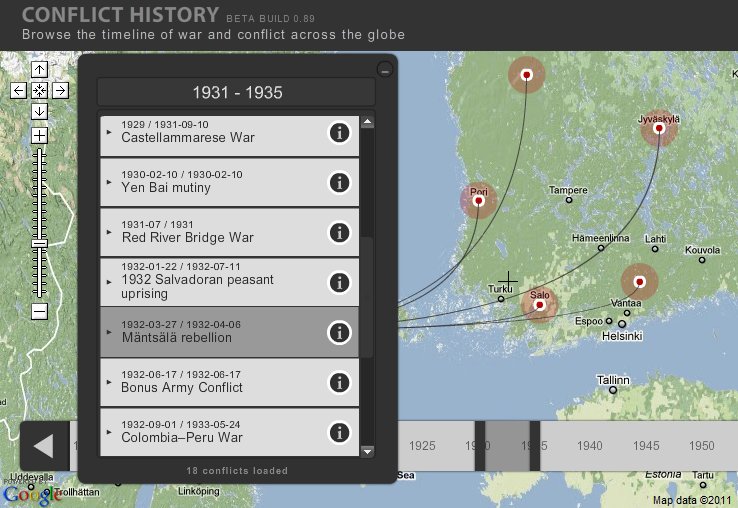
This is an interesting site:

The screencap above shows the significant sites in the Mäntsälä rebellion in Finland in 1932 (no, I’d never heard of it either). Use the slider at the bottom of the screen to choose the time in history, and the map will show you the known conflicts for that period.

April 9, 2011

Someone deserves a medal here

Filed under: Britain, Military — Tags: , — Nicholas @ 11:57

If this Guardian report is true, I hope that Royston Smith is on the next honours list:

Southampton city council leader, Royston Smith, was visiting the submarine with other dignitaries while it was berthed at the Eastern Docks on a five-day visit to the city.

He described how he “wrestled” the gunman to the ground in the submarine’s control room as he tried to stop him.

“Two shots were fired, straight after he entered the control room again and began shooting again,” Smith told the BBC.

“I ran towards him, I pushed him against the wall, we wrestled to take the gun from him. He fired again, I wrestled again to get the weapon from him. I pushed him to another wall, I wrestled him to the ground and managed to take the weapon away from him then others came to help to restrain him.”

He said a group of schoolchildren had left the submarine shortly before the attack.

That’s a civilian, charging a gunman armed with a battle rifle, and disarming him before the trained military personnel could intervene. There are very few people who could have reacted so quickly — and correctly — in that situation. That’s heroism.

Rare WW2 German bomber discovered off British coast

Filed under: Britain, Europe, Germany, History, Military, WW2 — Tags: , — Nicholas @ 11:32

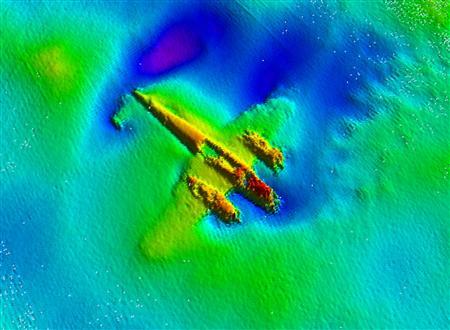
What may be the only intact example of the German Dornier 17 bomber has been discovered in the Goodwin Sands off the coast of Kent:

The plane came to rest upside-down in 50 feet of water and has become partially visible from time to time as the sands retreated before being buried again.


Image from Reuters

Now a high-tech sonar survey undertaken by the Port of London Authority (PLA) has revealed the aircraft to be in a startling state of preservation.

[. . .]

Known as “the flying pencil,” the Dornier 17 was designed as a passenger plane in 1934 and was later converted for military use as a fast bomber, difficult to hit and theoretically able to outpace enemy fighter aircraft.

In all, some 1,700 were produced but they struggled in the war with a limited range and bomb load capability and many were scrapped afterwards.

Striking high-resolution images appear to show that the Goodwin Sands plane suffered only minor damage, to its forward cockpit and observation windows, on impact.

“The bomb bay doors were open, suggesting the crew jettisoned their cargo,” said PLA spokesman Martin Garside.

H/T to Elizabeth for the link.

Upheaval in Finnish politics?

Filed under: Europe, Government, Media, Politics — Tags: , , , , — Nicholas @ 00:03

Ilkka is enjoying the spectacle of the “right-thinking” (i.e., left-thinking) folks in Finland who are horrified at the rise of a new party:

Canada will have yet another federal election that will bring yet another minority government, and back in the old country, the parliamentary elections have begun with the first early voting days, and the right-wing protest party True Finns is predicted to grab a significant chunk of the parliamentary seats. The impotent tantrum of the SWPL greens and leftists, along with the media that they still mostly control, reacting to the cognitive dissonance of the working class abandoning them has certainly been a laugh riot. Besides, this whole surge illustrates how just one voice of just the right pitch can smash a sufficiently ossified, smug and complacent echo chamber to little shards of glass by its mere existence. One can only imagine what the Finland of the 1970’s would have been like, had the Internet existed back then to give these voices a voice, as all leftism and progressivism can keep the reality at bay only if they get to have a totalitarian control of all media to constrain the parameters of debate.

« Newer PostsOlder Posts »

Powered by WordPress