Quotulatiousness

May 11, 2011

Brendan O’Neill: “The moralising Lib-Cons are New Labour in disguise”

Filed under: Britain, Government — Tags: , , — Nicholas @ 07:38

Brendan O’Neill pronounces his verdict on the first year of the British coalition government:

For all the claims that the Lib-Cons are Thatcher in disguise, with the wicked Bullingdon-braised David Cameron only pretending to be touchy-feely and a friend of Nick, in fact the most striking thing about this government one year in is how similar it has been to its ugly predecessor New Labour. The moralisation of everyday life, including people’s parenting styles and their drinking and smoking habits? Check. A promise to create a new kind of society (Dave calls it the Big Society; Blair called it the Stakeholders’ Society) while actually increasing the role of the state in economic, political and personal affairs? Check. Blather about environmentalism and nervousness about pursuing nuclear power? Check. The bombing of a foreign country in the name of all that is morally pure and right? Check. The New-Labour-Lib-Con eras have shown that Britain is no longer fought over by clashingly opposing parties but rather is dominated by a samey, conformist and vision-lite political class: samey both in terms of its members’ social origins and their political obsessions.

May 10, 2011

Superinjunctions

Filed under: Britain, Law, Liberty, Media — Tags: , , , , , — Nicholas @ 09:08

British law is already difficult enough for outsiders to suss out, but the recent use of superinjunctions to prevent even the hint that a story is being legally suppressed makes it even tougher:

The high profile are gagging, the press is losing the ability to speak, and now the Twitterati is vomiting up half-digested rumours. All the signs are that Britain is in the grip of the legal virus known as ‘injunctionitis’.

It makes for an unedifying spectacle. In between news of uprisings in the Middle East, the killing of Osama bin Laden and the marriage of Will’n’Kate, the British press has been running another set of stories about what it is forbidden from reporting. The reason for this is the increasingly problematic use of the injunction, a legal prohibition issued by a judge that prevents a particular story from being published. While these have been issued for a few years now with largely little public knowledge — especially after the use of so-called superinjunctions, which forbid people from mentioning the fact that an injunction exists — over the past year or so, the injunction in all its forms has started to make the news all by itself. Which, you’d be correct in thinking, rather defies the point.

In fact, over the past few weeks, the attempts by certain individuals to gag the press has resulted in an outbreak of calculated press indiscretion. There has been the tale of the unnamed English actor who employed the services of Helen Wood, a prostitute whose previous clients include footballer Wayne Rooney. Of course, given the injunction, Wood couldn’t do a proper bonk-and-blab about the actor, but there was enough detail there for a salacious few pages’ worth. Then there was the unnamed Premier League footballer who had allegedly been having an affair with Big Brother 7 victim/star Imogen Thomas. She has since been frequently pictured looking disconsolate in a series of fetching bikinis.

It’s bad enough when the government uses its powers to suppress public discussion of items of importance to “national security” (with the definition as loose as possible). It’s much worse when the courts are allowing private individuals and corporations to have their own version of court-imposed censorship, as there’s no possibility of it being a “national security” issue.

It has not just been the tabloids making news of the unreportable. There has also been the case of ex-Royal Bank of Scotland boss Fred Goodwin who took out a hyper-injunction, which absurdly forbids anyone from even talking about the subject of the injunction to the lawmakers themselves — namely, parliament. (Although, of course, someone did, hence we know about its existence if not any of the details.) And things became even crazier when a prominent member of the media, BBC journalist Andrew Marr, revealed that he himself had violated his own profession’s freedom by taking out an injunction in 2008 to hush up an infidelity. In fact, as The Times gleefully reported, there are over 30 high-profile injunctions currently in operation involving a whole heap of public figures, from footballers to politicians.

So, in at least one area, we’re back to there literally being two different kinds of law, differentiated by the wealth of the plaintiff.

May 9, 2011

The crushing defeat of the Alternative Vote in Britain

Filed under: Britain, Politics — Tags: , — Nicholas @ 11:58

Angela Harbutt recounts the scale of defeat for the pro-AV side in the recent referendum:

In any two horse political race, it is damned near impossible to poll less than 40% of the vote. You have to be spectacularly inept or obscenely unpopular to drop below this figure. For example, no Republican or Democrat Presidential candidate in recent US history has fallen this far. Even Barry Goldwater, Walter Mondale and Michael Dukakis — all famous for being electorally destroyed — managed to outscore the woeful YES percentage handsomely.

Yet somehow, the YES campaign managed to exceed even these extreme depths of campaigning ineptitude. It didn’t just lose. It was thrashed out of sight. It was humiliated. So appallingly bad has the YES vote been that any prospect of electoral reform has probably been obliterated for a generation.

The scale of incompetence by the YES campaign simply cannot be overstated. It is so vast and so staggering that it won’t merely fill column inches for days, if not weeks to come, it will be the subject of PhD theses for decades to come. It is unlikely that a wilful infiltration of the YES campaign by the NO side — at the most senior levels — could have resulted in a more calamitous result. The enormity of this professional political campaigning disaster is without parallel in modern British history.

H/T to Elizabeth for the link.

May 5, 2011

Brendan O’Neill on why Britons should vote “No” today

Filed under: Britain, Government, Politics — Tags: , — Nicholas @ 08:32

For some reason, British governments for the last decade have found it utterly impossible to organize a referendum on whether Britain should stay within the European Union, but they’ve been able to whip up today’s Alternative Voting referendum in double-quick time. Brendan O’Neill has a few last-minute words for those of you eligible to vote:

But now that we’ve been landed with a referendum for an electoral system that a majority of the public are savagely uninterested in, it’s paramount that we vote NO to AV.

Because AV would accentuate some of the most degenerate trends in politics today.

Through its invitation to voters to express their views about all candidates, it would turn voting from an impassioned statement of political desire or attachment to an ideal into a relativistic process of erming and ahhing.

And by making aspiring politicians potentially reliant on second- and third-preference votes, it would nurture even more public figures who refuse to say anything surprising or provocative for fear of alienating their kind-of constituencies.

In short, AV would water down the act of voting and reduce risk-taking and ideas-making in mainstream British politics – a trend that is already underway but which would effectively be institutionalised under AV.

So go out and say NO.

May 4, 2011

Britain’s SAS victims of their own success

Filed under: Britain, Military — Tags: , , — Nicholas @ 07:32

Strategy Page has an interesting article about the recruiting problems facing Britain’s elite Special Air Service as the regular army slims down:

The SAS has to recruit and train 20 or more new commandos a year just to maintain its current strength. Several thousand British troops apply to join the SAS each year, but the SAS is very selective in who it takes. Some SAS members felt that expanding to 480 troops would dilute the quality. This is not necessarily so, but the debate over the issue continues within the SAS. Another ongoing dispute has to do with how the SAS is sometimes used. There have been several actions in the last decade where an entire Sabre Squadron was used in one action. As one SAS officer observed, an infantry company would have been more suitable for these operations. But other SAS officers believe that only SAS men could have gotten to scene of the action and launched these attacks in time. Regular infantry may have been able to do the fighting effectively, but the SAS are the best trained force for getting to difficult locations, scouting them out adequately and then quickly coming up with an effective attack plan.

[. . .]

In peacetime, most SAS missions are at the request of the Foreign Ministry, and are usually to solve some problem overseas that does not require a lot of muscle, but must be done quietly. In these situations, the SAS will spend a lot of their time operating as spies, even though all they are doing is reconnaissance for some mission. In peacetime, the SAS rarely operates in groups of more than a dozen men. But the war in Afghanistan found British military planners realizing that the troops that could be moved to that isolated country most quickly were the SAS. For a while in Afghanistan, the only British combat troops available there were SAS. So anything that British commanders wanted to do had to be done by SAS. In effect, the SAS were victims of their own success in being able to get anywhere, anytime, in a hurry.

I posted about my own brief encounter with the SAS on the old blog.

May 3, 2011

The Royal Wedding as proof of monarchy’s descent to celebrity status

Filed under: Britain, Media — Tags: , , , — Nicholas @ 09:57

Brendan O’Neill won’t expect his name to show up on the royal honours list after this scathing piece:

Now that the I do’s have been done and the dress has been papped to death, it’s time to put the wedding of Prince William and Catherine Middleton into perspective. Friday’s knees-up in London and other parts of Britain was not, as both right-wing fantasists and bitter republicans would have us believe, evidence that everyday Brits remain in thrall to monarchy. Rather, the Big Day confirmed just how far the monarchy has been hollowed of meaning, and the extent to which it has rather desperately thrown its lot in with one of the few institutions that still has political purchase in Britain today: celebrity culture.

The observing classes were in equal measure overexcited and disgusted to see so many little people waving Union flags on Friday. For monarchists, this was evidence that Britons still have ‘great affection’ for their Queen and her brood and all that they represent — including hereditary privilege. For the more fashionable Windsor-weary set — republican commentators at publications such as the Guardian and the New Statesman — the sight of hordes of happy people cheering a prince and his gal was utterly alien. They are ‘brainwashed drones’, sniffed one columnist, partaking in a ‘monstrous [display] of imperial pride’, said another.

What both these cheerers and sneerers amongst the chattering classes fail to appreciate is the extent to which the royal wedding was a celebrity event rather than an imperial one. And people related to it accordingly, cheering and photographing Will’n’Kate not as their future natural rulers, but as individuals who have the aura, and authority, of celebrity. This was a celebrity happening not only in the much commented-upon fact that slebs such as David Beckham, Elton John and Tara-Wotsit-Wonkynose squeezed into the pews alongside the King of Tonga and the Queen of Denmark, but also in the fact that all those Union flags were handed out to the revellers by Hello! magazine. Responsibility for adding a nationalist gloss to Friday’s proceedings was effectively outsourced to the army of ‘Hello! helpers’ who ‘lined the royal wedding route’ armed with thousands of factory-made Union flags.

April 28, 2011

Bill for Royal Navy’s new carriers continues to rise

Filed under: Britain, Military, Technology — Tags: , — Nicholas @ 11:26

In news that will surprise nobody who has any familiarity with military equipment purchases, the Royal Navy’s new aircraft carriers are now expected to cost at least another £1bn:

The cost of building two new aircraft carriers for the navy has soared again and could eventually total £7bn.

The latest increases follow a series of costly delays and are largely the result of a decision in last year’s defence review to equip HMS Prince of Wales with aircraft catapults and traps. It is the second of the carriers due to enter into service by 2020.

The first carrier, HMS Queen Elizabeth, will be mothballed when it is completed, leaving Britain without a carrier able to take aircraft for 10 years.

The carriers were officially estimated to cost less than £4bn when they were announced in 2007. The estimate rose to £5bn last year after the Ministry of Defence decided to delay the construction programme to put off costs. Short-term savings led to cost increases in the longer term.

It’d be absolutely normal for the British government to decide to delay the ships’ completion even longer, raising total costs but stretching the purchase out over more budget years. It’s a common false economy, and it’s one of the reasons that military equipment manufacturers have to build possible delay costs into their plans.

April 24, 2011

No 21-gun salute for royal wedding due to “health and safety” concerns

Filed under: Britain, Bureaucracy, Health — Tags: , , , , — Nicholas @ 13:41

Ah, those “elf’n’safety” goons strike again:

When Prince William and Kate Middleton leave Westminster Abbey on Friday, there will be no 21-gun salute to mark their union. Mandrake can disclose that plans for such an honour in Hyde Park were abandoned because of fears over “health and safety” and “noise pollution”.

One of the Prince’s pals tells me: “We thought it would be a fitting tribute for the wedding, but we were told that, because of health and safety, and noise pollution concerns, it would involve too much red tape to get a new salute authorised.”

Twenty-one gun salutes in Hyde Park and Green Park are a traditional military honour, carried out by the King’s Troop, Royal Horse Artillery, to mark important royal occasions including Coronation Day and the official birthdays of the Queen, the Duke of Edinburgh and the Prince of Wales. Queen Victoria and Prince Albert’s wedding in 1840 began with such a tribute.

April 21, 2011

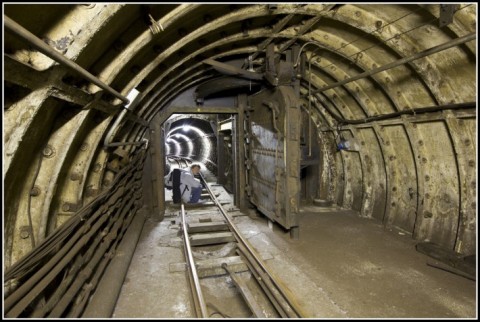
Exploring an abandoned underground mail railway line

Filed under: Britain, History, Railways — Tags: , — Nicholas @ 07:49

The Royal Mail system had a dedicated subway line of their own. It was eventually abandoned, but not destroyed, as some trespassers were able to discover:

Construction of the tunnels began on February 1915, from a series of shaft located along the route. The tunnels were primarily dug in clay using the Greathead shield system, although the connecting tunnels in and around the stations were mined by hand. Construction was suspended due to the outbreak of WW1, but was allowed to continue until completion for safety reasons. Further setbacks halted the construction of the stations during 1917 due to the shortage of labour and materials.

It wasn’t until June 1924, that workers began laying the track using 1000 tons of running rail and 160 tons of conductor rail. The remaining electrical installation took place in 1925 with the section between Paddington and the West Central District Office being ready for training. The line was eventually finished in 1927 with the first letter through the system running on February 1928.

In 1954, due to problems with access at the Western District Office and the Western Central District Office plans were drawn up to construct a new Western District Office at Rathbone Place. This meant the construction of a diversion to the line to the station which was completed in 1958, although the station was not opened until the 3rd August, 1965.

H/T to Cory Doctorow for the link.

April 20, 2011

Michael Ignatieff as a modern Kaiser Wilhelm II?

Filed under: Cancon, Germany, History, Politics, WW1 — Tags: , — Nicholas @ 13:00

This is a fascinating article. I’m not sure I agree, although we’ll find out in less than two weeks if this is the “Black Day of the German Army Liberal Party”:

The Liberal party, like the Kaiser’s Germany, is stuck in the middle. (An analogy I do not expect any Liberal to use in public, ever.) To the right is the Conservative party. To the left, the NDP. Every election campaign is a two-front war.

To deal with this mortal peril, the Liberals have traditionally followed their own Schlieffen Plan.

In the event of electoral war, the Liberals move swiftly to the left. Taking ground from the NDP ensures vote splits go their way but also creates the perception that the NDP is out of the fight. Voters whose primary concern is stopping the barbarians in the East — the Conservatives, naturally — are thus forced to support the Liberals.

Now, here comes the part of the column Michael Ignatieff won’t like.

More on the use of “kettling” by the police

Filed under: Britain, Law, Liberty, Media — Tags: , , , , — Nicholas @ 12:35

Patrick Hayes considers the “kettling” technique beloved of modern metropolitan police forces in the face of protest:

This is not in any way to defend kettling, which restricts basic freedoms of movement and protest. Being kettled is a deeply frustrating experience. You are penned into a small area with thousands of other protesters for hours on end, with no access to toilets or provisions and little to no knowledge of when the police will let you go. This repressive police technique should be abolished.

However, the emergence of kettling does not reflect a new era of police ‘barbarism’ or ‘gross police brutality’, as some have claimed. Rather, the logic behind kettling seems to be an attempt by the authorities to adapt to a new kind of aimless protesting.

[. . .]

The rise of kettling speaks to changes within the authorities too. This tactic reveals a new desire amongst the police to avoid engaging with protesters directly, to avoid beating and controlling them as they might have tried to do in the past. Instead, the police have developed mostly risk-averse, hands-off tactics for demos, of which kettling is a prime example.

Kettling is really a damage-limitation exercise. The hope is that in pinning protesters into one small area they will eventually become sedate or fall asleep after they have let off enough steam. In a bizarre turn of events, the police now even hand out glossy brochures explaining to protesters what kettling is all about and why the police do it. Kettling is analogous to parents sending children to the ‘naughty step’ to get them to calm down.

Indeed, in the absence of any clear collective ideas, protesters have in many ways become reliant on kettling as a focal point for their radicalism. Protests have turned into games of cat-and-mouse, as youths try to avoid being penned in by the police, using Twitter to organise flash mobs and effectively playing peek-a-boo with the police. The protesters achieve a semblance of collectivity through the experience of being trapped together in a kettle.

Modern bigotry

Filed under: Britain, Media, Politics — Tags: , , — Nicholas @ 12:27

Brendan O’Neill says that the worst form of bigotry today is the liberal elites’ view of the working classes:

We often hear of self-loathing Jews, but what about self-loathing proles — working-class people who look back with contempt at the communities they had the misfortune to grow up in? There’s a very good example of it in today’s Guardian, in this column by Lynsey Hanley, a woman who has made a writing career on the back of the fact that she grew up on a council estate. (It is testament to the middle classes’ continuing colonisation of the media that Ms Hanley can be treated as a curious novelty by Granta and the Guardian, almost as a messenger from some distant, dark planet, simply because she once lived in social housing.) Ms Hanley writes of the “terrible ignorance” of the community she used to live in, prior to her moral and mental rescue by “metropolitan elite liberal values”.

Perhaps keen to assure her current employers that she is now one of them and has been scrubbed clean of any trace of working-class brutishness, Ms Hanley sneers at the “view of life” that held strong in the community she was born into. These people were “paranoid, suspicious, mistrustful, misogynist and racist”, she says. She heaps disdain on the “social conservatism” of white working-class communities, which are given to “silently or violently rejecting anyone who is different or who expresses a different opinion to that of the crowd”. Thankfully for her (and let’s face it, probably for the community she was born into), Ms Hanley escaped from this “crowd” (in pre-PC times they called it “the mob”) by embracing what she refers to as metropolitan, liberal values. She pleads with New Labour not to ditch these values, since there might be other “provincial working-class teenagers” who, like Ms Hanley, also want to be rescued.

[. . .]

What’s more, Ms Hanley’s dutiful provision of moral porn for the chattering classes, who so enjoy reading about the weird goings-on in mysterious council estates over breakfast, speaks to the prejudices that are rife amongst the community she has now embraced: the “metropolitan liberal elite”. The great irony of this elite’s war on the wantonness, gluttony, slothfulness and bigotry of the little people is that it is fuelled by a bigotry of its own, a respectable, PC form of bigotry — one which treats the white working classes as unenlightened Daily Mail drones in need of moral deliverance by sussed outsiders. It is not the working classes who “silently or violently reject anyone who is different”; rather it’s this increasingly intolerant metropolitan elite, which can’t even abide the fact that some communities eat and drink differently, never mind think differently, to itself. In presenting Britain as being neatly split between a morally superior race of liberals and mongrel race of paranoid racists, Ms Hanley and others are unwittingly rehabilitating the very prejudices that originally fuelled the politics of racism in the 19th century: a mean-spirited, Malthusian view of Britain’s own native lower classes as morally defunct.

“British private schools are really good. But they’re the only institutions left in Britain that are really world class”

Filed under: Britain, Bureaucracy, Education, History — Tags: , — Nicholas @ 07:39

Niall Ferguson tries to find some nice things to say about Britain, as he packs up to head back to Harvard:

The first thing everyone always says about Niall Ferguson is that he’s far too glamorous to be an academic. So the surprise, when we meet, is his miserable little office — a bleak sliver of the London School of Economics, surely nowhere near sumptuous enough for the dashing professor. Lined with rows of empty bookshelves, it looks semi-vacated — but that’s because it sort of is. “I’ll be out of here in July,” Ferguson says quickly, with the air of a man for whom July cannot come soon enough. “This has been great fun, but . . . well, you know . . .”

The historian has been living back in the UK for almost a year, the first time since leaving for the US in 2002, where he now teaches at Harvard. From the outside, it’s looked like quite a successful stay; his Channel 4 series, Civilization, was broadly well-received, and the accompanying book is another dollop of vintage Ferguson history, devoted to the superiority of western civilisation. While here he’s also been advising Michael Gove on the history curriculum in secondary schools, and now that the Tories, of whom he approves, are back in charge of the country, he must have found the political climate more to his tastes. But when I ask him for the single biggest change he’s observed since leaving Britain, he replies with a kind of theatrical despair,

“I think the situation in British universities has gone from being parlous to being catastrophic. When you look at where British universities are going, and where Harvard’s going, you’d have to really love other things about England to take the hit.”

Logic, consistency not strong points for this would-be terror gang

Filed under: Britain, Middle East, Religion — Tags: , , , — Nicholas @ 07:30

A group of would-be terrorists were discovered before they could put their plans into action partly because of their disdain for “infidel” technology:

Recently, a British Moslem (Rajib Karim) was sentenced to 30 years for attempting to use his job at British Airways to help plan, coordinate and carry out terrorist attacks. One reason Karim was caught was the refusal of his terrorist cohorts in Yemen and Bangladesh to use modern cryptography for their communications. The reason was that the modern stuff was all invented by infidels (non-Moslems). Instead the group was forced to use ancient (over 2,000 year old) single letter substitution codes. The group’s implementation of this was accomplished using a spreadsheet. Unlike modern ciphers, like PGP and AES, the ancient substitution methods are easy to crack with modern decryption techniques.

A major shortcoming of Islamic radicalism is its disdain for modern, particularly non-Moslem (Western) technology. This often causes problems, like the one Karim (a computer specialist with British Airways) had with his less educated fellow terrorists in Yemen and Bangladesh. But what Karim encountered was another major problem for Islamic radicals, the fact that these groups tend to attract a disproportionate number of poorly educated recruits. The Islamic world, in general, is less educated and literate than the West, thus giving Islamic radical groups a poorly educated pool of potential recruits to begin with.

The disdain is highly selective, unless spreadsheets were also part of the Arabic cultural heritage.

April 18, 2011

True Finn party surges to 39 seats in Finnish election

Filed under: Europe, Politics — Tags: , , , , — Nicholas @ 15:53

From nowhere to third-largest party:

The True Finns finished just behind the conservative NCP and the Social Democrats on around 19%.

While the Social Democrats have called for changes on EU bail-outs, including the planned Portuguese rescue, True Finns opposes the plans altogether.

A hostile Finnish government could theoretically veto the package.

Unlike other eurozone countries, Finland’s parliament can vote on whether to approve the measures.

Correspondents say the increased sway of Euro-sceptics in Finland’s parliament could hold up any further bail-out deals.

As the biggest party, the NCP is tipped to lead the next government with former Finance Minister Jyrki Katainen likely to become prime minister of whatever coalition emerges, replacing Mari Kiviniemi of the Centre Party.

Gavin Hewitt called it a “tremor” with an “epicentre” in Finland:

A few years ago the True Finns were a fringe party, that received almost no attention. So what happened? The vote was not just about the bailout. There was anxiety about unemployment and fears of a jobless economic recovery. Reductions in pensions had angered many workers. The party also tapped into fears about immigration.

What makes this election so significant is that it follows a pattern across Europe. Establishment and incumbent parties are being rejected. Nationalist parties are gaining influence.

In the Netherlands, the anti-Islam MP Geert Wilders leads the country’s third largest party. In Italy the Northern League — hostile to immigration and wary of the EU — is increasingly powerful. In France, Marine Le Pen — who wants to abandon the euro — is showing strong support in the polls.

Recently, writing in the Financial Times, Peter Spiegel questioned whether we were seeing the emergence of a European Tea Party. Certainly there is a strong sense of alienation and dissatisfaction. Immigration is a key factor. It is shaking governments. There are more than 24 million people without work in the EU and there is no appetite to welcome new arrivals. That is why the migrants from Tunisia are sparking such tension between Italy and France.

As important as immigration is unemployment. In countries like Italy and Spain there is talk of a “lost generation” that cannot find work. There is a growing awareness that Europe may be a low-growth area.

H/T to Elizabeth, who reminded me that I had an obligation to report the final results after having posted links to the election race twice before.

« Newer PostsOlder Posts »

Powered by WordPress


