Quotulatiousness

May 27, 2011

Swedish subway stations or hallucinatory flashbacks to a 1975 shopping mall?

Filed under: Europe, Media, Railways, Randomness — Tags: , , — Nicholas @ 13:10

Andrew Coyne linked to this set of photos of Swedish subway stations saying “Good LØRD. Who was their designer, Willy Wonka?”


I shared the link with Jon, my former virtual landlord, who responded:

Tonight’s nightmares are going to leave a mark.

I can only imagine what the flashbacks must be like for you, though. I suspect that these stations look remarkably like Sherway Gardens did to you and your friend after you guys went drinkin’ at the Steak’n’Burger.

If there is a 1970’s-era Sherway Gardens in Hell, this is what it looks like.

I had a similar reaction to the photos . . . strikingly ugly where they’re not just flat-out disturbing. But what else could we expect from publicly funded artists selected by public transit officials?

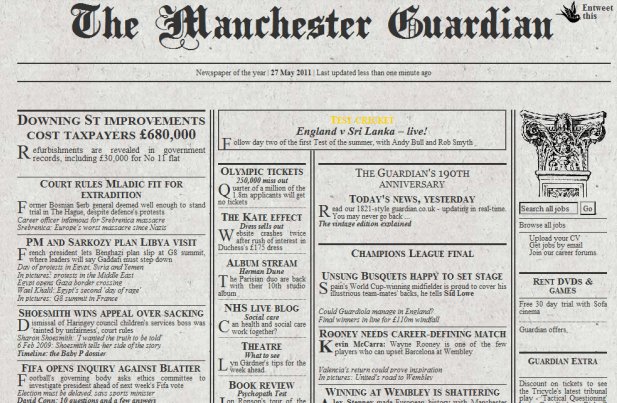
Happy 190th anniversary to the good old Grauniad

Filed under: Britain, History, Media — Tags: , — Nicholas @ 12:08

It’s the 190th anniversary, so the folks at The Guardian have virtually turned the calendar back:

More information about the “experiment in the typesetting of the mechanical facsimile we operate at guardian.co.uk” here.

May 26, 2011

The Danish Marmite affair thickens

Filed under: Britain, Bureaucracy, Europe, Food, Health — Tags: , , , — Nicholas @ 09:50

Lester Haines has the latest on the plight of ex-pat Brits suffering under a dictatorial food regime in Denmark:

According to this official statement, neither Marmite nor its Oz rival Vegemite are banned in Denmark, because they’ve never actually been approved for sale.

A 2004 law controls the distribution of products with “added vitamins, minerals or other substances”, and in order to punt such foodstuffs, they “need to be approved by the Danish Veterinary and Food Administration before the product can be marketed”.

[. . .]

In effect, then, those shops selling Marmite are dealing in unauthorised enhanced substances.

We and the Daily Mail have no doubt that any attempt to legalise Marmite would be met with a swift rejection, in defiance of EU directives on free trade. As Copenhagen-based expat Lyndsay Jensen put it: “They don’t like it because it’s foreign. But if they want to take my Marmite off me, they’ll have to wrench it from my cold dead hands.”

It’s been said that Marmite is an “acquired taste”, but Denmark’s health regulators are moving quickly to ensure that Danes never have the opportunity to develop that taste. Of course, like most other forms of prohibition, it might actually increase the attractiveness of the “forbidden fruit”.

Denmark has a long coastline, so smuggling in the little black jars across the North Sea would be quite possible . . .

May 25, 2011

Denmark moves to save its citizens from Marmite

Filed under: Bureaucracy, Europe, Food, Health — Tags: , , — Nicholas @ 07:22

Danish diners will no longer be subject to the horrors of Marmite, thanks to swift and decisive action by the country’s Veterinary and Food Administration:

According to the advert, you either love it or hate it. As far as Marmite goes, the Danish government hates the stuff. That at least is the conclusion that many foreigners have drawn following a ban on the sticky brown yeast extract.

The sales ban enforces a law restricting products fortified with added vitamins. Food giant Kellogg’s withdrew some brands of breakfast cereal from Denmark when the legislation passed in 2004, but until now Marmite had escaped the attention of Danish authorities.

“What am I supposed to put on my toast now?” asked British advertising executive Colin Smith, who has lived in the country for six years. “I still have a bit left in the cupboard, but it’s not going to last long.”

I celebrated the decision by having some Marmite on crackers for lunch yesterday. More for me!

Update: “Let the rise of the Marmite Army begin!”:

“Spread the word, but most importantly spread the Marmite,” wrote Kelly. “On every street in good old Denmark, show ’em what they’re missing after they’ve banned this iconic product from our supermarket shelves! Make it a Marmite day everyday folks! Let the rise of the Marmite army begin!”

But even on the page, opinion remained divided. A perplexed Ray Weaver wrote: “but… it’s horrible…”

On the page calling for a boycott of Danish goods, fan Joe Figg feared the ban could have far-reaching consequences. “This dastardly move could bring about global warming of toast,” he wrote. While Mark Salisbury wrote: “Down with spread fascism!”

How to cope with rapidly changing technology, Victorian style

Filed under: Britain, History, Military, Technology, Weapons — Tags: , , , — Nicholas @ 00:04

I just finished reading John Beeler’s Birth of the Battleship: British Capital Ship Design 1870-1881, which looks at a time where all the accepted norms of the previous three hundred years were all upset overnight.

In 1815, the Royal Navy was the unchallenged Mistress of the Seas: the most powerful navy in the world. France, the greatest threat to England and her trading empire, had just been destroyed as a military and naval power. The United States had survived the war, but had effectively been neutralized on the sea through much hard fighting. No other rival appeared close to challenging England’s primacy.

Fifty years later, the stasis is being broken technologically. Wind power is giving way to steam. Solid shell cannon are starting to give way to both larger and more complex weapons. Iron is starting to supplant oak as the material of choice for shipbuilding. The renowned duel between USS Monitor and CSS Virginia (formerly the USS Merrimac) sets all the major navies of the world busy considering how to protect their existing fleets and merchant vessels against the new threat of the ironclad.

The English government is suddenly faced with the stark reality that their entire fleet has become or is about to become obsolete. Neither Monitor nor Virginia are ocean-going ships, but the message is clear that no wooden vessel has a prayer of survival against the modern steam-powered ironclad. And even the greatest economic power in the world can’t replace an entire fleet overnight.

The Admiralty couldn’t depend on past experience for guidance, as everything they’d done for hundreds of years was now undecided: what kind of ships do you need to build? How will they be armed? How will they be armoured? How will they be propelled? Bureaucracies are, by nature, not well equipped to face challenges like this. The Royal Navy, from the late 1860’s until the late 1880’s struggled with finding the correct answer, or combination of answers, to meet the needs of the day.

I admit that my interest in British Imperial history fades very quickly after 1815 and only starts to pick up again in the 1870’s, and what little I’d retained of the reading I’d done left me with much disdain for the obvious pattern of muddle and stop-gap planning that clearly defined the Royal Navy’s approach to maintaining the fleet during that time period. I was very wrong in my assumptions, but I was far from alone.

To start with, I assumed that the retention of full sailing rig on steam-powered ships proved the raw incompetence of the Admiralty and their ship designers. What I failed to understand was that there were really two different navies operating under the same flag: the home fleet — close to home port with easy access to coal, drydock, and re-supply — and the colonial fleet which had none of those advantages. Merchant vessels of the 1850-1870 era could depend on refuelling at each end of their scheduled journeys (between fully equipped ports), while the Royal Navy could not. The steam engines of that time period were very inefficient and prone to breakdown: lose your engine in the Indian Ocean or the South Atlantic and you were almost certain to be lost. Sail was essential for Royal Navy ships outside home waters.

Iron as armour was a major step forward, but not without costs: it is far heavier than wood and because you needed it to protect the above-the-waterline essentials of the ship, it made it much harder to ensure that the ship would be stable and sufficiently buoyant in heavy seas (see the story of HMS Captain for an example of what could happen otherwise). It’s always been a rule of thumb in military affairs that you can’t protect everything: by trying to protect everything, you spread your forces (or your armour) too thin and you end up being too weak everywhere. This holds true especially for ship’s armour.

At the same time that you need to add armour to protect the ship, you also need to mount heavier, larger guns. Between placing your order with the shipyard for a new ship, the metallurgical wizards may have (and frequently did) come up with bigger, better guns that could defeat the armour on your not-yet-launched ship. Oh, and you now needed to revise the design of the ship to carry the newer, heavier guns, too.

The ship designers were in a race with the gun designers to see who could defeat the latest design by the other group. It’s no wonder that ships could become obsolete between ordering and coming into service: sometimes, they could become obsolete before launch.

The weapons themselves were undergoing change at a relatively unprecedented rate. As late at the mid-1870’s, a good case could be made for muzzle-loading cannon being mounted on warships: until the gas seal of the breech-loader could be made safe, muzzle-loaders had an advantage of not killing their own crews at distressingly high frequency. Once that technological handicap had been overcome, then the argument came down to the best way to mount the weapons: turrets or barbettes.

To the modern eye, the answer is obvious, but to the men responsible for making the decisions, it was far from obvious that the turret was the better answer. Turrets are heavier than barbettes and required clearer fields of fire (few masted-and-rigged ships could also carry turrets), and also generally required the turret to be mounted higher on the superstructure, which made the ship more top-heavy than an equivalent barbette vessel.

The other weapon controversy at the time was what the primary weapons of the battlefleet would be: gun, torpedo, or ram. The argument for the ram was the weakest, although CSS Virginia had done more damage to the Union fleet with her ram than with her guns. The torpedo was still in the transition stage from something that had to be physically pushed against an enemy ship (like a ram with an explosive charge) and the more modern notion of a self-propelled, unmanned weapon. Perhaps the argument was sealed by the accidental sinking of the HMS Victoria less than a decade later (a less-than-charitable interpretation of the event was fictionalized in Kind Hearts and Coronets in 1949).

In some ways it’s remarkable that the hidebound bureaucrats could keep up in the world’s first real arms race . . . and not only keep up, but stay (slightly) ahead. Each new class of battleship had to be equal to or better than the latest French, German, or Italian ships, yet also stay within fairly strict length, breadth, and displacement limits without going (too far) over budget. Oh, and also be capable of adaptation to whatever new naval gun had been introduced in the time between the ships being laid down and being brought into commission.

To the modern eye, even of someone who followed the general trend of naval technology, the Royal Navy of the early 1880’s looks like a random collection of misfit ships. What isn’t apparent is how much worse the picture could have been. Aside from the bombardment of Alexandria, the Royal Navy of Victoria’s reign exercised a policing rather than a strictly military role: they didn’t need to fight too often because they were clearly stronger than any potential adversaries.


May 24, 2011

Britain’s entry in the new race to space

Filed under: Britain, Space, Technology — Tags: , , — Nicholas @ 09:12

Jonathan Amos reports on the UK Space Agency (UKSA) long-simmered design/proposal called Skylon:

Skylon has been in development in the UK in various guises for nearly 30 years.

It is an evolution of an idea first pursued by British Aerospace and Rolls Royce in the 1980s.

That concept, known as Hotol, did have technical weaknesses that eventually led the aerospace companies to end their involvement.

But the engineers behind the project continued to refine their thinking and they are now working independently on a much-updated vehicle in a company called Reaction Engines Limited (REL).

Realising the Sabre propulsion system is essential to the success of the project.

The engine would burn hydrogen and oxygen to provide thrust — but in the lower atmosphere this oxygen would be taken directly from the air.

This means the 84m-long spaceplane can fly lighter from the outset with a higher thrust-to-weight ratio, enabling it to make a single leap to orbit, rather than using and dumping propellant stages on the ascent — as is the case with current expendable rockets.

Update: Lewis Page has more on the Skylon project.

May 22, 2011

QotD: The rise of the “new aristocracy”

Filed under: Europe, France, Politics, Quotations, USA — Tags: , , — Nicholas @ 13:39

A man is innocent until proven guilty, and it will be for a New York court to determine what happened in M Strauss-Kahn’s suite at the Sofitel. It may well be that’s he the hapless victim of a black Muslim widowed penniless refugee maid — although, if that’s the defense my lawyer were proposing to put before a Manhattan jury, I’d be inclined to suggest he’s the one who needs to plead insanity. Whatever the head of the IMF did or didn’t do, the reaction of the French elites is most instructive. “We and the Americans do not belong to the same civilization,” sniffed Jean Daniel, editor of Le Nouvel Observateur, insisting that the police should have known that Strauss-Kahn was “not like other men” and wondering why “this chambermaid was regarded as worthy and beyond any suspicion.” Bernard-Henri Lévy, the open-shirted, hairy-chested Gallic intellectual who talked Sarkozy into talking Obama into launching the Libyan war, is furious at the lèse-majesté of this impertinent serving girl and the jackanapes of America’s “absurd” justice system, not to mention this ghastly “American judge who, by delivering him to the crowd of photo hounds, pretended to take him for a subject of justice like any other.”

Well, OK. Why shouldn’t DSK (as he’s known in France) be treated as “a subject of justice like any other”? Because, says BHL (as he’s known in France), of everything that Strauss-Kahn has done at the IMF to help the world “avoid the worst.” In particular, he has made the IMF “more favorable to proletarian nations and, among the latter, to the most fragile and vulnerable.” What is one fragile and vulnerable West African maid when weighed in the scales of history against entire fragile and vulnerable proletarian nations? Yes, he Kahn!

Before you scoff at Euro-lefties willing to argue for 21st century droit de seigneur, recall the grisly eulogies for the late Edward Kennedy. “At the end of the day,” said Sen. Evan Bayh, “he cared most about the things that matter to ordinary people.” The standard line of his obituarists was that this was Ted’s penance for Chappaquiddick and Mary Jo Kopechne — or, as the Aussie columnist Tim Blair put it, “She died so that the Food Allergen Labeling and Consumer Protection Act might live.” Great men who are prone to Big Government invariably have Big Appetites, and you comely serving wenches who catch the benign sovereign’s eye or anything else he’s shooting your way should keep in mind the Big Picture. Yes, Ted Ken!

Nor are such dispensations confined to Great Men’s trousers. Timothy Geithner failed to pay the taxes he owed the United States Treasury but that’s no reason not to make him head of the United States Treasury. His official explanation for this lapse was that, unlike losers like you, he was unable to follow the simple yes/no prompts of Turbo Tax: In that sense, unlike the Frenchman and the maid, Geithner’s defense is that she wasn’t asking for it — or, if she was, he couldn’t understand the question. Nevertheless, just as only Dominique could save the European economy, so only Timmy could save the U.S. economy. Yes, they Kahn!

Mark Steyn, “The unzippered princelingand the serving wench”, Orange County Register, 2011-05-20

May 20, 2011

Britain’s Type 45 destroyers finally get main armament

Filed under: Britain, Military, Weapons — Tags: , — Nicholas @ 14:29

Back in October, I linked to an article which told the sad story of the Royal Navy’s most expensive class of unarmed warships, the Type 45 destroyers. In November, I linked to another sad story about the £1.1bn+ lead ship of this class breaking down in mid-Atlantic and having to make an emergency stop in Halifax for repairs.

In the first bit of good news about the Type 45’s, they’re now finally getting their primary missile systems into service:

HMS Daring, first of the £1.1bn+ Type 45 destroyers now coming into service with the Royal Navy, has finally fired her primary (and only significant) armament, the Sea Viper missile system.

The glad news comes five years after the ship was launched, three years after she was accepted into the Royal Navy and well into the tenure of her third commanding officer.

It’s not all good news, however, as the Sea Viper may not be the wonder weapon it’s been implied to be:

Stripping away the hype, Sea Viper has never been tested against a supersonic target and there are no plans to do so — meaning that it would be a brave decision indeed to rely on it against supersonic threats in combat. (The system’s first four trials even against subsonics saw two failures.)

Sea Viper’s French-made Aster missiles can probably reach out to 75 miles, but the inescapable curvature of the Earth means that the Sampson masthead fire control radar can’t lock on to a low-flying target until it is within 20 miles or so. Various modern and indeed not-so-modern anti-shipping missiles (eg the “Klub”, “Sunburn” and “Brahmos”) are both low-flying and supersonic.

Then there are some serious gaps in the Sea Viper’s (and thus the Type 45s’) capabilities. The system cannot attack surface targets, meaning that the Royal Navy’s new and cripplingly expensive destroyers will be almost powerless against properly-equipped warships or even quite minor gunboats and the like.

Salesmen get rewarded for whoring their wares

Filed under: Europe, Germany, Randomness — Tags: , , — Nicholas @ 09:09

At least, according to this story, the best salesmen at Munich Re were rewarded with whores:

However, this being a German-run orgy, it was not an unseemly free-for-all, but an efficient affair in which the prostitutes “had worn colour-coded arm-bands designating their availability, and the women had their arms stamped after each service rendered”.

Handelsblatt‘s informant told the paper: “After each such encounter the women were stamped on the lower arm in order to keep track of how often each woman was frequented.”

He elaborated: “The women wore red and yellow wrist bands. One lot were hostesses, the others would fulfill your every wish. There were also women with white wrist bands. They were reserved for board members and the very best sales reps.”

This was back in 2007, according to Handelsblatt, a German business publication. I’ve worked at companies where the sales force seemed to be extravagantly over-rewarded with various goodies, but this seems to be a few steps further.

May 19, 2011

Nathalie Rothschild: Britain’s debate on rape “is demeaning to women”

Filed under: Britain, Law, Liberty — Tags: , , , , — Nicholas @ 09:10

There is much sound and fury in Britain this week over some remarks by a Tory cabinet minister in a BBC interview. The leader of the opposition has demanded that he be dismissed from the government for suggesting that there are ‘other categories of rape’. Nathalie Rothschild wrote this article in response to a 2010 review of the rape law.

In 2007, Camilla Cavendish of The Times (London) found that rape allegations had jumped by 40 per cent between 2002 and 2005. While this can partly be put down to improved support for women, which facilitates the process of reporting rape, Cavendish argued that a widening official definition of rape also played a big role. Since the Sexual Offences Act 2003 came into force, the definition of rape has been expanded to include oral sex. But there has also been a profound attitude shift with roots in the second-wave feminist idea that heterosexual sex is an inherently violent and degrading act that women subject themselves to against their better judgement.

More than four out of five rape allegations are made against friends or acquaintances. As alcohol and/or drugs were involved in over half those cases, Cavendish puts this down to ‘the culture of binge drinking’. But this avoids the more complex picture. Today, various rape-awareness activists and state feminists are themselves helping to blur the boundaries between sex and rape, encouraging women to regard themselves as violated, abused and traumatised for having gone to bed with a man without thinking it through in minute detail.

The Sexual Offences Act 2003 declared that consent must be ‘active, not passive’; in rape cases, consent is now taken to mean agreement rather than the absence of a refusal. So if a woman goes along with sex, but doesn’t make it explicitly clear that she is actively consenting to it, it can be deemed to be rape. The government has even moved towards ensuring that no agreement can be taken as consent if it is given under the influence of alcohol. As Cavendish pointed out: ‘In our zeal to protect women, are we going to legislate so that a drunken man is accountable for his deeds, but a drunken woman is not? Why do we encourage women to see themselves as victims?’ Absolving women who engage in sexual liaisons — whether drunk or sober — of responsibility for their actions is not liberating; it’s demeaning.

There is no doubt that forcing someone to have sex is a heinous, violent and degrading act and victims of rape should indeed be treated with dignity and respect. But in the name of protecting women, the government is insisting that rape cases be treated differently from all other crimes, while interfering with the course of justice in a way that undermines defendants’ rights and undercuts the power of juries.

May 17, 2011

Matt Welch: BHL is a “national embarrassment to France”

Filed under: France, Law, Media — Tags: , , — Nicholas @ 10:42

Actually, I understate in the headline what Matt actually wrote:

And since we don’t want to reprint the whole quavering bag of apologia (“Charming, seductive, yes, certainly; a friend to women and, first of all, to his own woman, naturally,” etc.), let’s close with perhaps my favorite line:

     What I do know is that nothing in the world can justify a man being thus thrown to the dogs.

I’m guessing what BHL really means here is that no worldly rape can justify Strauss-Kahn’s treatment. Since if the accusations are true, a 62-year-old man known by every French person I’ve asked to have the sexual manners of a primate lunged nakedly at hired help half his age, grabbed her breast, knocked her to the floor, and chased her around his expensive hotel suite attempting with some success to thrust his penis into her body and discharge DNA evidence.

I don’t know if he’s guilty, and it would be imprudent not to consider the conspiracy theories in a case involving someone who until this week was the single biggest political threat to the sitting president of France, but the only decent way you can arrive at “nothing in the world can justify” Strauss-Kahn’s treatment is if you oppose all perp walks equally. Short of that, it’s just special pleading for a powerful dick. And another reminder that BHL is 10 times the national embarrassment to France than Jerry Lewis or even Johnny Hallyday ever was.

May 16, 2011

Christian holidays? Down the EU memory hole!

Filed under: Bureaucracy, Europe, Religion — Tags: , , , , — Nicholas @ 12:34

It could hardly be an oversight that the EU “forgot” to include any traditional Christian holidays in their run of 3 million school diaries produced for students:

A year ago the European Commission (EC) printed more than three million school diaries for distribution to students. They are lovely diaries which, true to the EU’s multicultural ethos, helpfully note all the Sikh, Hindu, Muslim and Chinese festivals. The diary also highlights Europe Day, which falls on 9 May. But the diary is not without some very big gaps. For example, it makes no reference to Christmas — or Easter or indeed to any Christian holidays.

However, the importance of 25 December is not entirely ignored. At the bottom of the page for that day, schoolchildren are enlightened with the platitude: ‘A true friend is someone who shares your concern and doubles your joy.’

Not surprisingly, many Europeans are not exactly delighted by the conspicuous absence of Christian festivals from a diary produced for children. In January, an Irish priest complained to the ombudsman of the EC and demanded an apology for the omission of Christian holidays and the recall of the diaries. A month later, the commission apologised for its ‘regrettable’ blunder. However, the ombudsman dismissed the demand to recall the diaries, arguing that a one-page correction sent to schools had rectified the error.

I suspect, had the complaint been from a religious leader in a non-Christian faith, they’d not have let a month elapse before springing to address the error in that faith’s holy days . . .

Ear worms

Filed under: Britain, Media — Tags: , — Nicholas @ 00:08

For the last few weeks, I’ve had a musical track bothering me: I knew it very well, but didn’t know what it was called or where I’d encountered it. An unexpected earworm from the past. Thanks to the wonders of YouTube, I finally managed to track it down — it’s the theme music to a British TV show that I don’t remember watching (yet I know the theme music very well):

It’s a very distinctive late-60s to early 70s sound. I have no idea why I know it so well: perhaps my dad used to watch the show and I just heard the music in the background. Actually, that’s the only thing I could come up with to explain why I’d know the theme music, yet not remember ever having watched the TV show.

I thought I’d exorcise the earworm demon and buy a copy from iTunes. But no, they’ve got several covers of the music by various artists (including an interesting version by the Band of the 1st Battalion, the Duke of Wellington’s Regiment — currently classified as “Rock” by iTunes), but not the original. HMVDirect has a similar selection (covers, but no original performance). “Curses, foiled again!”

I found out more about the TV show from Wikipedia, the Unofficial Sweeney website, and a true labour of love, a page devoted to sleuthing up all the many musical tracks used in the original series named for the only album of music released: the Shut it! The Music of “The Sweeney” site.

This page is an ongoing development to identify the 300 different pieces of music used in the 1970s British television series The Sweeney. As is common practice with many television shows, other than the specially-comissioned title theme, Harry South’s unforgettable, rousing actioner, “ready-made” music was mostly used to provide incidental themes to the action. These came from specialist “Production Music” houses, the most well-known being De Wolfe, KPM (Keith Prowse Music), Chappell and Bruton. The years 1971 to 1978 arguably represented the genre’s most creative era (before competition and corporatism took over and strangled much artistic creativity), serendipitously co-inciding with production of The Sweeney itself.

In 2001 Sanctuary Records issued a Sweeney CD compilation with 25 tracks used in the show. As good as it was, it really only scratched the surface and sadly no further volumes have been forthcoming.

But unless I happen across a physical copy of the CD, I’m stuck with my persistent earworm. Here’s the closing credits, in hopes it’ll help banish it from my mind temporarily:

May 15, 2011

Redefining the word “anarchist” to mean “statist”

Filed under: Economics, Europe, Greece, Media, Politics — Tags: , , — Nicholas @ 11:41

A post at the Cato @ Liberty blog, qualifies as a proper Fisking:

The Washington Post splashes a story about “anarchists” in Greece across the front page today. The print headline is “Into the arms of anarchy,” and a photo-essay online is titled “In Greece, austerity kindles the flames of anarchy.” And what do these anarchists demand? Well, reporter Anthony Faiola doesn’t find out much about what they’re for, but they seem to be against, you know, what the establishment is doing, man:

     The protests are an emblem of social discontent spreading across Europe in response to a new age of austerity. At a time when the United States is just beginning to consider deep spending cuts, countries such as Greece are coping with a fallout that has extended well beyond ordinary civil disobedience.

     Perhaps most alarming, analysts here say, has been the resurgence of an anarchist movement, one with a long history in Europe. While militants have been disrupting life in Greece for years, authorities say that anger against the government has now given rise to dozens of new “amateur anarchist” groups.

Faiola does acknowledge that the term is used pretty loosely:

     The anarchist movement in Europe has a long, storied past, embracing an anti-establishment universe influenced by a broad range of thinkers from French politician and philosopher Pierre-Joseph Proudhon to Karl Marx to Oscar Wilde.

So that’s, let’s see, a self-styled anarchist who was anti-state and anti-private property, the father of totalitarianism, and a witty playwright jailed for his homosexuality.

However you try to twist the word “anarchist” to include the Greek protestors, it still won’t fit:

Real anarchists, of either the anarcho-capitalist or mutualist variety, might have something useful to say to Greeks in their current predicament. But disgruntled young people, lashing out at the end of an unsustainable welfare state, are not anarchists in any serious sense. They’re just angry children not ready to deal with reality. But reality has a way of happening whether you’re ready to deal with it or not.

May 11, 2011

Belgian newspapers win appeal against Google

Filed under: Europe, Law, Liberty, Media — Tags: , , , , — Nicholas @ 07:45

Apparently, even a short summary and a hyperlink are considered to be a violation of copyright in Belgium:

A Belgian appeals court has upheld an earlier ruling that Google infringes on newspapers’ copyright when its services display and link to content from newspaper websites, according to press reports.

The search engine giant is responsible for infringing the copyrights of the papers when it links to the sites or copies sections of stories on its Google News service, the Belgian Court of Appeals said, according to a report in PC World.

Google must not link to material from Belgian newspapers, the court said, according to the report (in French). No translation of the ruling is yet available.

[. . .]

The newspapers argued that they were losing online subscriptions and advertising revenue because Google was posting free snippets of the stories and links to the full article on Google News.

Google’s search engine offers links to the websites it indexes but also to “cached” copies of those pages. The copies are stored on Google’s own servers.

« Newer PostsOlder Posts »

Powered by WordPress