
Published on 12 Mar 2015
The British Expeditionary Forces are starting their first major offensive since the beginning of trench warfare. Near Neuve-Chapelle they attack the Germans and try to “bite and hold” their position. This battle will be the blueprints for future British offensives. On the Balkan, Serbia is facing a different enemy: Typhus. The catastrophic sanitary conditions enable the disease to spread across the whole country.
March 13, 2015
The Battle of Neuve-Chapelle I THE GREAT WAR Week 33
Comments Off on The Battle of Neuve-Chapelle I THE GREAT WAR Week 33
March 8, 2015
Playing With Fire – The First Flame Thrower I THE GREAT WAR Week 32
Published on 5 Mar 2015
Modern war already took place in the sky and under water but the waring nations also wanted to gain an advantage in the trenches. So this week, we see the first use of another merciless invention on the battlefield: the flame thrower. The battles on the Western Front, in the Carpathian’s and near the Dardanelles continued nonetheless.
Comments Off on Playing With Fire – The First Flame Thrower I THE GREAT WAR Week 32
February 27, 2015
Prelude to Gallipoli – Naval Bombardement of the Dardanelles I THE GREAT WAR Week 31
Published on 26 Feb 2015
To break up the stalemate and get a decisive advantage, France and Great Britain open up yet another theatre of war in the Dardanelles. The plan is to seize the strait and open eventually open up the Bosporus in order to ship supplies to the Eastern and Balkan front. And so begins the naval bombardment of ottoman forts as prelude to a big offensive which will we know to today as Gallipoli.
Comments Off on Prelude to Gallipoli – Naval Bombardement of the Dardanelles I THE GREAT WAR Week 31
February 23, 2015
QotD: Why did people join the First Crusade?
Q: Why did people join the First Crusade?
A: The most common answer in Crusade scholarship — and you can tell I’m not going to accept it — is that the goal was penance and the opportunity to have sins forgiven. That’s not quite enough for me, because whenever we’re able to get as close as we can to knowing medieval warriors it looks like they’re not nearly as concerned with sin and penance and forgiveness as we would expect them to be. The king of France at the time of the Crusade was actually excommunicated because he was in a bigamist marriage. The pope excommunicated him, and he didn’t seem to care.
What I tried to emphasize in my book was that there was a real sense of prophetic mission among a lot of people who answered this call for Crusade. You can’t have a normal war for Jerusalem. That seems to me as true today as it would have been in the 11th century. Jerusalem, from the medieval Christian perspective, was both a city on earth and a city of heaven, and these two places were linked. The idea that the Jerusalem on earth was being dominated by an unbelieving, infidel — in their terminology “pagan” — group was unacceptable. The rhetoric that was associated with the people holding Jerusalem is pretty shocking: Christian men are being circumcised in baptismal fonts, and the blood is being collected! They’re yanking people’s innards out by their belly buttons! This is not normal talk. Hatreds and passions were stirred up. The heart of it, and why it was so successful, was that the call to Jerusalem was felt so strongly.
Virginia Postrel talking to Jay Rubenstein, “Why the Crusades Still Matter”, Bloomberg View, 2015-02-10.
Comments Off on QotD: Why did people join the First Crusade?
February 18, 2015
A tour of the French ballistic missile submarine Le Redoutable
Gerard Vanderleun posted a link to this set of photos of the retired French submarine Le Redoutable:
Fascinating and worthwhile for the blend of megadeath and French lifestyles: A tour of the ballistic missile submarine Redoutable (photos) the largest submarine you can tour without security clearance, and one of the only ballistic missile subs fully accessible to the general public. The French nuclear submarine Redoutable spent the ’70s and ’80s at sea and was home to 135 sailors for months at a time. The missile boat-turned-museum resides in the French seaside town of Cherbourg after extensive refurbishment.
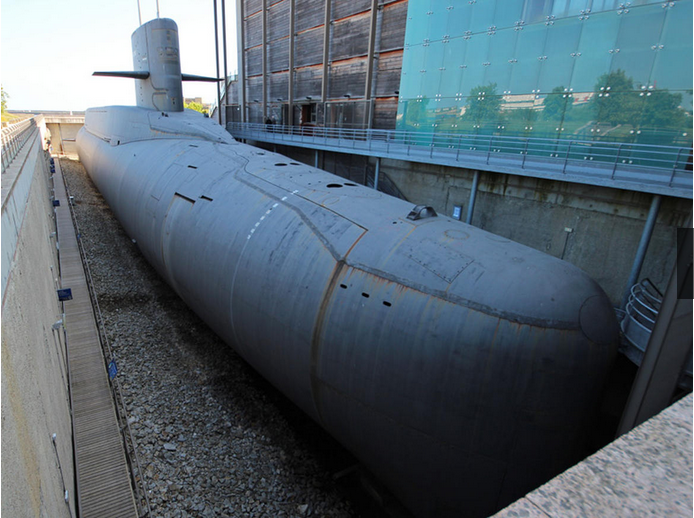
It’s pretty much impossible to get a full shot of the sub, given where it rests. Let’s just say, it’s big.
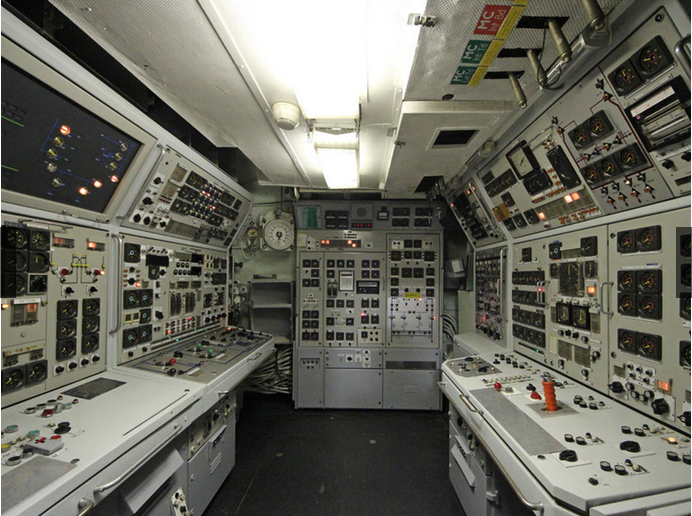
Man, this looks like a nuclear power station control room.
Oh, wait, it is. Along with all the other moving and dangerous parts of the “drivetrain.”
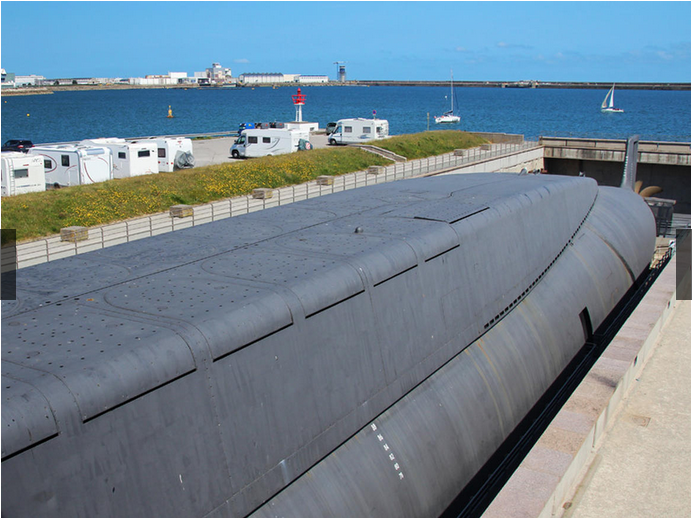
The 16 missile hatches, with the lovely Cherbourg harbor in the background.
Comments Off on A tour of the French ballistic missile submarine Le Redoutable
February 15, 2015
They call it “Great” Britain, after all
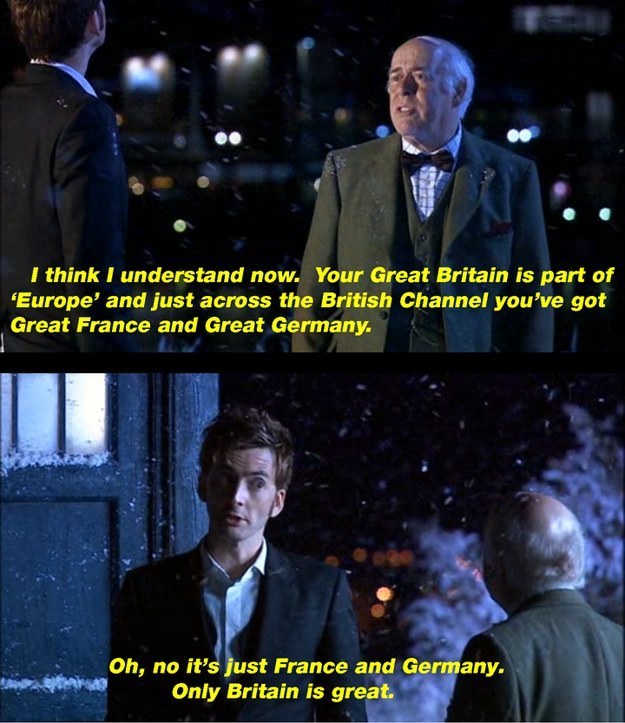
H/T to Think Defence for the image.
Let’s make no mistake, Great Britain is great, the clue is in the name after all.
Anyone who thinks otherwise is obviously uneducated, or French.
And not only that …
Without Great Britain the world would be a poorer place in every regard.
Lets just remind ourselves why…
We gave the world democracy, common law, the Bailey Bridge, tanks, gravity, the worlds most common second language, Led Zeppelin, fair play, queuing, the backhoe loader, metal bridges, modern economics, the industrial revolution and Hollywood villains.
The Beatles, Morris Dancing, penicillin, HP sauce, Top Gear, the World Wide Web (your welcome), One Direction, Carry On and Simon Cowell.
Tea drinking, chicken tikka masala, Shakespeare, Winston Churchill, battered Mars Bars, the BBC, the mini (car, roundabout and skirt), the Spice Girls, Darwin, football, Marmite, rugby, cricket, golf, tennis, ping pong, pubs, tea, sharp suits, Spitfires and the fact there are homosexuals, lesbians and transsexuals in the armed forces and no one gives two shits.
With our friends and allies stood against the Nazis, invented the railway, sarcasm, MRI scanners, the screw propellor and a proper breakfast, been on the right side of the Napoleonic, First, Second and Cold War and gave the world steam power, the Mexeflote, Wallace and Gromit, roast beef dinners, the Dyson, Doctor Who, television, telephones, text messaging, GMT, electric motors, lawn movers, spotted dick, sewage systems, the thermos flask, the jet engine, carbon fibre, the flushing toilet and polyester (just for the RAF), pencils, radar and the Bank of France (ha ha ha).
Comments Off on They call it “Great” Britain, after all
January 30, 2015
All Or Nothing – Winter Offensive In The Carpathians I THE GREAT WAR Week 27
Published on 29 Jan 2015
Konrad von Hötzendorf has to prevent the Russian army from entering the Hungarian plains. So, he starts a huge offensive in the Carpathian Mountains — in mid winter. He also wants to demonstrate his power to Italy and Romania who are considering entering the war for the Entente. Meanwhile, in the Northern Sea the first Battle of Dogger Bank takes place which leads to the sinking of the German ship SMS Blücher.
Comments Off on All Or Nothing – Winter Offensive In The Carpathians I THE GREAT WAR Week 27
January 23, 2015
Zeppelins Over England – New Inventions For The Modern War I THE GREAT WAR Week 26
Published on 22 Jan 2015
For a decisive advantage on the Western Front, the military commanders of both sides are trying to use technological advances. And so this week, German Zeppelins are flying their first air raids on English towns. Winston Churchill is outlining his ideas for what would later become the tank. Meanwhile at the Western Front, the soldier Adolf Hitler is thinking about how this war is going to continue.
Comments Off on Zeppelins Over England – New Inventions For The Modern War I THE GREAT WAR Week 26
January 20, 2015
Recap: The First Six Months I THE GREAT WAR
Published on 19 Jan 2015
World War 1 broke out in summer 1914, a little over 100 years ago. Our channel is following the historic events week by week. For everyone who recently joined this channel: this recap is specially for you! Catch up with the last six months, hence the first six months of the war. Between the assassination of Franz Ferdinand, the Battle of the Marne and the Christmas Truce, hundreds of thousands of soldiers had to die. This is modern war.
Comments Off on Recap: The First Six Months I THE GREAT WAR
January 19, 2015
Jewish life in Europe
Back in 2012, Mark Steyn wrote about the plight of individual Jews in Europe, as the various national governments seemed unable to prevent violent attacks on Jewish businesses, schools, synagogues and individual Jews. He’s reposted the original column, as it’s even more relevant today than it was then:
If the flow of information is really controlled by Jews, as the Reverend Jeremiah Wright assured his students at the Chicago Theological Seminary a year or two back, you’d think they’d be a little better at making their media minions aware of one of the bleakest stories of the early 21st century: the extinguishing of what’s left of Jewish life in Europe. It would seem to me that the first reaction, upon hearing of a Jewish school shooting, would be to put it in the context of the other targeted schools, synagogues, community centers, and cemeteries. And yet liberal American Jews seem barely aware of this grim roll call. Even if you put to one side the public school in Denmark that says it can no longer take Jewish children because of the security situation, and the five children of the chief rabbi of Amsterdam who’ve decided to emigrate, and the Swedish Jews fleeing the most famously tolerant nation in Europe because of its pervasive anti-Semitism; even if you put all that to the side and consider only the situation in France… No, wait, forget the Villiers-le-Bel schoolgirl brutally beaten by a gang jeering, “Jews must die”; and the Paris disc-jockey who had his throat slit, his eyes gouged out, and his face ripped off by a neighbor who crowed, “I have killed my Jew”; and the young Frenchman tortured to death over three weeks, while his family listened via phone to his howls of agony as his captors chanted from the Koran… No, put all that to one side, too, and consider only the city of Toulouse. In recent years, in this one city, a synagogue has been firebombed, another set alight when two burning cars were driven into it, a third burgled and “Dirty Jews” scrawled on the ark housing the Torah, a kosher butcher’s strafed with gunfire, a Jewish sports association attacked with Molotov cocktails…
Here’s Toulouse rabbi Jonathan Guez speaking to the Jewish news agency JTA in 2009: “Guez said Jews would now be ‘more discreet’ about displaying their religion publicly and careful about avoiding troubled neighborhoods. … The synagogue will be heavily secured with cameras and patrol units for the first time.”
This is what it means to be a Jew living in one of the most beautiful parts of France in the 21st century.
Well, you say, why are those Jewish kids going to a Jewish school? Why don’t they go to the regular French school like normal French kids? Because, as the education ministry’s admirably straightforward 2004 Obin Report explained, “En France les enfants juifs — et ils sont les seuls dans ce cas — ne peuvent plus de nos jours être scolarisés dans n’importe quel établissement“: “In France, Jewish children, uniquely, cannot nowadays be provided with an education at any institution.” At some schools, they’re separated from the rest of the class. At others, only the principal is informed of their Jewishness, and he assures parents he will be discreet and vigilant. But, as the report’s authors note, “le patronyme des élèves ne le permet pas toujours“: “The pupil’s surname does not always allow” for such “discretion.”
Comments Off on Jewish life in Europe
January 16, 2015
Onwards! – The Western Front Of Early 1915 – THE GREAT WAR Week 25
Published on 15 Jan 2015
French general Joseph Joffre is stuck in a dilemma: the Champagne offensive has been going on for weeks now — without any expected results. Should he dig in and tolerate the enemy on French soil? Or should his soldiers continue to run up against the impenetrable German defences? Meanwhile, South African troops attack German South West Africa and in London, Winston Churchill’s plan for an invasion of the Dardanelles has been approved.
Comments Off on Onwards! – The Western Front Of Early 1915 – THE GREAT WAR Week 25
December 28, 2014
Edward Luttwak on Napoleon’s modernization of European law
In the London Review of Books, Edward Luttwak starts his review of Britain against Napoleon: The Organisation of Victory, 1793-1815 by Roger Knight by contrasting British and European views of Napoleon’s legacy:
I can recall few heated arguments with my father, but I remember very well our Napoleon quarrel. After two years at a British boarding school, I had learned a fair amount of English and just about enough history to mention Wellington and Waterloo as we were approaching Brussels on a drive from Milan. To my great surprise, my father burst out with a vehement attack on ‘the English’ for having selfishly destroyed Napoleon’s empire. Wherever it had advanced in Europe, modernity had advanced with it, sweeping away myriad expressions of obscurantism and hereditary privilege, emancipating the Jews and all manner of serfs, allowing freedom of, and from, religion, and offering opportunities for advancement for the talented regardless of their origins. I do not recall his actual words, and he would hardly have put it as I have here, but that was certainly his meaning, and I remember his equal-opportunity quotation: ‘Every French soldier carries a field-marshal’s baton in his knapsack.’ I also remember his explanation of the reason he accused the English of being ‘selfish’: Great Britain was already on its way to liberty and did not need Napoleon, but Europe did, and Britain took him away.
In other words, for Jozef Luttwak of Milano, formerly of Arad, Transylvania, as for many others on the Continent (and not only the French), all the wars of Napoleon, all his victories, counted for little in evaluating the man and his deeds. What counted was the progressive moderniser, the law-giver of the Code Napoléon of 1804, actually the Code civil des Français, which was really a civil code for Europeans, since Napoleon’s empire français extended across the Low Countries to Jutland and into northwest Italy, and took in the ex-Papal States and Dalmatia (as Illyria), adding up to a good part of Western Europe. Nor was Napoleon’s Code as ephemeral as his victories. It endures as the core of civil law not only in France but in its former European possessions, and their former possessions too, encompassing ex-French Africa, all of Latin America and the Philippines by way of Spain, and Indonesia by way of the Netherlands, as well as Quebec and Louisiana.
Even that list understates the influence of the code, and therefore of Napoleon the moderniser. Its text conveyed three powerfully innovative principles whose influence transcended by far its actual legal application, and which no restoration could undo: clarity, so that all could know their rights if they could read, without the recondite expertise of jurists steeped in customary law, with its hundreds of exemptions, privileges and eccentricities; secularism, which inter alia replaced parishes with municipalities, thereby introducing civil marriage, part of an entirely new form of individual and civic existence; and the right to individual ownership of property – which untied the immobilised holders of communal property – and employment free from servile obligations.
It mattered greatly that these revolutionary principles were proclaimed by Napoleon, already a conservative and commanding figure – unlike the revolutionaries of 1789, who could not give an aura of authority to their Declaration of the Rights of Man and of the Citizen, which was itself soon challenged by the more egalitarian 1793 version, with both anyhow rejected by the upholders of privilege. In Napoleon’s vassal states (the Confederation of the Rhine, the Kingdoms of Spain, Italy and Naples, and the Grand Duchy of Warsaw), even where the code was not promulgated it was imitated, as was its drastically new style. Just as the florid convolutions and encrustations of rococo had been replaced by the linear elegance of the empire style, the thickets of customary law that Montesquieu had praised as barriers to despotism – as indeed they were, but only for privileged jurists – were replaced by the utterly systematic code, whose descending hierarchy of books, titles, chapters and sections that devolved into 2281 numbered paragraphs was itself infused with the new spirit of modernity. For Europeans of a liberal disposition, the code was a call to modernise not merely the law but society in its entirety – an impulse that would persist for decades.
Comments Off on Edward Luttwak on Napoleon’s modernization of European law
December 26, 2014
The First Battle of Champagne – Dying In Caucasus Snow I THE GREAT WAR Week 22
Published on 25 Dec 2014
Right before Christmas the allied powers begin the Champagne offensive, which will last several months. In the snow and the mud, and under horrible living conditions not only the soldiers suffer. The images of a war fought with honour and glory are finally over as even the white flag is used for ambushes. Far away in the mountains of the Caucasian, Russia and the Ottoman Empire are fighting a grim battle, too, in which many soldiers die during interminable marches in the snow wearing summer uniforms.
Comments Off on The First Battle of Champagne – Dying In Caucasus Snow I THE GREAT WAR Week 22
December 25, 2014
A Sign Of Friendship In The Midst Of War I THE CHRISTMAS TRUCE 1914
Published on 24 Dec 2014
Initially, everyone believed that this war would be over by Christmas, but on Christmas Eve 1914, soldiers were still facing each other in France, Belgium, throughout Eastern Europe, and all of the other theatres of war. But instead of shooting at each other, quite a few soldiers decided to sing and celebrate this night with their enemies. This happened in many places on the Western Front, and the commanding officers were not happy about it. In future, they would see to it that it did not happen again.
Comments Off on A Sign Of Friendship In The Midst Of War I THE CHRISTMAS TRUCE 1914
December 19, 2014
The Raid On Scarborough – A Failed Attempt at Intimidation I THE GREAT WAR Week 21
Published on 18 Dec 2014
German admiral Franz von Hipper reluctantly carries out his orders to bomb British coastal towns. And indeed, this attempt to intimidate British civilians only makes them more united. British propaganda gets another opportunity to portray Germans as bloodthirsty and brutal. Meanwhile, the French start a new offensive near Vimy on the Western Front.
Comments Off on The Raid On Scarborough – A Failed Attempt at Intimidation I THE GREAT WAR Week 21


