World War Two
Published 8 Apr 2021Under the violent occupation by Axis forces, dozens all over the globe resisted or took up arms to fight for the survival of their nation, ethnicity, ideology or ideals.
Join us on Patreon: https://www.patreon.com/TimeGhostHistory
Or join The TimeGhost Army directly at: https://timeghost.tvFollow WW2 day by day on Instagram @ww2_day_by_day – https://www.instagram.com/ww2_day_by_day
Between 2 Wars: https://www.youtube.com/playlist?list…
Source list: http://bit.ly/WW2sourcesHosted by: Spartacus Olsson
Written by: Spartacus Olsson and Joram Appel
Director: Astrid Deinhard
Producers: Astrid Deinhard and Spartacus Olsson
Executive Producers: Astrid Deinhard, Indy Neidell, Spartacus Olsson, Bodo Rittenauer
Creative Producer: Maria Kyhle
Post-Production Director: Wieke Kapteijns
Research by: Joram Appel
Edited by: Miki Cackowski
Sound design: Marek Kamiński
Map animations: Eastory (https://www.youtube.com/c/eastory)Colorizations by:
Mikołaj Uchman
Dememorabilia – https://www.instagram.com/dememorabilia/Sources:
Marxist Internet Archive
Picture of Tito during a Partisan gathering, courtesy of Музеј Старе Херцеговине
Yad Vashem 75FO4, 4613/899, 4248/20, 1605/91
Bundesarchiv
USHMM
IWM NA 15129Soundtracks from the Epidemic Sound:
Phoenix Tail – “At the Front”
Reynard Seidel – “Deflection”
Hakan Eriksson – “Epic Adventure Theme 4”
Johannes Bornlof – “The Inspector 4”
Fabien Tell – “Last Point of Safe Return”
Howard Harper-Barnes – “London”
Rannar Sillard – “March Of The Brave 10”Archive by Screenocean/Reuters https://www.screenocean.com.
A TimeGhost chronological documentary produced by OnLion Entertainment GmbH.
April 9, 2021
Leading the Resistance – WW2 – Gallery 03
April 7, 2021
Bring back the … guillotine?
I’d always generally assumed that Colby Cosh was a libertarian-leaning chap, but here he is banging on the table for executing criminals with that revolutionary French device, the guillotine:
The history of the death penalty in the English-speaking world looks extremely bizarre from any vantage point in the year 2021. The electric chair, now abolished throughout the United States, has always been a stupid, barbarous idea: it sprouted from a time when electricity was a fashionable new technology, and then just kind of stuck around for a century. Gas chamber arrangements came and went.
Hanging, which is still employed in Japan, has centuries of technique behind it, but is recognizably a holdover from a period when the risk of prolonged death was considered a feature, not a bug. Now the U.S. depends on lethal injection methods, some of them antiquated or illogical, that are very capable of being screwed up.
And in the meantime, the guillotine had its foolproof two-century run in France. The famous Dr. Joseph-Ignace Guillotin was a revolutionary opponent of capital punishment who advocated for the device as being more humane than existing methods. Can this be argued against even now? Measurement of the suffering involved with various methods of execution (or euthanasia) involves more uncertainty than anyone likes to admit, but patients receiving lethal injection, whether at their own request or the law’s, do receive sedation before actually being administered a fatal substance. The maximum duration of suffering in a beheading is a matter of seconds, not minutes; and if you believe in capital punishment without cruelty, there is no reason a person with a guillotine appointment should not be permitted to load up in advance on drugs of their own choosing.
The guillotine’s last use in France, and anywhere else in the world, took place on Sept. 10, 1977. It is associated in Anglo-Saxon minds with everything from French revolutionary terror to the Gestapo and the Stasi. There are good reasons to be reluctant to introduce mechanization of any kind into the process of executing murderers. Perhaps it makes the fatal step toward killing mere political enemies a little easier.
But, again, Americans used the electric chair without noticeable shame for more than 100 years: it came into use on a wave of passion for modernity before anyone even knew exactly how electricity kills you. Beheading’s principal problem, assuming one is willing to contemplate the taking of a human life by the state, is janitorial.
March 30, 2021
Caesar in Britain II: There and Back Again (54 B.C.E.)
Historia Civilis
Published 21 Mar 2017Patreon | http://historiacivilis.com/patreon
Donate | http://historiacivilis.com/donate
Merch | http://historiacivilis.com/merch
Mailing List | http://historiacivilis.com/mailinglist
Twitter | http://historiacivilis.com/twitter
Website | http://historiacivilis.comMusic is:
“Day Bird,” by Broke For Free
“Drums of the Deep,” by Kevin MacLeod
“Flood,” by Jahzzar
March 29, 2021
Caesar in Britain (55 B.C.E.)
Historia Civilis
Published 22 Feb 2017Patreon | http://historiacivilis.com/patreon
Donate | http://historiacivilis.com/donate
Merch | http://historiacivilis.com/merch
Mailing List | http://historiacivilis.com/mailinglist
Twitter | http://historiacivilis.com/twitter
Website | http://historiacivilis.comMusic is:
“Light Thought var 2,” by Kevin MacLeod
“Bird Day,” by Broke For Free
“Drums of the Deep,” by Kevin MacLeod
“Thinking Music,” by Kevin MacLeod
“Flood,” by Jahzzar
“Hallon,” by Christian Bjoerklund
The Bayeux Tapestry – all of it, from start to finish
Lindybeige
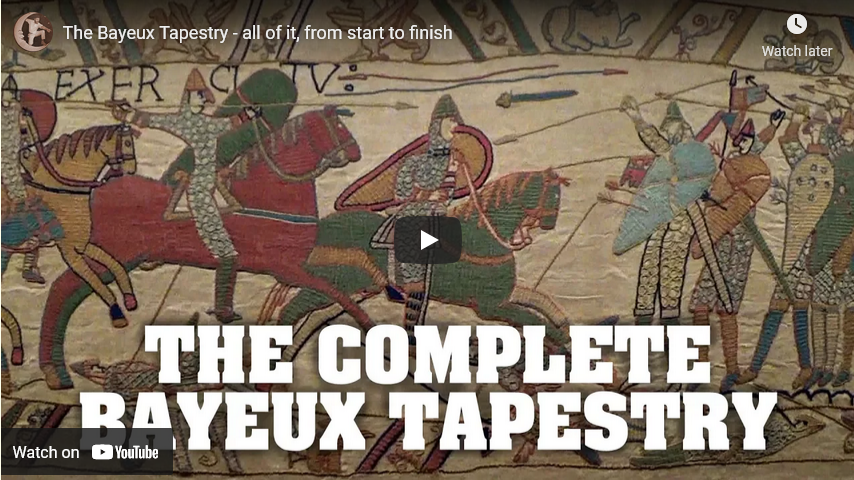
Published 18 Oct 2017A complete guide to the story as depicted on the famous Bayeux Tapestry. There is a lot more to it than just the Battle of Hastings.
Support me on Patreon: https://www.patreon.com/Lindybeige
Other than The Adventures of Stoke Mandeville, this is the longest editing job I have ever done. It took eleven very long days of work to put this together from the opportunist footage I snatched when changing trains near the museum where it is on display. The shoot was not without its problems, one of which was the fact that because the tapestry is behind glass, and the museum has many illuminated displays, the reflections in the glass were a bane, and I didn’t manage to get rid of them all. Another was that my stills camera refused to work after taking a small number of pictures. It had always worked fine before, and has always worked fine since. It wasn’t the battery and it wasn’t the SD card. It was a mystery.
For the curious, the edit involved seventeen tracks on the timeline, and has twenty-two animated scenes. Unfortunately, the main animation software I was using could not handle full HD images, and so there is a slight loss of picture quality during most of the animated scenes. You will notice that the close-ups have a better picture quality than the wide shots. This is because they were taken with the camera pushed up against the glass, which improved focussing, and got rid of almost all of the haze and reflections caused by the glass.
It is important to understand that this ‘tapestry’ is a piece of propaganda, and does not tell an accurate version of events. The story I tell here is the one depicted, not what actually happened.
I have enough material for more videos on the tapestry, but am in no great hurry to spend many more days editing this difficult footage. Trying to match the writing and speaking of narration to panning camerawork that had no notion when shot of what might need to be said about some passing scene, was a nightmare, and many editing compromises had to be made, with some scenes skipped past quickly, and others drawn out.
Clarification on the nudity: I said that the figure under the mysterious Cleric and woman was the the only figure displaying genitals on the tapestry. This was misleading. Several animals clearly are pictured with genitals, and on the tapestry in Bayeux today it looks as though a couple of other human figures have genitals. Some of these may have been added later, and these are not being ‘displayed’ as the displaying figure is clearly doing, but look more incidental.
I describe the tall figure emerging from the building with a lance and pennant, being brought his horse, as “William”. It occurred to me after making the video that all the sources I consulted describe this figure as William, but the text does not name him as William, so possibly he is just a Norman knight, representing any and all of the knights setting out for the battle, and that this figure is meant to be “William” could be a modern tradition that has become accepted fact just by repetition.
Buy the music – the music played at the end of my videos is now available here: https://lindybeige.bandcamp.com/track…
Lindybeige: a channel of archaeology, ancient and medieval warfare, rants, swing dance, travelogues, evolution, and whatever else occurs to me to make.
▼ Follow me…
Twitter: https://twitter.com/Lindybeige I may have some drivel to contribute to the Twittersphere, plus you get notice of uploads.
website: www.LloydianAspects.co.uk
March 28, 2021
QotD: Laïcité and French Catholicism
What of Catholicism in France? Soundly defeated by the Third Republic in 1905 with the introduction of Laïcité, are there Catholics (and other Christians) who secretly wish to see secularism get a bloody nose by way of the Islamists?
As I said, “secularism” isn’t a real thing. I am an optimist when it comes to French Catholicism. There is a rising generation of young Catholics, and they are excellent, and numerous. More and more people are understanding that the only thing modernity offers is consumer crap from China, divorce, and joyless sex at best. The churches on Sunday are full in the big cities. Houellebecq is right; for us, the future is either the foot of the Cross, or submission to Islam. And I think we’re showing we don’t want to submit to Islam …
What people don’t understand about French Catholicism is that while 1905 was certainly a defeat, French Catholics did not simply disappear. They abandoned politics, but they did continue to have children, to bring them up into Catholic schools, etc. so there has always been an important Catholic subculture, including at the elite levels. I am optimistic about the future of Catholicism in France.
Niccolo Soldo, “The Zürich Interviews – Pascal-Emmanuel Gobry: Unrepentant Baguette Merchant”, Fisted by Foucault, 2020-12-02.
March 27, 2021
Battles of Somosierra and Corunna 1808-1809 – Napoleonic Wars
Kings and Generals
Published 17 Feb 2019We are continuing our historical animated documentary series on the Napoleonic Wars with another episode on the Peninsular War, covering the battles of Somosierra and Corunna. Napoleon attempted to take back Madrid and crush the British resistance led by General Moore.
This script was researched and written by Everett Rummage. Check out his brilliant Age of Napoleon podcast – http://bit.ly/2vC3cIE In our opinion, it is the best podcast on the Napoleonic era.
Support us on Patreon: http://www.patreon.com/KingsandGenerals or Paypal: http://paypal.me/kingsandgenerals
We are grateful to our patrons and sponsors, who made this video possible: https://drive.google.com/open?id=1Jlq…
This video was narrated by Officially Devin (https://www.youtube.com/user/OfficiallyDevin)
Machinimas were made on NTW3 mod for Napoleon Total War by Malay Archer (https://www.youtube.com/user/Mathemed…)
✔ Merch store ► teespring.com/stores/kingsandgenerals
✔ Podcast ► Google Play: http://bit.ly/2QDF7y0 iTunes: https://apple.co/2QTuMNG
✔ Twitter ► https://twitter.com/KingsGenerals
✔ Instagram ► http://www.instagram.com/Kings_GeneralsProduction Music courtesy of Epidemic Sound: http://www.epidemicsound.com
#Documentary #Kingsandgenerals #Napoleon
March 25, 2021
Modern Artists: The Original Shitposters! | B2W: ZEITGEIST! I E.14 – Winter 1922
TimeGhost History
Published 24 Mar 2021The interwar era has seen an explosion of art movements all vying to offer the most revolutionary response to modern society. The competition is intense and, as we shall see, often spills over into open conflict.
Join us on Patreon: https://www.patreon.com/TimeGhostHistory
Hosted by: Indy Neidell
Written by: Francis van Berkel
Director: Astrid Deinhard
Producers: Astrid Deinhard and Spartacus Olsson
Executive Producers: Astrid Deinhard, Indy Neidell, Spartacus Olsson, Bodo Rittenauer
Creative Producer: Maria Kyhle
Post-Production Director: Wieke Kapteijns
Research by: Francis van Berkel
Edited by: Michał Zbojna
Sound design: Marek KamińskiColorizations:
Daniel Weiss – https://www.facebook.com/TheYankeeCol…Sources:
Some images from the Library of CongressSoundtracks from Epidemic Sound:
“Epic Adventure Theme 3” – Håkan Eriksson
“Crimp” – Hysics
“Substage” – Jay Varton
“Appeased Soundscape 01” – August Wilhelmsson
“Stranger Days” – Alexandra Woodward
“Superior” – Silver Maple
“Rememberance” – Fabien Tell
“Ghost Dungeons” – Ethan Sloan
“Ancient Discoveries” – Gabriel LewisArchive by Screenocean/Reuters https://www.screenocean.com.
A TimeGhost chronological documentary produced by OnLion Entertainment GmbH.
From the comments:
TimeGhost History
2 days ago (edited)
The original idea for this episode came from me (Francis here, hello) stumbling across a passing reference to the 1922 trial of André Breton buried deep in a Wikipedia article. It led me down a huge rabbit hole on the history of the chaotic artists milling around in Paris, New York, Zurich, and beyond.Considering that it also takes place in the same season as the publication of Ulysses, the release of Nosferatu, the birth of Brazillian Modernism, and more, I realized that it was the perfect opportunity to dedicate an entire episode to the weird and wonderful artistic movements of the modern era. If this kind is new to you then consider this episode your introduction to the topic. Indy talks about the Cubist revolution, then Dadaism, Expressionism, and more.
In case all that seems a bit too niche for your liking then look at it this way: if you want to understand how people processed the horrors of the Great War, the rise of mass production, and modern geopolitical machinations, then diving into the art of the time is a great place to start.
Watch the video to find out why.
March 19, 2021
Napoleon Defeated! Aspern 1809
Epic History TV
Published 9 May 2019In 1809, with Napoleon and his best troops bogged down in Spain, Austria decided to try to get revenge for her humiliation at Austerlitz three years before. Archduke Charles led an invasion of France’s ally Bavaria, but Napoleon raised fresh troops and transformed the strategic situation in four days of hard fighting along the Danube. But having taken Vienna, Napoleon’s overconfidence led to a desperate battle at Aspern-Essling, resulting in his first major defeat as Emperor, and the death of his closest friend.
With thanks to HistoryMarche, check out his channel here: https://www.youtube.com/channel/UC8MX…
Get early access & vote for future topics at Patreon https://www.patreon.com/epichistorytv
Find Osprey books on the Napoleonic Wars https://ospreypublishing.com/
Recommended books on the Napoleonic Wars (as an Amazon Associate I earn from qualifying purchases):
Eggmühl 1809: Storm Over Bavaria https://geni.us/mRvuG
Aspern & Wagram 1809 https://geni.us/4wewlr
French Napoleonic Infantryman 1803-15 https://geni.us/ivLojZD
British Light Infantry & Rifle Tactics of the Napoleonic Wars https://geni.us/02ycFR4
Tactics and the Experience of Battle in the Age of Napoleon https://geni.us/mKAYz
Napoleon the Great http://geni.us/NqMWMusic from Filmstro: https://filmstro.com/?ref=7765
Get 20% off an annual license with this exclusive code:EPICHISTORYTV_ANN#EpicHistoryTV #NapoleonicWars #Napoleon
March 16, 2021
“… because who doesn’t like to see both wine snobs and the French taken down a peg or two?”
In The Critic, Henry Jeffreys sadly notes the passing of Steven Spurrier, perhaps best known for organizing the “Judgement of Paris” in 1976:
The wine world lost one of its giants this week in Steven Spurrier. He’s one of the very few people who managed to put the subject on the front pages of the world’s newspapers when he organised the so-called Judgement of Paris competition in 1976.
This was a blind tasting judged by the great and good of the French wine world pitting the might of Bordeaux and Burgundy, against California, a place whose wines most Europeans had never even tasted. Surely France could not lose. But thrillingly, and deliciously, it did, with Californian wines coming top in both the white and red categories. It inspired a book and a feature film Bottle Shock starring Alan Rickman as Spurrier. In fact, the media, particularly over here and in the US, has never lost interest. Perhaps because who doesn’t like to see both wine snobs and the French taken down a peg or two?
More significantly, it marked the arrival of American and later Australian, Chilean and other New World wines. Fittingly, I first met Spurrier at a round table tasting for an upmarket Chilean wine. These tastings could be nerve-wracking affairs for new writers. They still fill me with anxiety. I never know what to say as the big beasts of the wine world opine. Sometimes, the cellar rooms where such tastings are often held seem much too small for all those jostling egos.
I was sat next to Spurrier and, much to my surprise, he asked me my opinion on the wines, something I don’t think any other writer had done up to that point. He then engaged with what I said, and said something like, “yes, I think you’ve got it there.” Or words to that effect. It’s quite hard to express how startling this experience was to someone outside the wine world. It’s like Martin Scorsese asking your opinion on film making.
March 15, 2021
Battle of Jena-Auerstedt 1806: Napoleon Smashes Prussia
Epic History TV
Published 28 Aug 2018Fresh from his great victory at Austerlitz, Napoleon’s next campaign saw him take on Prussia in the autumn of 1806. Prussia’s army had been feared throughout Europe since the days of Frederick the Great, but in just 5 weeks of “Napoleonic Blitzkrieg”, the French Emperor showed that those days were long gone.
Start your FREE trial with The Great Courses Plus here: http://ow.ly/Fq9R30kFTgf
Get early access and a vote on future topics by supporting Epic History TV on Patreon: https://www.patreon.com/epichistorytv
With thanks to HistoryMarche, check out his channel here: https://www.youtube.com/channel/UC8MX…
Learn more about the Napoleonic Wars with books from our co-production partner Osprey Publishing (as an Amazon Associate I earn from qualifying purchases):
Jena 1806 http://geni.us/C8ieSe
Napoleon’s Cuirassiers & Carabiniers http://geni.us/AZ4nWU
Prussian Cavalry of the Napoleonic Wars http://geni.us/xepcMusic from Filmstro: https://filmstro.com/?ref=7765
Get 20% off an annual license with this exclusive code:EPICHISTORYTV_ANN#EpicHistoryTV #NapoleonicWars #Napoleon
“The Great Courses Plus is currently available to watch through a web browser to almost anyone in the world and optimized for the US, UK, and Australian markets. The Great Courses Plus is currently working to both optimize the product globally and accept credit card payments globally.”
March 13, 2021
QotD: The legendary French snobbery
French people are assholes. Whether complaining about food when abroad, or looking at you like a filthy peasant when you dare ask them a question in English, the French are the epitome of snobbery. This is your opportunity to apologize to the rest of the World. I strongly suggest that you take it.
No Frenchman worthy of the name has ever apologized for anything, and I’m certainly not going to start. Obviously the English word “snob” is an inaccurate description, since a snob is someone who thinks he’s superior, which is different from a Frenchman, who knows he’s superior.
Our food is superior, our language is superior, our culture is superior, our women are more beautiful and sophisticated, but we still take your women as well, because we can. Did you know that syphilis is known as “the French disease” in every major European language and Arabic? We’re not even sorry for that.
Niccolo Soldo, “The Zürich Interviews – Pascal-Emmanuel Gobry: Unrepentant Baguette Merchant”, Fisted by Foucault, 2020-12-02.
March 5, 2021
Colonial Troops Saving Their Masters – WW2 Special
World War Two
Published 4 Mar 2021Without the incredible support and sacrifice of troops from British and French colonies, the Allies would be having an even harder time withstanding the Axis onslaught. This episode looks at their formation and their fighting style.
Join us on Patreon: https://www.patreon.com/TimeGhostHistory
Or join The TimeGhost Army directly at: https://timeghost.tvFollow WW2 day by day on Instagram @ww2_day_by_day – https://www.instagram.com/ww2_day_by_day
Between 2 Wars: https://www.youtube.com/playlist?list…
Source list: http://bit.ly/WW2sourcesHosted by: Indy Neidell
Written by: Markus Linke and Indy Neidell
Director: Astrid Deinhard
Producers: Astrid Deinhard and Spartacus Olsson
Executive Producers: Astrid Deinhard, Indy Neidell, Spartacus Olsson, Bodo Rittenauer
Creative Producer: Maria Kyhle
Post-Production Director: Wieke Kapteijns
Research by: Markus Linke
Edited by: Miki Cackowski
Sound design: Marek Kamiński
Map animations: Miki Cackowski, Eastory (https://www.youtube.com/c/eastory)Colorizations by:
Daniel Weiss
Mikołaj UchmanSources:
Photo of French Saharan troops (1932), courtesy of Acln https://commons.wikimedia.org/wiki/Fi…
Archives du département du Rhône et de la métropole de Lyon
The New York Public Library – Digital Collections
USMC Archives
IWM E 11584, CBM 2264, E 6605, IND 2864, IND 2290, K 1385
Picture of Sudanese Defense Force near Kufra Oasis, courtesy of Major PJ HurmanSoundtracks from Epidemic Sound
Johannes Bornlof – “Deviation In Time”
Hakan Eriksson – “Epic Adventure Theme 3”
Phoenix Tail – “At the Front”
Philip Ayers – “The Unexplored”
Johannes Bornlof – “The Inspector 4”
Fabien Tell – “Weapon of Choice”
Reynard Seidel – “Deflection”
Fabien Tell – “Other Sides of Glory”
Philip Ayers – “Please Hear Me Out”Archive by Screenocean/Reuters https://www.screenocean.com.
A TimeGhost chronological documentary produced by OnLion Entertainment GmbH.
From the comments:
World War Two
9 hours ago
As regular viewers will know, we try to give the most complete picture of World War Two possible by diving into the multitude of people that took part and seeing it from their unique perspective.This episode is part of that effort, looking at the colonial troops who fought on the side of their imperial administrators. In a different way, our On the Homefront series is also part of that effort, and we are happy to announce that we have just got started with it again. Check out the latest episode here where Anna looks at the changing role of the Geisha in wartime Japanese society: https://youtu.be/7Y3IYsNC1WM
February 28, 2021
Cultural appropriation foods around the world
J.J. McCullough
Published 14 Dec 2019Baguettes in Vietnam! Curry in Japan! Tea in India! Let’s look at the practice of eating food from other countries, which is more widespread than you might think, thanks to imperialism and immigration.
FOLLOW ME:
🇨🇦Support me on Patreon! https://www.patreon.com/jjmccullough
🤖Join my Discord! https://discord.gg/3X64ww7
🇺🇸Follow me on Instagram! https://www.instagram.com/jjmccullough/
🇨🇦Read my latest Washington Post columns: https://www.washingtonpost.com/people…
🇨🇦Visit my Canada Website http://thecanadaguide.comHASHTAGS:
#food #curry #empire
February 25, 2021
QotD: Islam and the impact of the Enlightenment
In private, however, or when addressing his soldiers, Napoleon was contemptuous of the Islamic word. “You have come to this country,” he told his army before the battle of the Pyramids, “to save the inhabitants from barbarism, and to bring civilisation to the Orient.” This was why, in addition to muskets, cannon and cavalry, he had brought with him to Egypt a printing press, a hot-air balloon and a small army of intellectuals.
The blaze of the Enlightenment, although it might seem to have been lit in Europe, was not just for Europeans. All the world had the potential to share in its radiance. Illumination was the same wherever it manifested itself, and this meant that in Peking as in Paris, in Baghdad as in Bordeaux, there were sages more than qualified to rank alongside Voltaire and Diderot.
The Enlightenment, far from ranking as something parochial and culturally contingent, was properly a global phenomenon. These various dogmas, which the philosophes had tended to take for granted, had then been given a new and militant edge by the French Revolution. That religion was superstition; that rights were universal; that equality, individual liberty and freedom of expression were simultaneously natural and sacred: these were the convictions that had inspired in the citizens of revolutionary France their continent-shaking sense of certitude. Thrones had been toppled; abbeys demolished; the detritus of a benighted past erased. And if in Europe, then why not further afield? The Rights of Man were for everyone, after all, or they were nothing. “Any law that violates them,” as Robespierre had put it, “is fundamentally unjust and tyrannical. Indeed, it is not law at all.”
This sense of missionary purpose, which inspired in those who felt it an ambition to bring the entire world from darkness into light, outlasted the execution of Robespierre, the defeat of Napoleon, the seeming triumph of reaction across post-revolutionary Europe. In 1854, when the Ottoman Empire was facing a critical threat from Russia, France joined Britain in insisting as a condition of its entry into the Crimean War that the slave trade across the Black Sea be abolished.
Also abolished was the jizya, a tax on Jews and Christians that reached back to the very beginnings of Islam, and was directly mandated by the Qur’an. Such measures, to the Ottomans, risked immense embarrassment. The effect, after all, was to reform Islamic jurisprudence according to the standards of non-believers. It was, for Muslim traditionalists, an ominous straw in the wind. Over the course of the century and more that followed, the weathering effects of Western hegemony on the practices that Muslims believed they had inherited from Muhammad — the Sunnah — became more and more pronounced.
Tom Holland, “The age-old tension between Islam and France”, UnHerd, 2020-11-02.