Quotulatiousness

October 29, 2021

The Last Imperial Army Surrenders at Metz – Battle of Le Bourget 1870

Filed under: France, Germany, History, Military — Tags: , , , , — Nicholas @ 06:00

Real Time History
Published 28 Oct 2021

Much of the remaining French hope to stem the tide against the German armies comes from the more than 200,000 professional troops trapped in Metz since August. French Marshal Bazaine tries to negotiate with the Germans and even offers to march against the French republic. But to no avail.

» THANK YOU TO OUR CO-PRODUCERS
John Ozment
James Darcangelo
Jacob Carter Landt
Thomas Brendan
James Giliberto
Kurt Gillies
Albert B. Knapp MD
Tobias Wildenblanck
Richard L Benkin
Scott Deederly
John Belland
Adam Smith
Taylor Allen
Jim F Barlow
Rustem Sharipov

» OUR PODCAST
https://realtimehistory.net/podcast – interviews with historians and background info for the show.

» LITERATURE
Arand, Tobias: 1870/71. Die Geschichte des Deutsch-Französischen Krieges erzählt in Einzelschicksalen. Hamburg 2018

Gouttman, Alain: La grande défaite de 1870-1871. Paris 2015

Milza, Pierre: L’année terrible. Paris 2009

» SOURCES
Braun, Lily (Hrsg.): Kriegsbriefe aus den Jahren 1870/71 von Hans v. Kretschman. Berlin 1911

Crombrugghe, Ida de: Journal d’une infirmière. Paris 1871

Engels, Friedrich: Der Deutsch-Französische Krieg. Sechzig Artikel aus der “Pall Mall Gazette”. Berlin (Ost) 1957

Fontane, Theodor: Der Krieg gegen Frankreich. Bd. 3. Berlin 1873–1876

Großer Generalstab (Hrsg.): Der Deutsch-Französische Krieg, 1870–71. Bd. 1–3. Berlin 1874 ff.

Historischer Verein der Höhen von Spicheren des 67. Kaiserlichen Linienregiments der Infaterie (Hrsg.): Das Kriegstagebuch von Clovis Hardy. Soldat im 63. Linienregiment. Deutsch-Französischer Krieg 1870/71. Vom Lager in Châlons bis nach Ansbach in Bayern. O.O. [Esvres] O.J. [2011]

Kürschner, Joseph (Hrsg.): Der große Krieg 1870–71 in Zeitberichten. Leipzig o. J. (1895)

Meisner, Heinrich Otto (Hrsg.): Kaiser Friedrich III. Das Kriegstagebuch von 1870/71. Berlin, Leipzig 1926

Sternegg, Johann Khoss von: Schlachtenatlas des XIX. Jahrhunderts. Leipzig 1886

Steenackers, François-Frédéric: Histoire du gouvernement de la défense nationale en province, 4 septembre 1870-8 février 1871. Band 2. Paris o.J. (1884-1885)

» OUR STORE
Website: https://realtimehistory.net

»CREDITS
Presented by: Jesse Alexander
Written by: Cathérine Pfauth, Prof. Dr. Tobias Arand, Jesse Alexander
Director: Toni Steller & Florian Wittig
Director of Photography: Toni Steller
Sound: Above Zero
Editing: Toni Steller
Motion Design: Philipp Appelt
Mixing, Mastering & Sound Design: http://above-zero.com
Maps: Battlefield Design
Research by: Cathérine Pfauth, Prof. Dr. Tobias Arand
Fact checking: Cathérine Pfauth, Prof. Dr. Tobias Arand

Channel Design: Battlefield Design

Contains licensed material by getty images
All rights reserved – Real Time History GmbH 2021

October 23, 2021

French Guerrilla War & German Retaliation during the Franco-Prussian War 1870

Filed under: France, Germany, History, Military — Tags: , , , , — Nicholas @ 04:00

Real Time History
Published 21 Oct 2021

Sign up for Curiosity Stream and get Nebula bundled in and SAVE 26%: https://curiositystream.com/realtimeh…

The French increasing reliance on franc-tireurs, guerrilla style fighters, is causing brutal German retaliation and a spiral of violence in the fall phase of the Franco-Prussian War.

Special thanks goes out to Quentin Censier from Sur le Champ. Check out his Channel: https://www.youtube.com/surlechamp

» THANK YOU TO OUR CO-PRODUCERS
John Ozment
James Darcangelo
Jacob Carter Landt
Thomas Brendan
James Giliberto
Kurt Gillies
Albert B. Knapp MD
Tobias Wildenblanck
Richard L Benkin
Scott Deederly
John Belland
Adam Smith
Taylor Allen
Jim F Barlow
Rustem Sharipov

» OUR PODCAST
https://realtimehistory.net/podcast – interviews with historians and background info for the show.

» LITERATURE
Arand, Tobias: 1870/71. Die Geschichte des Deutsch-Französischen Krieges erzählt in Einzelschicksalen. Hamburg 2018

Keegan, John: Die Kultur des Krieges. Berlin 1995

Neitzel, Sönke/Hohrath, Daniel (Hrsg.): Kriegsgreuel. Die Entgrenzung der Gewalt in kriegerischen Konflikten vom Mittelalter bis ins 20. Jahrhundert. Paderborn, München 2008

Roth, François: La Guerre de 1870. Paris 1990

» SOURCES
Busch, Moritz: Graf Bismarck und seine Leute während des Krieges mit Frankreich. Bd. I. Berlin 1878

Chuquet, Arthur: La Guerre 1870-71. Paris 1895

Engels, Friedrich: Der Deutsch-Französische Krieg. Sechzig Artikel aus der “Pall Mall Gazette”. Berlin (Ost) 1957

Fontane, Theodor: Kriegsgefangen. Erlebtes 1870. Briefe 1870/71. Berlin (Ost) 1984

Kriegsgeschichtliche Abteilung des Großen Generalstabs (Hrsg.): Der deutsch-französische Krieg 1870-71. II.1 Berlin 1878

Kürschner, Joseph (Hrsg.): Der große Krieg 1870–71 in Zeitberichten. Leipzig o. J. (1895)

Meisner, Heinrich Otto (Hrsg.): Kaiser Friedrich III. Das Kriegstagebuch von 1870/71. Berlin, Leipzig 1926

Roux, Georges: La Guerre de 1870. Paris 1966

Sarrepont, Major H. de (i.e. Eugène Hennebert): Histoire de la défense de Paris en 1870-1871. Paris 1872

Zeitz, Karl: Kriegserinnerungen eines Feldzugsfreiwilligen aus den Jahren 1870 und 1871. Altenburg 1905

» OUR STORE
Website: https://realtimehistory.net

»CREDITS
Presented by: Jesse Alexander
Written by: Cathérine Pfauth, Prof. Dr. Tobias Arand, Jesse Alexander
Director: Toni Steller & Florian Wittig
Director of Photography: Toni Steller
Sound: Above Zero
Editing: Toni Steller
Motion Design: Philipp Appelt
Mixing, Mastering & Sound Design: http://above-zero.com
Maps: Battlefield Design
Research by: Cathérine Pfauth, Prof. Dr. Tobias Arand
Fact checking: Cathérine Pfauth, Prof. Dr. Tobias Arand

Channel Design: Battlefield Design

Contains licensed material by getty images
All rights reserved – Real Time History GmbH 2021

October 19, 2021

Semiauto FAMAS F1 Rifle

Filed under: France, History, Military, Weapons — Tags: , , , , , — Nicholas @ 02:00

Forgotten Weapons
Published 9 Aug 2016

http://www.patreon.com/ForgottenWeapons

The French FAMAS was one of the first bullpup rifles to be adopted and built in large numbers by a military power. It was adopted by France in 1978 at right about the same time as the Steyr AUG was being adopted by the Austrian military. Bullpup rifles offered a short overall length without sacrificing barrel length, an advantage that seemed quite valuable for troops who were to spend significant amounts of time in vehicles, where space is at a premium. In French service, the FAMAS was also made the formal replacement for both the MAS-49/56 rifle and the MAT-49 submachine gun, thanks to its compact nature.

The FAMAS is interesting mechanically, as it is one of very few production delayed-blowback rifle designs (the other common one being the CETME/HK series). The FAMAS uses a lever-delaying system, which allows a very simple bolt and action mechanism. The F1 model (adopted by the French Army and still in use today, making up the bulk of FAMAS production) has a 1:12″ twist to its rifling, effectively limiting it to 55 grain projectiles — and it also requires steel-cased ammunition to run reliably. The G2 variant (adopted in 1995 by the French Navy) changed to a 1:9″ twist, introduced a full-hand trigger guard, and also uses NATO standard AR15 magazines instead of the proprietary 25-round magazine of the F1.

In the late 1980s a small number of semiauto FAMAS rifles were made by St Etienne and imported into the US by Century. Most people say 100-125 rifles, although serial number suggest this may have actually been 225-250 rifles. Regardless, they are quite scarce and expensive today.

October 15, 2021

The Battle of Orléans 1870 – French Raw Recruits vs. Experienced German Soldiers

Filed under: France, Germany, History, Military, Weapons — Tags: , , , , , — Nicholas @ 06:00

Real Time History
Published 14 Oct 2021

All across France French Armies have been raised from any available troops. From international volunteers to raw teenaged recruits. How these sub-par soldiers fare against professional German soldiers is not hard to guess and we can see how that goes in the first battles for Orléans.

Special Thanks to Jonathan Ferguson from Royal Armouries. Check out their Channel: https://www.youtube.com/RoyalArmouries

» THANK YOU TO OUR CO-PRODUCERS
John Ozment
James Darcangelo
Jacob Carter Landt
Thomas Brendan
James Giliberto
Kurt Gillies
Albert B. Knapp MD
Tobias Wildenblanck
Richard L Benkin
Scott Deederly
John Belland
Adam Smith
Taylor Allen
Jim F Barlow
Rustem Sharipov

» OUR PODCAST
https://realtimehistory.net/podcast – interviews with historians and background info for the show.

» LITERATURE
Arand, Tobias: 1870/71. Der Deutsch-Französische Krieg erzählt in Einzelschicksalen. Hamburg 2018

Milza, Pierre: L’année terrible. La guerre franco-prussienne. Septembre 1870 – mars 1871. Paris 2009

» SOURCES
Bernhardt, Sarah: Mein Doppelleben. Leipzig 1908

Hérisson, Maurice Graf d’: Journal d’un officier d’ordonannce. Juillet 1870 – Février 1871. Paris 1885

Kühnhauser, Florian: Kriegs-Erinnerungen eines Soldaten des königlich bayerischen Infanterie Leibregiments. Partenkirchen 1898 (Neudruck 2012)

Meisner, Heinrich Otto (Hrsg.): Kaiser Friedrich III. Das Kriegstagebuch von 1870/71. Berlin, Leipzig 1926

N.N. (Hrsg.): Theodor Fontane. Kriegsgefangen – Erlebtes 1870. Briefe 1870/71. Berlin (Ost) 1984

» OUR STORE
Website: https://realtimehistory.net

»CREDITS
Presented by: Jesse Alexander
Written by: Cathérine Pfauth, Prof. Dr. Tobias Arand, Jesse Alexander
Director: Toni Steller & Florian Wittig
Director of Photography: Toni Steller
Sound: Above Zero
Editing: Toni Steller
Motion Design: Philipp Appelt
Mixing, Mastering & Sound Design: http://above-zero.com
Maps: Battlefield Design
Research by: Cathérine Pfauth, Prof. Dr. Tobias Arand
Fact checking: Cathérine Pfauth, Prof. Dr. Tobias Arand

Channel Design: Battlefield Design

Contains licensed material by getty images
All rights reserved – Real Time History GmbH 2021

October 12, 2021

Richard Overy looks at the “Great Imperial War” of 1931-1945

Filed under: Asia, Books, Britain, China, France, History, India, Japan, Military, WW2 — Tags: , , , , , — Nicholas @ 05:00

I missed Rana Mitter‘s review of Richard Overy’s latest book when it was published in The Critic last week:

Imagine there’s no Hitler. It’s not that easy, even if you try, at least if you’re a westerner thinking about the Second World War. But for millions of Asians, those years of conflict had little to do with the horrors of Nazi invasion and genocide, and it is their experience that frames Richard Overy’s account of a seemingly familiar conflict. For most non-Europeans, the war was not a struggle for democracy, but a conflict between empires, and in this book, that imperial struggle begins not with the invasion of Poland by Germany in 1939 but the occupation of Manchuria by the Japanese in 1931.

Blood and Ruins is really two books in one. The first is perhaps the single most comprehensive account of the Second World War yet to appear in one volume. You might think that by reading extensively, you could construct a book like this one. You could not — unless you have Overy’s control over a staggering range of World War II scholarship, much of it drawn from his own decades of research on the economics of total warfare, the development of technology, from radar to aerial bombing, and the idea of the “emotional geography” of war, encompassing morale, hope, and despair. Then you’d need to go back and cover all those categories for each of the major Allied and Axis belligerents: Britain, the US, Japan, Germany, France, Italy and China among them.

The second book is an argument about what kind of conflict the Second World War really was. Overy is clear: on a global as opposed to European scale, it was not (just) a war about democracy, but about empires and their fate, although “the starting point in explaining the pursuit of territorial empire is, paradoxically, the nation.”

Overy points out what is generally lost to view when the European war is placed at the centre of the historiography: both Britain and France were undertaking an “awkward double standard” in their defence of democratic values, as their Asian and African possessions “rested on a denial of those liberties and the repression of any protest against the undemocratic nature of colonial rule”. While this argument has been made before (not least by figures such as Nehru and Gandhi in India at the time), Overy does something unusual and revealing: he compares the western empires with Japan’s justification for its own imperial project in the early twentieth century.

The book is scrupulously careful not to endorse or excuse the worldview of Tokyo’s imperialists, and gives full weight to the voices of the Chinese nationalists and communists who were bitterly opposed to Japan’s expansion on the Asian mainland. Still, the comparison of Japan’s pre-war and wartime empire to those of the western powers provides an important and original broadening of a contemporary debate.

There is ongoing public British (and to some extent French) argument about whether empire was a “good” or “bad” thing. Yet neither attackers nor defenders of the British empire tend to analyse it alongside the Japanese equivalent that lasted nearly half a century. Britain committed colonial massacres (Amritsar) and deadly repression (Mau Mau). So did Japan (the rape of Nanjing, invasion of Manchuria).

Britain’s empire also created an aspirational middle class full of cosmopolitan nationalists, and drew on ideas of loyalty to recruit its subjects to fight in world wars. All these things are also true of Japan, which like Britain was a multi-party democracy for much of its period as an overseas empire (between 1898 and 1932), and whose capital city was an intellectual hub for political activists from across Asia.

As a colony of Japan between 1895-1945, Taiwan developed a middle class that was Japanese-speaking and keen to draw on new economic opportunities brought by empire: Lee Teng-hui, the first democratically elected president of the Republic of China on Taiwan, always thought of Japanese as his mother tongue. Park Chung-hee, the American-sponsored dictator of Cold War South Korea, learned his political craft as an army officer in the Japanese Manchukuo Army that occupied Manchuria.

October 8, 2021

Rise of Guerrilla Warfare & Daring Balloon Escapes – The Franco-Prussian War Early October 1870

Filed under: France, Germany, History, Military — Tags: , , , , , — Nicholas @ 04:00

Real Time History
Published 7 Oct 2021

Sign up for Curiosity Stream and get Nebula bundled in and SAVE 26%: https://curiositystream.com/realtimehistory

In early October 1870, the German states are still confident the Franco-Prussian War is as good as over. But two events might cross their plans: One of the leaders of the new French Republic, Leon Gambetta, escapes the Siege of Paris in a hot-air balloon to coordinate the French Armies outside of Paris. And in Ablis, French guerrilla fighters, the so-called Franc-Tireurs, ambush a German patrol in their sleep — with swift German retribution.

» THANK YOU TO OUR CO-PRODUCERS
John Ozment
James Darcangelo
Jacob Carter Landt
Thomas Brendan

» OUR PODCAST
https://realtimehistory.net/podcast – interviews with historians and background info for the show.

» LITERATURE
Arand, Tobias: 1870/71. Die Geschichte des Deutsch-Französische Krieg erzählt in Einzelschicksalen. Hamburg 2018

Arand, Tobias: Gestorben für “Vaterland” und “Patrie” – Die toten Krieger aus dem Feldzug von 1870/71 auf dem “Alten Friedhof” in Ludwigsburg. Ludwigsburg 2012

Hahn, Joachim: Jüdisches Leben in Ludwigsburg. Geschichte, Quellen, Dokumentation. Karlsruhe 1998

Schneider, Fernand Thiébaut: “Der Krieg in französischer Sicht”, in: Entscheidung 1870. Der deutsch-französische Krieg, hrsg. v. Wolfgang von Groote und Ursula von Gersdorff. Stuttgart 1970. S. 165-203

» SOURCES
Engels, Friedrich: Der Deutsch-Französische Krieg. Sechzig Artikel aus der “Pall Mall Gazette”. Berlin (Ost) 1957

Huber, Rudolf (Hrsg.): Dokumente zur deutschen Verfassungsgeschichte. Bd. 2. 1851-1900. Stuttgart 1964

Kürschner, Joseph (Hrsg.): Der große Krieg 1870-71 in Zeitzeugenberichten. Leipzig o.J. (1895)

N.N. (Hrsg.): Bismarcks Briefe an seine Gattin aus dem Kriege 1870/71. Stuttgart, Berlin 1903

Philippson, G.: “Jom Kippur 1870 vor Metz”, in: Wegweiser für die Jugendliteratur, Heft 4, 6 (1910). S. 26-27

Steenackers, François-Frédéric/Le Goff, F.: Histoire du gouvernement de la Défense nationale en province, 4 Septembre 1870 – 8 Février 1871. Bd. II. Paris 1884

Tissandier, Gaston: Souvenirs et récits d’un aérostier militaire de l’armée de la Loire. Paris 1891

» OUR STORE
Website: https://realtimehistory.net

»CREDITS
Presented by: Jesse Alexander
Written by: Cathérine Pfauth, Prof. Dr. Tobias Arand, Jesse Alexander
Director: Toni Steller & Florian Wittig
Director of Photography: Toni Steller
Sound: Above Zero
Editing: Toni Steller
Motion Design: Philipp Appelt
Mixing, Mastering & Sound Design: http://above-zero.com
Maps: Battlefield Design
Research by: Cathérine Pfauth, Prof. Dr. Tobias Arand
Fact checking: Cathérine Pfauth, Prof. Dr. Tobias Arand

Channel Design: Battlefield Design

Contains licensed material by getty images
All rights reserved – Real Time History GmbH 2021

October 1, 2021

This French General Saved Strasbourg From Total Destruction During the Franco-Prussian War 1870

Filed under: France, Germany, History, Military — Tags: , , , — Nicholas @ 04:00

Real Time History
Published 30 Sep 2021

The symbolic city of Strasbourg had been besieged since the early stages of the Franco-Prussian War. The German siege troops are ready to breach the walls of the city and take it by storm. To avoid the destruction of the city, French general Uhrich surrenders and chooses, in his view, honor above glory.

» THANK YOU TO OUR CO-PRODUCERS
John Ozment
James Darcangelo
Jacob Carter Landt
Thomas Brendan

» OUR PODCAST
https://realtimehistory.net/podcast – interviews with historians and background info for the show.

» LITERATURE
Arand, Tobias: Gestorben für “Vaterland” und “Patrie”. Die toten Krieger aus dem Feldzug von 1870/71 auf dem “Alten Friedhof” in Ludwigsburg. Ludwigsburg 2012

Ders.: 1870/71. Der Deutsch-Französische Krieg erzählt in Einzelschicksalen. Hamburg 2018

Chrastil, Rachel: The Siege of Strasbourg. Cambridge, 2014

» SOURCES
Busch, Moritz: Graf Bismarck und seine Leute vor Paris. Bd. 1. Leipzig 1878

Du Casse, Albert: Journal authentique du Siège de Straßbourg. Paris 1871

Fischbach, Gustave: Le siège et le bombardement de Strasbourg, Paris, 1871

Fontane, Theodor: Der Krieg gegen Frankreich 1870-1871. Bd. 2. Berlin 1874

Kriegsgeschichtliche Abtheilung des Großen Generalstabs (Hrsg.): Der deutsch-französische Krieg 1870-71. II.1. Berlin 1878

Meisner, Heinrich Otto (Hrsg.): Kaiser Friedrich III. Das Kriegstagebuch von 1870/71. Berlin, Leipzig 1926

N.N. Straßbourg. Paris 1874

N.N. (Hrsg.): Theodor Fontane. Kriegsgefangen – Erlebtes 1870. Briefe 1870/71. Berlin (0st) 1984

» OUR STORE
Website: https://realtimehistory.net

»CREDITS
Presented by: Jesse Alexander
Written by: Cathérine Pfauth, Prof. Dr. Tobias Arand, Jesse Alexander
Director: Toni Steller & Florian Wittig
Director of Photography: Toni Steller
Sound: Above Zero
Editing: Toni Steller
Motion Design: Philipp Appelt
Mixing, Mastering & Sound Design: http://above-zero.com
Maps: Battlefield Design
Research by: Cathérine Pfauth, Prof. Dr. Tobias Arand
Fact checking: Cathérine Pfauth, Prof. Dr. Tobias Arand

Channel Design: Battlefield Design

Contains licensed material by getty images
All rights reserved – Real Time History GmbH 2021

September 27, 2021

Why Were Things So Terrible In the 17th Century – General Crisis Theory

Kings and Generals
Published 26 Sep 2021

💻 Go to https://NordVPN.com/kingsandgenerals and use code kingsandgenerals to get a 2-year plan with a huge discount plus 4 additional months for free. Protect yourself online today!

Kings and Generals animated historical documentary series on early modern history and economic history continue with a video on the general crisis theory, as we try to deduce why the 17th century events were so terrible and why so many wars, rebellions, and upheavals happened in this period

Support us on Patreon: http://www.patreon.com/KingsandGenerals or Paypal: http://paypal.me/kingsandgenerals. We are grateful to our patrons and sponsors, who made this video possible: https://docs.google.com/document/d/1o…

The video was made by EdStudio while the script was researched and written by Turgut Gambar. Narration by Officially Devin (https://www.youtube.com/user/OfficiallyDevin)

✔ Merch store ► teespring.com/stores/kingsandgenerals
✔ Podcast ► http://www.kingsandgenerals.net/podcast/
✔ Twitter ► https://twitter.com/KingsGenerals
✔ Instagram ► http://www.instagram.com/Kings_Generals

Production Music courtesy of Epidemic Sound: http://www.epidemicsound.com

#Documentary #EarlyModern #GeneralCrisis

September 24, 2021

Italian Soldiers in France Fighting Germans I Franco-Prussian War 1870

Filed under: Europe, France, Germany, History, Italy, Military — Tags: , , , — Nicholas @ 06:00

Real Time History
Published 23 Sep 2021

Sign up for Curiosity Stream and get Nebula bundled in and SAVE 26%: https://curiositystream.com/realtimehistory

While the Franco-Prussian War was raging in France, another armed conflict to the south was reaching its conclusion. The unification of Italy was not yet complete in the eyes of Italian nationalists because Rome and the Papal State still held out. After the defeat at Rome, the Papal Zouaves went on to France to fight the Prussians.

» THANK YOU TO OUR CO-PRODUCERS
John Ozment
James Darcangelo
Jacob Carter Landt
Thomas Brendan

» OUR PODCAST
https://realtimehistory.net/podcast – interviews with historians and background info for the show.

» LITERATURE
Arand, Tobias: 1870/71. Die Geschichte des Deutsch-Französischen Krieges erzählt in Einzelschicksalen. Hamburg 1870

Bunnenberg, Christian: “Granaten sammeln. Totenkult und Tourismus auf den Schlachtfeldern”, in: 1870/71 – Der deutsch-französische Krieg und die Gründung des Kaiserreiches, ZEITGeschichte 4 (2020), S. 97.

Fiori, Simonetta: “Porta Pia. Roma libera e italiana”, in: La Repubblica v. 19.9.2020. o. S.

Pilant Paul: “La population messine pendant le siège de 1870”. In: La Révolution de 1848 et les révolutions du XIXe siècle, Tome 33, Numéro 158, Septembre-octobre-novembre 1936. pp. 141-175.

Plessner, Helmuth: Die verspätete Nation. Über die politische Verführbarkeit bürgerlichen Geistes. Kohlhammer, Stuttgart 1959

Seibt, Gustav: Rom oder Tod. Der Kampf um die italienische Hauptstadt. Berlin 2001

» SOURCES
Bazaine, François Achille: L’Armée du Rhin depuis 12. Août jusqu’ au 29. Octobre 1870. Paris 1872

Braun, Lily (Hrsg.): Kriegsbriefe aus den Jahren 1870/71 von Hans v. Kretschman. Berlin 1911

Crombrugghe, Ida de: Journal d’une infirmière. Paris 1871

» OUR STORE
Website: https://realtimehistory.net

»CREDITS
Presented by: Jesse Alexander
Written by: Cathérine Pfauth, Prof. Dr. Tobias Arand, Jesse Alexander
Director: Toni Steller & Florian Wittig
Director of Photography: Toni Steller
Sound: Above Zero
Editing: Toni Steller
Motion Design: Philipp Appelt
Mixing, Mastering & Sound Design: http://above-zero.com
Maps: Battlefield Design
Research by: Cathérine Pfauth, Prof. Dr. Tobias Arand
Fact checking: Cathérine Pfauth, Prof. Dr. Tobias Arand

Channel Design: Battlefield Design

Contains licensed material by getty images
All rights reserved – Real Time History GmbH 2021

Kill The Nazis – WAH 042 – September 1942, Pt. 1

Filed under: Europe, France, Germany, History, Military, WW2 — Tags: , , , , — Nicholas @ 04:00

World War Two
Published 23 Sep 2021

The Nazi German occupiers have kept increasing their pressure in occupied territory, and fooled their victims to still have hope, but at some point when the oppression gets unbearable, or all hope is lost, people will resist.
(more…)

September 19, 2021

Chassepot: Best of the Needle Rifles

Filed under: France, History, Military, Weapons — Tags: , , , — Nicholas @ 02:00

Forgotten Weapons
Published 3 May 2019

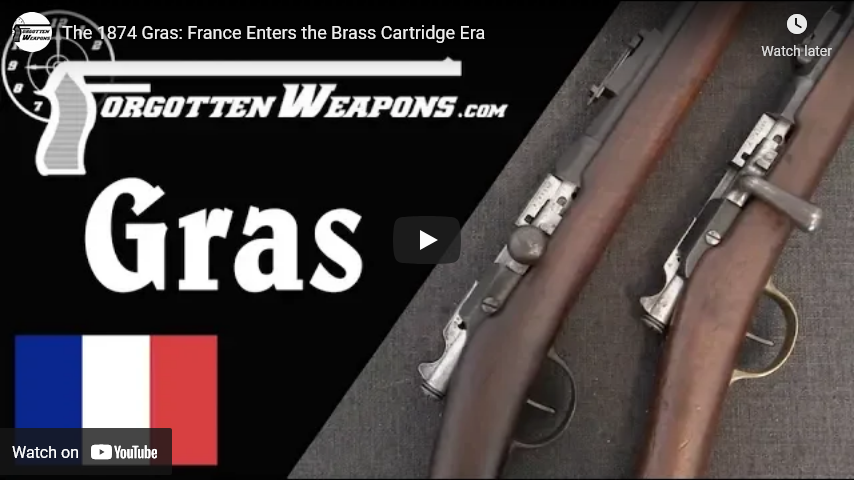
The Model 1866 Chassepot was France’s first military cartridge-firing rifle. It used a self-contained paper cartridge on the same basic principle as the Prussian 1841 Dreyse rifle, but was a substantial improvement on that system. The Chassepot fired an 11mm bullet at about 1350 fps (410 m/s), which was substantially higher velocity than the Dreyse. It was more accurate and had a substantially longer effective range. The French would produce about 1.5 million Chassepot rifles, most of them before the Franco-Prussian War.

Despite the quality of the Chassepot rifle, that war would go tremendously badly for the French, with hundreds of thousands of men and arms captured by the Prussians and the new German state being declared in the palace of Versailles. In the aftermath, many German cavalry units would adopt Chassepots for their own use, until the Gewehr 71 was available in carbine form. The French would resume Chassepot production briefly after the war, but would soon transition to a new rifle, the metallic cartridge firing Gras.

http://www.patreon.com/ForgottenWeapons

Cool Forgotten Weapons merch! http://shop.bbtv.com/collections/forg…

Contact:
Forgotten Weapons
PO Box 87647
Tucson, AZ 85754

September 18, 2021

Paris Fights Back – The French Battle Against German Encirclement I Franco-Prussian War 1870

Filed under: France, Germany, History, Military — Tags: , , , , — Nicholas @ 04:00

Real Time History
Published 16 Sep 2021

Support Glory & Defeat: https://realtimehistory.net/gloryandd…

The German armies are on their way to encircle the French capital Paris after their victory at Sedan. The new French government is raising new troops all across the country and in Paris itself to stem the tide. Poorly equipped and poorly trained troops fight the Germans at Sceaux/Chatillon. Meanwhile, the German states start their negotiations for German unification.

» THANK YOU TO OUR CO-PRODUCERS
John Ozment
James Darcangelo
Jacob Carter Landt
Thomas Brendan

» OUR PODCAST
https://realtimehistory.net/podcast – interviews with historians and background info for the show.

» LITERATURE
Arand, Tobias: 1870/71. Die Geschichte des Deutsch-Französischen Krieges erzählt in Einzelschicksalen. Hamburg 2018

Bourguinat, Nicolas/Vogt, Gilles: La guerre franco-allemande de 1870. Une histoire globale. Paris 2020

Gouttman, Alain. La grande défaite de 1870-1871. Paris 2015

Haselhorst, Olaf: Operationen der deutschen Heere im Krieg gegen Frankreich 1870/71, in: Der Deutsch-Französische Krieg 1870/71.

Vorgeschichte, Verlauf, Folgen, hrsg. v. J. Ganschow unter anderem Graz 2009, S. 83–120

Milza, Pierre: L’année terrible. Paris 2009

» SOURCES
Chuquet, Arthur: La Guerre 1870-71. Paris 1895

Busch, Moritz: Bismarck und seine Leute während des Kriegs mit Frankreich Band. 1. Leipzig 1878.

Goncourt, Edmonde de: Memoires de la vie Litteraire. Paris 1890

Kriegsgeschichtliche Abtheilung des Großen Generalstabes (Hrsg.): Der deutsch-französische Krieg 1870-71. II.1 Berlin. 1878

Russell, William Howard: My diary during the last great war. London and New York, 1874

Sternegg, Generalmajor von: Schlachten-Atlas des 19. Jahrhunderts. Band 10. Deutsch-Französischer Krieg1870/71. Leipzig u.a. o.J. [1885]

» OUR STORE
Website: https://realtimehistory.net

»CREDITS
Presented by: Jesse Alexander
Written by: Cathérine Pfauth, Prof. Dr. Tobias Arand, Jesse Alexander
Director: Toni Steller & Florian Wittig
Director of Photography: Toni Steller
Sound: Above Zero
Editing: Toni Steller
Motion Design: Philipp Appelt
Mixing, Mastering & Sound Design: http://above-zero.com
Maps: Battlefield Design
Research by: Cathérine Pfauth, Prof. Dr. Tobias Arand
Fact checking: Cathérine Pfauth, Prof. Dr. Tobias Arand

Channel Design: Battlefield Design

Contains licensed material by getty images
All rights reserved – Real Time History GmbH 2021

September 15, 2021

QotD: The cult of Napoleon

Filed under: Europe, France, History, Military, Quotations — Tags: , , , , , — Nicholas @ 01:00

The worship of Napoleon has always been a French mystery. Is it spontaneous, reflecting nostalgia for empire, or something organized by the state, which has inherited from that period a matchless taste for authority? French schoolchildren are taught only the benefits of the emperor’s reign. According to our textbooks, Napoleon is supposed to have endowed France with a perfect legal system that still governs us today and to have caused the winds of freedom to blow across Europe. Each year, a dozen more books are published in France touting Napoleon’s glory. He has been represented more often than Christ on film, always as a positive hero.

Other Europeans see him very differently. While French historians amplify the myth that Napoleon himself created by dictating his idealized Memoires on St. Helena, English, German, Russian and Spanish authors count up the massacres and the destruction of their cities and their civilization.

Napoleon began shaping his reputation while he was still alive. He commonly wrote reports of his victories before the battles had even begun, which makes him the founding father of fake news. Certain disasters, such as the Battle of Eylau (now in Poland) against the Russians and Prussians, for example, are still inscribed in the walls of the Arc de Triomphe in Paris as if they were victories, since that is how they were first announced.

Since France is now part of Europe — rather than Europe becoming part of France, as Napoleon wished — what should we commemorate? French victories, such as Austerlitz, were defeats for the Russians and Austrians. Waterloo, a day of mourning for the French, is a symbol of liberation for the British, Germans, and Dutch. In any case, since the return of Napoleon’s ashes, our view of history has changed; the fate of people concerns us more than the fate of armies. Napoleon’s stature does not benefit from this change of perspective. To finance his wars, he ruined Europe, banning international commerce (only smugglers got rich), conscripting peasants, ravaging harvests, and confiscating horses. How should we commemorate the Russian and German campaigns of 1812 and 1813, when the Grand Army left in its wake not the liberation of peoples, but famine and epidemic? Worst still, how should we commemorate the restoration of slavery in the French Antilles, Guadeloupe, and Santo Domingo (Haiti), where the deputies of France’s Revolutionary Convention had abolished it in 1794?

Guy Sorman, “Which Napoleon?”, City Journal, 2021-05-14.

September 10, 2021

Why France Did Not Surrender After Sedan – Empress Eugénie Flees The Country I Franco-Prussian War

Filed under: France, Germany, History, Military — Tags: , , , , — Nicholas @ 06:00

realtimehistory
Published 9 Sep 2021

Sign up for a free 1 month trial for Skillshare: https://skl.sh/realtimehistory08211

After the French defeat at Sedan, the German states expect peace negotiations. But instead the new French republic declares an early form of “total war” and continues the fight. Meanwhile Empress Eugénie flees the country for Britain.

» THANK YOU TO OUR CO-PRODUCERS
John Ozment
James Darcangelo
Jacob Carter Landt
Thomas Brendan

» OUR PODCAST
https://realtimehistory.net/podcast – interviews with historians and background info for the show.

» LITERATURE
Arand, Tobias: 1870/71. Der Deutsch-Französische Krieg erzählt in Einzelschicksalen. Hamburg 2018
Arand, Tobias/Bunnenberg, Christian (Hrsg.): Karl Klein. Die Fröschweiler Chronik. Hamburg 2021
Herre, Franz: Eugénie. Kaiserin der Franzosen. München 2000
Howard, Michael: The Franco-Prussian War. London 1961
Milza, Pierre: L’année terrible. La guerre franco-prussienne. Septembre 1870 – mars 1871. Paris 2009

» SOURCES
Braun, Lily (Hrsg.): Kriegsbriefe aus den Jahren 1870/71 von Hans v. Kretschman. Berlin 1911
Hérisson, Maurice Graf d’: Journal d’un officier d’ordonannce. Juillet 1870 – Février 1871. Paris 1885
Goncourt, Edmond de: Journal des Goncourt. Memoire de la vie litteraire. 2.1. 1870-1871. Paris 1890
Russell, William Howard: Meine sieben Kriege. Die ersten Reportagen von den Schlachtfeldern des 19. Jahrhunderts. Frankfurt a. M. 2000

» OUR STORE
Website: https://realtimehistory.net

»CREDITS
Presented by: Jesse Alexander
Written by: Cathérine Pfauth, Prof. Dr. Tobias Arand, Jesse Alexander
Director: Toni Steller & Florian Wittig
Director of Photography: Toni Steller
Sound: Above Zero
Editing: Toni Steller
Motion Design: Philipp Appelt
Mixing, Mastering & Sound Design: http://above-zero.com
Maps: Battlefield Design
Research by: Cathérine Pfauth, Prof. Dr. Tobias Arand
Fact checking: Cathérine Pfauth, Prof. Dr. Tobias Arand

Channel Design: Battlefield Design

Contains licensed material by getty images
All rights reserved – Real Time History GmbH 2021

September 4, 2021

Battle of Sedan – German Victory and Fall of the French Empire (Franco-Prussian War)

Filed under: France, Germany, History, Military — Tags: , , , , , — Nicholas @ 04:00

realtimehistory
Published 2 Sep 2021

The Battle of Sedan was one of the pivotal moments in the 19th century. The French 2nd Empire’s defeat at Sedan (and the capture of Emperor Napoleon III) unleashed social tensions in Paris and a new French republic was proclaimed. And while the victory of the German Armies was resounding, the cost at places like Bazeilles was also high.

» THANK YOU TO OUR CO-PRODUCERS
John Ozment
James Darcangelo
Jacob Carter Landt
Thomas Brendan

» OUR PODCAST
https://realtimehistory.net/podcast – interviews with historians and background info for the show.

» LITERATURE
Arand, Tobias: 1870/71. Die Geschichte des Deutsch-Französischen Krieges erzählt in Einzelschicksalen. Hamburg 2018

Barry, Quintin: The Franco-Prussian War 1870-1871. Vol 1: the Campaign of Sedan. Solihull 2006

Bourguinat, Nicolas/Vogt, Gilles: La guerre franco-allemande de 1870. Une histoire globale. Paris 2020

Gouttman, Alain: La grande défaite de 1870-1871. Paris 2015

Howard, Michael: The Franco-Prussian War. London 1961

Herre, Franz: Eugénie. Kaiserin der Franzosen. Stuttgart, München 2000

Milza, Pierre: L’année terrible. Paris 2009

» SOURCES
Chuquet, Arthur. La Guerre 1870-71. Paris 1895

Fontane, Theodor: Der Krieg gegen Frankreich. Bd. Berlin 1874

Kühnhauser, Florian: Kriegs-Erinnerungen eines Soldaten des königlich bayerischen Infanterie-Leib-Regiments. Patenkirchen 1898

N.N. (Hrsg.): Bismarcks Briefe an seine Gattin aus dem Kriege 1870-71. Stuttgart, Berlin 1903

Sheridan, Philip H.: Von Gravelotte nach Paris. Erinnerungen aus dem deutsch-französischen Kriege. Leipzig 1889

» OUR STORE
Website: https://realtimehistory.net

»CREDITS
Presented by: Jesse Alexander
Written by: Cathérine Pfauth, Prof. Dr. Tobias Arand, Jesse Alexander
Director: Toni Steller & Florian Wittig
Director of Photography: Toni Steller
Sound: Above Zero
Editing: Toni Steller
Motion Design: Philipp Appelt
Mixing, Mastering & Sound Design: http://above-zero.com
Maps: Battlefield Design
Research by: Cathérine Pfauth, Prof. Dr. Tobias Arand
Fact checking: Cathérine Pfauth, Prof. Dr. Tobias Arand

Channel Design: Battlefield Design

Contains licensed material by getty images
All rights reserved – Real Time History GmbH 2021

« Newer PostsOlder Posts »

Powered by WordPress