
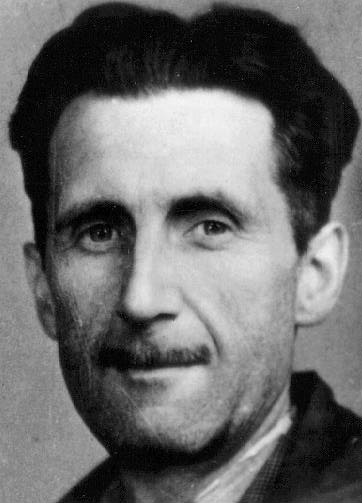
Orwell’s press card portrait, 1943
The history of British relations with Mussolini illustrated the structural weakness of a capitalist state. Granting that power politics are not moral, to attempt to buy Italy out of the Axis — and clearly this idea underlay British policy from 1934 onwards — was a natural strategic move. But it was not a move which Baldwin, Chamberlain and the rest of them were capable of carrying out. It could only have been done by being so strong that Mussolini would not dare to side with Hitler. This was impossible, because an economy ruled by the profit motive is simply not equal to rearming on a modern scale. Britain only began to arm when the Germans were in Calais. Before that, fairly large sums had, indeed, been voted for armaments, but they slid peaceably into the pockets of the shareholders and the weapons did not appear. Since they had no real intention of curtailing their own privileges, it was inevitable that the British ruling class should carry out every policy half-heartedly and blind themselves to the coming danger. But the moral collapse which this entailed was something new in British politics. In the nineteenth and early twentieth centuries, British politicians might be hypocritical, but hypocrisy implies a moral code. It was something new when Tory M.P.s cheered the news that British ships had been bombed by Italian aeroplanes, or when members of the House of Lords lent themselves to organized libel campaigns against the Basque children who had been brought here as refugees.
When one thinks of the lies and betrayals of those years, the cynical abandonment of one ally after another, the imbecile optimism of the Tory press, the flat refusal to believe that the dictators meant war, even when they shouted it from the house-tops, the inability of the moneyed class to see anything wrong whatever in concentration camps, ghettos, massacres and undeclared wars, one is driven to feel that moral decadence played its part as well as mere stupidity. By 1937 or thereabouts it was not possible to be in doubt about the nature of the Fascist régimes. But the lords of property had decided that Fascism was on their side and they were willing to swallow the most stinking evils so long as their property remained secure. In their clumsy way they were playing the game of Machiavelli, of “political realism”, of “anything is right which advances the cause of the Party” — the Party in this case, of course, being the Conservative Party.
All this “Cassius” brings out, but he does shirk its corollary. Throughout his book it is implied that only Tories are immoral. “Yet there is still another England,” he says. “This other England detested Fascism from the day of its birth… this was the England of the Left, the England of Labour.” True, but only part of the truth. The actual behaviour of the Left has been more honourable than its theories. It has fought against Fascism, but its representative thinkers have entered just as deeply as their opponents into the evil world of “realism” and power politics.
“Realism” (it used to be called dishonesty) is part of the general political atmosphere of our time. It is a sign of the weakness of “Cassius”s position that one could compile a quite similar book entitled The Trial of Winston Churchill, or The Trial of Chiang Kai-shek, or even The Trial of Ramsay MacDonald. In each case you would find the leaders of the Left contradicting themselves almost as grossly as the Tory leader quoted by “Cassius”. For the Left has also been willing to shut its eyes to a great deal and to accept some very doubtful allies. We laugh now to hear the Tories abusing Mussolini when they were flattering him five years ago, but who would have foretold in 1927 that the Left would one day take Chiang Kai-shek to its bosom? Who would have foretold just after the General Strike that ten years later Winston Churchill would be the darling of the Daily Worker? In the years 1935-9, when almost any ally against Fascism seemed acceptable, left-wingers found themselves praising Mustapha Kemal and then developing tenderness for Carol of Rumania.
George Orwell, “Who are the War Criminals?”, Tribune, 1943-10-22.
July 28, 2019
QotD: Anglo-Italian relations, 1922-1940
July 26, 2019
The young Boris Johnson at Oxford
Toby Young recounts his first encounter with the new Prime Minister of the United Kingdom at Oxford in 1983:
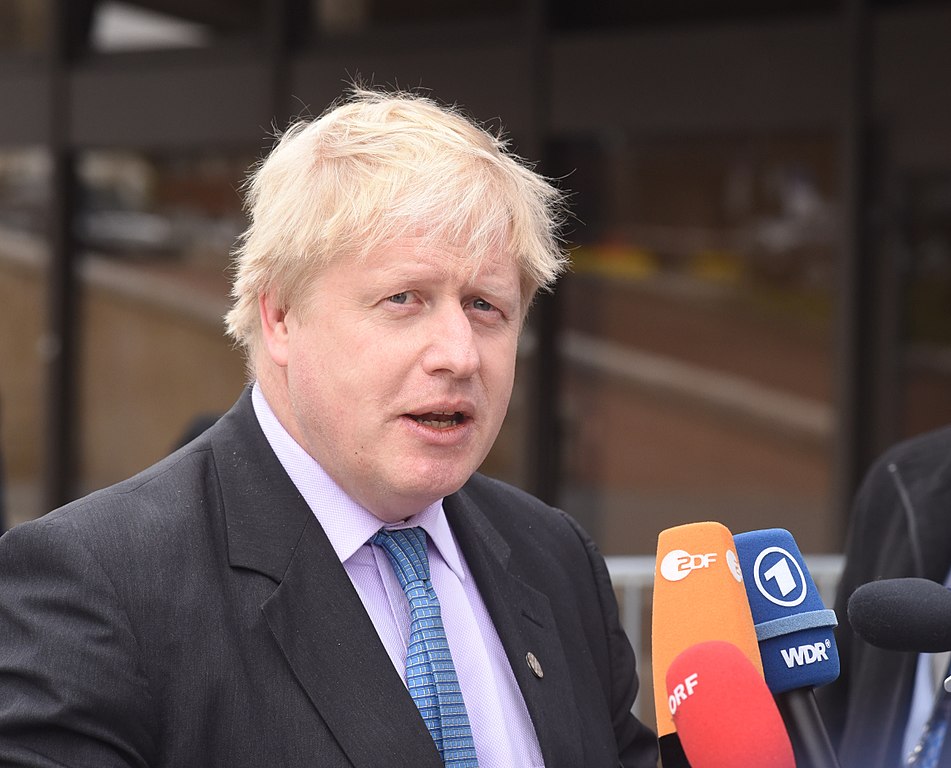
Boris Johnson, Secretary of State for Foreign and Commonwealth Affairs at an informal meeting of the Foreign Affairs Council on 15 February 2018.
Photo by Velislav Nikolov via Wikimedia Commons.
I first set eyes on Boris Johnson in the autumn of 1983 when we went up to Oxford at the same time. I knew who he was since my uncle Christopher was an ex-boyfriend of his mother’s and he had told me to keep an eye out for him, but I still wasn’t prepared for the sight (and sound) of him at the dispatch box of the Oxford Union. This was the world famous debating society where ambitious undergraduates honed their public-speaking skills before embarking on careers in politics or journalism, and Boris was proposing the motion.
With his huge mop of blond hair, his tie askew and his shirt escaping from his trousers, he looked like an overgrown schoolboy. Yet with his imposing physical build, his thick neck and his broad, Germanic forehead, there was also something of Nietzsche’s Übermensch about him. You could imagine him in lederhosen, wandering through the Black Forest with an axe over his shoulder, looking for ogres to kill. This same combination — a state of advanced dishevelment and a sense of coiled strength, of an almost tangible will to power — was even more pronounced in his way of speaking.
He began to advance an argument in what sounded like a parody of the high style in British politics — theatrical, dramatic, self-serious — when — a few seconds in — he appeared to completely forget what he was about to say. He looked up, startled — Where am I? — and asked the packed chamber which side he was supposed to be on. “What’s the motion, anyway?” Before anyone could answer, a light bulb appeared above his head and he was off, this time in an even more orotund, florid manner. Yet within a few seconds he’d wrong-footed himself again, this time because it had suddenly occurred to him that there was an equally compelling argument for the opposite point of view. This endless flipping and flopping, in which he seemed to constantly surprise himself, went on for the next 15 minutes. The impression he gave was of someone who’d been plucked from his bed in the middle of the night and then plonked down at the dispatch box of the Oxford Union without the faintest idea of what he was supposed to be talking about.
I’d been to enough Union debates at this point to know just how mercilessly the crowd could punish those who came before them unprepared. That was particularly true of freshmen, who were expected to have mastered all the arcane procedural rules, some of them dating back to the Union’s founding in 1823. But Boris’s chaotic, scatter-brained approach had the opposite effect. The motion was deadly serious — “This House Would Reintroduce Capital Punishment” — yet almost everything that came out of his mouth provoked gales of laughter. This was no ordinary undergraduate proposing a motion, but a Music Hall veteran performing a well-rehearsed comic routine. His lack of preparedness seemed less like evidence of his own shortcomings as a debater and more a way of sending up all the other speakers, as well as the pomposity of the proceedings. You got the sense that he could easily have delivered a highly effective speech if he’d wanted to, but was too clever and sophisticated — and honest — to enter into such a silly charade. To do what the other debaters were doing, and pretend he believed what was coming out of his mouth, would have been patronising. Everyone else was taking the audience for fools, but not him. He was openly insincere and, in being so, somehow seemed more authentic than everyone else.
To say I was impressed would be an understatement. A few years before arriving at Oxford I had watched the television adaptation of Brideshead Revisited, Evelyn Waugh’s Oxford novel, and had been expecting to meet the modern-day equivalents of Sebastian Flyte and Anthony Blanche: larger-than-life, devil-may-care aristocrats delivering bon mots in between sips of champagne and spoonfuls of caviar. But the reality was very different: warm beer, stale sandwiches and second-hand opinions. Lots of spotty students, all as gauche as me. Less like an Oscar Wilde play than a Mike Leigh film.
In Boris, though, it was as if I’d finally encountered the “real” Oxford, the Platonic ideal. While the rest of us were works-in-progress, vainly trying on different personae, Boris was the finished article. He was an instantly recognizable character from the comic tradition in English letters: a pantomime toff. He was Sir Toby Belch in Twelfth Night demanding more cakes and ale, Bertie Wooster trying to pass himself off as Eustace H. Plimsoll when appearing in court after overdoing it on Boat Race night. Yet at the same time fizzing with vim and vinegar — “bursting with spunk,” as he once put it, explaining why he needs so many different female partners. He was a cross between Hugh Grant and a silverback gorilla.
My uncle had described him as a “genius” and as a boy he’d been regarded as something of a wunderkind. There was the occasion when he was holidaying with his family in Greece, aged 10, and asked a group of Classics professors if he could join their game of Scrabble. They indulged the precocious, blond-haired moppet, only to be beaten by him. Thinking it was a one-off, they asked him to play another round and, again, he won. On and on it went, game after game. At the prep school he attended before going to Eton, Britain’s grandest private school, he was seen as a prodigy. A schoolmaster who taught him back then told his biographer, Andrew Gimson, that he was the quickest-learner he’d ever encountered. In the staff room, the teachers would compare notes about the “fantastically able boy.”
He was without doubt the biggest man on campus — the person most likely to succeed. He made no secret of his desire to be Prime Minister one day, and not just a run-of-the-mill, common-or-garden PM, but up there with Gladstone and Disraeli. And this was a scaling back of his ambitions — as a boy he’d told his younger sister Rachel that he wanted to be “world king.” (There was an intermediate stage during his teenage years when he harboured fantasies of becoming President of the United States — something that’s technically possible, given that he was born in New York.) He was by no means the only member of the Oxford Union to express such hopes during that period, but in his case you felt it might actually happen. Unlike so many other privileged undergraduates, with their vaulting sense of entitlement, Boris’s gargantuan self-belief seemed of a piece with his outsized personality. He had an electrifying, charismatic presence of a kind I’d only read about in books before. Our mutual friend Lloyd Evans, who knew Boris better than me at Oxford, put it well. “He’s a war leader,” he told Andrew Gimson. “He is one of the two or three most extraordinary people I’ve ever met. You just feel he’s going somewhere. People just love him. They enjoy going with him and they enjoy being led.”
To get a sense of Boris Johnson’s unique charm, here’s a brilliant pastiche of some of his TV appearances, stitched together as if it was his Olympic Games Welcome during his time as Lord Mayor of London (do watch, it’s hilarious).
Post-Brexit, consider CANZUK
Tom Colsey explains why in a post-Brexit world, CANZUK might be an attractive economic alternative:
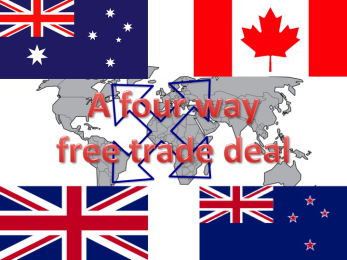
One possible option would mean the island nation would initially turn away from Europe toward certain anglophone Commonwealth nations and former colonies. I talk, of course, of the promising CANZUK proposal that would see Canada, Australia, New Zealand, and the United Kingdom band together with voluntary agreements on multilateral free trade and movement, forming a bloc that would singularly hold the third largest nominal GDP in the world.
The Free Movement Proposal
What makes CANZUK unique is how viable and well-thought-out it is on every level. Unlike within the EU, the grouping would not be consolidated through impositional treaties laced with unpleasant footnotes delegating political power to a bureaucratic institution. Freedom of movement would assist meeting labor market demands across the countries, yet this would be prohibited to those with serious criminal records.
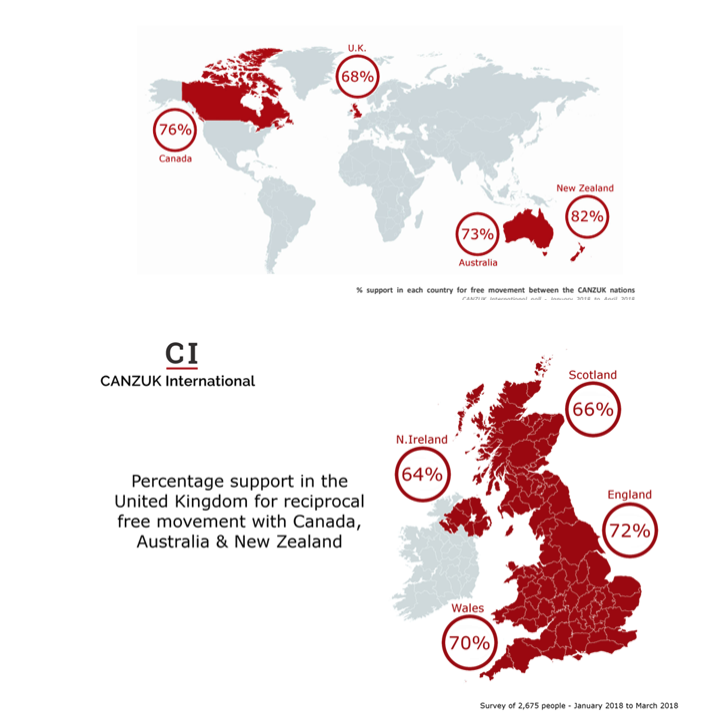
Everything the EU seemed to get wrong about forming unions under a liberal-internationalist pretense, CANZUK proposals seem to get right. They account for social attitudes and the dangers of becoming impositional, eroding national sovereignty. Free movement within the European Union had been widely reviled by the domestic population — and is part of the reason Britain now is set to leave. Yet the very same population overwhelmingly favor the same principle, alternatively implemented, across the CANZUK nations, polling outright majorities in favor in every region.
Perhaps a reason for this is that while the nations are extremely close culturally, they are also resoundingly similar socio-economically. Despite their distances, the states could have been separated at birth (of course, they do share the same monarch).
July 24, 2019
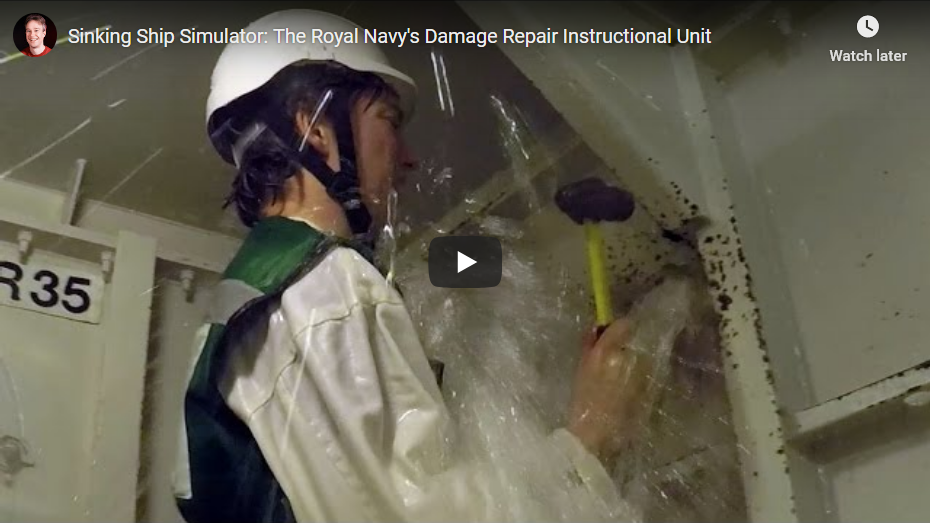
Sinking Ship Simulator: The Royal Navy’s Damage Repair Instructional Unit
Tom Scott
Published on Sep 7, 2015http://tomscott.com – with many, many thanks to the Royal Navy and everyone at HMS Excellent! http://royalnavy.mod.uk
How do you train sailors to save a sinking ship? Sure, you can teach them the theory, but there’s no replacement for having to hammer softwood wedges into deck and bulkhead splits that are spraying cold, high-pressure water in your face.
At HMS Excellent in Portsmouth sits Hazard, a Royal Navy Damage Repair Instructional Unit (DRIU). Every Navy recruit who’s going out to sea will have to go through something like this — and on a much harder level than we did! But then, they’ll have had months of training and teamwork beforehand…
DIRECTED BY Matt Gray: http://mattg.co.uk – @unnamedculprit – see behind-the-scenes video at https://www.youtube.com/watch?v=zwlnb…
WITH:
Paul Curry – @cr3
Melinda Seckington – http://missgeeky.com – @mseckingtonAnd again, with many thanks to all the Navy team who were so generous with their time and effort: http://royalnavy.mod.uk – http://twitter.com/royalnavy
July 22, 2019
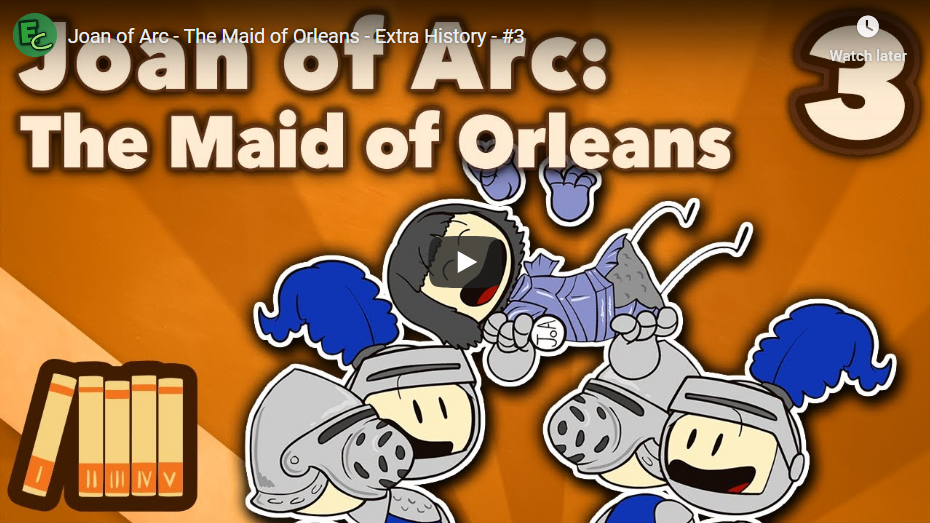
Joan of Arc – The Maid of Orleans – Extra History – #3
Extra Credits
Published on 20 Jul 2019Join us on Patreon! http://bit.ly/EHPatreon
When Joan met the army of Orleans, they weren’t exactly keen on her idea to just GET ‘EM and go completely offensive — thinking she would have more use as a mascot. But both they, and she, would be in for many surprises…
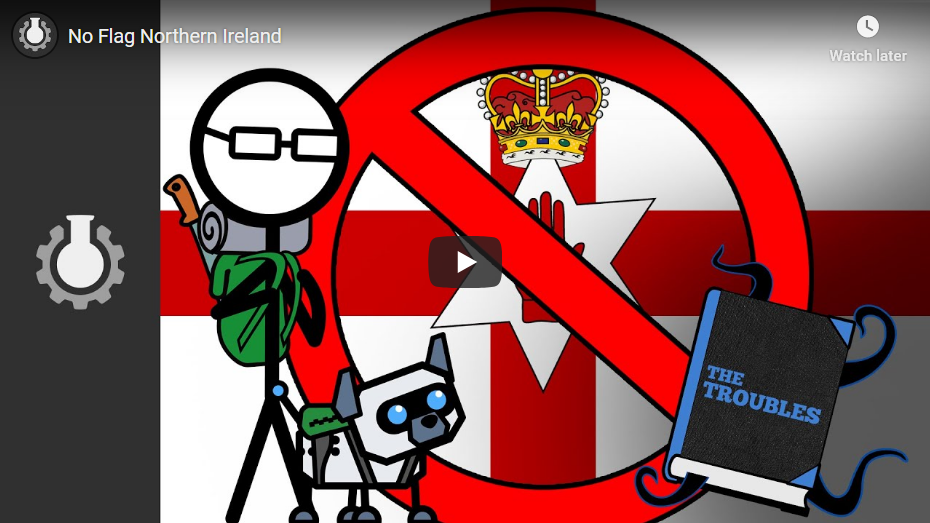
No Flag Northern Ireland
CGP Grey
Published on 18 Jun 2019Northern Ireland’s officially unofficial flag.
July 21, 2019
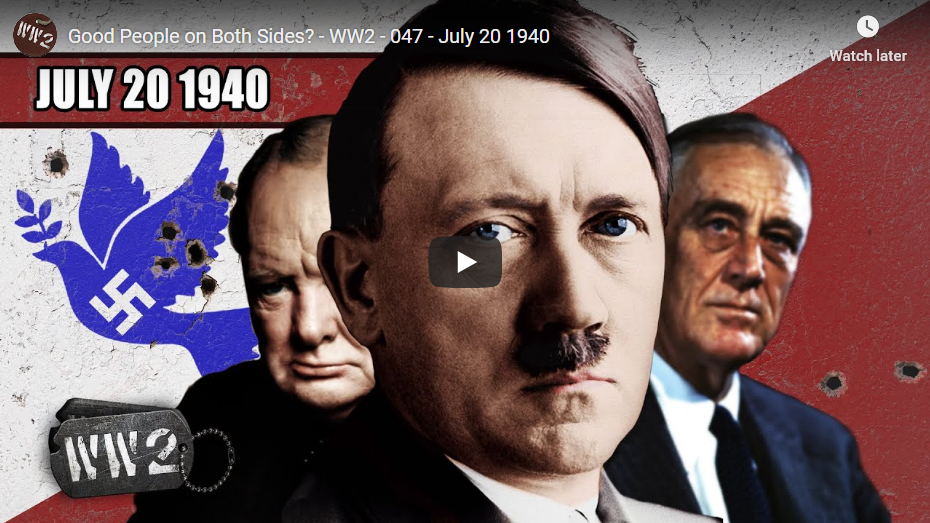
Good People on Both Sides? – WW2 – 047 – July 20 1940
World War Two
Published on 20 Jul 2019Peace seems to slowly return to the European mainland, but not for long, as the Germans move their airplanes to the French coast to Battle Britain in the skies while they make invasion plans, and the Soviets are entering the Baltics after ‘elections’ invited them to.
Join us on Patreon: https://www.patreon.com/TimeGhostHistory
Or join The TimeGhost Army directly at: https://timeghost.tvFollow WW2 day by day on Instagram @World_war_two_realtime https://www.instagram.com/world_war_t…
Join our Discord Server: https://discord.gg/D6D2aYN.
Between 2 Wars: https://www.youtube.com/playlist?list…
Source list: http://bit.ly/WW2sourcesWritten and Hosted by: Indy Neidell
Produced and Directed by: Spartacus Olsson and Astrid Deinhard
Executive Producers: Bodo Rittenauer, Astrid Deinhard, Indy Neidell, Spartacus Olsson
Creative Producer: Joram Appel
Post production director:Wieke Kapteijns
Research by: Indy Neidell
Edited by: Marek Kaminski
Map animations: EastoryColorisations by Norman Stewart and Julius Jääskeläinen https://www.facebook.com/JJcolorization/
Eastory’s channel: https://www.youtube.com/channel/UCEly…
Archive by Screenocean/Reuters https://www.screenocean.com.A TimeGhost chronological documentary produced by OnLion Entertainment GmbH.
July 20, 2019
“Boris Johnson is the only man alive who could convincingly turn The Emperor’s New Clothes into a one-man play”
In Spiked, Alaa al-Ameri says that Boris Johnson actually does have a valid point in his criticism of Islam:
Boris Johnson, Secretary of State for Foreign and Commonwealth Affairs at an informal meeting of the Foreign Affairs Council on 15 February 2018.
Photo by Velislav Nikolov via Wikimedia Commons.
Boris Johnson is the only man alive who could convincingly turn The Emperor’s New Clothes into a one-man play. He’s perfect for every role – the pompous, bumbling, vain emperor; the barefaced conmen trafficking in audacious whoppers; and, most importantly, the little boy, unable to keep from blurting out the obvious, especially when everyone around him is busy parroting the convenient lie of the day.
Not for the first time, Johnson has offended polite society by suggesting that there might be something less than perfectly laudable about some aspects of Islam. Perish the thought. In particular, offence-miners at the Guardian have discovered that Johnson once wrote that Islam has held Muslim countries back by “centuries”.
A cursory look around the world is enough to conclude that there may be something to Johnson’s argument. A deeper look at Arab and Muslim history – both ancient and recent – might at least confirm the possibility that such a statement is something other than flat-out bigotry. Or so you might have thought, if you had recently awoken from a 30-year coma. In 2019, however, such thoughts are unthinkable.
We can moralise all day long about the evils of European colonialism. But it was a historical blink of an eye in comparison to the centuries of Arab and Muslim colonialism that produced the cultures to which Johnson was referring. We can wring our hands over the influence of literalist Christianity on American politics. But this is a drop in the ocean compared to the cultural and political leverage of Islam across the globe. We can lament the potential harm to Indian democracy posed by militant Hindu nationalism. But there is nothing questionable about entertaining the notion that centuries of Muslim global imperialism – which ended less than 100 years ago – might have left behind a less than a gleaming legacy.
July 18, 2019
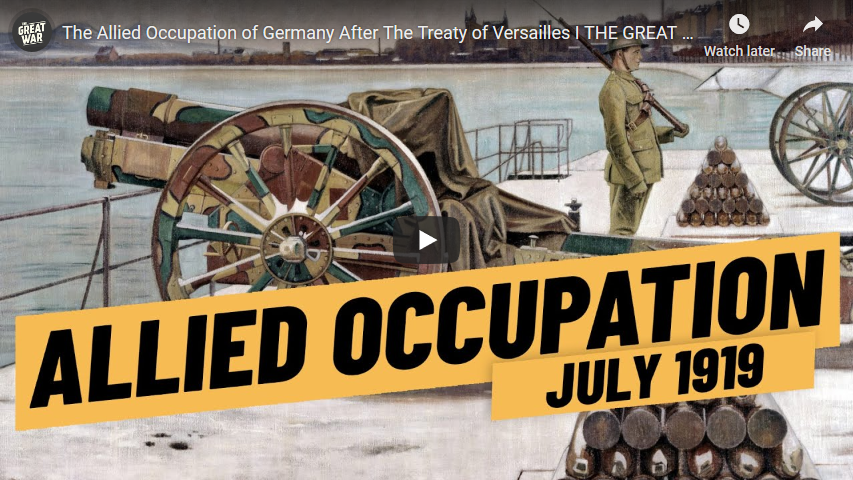
The Allied Occupation of Germany After The Treaty of Versailles I THE GREAT WAR July 1919
The Great War
Published on 17 Jul 2019When the Allied armies marched into German territory in late 1918 under the terms of the armistice, they were surprised to see a relatively untouched land. After the signing of the Treaty of Versailles, the Allied Occupation was made permanent and the troops settled in to stay in a country that did not want them there initially.
» SUPPORT THE CHANNEL
Patreon: https://www.patreon.com/thegreatwar
Merchandise: https://shop.spreadshirt.de/thegreatwar/» SOURCES
Leonhard, Jörn. Der überforderte Frieden. Versailles und die Welt 1918-1923 (CH Beck, 2018)
Macmillan, Margaret. The Peacemakers: Six Months that Changed the World (London: John Murray, 2001).
Le Naour, Jean-Yves. La Honte noire (Hachette, 2004).
Schröder, Joachim, Watson, Alexander. “Occupation during and after the War (Germany)” in: 1914-1918-online. International Encyclopedia of the First World War https://encyclopedia.1914-1918-online…
Roos, Julia. “Schwarze Schmach” in: 1914-1918-online. International Encyclopedia of the First World War https://encyclopedia.1914-1918-online…
Godfroid, Anne. “Occupation after the War (Belgium and France)” in: 1914-1918-online. International Encyclopedia of the First World War https://encyclopedia.1914-1918-online…
Pawley, Margaret. The Watch on the Rhine: The Military Occupation of the Rhineland, 1918-1930 (I.B.Tauris, 2007).
Hart, Keith. “A Note on the Military Participation of Siam in WWI.” Journal of the Siam Society (ndp): 133–136.
Lauter, Anna-Monika. Sicherheit und Reparationen. Die französische Öffentlichkeit, der Rhein und die Ruhr (1919-1923) (Essen: Klartext, 2006).
Krugler, Gilles. “Allemagne decembre 1918. Les premières heures de l’occupation“. In Revue historique des armées 254 (2009): 76-81. https://journals.openedition.org/rha/…
Mignon, Nicolas. “Boche, ex-ennemie ou simplement femme? Le point de vue des responsables politiques et militaires sur la question des mariages entre militaires belges et femmes allemandes pendant les occupations de la Rhénanie et de la Ruhr (1918-1929).” In Revue belge de Philologie et d’Histoire (2013) 91-4 : 1259-1283.»CREDITS
Presented by: Jesse Alexander
Written by: Jesse Alexander
Director: Toni Steller & Florian Wittig
Director of Photography: Toni Steller
Sound: Toni Steller
Editing: Toni Steller
Mixing, Mastering & Sound Design: http://above-zero.com
Motion Design: Christian Graef – GRAEFX
Maps: Daniel Kogosov (https://www.patreon.com/Zalezsky)
Research by: Jesse Alexander
Fact checking: Florian WittigChannel Design: Alexander Clark
Original Logo: David van StepholdA Mediakraft Networks Original Channel
Contains licensed material by getty images
All rights reserved – Real Time History GmbH 2019
July 17, 2019
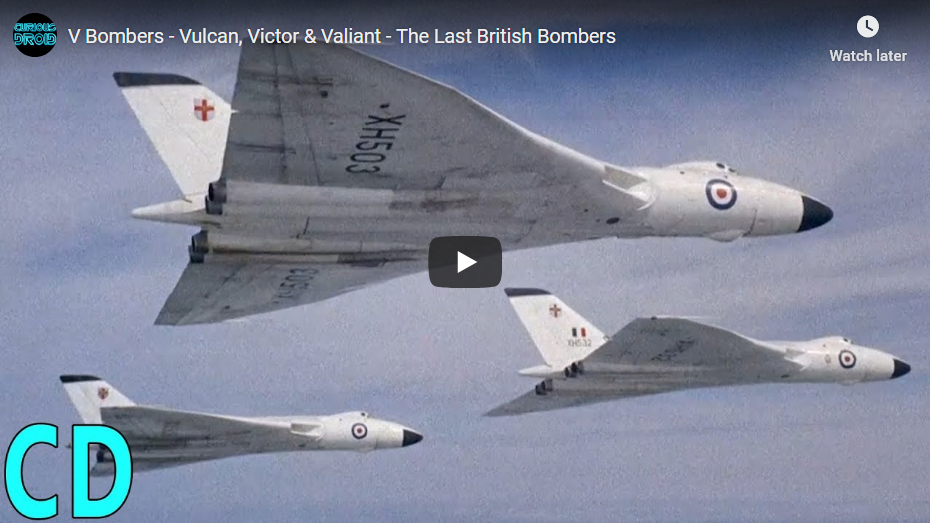
V Bombers – Vulcan, Victor & Valiant – The Last British Bombers
Curious Droid
Published on 28 Nov 2017It took just 11 years to go from the first flight of the Lancaster Bomber in 1941 to the first flight of the VX770, the prototype Vulcan bomber in 1952. Yet the difference between them could hardly be greater, the Vulcan along with the Victor and Valiant were a new generation of the new planes known as the “V” bombers, planes for a new era and a newly, nuclear-armed Britain.
Patreon : https://www.patreon.com/curiousdroid
Paypal.me : https://www.paypal.me/curiousdroidSponsers: Drew Hendrix, Symon Hamer, Florian Hesse, Lucius Kwok, Hunter Schwisow, Pyloric, Seb Stoodley, Oscar Anderson, Peter Cote, Cody Belichesky, Mogoreanu Daniel, Douglas Gustafson, Marcus Chiado, Jorn Magnus Karlsen.
This episode’s shirt was the was the Tabla Paisley by Madcap England and is available from https://www.atomretro.com/madcap_england.
Get 10% discount with the code DROID10.Presented by Paul Shillito
Written and Researched by Andy Munzer
Additional material by Paul Shillito
Images and footage: Avro, Handley-Page, Vickers-Armstrong
Jim Debinham, Pathe.Music – Machiotil by Seclorance is licensed under an Attribution License.
Source : http://freemusicarchive.org/music/Sec…
July 14, 2019
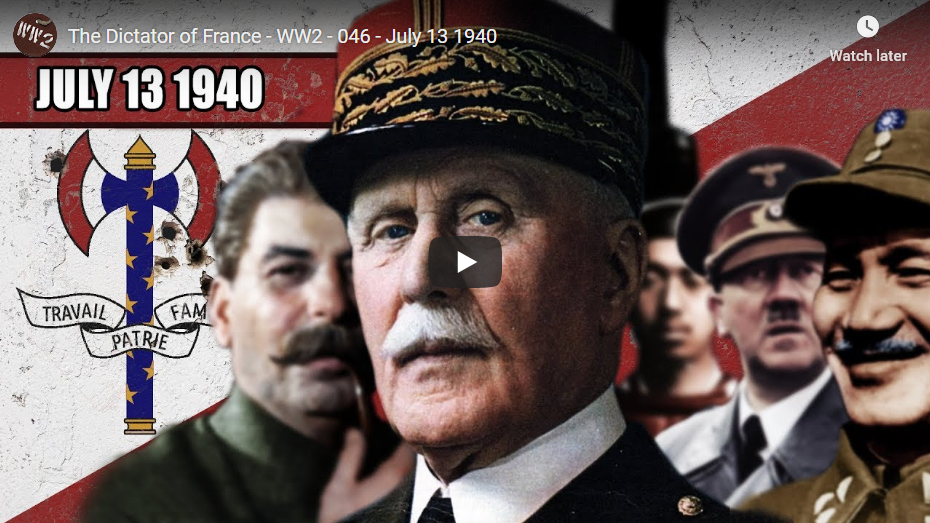
The Dictator of France – WW2 – 046 – July 13 1940
World War Two
Published on 13 Jul 2019The Germans and the French in Vichy consolidate their newly acquired power as the British deal with the remnants of the French navy. The Battle of Britain begins with fighting above the English Channel, a battle with great consequences for the future of Europe.
Join us on Patreon: https://www.patreon.com/TimeGhostHistory
Or join The TimeGhost Army directly at: https://timeghost.tvFollow WW2 day by day on Instagram @World_war_two_realtime https://www.instagram.com/world_war_t…
Join our Discord Server: https://discord.gg/D6D2aYN.
Between 2 Wars: https://www.youtube.com/playlist?list…
Source list: http://bit.ly/WW2sourcesWritten and Hosted by: Indy Neidell
Produced and Directed by: Spartacus Olsson and Astrid Deinhard
Executive Producers: Bodo Rittenauer, Astrid Deinhard, Indy Neidell, Spartacus Olsson
Creative Producer: Joram Appel
Research by: Indy Neidell
Edited by: Iryna Dulka
Map animations: EastoryColorisations by Norman Stewart and Julius Jääskeläinen https://www.facebook.com/JJcolorization/
Eastory’s channel: https://www.youtube.com/channel/UCEly…
Archive by Screenocean/Reuters https://www.screenocean.com.Sources:
– IWM: HU 25966, D 734, HU 104721, D 735,
A 18492, HU 52333, Q 69694, A 18284, AMY 450, MH 4560
– Collection of Adolph B. Miller/COLL1068, USMC Archives & Special Collections
– Lloyd W. Williams Collection (COLL/77), USMC Archives & Special CollectionsA TimeGhost chronological documentary produced by OnLion Entertainment GmbH.
From the comments:
World War Two
3 days ago (edited)
“You either die a hero or live long enough to see yourself become the villain,” could very well describe the life of Philippe Pétain. Or at least, thats what many generally agree on in hindsight. For the people living in France in 1940, it wasn’t that black or white. “Saving France” didn’t necessarily mean fighting from exile, and establishing a French state with approval of the German victors might have seemed like the best option to protect French interests, people and identity. It’s hard to place yourself in the shoes of people who lived through hard times and had to make tough decisions. Thats why we try to report and describe what happened as unbiased as we can. Keep that in mind when commenting, as well as our rules and guidelines.
July 11, 2019
QotD: English is weird
English started out as, essentially, a kind of German. Old English is so unlike the modern version that it feels like a stretch to think of them as the same language at all. Hwæt, we gardena in geardagum þeodcyninga þrym gefrunon – does that really mean “So, we Spear-Danes have heard of the tribe-kings’ glory in days of yore”? Icelanders can still read similar stories written in the Old Norse ancestor of their language 1,000 years ago, and yet, to the untrained eye, Beowulf might as well be in Turkish.
The first thing that got us from there to here was the fact that, when the Angles, Saxons and Jutes (and also Frisians) brought their language to England, the island was already inhabited by people who spoke very different tongues. Their languages were Celtic ones, today represented by Welsh, Irish and Breton across the Channel in France. The Celts were subjugated but survived, and since there were only about 250,000 Germanic invaders – roughly the population of a modest burg such as Jersey City – very quickly most of the people speaking Old English were Celts.
Crucially, their languages were quite unlike English. For one thing, the verb came first (came first the verb). But also, they had an odd construction with the verb do: they used it to form a question, to make a sentence negative, and even just as a kind of seasoning before any verb. Do you walk? I do not walk. I do walk. That looks familiar now because the Celts started doing it in their rendition of English. But before that, such sentences would have seemed bizarre to an English speaker – as they would today in just about any language other than our own and the surviving Celtic ones. Notice how even to dwell upon this queer usage of do is to realise something odd in oneself, like being made aware that there is always a tongue in your mouth.
John McWhorter, “English is not normal”, Aion, 2015-11-13.
July 9, 2019
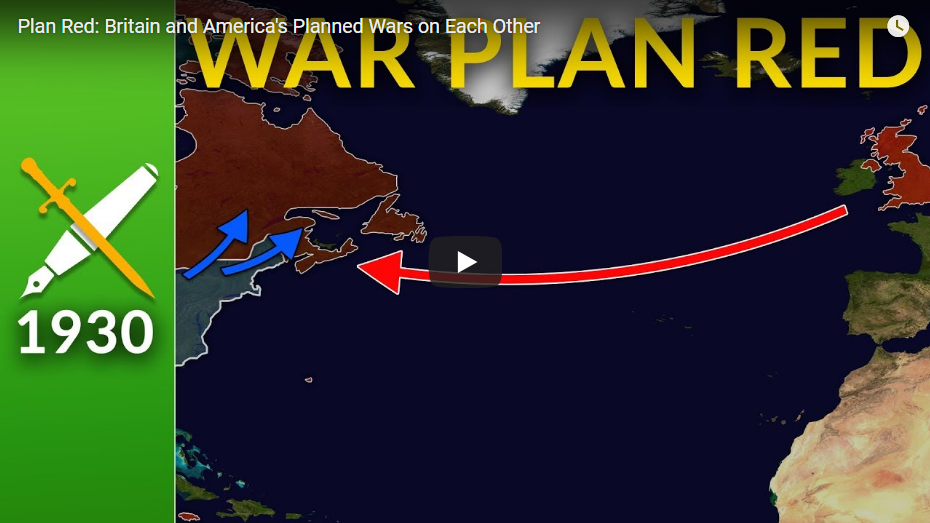
Plan Red: Britain and America’s Planned Wars on Each Other
Historigraph
Published on 27 Jan 2019If you enjoyed this video and want to see more made, consider supporting my efforts on Patreon: https://www.patreon.com/historigraph
Check out my other videos here: https://www.youtube.com/playlist?list…
#WarPlanRed #Historigraph
► Twitter: https://twitter.com/historigraph
►Patreon: https://www.patreon.com/historigraph
►Discord: https://discord.gg/f8JZw93
►My Gaming Channel: https://www.youtube.com/c/Addaway
►My Twitch: https://www.twitch.tv/addawaySources:
Christopher M. Bell, “Thinking the Unthinkable: British and American Naval Strategies for an Anglo-American War, 1918-1931”, The International History Review, Vol. 19, No. 4 (Nov. 1997).
Kevin Lippert, War Plan Red: The United States’ Plan to Invade Canada and Canada’s Secret Plan to Invade The United States (New York: Princeton Architectural Press, 2015)
Stephen Roskill, Churchill and the Admirals
Ben Wilson, Empire of the Deep: The Rise and Fall of the British Navy
The main economic damage of Brexit is the extended period of uncertainty
At the Continental Telegraph, Tim Worstall interprets a recent Bank of England recommendation to really mean “do Brexit” and “get it over with”:
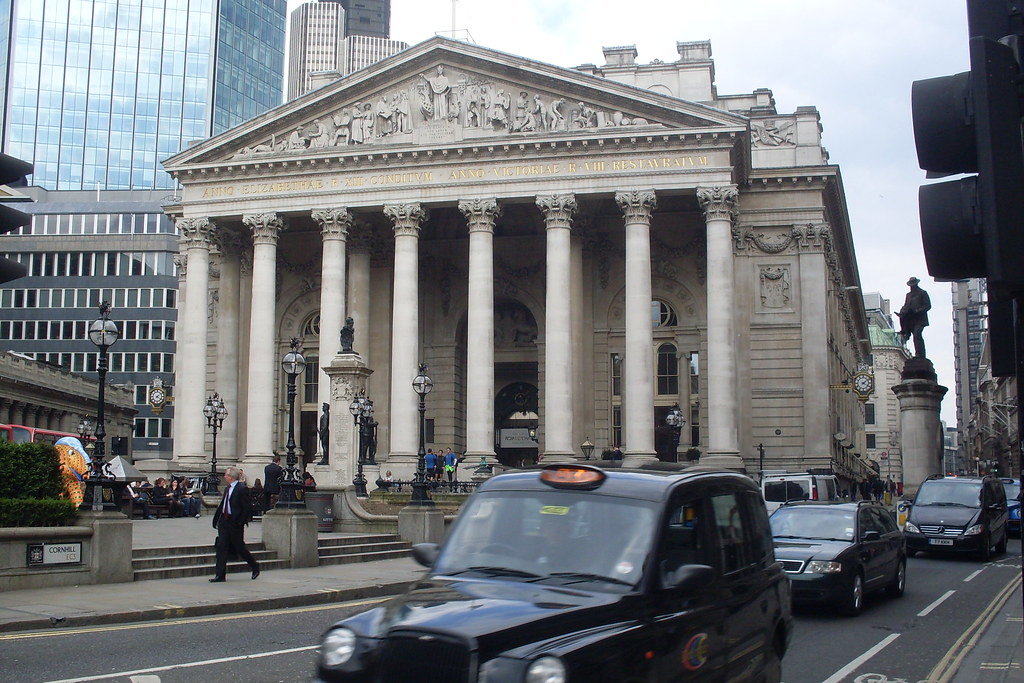
“The bank of England. London.”by Demetrio Neri_1959 is licensed under CC BY-NC-SA 2.0


To pull that out of the jargon, when every bugger’s running around screaming because they don’t know what’s going to happen then things are dark for the long term future of the economy. Just because the screaming and the running around means no bugger is doing anything else.
And here’s the thing – that lookin’ dark bit gets worse the longer the uncertainty lasts. To the point that the effect just of the not knowing becomes greater than the possible effect of any particular event in that universe of possibilities. It really is true that continuing to delay Brexit will, at some point, become worse than any particular Brexit outcome.
Thus get on with it, get it done. And given that we’ll get something of a bloody revolution if the Remainers win – we Brits being really quite keen on this democracy idea, we get to choose not they – then the getting on with it will have to be to leave. Yesterday would have been good, tomorrow if that’s not possible.
July 8, 2019
QotD: Orwell on capitalism versus socialism
Orwell’s press card portrait, 1943
No one can question the dirtiness of international politics from 1870 onwards: it does not follow that it would have been a good thing to allow the German army to rule Europe. It is just possible that some rather sordid transactions are going on behind the scenes now, and that current propaganda “against Nazism” (cf. “against Prussian militarism”) will look pretty thin in 1970, but Europe will certainly be a better place if Hitler and his followers are removed from it. Between them these two books sum up our present predicament. Capitalism leads to dole queues, the scramble for markets, and war. Collectivism leads to concentration camps, leader worship, and war. There is no way out of this unless a planned economy can somehow be combined with the freedom of the intellect, which can only happen if the concept of right and wrong is restored to politics.
Both of these writers are aware of this, more or less; but since they can show no practicable way of bringing it about the combined effect of their books is a depressing one.
George Orwell, “The Road to Serfdom by F.A. Hayek / The Mirror of the Past by K. Zilliacus”, Observer, 1944-04-09.


