
ReasonTV
Published on 2 Mar 2018Forget the Oscars! Here are five great movies made over the past quarter-century that any libertarian will (must?) enjoy.
_____The Incredibles (2004)
This Pixar film directed by Brad Bird is so full of speeches extolling individualism, it sometimes sounds like an Ayn Rand novel (in fact, Rand is clearly part of inspiration for the character of Edna Bird). Even the supervillain in The Incredibles is a creature of self-invention and self-improvement. While the Incredibles are born with their powers, Syndrome is a normie who worships Mr. Incredible and is desperate to be his sidekick.
Like an animated version of Richard Nixon, Syndrome’s ambition ultimately gets the best of him.
The Barbarian Invasions (2003)
Québécois director Denys Arcand’s brilliant sequel to The Decline of the American Empire is the single-best depiction of the depredations of socialized medicine. Canada’s health-care system is so sclerotic that the movie’s protagonist, a retired academic named Rémy, cannot even score the drugs he needs to commit suicide until his estranged son, a banker, buys them on the black market.
Even more disturbing is the moment when the terminally ill Rémy and his former colleagues admit that their intellectual faddishness led them to embrace every awful left-wing “ism” of the past 30 years despite their massive human toll.
Dallas Buyers Club (2013)
Set in the 1980s, Matthew McConaughey plays Ron Woodroof, a boozey roughneck who is given 30 days to live after being diagnosed with AIDS. Faced with a death sentence, he schools himself on a wide variety of treatments, first in Mexico and then all over the world. With the help of a cross-dressing party girl named Rayon, Woodroof skirts FDA prohibitions against importing, using, and selling unapproved drugs by creating a “buyers club,” in which members pay a monthly fee and assume all risks.
The depiction of official indifference to patient suffering and the bureaucratic quashing of medical freedom even for people who are certain to die is inspirational, especially now that even Donald Trump has endorsed “right-to-try” legislation that would allow terminally ill patients access to non-approved medicines.
Joy (2015)
Jennifer Lawrence became a mega-star playing the anti-government rebel Katniss Everdeen in The Hunger Games movies. While there’s no shortage of libertarian sentiment coursing through that trilogy, it’s actually a quieter movie starring Lawrence that embodies libertarian virtues of hard work, commercial innovation, and entrepreneurship.
In Joy, Lawrence plays real-life “Miracle Mop” inventor Joy Magano, who helped make cleaning your floors easier while making herself rich. The film is nothing less than a paean to capitalism’s genius at allowing self-expression and self-fulfillment.
In a dramatic scene with Bradley Cooper, who plays an executive at a home-shopping network, Joy summarizes in a few sentences what it took Joseph Schumpeter, Friedrich Hayek, and Milton Friedman whole books to say.
As former Reason Editor Virginia Postrel wrote, the film “acknowledges the wealth-creating value of incremental improvements even in the most mundane items.”
Ghostbusters (1984)
Released in 1984, Ghostbusters quickly became one of most successful comedies in film history.
The movie was perfectly in synch with the Reagan Revolution’s valorization of business and demonization of government. Ghostbusters begins with a team of paranormal investigators getting kicked out of Columbia University and starting a ghost-hunting business. But even though New York is literally being invaded by evil spirits, the real villain of the movie is not the otherwordly demon Gozer but an Environmental Protection Agency bureaucrat named Walter Peck, who shuts down their operation and puts the city at risk.
Well, what do you think? How far off the mark are we? What great libertarian movies would you add to the list? Let us know in the comments.
Produced by Todd Krainin. Written and narrated by Nick Gillespie.
March 3, 2018
5 Great Libertarian Movies!
March 2, 2018
Defining the Unemployment Rate
Marginal Revolution University
Published on 18 Oct 2016How is unemployment defined in the United States?
If someone has a job, they’re defined as “employed.” But does that mean that everyone without a job is unemployed? Not exactly.
A minor without a job isn’t unemployed. Someone who has been incarcerated also isn’t counted. A retiree, too, does not count toward the unemployment rate.
For the official statistics, you have to meet quite a few criteria to be considered unemployed in the U.S. For instance, if you’re without a job, but have actively looked for work in the past four weeks, you are considered unemployed.
In times of recession, when people are faced with long-term unemployment and lots of discouragement, the official rate might not count some of the people that you would otherwise consider unemployed.
This video will give you a clear picture of how the unemployment rate is defined and build a foundation for further understanding this important facet of labor markets.
QotD: Cronyism
… I would argue that we don’t have truly free trade or, increasingly, a free economy in the United States. The Progressives always look at the rising income inequality and maintain that it’s the inevitable result of capitalism. That’s hogwash, of course, and Proggies believe it because they’re dolts. But the problem in this country isn’t free trade — we have precious little of it — or unrestricted capitalism, since we have precious little of that as well. The issue behind rising income inequality isn’t capitalism, it’s cronyism. Income isn’t being redirected to the 1% because capitalism has failed, it’s happening because we abandoned capitalism in favor of the regulatory crony state and its de facto collusion between big business/banking interests and a government that directs capital to favored political clients, who become “too big to fail”. It doesn’t matter, for instance, whether the president is a Democrat or Republican, because we know the Treasury Secretary will be a former — and future — Goldman Sachs executive.
Indeed, what we call “free trade” nowadays isn’t the Theory of Comparative Advantage in action. It’s corporations being allowed to ship jobs to low wage countries overseas to offset the cost of regulatory burdens in the US that restrict competition from new entrants to the market. That works great for large corporations. Not only do they get to offset the regulatory costs by overseas production, but slower job growth in the US flattens domestic wages, too, and sends millions out of the labor force altogether. For working people, the biggest financial rewards from the current “free trade” regime seem mainly reaped by large business and banking interests. Again, people know if their own lives are better or worse than they used to be, and if the promises of elites have been born out by their own experience.
Dale Franks, “Vote Properly, You Virulent Racist!”, Questions and Observations, 2016-06-28.
February 28, 2018
China: Triumph and Turmoil, Episode 1 – Emperors
Niall Ferguson
Published on Jan 31, 2018Niall Ferguson shows how the vast apparatus of the Chinese state has always been called on to subjugate individual freedom to the higher goal of unity. Ferguson also examines how, on the other hand, centralized control produces tensions that threaten to destroy the country.
February 25, 2018
QotD: Trade deficits
No economic statistic is reported more dolefully these days than the country’s trade balance.
Ever on the alert for signs of impending economic disaster, the press routinely couples reports of record monthly trade deficits with warnings of experts and Government officials of the dangers of the deficit.
Just what is so dangerous about receiving more goods from foreigners than we give them back is never actually explained, but it is often suggested that that it causes a loss of American jobs.
News reports sometimes even provide estimates of the number of jobs lost owing to every billion dollar increase in the trade deficit. Heaven only knows how these estimates are made, but presumably they are based on the assumption that imports deprive Americans of jobs they could have had producing domestic substitutes for the imports.
It almost seems tedious to do so, but it apparently still needs to be pointed out that buying less from foreigners means that they will buy less from us for the simple reason that they will have fewer dollars with which to purchase our products.
Thus, even if reducing imports increases employment in industries that compete with imports, it must also reduce employment in export industries.
Moreover, the notion that the trade deficit destroys domestic jobs is contradicted by the tendency of the deficit to increase during economic expansions and to decrease during contractions.
The demand for imports rises with income, so imports normally tend to rise faster than exports when a country expands more rapidly than its trading partners. The trade deficit is a symptom or rising employment — not the cause of rising unemployment.
That balance-of-trade figures are misunderstood and misused is not surprising, since their function has never been to inform or to enlighten. Their real purpose is to provide spurious statistical and pseudo-scientific support to groups seeking protectionist legislation. These groups try to cloak their appeals to protection with an invocation of the general interest in a favorable balance of trade.
David Glasner, “What’s So Bad about the Trade Deficit?”, Uneasy Money, 2016-06-02 (originally published in the New York Times in 1984).
February 24, 2018
Is Unemployment Undercounted?
Marginal Revolution University
Published on 25 Oct 2016You may recall from our previous video that to be counted in the official unemployment rate in the U.S., you have to be an adult without a job and have actively looked for work within the past four weeks. That means that if someone has given up looking for a job, even if they want one, they are no longer counted under the official definition.
Does this mean that unemployment is undercounted? In other words, is the unemployment rate in fact higher than is reported?
Some have claimed this to be the case. However, unemployment is a tricky statistic. It’s important to consider that adults without jobs can fall into different categories. Many retirees, for example, are willing to leave retirement and take a job for the right price. If we are counting people that aren’t actively looking for employment, shouldn’t the retirees also be considered unemployed?
The simplest solution to this conundrum is to only count unemployed adults actively seeking work.
But what about discouraged workers — those who are unemployed and have not sought work in the past four weeks, but have sought work in the past year. Should we consider them in our calculations?
There are actually six different unemployment rates measured by the U.S. Bureau of Labor Statistics. The various rates have less and more stringent criteria. The official rate, called U3, falls somewhere in the middle. Another rate, called U4, does include discouraged workers in its calculation. All six rates follow a similar track over time.
So while the official unemployment rate may not be perfect, it does provide us with a good indicator of the state of the labor market and where it’s headed.
February 21, 2018
QotD: Regulation
… “regulation” could also be described as high-handed and ignorant interference in the mutually advantageous deals contracted voluntarily among the miserable serfs of the state, interference at best inspired by antique theories of natural monopoly and using antique policies appropriate to obsolete technologies, and at worst by conspiracies to benefit existing rich people, backed by state violence. Much of regulation, looked at coldly, would fall under such a definition, if not immediately on its passage, then after a few years of technological change or regulatory capture.
Deirdre N. McCloskey, Bourgeois Equality, 2016.
February 20, 2018
The EU transition period proposals “are the sort of terms which might be imposed by a victorious power in war on a defeated enemy”
Martin Howe on the way the European Union “negotiators” are treating the transition period for the UK as a re-run of the Versailles Treaty, with the UK substituted for the Kaiser’s Imperial Germany:
The European Union’s proposals for the UK’s transition period make grim reading. They are the sort of terms which might be imposed by a victorious power in war on a defeated enemy. They are not terms which any self-respecting independent and sovereign country could possibly agree to, even for an allegedly limited period.
Apparently, we must agree to implement every new EU law while having no say or vote; and we shall not be allowed to conclude trade agreements, even to roll over existing agreements which the EU has with other countries so that they continue to apply to us, without the EU’s permission. We must abide by the rulings of a foreign court on which there will no longer be any British representation.
Apparently, an outrageous and demeaning proposal by the Commission that the UK should be subject to extra-judicial sanctions under which the EU could suspend market access rights is now to be “re-worded”. But that would still leave the UK extremely vulnerable to damaging new rules being imposed on us during the transition period by processed in which we would have no vote and no voice. As reported in the Telegraph last week, the EU has plans to use these powers in order to launch regulatory “raids” on financial institutions on British territory and to make rules which will damage the competitiveness of the UK’s financial services industry.
But quite apart from the totally unacceptable terms for the transition period itself which are being proposed by the EU, the EU is seeking to use the transition period deal as a lever to secure damaging long term commitments from the UK. The most damaging of these is the EU’s attempt to lever the Irish border issue in order to force the UK to act as a long term captive market for EU goods exports by pressing for legally binding text that would force us into a long term obligation to comply with EU tariffs and regulations on standards of goods, on the specious ground that it is impossible to have an open border without all tariffs and regulations being the same.
There should be no doubt that being required to follow either EU tariffs or EU standards on goods would be a total disaster for the UK. It would make it difficult or impossible to conduct an independent trade policy, and to negotiate trade agreements with non-EU countries. How could we expect any significant trading partner to be willing to enter into an agreement with us, if we tell them that we cannot grant mutual recognition to their own goods standards because our own are permanently regulated by the EU? And how can subordinating the UK to the vassal status of taking rules on which we have no vote possibly be compatible with the British people’s vote to take back control of our laws and our courts?
February 19, 2018
Graphing good news
In the Times Literary Supplement, David Wootton reviews Enlightenment Now: A manifesto for science, reason, humanism and progress by Steven Pinker:
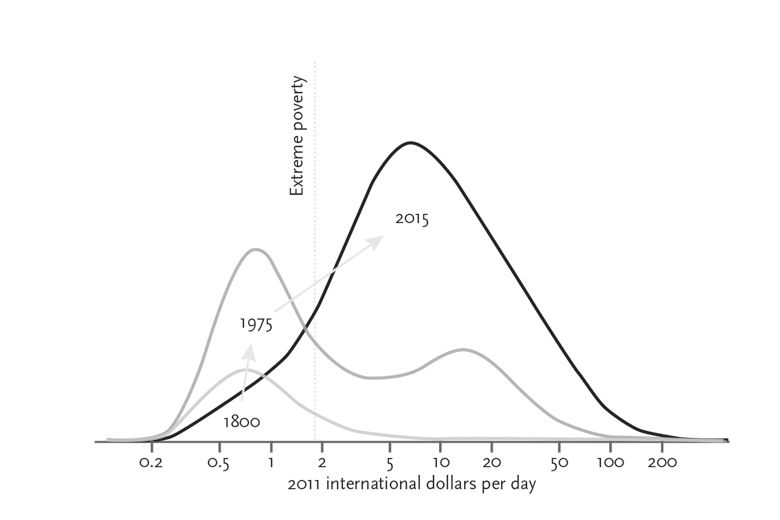
This book consists essentially of seventy-two graphs – and, despite that, it is gripping, provocative and (many will find) infuriating. The graphs all have time on the horizontal axis, and on the vertical axis something important that can be measured against it – life expectancy, for example, or suicide rates, or income. In some graphs the line, or lines (often the graphs compare trends in several countries) fall as they go from left to right; in others they rise. In every single one, the overall picture (with the inevitable blips and bounces) is of life getting better and better. Suicide rates fall, homicides fall, incomes rise, life expectancies rise, literacy rates rise and so on and on through seventy-two variations. Most of these graphs are not new: some simply update graphs which appeared in Pinker’s earlier The Better Angels of Our Nature (2011); others come from recognized purveyors of statistical information. The graphs that weren’t in Better Angels extend the argument of that book, that war and homicide are on the decline across the globe, to assert that life has been getting better and better in all sorts of other respects. The claim isn’t new: a shorter version is to be found in Johan Norberg’s Progress (2017). But the range and scope of the evidence adduced is new. The only major claim not supported by a graph (or indeed much evidence of any kind) is the assertion that all this progress has something to do with the Enlightenment.
Since the argument of the book is almost entirely contained in the graphs, those who want to attack the argument are going to attack the figures on which the graphs are based. Good luck to them: arguments based on statistics, like all interesting arguments, should be tested and tested again. Better Angels caused a vitriolic dispute between Pinker and Nassim Nicholas Taleb as to whether major wars are becoming less frequent. In Taleb’s view the question is a bit like asking whether major earthquakes are getting less frequent or not: they happen so rarely, and so randomly, that you would need records going back over a vast stretch of time to reach any meaningful conclusion; a graph showing falling death rates in wars over the past seventy years won’t do the job. But it certainly will tell you that lots of generalizations about modern war are wrong. Much, indeed most, of Pinker’s argument survived Taleb’s attack, which in any case was directed at only one graph among many.
A more radical line of criticism of Better Angels came from John Gray. How can one find a common standard of measurement for the suffering of a concentration camp victim, of a soldier who died in the trenches, and of someone killed in the firebombing of Dresden? To turn to economics, how can one find a common standard of measurement for books and washing machines, oranges and steak pies? Money, you might think, provides that standard, but what happens if many of the goods being measured – electric lighting, cars, televisions, computers – get cheaper and cheaper as time goes on, so that a rising standard of living is concealed by falling prices? For Gray, to place one’s faith in statistics, which claim to be measuring the unmeasurable, is no different from believing in conversations with angels or in the efficacy of Buddhist prayer wheels. Quantification is our religion.
February 17, 2018
The great enrichening of 1960-2016
Marian Tupy explains why all the Malthusian worry about overpopulation in the Third World was wrong:
Many people believe that global population growth leads to greater poverty and more famines, but evidence suggests otherwise. Between 1960 and 2016, the world’s population increased by 145 percent. Over the same time period, real average annual per capita income in the world rose by 183 percent.
Instead of a rise in poverty rates, the world saw the greatest poverty reduction in human history. In 1981, the World Bank estimated, 42.2 percent of humanity lived on less than $1.90 per person per day (adjusted for purchasing power). In 2013, that figure stood at 10.7 percent. That’s a reduction of 75 percent. According to the Bank’s more recent estimates, absolute poverty fell to less than 10 percent in 2015.
Rising incomes helped lower the infant mortality rate from 64.8 per 1,000 live births in 1990 to 30.5 in 2016. That’s a 53 percent reduction. Over the same time period, the mortality rate for children under five years of age declined from 93.4 per 1,000 to 40.8. That’s a reduction of 56 percent. The number of maternal deaths declined from 532,000 in 1990 to 303,000 in 2015 — a 43 percent decrease.
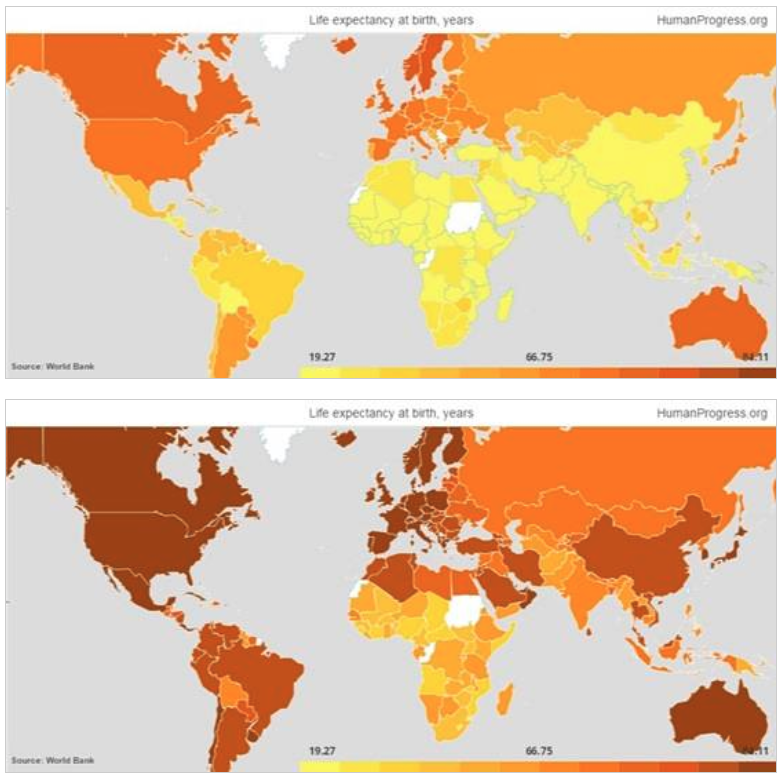
Famine has all but disappeared outside of war zones. In 1961, food supply in 54 out of 183 countries was less than 2,000 calories per person per day. That was true of only two countries in 2013. In 1960, average life expectancy in the world was 52.6 years. In 2015, it was 71.9 years — a 37 percent increase.
In 1960, American workers worked, on average, 1,930 hours per year. In 2017, they worked 1,758 hours per year — a reduction of 9 percent. The data for the world are patchy. That said, a personal calculation based on the available data for 31 rich and middle-income countries suggests a 14 percent decline in hours worked per worker per year.
And because everyone loves pictures, here’s one from an earlier article by the same author showing increases in life expectancy between 1960 (top) and 2015 (bottom):
February 16, 2018
Games Should Not Cost $60 Anymore – Inflation, Microtransactions, and Publishing – Extra Credits
Extra Credits
Published on 24 Jan 2018You would think that paying $60 for a game would be enough, but so many games these days ask for money with DLC, microtransactions, and yes, lootboxes. There’s a reason for that.
QotD: It’s not economics, it’s magic!
People who really believe that trade restrictions prevent domestic unemployment or raise domestic wages – people who really believe that minimum wages raise the incomes of low-skilled workers without causing any loss of employment or worsening of other terms of these workers’ jobs – people who really believe that government-mandated family leave leaves workers better off – are like people who attend magic shows and really believe that the magician causes a rabbit to materialize out of the thin air within the magician’s hat.
“Wow!” exclaims an audience member. “I saw with my own eyes the magician pull a rabbit from a hat that only a moment earlier was empty! And also, the magician assures me that that’s what he did. He wouldn’t lie to me. So it must be true that the magician pulled a rabbit miraculously from his hat – that he bends reality to his will. I’m impressed!!”
These people believe their eyes. And why shouldn’t they? The empirical record, after all, is stuffed with rabbits being pulled from magicians’ hats – hats that audiences saw were empty just moments before live rabbits were pulled from them. What’s not to believe?
Don Boudreaux, “Do You Believe in Magic?”, Café Hayek, 2016-06-22.
February 15, 2018
The rise of the bourgeoisie
Ed West on the beginning of the end of military aristocracy in Europe and the rise of the merchant class:
The medieval system began with the Franks, whose mastery of cavalry made them the most powerful tribe in the former western empire. Later, the Normans used horses in far larger numbers and developed the cavalry charge, used to lethal effect at the Battle of Hastings. Cavalry underpinned the European social order because only those with a reasonable amount of land could afford the destrier warhorse, which cost 30 times as much as a regular farm animal and could carry up to 300lbs in weight, including 50lbs of iron armor — itself very costly.
The sons of the aristocracy were mostly schooled in warfare from a young age and despised learning and trade, which were viewed as dishonorable, leading to an excess of landless younger sons whose only skill was fighting, many of whom found their way to wars, or caused them, or made a living at absurdly dangerous tournaments. Cavalry developed certain rules — chivalry, which primarily concerned the treatment of aristocratic prisoners — as well as an idealization of the aristocratic warrior through the stories of Arthur, Lancelot, and Roland that singers recited at the courts of dukes and counts.
This order was first shaken in 1302 when France’s cavalry confidently marched north to suppress a revolt by the Flemish. Flanders is not naturally rich in resources — Vlaanderen means flooded — but its people had turned swamps into sheep pastures and towns, building a cloth industry that made it the wealthiest part of Europe, its GDP per capita 20 percent greater than France and 25 percent better than England. The wealth of Flanders’ merchants was such that when Queen Joan of France visited, she afterward wrote in horror that: “I thought I would be the only queen there, but I find myself surrounded by 600 other queens.”
The Flemish were traders, not knights, which is why the French were sure of victory. And yet, with enough money to pay for a large, well-drilled infantry, they were able, for the first time, to destroy the cavalry at the Battle of the Golden Spurs. It was the beginning of the end. No longer could the aristocracy simply push around the bourgeoisie, and as the latter grew in strength, it undermined the violence-obsessed culture of the nobility.
[…]
The aristocratic class that wished for glory in battle was in retreat, and yet, despite this, won the narrative. While in exile in Burgundy, King Edward had met a London merchant by the name of William Caxton who in his spare time transcribed books for aristocratic women. Exhausted at the toll of work, he learned through business contacts of a new technology in Germany, called movable type; when Caxton brought a printing press back home one of the most successful books he published was Thomas Malory’s The Death of Arthur.
It became the influential work in celebrating the Heroic Narrative of the Middle Ages, but the aristocratic ideals it harked back to were mostly a sham and ultimately rested on the rusty sword (and Malory was a convicted rapist). No account of any trader or banker could ever compete with these knights’ tales, of course, and yet you could argue that they were the real heroes who shaped our world.
QotD: Computer models
How can one be certain about outcomes in a complex system that we’re not really all that good at modeling? Anyone who’s familiar with the history of macroeconomic modeling in the 1960s and 1970s will be tempted to answer “Umm, we can’t.” Economists thought that the explosion of data and increasingly sophisticated theory was going to allow them to produce reasonably precise forecasts of what would happen in the economy. Enormous mental effort and not a few careers were invested in building out these models. And then the whole effort was basically abandoned, because the models failed to outperform mindless trend extrapolation — or as Kevin Hassett once put it, “a ruler and a pencil.”
Computers are better now, but the problem was not really the computers; it was that the variables were too many, and the underlying processes not understood nearly as well as economists had hoped. Economists can’t run experiments in which they change one variable at a time. Indeed, they don’t even know what all the variables are.
This meant that they were stuck guessing from observational data of a system that was constantly changing. They could make some pretty good guesses from that data, but when you built a model based on those guesses, it didn’t work. So economists tweaked the models, and they still didn’t work. More tweaking, more not working.
Eventually it became clear that there was no way to make them work given the current state of knowledge. In some sense the “data” being modeled was not pure economic data, but rather the opinions of the tweaking economists about what was going to happen in the future. It was more efficient just to ask them what they thought was going to happen. People still use models, of course, but only the unflappable true believers place great weight on their predictive ability.
Megan McArdle, “Global-Warming Alarmists, You’re Doing It Wrong”, Bloomberg View, 2016-06-01.


