
I believe, and I have alluded to this several times, that we must anchor all our policies in North America. We are, I have said, again more than once, bound by what some wag called TINA²: we are Trapped In North America and There Is No Alternative. (TINA X TINA = TINA²) That’s the crux of it … no matter what some romantics might wish we are and must remain for generations anchored in North America. We are not big enough and rich enough to be powerful enough to face the world on our own, treating the USA as just another great power ~ as, arguably, Australia does. Geography, economics, personal issues ~ we are kith and kin ~ and the power imbalance make us dependent upon America to a degree that some, including me, find unhealthy.
But, until we can grow our population to 100 million, until we can grow up and appreciate that we need substantial hard (military) power in order to promote and protect our vital interests around the globe, until we can become a global free trader, and until America’s decline is more marked then There Is No Alternative … we are Trapped In North America ~ trapped in Donald Trump’s America, for now, anyway.
Ted Campbell, “Anchor, cornerstone or stumbling block?”, Ted Campbell’s Point of View, 2018-07-17.
August 17, 2018
QotD: TINA
August 15, 2018
QotD: State economic intervention in theory and practice
The economic theory: the state intervenes in the economy in order to prevent free-riding – in order to internalize externalities – in order to better ensure that all private parties pay the full marginal costs of their activities, and that all private parties reap the full marginal benefits of their activities – in order to promote competition – in order to protect the weak from the strong.
The political reality: the state intervenes in the economy in order to promote free-riding – in order to externalize costs and benefits that the market has reasonably internalized – in order to better ensure that politically powerful private parties escape the full marginal costs of their activities, and that politically disfavored groups be stripped of much of the marginal benefits of their activities – in order to promote monopoly – in order to render some people weak who are then pillaged by the strong.
Don Boudreaux, “Economists’ Normative Case for Government Intervention is a Very Poor Positive Theory of that Intervention”, Café Hayek, 2016-09-26.
August 14, 2018
QotD: The money pump
I would like to introduce you to the idea of a money pump. A money pump is a person whose irrationalities can be systematically exploited for financial gain. The simplest money pump is a person who prefers an apple to a doughnut, prefers a doughnut to a chocolate bar, and prefers a chocolate bar to an apple. Just offer them an apple in exchange for their doughnut plus a penny. They will accept. Then offer them a chocolate bar for their apple plus a penny. Then offer them a doughnut for their chocolate bar plus a penny. They end up with their original doughnut and are three pence poorer. Repeat for ever.
Money-pump arguments are sometimes deployed to object that people cannot be irrational, otherwise they would be bankrupted by money pumping. But economists are increasingly coming to realise that, instead, we should be looking for money pumping in action.
Given our anxiety about small risks, what would the money pumping look like? It would be an insurance policy focused on the narrowest possible slice of risk. It would be sold alongside another product or service, often at the last moment. It would be marketed by creating anxiety and then offering the product to make the anxiety go away. In short, it would look like the collision damage waiver, the extended warranty, and PPI [payment protection insurance]. These bespoke slices of insurance are among the largest money-pumping projects in the modern economy. No wonder the banks abandoned their principles to join in.
Tim Harford, “How insurers keep the money-pump flowing”, TimHarford.com, 2016-09-21.
August 12, 2018
Misunderstanding what the trade deficit represents
In a post from last week, Tim Worstall explains why Donald Trump is wrong about the economic impact of a trade deficit:
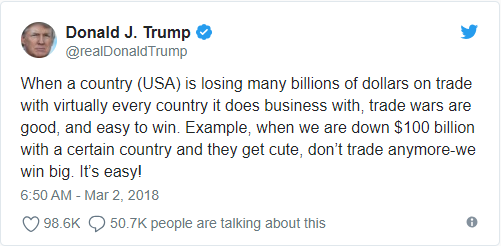
I should note here that I didn’t, because as a foreigner I can’t, support The Donald at the last election. But I didn’t support Hillary even more. So this is more about really, actually, insisting that Trump is wrong on trade issues rather than just the more general he’s wrong about everything common in the US press.
[…]
What Trump, DiMicco and Navarro are getting wrong is this, the GDP equation.
Y = C+I+G+(X-M)GDP is consumption plus investment plus government spending plus the trade balance – and minus it if there’s a trade deficit. So people look at this and think yep, if there’s a trade deficit than that makes Y, GDP, smaller!
But this is a mistake, an error. For, as the textbook immediately goes on to explain, what is it that we do with imports? Well, we either consume them, use them in investments or government buys them. So all imports are already in C and I and G. Meaning that if we don’t deduct them we’ll be double counting them. So, to avoid double counting we subtract them.
Trump and his advisers are simply wrong on this. The trade deficit doesn’t reduce the size of the economy. They’re getting it wrong simply because they’re not reading the second page of the explanation of the GDP equation.
August 10, 2018
The tough part of selling a national carbon tax … is the “tax” part
As Colby Cosh points out, you can find all sorts of economists to explain why a properly constructed and applied carbon tax is the least harmful way to reduce carbon output, but Canadians typically focus on the “tax” part and not the claimed environmental efficiency benefits:
In yesterday’s Financial Post, the Calgary economist Jack Mintz asked the question “Why are carbon taxes so unpopular?”, pointing out that plenty of countries and jurisdictions have commitments to climate progress and energy efficiency but that few use this particular policy instrument. I guess Jack wouldn’t have had much of a column if he had just adopted the spirit of an auto mechanic explaining a breakdown to a naive car owner and jabbed directly at the problem. “See that word ‘taxes’? There’s your problem right there.”
And, truly, it is not quite as simple as that. But, as Mintz suggests, it is a big part of the difficulty. As a means of helping reduce carbon output, carbon taxes are competing with subsidies and regulations. Pervasive carbon taxes are, as a general principle, a less costly way of eliminating freely exhaled carbon, pound for pound or ton for ton.
If the tax is well designed, you are slapping a uniform unit price directly onto the thing you are trying to prevent; and you are leaving people and businesses to make decentralized judgments, based on their knowledge of their own circumstances, about whether to avoid the tax, and when, and how to do it. Even though the initial level of the tax must be something of a guess, you can adjust it by arbitrarily small increments until you have eliminated just as much carbon output as you wish to.
Economists will recognize that last paragraph as a grocery list of the relative advantages of carbon taxation. But voters are predisposed to hate taxes, and are very sensitive to their size and their side effects. They may not like government subsidies for windmills or carbon-capture schemes or certain species of light bulb either; but subsidies can usually be sold on the basis of local job creation or business incubation, and they can be — let’s face it, inevitably are — adjusted for maximum electoral benefit.
For my part, I don’t disbelieve the economists on the efficiency arguments … I just don’t trust the government to design and implement such a tax without rigging the system to benefit favoured corporations, regions, and donors.
QotD: Demands for “fair” trade
Whenever you hear someone demand that trade be made “fair” – whenever you hear someone plead for trade to be conducted on a “level playing field” – you can bet your pension that you are hearing a domestic producer, or its spokesperson, soliciting the state for protection from competition. You are hearing sweet words mask a sour plea for monopoly power. You are hearing a greedy corporation or other politically powerful producer group appeal to those who hold power that that power be wielded against fellow citizens who dare to spend their own money in ways that promote their and their families’ best interests rather than in ways that promote the interests of the greedy corporation or other politically powerful producer group.
You are hearing, in short, a seeker of unfair privilege – a demander that the playing field be tilted against consumers’ and society’s broad interests and toward its own narrow interests.
Don Boudreaux, “Quotation of the Day…”, Café Hayek, 2016-11-01.
August 9, 2018
Quantity Theory of Money
Marginal Revolution University
Published on 17 Jan 2017The quantity theory of money is an important tool for thinking about issues in macroeconomics.
The equation for the quantity theory of money is: M x V = P x Y
What do the variables represent?
M is fairly straightforward – it’s the money supply in an economy.
A typical dollar bill can go on a long journey during the course of a single year. It can be spent in exchange for goods and services numerous times. In the quantity theory of money, how many times an average dollar is exchanged is its velocity, or V.
The price level of goods and services in an economy is represented by P.
Finally, Y is all of the finished goods and services sold in an economy – aka real GDP. When you multiply P x Y, the result is nominal GDP.
Actually, when you multiply M x V (the money supply times the velocity of money), you also get nominal GDP. M x V is equal to P x Y by definition – it’s an identity equation.
You can think about the two sides of the equation like this: the left (M x V) covers the actions of consumers while the right (P x Y) covers the actions of producers. Since everything that is sold is bought by someone, these two sides will remain equal.
Up next, we’ll use the quantity theory of money to discuss the causes of inflation.
August 7, 2018
“[Trudeau’s] ideology is jeopardizing 20% of the Canadian economy”
Brandon Kirby on Prime Minister Justin Trudeau’s failing efforts to negotiate with the United States on trade:
Trade with Canada constitutes 2% of America’s GDP and trade with America constitutes a whopping 20% of Canada’s GDP. My home province of New Brunswick finds 50% of its private sector exporting to the U.S. – NAFTA is of vital importance to our economy.
The dwindling efforts of Trudeau’s cabinet to negotiate a deal with the Americans could become his government’s greatest failure. With tariffs already being imposed on steel and aluminum, NAFTA is potentially unraveling before our eyes and along with it, the Canadian economy.
Trudeau’s American counterpart isn’t known for his vocal support of trade and yet he handed Canada everything on a silver platter at the recent G7 summit. He offered to remove all tariffs and subsidies on imports and exports, provided Canada did the same. This is about as fair an offer as one could expect. Trudeau retaliated by insisting Canada had been insulted.
The trouble with Trudeau is precisely that. He was given a talking point. He developed rhetoric rather than substance. Akin to Marco Rubio’s disaster of a debate performance, who refused to go off script even when he was being called out for scripted answers, Trudeau had a talking point. It was a good one, Canadians and Americans died together in the mountains of Afghanistan to bring justice for Americans who died on September 11th. Trump alluded to our tariffs on their dairy farmers as a national security threat. But when Trump acquiesced, Trudeau kept to his talking points and refused to go off script, even when his talking points no longer made sense.
The initial renegotiation began with Trudeau’s government attempting to include a chapter on gender. The Americans weren’t enthusiastic about devoting a significant portion of their time at the negotiations to discussing an unenforceable chapter of the deal, but Trudeau pressed on.
The liberal rationale in the briefing notes was leaked, “Think back 20 years and remember the early discussions of labour and environment in the context of trade agreements.”
Environmental and labour standards were included in the negotiations of decades past because a country that has humane labour standards is at a trade disadvantage to countries that neglect their workers and their environment. Gender doesn’t have any bearing on trade. His ideology is jeopardizing 20% of the Canadian economy.
Grasping at straws to virtue signal
Richard Morrison points out just how banning plastic straws will not do anything meaningful to save the environment, but will definitely have a negative impact on consumers:
Of all the consumer products one might have expected to become a flashpoint for political controversy, the humble plastic drinking straw is an unlikely contender. Leap into the headlines it has, though, with communities like Seattle and San Francisco recently enacting bans on disposable straws. The city council of Santa Barbara, California, initially voted for a ban that would have punished restaurant workers with up to six months of jail time for giving out a disposable plastic straw, but city officials agreed to revisit the ordinance when it appeared to also ban the sale of straws at supermarkets.
[…] the case against the plastic straw is exceedingly weak. There aren’t as many plastic straws thrown away as claimed, and only a tiny portion of U.S. straws end up anywhere near the oceans — the vast majority of municipal solid waste in this country ends up either buried in landfills, recycled, or burned up in incinerators, far from any congested sea turtles.
The vast majority of plastic waste in oceans actually comes not from advanced countries like the U.S. but from countries like China and Indonesia that consume a large volume of plastic products but lack our modern waste collection infrastructure. Much of their plastic waste ends up washed into major river systems that empty into the oceans. A study published last year in the journal Environment Science & Technology by three German researchers found that 90 percent of the plastic debris found in the world’s oceans is dumped there by just ten of the world’s rivers — none of which are in the Western Hemisphere, much less the United States.
Beside the fact that U.S. consumers are contributing very little to the ostensible problem is the other side of the equation: the benefits of the straws themselves. I suspect many Americans who were initially receptive to the idea of a ban were genuinely surprised to learn that disposable drinking straws are very important to people with certain disabilities. British disability rights activist Penny Pepper recently commented in the Guardian about how she depends on plastic straws — and other single-use, disposable products like baby wipes — writing “I don’t have the luxury of a plastic-free life.” The durability, convenience, cleanliness, low price, and resistance to heat of disposable plastic straws make them irreplaceable to people with many different physical limitations.
Vancouver, as any Canadian would have guessed, was the first Canadian city to pick up on this particular variant of virtue signalling.
August 5, 2018
QotD: Risk aversion
… let’s step back and ask ourselves what insurance is for. Classical economics has an answer: people are risk-averse, which means that they will pay good money to reduce the variability of outcomes they face. If home insurance guards against the loss of a million pounds when my house burns down, I’m happy to buy the insurance even though the insurance company expects to make a profit from it.
But this risk aversion emerges from the fact that money is worth more to poor people than to rich people. Gaining a million pounds would make me rich but losing a million pounds would make me poor. I should not gamble a million pounds on the toss of a coin, because the million pounds I might lose is more precious to me than the million pounds I might gain.
As so often with classical economics, this is an excellent description of how we should behave. It is not such an excellent description of how we actually do behave. Risk aversion can only explain why we insure large risks. It cannot explain why we insure small ones. This is because risk aversion turns on the idea that an extra pound is worth more if you are poor than if you are rich. But having to replace a phone is not going to make the difference between poverty and wealth.
In one of my favourite economics articles, written in 2001, the behavioural economists Richard Thaler and Matthew Rabin point out that anyone who rejects a 50/50 gamble to win £10.10 or lose £10 — apparently a reasonable enough taste for caution — cannot possibly be doing so because of risk aversion. (The degree of risk aversion necessary would mean that the same individual wouldn’t risk £1,000 on the toss of a coin for all the money in the world.) Risk aversion simply cannot explain why anyone would turn down that fractionally favourable gamble. And it cannot explain why anyone would insure a mobile phone.
A better explanation is that we tend to view risks in isolation. Rather than telling ourselves “a lost mobile phone would lower my lifetime wealth by 0.005 per cent”, we tell ourselves “it would be so annoying to have to pay for a new mobile phone”. Isolating and obsessing about risks in this way is arbitrary and illogical. But that does not mean we don’t do it.
Tim Harford, “How insurers keep the money-pump flowing”, TimHarford.com, 2016-09-21.
August 4, 2018
QotD: Supply and demand
… that terribly simplistic stuff about supply and demand in those econ 101 classes is actually true. Prices are not some arbitrary numbers thrown at something by the capitalist neoliberals in order to do down the proletariat. They’re vital and essential information about who wants what and who is willing to produce what. Where the supply and demand curves meet is where the market will clear and the market price will be the market clearing price. The meaning of this is that when you decide to arbitrarily throw a price at something you’re going to up set that balance. And if you tell producers that the price will be lower than the market one then they will produce less. And as demand curves slope downwards so will consumers desire more at that lower price. Thus price fixing below the market price produces a shortage, a dearth.
This is not some optional feature, it’s an essential fact about our universe. It is the explanation for those food shortages that Venezuela has been having. More than that it’s the only explanation we need or desire. Fix prices below the market price and you will have shortages. Stop fixing prices and you will stop having shortages.
So, well done to Venezuela for giving in to reality there. And this is something that we need to take on board too. Rent controls which fix the price of housing below the market price will lead to a shortage of housing. And the opposite applies too – fix the price of labour above that market price with a minimum wage and you’ll have an excess supply of labour. Or, as we usually call that, an excess of unemployment.
The price of something simply is the price of something and don’t ever forget it.
Tim Worstall, “Congratulations To Bolivarian Socialism – Finally A Sensible Economic Policy In Venezuela”, Forbes, 2016-10-15.
August 2, 2018
QotD: Economic complexity
“Progressives” mistake as “science” their habit of lumping countless idiosyncratic individuals and things, each always in an ever-changing set of deeply nuanced circumstances, into catch-all categories (such as “consumers,” “labor,” “government,” “the environment,” “the health-care sector,” “the money supply,” “the unemployment rate,” “the capital stock,” and “imports”) and then theorizing about how these big blobs of people and things interact with each other, and how these interactions can be “improved” by an apolitical, loving, intelligent, ever-diligent scientific guiding hand. That professors and their graduate students can assemble data on each of these big blobs of people and things, can write intricate equations describing mathematically how the professors and their graduate students imagine these blobs interacting with each other, and use the gathered data and sophisticated software to “test” the equation-ladened “models” seems oh-so-objective and truly scientific.
Yet most such exercises are b.s. Far too many of these exercises, when done by economists, are done in utter disregard of the meaningful, if impossible to observe from afar, differences that separate from each other each of the individuals and things that comprise each constructed blob. Far too many of these exercise are done by people whose impressive, deep, and vast knowledge of econometric techniques does not begin to compensate for their innocence of price theory, of history, and of formal and informal institutions.
Correctly taught and understood, economics reveals that reality is vastly more complex than the economically untutored mind realizes. Yet this message of complexity is unwelcome by those who want to rule and command. The reason is that to understand the reality of reality’s complexities is to understand that ruling and commanding – the actions of the “man of system” – can only worsen most individuals’ lives. Ruling and commanding of the sort that “men – and women – of system” itch to do can only disrupt for the worse, and not improve for the better, the spontaneous forces of society.
Don Boudreaux, “Quotation of the Day…”, Café Hayek, 2016-09-20.
July 31, 2018
A gruesome experiment in determining the actual need for social housing
Tim Worstall discusses an aspect of the terrible Grenfell Tower fire in London that I hadn’t considered:

The fire at Grenfell Tower in London, 14 June 2017.
Photo by Natalie Oxford via Wikimedia Commons
That the Grenfell Tower fire was a tragedy is obvious. That lessons need to be learned is equally so. At which point, OK, which lessons would we like to learn? One that would be useful is to work out how much of social housing in London – for that’s what the evidence allows us to estimate – is illegally sublet. Or, as we might also put it, how much social housing in London is not actually needed as social housing?
For sublets are, by their nature, at something close to market rents, the difference between those and the social rents being pocketed by those doing the renting out.
No, we don’t know and that might be just because we’ve not been paying the detailed attention required. But it’s also something we tend to think will have been glossed over in investigations into the events. Something that perhaps should not have been glossed over – if indeed it has.
[…] The thought that a place, in the centre of London, where we could house – safely perhaps this time – several hundred people not be used to house several hundred people? We have a housing shortage or not?
However, it’s the insight into that larger question that interests. We know that some amount of social (and or council) housing in London is illegally sublet. The very fact that it is shows that it’s not needed. Those who are paying the landlord a reduced rent clearly don’t need the property as they’re not living in it. Those paying the near market rents don’t need social housing as they’re paying near market rents. Thus subletting shows that the entire structure of – at least in that instance – the social rent isn’t necessary.
So, how prevalent is it? We know that some of it occurred at Grenfell. We’ve all admitted it, clearly, for we’ve not insisted that only those on the tenants’ listing are those who should be granted aid for having had their home burned down. So, we know there’s some. So, how much?
It’s unlikely that we’ve as much information on this concerning any other building in the country. Thus this is an excellent place to actually conduct such research.
QotD: Hostility to international trade
Much suspicion of, and hostility to, international trade is akin to atavistic superstitions that raised in some peoples suspicions of, and hostility to, mating with individuals outside of those people’s ethnic or racial or religious groups. “Only We are worthy of your seed or your womb – They are not!” “Corruption of the purity of Our race is the inevitable result of your conjugal mixing with Them!”
Or only slightly differently: protectionism is much like in-breeding. Like in-breeding, protectionism weakens the economy that practices it. Like in-breeding, protectionism causes the group that practices it to become ever-more stupid, uncreative, fragile, and vulnerable – a population of pathetic misfits destined to be weaker and poorer than are their more-cosmopolitan and open neighbors.
Don Boudreaux, “Quotation of the Day…”, Café Hayek, 2016-09-14.


