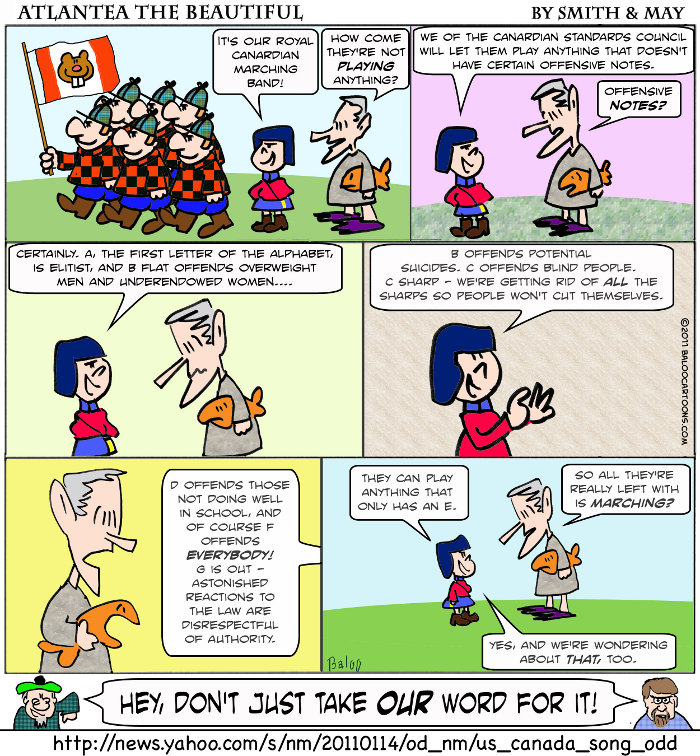
Link to news.yahoo.com/s/nm/20110114/od_nm/us_canada_song_odd.
Cartoon from this week’s edition of Libertarian Enterprise.

Link to news.yahoo.com/s/nm/20110114/od_nm/us_canada_song_odd.
Cartoon from this week’s edition of Libertarian Enterprise.
Publius has a post up with the interview of Christie Blatchford, author of Helpless on Steve Paikin’s TVO show The Agenda.
If Toronto was part of Canada, why would a forecast of five centimetres of snow (that’s about two inches) require a special weather statement from Environment Canada?
Really, Toronto? Five measly centimetres and you need a special “OMG! Snow!” notice from the weather folks? That’s too silly for parody.
I mentioned it to Elizabeth before starting this post, and she suggested that it’s another attempt to set up the media template for next year: “Look at the huge increase in special weather statements for the GTA over the last few years. Clearly this proves [global warming | climate change | climate chaos] is real.”
Banned on the radio in Canada, but still (for the moment) legal on the internet:
Update, 14 January: I’ve been informed that this video isn’t playing for some, and it’s not working for me now either. I guess it’s another one of those content licensing issues. So I guess I’ll have to make this change:
Banned on the radio in Canada, but still (for the moment) legal on the internet. Banned on the radio in Canada, AND on the internet.
Canadians often have a disturbing eagerness to see themselves coming out atop various world rankings. Let a UN agency or a big NGO list Canada in the top five of any kind of list and they practically declare a national day of celebration . . . it’s kinda pathetic, actually.
Andrew Coyne finds a list that nobody in Canada will find as a source of national pride:
Indeed, for sheer mind-numbing, soul-destroying aggravation, traffic in our largest cities can compete with any in the developed world. A Toronto Board of Trade report earlier this year looked at commuting times in 19 major European and North American cities. Toronto’s ranking? Dead last: worse than New York or London, worse than Los Angeles. But other Canadian cities were scarcely better. Montreal was 18th, Vancouver 14th, Calgary 13th, Halifax 10th.
So, what’s the answer? Ban private vehicles and load everybody into mass transit? If anything would turn Canadians away from their “peace loving” self-image, that might well do it. Canadians love their cars as much as any other western country and more than most. There’s also the fact that for most commuters, taking public transit would increase, not decrease their commuting time.
The reason is simple: it’s quicker by car. As bad as the commute is for drivers, it’s much worse for public transit users: 106 minutes, versus 63 minutes by car. Granted, part of the reason it takes so long to get anywhere by transit is because of all the cars blocking the way. But you’d have to persuade an awful lot of those drivers to give up the comfort and convenience of their cars to put much of a dent in that. And they’d still take longer to get to work even then.
So, what’s the answer? Toll roads.
Kelly McParland contrasts the Ontario government’s treatment of alcohol and tobacco as they’ve reversed position over time:
Ontario’s government-owned liquor monopoly operated bleak little dispensaries that had all the allure of an all-night pharmacy. No actual booze was allowed to be displayed, for fear the merest glimpse might turn solid citizens into a blubbering mass of addiction. You elbowed your way up to utilitarian counters with display boards that listed the limited products deemed acceptable for purchase. Using stubby little pencils, you scribbled down the name and code of the offending brand, then stood in line with similarly sad-sack individuals and handed your little list to a disapproving civil servant, who sent someone off to fetch your bottle and wrap it in a brown paper bag so as not to alarm any passing school marms or Sunday school teachers.
That was before the Ontario government realized just what a gold mine it had on its hands, and began redesigning liquor stores to serve as candy stores for grown-ups. Now there are free samples when you enter, kitchens to pass on recipes that encourage you to eat your booze as well as drink it, snob sections for high-priced wines and whiskies, and aisles full of expensive imported brews and hard-to-obtain craft beers, for people who only drink beer but want to feel just as snooty as everyone else.
I wrote about the bad old days of the LCBO back in my first year of blogging:
A few elections ago, the Ontario government under Premier Mike Harris started talking about getting the government out of the liquor business. The LCBO, which up until that point had operated like a sluggish version of the Post Office, suddenly had plenty of incentive to try appealing to their customers. Until the threat of privatization, the LCBO was notorious for poor service, lousy retail practices, and surly staff. Until the 1980’s, many LCBO outlets were run exactly like a warehouse: you didn’t actually get to see what was for sale, you only had a grubby list of current stock from which to write down your selections on pick tickets, which were then (eventually) filled by the staff.
If the intent was to make buying a bottle of wine feel grubby, seamy, and uncomfortable, they were masters of the craft. No shopper freshly arrived from behind the Iron Curtain would fail to recognize the atmosphere in an old LCBO outlet.
During the 1980’s, most LCBO stores finally became self-service, which required some attempt by the staff to stock shelves, mop the floors, and generally behave a bit more like a normal retail operation. It took quite some time for the atmosphere to become any more congenial or welcoming, as the staff were all unionized and most had worked there for years under the old regime — you might almost say that they had to die off and be replaced by younger employees who didn’t remember the “good old days”.
Now, contrast that with the way tobacco products — which used to be sold just about everywhere (and to anyone) — are now the pariah of the retail world:
Meanwhile, anyone desperate enough to buy a pack of cigarettes has been reduced to the status of those sorry, forlorn customers who used to slip into LCBOs hoping not to be recognized. The latest government regulations will increase the size of the warning labels and the sheer gore of the illustrations. To catch a glimpse of the rotting teeth and ulcerated organs you have to ask someone to fetch you a pack from the nondescript, unlabelled shelves behind the counter, where they used to keep the dirty magazines before we started getting our porn free online. Fierce competition and viticultural advances have relentlessly pushed down the price of booze so that wholly acceptable products are available at ever more reasonable prices; tobacco prices, meanwhile, are so prohibitive they’ve spawned a cross-border smuggling trade that would have impressed Al Capone.
I’m not kidding about the “sold to anyone” line either: I was regularly sent to the store to buy cigarattes for my parents even before I was in my teens. The odd punctilious shopkeeper would occasionally require a note from an adult, but generally they didn’t even bother asking.
An article at the Globe and Mail pushes the idea of designating part of Danforth Avenue in Toronto as “Little Ethiopia”. The comments were far more interesting than the original article, especially some rather inflammatory comments from “Gus66” (some of these comments have already been removed by the G&M moderators):
Canadian Centralist: “People don’t want to live in a foreign community. That is why immigrants what to live with people from their own race, that is why they want “little” communities from home. If home was so great, why did they leave in the first place?”
Gus66: “C.C. Go back to Pickering and live in your nanas basement…..!”
[. . .]
sore throat: “The statement was made that there would be no tax implications.
“We heard that before, in another ethnic situtation, and when the dust settled it was proven to indeed require tax dollars.
“Just saying blanket statments such as you made will come back to bite your butt. And you can keep your modern multicultural and pluralistic society — give me a totally integrated societly with no enclaves for any ethnic group anytime.”
Canadian Centralist: “Special interest groups always require taxpayer funds.”
Gus66: “Deepest throat I saw your name on Kyle Rae’s contribution list…When it’s rainbow flags it’s okay but when people want to spend their own money we call them freeloaders. Which gay couple are you?”
[. . .]
Nick Barlas: “Since the time DECA [Danforth East Community Association] started our neighbourhood has become bullied. No class, no honesty from your residents who only care about ramming their interests down everybody’s throats. I loathe the days people like you migrated back into the cities. You came back into the “ethnic” neighbourhoods and now you are bossing immigrants around? You guys are shameless and deserve to be sued. I hope your names get published and you are expressing your views as DECA because you deserve to be sued.”
[. . .]
Gus66: “landed immigrant in East York, home of the European people who’ve been living there and owning the area. All of sudden we have a bunch of snot faced yoyos telling us what to do?
“First of all, go pay your mortgage. Not a member = no rights, so shut your pie hole!
“Second, get off your little ponies… You own squat on another street and have no business telling businesses what to do with their money or how to manage their affairs. That is up to the businesses.
“Why don’t you stroll down the street with your nuncycles to some other hoods and try to pull this stunt on those BIAs? Hate mongerers. Because you think you’re smarter than the landlords and businesses in the area? Whose respect do you command? Own nothing, sitting on your well-fed behinds. You’re talking about tax payer respect with Rob Ford, newsflash geniuses, business people support Rob Ford, snot nosed DECA geeks do not and are a bunch of flaky NDPers and NOTHING MORE.
“You’re worse than maggots and parasite…sucking up someone else’s blood for yourselves. Bunch of cheap bimbos who pretend they care but really a bunch of spineless buffoons.”
[. . .]
Gus66: “Who are you weasels? I suggest you send a registered mail of yourselves to that BIA. I have four buildings just on that street and I will not put up with your antics. I have buildings all over the city, paid off, yes my grease haired g-parents came to this country like these immigrants do every day to make a living. Got a problem with that? No landmass belongs to anyone people. We all have rights, stuff it.
“Greeks started off in the back of the kitchen. Now the Sri Lankans who were in the back are buying stores. Are you going to go to their stores and tell them you don’t want them to have a chance before they started?
“TRY DEMOCRACY, not HARASSING stores. I’ve got dozens of stores all around the city and you people are the biggest goof balls. If you want your hood to improve, shove your winy twats over and let the real business people make decisions for themselves.
“I’ll rent all my stores to these people. They pay their rent, they’re clean and they RESPECT. One way or another, all your kind does is look for freebies and drink beer at your houses….”
Kelly McParland looks at the efforts of the Canadian and provincial governments to come to some sort of agreement over pension reform:
If you want a hint of the difficulty of winning agreement on an issue like Canada’s creaking pension system, consider this carefully considered statement from Finance Minister Jim Flaherty:
“It’s a multi-jurisdictional challenge to get a consensus on the CPP,” he said.
If you speak politics, you realize that “multi-jurisdictional challenge” means that getting the country’s federal and provincial leaders to agree on anything beyond what time to quit for lunch is beyond the power of mere mortals. It is especially hopeless on an issue as fraught with electoral danger pensions, which, after all, are all about old people and their money. Who votes in far bigger numbers than any other demographic? Old people. What gets them more excited than half-price fares to Florida? Their money.
When the National Post carries a story about someone purloining one of the wise men figures from a church in Brooklin:
Durham Region police reported that the 6′ x 3′ plywood cutout of one of the Three Wise Men was stolen in the early morning hours Dec. 12, and the church had said they would like it returned.
“It’s a bit of an insult,” said Brooklin United Church council chair Rick Barnes.
Mr. Barnes said the thieves were caught on camera, and said they appeared to be “a bunch of kids goofing around and having fun.” The wooden cut-out, which was fastened to a metal post and then attached to the larger constructed scene, would be hard to remove quickly, he said.
“It didn’t take all night but it took them a considerable effort to get it removed,” he said.
Mr. Barnes said that although Brooklin United doesn’t plan to make a big deal out of the incident, it is unfortunate for the church, who have limited resources to begin with.
Brooklin is kind of a quiet place . . . but even here, this isn’t really a big story. Why the National Post bothered to report on it, I can’t begin to imagine.
Okay, they’re not even pretending to be fiscally conservative any more:
The Conservative government has announced it is loaning aerospace giant Pratt & Whitney Canada $300 million for a $1 billion research project to develop the next generation of aircraft engines.
Industry Minister Tony Clement made the announcement on Monday saying it will create 700 high-skilled jobs in the GTA and more than 2,000 over the 15-year lifespan of the project. He also claimed the firm is in the process of hiring 200 engineers.
[. . .]
‘Create and maintain Canadian jobs’ has been the Conservative mantra during their recent shift to Keynesian economics and massive long-term deficits for the next half decade. The same political party that once decried government largesse and inexplicable corporate subsidies (also known affectionately as corporate welfare) is now a major player in the ‘too big to fail’ macroeconomics game.
This is nothing new: under former minister Maxime Bernier, the current darling of the small-government wing of the Conservative party, Pratt & Whitney got $350 million in corporate welfare just four years ago. That debt hasn’t been repaid.
Later in the trip we were at a Napa Valley winery. During our winery tour, the guide mentioned that if we filled out an order form we could have a case of wine delivered to home or office. Then she stopped, looked at my friend and me, and said, “Oh wait, not to Ontario. You guys are worse than Utah.” She proceeded to list all the countries they ship to, two of which have majority Muslim populations. But Ontario was too much trouble, so they gave up trying. We could buy the wine and bring it over the border ourselves, but if it were to be shipped across the border it would clearly be illegal.
Our restrictive, puritanical, liquor laws are not just limited to restricting products or preventing private stores from selling alcohol. On our trip it became a running joke to point out things that were banned in Ontario. Happy hour is illegal in Ontario. I pointed to a seasonal winter beer in at a convenience store with a cartoon picture of Santa Claus on the label and noted it would be banned in Ontario. There is cheap beer across the U.S. because of intense competition, but Ontario has a price floor of $1.07 per bottle.
So I pose the question that I was asked in the bar in San Francisco. Why are we so puritanical when it comes to alcohol?
Hugh MacIntyre, “Ontario’s liberalism dies at the brewery door”, National Post, 2010-12-08
The US military has been struggling with their “Don’t Ask/Don’t Tell” policy for the last few years. Not every military has the same concerns: the Canadian Forces have reportedly introduced dress rules for transsexuals and transvestites in the military:
As U.S. politicians continue to debate whether to let gays serve openly in the American military, the Canadian Forces have issued a new policy detailing how the organization should accommodate transsexual and transvestite troops specifically. Soldiers, sailors and air force personnel who change their sex or sexual identity have a right to privacy and respect around that decision, but must conform to the dress code of their “target” gender, says the supplementary chapter of a military administration manual.
A gay-rights advocate hailed development of the guidelines as a progressive approach to people whose gender issues can trigger life-threatening psychological troubles.
Cherie MacLeod, executive director of PFLAG Canada, a sexual orientation-related support group, said she has helped a number of Forces members undergoing sex changes, surgery the military now funds.
I’m quite surprised that the armed forces were willing to introduce this policy without being forced into it by court action or human rights tribunal activity. There are one or two members of the armed forces who transition every year, according to a DND spokesperson, and it has paid for the costs involved since 1998.
Changing sex is difficult for someone in civilian life, but it must be exponentially harder in a self-consciously “macho” environment like the military.
I expect the conservative bloggers will have a field day with this announcement.
Publius has done all the hard work for you so you can ace the new citizenship test:
So from the mouth of well meaning ignorance, how would a typical Canadian fare on Mr Kenney’s new immigration test? Thanks to the vast resources of this blog, and its network of agents and correspondents through out the Dominion, we have located the typical Canadian. He’s a male in his late thirties and lives in Kenora. Which I think is in Alberta. But from Toronto it’s hard to tell. We brought the typical Canadian to our high-tech testing center at the corner of Center St and Universe Ave, in downtown Toronto. Here is the test. And here is the typical Canadian’s answers:
– Identify four (4) rights that Canadians enjoy.
The right to complain about the weather. The right to complain about how taxes are too high. The right to complain that the government isn’t spending enough money on me or my community. The right to stand in the middle of the cookie aisle at Loblaws and block everybody’s way (I know who you are).
-Name four (4) fundamental freedoms that Canadians enjoy.
The freedom to speak, unless it offends a politically influential minority group. The freedom to own property, unless it offends a politically influential environmental group. The freedom to protest, unless it offends visiting dignitaries. The freedom to bitch about the weather, unless it offends a co-worker who is a ski-nut.
[. . .]
-What did the Canadian Pacific Railway symbolize?
That graft, corruption, political manipulation, juvenile anti-Americanism, and screwing over people who don’t live in Ontario and Quebec, has been a Canadian tradition since the beginning.
-What does Confederation mean?
Like federation but with more “con” in it. Like transfer payments.
[. . .]
-What is the role of the courts in Canada?
To uphold the laws of Canada, unless it conflicts with their personal political beliefs. At that point they just make stuff up, and then use some latin terms to cover their tracks.
-In Canada, are you allowed to question the police about their service or conduct?
Yes, but not during the APEC conference, the G20, or if you’re living in Caledonia.
The maxim “Ignorance of the law is no excuse” made sense back in the days when the only kind of acts that were illegal were genuine crimes that caused palpable harm to innocent victims: murder, rape, theft, etc.
But with the growth of the regulatory state, every individual is now subject to thousands of pages of densely written federal, provincial and municipal statutes and regulations. The law is also embodied in innumerable judicial decisions. And it’s all in continual flux: Regulations are passed without parliamentary debate, and courts release new judgments daily.
There is probably not a single law professor, judge or legislator in Canada who has even a passing familiarity with, let alone full comprehension of, all the laws we are required to obey. The average joe doesn’t stand a chance. We are all potential offenders every day, no matter how law-abiding we might wish to be.
Given this welter of law, how should those responsible for enforcing it conduct themselves?
Karen Selick, “Drop that pig and put your hands in the air”, National Post, 2010-12-06
Norman Spector goes where US federal government employees are forbidden to go:
In February of last year, U.S. diplomatic posts were given one month by Washington to compile and forward an inventory of critical infrastructure and key resources in their respective reporting areas “whose loss could critically impact the public health, economic security, and/or national and homeland security of the United States.” The U.S. embassy in Ottawa — and the string of American consulates across Canada — were included in this “action request.”
[. . .]
Not surprisingly given that we share a continent, the U.S. compilation of critical infrastructure and key resources in foreign countries includes many sites and undertakings in Canada, from Nova Scotia to British Columbia. Dams; undersea cables; oil and gas pipelines; border crossings, including bridges; nuclear power plants; defence production factories; mines; and, last but not least, pharmaceutical and vaccine production plants.
While, there has been considerable sympathy to date for WikiLeaks and for Mr. Assange, I suspect that some of this might erode once Canadians get a look at this latest cable, which is now widely available, and which sets out the juiciest targets in Canada for those looking to do harm to the United States. Moreover, once Canadians have had a chance to examine the list of sites it includes, I doubt that many of our compatriots will conclude that its compilation by U.S. diplomats serving in this country amounts to anything remotely connected to what we understand to constitute espionage:
Canada: Hibernia Atlantic undersea cable landing Halifax, Nova Scotia, Canada
James Bay Power Project, Quebec: monumental hydroelectric power development
Mica Dam, British Columbia: Failure would impact the Columbia River Basin.
Hydro Quebec, Quebec: Critical irreplaceable source of power to portions of Northeast
U. S. Robert Moses/Robert H. Saunders Power, Ontario: Part of the St. Lawrence Power Project, between Barnhart Island, New York, and Cornwall, Ontario
Seven Mile Dam, British Columbia: Concrete gravity dam between two other hydropower dams along the Pend d’Oreille River
Pickering Nuclear Power Plant, Ontario, Canada
Chalk River Nuclear Facility, Ontario: Largest supplier of medical radioisotopes in the world
Hydrofluoric Acid Production Facility, Allied Signal, Amherstburg, Ontario
Enbridge Pipeline Alliance Pipeline: Natural gas transmission from Canada
Maritime and Northeast Pipeline: Natural gas transmission from Canada
Transcanada Gas: Natural gas transmission from Canada
Alexandria Bay POE, Ontario: Northern border crossing
Ambassador Bridge POE, Ontario: Northern border crossing
Blaine POE, British Columbia: Northern border crossing
Blaine Washington Rail Crossing, British Columbia
Blue Water Bridge POE, Ontario: Northern border crossing
Champlain POE, Quebec: Northern border crossing
CPR Tunnel Rail Crossing, Ontario (Michigan Central Rail Crossing)
International Bridge Rail Crossing, Ontario International Railway Bridge Rail Crossing
Lewiston-Queenstown POE, Ontario: Northern border crossing
Peace Bridge POE, Ontario: Northern border crossing
Pembina POE, Manitoba: Northern border crossing
North Portal Rail Crossing, Saskatchewan
St. Claire Tunnel Rail Crossing, Ontario
Waneta Dam, British Columbia: Earthfill/concrete hydropower dam
Darlington Nuclear Power Plant, Ontario, Canada.
E-ONE Moli Energy, Maple Ridge, Canada: Critical to production of various military application electronics
General Dynamics Land Systems – Canada, London Ontario, Canada: Critical to the production of the Stryker/USMC LAV Vehicle Integration
Raytheon Systems Canada Ltd. ELCAN Optical Technologies Division, Midland, Ontario, Canada: Critical to the production of the AGM-130 Missile
Thales Optronique Canada, Inc., Montreal, Quebec: Critical optical systems for ground combat vehicles
Germanium Mine Graphite Mine Iron Ore Mine Nickel Mine Niobec Mine, Quebec, Canada
Niobium Cangene, Winnipeg, Manitoba: Plasma
Sanofi Pasteur Ltd., Toronto, Canada: Polio virus vaccine
GlaxoSmithKile Biologicals, North America, Quebec, Canada: Pre-pandemic influenza vaccines.
As Colby Cosh notes on Twitter, “That scary list of Cdn targets in the Wikileaks cable on security installations? You could have written it after a morning in the library.”



Powered by WordPress