
As a conscious, de jure Libertarian; and antiauthoritarian to the very core of my being — I have more than once observed that in terms of outcomes — the greatest individual Liberty for the greatest number — Canada is a FAR more Libertarian country than the United States.
You see — and you will find this point made in core libertarian writings — liberty requires social infrastructure in order to ensure basic, common wants; otherwise those wants and needs can be and WILL be used by the minority against the majority to reduce them to a state of permanent serfdom.
Unless you can afford to say “take this job and shove it,” you are not free. Arguably, it should not be a trivial step, without consequence, but it absolutely MUST be possible — or you are not living in a free society.
Likewise, there must be robust regulations and vigilant guardians watching over the markets and the commons, so that — well, so that what is happening in economic terms in the US and Europe, does not happen. And in Canada, that is the case. Canada has not abandoned regulatory oversight of critical industries in order to pander to would be Madoffs and Enrons and the result is more — not less — economic opportunity and practical liberty for more people.
But US Libertarians are of the opinion that Liberty is the same as License. It is a movement of the self-indulgent, those who cry that “I have mine, and you are a luser who deserves nothing from me.”
Bob King, “Basement Bunker Libertarians”, Graphictruth, 2009-04-30
April 9, 2011
QotD: “In terms of outcomes — the greatest individual Liberty for the greatest number — Canada is a FAR more Libertarian country than the United States”
April 8, 2011
Graphic illustrating why I don’t expect my MP to change
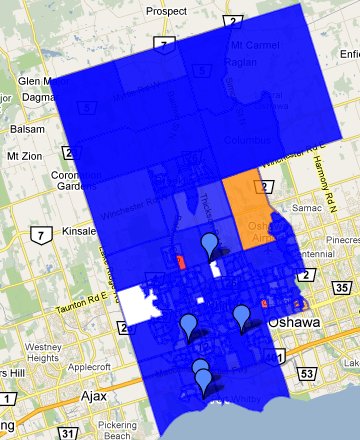
 Here’s the riding of Whitby-Oshawa in the 2008 election. Notice all that deep blue colour? As the legend says, the opacity of colour indicates the strength of the party in that area. Up in the Brooklin area, you can barely see the underlying road pattern for all the blueness.
You can find how blue (or red, or whatever) your riding is by using the cyberpresse.ca Interactive map (this is now available in English: the original was in French). It’s another illustration of how to use Google Maps to display geographical data in interesting ways.
This time around, I’ll at least have a Libertarian candidate to vote for: Josh Insang is running for the Libertarian Party. Check the LPC Candidate page to see if you have a Libertarian running in your riding.
April 6, 2011
April 4, 2011
Totally underground band loses millions to illegal downloads…or do they?
An interesting article looks at a claim by an obscure band that their debut CD had been pirated over 100,000 times:
Late last week, TorrentFreak was contacted by a guy called Wayne Borean who alerted to us to a somewhat heated debate he’d been participating in on the ‘Balanced Copyright For Canada’ Facebook page.
“There’s a Rock Band called One Soul Thrust. They have a debut album, which I like (bought it off iTunes). However the first I heard of the band was when there were complaints that the band had gone Platinum — because of illegal Torrent downloads!” Borean explained.
Indeed, according to a press release from the band’s manager, Cameron Tilbury, the situation is very serious.
“The Canadian Recording Industry Association (CRIA) states that, to achieve Platinum status, an album must achieve sales of 100,000 copies/downloads of an album. Sales…that’s the key. A random polling of several torrent site’s downloads — ILLEGAL downloads — has shown that 1ST, the debut cd by ONE SOUL THRUST has been downloaded over 100,000 times,” he wrote.
That’s really terrible, isn’t it? An obscure band, hoping to make it big by selling their CD have an illegal audience more than 300 times their number of Facebook fans? How did all these illegal downloaders even find out about the band? Well, perhaps they didn’t:
At this point, since we couldn’t find any torrents on any site (Borean tried everywhere too), we have to admit we were beginning to wonder if this 100K download claim was some kind of publicity stunt. Furthermore, since Wayne Borean and Tilbury were starting to publicly tear each other apart (and getting pretty personal at times) it seemed sensible to get to the bottom of this, particularly since the band’s manager claimed that the all-powerful CRIA is supporting the band’s stance.
[. . .]
As many readers will now be aware, there is a huge problem. These results are completely fake and are generated from user input to draw traffic to site advertisers. You can type anything in the search boxes on some of these torrent sites (these apparently came from LimeTorrents) and anyone can appear to be pirated into oblivion [. . .]
We wrote back to Tilbury and explained our findings. We also asked him to comment on how he feels now that he realizes that people aren’t downloading the band’s music at all. He hasn’t responded to that question which is a real shame, because personally I think this is the most important part of the whole story.
I’m absolutely confident that there was no attempt to mislead with the band’s ‘piracy problem’ press release and that the band and their manager sincerely believed that 100K people had downloaded their album without paying for it. However, it would be intriguing to know what happened, when emotions of supposedly being ripped off by 100,000 pirates were replaced by other, perhaps more confused feelings.
Update, 5 April: Apparently you have two choices in a situation like this. 1) Own up to being mistaken and apologize for making a stink about a non-issue. 2) Double-down on stupid:
A day after One Soul Thrust’s manager had the entire Internet explain to him that his band’s music wasn’t being downloaded 100,000 times on BitTorrent sites, he’s still in deep denial. Today’s post is all about how the pirates attacked him “[b]ecause a debut album by an independent Canadian band is listed on torrent sites around the world and we had the audacity to point that out.” Um, no it’s not. It’s not listed on any torrent sites. As far as anyone can tell, not one human being on this planet has torrented this band’s CD. Dude, you made a mistake, you freaked out, you looked a little naive. Now you’re looking like an ass. Quit while you’re ahead, maybe?
Creative comments to that last post include 1) someone, somewhere actually upload the album to a torrent site, just so the band doesn’t look quite as pathetic, and 2) replace each track with varying length versions of a certain Rick Astley tune.
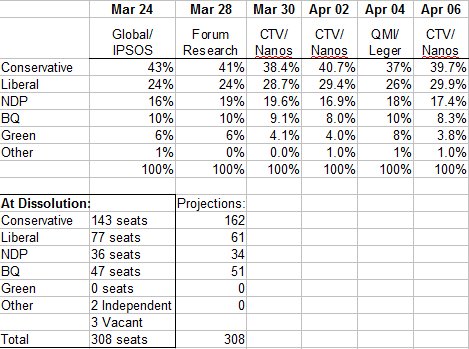
Politics: Tories have terrible week, yet are up to 14 point lead
The most useful polling right now is coming from Nanos Research, who are conducting daily summaries of the previous three-day trend. After getting slapped around by the press much of last week, the Conservatives are . . . the only party making gains over the last three days:
- Conservative: 42%, up 1.6%
- Liberal: 28%, down 1%
- NDP: 16%, down 0.5%
- Bloc Quebecois: 8%, unchanged
- Green: 4%, down 0.2%
The Twitter reactions are . . . surprised. Paul Wells “If the Conservatives lost week one and gained four points, the Liberals can’t afford to win many more weeks.” Andrew Coyne “Another such victory and I come back to Epirus alone.”
Updating the non-scientific, unbalanced sample of published polls:
April 3, 2011
QotD: The reason not to anticipate a simpler tax system
But boutique credits are smart politics. First, they appeal to people’s sense that they deserve a break, validate their choices, and reaffirm their sense of self-worth. The Children’s Art Tax Credit goes to good parents, ones who enroll their children in Suzuki violin lessons, not bad parents who spend their money on beer and popcorn. Second, they give people a sense of control. Tax liabilities stop being something outside of an individual’s control. Instead, the plethora of credits available mean that taxes can be reduced through planning and wise choices.
Policies are smart politics for a reason: they appeal to voters. If economists want to have a positive influence on the policy debate, they have to understand voter psychology: why do voters like special tax credits so much? “Smart politics” isn’t a criticism. Sometimes it’s a way of saying “I don’t understand why people like this policy.” At other times, it’s a way of saying, “I understand why this policy appeals to people, but if they were well-informed, they would think otherwise.”
There’s no point in telling politicians that a particular policy is “smart politics, bad economics.” They’ll take it as a compliment, and keep on making the same kind of policy choices.
Frances Woolley, “Economy Lab: Why politicians love boutique tax credits”, Globe and Mail, 2011-04-03
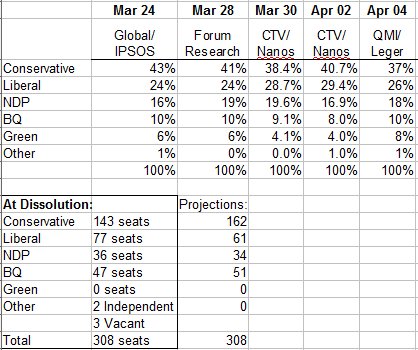
Latest polling numbers
The Tory lead continues to hold fairly steady, in spite of the drumbeat of disapproval from the newspapers:
April 2, 2011
QotD: The nature of Harper’s “slap in the face” to Quebec
I labour over this history to place in context the astounding, even outré, comments offered by Canada’s First Separatist, Gilles Duceppe, on hearing of the proposed arrangement — which, I hasten to mention, is merely a $4.2-billion loan guarantee from Ottawa, not some massive outright subsidy. Mr. Duceppe, with a logic that can only belong to a man who gets paid to be a separatist by the government he’s trying to extinguish, called the deal “a direct attack on Quebec.”
What really bothers Mr. Duceppe and other separatists is that they want to retain Quebec’s monopoly on southbound power sales to the United States — something the Lower Churchill project, including its 1,100 km of underwater transmission cables, would threaten. “By financing the Newfoundland project, Stephen Harper has given Quebec a slap right in the face,” the BQ leader declared.
It’s one of the continuing risibilities of the Canadian federation that we cosset and pamper and pay for the separatist faction in the House of Commons, and go along with the pretense that they’re parliamentarians like any other. They are not. They displace the natural balance of the federation. They have a vested interested in seeing the parliament they attend not working. And they leap to any perceived or manufactured imperfection in our system as evidence of dark perfidy or contempt for Quebec. They warp the system. Nowhere do these observations meet with greater validation than these ludicrous comments by Duceppe on the proposed assistance to the Lower Churchill.
Rex Murphy, “Newfoundland’s three-gigawatt insult to Gilles Duceppe”, National Post, 2011-04-02
The high cost of modern combat aircraft
Many claims have been made about the actual cost to Canada for the small tranche of F-35 aircraft the Conservative government has agreed to buy. The opposition claimed that there were potentially huge savings from having a competition instead of ordering F-35’s. This may or may not be true, especially as the Department of National Defence still hasn’t made a clear statement about what role the new aircraft will be expected to fill (that is, we’re told the F-35 is the answer, but the question still hasn’t been specified).
Back when we bought the F-18, for example, one of the stated criteria was that the plane we bought had to have two engines, due to the potential risk of engine failure in the far north (where airfields are very few and very far apart). This ruled out the F-16, a single-engine plane. This time around, we’re buying a single-engine plane, but the reasons have not been spelled out. It may well be that the F-35 really is everything we need, but it does feel like we’re buying it because we were part of the original “team” during the early design phases.
Combat aircraft are not cheap, and the currently available crop show that well:
Despite the high expense all the electronic gear, the F-18G is not the most expensive combat aircraft out there. The F-22 costs $355 million each. The low budget F-18E costs $94 million each, while the F-18G goes for $105 million. The F-35 costs over $130 million (and growing). Even unmanned aircraft are pricy, with the Global Hawk costing $182 million each (with high end sensors). Older fighters, like the F-16, cost $60 million, and an F-15E goes for about $100 million. The price of the export EA-18G hasn’t been set yet, but it will probably be under $100 million.
These prices constantly fluctuate because of the need to incorporate a share of the development cost for each aircraft built. While most development expense occurs before mass production begins, there is sometimes considerable additional development expense, or major refurbishment, later in the lifetime of an aircraft. Many modern warplanes cost more than most warships, and have the same high maintenance (periodic refurbishment and development of new components) expenses.
Update: There’s another Strategy Page article of interest, this one talking about the decline of Canadian air power:
When the Canadian government decided to send some warplanes to assist in establishing the no-fly zone over Libya, they found out that sending six of their CF-18 fighters would amount to 20 percent of flyable Canadian fighters. That was a bit shocking to most Canadians. But not to those who run the Canadian Air Force, as they know quite well that the CF-18 is on the way out. For example, late last year, Canada awarded $700 million in contracts to two commercial firms (Harris and L3) to provide maintenance for its F-18 fleet of jet fighters over the next nine years. This type of contract is increasingly popular, as they provide a cheaper way to provide all the more complex maintenance, other than what the ground crews do on a daily basis. This involves major overhauls, management of spare parts and upgrades of equipment. This includes the airframe, engines and electronics. Canada expects to retire its remaining 79 CF-18s by 2020, and replace them with 65 F-35s. Meanwhile, only about 30 CF-18s are flyable, because so many aircraft are undergoing upgrades and extended maintenance.
[. . .] Canada plans to replace its CF-18s with the new 65 F-35s. The trend towards fewer, but more capable and expensive aircraft is a common one. Half a century ago, Canada had a fleet of nearly 600 fighters, including license built U.S. F-86s, and what would eventually amount to over 600 CF-100 fighters, the only Canadian designed fighter to enter mass production. The CF-100s were gradually retired over the next three decades. The last ones left service as the CF-18 entered service. But in between, Canada built, under license, several other U.S. fighter designs. Canada had become a major aircraft manufacturer during World War II (over 16,000 aircraft produced), and that provided the foundation for an aircraft industry that remains a major supplier of commercial aircraft to this day.
March 31, 2011
Corcoran: Harper’s family tax plan full of “shabby contradictions”
I think it’d be fair to say that Terence Corcoran is not a fan of Stephen Harper’s proposed “family tax plan”:
By calling this a “family tax cut,” and playing it as a matter of tax fairness, the Conservatives have managed to gloss over the shabby contradictions it introduces into Canadian tax policy. The Tory announcement said that the United States, France and other countries allow some form of income splitting. They do, but that’s not saying much about taxation or fairness.
France has a full-blown family tax regime, in which the incomes of both spouses are blended at a tax rate that is based on a formula that includes the number of children. But so what? France has one of the highest marginal tax rates in the world, and a notoriously dysfunctional tax burden that distorts behaviour and incentives. The U.S. income-splitting regime isn’t exactly revered for its soundness, in part because it clearly discriminates against single earners or anyone not part of a married couple. Nor are children a requirement to be part of the U.S. splitting regime.
[. . .]
The Harper family tax cut, based on the debatable tax policy ideal of taxing families instead of individuals, is a misguided income-splitting scheme that demonstrates once again that the Conservatives will never, ever get around to cutting personal income tax rates. The cost of the family tax cut will come at the expense of across-the-board income tax cuts for other Canadians. To pay for the family cut, other Canadians will have to continue to pay marginal tax rates that are too high.
The family tax cut, in some ways, is just another tax expenditure, a special tax treatment aimed at fulfilling some social-policy objective. The major beneficiaries are likely to be higher-income single-earner couples with children. Everybody else is out of luck.
To pull out the old saying, “that’s a feature, not a bug” to the Conservative party faithful.
Calculating “Tax Freedom Day” for each state
The least-taxed five states have already celebrated their Tax Freedom Days: Mississippi, Tennessee, South Carolina, Louisiana, and South Dakota. Other states may wait as long as May 2:
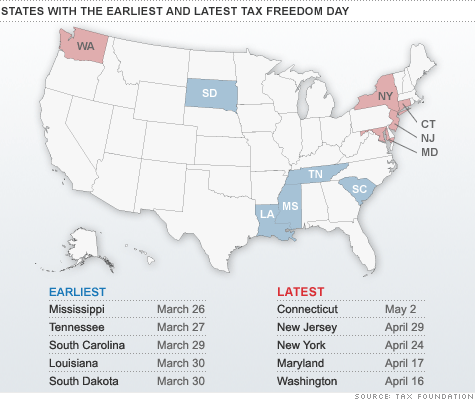
Americans will spend an average of 28% of their income to pay federal, state and local taxes this year, the Tax Foundation said Wednesday.
That means you will need to work 102 days — more than three months — just to earn enough to pay your tax bill. So on April 12 you will be free of your 2011 tax burden.
This year’s “Tax Freedom Day,” as the Tax Foundation calls it, comes three days later than last year. Rising incomes — resulting in more income tax owed — are largely to blame for its late arrival, the organization said.
For Canadians, you can calculate your own personal Tax Freedom Day using the Fraser Institute’s customized web tool. If I lived in Alberta, for example, my Tax Freedom day would be May 13, but as I live in Ontario it’s actually May 27.
March 30, 2011
Nanos poll for CTV/Globe still shows large Tory lead
The latest election poll is from Nanos, conducted for CTV and the Globe and Mail. The numbers show a smaller lead for Stephen Harper’s Conservatives, but it’s still ten percent over Michael Ignatieff and the Liberal party:
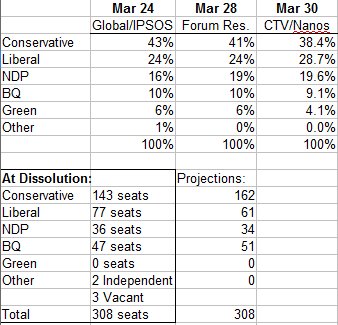
Nationally, the Conservatives are in front with 38.4 per cent. The Liberals are 10 points behind at 28.7 per cent, followed by the NDP at 19.6 per cent, the Bloc Quebecois at 9.1 per cent and the Greens at 4.1 per cent.
In comparison, a March 15 Nanos survey found the Tories at 38.6 per cent, the Liberals at 27.6 per cent, the NDP at 19.9 per cent, the Bloc at 10.1 per cent and the Greens at 3.8 per cent.
[. . .]
Pollster Nik Nanos said there’s reason for disappointment in the numbers for both the Conservatives and the Liberals.
For the Tories, it shows that so far Stephen Harper’s campaign for a majority mandate is not attracting enough support to actually win a majority of seats when Canadians vote again on May 2.
For the Liberals, Mr. Nanos noted that Michael Ignagtieff’s team might have expected its numbers to improve with the added attention that comes from a campaign, and the fact that they are now running TV ads in heavy rotation.
The Nanos numbers put the Conservatives back down in minority territory, unlike the two previous polls which indicated a majority government.
March 28, 2011
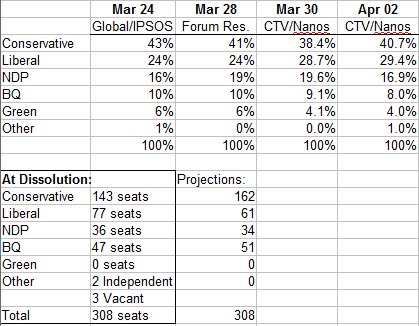
Tory lead still holding in latest poll result
So far, the opposition hasn’t been able to make much headway against that strong Conservative lead:
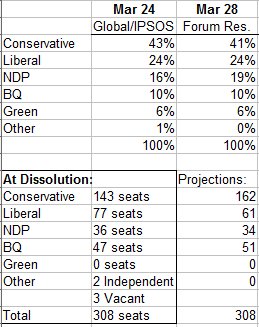
Here’s a summary from Kathryn Blaze Carlson:
The first poll since Saturday’s election call shows Tory support largely unchanged, bringing into question the opposition’s early emphasis on ethics.
Despite a weekend of being hammered for their alleged contempt of Parliament, the Conservatives boast the support of 41% of decided voters — 17 points ahead of the Liberals, who are at 24%. The NDP is at 19%, and the Bloc 10%.
The Forum Research poll also breaks it down by seat count, suggesting that if the election were held today, the Tories would surge from 143 seats to 162 seats, the Liberals would drop 17 seats to 61, the Bloc would rise from 44 to 51 and the NDP would be whittled from 36 seats to 34. The poll, conducted over the weekend via telephone with a random sample of 2,095 voters, is within the range of approximately plus or minus 10 seats for each party.
The seat projections reflect the regional strength of the BQ, who only run candidates in Quebec, and the natural disproportion of first-past-the-post voting.
Update: Publius points out the real root of Canada’s election issues:
Unfortunately neither you, nor any of the party leaders, have the temerity to admit what is actually wrong with Ottawa. Let me give you a hint. It’s not Stephen Harper’s pragmatism. It isn’t Lord Iggy’s incompetence. Not even Jack Layton’s spend till you’re broke ideology. The problem with Ottawa is Quebec. Gilles Duceppe and the Bloc Quebecois are merely the symptoms. Our national democracy is broken because part of the electorate refuses to participate.
In the 2006 and 2008 federal elections there were 308 seats up for grabs. That’s 75 in Quebec and 233 in the Rest of Canada (ROC). The 2006 election saw the Conservatives win 114 seats in ROC and 10 in Quebec. The Conservatives did better in the ROC in 2008 winning 133 seats and holding on to their seats in Quebec. If we were to remove Quebec’s 75 seats from Parliament a majority government could be formed with 117 seats. On that basis, including only their ROC seats, the Harper Tories would have won a strong minority government in 2006 and a clear majority in 2008. To say, as the opposition parties and the MSM have, that Harper has failed to seal the deal with Canadians is only partially correct.
For all his faults, chronicled in some detail on this blog over the years, Stephen Harper has in fact convinced a critical mass of the interested Canadian electorate of his fitness to lead us. Those who vote for the Bloc Quebecois have declared their disinterest in Canada as a working proposition.
The Bloc Quebecois are not political party in any meaningful sense but merely a pressure group that has won election to parliament. It is because of this we find ourselves in a series of weak hung parliaments. The BQ offers no vision for Canada, only its potential destruction. It’s bargaining position with the other parties in recent parliaments has been of routine blackmail. Vote what is in the best interests of Quebec, or else.
QotD: Even heroes wear out their welcome eventually
Fraternization between soldiers and civilian women in the weeks following libertion was intense, and inhibitions in the traditionally prudish Dutch society fell away. The fighting was over, but a new battlefront now loomed. By the summer of 1945, a medical officer in General Hoffmeister’s Fifth Division was confirming a sharp rise in VD rates among the troops. This was despite an efficient campaign to hand out contraceptives and warn the troops about the dangers of unprotected sex. “Perhaps,” noted the officer, “it was because the Dutch and Canadians get along well together.” There were no reports of rape in the area.
However, as the summer passed, popular resentment about the behavior of Canadian soldiers and Dutch girls began to rise, and the sight of their women arm in arm with their occupiers started to grate. “Dutch men were beaten militarily in 1940, sexually in 1945,” observed one Dutch journalist. Popular songs and doggerel reflected a new mood about the Canadians.
[. . .]
A joke hinting at the number of girls who were “getting into trouble” also began to circulate. “In twenty years, when another world war breaks out, it will not be necessary to send a Canadian expeditionary force to the Netherlands. A few ships loaded with uniforms will be enough.”
David Stafford, Endgame, 1945: The missing final chapter of World War II, Little, Brown 2007. pp 451-452.
March 27, 2011
Rogers is actively throttling bandwidth for World of Warcraft players
In what isn’t really a surprise, Justin Olivetti reports on how Canadian WoW players have been suffering from deliberate throttling:
If you play World of Warcraft in Canada and were wondering why your connection seemed a bit slow, it turns out there may be a good explanation: Rogers Communications has been deliberately throttling the game across the country.
[. . .]
Rogers said that it was Blizzard’s use of BitTorrent to deliver updates that triggered the throttling, and said that customers who disabled this setting — as well as any other peer-to-peer applications — would not see a slowdown in speed. “Rogers will engage our customers to ensure they are aware of these recommendations, while continuing to work on a longer term solution,” a spokesperson said.


