
Gandhi, therefore, the film, this paid political advertisement for the government of India, is organized around three axes: (1) Anti-racism — all men are equal regardless of race, color, creed, etc.; (2) anti-colonialism, which in present terms translates as support for the Third World, including, most eminently, India; (3) nonviolence, presented as an absolutist pacifism. There are other, secondary precepts and subheadings. Gandhi is portrayed as the quintessence of tolerance (“I am a Hindu and a Muslim and a Christian and a Jew”), of basic friendliness to Britain (“The British have been with us for a long time and when they leave we want them to leave as friends”), of devotion to his wife and family. His vow of chastity is represented as something selfless and holy, rather like the celibacy of the Catholic clergy. But, above all, Gandhi’s life and teachings are presented as having great import for us today. We must learn from Gandhi.
I propose to demonstrate that the film grotesquely distorts both Gandhi’s life and character to the point that it is nothing more than a pious fraud, and a fraud of the most egregious kind. Hackneyed Indian falsehoods such as that “the British keep trying to break India up” (as if Britain didn’t give India a unity it had never enjoyed in history), or that the British created Indian poverty (a poverty which had not only existed since time immemorial but had been considered holy), almost pass unnoticed in the tide of adulation for our fictional saint. Gandhi, admittedly, being a devout Hindu, was far more self-contradictory than most public men. Sanskrit scholars tell me that flat self-contradiction is even considered an element of “Sanskrit rhetoric.” Perhaps it is thought to show profundity.
Richard Grenier, “The Gandhi Nobody Knows”, Commentary, 1983-03-01.
June 11, 2018
QotD: Gandhi as filmic hagiography
May 29, 2018
ESR’s thumbnail sketch on the origins of the Indo-European language families
When you mash historical linguistics hard enough into paleogenetics, interesting things fall out:
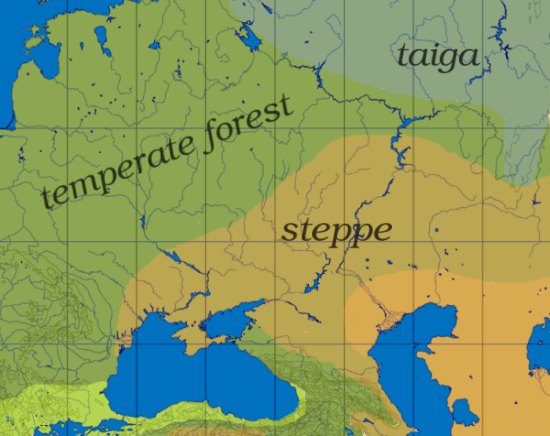
The steppe extends roughly from the Dniepr to the Ural or 30° to 55° east longitude, and from the Black Sea and the Caucasus in the south to the temperate forest and taiga in the north, or 45° to 55° north latitude.
Via Wikipedia
What we can now say pretty much for sure: Proto-Indo-European was first spoken on the Pontic Steppes around 4000 BCE. That’s the grasslands north of the Black Sea and west of the Urals; today, it’s the Ukraine and parts of European Russia. The original PIE speakers (which we can now confidently identify with what archaeologists call the Yamnaya culture) were the first humans to domesticate horses.
And – well, basically, they were the first and most successful horse barbarians. They invaded Europe via the Danube Valley and contributed about half the genetic ancestry of modern Europeans – a bit more in the north, where they almost wiped out the indigenes; a bit less in the south where they mixed more with a population of farmers who had previously migrated in on foot from somewhere in Anatolia.
The broad outline isn’t a new idea. 400 years ago the very first speculations about a possible IE root language fingered the Scythians, Pontic-Steppe descendants in historical times of the original PIE speakers – with a similar horse-barbarian lifestyle. It was actually a remarkably good guess, considering. The first version of the “modern” steppe-origin hypothesis – warlike bronze-age PIE speakers domesticate the horse and overrun Europe at sword- and spear-point – goes back to 1926.
But since then various flavors of nationalist and nutty racial theorist have tried to relocate the PIE urheimat all over the map – usually in the nut’s home country. The Nazis wanted to believe it was somewhere in their Greater Germany, of course. There’s still a crew of fringe scientists trying to pin it to northern India, but the paleogenetic evidence craps all over that theory (as Cochran explains rather gleefully – he does enjoy calling bullshit on bullshit).
Then there have been the non-nutty proposals. There was a scientist named Colin Renfrew who for many years (quite respectably) pushed the theory that IE speakers walked into Europe from Anatolia along with farming technology, instead of riding in off the steppes brandishing weapons like some tribe in a Robert E. Howard novel.
Alas, Renfrew was wrong. It now looks like there was such a migration, but those people spoke a non-IE language (most likely something archaically Semitic) and got overrun by the PIE speakers riding in a few thousand years later. Cochran calls these people “EEF” (Eastern European Farmers) and they’re most of the non-IE half of modern European ancestry. Basque is the only living language that survives from EEF times; Otzi the Iceman was EEF, and you can still find people with genes a lot like his in the remotest hills of Sardinia.
Even David Anthony, good as he is about much else, seems rather embarrassed and denialist about the fire-and-sword stuff. Late in his book he spins a lot of hopeful guff about IE speakers expanding up the Danube peacefully by recruiting the locals into their culture.
Um, nope. The genetic evidence is merciless (though, to be fair, Anthony can’t have known this). There’s a particular pattern of Y-chromosome and mitochondrial DNA variation that you only get in descendant population C when it’s a mix produced because aggressor population A killed most or all of population B’s men and took their women. Modern Europeans (C) have that pattern, the maternal line stuff (B) is EEF, and the paternal-line stuff (A) is straight outta steppe-land; the Yamnaya invaders were not gentle.
How un-gentle were they? Well…this paragraph is me filling in from some sources that aren’t Anthony or Cochran, now. While Europeans still have EEF genes, almost nothing of EEF culture survived in later Europe beyond the plants they domesticated, the names of some rivers, and (possibly) a murky substratum in some European mythologies.
The PIE speakers themselves seem to have formed, genetically, when an earlier population called the Ancient Northern Eurasians did a fire-and-sword number (on foot, that time) on a group of early farmers from the Fertile Crescent. Cochrane sometimes calls the ANEs “Hyperboreans” or “Cimmerians”, which is pretty funny if you’ve read your Howard.
QotD: Gandhi on the Holocaust
I am aware that for many not privileged to have visited the former British Raj, the names Gujarat, Rajasthan, and Deccan are simply words. But other names, such as Germany, Poland, Czechoslovakia, somehow have a harder profile. The term “Jew,” also, has a reasonably hard profile, and I feel all Jews sitting emotionally at the movie Gandhi should be apprised of the advice that the Mahatma offered their coreligionists when faced with the Nazi peril: they should commit collective suicide. If only the Jews of Germany had the good sense to offer their throats willingly to the Nazi butchers’ knives and throw themselves into the sea from cliffs they would arouse world public opinion, Gandhi was convinced, and their moral triumph would be remembered for “ages to come.” If they would only pray for Hitler (as their throats were cut, presumably), they would leave a “rich heritage to mankind.” Although Gandhi had known Jews from his earliest days in South Africa — where his three staunchest white supporters were Jews, every one — he disapproved of how rarely they loved their enemies. And he never repented of his recommendation of collective suicide. Even after the war, when the full extent of the Holocaust was revealed, Gandhi told Louis Fischer, one of his biographers, that the Jews died anyway, didn’t they? They might as well have died significantly.
Richard Grenier, “The Gandhi Nobody Knows”, Commentary, 1983-03-01.
May 22, 2018
The Fightinest Marine – Dan Daly I WHO DID WHAT IN WW1?
The Great War
Published on 21 May 2018Dan Daly was one of only two Marines to be awarded Medals of Honor in two separate conflicts. The first, for his actions in 1901 during the China relief. His second, for his actions during the U.S. invasion and occupation of Haiti in 1915. But he wasn’t done yet and after the U.S. entry into WW1 in April 1917, he was close to receiving his third one on the battlefield of Belleau Wood in France.
A variant factor in Chinese economic statistics
I’ve long been on the record as not trusting Chinese government statistics (some examples here, here here, here, here, here, here, here, here here, here, here, here, here, here, here, and here), but this is a twist I hadn’t previously noticed:
A useful and basic rule of thumb about international economic statistics. Never, but just never, believe nor pay attention to anything about the Chinese economy for the first quarter of the year. No, this isn’t because our inscrutable bretheren dissemble more or less at this time of year, it’s not because their statisticians spend January drunk or hungover (unlike our own), it’s because the Chinese New Year obeys its own little calendar.
The modern Chinese New Year begins on the first new moon between January 21st and February 20th. Earlier calendar systems were more complicated:
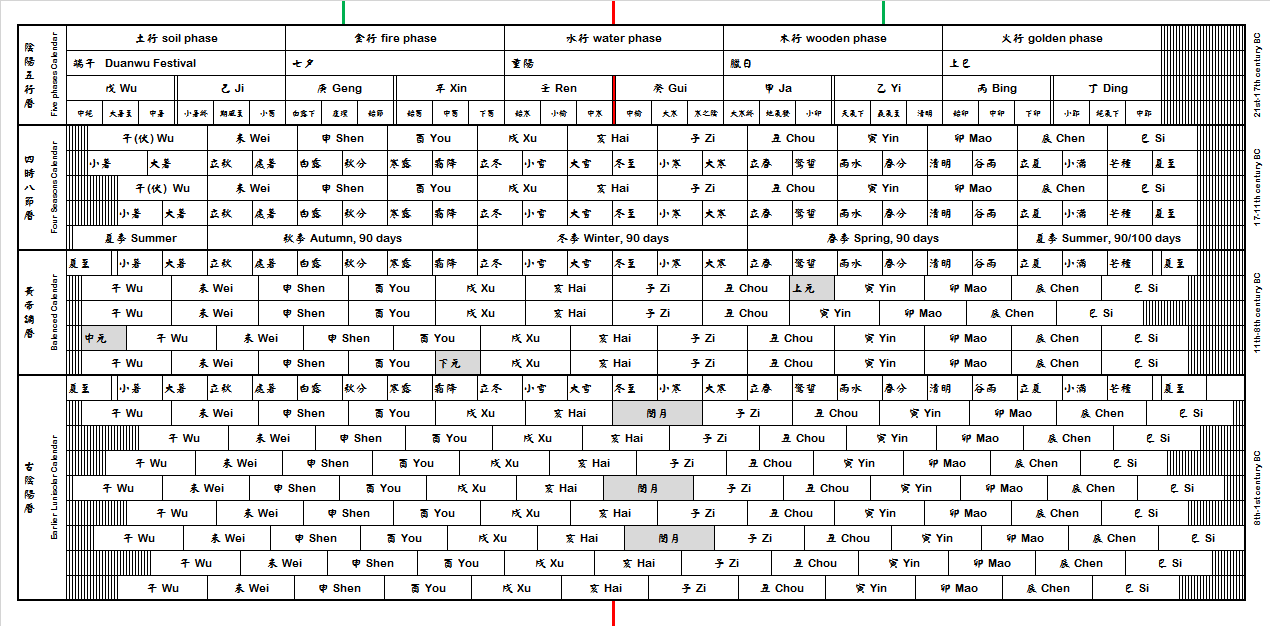
Chinese five phases and four seasons calendar, used during the Zhou dynasty (c. 1046 BC-256 BC).
Image by Orienomesh-w, via Wikimedia Commons.
Well, OK, so if this was a western country that really celebrated the New Year (say, Scotland) then everyone would be back at work 48 hours later. However, the Chinese New Year is also the start of the two week holiday. Sorta a mixture between American Thanksgiving (you WILL eat at your mother’s table or a close simulacrum of it) plus a Wakes Week (English industrial towns would shut every single factory so that all could get away to the beach for a week. Well, beach not so much, Skegness maybe). The combination of the two means that near every factory in the country shuts for a couple of weeks as the largest migration in history takes place. All those migrant workers heading back to Mom’s dumplings.
If this all took place at the same time each year then our economic statistics would take account of it just fine with our seasonal adjustments. Just like we do with Christmas. We know very well that hundreds of thousands get hired for temporary jobs packing and delivering just before, get laid off immediately afterwards. We don’t see that reflected in the unemployment numbers because we’re not interested. We want to see trends, not known seasonal variations. So too with output and all that – many European factories do close in that week after Christmas. We don’t measure a drop in GDP then because we know about it therefore ignore it.
So Chinese official economic statistics are even less likely to correspond to reality during the first quarter than at any other time of the year.
Feature History – Opium Wars
Feature History
Published on 19 Oct 2016Welcome to Feature History, featuring the Opium Wars, western imperialism, and this fancy new intro and vignette.
The super sexy stuff like animation, voice, and script are all by the super sexy me.
The music is Anamalie and Clash Defiant, both by Kevin MacLeod
Twitter: https://twitter.com/Feature_History
May 15, 2018
QotD: The making of Gandhi
As it happens, the government of India openly admits to having provided one-third of the financing of Gandhi out of state funds, straight out of the national treasury — and after close study of the finished product I would not be a bit surprised to hear that it was 100 percent. If Pandit Nehru is portrayed flatteringly in the film, one must remember that Nehru himself took part in the initial story conferences (he originally wanted Gandhi to be played by Alec Guinness) and that his daughter Indira Gandhi is, after all, Prime Minister of India (though no relation to Mohandas Gandhi). The screenplay was checked and rechecked by Indian officials at every stage, often by the Prime Minister herself, with close consultations on plot and even casting. If the movie contains a particularly poisonous portrait of Mohammed Ali Jinnah, the founder of Pakistan, the Indian reply, I suppose, would be that if the Pakistanis want an attractive portrayal of Jinnah let them pay for their own movie. A friend of mine, highly sophisticated in political matters but innocent about film-making, declared that Gandhi should be preceded by the legend: The following film is a paid political advertisement by the government of India.
Gandhi, then, is a large, pious, historical morality tale centered on a saintly, sanitized Mahatma Gandhi cleansed of anything too embarrassingly Hindu (the word “caste” is not mentioned from one end of the film to the other) and, indeed, of most of the rest of Gandhi’s life, much of which would drastically diminish his saintliness in Western eyes. There is little to indicate that the India of today has followed Gandhi’s precepts in almost nothing. There is little, in fact, to indicate that India is even India. The spectator realizes the scene is the Indian subcontinent because there are thousands of extras dressed in dhotis and saris. The characters go about talking in these quaint Peter Sellers accents. We have occasional shots of India’s holy poverty, holy hovels, some landscapes, many of them photographed quite beautifully, for those who like travelogues. We have a character called Lord Mountbatten (India’s last Viceroy); a composite American journalist (assembled from Vincent Sheehan, William L. Shirer, Louis Fischer, and straight fiction); a character called simply “Viceroy” (presumably another composite); an assemblage of Gandhi’s Indian followers under the name of one of them (Patel); and of course Nehru.
I sorely missed the fabulous Annie Besant, that English clergyman’s wife, turned atheist, turned Theo-sophist, turned Indian nationalist, who actually became president of the Indian National Congress and had a terrific falling out with Gandhi, becoming his fierce opponent. And if the producers felt they had to work in a cameo role for an American star to add to the film’s appeal in the United States, it is positively embarrassing that they should have brought in the photographer Margaret Bourke-White, a person of no importance whatever in Gandhi’s life and a role Candice Bergen plays with a repellant unctuousness. If the film-makers had been interested in drama and not hagiography, it is hard to see how they could have resisted the awesome confrontation between Gandhi and, yes, Margaret Sanger. For the two did meet. Now there was a meeting of East and West, and may the better person win! (She did. Margaret Sanger argued her views on birth control with such vigor that Gandhi had a nervous breakdown.)
I cannot honestly say I had any reasonable expectation that the film would show scenes of Gandhi’s pretty teenage girl followers fighting “hysterically” (the word was used) for the honor of sleeping naked with the Mahatma and cuddling the nude septuagenarian in their arms. (Gandhi was “testing” his vow of chastity in order to gain moral strength for his mighty struggle with Jinnah.) When told there was a man named Freud who said that, despite his declared intention, Gandhi might actually be enjoying the caresses of the naked girls, Gandhi continued, unperturbed. Nor, frankly, did I expect to see Gandhi giving daily enemas to all the young girls in his ashrams (his daily greeting was, “Have you had a good bowel movement this morning, sisters?”), nor see the girls giving him his daily enema. Although Gandhi seems to have written less about home rule for India than he did about enemas, and excrement, and latrine cleaning (“The bathroom is a temple. It should be so clean and inviting that anyone would enjoy eating there”), I confess such scenes might pose problems for a Western director.
Richard Grenier, “The Gandhi Nobody Knows”, Commentary, 1983-03-01.
May 14, 2018
China launches the second Type 001 aircraft carrier (Type 001A)
In the New York Times, Steven Lee Myers reports on the newest People’s Liberation Army Navy (PLAN) aircraft carrier departing from Dalian to undergo its initial sea trials:
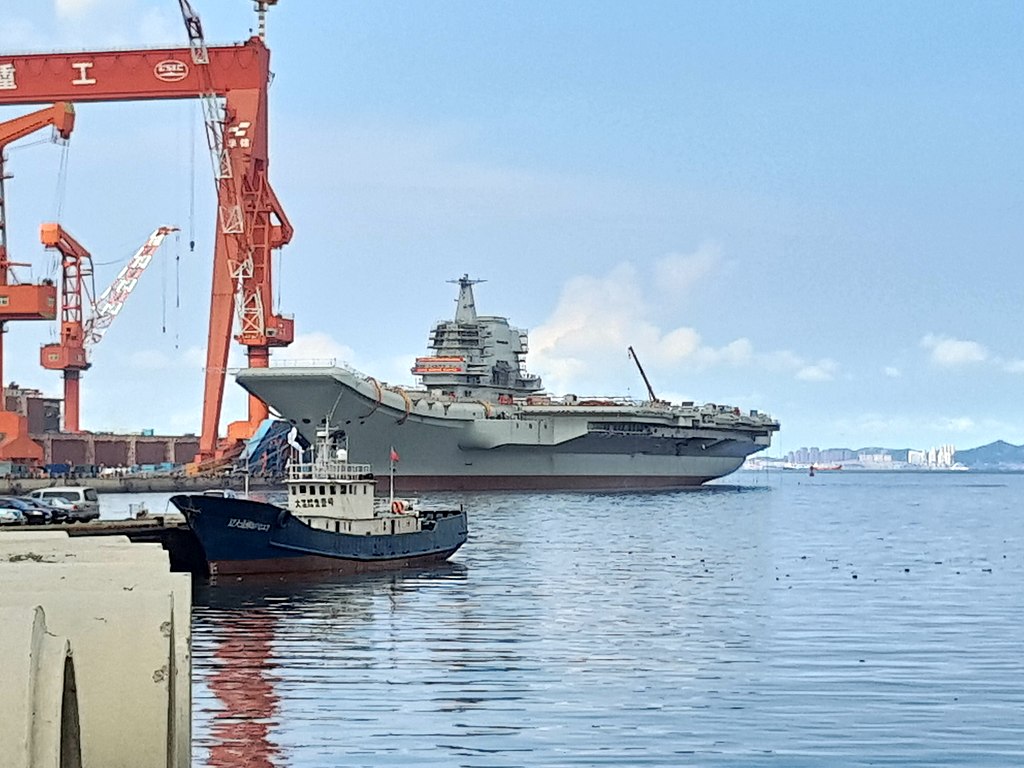
China’s Type 001A aircraft carrier shortly after launch, 17 August 2017.
Photo via Wikimedia Commons
China launched its first domestically built aircraft carrier to begin sea trials on Sunday, reaching another milestone in the expansion of the country’s navy.
The aircraft carrier, as yet unnamed, left its berth at a shipyard in the northeastern port of Dalian after a blow of its horn and a display of fireworks, according to reports in state news media.
The Chinese Navy — officially the People’s Liberation Army Navy — already has one operational carrier, the Liaoning, which it bought unfinished from Ukraine after the collapse of the Soviet Union. That ship joined the Chinese fleet in 2012 and began its first operations four years later, putting China in the small group of seafaring powers that maintain aircraft carriers, led by the United States, which has 11.
The Liaoning, which appears to serve as a training vessel as much as a combat ship, was the centerpiece of a naval parade of 48 ships attended last month by China’s leader, Xi Jinping. The following week, it led a carrier battle group in live-fire exercises in the Taiwan Strait and in the East China Sea.
Since taking office, Mr. Xi has driven an ambitious effort to modernize the country’s military, reducing the traditional focus on readying the ground forces of the People’s Liberation Army to defend against an invasion of the mainland and increasing the emphasis on technology-dependent naval, air and missile forces.
The new carrier, built by the Dalian Shipbuilding Industry Company, has a similar design to the Liaoning but has been modified and expanded, according to Chinese and foreign experts.
May 7, 2018
DicKtionary – J is for Junk – Ching Shih
TimeGhost History
Published on 6 May 2018J is for Junk, boat of the Chinese,
For trade and for pleasure, they sailed the blue seas
Some junks were pirates, that ain’t a good thing,
And the queen of them all, was one Madame ChingJoin us on Patreon: https://www.patreon.com/TimeGhostHistory
Written and Hosted by: Indy Neidell
Based on a concept by Astrid Deinhard and Indy Neidell
Directed by: Spartacus Olsson
Produced by: Astrid Deinhard
Executive Producers: Bodo Rittenauer, Astrid Deinhard, Indy Neidell, Spartacus Olsson
Edited by: Bastian BeißwengerA TimeGhost format produced by OnLion Entertainment GmbH
The Chinese Civil War – Blood for Unity l HISTORY OF CHINA
IT’S HISTORY
Published on 5 Sep 2015After the fall of the Qing dynasty China fell apart and both, forces loyal to Chiang Kai-shek’s National Kuomintang Party and as Mao Zedong’s Communist Party of China, fought to rule the country. This bloody struggle would ultimately result in the Chinese Civil War. It would take more than 22 years but would come to a halt during the 2nd Sino-Japanese War. After Japan’s defeat, Mao’s troops grew strong quickly and soon after they were able to force Chiang Kai-shek and his followers out of China. They sought refuge in Taiwan. Shortly after, Mao Zedong called out the People’s Republic of China. Learn all about the Chinese Civil War in this episode of Battlefields with Indy Neidell.
May 1, 2018
Sikh separatists (and even terrorists) are being protected by the federal government
There’s no reason that Canadian Sikhs can’t agitate for their fellow Sikhs in India to create a separate country in the Punjab, but that freedom must not include active support for terrorists. The Canadian government is looking particularly bad on this front, and it isn’t just because of Justin Trudeau’s farcical adventures on his recent trip to India. None of the major federal parties want to appear to be anti-Sikh, as Sikh voters cluster in several key swing ridings around the country, and any criticism of the terrorists is spun as an attack on all Sikhs. At Quillette Terry Milewski details the government’s unwillingness to deal with the problem:
The Sikh faith, created in what is now northern India by the 15th-century Guru Nanak, remains obscure to many in the West. Turbaned Sikh men are sometimes confused with Muslims, and some have been assaulted by confused thugs following Islamist terrorist attacks. Like the United States, Britain and other Western countries, Canada has been home to emigrant Sikhs for generations—the vast majority of them living peaceably in their adopted homeland.
In the 1980s, however, a powerful spasm of separatist militancy shook India and spread to the Sikh diaspora. In June, 1984, two months before the Madison Square Garden convention, Prime Minister Gandhi and her government set out to end a killing spree by Sikh militants who had turned the Sikhs’ holiest site — the Golden Temple at Amritsar — into an armed camp. The Indian army wrecked the temple complex and took many lives. Revenge came on October 31, 1984, when Gandhi was gunned down in her garden by two of her Sikh bodyguards. Hindu mobs immediately took revenge for the revenge, slaughtering thousands of Sikhs in hellish reprisals that were aggravated by official complicity. The police looked the other way. The horrors of 1984 won’t be forgotten by either side.
Soon, Canada and its Sikh community were dragged into the thick of the struggle. In June of 1985, Parmar’s Babbar Khalsa placed suitcase bombs on two planes leaving Vancouver. One brought down Flight 182, a massacre that remained, until 9/11, the deadliest terrorist attack in the history of aviation. The second bomb, intended to destroy another Air India plane simultaneously, exploded on the ground at Narita Airport in Japan, killing two baggage handlers. The reverberations from the attack were so profound in Canada that even today, 33 years later, a striking emblem of the Khalistani dream survives: a large “martyr” poster honouring Talwinder Parmar, sword in hand, permanently fixed to the exterior of an important Sikh gurdwara in Surrey, British Columbia. Tens of thousands gather beneath it each spring for an annual Sikh parade. In American terms, the poster is equivalent to a public veneration of Osama Bin Laden.
[…]
Today, the parents who lost their children [on Air India Flight 182] are old, the orphaned children have their own children and the Sikh struggle for independence is moribund in India. Last year, in fact, Sikh voters overwhelmingly supported a united India and were key to the election of the Congress Party — the party of Indira Gandhi — to govern the Sikh homeland of Punjab. Support for Congress was especially strong in majority-Sikh districts. And Punjab’s Chief Minister is a strongly pro-unity Sikh, Amarinder Singh, who has alleged separatist influence in the Canadian government.
Harjit Sajjan, a Sikh who is Canada’s Minister of National Defence, firmly denied the claim. And on Justin Trudeau’s visit to India this year, Singh agreed to a photo-op including Sajjan. But the Chief Minister let it be known that he’d handed over a list of Canadians he suspects of fundraising for Punjab’s few remaining separatist Sikh militants.
The listed suspects amount to a tiny subculture among Canada’s 450,000 Sikhs, the vast bulk of whom seek no return to the bloody 1980s and 1990s, when the battle for Khalistan took some 20,000 lives in India, most of them Sikh. But the hardliners are a well-organized political force, still raising the cry of “Khalistan Zindabad!” — long live Khalistan — in some Canadian gurdwaras where “martyred” Sikh assassins are memorialized as models for the young. These include the two bodyguards who machine-gunned Indira Gandhi. Khalistani fervour is alive on social media and a 2018 tweet from “George” (@PCPO_Brampton) declared: “Indira’s assassins are HEROES. Sikhs should glorify them.”
The endurance of such attitudes in Canada reflects the weak record of its justice system in deterring violence. For years, it seemed, Canadian courts were where terrorism cases went to die.
April 30, 2018
QotD: Gandhi versus Gandhi
I had the singular honor of attending an early private screening of Gandhi with an audience of invited guests from the National Council of Churches. At the end of the three-hour movie there was hardly, as they say, a dry eye in the house. When the lights came up I fell into conversation with a young woman who observed, reverently, that Gandhi’s last words were “Oh, God,” causing me to remark regretfully that the real Gandhi had not spoken in English, but had cried, Hai Rama! (“Oh, Rama”). Well, Rama was just Indian for God, she replied, at which I felt compelled to explain that, alas, Rama, collectively with his three half-brothers, represented the seventh reincarnation of Vishnu. The young woman, who seemed to have been under the impression that Hinduism was Christianity under another name, sensed somehow that she had fallen on an uncongenial spirit, and the conversation ended.
At a dinner party shortly afterward, a friend of mine, who had visited India many times and even gone to the trouble of learning Hindi, objected strenuously that the picture of Gandhi that emerges in the movie is grossly inaccurate, omitting, as one of many examples, that when Gandhi’s wife lay dying of pneumonia and British doctors insisted that a shot of penicillin would save her, Gandhi refused to have this alien medicine injected in her body and simply let her die. (It must be noted that when Gandhi contracted malaria shortly afterward he accepted for himself the alien medicine quinine, and that when he had appendicitis he allowed British doctors to perform on him the alien outrage of an appendectomy.) All of this produced a wistful mooing from an editor of a major newspaper and a recalcitrant, “But still …” I would prefer to explicate things more substantial than a wistful mooing, but there is little doubt it meant the editor in question felt that even if the real Mohandas K. Gandhi had been different from the Gandhi of the movie it would have been nice if he had been like the movie-Gandhi, and that presenting him in this admittedly false manner was beautiful, stirring, and perhaps socially beneficial.
Richard Grenier, “The Gandhi Nobody Knows”, Commentary, 1983-03-01.
April 18, 2018
QotD: The United Nations
It’s a good basic axiom that if you take a quart of ice-cream and a quart of dog faeces and mix ’em together the result will taste more like the latter than the former. That’s the problem with the UN. If you make the free nations and the thug states members of the same club, the danger isn’t that they’ll meet each other half-way but that the free world winds up going three-quarters, seven-eighths of the way. Thus the Oil-for-Fraud scandal: in the end, Saddam Hussein had a much shrewder understanding of the way the UN works than Bush and Blair did.
And, of course, corrupt organisations rarely stop at just one kind. If you don’t want to bulk up your pension by skimming the Oil-for-Food programme, don’t worry, whatever your bag, the UN can find somewhere that suits — in West Africa, it’s Sex-for-Food, with aid workers demanding sexual services from locals as young as four; in Cambodia, it’s drug dealing; in Kenya, it’s the refugee extortion racket; in the Balkans, sex slaves.
Mark Steyn, “UN forces — just a bunch of thugs?”, Telegraph Online 2005-02-15
April 13, 2018
India and the “Quad”
At Strategy Page, Austin Bay discusses India’s position, both geographically and militarily with respect to China:
As the Cold War faded, a cool aloofness continued to guide India’s defense and foreign policies. Indian military forces would occasionally exercise with Singaporean and Australian units — they’d been British colonies, too. Indian ultra-nationalists still rail about British colonialism, but the Aussies had fought shoulder to shoulder with Indians in North Africa, Italy, the Pacific and Southeast Asia, and suffered mistreatment by London toffs. Business deals with America and Japan? Sign the contracts. However, in defense agreements, New Delhi distanced itself from Washington and Tokyo.
The Nixon Administration’s decision to support Pakistan in the 1971 Indo-Pakistani War [Wikipedia link] embittered India. Other issues hampered the U.S.-India relationship. Indian left-wing parties insisted their country was a “Third World leader” and America was hegemonic, et cetera.
However, in the last 12 to 15 years, India’s assessments of its security threats have changed demonstrably, and China’s expanding power and demonstrated willingness to use that power to acquire influence and territory are by far the biggest factors affecting India’s shift.
In 2007, The Quad (Quadrilateral Security Dialogue), at the behest of Japan, held its first informal meeting. The Quad’s membership roll sends a diplomatic message: Japan, Australia, America and India. Japan pointed out all four nations regarded China as disruptive actor in the Indo-Pacific; they had common interests. Delhi downplayed the meeting, attempting to avoid the appearance of actively “countering China.”
No more. The Quad nations now conduct naval exercises and sometimes include a quint, Singapore.
The 2016 Hague Arbitration Court decision provided the clearest indication of Chinese strategic belligerence. In 2012, Beijing claimed 85 percent of the South China Sea’s 3.5 million square kilometers. The Philippines went to court. The Hague tribunal, relying on the UN Convention on the Law of the Sea treaty, supported the Filipino position that China had seized sea features and islets and stolen resources. Beijing ignored the verdict and still refuses to explain how its claims meet UNCLOS [Wikipedia link] requirements.
That is the maritime action. India and China also have mountain issues. In 1962, as the Cuban Missile Crisis diverted world attention, the two Asian giants fought the Indo-Chinese War [Wikipedia link] in the Himalayas. China won. The defeat still riles India.
April 11, 2018
Mumbai’s high court demonstrates lack of economic knowledge in theatre ruling
Movie theatres and multiplexes generally charge more for the concessions than sometimes adjacent businesses in the same area, and also usually forbid patrons from bringing in their own food to consume on the premises. A recent case before the Bombay High Court argued that this was unfair to moviegoers and the court agreed:
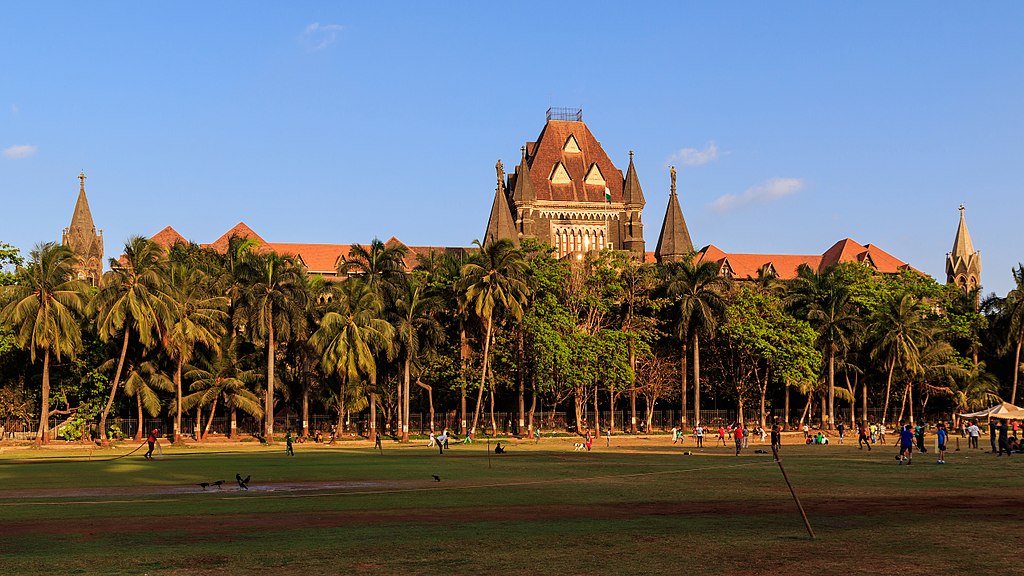
Bombay High Court in Mumbai
© A.Savin, Wikimedia Commons
This is an interesting little test of the judicial system – you know, those told that the Beatles were a popular beat combo – on the subject of property rights. The Bombay High Court has just failed this test too. The question is, multiplex cinemas, why is the food so expensive in them? The correct answer is because the owners of multiplex cinemas make a profit in that manner. According to the court this doesn’t wash. In fact, they seem not to have even considered the argument in that manner:
The Bombay High Court has ruled that food items and bottled water be sold at regular prices inside multiplexes. The directive was issued by a division bench of Justices S.M. Kemkar and M.S. Karnik last week in response to a Public Interest Litigation (PIL) filed by Mumbai resident Jainendra Baxi. He had challenged the prohibition on carrying outside food in movie theatres and multiplexes across Maharashtra.
The economics here is simple enough. The people who order food inside the cinema, at those higher prices, subsidise the others who only buy the ticket to see the movie. Sure, that’s not the first round outcome, but it is the competitive equilibrium. Cinema owners being able to profit from food makes the basic ticket cheaper.
The rights based part is also simple enough. I’m running a business, I can and should be able to decide how people access that business. If I’m running a restaurant I’m entirely at liberty to insist that you only get to consume things at my table that you’ve bought from me. Even if I show a film at the same time.
Another way to put this is that the judges have just failed Chesterton’s Fence. They’ve not grasped why the limitation is in place to start with, therefore they see nothing wrong in ridding everyone of the limitation. And the net effect of this is going to be higher multiplex cinema ticket prices for everyone in Maharashtra.


