
Lindybeige
Published on 10 Jul 2018Tigers? Why talk about Tigers when one can talk about tanks that were even worse? More tank banter with The Chieftain.
Support me on Patreon: https://www.patreon.com/LindybeigeA low-tech tank with fragile armour, a tank that never saw the enemy, and the tank used to teach how not to build tanks. Thanks to Nicholas Moran (AKA The Chieftain) and Matt Sampson, the cameraman at Bovington Tank Museum.
The third of these three segments was shot with my new camera, and it really shows.
Lindybeige: a channel of archaeology, ancient and medieval warfare, rants, swing dance, travelogues, evolution, and whatever else occurs to me to make.
▼ Follow me…
Twitter: https://twitter.com/Lindybeige I may have some drivel to contribute to the Twittersphere, plus you get notice of uploads.
Facebook: https://www.facebook.com/Lindybeige (it’s a ‘page’ and now seems to be working).
Google+: “google.com/+lindybeige”
website: http://www.LloydianAspects.co.uk
July 29, 2018
A poor tank, a useless tank, and the worst tank in the world
July 27, 2018
“Tariffs are the classic example of government interventions with concentrated benefits and dispersed costs”
Robert Higgs on what he describes its supporters as “waging the trade war to end all trade wars”:
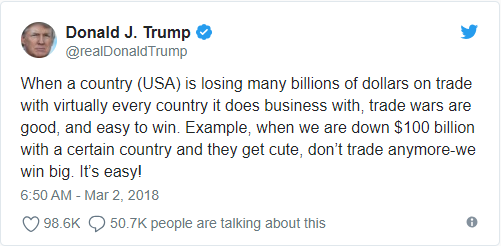
… even as Trump spouts venerable fallacies to justify and seek support for his destructive trade policies and related ad hoc actions, he and his supporters have sometimes offered a strange defense of their tactics: they purport to be seeking, at the end of the game, universal free trade, a world in which all countries have abandoned tariffs, quotas, subsidies, and other government intrusions in international exchange. In Wilsonian terms, they claim to be waging the trade war to end all trade wars. The idea is that by raising U.S. tariffs, they will induce other governments to lower and ultimately eliminate their own.
Of course, this rationale may be nothing more than wily claptrap, tossed out as a rhetorical bone to Republicans who favor freer trade. The administration’s actions to date certainly give no indication that it is aiming at global free trade. On the contrary. So the Wilsonian gambit may consist of nothing but hot air.
But if Trump and his trade advisers actually take this tactic seriously, they are deluding themselves.
First, and surely obviously, U.S. tariff increases will not induce other governments to lower their own, but to raise them, as the EU, China, Mexico, Canada, and other trading partners have already demonstrated. That’s why it’s called a trade war — because the “enemy” shoots back. History has shown repeatedly, most notably in the early 1930s, in the wake of the Smoot-Hawley Tariff Act of 1930, that such trade wars only spiral downward, choking off more and more trade, despoiling the international division of labor in accordance with comparative advantage, and thereby diminishing real income in all the trading countries.
Second, the prospect of the U.S. government’s ever abandoning tariffs is slim to none. Tariffs are the classic example of government interventions with concentrated benefits and dispersed costs. This character makes them attract great support from protected special interests and little opposition from the general public — including other producers — when they are enacted or extended. They are easy for politicians to put in place and diabolically difficult for anyone to eliminate. Although the costs are great — much greater than the benefits for the economy as a whole — hardly anyone’s costs are great enough to justify mounting a potent political attack on the tariffs.
People who get tariffs put in place to protect them in the first place are well positioned to marshal strong opposition to any political attempt to eliminate these taxes on consumers who buy from competing, foreign suppliers. Consumers rarely know anything about why foreign goods are priced as they are, and producers, in general, are usually not affected enough by tariffs on imported raw materials and components to justify well-funded politicking against them.
July 21, 2018
Singapore suffers data breach from SingHealth
In the Straits Times, Irene Tham reports on the data loss:
In Singapore’s worst cyber attack, hackers have stolen the personal particulars of 1.5 million patients. Of these, 160,000 people, including Prime Minister Lee Hsien Loong and a few ministers, had their outpatient prescriptions stolen as well.
The hackers infiltrated the computers of SingHealth, Singapore’s largest group of healthcare institutions with four hospitals, five national speciality centres and eight polyclinics. Two other polyclinics used to be under SingHealth.
At a multi-ministry press conference on Friday (July 20), the authorities said PM Lee’s information was “specifically and repeatedly targeted”.
The 1.5 million patients had visited SingHealth’s specialist outpatient clinics and polyclinics from May 1, 2015, to July 4, 2018.
Their non-medical personal data that was illegally accessed and copied included their names, IC numbers, addresses, gender, race and dates of birth.
No record was tampered with and no other patient records such as diagnosis, test results and doctors’ notes were breached. There was no evidence of a similar breach in the other public healthcare IT systems.
Health Minister Gan Kim Yong and Minister for Communications and Information S. Iswaran both described the leak as the most serious, unprecedented breach of personal data in Singapore.
John Coltrane: My Favourite Things – Sachal Jazz and Wynton Marsalis
Hassan Khan
Published on Apr 30, 2015The original was regarded to have transcended from the West to the East and this tribute absolutely manages to do so! What a tribute and proof that when the East and West compliment rather than compete, there is no limit to what we can achieve! #Makejazznotwar! Sachal Includes Baqir Abbas (flute, bansuri), Nijat Ali (conductor), Ustad Ballu Khan (tabla), Nafees Ahmed (sitar), Asad Ali (guitar), Najaf Ali (dholak), Rafiq Ahmed (dholak)
H/T to Open Culture for the link.
July 13, 2018
Lee Kuan Yew and the Muslim minority in Singapore
I must admit that I know very little about Singapore’s late long-serving Prime Minister, or that he’d been quite outspoken in his views on Islam and how Muslims must fit in to Singapore’s future (and not the other way around):
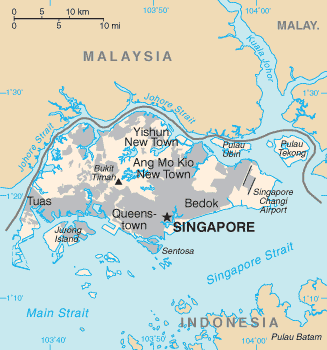
Singapore has been in the news for other reasons recently, but its appearance on the world stage, however brief, may provide us with an excuse to consider the views on Islam of the founding father of Singapore, and its longest-serving Prime Minister, Lee Kuan Yew, who died in 2015. Lee Kuan Yew lived in a multicultural city, with a Chinese majority and Indian and Muslim Malay minorities. All his political life, Lee Kuan Yew was aware of the need to keep the Muslim population in check. The laws he had passed, the regulations he enforced, were directed in large part to that end. He knew about Muslim efforts to convert others, and he made sure that any convert had to immediately register with the government, so such efforts could be monitored, and then countered, by the government. A study of all the ways that Lee Kuan Yew dealt with Muslims, and took careful note of, and combated, their natural aggressiveness and political machinations in tiny Singapore, an island of mostly Unbelievers — 3/4 of whom are Chinese — in a Muslim sea, should be instructive for Western leaders, who have the same problem and as yet only timid and confused ideas as to how to solve it.
Wikileaks revealed that Lee Kuan Yew had called Islam “a venomous religion.” He made sure to limit the numbers of Muslims in Singapore’s armed forces, suggesting their religion made them a possible danger to their non-Muslim fellow soldiers. In his “The Malays in Singapore,” he wrote that “if, for instance, you put in a Malay officer who’s very religious and who has family ties in Malaysia in charge of a machine gun unit, that’s a very tricky business.” It was under his leadership that the government instituted a ban on hijabs and other Muslim headscarves in both the police forces and nursing jobs. Lee Kuan Yew also substantially reduced government funding for madrasas, while increasing support for secular education. His government carefully monitored the mosques, both for the content of the imam’s sermons, and for any foreign (especially Saudi) sources of financial support that might lead to a mosque being “radicalized.” Clearly he understood the danger of Islam.
Lee Kuan Yew had, after all, originally declared Singapore’s independence from Malaysia because the Muslim Malays rejected meritocracy, and insisted on giving economic advantage to themselves. All Malays were required to be counted as Muslims (even if some were not), and all Muslims benefited from a disguised jizyah tax on non-Muslims which is called the “Bumiputra.” Although the word means “sons of the soil,” it is not the indigenous Malaysian tribes that benefit from the “Bumiputra” policy, but Malay Muslims alone.
Singapore has been an economic miracle since independence, but it has been ruled with an authoritarian iron hand in many ways.
July 12, 2018
Great Blunders of WWII: Japan’s Mistakes at Midway
Anthony Coleman
Published on 3 Nov 2016From the History Channel DVD series “Great Blunders of WWII”
July 9, 2018
1918 Flu Pandemic – Emergence – Extra History – #1
Extra Credits
Published on 7 Jul 2018Between 3 and 6 percent of the world’s population died in 18 months when the flu first tried to take over the world. In today’s episode we explore the flu outbreak’s origins from military camps across the United States and Canada.
The flu was the first modern plague — turning our interconnected world against us by spreading through shipping lanes, rail lines and the arteries of industrialized war. Yet it was also the first pandemic of the scientific age, where doctors could to some extent understand what was happening and stand against the infection, though they lacked the tools to stop it. Also, say hello to the voice of “professor” Matt!
July 2, 2018
Drowsy Maggie – Scottish Indian Punjabi Mix (The Snake Charmer)
TheSnakeCharmer
Published on 4 Jun 2018When a 200 year old Traditional Scottish Folk song gets a Punjabi Dubstep revival by The Snake Charmer. A multi cultural music video with Britain’s Castles, highland dancers, Bagpipes, Graffiti walls from India, punjabi folk, bhangra dancers, Russian violinist and a crazy dhol player get together to showcase the amazing diversity in the world and how we all have something in common and can contribute to each other despite the distance and differences. Enjoy this brand new Celtic punjabi mix with Bagpipes.
Patreon (Support me for as less as $1) – https://www.patreon.com/thesnakecharmer
GET MP3
iTunes – https://goo.gl/eoszgf
Google Play – https://goo.gl/3sGBgbBagpipes – Archy Jay
Violin – MadinaHighland Dancers – Northumberland Church of England Academy combined cadet Force, Laura Greyson, Whistle School of Highland Dance.
Bhangra Group – https://www.facebook.com/bhangrainspire/
Dhol Player – Sarthak Pahwa
July 1, 2018
Mapping medieval trade routes
Open Culture linked to a fascinating new map by a Swedish grad student, showing trade routes during the Medieval period:
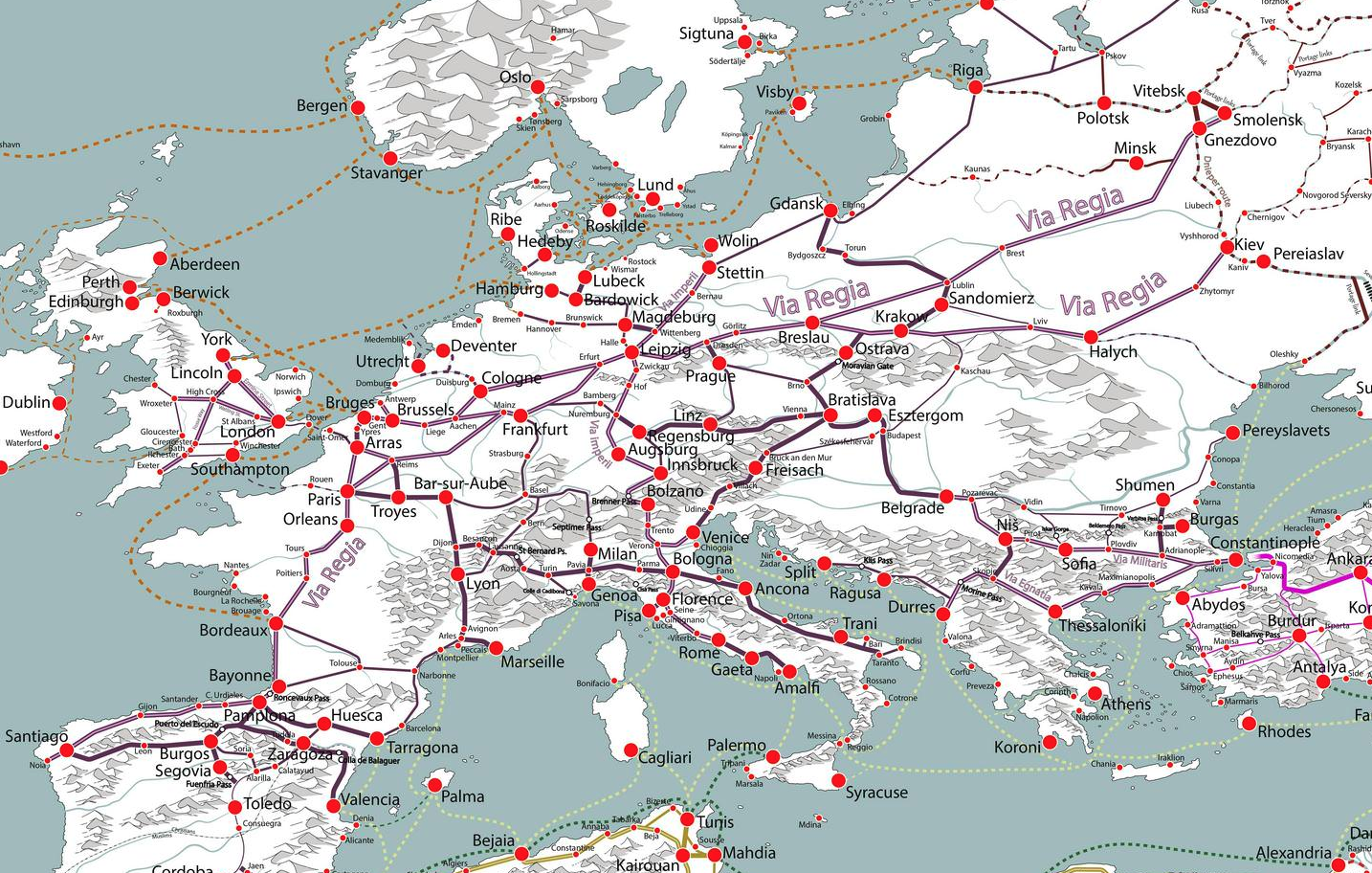
A small portion of Martin Jan Månsson’s trade map of the Middle Ages.
“I think trade routes and topography explains world history in the most concise way,” Månsson explains in the very small print at the map’s lower right corner. “By simply studying the map, one can understand why some areas were especially important–and remained successful even up to modern times.”
The map covers 200 years, spanning both the 11th and 12th centuries, and “depicts the main trading arteries of the high Middle Ages, just after the decline of the Vikings and before the rise of the Mongols, the Hansa and well before the Portuguese rounded the Cape of Good Hope.”
It also shows the complex routes already available to Africa and Asia, and the areas where Muslim and Christian traders would meet. The open-to-trade Song Dynasty ruled China, and the competitive kingdoms in the Indonesia region provided both Muslims and Europeans with spice.
Looking like a railway map, Månsson’s work shows how interconnected we really were back in the Middle Ages, from Greenland in the west to Kikai and Kagoshima in the East, from Arkhangelsk in the frozen north to Sofala in modern-day Mozambique.
The full-sized, high-resolution map can be downloaded here.
Update: Tim Worstall was kind enough to link to this post and uses Månsson’s map to help explain the gravity model of trade:
A standard observation is that places which are closer together trade with each other more than places which are further apart. Add to that the thought that larger economies will trade more with other larger economies – well, you know, more economic activity means more economic activity – and you get the gravity model of trade. So, therefore Britain’s trade future lies with those places nearby, in the EU, than with places further away like the Commonwealth or the US.
This is, sadly, actually the level of debate over Brexit at times. We should trade with France because it’s 26 miles away, so there. The point being that while the gravity model is true – among the best empirically supported of all economic observations – that’s not actually what it says. Rather, that those places which are closer by trade distance trade more with each other. Trade distance being a more complex point than mere geographical location.
[…]
The point here being that by showing the trade routes it is showing us this trade, or perhaps economic, distance which is what the gravity model is about. Valencia and Palma were very much closer – and trade very much more – than Valencia and Toledo, despite roughly equal distances crowfly wise.
June 27, 2018
Calico prohibition
In the current issue of Reason, Virginia Postrel outlines an eighteenth-century French government attempt to prohibit calico cloth:
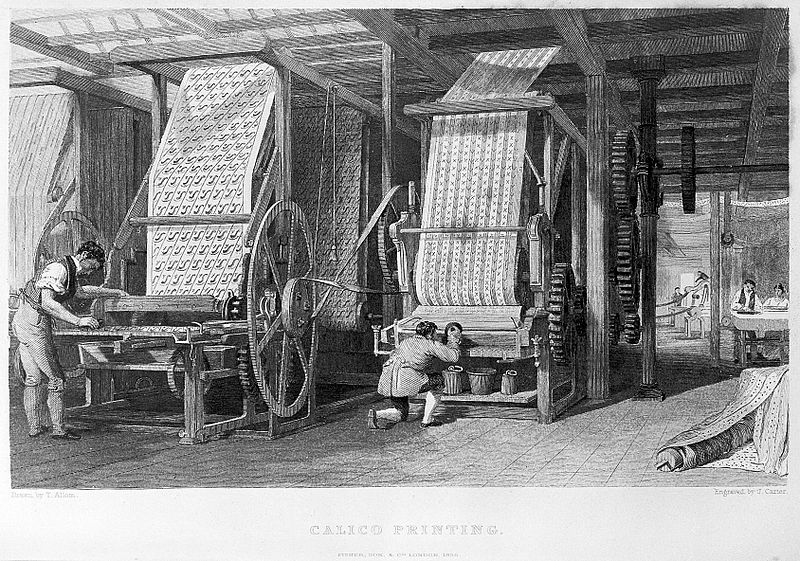
Calico printing, an image from Wellcome Images, via Wikimedia Commons
On a shopping trip to the butcher’s, young Miss la Genne wore her new, form-fitting jacket, a stylish cotton print with large brown flowers and red stripes on a white background. It got her arrested.
Another young woman stood in the door of her boss’ wine shop sporting a similar jacket with red flowers. She too was arrested. So were Madame de Ville, the lady Coulange, and Madame Boite. Through the windows of their homes, law enforcement authorities spotted these unlucky women in clothing with red flowers printed on white. They were busted for possession.
It was Paris in 1730, and the printed cotton fabrics known as toiles peintes or indiennes — in English, calicoes, chintzes, or muslins — had been illegal since 1686. It was an extreme version of trade protectionism, designed to shelter French textile producers from Indian cottons. Every few years the authorities would tweak the law, but the fashion refused to die.
Frustrated by rampant smuggling and ubiquitous scofflaws, in 1726 the government increased penalties for traffickers and anyone helping them. Offenders could be sentenced to years in galleys, with violent smugglers put to death. Local authorities were given the power to detain without trial anyone who merely wore the forbidden fabrics or upholstered furniture with them.
“The exasperation of the lawmakers, after forty years of successive edicts and ordinances which had been largely ignored, flouted or circumvented on a wholesale basis, can be sensed in this law,” writes the fashion historian Gillian Crosby in a 2015 dissertation on the ban. Her archival research shows a spike in arrests for simple possession. “Impotent at stopping the cross-border trade, printing or the peddling of goods,” she writes, “government officials concentrated on making an example of individual wearers, in an attempt to halt the fashion.”
They failed.
In the annals of prohibition, the French war on printed fabrics is one of the strangest, most futile, and most extreme chapters. It’s also one of the most intellectually consequential, producing many of the earliest arguments for economic liberalism. “Long before the more famous debates about the liberalisation of the grain trade, about taxation, or even about the monopoly of the French Indies Company, philosophes and Enlightenment political economists saw the calico debate as their first important battleground,” writes the historian Felicia Gottmann in Global Trade, Smuggling, and the Making of Economic Liberalism (Palgrave Macmillan).
June 26, 2018
Saragarhi – The Last Stand – Extra History
Extra Credits
Published on 5 Aug 2017A humble signal station manned by only twenty one Sikh soldiers of the British Empire finds itself beset by 10,000 attackers. There is no hope for relief, but even knowing it will come at the cost of their lives, the Sikhs refuse to stand down.
Twenty one men in the 36th Sikh Regiment stand against thousands of attackers, prepared to make their final stand.
June 25, 2018
QotD: Gandhi and the British army
The film, moreover, does not give the slightest hint as to Gandhi’s attitude toward blacks, and the viewers of Gandhi would naturally suppose that, since the future Great Soul opposed South African discrimination against Indians, he would also oppose South African discrimination against black people. But this is not so. While Gandhi, in South Africa, fought furiously to have Indians recognized as loyal subjects of the British empire, and to have them enjoy the full rights of Englishmen, he had no concern for blacks whatever. In fact, during one of the “Kaffir Wars” he volunteered to organize a brigade of Indians to put down a Zulu rising, and was decorated himself for valor under fire.
For, yes, Gandhi (Sergeant-Major Gandhi) was awarded Victoria’s coveted War Medal. Throughout most of his life Gandhi had the most inordinate admiration for British soldiers, their sense of duty, their discipline and stoicism in defeat (a trait he emulated himself). He marveled that they retreated with heads high, like victors. There was even a time in his life when Gandhi, hardly to be distinguished from Kipling’s Gunga Din, wanted nothing so much as to be a Soldier of the Queen. Since this is not in keeping with the “spirit” of Gandhi, as decided by Pandit Nehru and Indira Gandhi, it is naturally omitted from the movie.
Richard Grenier, “The Gandhi Nobody Knows”, Commentary, 1983-03-01.
June 20, 2018
Korea adds a second helicopter carrier, may adapt them to carry F-35 aircraft
At Strategy Page, a look at the Korean and Japanese helicopter carrier ships, including the recently launched ROKS Marado, the second ship of the Dodko class:
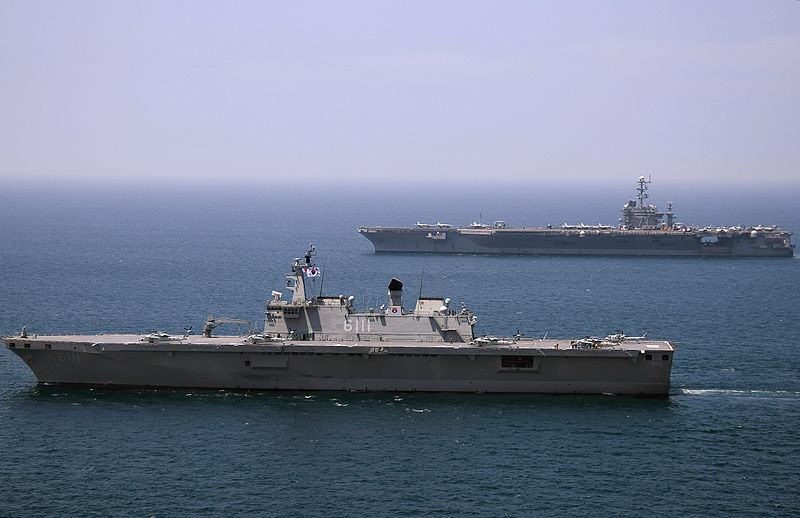
The Republic of Korea Navy amphibious landing ship ROKS Dokdo (LPH 6111) and the aircraft carrier USS George Washington (CVN 73) transit the Sea of Japan (July 27, 2010).
U.S. Navy photo by Mass Communication Specialist 3rd Class Charles Oki via Wikimedia Commons.
During May South Korea launched its second Dokdo class large amphibious ship, the 14,500 ton Marado. The first of these ships, the 14,000 ton LPH (Landing Platform Helicopter) Dokdo entered service in 2007 and the Marado is expected to follow in 2020. In addition to being a bit larger than the first Dokdo, the Marado has a number of new features that enhance its ability to operate as an aircraft carrier. This includes more capable electronics, many of them made in South Korea as well modifications to the flight deck and the hanger deck below.
Both 199 meter long Dokdos are similar in appearance and operation to the larger American amphibious ships. The LPH flight deck can handle helicopters, as well as vertical takeoff jets like the F-35B. The Koreans deny that the ship will be used with these jets, but the capability is there. The LPH normally carries 720 combat troops, a crew of 300, ten tanks, seven amphibious assault vehicle, three towed 155mm howitzers and ten trucks. Dokdos carry fifteen aircraft (two V-22 vertical takeoff transports and 13 helicopters) and two LCAC hovercraft in the well deck for landing troops.
The Marado has a redesigned flight deck that can handle two V-22s at once instead of just one. In addition to a more powerful 3-D surveillance radar for tracking aircraft, Marado has two Phalanx anti-missile systems compared to one Goalkeeper system on Dokdo. South Korea is also going to add a locally developed and manufactured K-SAAM anti-aircraft and anti-missile system. This is similar to the existing U.S. made ESSM but with longer range and an improved guidance system.
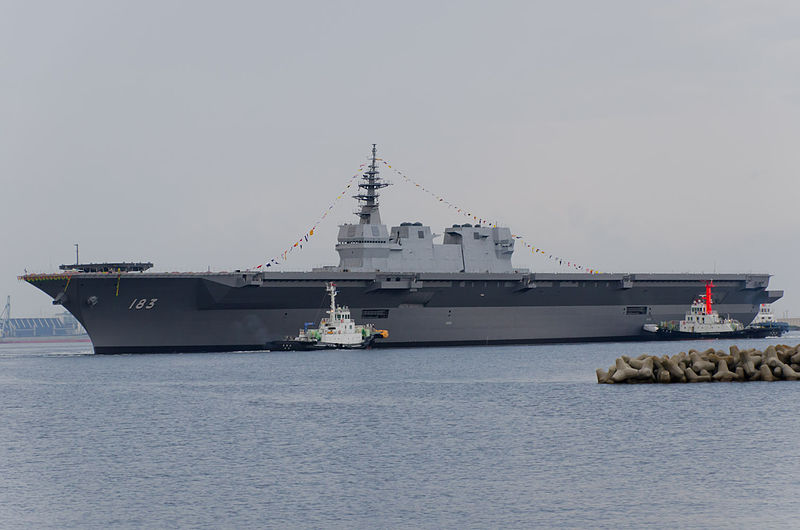
JS Izumo DDH-183, sister-ship of the JS Kaga DDH-184, both helicopter-equipped destroyers, officially.
Meanwhile, neighbor Japan has taken the Dokdo concept a bit farther. In early 2017 Japan put into service a second 27,000 ton “destroyer” (the Kaga, DDH 184) that looks exactly like an aircraft carrier. Actually, it looks like an LPH, an amphibious ship type that first appeared in the 1950s. This was noted when Izumo, the first Japanese LPH, was launched in 2012 (and entered service in 2015). The Izumos can carry up to 28 aircraft and are armed only with two Phalanx anti-missile systems and a launcher with sixteen ESSM missiles for anti-missile and anti-aircraft defense.
[…]
The Izumo is part of a trend. In 2009, Japan launched its second Hyuga class “LPH”. Earlier in 2009, it commissioned the first of these “helicopter-carrying destroyers”. This was the first Japanese aircraft to enter service since 1945. The Hyuga class are 197 meter (610 foot) long, 18,000 ton warships that operates up to eleven (mostly SH-60) helicopters from a full-length flight deck. Although called a destroyer, it very much looks like an aircraft carrier. While its primary function is anti-submarine warfare, the Hyuga will also give Japan its first real power projection capability since 1945. The Hyuga was also the largest warship built in Japan since World War II.
South Korea could adapt their Dokdos to handle a few F-35Bs by making the flight deck more heat resistant and rearranging the hanger deck. South Korea is getting land based F-35As which would enable them to determine if it would be worth the time and money to adapt their LPHs to carry some vertical takeoff F-35Bs. Sometimes peacekeeping missions involve some peacemaking and F-35Bs would help with that.
June 18, 2018
Feature History – Meiji Restoration
Feature History
Published on 21 May 2017Hello and welcome to Feature History, featuring Meiji Restoration, a fancy schmancy collab, and most likely too many bill wurtz references in the comments.
Rackam’s Life & Times of Tokugawa Ieyasu
https://www.youtube.com/watch?v=-6fR8oDewdg
Patreon
https://www.patreon.com/FeatureHistory
https://twitter.com/Feature_History
———————————————————————————————————–
I do the research, writing, narration, art, and animation. Yes, it is very lonely
Music
Jeff Van Dyck – The Shoto
Jeff Van Dyck – Ona Hei
Jeff Van Dyck – Sonaiyo
Jeff Van Dyck – Now and Zen
Jeff Van Dyck – Fudo Myo March
Jeff Van Dyck – Rock and a Hard Place
Jeff Van Dyck – Winds of Fate
Jeff Van Dyck – Duty Calls
Jeff Van Dyck – Battle of Shinobue
Jeff Van Dyck – The Harvest
Jeff Van Dyck – Death Cures a Fool
Jeff Van Dyck – The Fall of the Samurai
Jeff Van Dyck – Stalemate


