
World War Two
Published 27 Jun 2024The US bombers continue destroying Japanese cities with a rain of firebombs. As the country burns, the Japanese leadership and Emperor Hirohito finally realise they must seek peace.
(more…)
June 28, 2024
Japan Decides on Peace – Are They Too Late? – War Against Humanity 137
Comments Off on Japan Decides on Peace – Are They Too Late? – War Against Humanity 137
June 26, 2024
The Korean War Begins – Week 1 – June 25, 1950
The Korean War by Indy Neidell
Published 25 Jun 2024Despite the fact that there have been clear signs that they might soon invade South Korea, when the North actually does in force on June 25th, 1950, it comes as a complete shock to the world. But is this a full invasion, or just cross border raids such as there were in 1949? And is there something more behind this? Stalin’s Soviets? Mao’s Chinese? And how will the world react? Find out this week as our week by week coverage of the war begins!
(more…)
Comments Off on The Korean War Begins – Week 1 – June 25, 1950
June 24, 2024
QotD: Raid warfare on the Eurasian Steppes and on the Great Plains
The other strategic aim nomads might fight over is for the acquisition of some kind of movable good, which is to say raiding for stuff. Because all of the warriors (which is generally to say all of the free adult males) of these societies are mounted and because they have a subsistence system which allows rapid, relatively along distance movements (often concealed; remember that Mongols need not light any camp fires), nomads make fearsome raiders, able to strike, grab the things they are looking for and quickly retreat before a counterattack can be mobilized. That goes just as well for raiding each other as it does for raiding the farmers at the edges of the grasslands.
But what are the things here that they are aiming to get? It depends on the targets; nomadic raids into the settled zone generally aim to capture the goods that agrarian societies produce which nomadic societies do not: stocks of cereal crops, metal goods and luxury goods. But most nomadic raiding was directed against other nomads, seeking to acquire either people or animals.
On the Great Plains, the animals in question were invariably horses; the act of stealing, or “cutting out” a horse gives McGinnis part of the title of his book (Counting Coup and Cutting Horses) and raids for horses dominate both McGinnis and Secoy’s discussion of Plains Native American warfare. Horses were, after all, a scarce commodity which only percolated into the Great Plains from the South (and which could only be raised in quantity in its southern reaches), but which all tribes required both to hunt and fight effectively. Stealing enemy horses thus both strengthened your tribe while weakening your enemies, both in military and subsistence terms. The Mongols also engaged in quite a lot of raiding for horses, but also – in a pastoral subsistence system – a lot of simple cattle rustling as well (e.g. Ratchnevsky, op. cit., 28-31).
Raiding for people is more complex, but undeniably part of this system of warfare. But crucially this raiding was generally not for slave-trading (though there are exceptions which I discussed last time), but instead incorporative raiding. What I mean by that is that the intent in gaining captives in the raid was to incorporate those captives, either as full or subordinate members, into the nomadic community doing the raiding. Remember: the big tribe is the safe tribe, so incorporating new members is a good way to improve security in the long run.
On the Eurasian Steppe, incorporated captives became the ötögus bo’ol “bonded serfs” that we mentioned previously (Ratchnevsky, op. cit., 12-4). Unlike warfare on the Great Plains, it seems possible for the bo’ol to include adult men, either captured or sold (by destitute parents) as children or else taken as prisoners when their tribe or clan was essentially dissolved by being conquered in war. Indeed, in his own conquests, Chinggis only decreed the annihilation of one tribe, the Mongols’ traditional enemies, the Tatars – there he ordered the death of any Tatar male taller than the linchpin of an oxcart (May, Mongols, 12). In other cases, it is clear that the incorporation of defeated nomad warriors into the successful tribe was fairly normal, though raids to capture women and children (also for incorporation) were just as common. Bride abduction in particular was very common on the Steppe, as Ratchnevsky notes (op. cit., 34-5).
The incorporation of males was far less common in Great Plains Native American warfare, but the capture of women and children to enhance tribal strength in the long term was a core objective in raiding. McGinnis (op. cit., 42-3) notes how the Crow, after suffering a massive defeat in the early 1820s which resulted in the deaths of many warriors and the capture of perhaps several hundred women and children, steadily built their tribe back up over the following decades with an intentional strategy of capturing women and children from their enemies. As McGinnis (op. cit., 24) notes, women captured in this way might be married into the capturing tribe, adopted into it, or sometimes kept as an enslaved laborer (under quite bad conditions). Adult males, by contrast, were almost always killed; unlike on the Steppe, the incorporation of formerly hostile warriors doesn’t seem to have been considered possible (though one wonders if this would have become cultural practice given enough time; both McGinnis and Secoy note how the increasing lethality of warfare post-gun/horse led to slow population decline overall, which may, had the system run without outside interference long enough, led to the emergence of norms more closely resembling the Eurasian Steppe. We should keep in mind that the Eurasian horse-system had many centuries to sort itself out, whereas the North American horse-system was essentially strangled in its crib).
Of course, taken together with the previous discussion of territorial warfare, we can see that all of these raids have a double purpose: they both aim to acquire resources (horses, sheep, humans) and at the same time inflict damage on an opponent with the long-term goal of forcing that enemy to move further away, opening their pastures or hunting grounds for exploitation by the victorious tribe. Thus in the long-term, each successful raid is intended to build a sense of threat which eventually results in territorial gains (though in cases of real power asymmetry, the long term could come very rapidly; people aren’t stupid and if you are being raided by a clearly superior opponent, you are likely to move on before you lose everything of value).
Squaring the ugly reality of nomadic raiding with [George R.R.] Martin’s depiction [of his nomadic Dothraki] is tricky. On the one hand, a raid in which exceptional victory results in enemy women and children taken captive and fit adult males slain fits within either the Great Plains Native American or Steppe nomad military tradition. On the other hand, the immediate declaration by Drogo’s men that female captives taken this way are not marriageable (AGoT, 559; the idea is treated as laughable) and the killing of all of the very valuable livestock (which, even if the Dothraki are not herdsmen, these animals could be eaten, or quite easily driven to a place where they could be sold or traded for other resources, like metalwork) suggests that Martin has not understood why those raids happened. Instead, it seems like his imagination is only able to view these raids from the perspective of the settled people on the receiving end.
Instead, Martin’s understanding of Native American warfare seems not conditioned by any actual Native Americans, but rather by Hollywood depictions of Native Americans during the Hollywood “Golden Age” which were in turn conditioned by sensational accounts of Western settlers who themselves didn’t understand how Native American warfare worked on the Great Plains. As we will see, the Game of Thrones showrunners took that unfortunate subtext when making the show itself, and turned it into actual text.
Bret Devereaux, “Collections: That Dothraki Horde, Part IV: Screamers and Howlers”, A Collection of Unmitigated Pedantry, 2021-01-08.
Comments Off on QotD: Raid warfare on the Eurasian Steppes and on the Great Plains
June 23, 2024
Okinawa Ends – WW2 – Week 304 – June 22, 1945
World War Two
Published 22 Jun 2024Mitsuru Ushijima’s forces are defeated and the Battle of Okinawa is officially over. However, since most of the Japanese fought to the death, victory comes at a bloody cost – over 50,000 US casualties and over 100,000 Japanese and also possibly that many Okinawan deaths. The fight on North Borneo continues, there’s a raid on Wake Island, and the Japanese powers that be meet to actually discuss making some sort of peace with the Allies.
00:00 Intro
01:25 Truman And The Interim Committee
05:00 Battle Of Okinawa
08:06 The End Of Okinawa
13:22 Raid On Wake Island
14:23 Battle Of North Borneo
15:33 Hirohito Wants Peace
16:54 Conclusion
(more…)
Comments Off on Okinawa Ends – WW2 – Week 304 – June 22, 1945
June 20, 2024
The birth of para-rescue
At The War Room, Dr. Robert Lyman discusses an air crash in 1943 and the innovative and daring rescue of the survivors using parachutes:
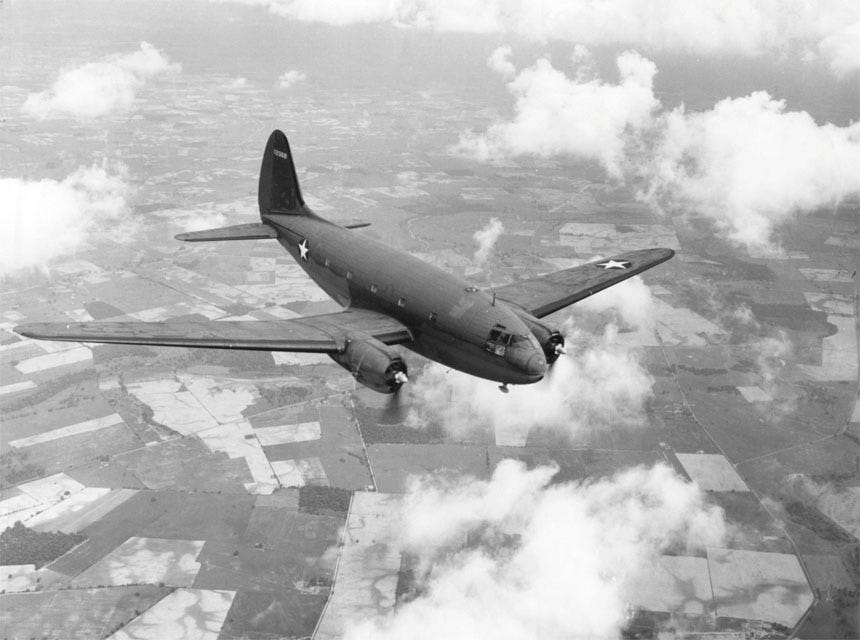
A United States Army Air Force (USAAF) C46 similar to that of Flight 12420.
The birth of para-rescue can be placed in operations across the Hump airlift in 1942 and 1943. The story of the crash of Flight 12420 was a central part of the story.
The story itself is extraordinary. In 1943 a Soviet spy inside the predecessor organization to the CIA and a proud descendant of the famous Southern leader General Robert E Lee, on his way to China to meet General Dai Li, the mysterious and secretive Kuomintang intelligence chief; a celebrated American journalist sent by President Roosevelt to ascertain the “truth about China”; and General “Vinegar Joe” Stilwell’s political adviser; together with eighteen others — American and Chinese — survived a C46 air crash on the mountainous and remote border between India and Burma. It was, and remains, the largest evacuation of an aircraft by parachute, and, given the fact that even the crew had never been trained in the technique, it was a miracle that so many survived. But they fell with their crippled plane from the frying pan into the fire. On disentangling themselves from their parachutes, the twenty shocked survivors soon found that they had arrived in wild country dominated by a tribe that had an especial reason to hate white men. The Nagas of the Patkoi Hills on their remote and unsurveyed land were notorious headhunters, who continued — despite the feeble wrath of distant British imperial authority — to practice both slavery and human sacrifice. Their specialty was the removal of the heads of their enemies — often women and children — achieved with a swipe of ugly, razor-sharp daos. On two occasions in recent years their village, or parts of it, had been burned to the ground and their warriors killed in running battles with sepoys sent to teach the villagers a lesson and to exert the authority of the Raj.
Nevertheless, and against all the odds, all but one of the twenty-one passengers and crew on the doomed aircraft survived. The story of the extraordinary adventure of those men among the Nagas of Pangsha and of their rescue by the young representative of the distant imperial power, the British deputy commissioner who arrived wearing “Bombay bloomers” and stout leather walking shoes, carrying a bamboo cane, and leading an armed party of “friendly” Nagas, is told in my book Among the Headhunters. In their meeting in some of the world’s most inaccessible and previously unmapped terrain, three very different worlds collided. The young, exuberant apostles of the vast industrial democracy of the United States came face-to-face with members of an ancient mongoloid race, uncomprehending of the extent of modernity that existed beyond the remote hills in which they lived and determined to preserve their local power, based on ancient head-hunting and slaving prerogatives. Both groups met — not for the first time for the Nagas, whose village had been burned twice, in 1936 and 1939, because of persistent head-hunting — the vestiges of British authority in India, disintegrating as the Japanese tsunami washed up at its gate.
One of the reasons for the survival of the men whose aircraft fell to earth that tumultuous day was the quick thinking, rapid action and spontaneous sacrifice of a group of US servicemen at the airbase from whence the aircraft departed that morning, Chabua. One in particular needs calling out, thirty-six-year-old ATC wing surgeon Lieutenant Colonel Don Flickinger. He had been duty medical officer at Pearl Harbor during the Japanese attack on December 7, 1941 and in 1943 found himself stationed in the upper reaches of Assam as part of the mammoth Hump airlift to China.
On the day the C46 went down over the rugged Paktoi ranges, the dividing line between astern India and Burma in the first leg of the journey to China, a C47 sent up to see if it could find the wreckage, and found the survivors waving from a remote village high in the hills. Using ground signalling panels the C47 dropped to the survivors they indicated that at least one of the party was badly injured. When the C47 returned to Chabua with the news that survivors were seen in the sprawling village and its location pinpointed on the map, the British deputy commissioner gave the Americans the grave news that the men were likely to be in grave danger. The villagers were, unknown to the survivors, the most practised headhunters of the region, a powerful and unruly tribe who were notorious for their violence. It was unlikely that the men would survive the encounter.
Comments Off on The birth of para-rescue
June 19, 2024
Soviet America in decay
At The Free Press, Niall Ferguson invites us to consider that America, not China, has taken the place of the Soviet Union in the post-Soviet world:
The witty phrase “late Soviet America” was coined by the Princeton historian Harold James back in 2020. It has only become more apposite since then as the cold war we’re in — the second one — heats up.
I first pointed out that we’re in Cold War II back in 2018. In articles for The New York Times and National Review, I tried to show how the People’s Republic of China now occupies the space vacated by the Soviet Union when it collapsed in 1991.
This view is less controversial now than it was then. China is clearly not only an ideological rival, firmly committed to Marxism-Leninism and one-party rule. It’s also a technological competitor — the only one the U.S. confronts in fields such as artificial intelligence and quantum computing. It’s a military rival, with a navy that is already larger than ours and a nuclear arsenal that is catching up fast. And it’s a geopolitical rival, asserting itself not only in the Indo-Pacific but also through proxies in Eastern Europe and elsewhere.
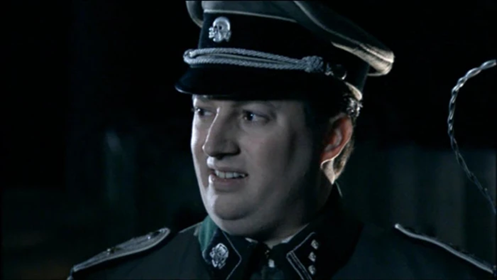
But it only recently struck me that in this new Cold War, we — and not the Chinese — might be the Soviets. It’s a bit like that moment when the British comedians David Mitchell and Robert Webb, playing Waffen-SS officers toward the end of World War II, ask the immortal question: “Are we the baddies?”
I imagine two American sailors asking themselves one day — perhaps as their aircraft carrier is sinking beneath their feet somewhere near the Taiwan Strait: Are we the Soviets?
Yes, I know what you are going to say.
There is a world of difference between the dysfunctional planned economy that Stalin built and bequeathed his heirs, which collapsed as soon as Mikhail Gorbachev tried to reform it, and the dynamic market economy that we Americans take pride in.
The Soviet system squandered resources and all but guaranteed shortages of consumer goods. The Soviet healthcare system was crippled by dilapidated hospitals and chronic shortages of equipment. There was grinding poverty, hunger, and child labor.
In America today, such conditions exist only in the bottom quintile of the economic distribution — though the extent to which they do exist is truly appalling. Infant mortality in the late Soviet Union was around 25 per 1,000. The figure for the U.S. in 2021 was 5.4, but for single mothers in the Mississippi Delta or Appalachia it is 13 per 1,000.
The comparison to the Soviet Union, you might argue, is nevertheless risible.
Take a closer look.
Comments Off on Soviet America in decay
Why the US Lost the Tet Offensive Despite Beating the NVA
Real Time History
Published Feb 16, 2024After years of boots on the ground and bloody combat in Vietnam, US officials are publicly confident. The strategy of eliminating the Viet Cong is working. The North Vietnamese communist forces are on their last legs and victory is only a matter of time. Or so they say. But as 1968 and the traditional lunar new year festivities begin, US and South Vietnamese troops find themselves on the receiving end of a formidable North Vietnamese surprise attack: The Tet Offensive.
(more…)
Comments Off on Why the US Lost the Tet Offensive Despite Beating the NVA
June 16, 2024
Mao Tightens His Grip – WW2 – Week 303 – June 15th, 1945
World War Two
Published 15 Jun 2024After several weeks of the Congress of the Chinese Communist Party, Mao Zedong’s power has consolidated to the point that it is absolute. All pledge loyalty Mao, and his infallibility shall not be questioned. Meanwhile the war goes on in the field with Australian landings on Brunei, continuing fighting on Okinawa, and the last part of Europe — in the Netherlands — liberated from Axis control.
(more…)
Comments Off on Mao Tightens His Grip – WW2 – Week 303 – June 15th, 1945
June 14, 2024
QotD: European “megacorporations” in the east
And the structure of these massive trading companies mirrors some of the elements of a megacorp. While both companies were, in theory, shipping companies, in practice they were massive vertically integrated conglomerates. Conquering the production areas (particularly India for the EIC and Java for the VOC), they essentially controlled the production chain from start to finish. That complete vertical integration meant that the companies also had to supply employees and colonial subjects, which in turn meant controlling trade and production in everything from food and clothes to weapons. Both companies had their own armies and fleets (the EIC boasted more than 25,000 company soldiers at its height, the VOC more than 10,000) and controlled and administered territory.
In short, they were the colonial Dutch and British governments for many millions of colonial subjects. For the people living in territory dominated by these companies, they really would have resembled the megacorps of speculative fiction, operating with effectively impunity and using their vast profits to field armies and navies capable of defeating local states and compelling them to follow the interests of the company (which remained profit-oriented).
(I feel the need to stop and note that “company rule” in India and even more so in the Dutch East Indies was brutally exploitative, living up to – and in many cases quite surpassing – the normal dystopian billing of science fiction megacorporations. At the same time, it seems equally worth noting that the shift to direct colonial rule by the state was not always much better.)
So in one sense, the speculative fiction megacorp has already existed, but in the other, the limits of these historical entities are informative too. First, it seems relevant that none of these companies were creatures of the markets, rather, they were created by state action – they were chartered companies, state monopolies, or both. These massive imperial trading companies (of which the EIC and VOC were the most successful, but not the only ones) were all created by their respective governments, armed with substantial privileges and typically given exclusive rights to certain trade – they were state-sanctioned monopolies (echoes of this also in the Japanese Zaibatsu state-sanctioned vertical monopolies; note that the Roman publicani [tax-farming “companies” of the middle and late Republic] were also state-sanctioned monopolies) whose monopolies were backed by state power to the point that their states (that is, Britain, the Dutch Republic, France and so on) would and did go to war to protect the trading rights of their monopoly trading companies.
Second, these megacorporations, far from being in a position to usurp the states that formed them (as fictional megacorporations often do), turn out to be extremely vulnerable to those states. The EIC was effectively nationalized by an act of parliament in 1858 (after the Indian Mutiny of 1857 discredited company rule in the eyes of the British government) and disbanded in 1874. The VOC was likewise nationalized by its parent government in 1796 and then dissolved in 1799. No effort was made by either company to resist being disbanded with any sort of force; it would have been a pointless gesture in any case. While the resources of the EIC were vast, the military capabilities of the British Empire were far greater. Moreover, the companies simply didn’t have the legitimacy to operate absent their state backing.
This is of course also true for the not-quite-megacorporations, like the great trusts of America’s gilded age (Standard Oil, U.S. Steel, etc.), or the Japanese zaibatsu or even modern super-sized corporate entities. Of the 10 largest companies in the world, four are straight up state-owned enterprises. Even for the private modern massive company, by and large when they try to fight their “home” state, they lose, or at least are badly damaged without seriously inconveniencing the far greater power of the state (just ask AT&T or Microsoft).
Bret Devereaux, “Fireside Friday: January 1, 2021”, A Collection of Unmitigated Pedantry, 2021-01-01.
Comments Off on QotD: European “megacorporations” in the east
June 11, 2024
History-Makers: Sun Tzu & the Art of War
Overly Sarcastic Productions
Published Mar 1, 2024TBH I prefer “Moon Aquarium” but Sun Tzu is pretty cool too.
SOURCES & Further Reading:
The Art of War by Sun Tzu, translated and with introduction by Lionel Giles (1910)
Tao Te Ching by Lao Tzu, translated by Stephen Addiss & Stanley Lombardo (1993)
“Sun Tzu’s Art of War” & “Sun Tzu Through Time” from Masters of War: History’s Greatest Strategic Thinkers by Andrew R. Wilson, Ph.D.
“China: A History” by John Keay
“Sun-zi and the Art of War: The Rhetoric of Parsimony” by Steven C. Combs, Quarterly Journal of Speech, Vol.86, No 3, August 2000
“The Art of War” by Mark Cartwright and “Sun Tzu” by Joshua J Mark from World History Encyclopedia
R/AskHistorians answer by u/Iphikrates to the question “Who was Sun Tzu Writing For?” https://www.reddit.com/r/AskHistorians/comments/7ym4yr/comment/duicm6q/
(more…)
Comments Off on History-Makers: Sun Tzu & the Art of War
June 9, 2024
Operation Downfall: 2 Million Men to Invade Japan – WW2 – Week 302 – June 8, 1945
World War Two
Published 8 Jun 2024The plans to invade the Japanese Home Islands in the fall grow ever more concrete, with the main issue being not just how to transport men by the millions around the world, but where to put them once they get there. On land the fight continues in Okinawa and the Philippines, and at sea the American fleet is savaged by a typhoon for the second time in six months.
Chapters
00:34 Recap
01:22 The Allied Control Commission
02:29 Okinawa
03:50 The War in the Philippines
06:22 Halsey and another typhoon
09:13 Operation Downfall
19:07 Summary
19:24 Conclusion
20:28 Dedication to Donald Wilson Round
(more…)
Comments Off on Operation Downfall: 2 Million Men to Invade Japan – WW2 – Week 302 – June 8, 1945
June 7, 2024
Redeployment! – Millions of men from Europe to Asia
World War Two
Published 5 Jun 2024Now that Japan is the only Axis power still in the fight, Allied forces — especially American ones — must redeploy to prepare for the final invasion of the Japanese Home Islands. But how do you move millions of men halfway around the globe? And which ones go — veterans, new recruits, or some combination? Who decides? Where exactly do you send them to prepare too, with some many eastern ports like Manila a shambles? Let’s take a look.
(more…)
Comments Off on Redeployment! – Millions of men from Europe to Asia
June 2, 2024
Japan vows to fight to the end! – WW2 – Week 301 – June 01, 1945
World War Two
Published 1 Jun 2024This week President Truman and his aides meet to discuss the use of the atomic bomb. In Japan, the Imperial government vows to fight on even as Yokohama is turned to ash by firebombing. On Okinawa, Japanese 32nd Army withdraws from the defences of Shuri Castle but there is still plenty of hard fighting left for the Americans. There are US Navy command reshuffles and the stage is set for an Allied conference in Potsdam.
Chapters
01:21 Recap
05:08 The Fight on Okinawa
08:38 The Interim Committee And The Bomb
14:02 Notes
(more…)
Comments Off on Japan vows to fight to the end! – WW2 – Week 301 – June 01, 1945
THIS is how Plastic Model Kits are MADE! I spent a day at the UK Airfix Factory!
Model Minutes
Published Nov 26, 2022In November 2022 a press day was held at the UK factory which manufactures quickbuild and the NEW Supermarine Spitfire Mk.IXc in 1/24 scale from @OfficialAirfix. During the visit we were given presentations from Luke (researcher) and Chris (designer) on the various elements that go into creating the designs of the tooling.
Join me in this video where I take a look at how plastic model kits are actually manufactured, focusing on the physical creation of the kits through injection moulding and quality control at the Plastech factory in Newhaven.
I’d like to extend my thanks to Airfix and Plastech for putting on this event.
Chapters:
00:00 Intro
00:48 Research & Design
01:36 Plastech Background
02:47 Tooling Prep
03:21 Injection Moulding
06:38 Quality Control
11:31 Boxes & Packaging
13:21 Packing a kit!
16:04 Conclusion
(more…)
Comments Off on THIS is how Plastic Model Kits are MADE! I spent a day at the UK Airfix Factory!
June 1, 2024
I plead the Pith: a History of the Pith Helmet
HatHistorian
Published Jun 1, 2022A symbol of exploration, tropical adventure, and colonialism, the pith helmet has had a long history since its origins as the salakot, a Philippine sun hat. Through many iterations, it had become one of the most famous hats out there, a powerful part of popular imagination.
The helmets I wear in this video come respectively from a gift from a family friend (so I don’t know where it was bought, https://www.historicalemporium.com/, and Amazon.com. The red tunic comes from thehistorybunker.co.uk
Title sequence designed by Alexandre Mahler
am.design@live.comThis video was done for entertainment and educational purposes. No copyright infringement of any sort was intended.
Comments Off on I plead the Pith: a History of the Pith Helmet


