
China’s not buying our oil; it’s buying the reliable flow of Canadian corporate profits and our stable economic outlook.
Is it a national security risk to Canada?
No, again. It is true that, according to CSIS, the Chinese government represents the largest espionage threat to Canada, stealing the equivalent of $1-billion a month from our country in industrial secrets. (That’s more than our annual exports to China.)
But that espionage is done illegally by Chinese students, expats and other sympathizers, not through the legal ownership of share certificates. No doubt our high-tech energy secrets are being stolen and will continue to be stolen, but that is not happening because of a Wall Street deal. The central strategic value of the oil sands is not at risk.
Ezra Levant, “Pipeline to Asia”, National Post, 2010-04-15
April 15, 2010
QotD: Chinese espionage in Canada
Uninhabited islands could be flashpoint in Sino-Japanese conflict
A group of uninhabited islands south of Okinawa have the potential to increase tensions between China and Japan. The Senkaku island group is subject to overlapping claims from China, Taiwan, and Japan:
Japan reports that, for the third time in the past 18 months, Chinese warships have been spotted south of the Japanese Island of Okinawa. This time, it was two Chinese submarines, running on the surface. That had never been seen before, in the area near the Senkaku islands (which are claimed by China, Taiwan and Japan). The Senkakus are eight uninhabited islands, which in the past were only used occasionally by fishermen. The Senkakus are 220 kilometers from Taiwan, 360 kilometers from China and 360 kilometers from Okinawa (which is part of Japan).
[. . .]
Five years ago, a Chinese oil drilling platform, in disputed waters halfway between China and the Japanese island of Okinawa, began producing natural gas, despite ongoing negotiations over who owns what in that patch of ocean. The Chinese spent two years building that platform, in waters claimed by Japan. A second platform was later built, as well as an underwater oil pipeline for both platforms. China regularly sends groups of warships to patrol the area, to underline their belief that this bit of water is under Chinese control. Japan would probably win any naval war with China, but since China has nuclear weapons, and Japan does not (at least not right now), such a war could go seriously against Japan. This has been brought up in Japan before, and it is feared that the issue may lead to Japan secretly, or openly, building nuclear weapons (which it could certainly do, and quite quickly.)
I’m certainly hoping that this is just speculation on the part of Strategy Page (the bit about nuclear weapons), as territorial disputes over islands do have a way of getting out of hand (see Falkland Islands, for example).
March 25, 2010
Another tidbit on military reform in China
In an article briefly discussing the not-widely-reported unrest in ethnic Uighur regions, a mention of some progress in reducing corruption in China’s military hierarchy:
There’s a lot of corruption remaining in the military as well. For over a decade, the government has worked to eliminate the worst of the theft and moonlighting. The most outrageous examples of this have been curbed. Thus military officers no longer use cash from the defense budget to set up weapons factories they run and profit from. Big chunks of procurement cash no longer disappear into the offshore bank accounts of generals and admirals. But there’s still a lot of corruption. Much is still for sale, like promotions. Lower ranking officers and NCOs can still be found selling weapons and equipment that is reported “destroyed” or “mission.” Commanders who are not doing so well, can pay to have reports of their performance upgraded. Senior government officials still have doubts about how effective the military would be in another war. It was noted, usually by journalists, that the army response to several recent national disasters (which usually employ troops for disaster relief) had problems. This is not supposed to be reported, but the journalists discuss it among themselves, and some of this knowledge gets onto the Internet and outside the country. People love to gossip, especially in a police state like China.
In response to the corruption, and uncertainly about how the military reform (and modernization) program is going, this year’s defense budget only went up 7.5 percent. For over a decade, the annual increases were in the double digits. But another reason for the stall is the impact of the worldwide recession. While the Chinese economy continued to grow, the rate was less.
The usual caveats apply about any official statistics used in discussions about China: if you’ve somehow managed to avoid seeing ’em before, there’s a roundup here.
March 23, 2010
Another sign of modernization or just window-dressing?
China has been actively modernizing their military forces for the last couple of years, including not only new designs in equipment, but also doctrinal changes in how those forces go about doing their jobs. The generals seem to have finally decided that moving away from the Mao-era massed infantry is necessary, as Korean War tactics won’t prevail against an opponent with modern equipment. A minor name change is a way-marker for all the other military changes happening:
Without any fanfare, China has changed the names of its armed forces. Gone are the PLA (Peoples Liberation Army) prefix for the navy (PLAN) and air force (PLAAF). It’s now just the Chinese Army, Chinese Navy and Chinese Air Force. Since there was no official announcement, there was no explanation for why the old PLA prefix was dropped. The PLA was the original armed forces, founded in 1927, of the Chinese Communist Party. This force was initially known as the Chinese Red Army. After World War II, the PLA name was formally adopted for all the armed communist armed forces.
If nothing else, it will make future reports on the Chinese military sound less like propaganda reels from the 1950s.
March 17, 2010
Superbubble?
Jon, my former virtual landlord, sent me this link, suggesting that it “gives you an opportunity to round up all of your ‘as I said about China earlier…’ [posts]”.
The world looks at China with envy. China’s economy grew 8.7 percent last year, while the world economy contracted by 2.2 percent. It seems that Chinese “Confucian capitalism” — a market economy powered by 1.3 billion people and guided by an authoritarian regime that can pull levers at will — is superior to our touchy-feely democracy and capitalism. But the grass on China’s side of the fence is not as green as it appears.
In fact, China’s defiance of the global recession is not a miracle — it’s a superbubble. When it deflates, it will spell big trouble for all of us.
I don’t want to give the impression that I’m anti-Chinese, because that isn’t why I post this sort of material. I think the Chinese miracle has been to raise literally hundreds of millions out of poverty, but it hasn’t been a purely positive thing: hundreds of millions of others are supporting the uplift but being deprived of similar opportunities. It’s a fantastic achievement, but it has involved — and continues to involve — injustice and repression.
It also requires continued state control over media, and not just BBC/CBC/PBS type state funding, but actual state censorship and worse:
During the crisis, Chinese exports were down more than 25 percent, tonnage of goods shipped through railroads was down by double digits, and electricity use plummeted.
Yet Beijing insisted that China had magically sustained 6 to 8 percent growth.
China lies. It goes to great lengths to maintain appearances, including censoring media and jailing those who write antigovernment articles. That’s why we have to rely on hard data instead.
Those lies will compound the impact when the lies can’t be maintained any more:
What happens in China doesn’t stay in China. A meltdown there — or even a slowdown — would have severe consequences for the rest of the world.
It will tank the commodity markets. Demand for industrial goods will fall off the cliff. Finally, Chinese appetite for our fine currency will diminish, driving the dollar lower against the renminbi and boosting our interest rates higher. No more 5 percent mortgages and 6 percent car loans.
It will be bad for the US and the rest of the world’s economies, but it could well be catastrophic (in the full meaning of that word) for China. As the US economy contracted over the last couple of years, it revealed lots of malinvestments . . . and the companies which were most exposed to the risks took huge hits to their balance sheets and their business models. A similar shock to the Chinese economy could topple the government or raise the already-high chances of massive unrest and corresponding increased repression.
Interesting times, indeed.
As Jon suggested, you can see my previous concerns about the Chinese economy here.
March 16, 2010
That Red Dragon may be paper after all
Strategy Page makes a case for the recent military spending and increased media attention being paid to it being highly misleading:
Over the next few years, you’ll be seeing a lot media attention paid to China’s growing military might. China’s ever increasing spending on modern weapons and military equipment gives the illusion of growing military power. It is very much an illusion. The 2.3 million troops in the Chinese armed forces are poorly trained and led. China has a long history of corruption and rot in the military during long periods of peace. The last time the Chinese military has been in action was 1979 (when they attacked Vietnam, and got beaten up pretty bad). [. . .]
American sailors are constantly exposed to examples of the poor training and leadership in the Chinese navy, whenever they encounter Chinese warships at sea. Foreigners living in China, and speaking Chinese, can pick up lots of anecdotes about the ineptitude and corruption found in the military. It’s all rather taken for granted. But in wartime, this sort of thing would mean enormous problems for the troops, when they attempted to fight better trained and led troops.
You don’t see much in the media about the poor training of Chinese troops, pilots and ship crews. You don’t hear much about the poor leadership and low readiness for combat. But all of this is common knowledge in China. There, the military is not walled off from everyone else. Cell phone cameras and the Internet make it easy to pass around evidence (often in the form of “hey, this one is hilarious”). The government tries to play up how modern and efficient the military is, but most Chinese know better, and don’t really care. China is winning victories on the economic front, and that what really counts to the average Chinese.
According to this analysis, the key role of the Chinese military is actually as a tool in American politics, specifically filling the role once occupied by the mighty Soviet armed forces. The Chinese are portrayed as being the reason for maintaining or increasing US military spending, which must work well enough, for aside from the required money to keep troops on active duty in Iraq and Afghanistan, the government still provides additional funds for this purpose.
The basic weapon for this sort of thing is FUD (Fear, Uncertainty and Doubt). Works every time, although it is difficult to pitch the Chinese navy as a crack force. Most of their ships are elderly, poorly designed and rarely used. Their nuclear subs are worse than the first generation of Russian nukes back in the 1960s. The most modern Chinese ships are Russian made, Cold War era models. Chinese ships don’t go to sea much, not just because it’s expensive, but because Chinese ships tend to get involved in nasty incidents. Like the submarine that killed its crew when the boat submerged (and the diesel engines did not shut down when the batteries kicked in, thus using up all the oxygen.) Breakdowns are more common, as well as a lot of accidents you don’t hear about (weapons and equipment malfunctions that kill and maim.)
Given my skepticism about the Chinese economy (see here for example), I’m somewhat inclined to agree with the author of this article about the Chinese military.
March 3, 2010
Exact terminology aids understanding
Apple Computer has been accused of exploiting child labour, indirectly, in factories that make iPods and iPhones. This is a serious charge, and the moral outrage it provokes is understandable. It evokes images of Victorian factories (those “satanic mills”), with children as young as seven or eight being starved and abused in horrific conditions.
However, the term “child labour” isn’t particularly exact, as Whit points out:
What I found most interesting was the “child” part — when I was 15 I would have slugged anyone who called me a child. During the summer of my 15th year, I was working in our metal stamping plant where the highest temperature reached 103 F (40 C). I had my first factory job when I was 14 turning wheels on a lathe. My Father never read child-labor laws, and thank God for that. It was an invaluable experience that I am sad to say I won’t be able to give to my son.
I can remember in 1998 visiting a factory for a major automotive supplier in Taiwan. There were 14 year old boys working on the lines making seat belt assemblies. I asked about it and found that they were students at the local technical school. They worked half a shift on the line and spent the rest of the day in class studying engineering. Today, 12 years later, they would be around 26 with degrees in mechanical engineering and over a decade of hands-on experience. I imagine some of them are running plants in China now.
So, there are the imagined children in a Dickensian hell, and there are teenagers (“young adults” in some situations) doing co-op terms in factories. Remember that our ideas about appropriate ages to leave school and work in factories or on farms have changed dramatically over the last two generations. Our grandparents wouldn’t have batted an eye at 14-year-olds working in factories. For most of their contemporaries, the concept of “teenage years” just didn’t have any particular cultural meaning. You were a child, you went to school, then you left school and got a job.
Even 60 years ago, however, they would have objected to under-12’s working away from home (but not on the family farm . . . farming families still looked at kids as extra working hands).
I understand that Apple is worried about its image, and I acknowledge that those eleven 15 year olds may not have wanted to be there. But there is a big difference between a 15 year old farm kid fibbing about his age to get a good factory job to help support his family and using 6 year old slave labor in an illegal fireworks factory in Sichuan. It would be nice if the amazingly flexible English language had a concise way of stating the difference. I think “under-aged labor” is more reflective of the reality of the situation.
It’s also not to excuse bad employers or condone involuntary labour (permitted in some developing countries).
February 11, 2010
QotD: Slandering and insulting Uzbekistan
Yesterday Uzbek photographer Umida Akhnedova was convicted of slandering and insulting her people. Her crime consisted of taking pictures, such as the one on the right, that government officials thought made Uzbekistan look bad. Among other things, The New York Times reports, Akhnedova was accused of “showing people with sour expressions or bowed heads, children in ragged clothing, old people begging for change or other images so dreary that, according to a panel of experts convened by the prosecutors, ‘a foreigner unfamiliar with Uzbekistan will conclude that this is a country where people live in the Middle Ages'” (a misleading impression, since the Spanish Inquisition never persecuted people for taking photographs). The government also charged that Akhnedova’s 2008 documentary about the Uzbek custom of verifying a bride’s virginity is “not in line with the requirements of ideology” and “promotes serious perversion in the young generation’s acceptance of cultural values.” Although her crime is punishable by up to three years in prison, the judge let her go, officially to celebrate the 18th anniversary of Uzbek independence but possibly also because the publicity surrounding the case was tarnishing Uzbekistan’s reputation (no mean feat).
Jacob Sullum, “One Frown Over the Line”, Hit and Run, 2010-02-11
February 8, 2010
Further skepticism warranted
If, as I believe, China’s official economic statistics are not to be depended upon, even more skepticism is required whenever the topic of military spending is discussed:
In Asia, China is increasing its lead in defense spending. China does not release accurate data on defense spending (a common trait in all communist nations), but admits that its defense spending has doubled in the last decade. Current Chinese defense spending is believed to be $90 billion a year. That’s nearly ten times the $9.2 billion Taiwan spends. China spends twice what Japan does, and more than three times South Koreas’ $24 billion. Tiny Singapore spends nearly $6 billion a year, and has one of the most effective, man-for-man, forces in the region. India, which is increasingly becoming a military rival of China, spends about $30 billion a year. Australia spends about $24 billion a year. All the other nations in the region spend relatively small amounts, barely enough to keep threadbare forces fed and minimally equipped. China’s only allies in the region; North Korea and Pakistan, together spend less than $5 billion a year on defense.
China increased its defense spending 14.9 percent last year. That’s down from the 17.9 percent jump in 2008. China claims that its defense spending is only 1.4 percent of GDP (compared to 4 percent for the U.S. and 1-2 percent for most other Western nations.) But China keeps a lot of defense spending off the official defense budget, and actual spending is closer to three percent of GDP. Currently, the U.S. has a GDP of $13.8 trillion, Japan $4.4 trillion and China, $3.5 trillion.
February 7, 2010
Philippine music critics over-react to “My Way” karaoke
I’m not a karaoke fan, but even I think that this is a bit of over-reaction to bad singing:
The authorities do not know exactly how many people have been killed warbling “My Way” in karaoke bars over the years in the Philippines, or how many fatal fights it has fueled. But the news media have recorded at least half a dozen victims in the past decade and includes them in a subcategory of crime dubbed the “My Way Killings.”
The killings have produced urban legends about the song and left Filipinos groping for answers. Are the killings the natural byproduct of the country’s culture of violence, drinking and machismo? Or is there something inherently sinister in the song?
Whatever the reason, many karaoke bars have removed the song from their playbooks. And the country’s many Sinatra lovers, like Mr. Gregorio here in this city in the southernmost Philippines, are practicing self-censorship out of perceived self-preservation.
Karaoke-related killings are not limited to the Philippines. In the past two years alone, a Malaysian man was fatally stabbed for hogging the microphone at a bar and a Thai man killed eight of his neighbors in a rage after they sang John Denver’s “Take Me Home, Country Roads.” Karaoke-related assaults have also occurred in the United States, including at a Seattle bar where a woman punched a man for singing Coldplay’s “Yellow” after criticizing his version.
H/T to Walter Olsen for the link.
February 5, 2010
China ramps up submarine activity
Strategy Page reports on increased activity around China’s maritime periphery:
Recently, the Taiwanese Navy detected an unidentified submarine outside one of its major naval bases. Ships and helicopters pursued the contact, but the suspected submarine left the area. A Chinese boat was suspected, mainly because for the last decade, Chinese subs have increasingly been showing up close to Japan and South Korea as well.
[. . .]
Chinese Song class diesel electric and Han class nuclear powered boats have been detected and tracked with increasing frequency over the last few years. In that time, one of each of these was spotted stalking the American carrier USS George Washington, as it headed to South Korea for a visit.
China is rapidly acquiring advanced submarine building capabilities, and providing money (for fuel and spare parts) to send its subs to sea more often. Moreover, new classes of boats are constantly appearing. The new Type 39A, or Yuan class, looks just like the Russian Kilo class. In the late 1990s, the Chinese began ordering Russian Kilo class subs, then one of the latest diesel-electric design available. Russia was selling new Kilos for about $200 million each, which is about half the price other Western nations sell similar boats for. The Kilos weigh 2,300 tons (surface displacement), have six torpedo tubes and a crew of 57. They are quiet, and can travel about 700 kilometers under water at a quiet speed of about five kilometers an hour. Kilos carry 18 torpedoes or SS-N-27 anti-ship missiles (with a range of 300 kilometers and launched underwater from the torpedo tubes.) The combination of quietness and cruise missiles makes Kilo very dangerous to American carriers. North Korea and Iran have also bought Kilos.
Crying “Wolf!” about China
Jon, my former virtual landlord sent me a link to this article by Robert Fogel, suggesting that it was “time for another one of your ‘whistling past the graveyard / you can’t trust the numbers’ posts”. And he’s quite right.
As with just about every other “forward looking” report on China, Fogel focuses on current trends which cannot continue in a straight line:
In 2040, the Chinese economy will reach $123 trillion, or nearly three times the economic output of the entire globe in 2000. China’s per capita income will hit $85,000, more than double the forecast for the European Union, and also much higher than that of India and Japan. In other words, the average Chinese megacity dweller will be living twice as well as the average Frenchman when China goes from a poor country in 2000 to a superrich country in 2040. Although it will not have overtaken the United States in per capita wealth, according to my forecasts, China’s share of global GDP — 40 percent — will dwarf that of the United States (14 percent) and the European Union (5 percent) 30 years from now. This is what economic hegemony will look like.
Maybe. Or maybe the demographics that this ultra-expansionist scenario depends on won’t play out the way Fogel thinks. There’s also the problem of depending (in any meaningful way) on official government statistics:
Most accounts of China’s economic ascent offer little but vague or threatening generalities, and they usually grossly underestimate the extent of the rise — and how fast it’s coming. (For instance, a recent study by the Carnegie Endowment for International Peace predicts that by 2050, China’s economy will be just 20 percent larger than that of the United States.) Such accounts fail to fully credit the forces at work behind China’s recent success or understand how those trends will shape the future. Even China’s own economic data in some ways actually underestimate economic outputs.
[. . .]
though it’s a common refrain that Chinese data are flawed or deliberately inflated in key ways, Chinese statisticians may well be underestimating economic progress. This is especially true in the service sector because small firms often don’t report their numbers to the government and officials often fail to adequately account for improvements in the quality of output. In the United States as well as China, official estimates of GDP badly underestimate national growth if they do not take into account improvements in services such as education and health care. (Most great advances in these areas aren’t fully counted in GDP because the values of these sectors are measured by inputs instead of by output. An hour of a doctor’s time is considered no more valuable today than an hour of a doctor’s time was before the age of antibiotics and modern surgery.) Other countries have a similar national accounting problem, but the rapid growth of China’s service sector makes the underestimation more pronounced.
Well, then, at least Fogel accepts the notion that the official data may not be accurate. That’s better than a lot of commentators, although he’s still looking at it as if the official numbers were some sort of “baseline”. They’re not (although he does make a very good point that GDP numbers don’t capture improvements in quality . . . but that’s true for all economies, not just China’s). They’re even more pure fiction than the Climate Research Unit’s imaginary data.
It’s not even a deliberate lie: it’s a natural artifact of the current Chinese economic model. China’s economy is much more free now than it was ten years ago, but it’s not a free market economy yet. The central planners still attempt to control the “levers” of the economy — and they have some pretty crude ways of doing that. During the modernization of the industrial sector, probably the biggest driving force was the Peoples’ Liberation Army (PLA). They needed huge quantities of equipment, and the government didn’t want to buy everything from former Soviet and Warsaw Pact inventories (for one thing, the quality was generally poor and the technology was at least a generation behind the West).
This meant that the PLA needed — and got — much more say in what was produced and where it was produced. In other centrally planned economies, the state handled this sort of industrial policy. In China, the PLA got directly involved. A Soviet arms factory might have a military liason office with a general, several staff officers, and some GRU/KGB/NKVD oversight. The Chinese equivalent would have the general directly in charge of the factory, running it like a division of the army.
In this way, the PLA stopped being just the customer/end user. They cut out the middleman and absorbed the entire supply chain. The PLA became a significant economic player in the Chinese industrial economy . . . and this is still true today. The generals aren’t formally in charge, but they own the companies that do military production.
So what? So let’s look at how a civilian corporation’s incentives differ from one owned directly by the army. In a civilian corporation, the CEO runs the business with an eye to generating the largest profit possible while staying (for the most part) within the law. A CEO who deviates from this to ride a favourite hobby horse will eventually face the wrath of the stockholders who want that maximized profit. There are natural limits on how much freedom to invest in uneconomic activity any CEO will be given. Sensible stockholders don’t try to micromanage the firm, but do raise questions if too much of the company’s efforts are devoted to things clearly not related to the company’s long term benefit. Company accounts can be rigged, for a time, to show misleading results, but eventually (Enron, Worldcom, etc.) the truth will out.
A Chinese firm that’s owned by the army? Profit may be nice, but the “CEO” reports to a different master: the guys with the guns. The company accounts will show exactly what the guys with the guns want them to show . . . and the oversight and auditing committee members carry submachine guns. You’re told that your target is 10% growth? Don’t you think that the reported result will be at least 10%? Because your life may depend on the reported results being acceptable.
If the PLA had scaled back their involvement in the economy as the economy liberalized, this might only be a problem in old fashioned “heavy” industries. There’s not much evidence that this happened, however. The PLA’s portfolio may not include all sectors of the economy (even the PLA must have limits), but the official stats can’t indicate what portion of reported growth is from freer parts of the economy and what portion is from the 47th PLA industrial army.
Then there’s the other factor that will hobble China’s reported growth, demographics:
It’s the same story with the relative decline of a Europe plagued by falling fertility as its era of global economic clout finally ends. Here, too, the trajectory will be more sudden and stark than most reporting suggests. Europe’s low birthrate and its muted consumerism mean its contribution to global GDP will tumble to a quarter of its current share within 30 years. At that point, the economy of the 15 earliest EU countries combined will be an eighth the size of China’s.
Europe does indeed have a falling birthrate: most population growth in Europe these days is from immigration and the vastly higher birth rate of recent immigrants. Set aside the immigrants and the immigrant birth rate and most EU countries are well below replacement rate — they’ve stopped growing and started shrinking in population. Is it any wonder that Europe’s predicted share of the world GDP is poised to shrink as well?
China has a different demographic problem, and one that has the potential to cause disruptions far beyond their own borders: the aftermath of the famous “one child” policy. China has a vast disproportion of males, because Chinese parents opted to keep boy babies and abort girl babies. This may be another case where we can’t depend on the official numbers, but even if you do think they’re close to accurate, it doesn’t paint a pretty picture:
To say that China’s one-child family policy has been a disaster is an understatement. A report released earlier this month by the nation’s top think tank — the Communist Government’s Chinese Academy of Social Sciences (CASS) — says that the policy has created a huge gender imbalance with significant implications for future social stability.
Indeed, according to the report, 24 million men reaching marriageable age by 2020 will never marry because of the sex imbalance. Think of it in these terms: what if the entire population of New York City or of Australia was never able to marry. Imagine the social implications in a city or nation that large where no one can marry. Imagine if that city or country is comprised solely of 24 million men; men with no homes to return to at night; men without the responsibilities of a family to keep them engaged in productive pursuits.
Military adventurism may be in the near future for China’s neighbourhood. It’s one of the traditional ways to control and direct the excess of young males away from domestic social disruption. Fogel still prefers the rosy glow of the positive scenario, however:
Of course, China faces its own demographic nightmares, and skeptics point to many obstacles that could derail the Chinese bullet train over the next 30 years: rising income inequality, potential social unrest, territorial disputes, fuel scarcity, water shortages, environmental pollution, and a still-rickety banking system. Although the critics have a point, these concerns are no secret to China’s leaders; in recent years, Beijing has proven quite adept in tackling problems it has set out to address. Moreover, history seems to be moving in the right direction for China. The most tumultuous local dispute, over Taiwan’s sovereignty, now appears to be headed toward a resolution. And at home, the government’s increasing sensitivity to public opinion, combined with improving living standards, has resulted in a level of popular confidence in the government that, in my opinion, makes major political instability unlikely.
I’m not too sure that the Taiwan situation is even close to a peaceful resolution, but that’s a different topic altogether.
Anyway, speaking of hobby horses, I guess this topic counts as one of mine:
- August, 2004 – Rant: “The Chinese Economy”
- October, 2004 – More Economic Voodoo — or is that Feng Shui?
- April, 2007 – The Chinese economy
- May 2008 – Those untrustworthy Chinese economic numbers
- January, 2009 – China’s economic situation
- May, 2009 – Official Chinese statistics
- November, 2009 – Contrarian investment strategy: short Chinese stocks
February 1, 2010
Modern etiquette
I guess I missed the class on American etiquette, because I had this odd notion that Americans weren’t supposed to bow to royalty. There must have been more to than that, however, as apparently you’re supposed to bow to Mayors, too:
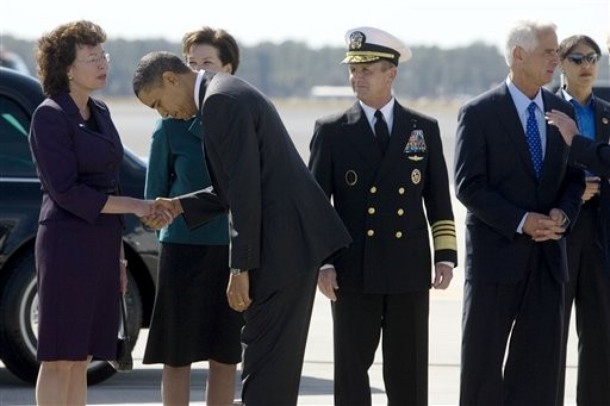
So let me get this straight . . . Americans should not bow to Queen Elizabeth (who is head of state of the United Kingdom, Canada, Australia, New Zealand, etc.), but should bow to the Emperor of Japan, the King of Saudi Arabia, and the Mayor of Tampa? Is that the full list? How about deputy mayors?
January 29, 2010
This is more than a slight confusion of terminology
Jon (my former virtual landlord) sent along a link to this FoxNews story indicating that there is a long road ahead — sociologically speaking — for Afghanistan:
An unclassified study from a military research unit in southern Afghanistan details how homosexual behavior is unusually common among men in the large ethnic group known as Pashtuns — though they seem to be in complete denial about it.
The study, obtained by Fox News, found that Pashtun men commonly have sex with other men, admire other men physically, have sexual relationships with boys and shun women both socially and sexually — yet they completely reject the label of “homosexual.” The research was conducted as part of a longstanding effort to better understand Afghan culture and improve Western interaction with the local people.
The research unit, which was attached to a Marine battalion in southern Afghanistan, acknowledged that the behavior of some Afghan men has left Western forces “frequently confused.”
The report details the bizarre interactions a U.S. Army medic and her colleagues had with Afghan men in the southern province of Kandahar.
[. . .]
Apparently, according to the report, Pashtun men interpret the Islamic prohibition on homosexuality to mean they cannot “love” another man — but that doesn’t mean they can’t use men for “sexual gratification.”
Trying to use a western term, which almost certainly has highly negative connotations to Afghans who may have encountered it, isn’t likely to be helpful in dealing with the Pashtuns. Labelling is the least of the concerns, I’d think.
The U.S. army medic also told members of the research unit that she and her colleagues had to explain to a local man how to get his wife pregnant.
The report said: “When it was explained to him what was necessary, he reacted with disgust and asked, ‘How could one feel desire to be with a woman, who God has made unclean, when one could be with a man, who is clean? Surely this must be wrong.'”
January 21, 2010
Naval forces, estimated
Strategy Page summarizes the recent accidental release of US intelligence estimates about the People’s Liberation Army Navy (PLAN):
The strength of the Chinese fleet was listed as;
Submarines- 62 (53 diesel Attack Submarines, six nuclear Attack Submarines, three nuclear Ballistic Missile Submarines). The U.S. has 72 submarines, all nuclear (53 attack and 18 ballistic missile.)
Destroyers-26. The U.S. has 52.
Frigates-48. The U.S. has 32, including two of the new LCS vessels.
Amphibious Ships 58. The U.S. has 30, all much larger and equipped with flight decks and helicopters, plus landing craft.
Coastal Patrol (Missile)- at least 80. The U.S. had a few of these, but got rid of them. China uses these for coastal patrol and defense, a concept they inherited from the Russians.
In addition, the U.S. has eleven aircraft carriers (ten of them nuclear powered) and 22 cruisers.
Most of the Chinese ships are older (in design, if not in the age of the vessels) than their American counterparts. China is building new classes of ships, with more modern equipment and weapons.


