Quotulatiousness

May 29, 2025

Q&A: The Falklands War of 1982

Forgotten Weapons
Published 3 Jan 2025

Since I spent a couple weeks hiking across the Falklands and then visiting battlefields (and penguins), it seems reasonable to do a Q&A video about the place and the 1982 war there between Argentina and the UK. All the questions were provided by Forgotten Weapons Patrons.

01:38 – How did the FAL perform, seeing as both sides used it?
03:43 – Effectiveness of light and heavy weapons in the war
08:49 – Would the British have been better off Yomping with AR15s, like the SAS used?
10:09 – Is there much local animosity to Argentina today?
12:21 – Local food and adult beverages
15:31 – What do people do for fun on the Falklands?
17:52 – Oldest small arm in service during the war?
20:18 – Military equipment wreckage on the islands
22:06 – Value of full powered rifle round in the FI terrain?
24:31 – Minefields
25:44 – Interaction of weapons with different effective ranges
28:46 – Did Exocet spur development of CIWS?
31:00 – What has been done to defend the islands against another invasion?
33:51 – Issues with an army designed to fight the USSR in Europe deploying to the South Atlantic?
35:30 – Weirdest weapon used in the conflict?
36:29 – Field modifications of small arms and unique kit
38:20 – Were British vehicle at risk of damage there?
39:40 – Engagement ranges
40:23 – Relevancy of bayonet fighting
41:28 – Unique equipment used by the Falkland Islands Defense Force
43:27 – American view of the Falklands War today
44:41 – Which Yomp route did we take?
45:01 – Did we visit Ajax Bay or the cemetery?
46:00 – Reality vs my expectations of the islands
46:57 – How would the war go if it happened today instead of in 1982?
48:25 – Did British soldiers use Argentine FALs?
(more…)

May 9, 2025

They keep saying the quiet part out loud – democracy is a threat to the establishment

N.S. Lyons went to Barad-dûr Ottawa earlier this month to speak at the 2025 Civitas Canada Conference, and posted his remarks on his Substack:

The 2022 Freedom Convoy induced a state of panic in the Canadian federal government, yet the elected representatives proved completely unwilling to even talk to anyone from the protests. The government clearly persuaded itself that this was an actual insurrection, and waited for the violence to break out … and there was no violence, other than that provided by the police and a few paid actors.
A screenshot from a YouTube video showing the protest in front of Parliament in Ottawa on 30 January, 2022.
Photo via Wikimedia Commons.

Good evening ladies and gentlemen! It’s a pleasure to visit the North and get a glimpse behind the new Iron Curtain …

As it happens, the official theme of this conference is “Freedom and its Discontents: Liberal Democracy at a Crossroads”. That is a timely theme indeed. Because I think it isn’t too extreme to say that, all around the Western world today, democracy is under assault — even that it risks extinction. It risks extinction because the authorities that run our societies seem to find the practice, values, and very spirit of democracy to be increasingly intolerable.

In France, where the ruling government maintains power despite being the most widely hated in decades, the most popular candidate of the most popular political party has been barred from challenging that government in upcoming elections, on legal grounds that are openly political.

In Romania, when the “wrong” outsider candidate appeared poised to win an election, authorities simply canceled the election outright and then had him arrested, the unelected national security state inventing entirely unsupported excuses about foreign meddling to justify their coup d’état against the democratic process.

In Germany, the state has now begun the process of banning the country’s most popular party, supported by more than a quarter of the voting population, in order to avoid facing any real political opposition. “We did it in Romania, and we will obviously have to do it in Germany, if necessary”, is how a former European Commissioner confidently foreshadowed events on live television a few months ago.

One gets the sense that the honest view of our exasperated political elites is as captured in a Bloomberg News headline from last year which read: “2024 is a year of elections, and that’s a threat to democracy”.

In country after country, governments are moving to desperately tighten their grip over the people they rule, sharply curtailing freedom of speech and access to information, and using alleged threats to security and stability to justify granting themselves emergency powers, weaponizing the law, criminalizing dissent, and suppressing any meaningful political opposition.

In the United Kingdom, more than 12,000 people per year (that’s 33 per day on average) — are now arrested for speech- and literal thought-crimes, including silent prayer. UK jails now hold hundreds of political prisoners, more than anywhere else in Europe outside of Russia and Belarus. These are people persecuted for, essentially, voicing dissent over their government’s catastrophic policies. Recently, for instance, a British woman with no criminal history was jailed for more than two years for a single Facebook post criticizing the state’s willful failure to stop illegal migration.

In Brazil, a single Supreme Court judge, in alliance with the country’s leftist president, has effectively established a judicial dictatorship, locking up political rivals by decree, silencing the speech of opposition figures, and utilizing state leverage over the financial system to punish political enemies by banishing them from public economic life.

But of course Brazil’s authorities learned these tactics by observation. Observation of Canada, to be precise, where Justin Trudeau’s government first employed debanking — along with a little brute force — as a tool to crush peaceful protest of his draconian and disastrous pandemic lockdown policies.

Today, the Canadian government’s weaponization of the legal system and public institutions, including state-funded media, to impose a quasi-totalitarian progressive ideological regime, censor and jail dissenters, and effectively transform Canada into a one-party state, has, I’m afraid, won your country a real measure of global infamy. Many Canadians here may not be aware of just how your government appears from the outside, but I’m afraid it’s not a good look at all. Unfortunately I must report that when many of us look at Canada what we see is a global leader in progressive authoritarianism, out-of-control migration, growing anarcho-tyranny, foreign subversion, and ideologically-induced economic stagnation.

But then, what we might realistically call the liberal-authoritarian model is, sadly, the new normal in the West, where many hyphenated liberal-democracies seem to have concluded that they must now begin to cast off the democratic half of that historical compact.

It may seem that this hardening of control is a response to the rise of so-called populism, which has swept the Western world. Certainly many authoritarian measures have been justified, without any sense of irony, as necessary to defend “our democracy” (so-called) against the dissatisfaction of the actual demos. And it’s true that fear of populism — which is really fear of genuine democracy — does seem to consistently provoke a spiral of ham-fisted reactions by our increasingly authoritarian states. But the reality is that populism is itself a reaction, an organic immune response to the particularly unresponsive and anti-democratic new form of governance that has visibly overtaken the West in recent decades.

Steyr AUGs of the Falkland Islands Defense Force

Filed under: Americas, History, Military, Weapons — Tags: , , , — Nicholas @ 02:00

Forgotten Weapons
Published 8 Jan 2025

The Falkland Islands Defense Force is a small organization independent of the British military, run directly by the Falkland Islands government. When it decided to update its small arms form the L1A1 SLR (aka British FAL) in the early 1990s, the British assumed they would purchase the new L85A1 rifles. However, by that time the flaws in the L85 were pretty well known, and the Islanders exercised their independence and chose to adopt something different. After investigating a number of different options they chose to use the Steyr AUG. At this time the AUG was in service with a number of other nations including the Australians and New Zealanders, and Steyr offered good terms and good support for the FIDF.

The FIDF purchased about 160 AUG rifles in total, including a small number of carbines and heavy-barreled LMGs. The carbines were particularly useful in a maritime role, which was part of the FIDF mission at the time (fisheries patrol). The LMG version, fitted with an Elcan C79 4x optic, was intended to supplant the FN MAG as a support weapon, but was found unfit for that role. Instead, most of the LMGs were converted to standard rifles via simple barrel swap. In addition, the Elcan optics proved prone to breakage, and were eventually replaced with British SUSATs. Indeed, some of the standard AUGs had their factory scopes replaced with SUSATs as well.

The AUG remained the standard rifle for the FIDF until recently, when the service received L85A3 rifles from the British. The AUG was not configured to use the bullet-trap blank adapters that the British used, and the L85s were intended to allow better integrated training between the two forces. A formal replacement for the AUG has not yet been determined, as it remains a bit unclear what the British military will decide to do to replace the L85 in the coming years.

Many thanks to the FIDF for giving me access to their armory to dig out these rifles to film for you! They remain today a small but quite well-equipped all-volunteer force dedicated to maintaining the security of the Falkland Islands.
(more…)

May 1, 2025

Military Tactics In The Falklands

Pegasus Tests
Published 27 Dec 2024

A discussion with Ian McCollum of Forgotten Weapons about Argentine and British tactics during the Falklands War.

#forgottenweapons

April 27, 2025

In the Footsteps of 45 Commando: 60 Miles Across the Falklands

Forgotten Weapons
Published 28 Dec 2024

I was recently joined by my friends Les Winner (Polaris Logistics) and Jari Laine (Varusteleka) for an epic trek across East Falkland in the footsteps of 45 Commando of the British Royal Marines. In 1982, the Marines landed to rebuff the Argentine invasion of the islands. Specifically, they landed at Port San Carlos on the far western side of the island, planning to use heavy-lift helicopters to move east to attack the Argentine positions around Stanley. However, the Chinooks they were counting on were on the Atlantic Conveyor, which was sunk by Argentine Exocet attack on May 25. That left the Marines with no choice but to hike the 60 miles or so overland. They did so overland in the South Atlantic winter, with combat loads and full rucksacks — it was a brutal movement that they executed with aplomb.

Les, Jari, and I wanted to see the ground, and so we headed out to follow the same path, albeit without the weapons or ammunition and in the summer. We took four days to complete the distance, meeting some really cool people and making lots of blisters along the way. This video is a record of that trip.
(more…)

March 14, 2025

Greenland in the news again … and it’s not about Trump this time

Filed under: Americas, Business, Government, Law — Tags: , , , , — Nicholas @ 04:00

Tim Worstall sums up coverage from The Guardian about a case involving the government of Greenland and a mining operation going to court for damages from the government’s change of policy:

So, here’s a case:

    Fearing toxic waste, Greenland ended uranium mining. Now, they could be forced to restart — or pay $11bn

Gosh.

    In 2021, Greenland went to the polls, in a contest to which uranium was so central, international media dubbed it “the mining election”. The people voted in a green, leftwing government, led by the Inuit Ataqatigiit party, which campaigned against uranium mining due to the potential pollution.

    When it took power, the new government kept its campaign promise, passing legislation to ban uranium mining. While not primarily a uranium mine, the Kvanefjeld project would require unearthing the radioactive substance to extract its rare earth oxides, putting it in violation of the law.

    Many Greenlanders celebrated the vote as a victory for health and the environment. But three years later, the company is suing Greenland for stopping its plans, demanding the right to exploit the deposit or receive compensation of up to $11.5bn: nearly 10 times the country’s 8.5bn krone (£950m) annual budget.

That part of it isn’t wholly biased. It is, roughly and around and about, true.

Just as an aside I think I met one of the lads behind the mining company once. Mickey Five Names was it? Management and all has changed since then but they were not, say, of the probity of the board of Rio Tinto. Just as an opinion, you understand.

Still, they signed a contract which allowed them to prospect and so they then spent money. The law stated that they would, naturally, advance to an exploitation licence. That’s what they got denied.

[…]

Everyone’s agreeing on what happened. Roughly they are at least. You Mr. Corporation can explore and if you find something you can dig it up and so make money back on your costs. Then the government changed its mind leaving the company facing the total loss of all it had spent.

So, who has to cough up here?

No one — really, no one at all — is saying that a government cannot change its mind. Or even that elections should not have consequences and that policy might change after having had one.

What is being said is that if you nick someone’s property then you’ve got to pay for it.

Well, is not issuing an exploitation licence that you said you would nicking someone’s property? That’s clearly arguable (I would say “Yes!” but then that’s me) so, where do we go to argue this?

March 2, 2025

The Mexican Revolution – Bandits Turned Heroes

The Great War
Published 11 Oct 2024

The Mexican Revolution of 1910-1920 was a conflict of shifting alliances and assassinations, peasant revolutionaries, an attack on US soil, and US intervention in Mexico. The decade of struggle cost hundreds of thousands of lives, resulted in new constitutions and governments, and — for some at least — turned bandits into heroes.
(more…)

February 25, 2025

Argentina’s experience of life with high tariffs

Marcos Falcone explains how Argentina’s unusually high tariff barriers distort ordinary economic activity for Argentines every day:

When Argentines go abroad, they usually go shopping. Many of the products they want cannot be bought at home, ranging from clothes to smartphones and all kinds of home appliances. Because of this, it has become a tradition to return from a trip with one or two extra suitcases filled with smuggled goods. Did you know that it is more expensive to buy an outdated iPhone in Argentina than it is to fly from Buenos Aires to Miami, stay for three days, and get the newest one?

[…]

Tariffs do not just make it difficult to get phones at home — they can make life dangerous as well. Argentina’s most sold car, which is artificially expensive because of protectionist measures, got 0 (zero) stars on one of Latin America’s most renowned safety tests. Cars in Argentina are not only more expensive than elsewhere in the region, but also markedly less safe.

To achieve these terrible results, the only thing Argentina had to do was enact tariffs, and now the US seems to be heading in the same direction. But in the past, protectionism has caused the same damage in the north as it caused in the south. Back in the first Trump administration, protecting the steel-production industry saved some jobs, but eliminated many more. Tariffs have also hurt businesses that rely on imports within the US and can continue to do so in a world of globally integrated supply chains. More generally, the 1933 Buy American Act, which forces the government to pay more for US-made goods, has been proven to be both ineffective and costly.

There is no escaping the negative effects of blocking outside competition. The more barriers a country enacts, the more damage it causes to itself. If we, as individuals, acted in a protectionist way, we should aim to grow our own food, build our own house, or make our own cars. But how does that make any sense? Economist Robert Solow once said, “I have a chronic deficit with my barber, who doesn’t buy a darned thing from me”. He meant it as a joke, but he had a point: What matters is to create wealth, which can be done both by selling and buying from others.

The revival of protectionism in the US is worrisome. To avoid it, Americans should take a look at the enormous destruction of wealth that tariffs have caused in other countries. Despite President Milei’s recent efforts to lift tariffs and take Argentina out of the “prison” in which it exists, the fact that the country shot itself in the foot decades ago has put it in a very delicate economic position. The US should not follow its path.

January 17, 2025

“… most of them can do simple low-IQ jobs like manual labor, basic retail, or writing for the New York Times

Filed under: Africa, Americas, Asia, Europe, Health — Tags: , , , — Nicholas @ 04:00

At Astral Codex Ten, Scott Alexander discusses the highly controversial national IQ estimates of Richard Lynn … I’m sure I don’t need to spell out exactly why they were (and continue to be) controversial:

Lynn’s national IQ estimates (source)

Richard Lynn was a scientist who infamously tried to estimate the average IQ of every country. Typical of his results is this paper, which ranged from 60 (Malawi) to 108 (Singapore).

People obviously objected to this, and Lynn spent his life embroiled in controversy, with activists constantly trying to get him canceled/fired and his papers retracted/condemned. His opponents pointed out both his personal racist opinions/activities and his somewhat opportunistic methodology. Nobody does high-quality IQ tests on the entire population of Malawi; to get his numbers, Lynn would often find some IQ-ish test given to some unrepresentative sample of some group related to Malawians and try his best to extrapolate from there. How well this worked remains hotly debated; the latest volley is Aporia‘s Are Richard Lynn’s National IQ Estimates Flawed? (they say no).

I’ve followed the technical/methodological debate for a while, but I think the strongest emotions here come from two deeper worries people have about the data:

First, isn’t it horribly racist to say that people in sub-Saharan African countries have IQs that would qualify as an intellectual disability anywhere else?

Second, isn’t it preposterous and against common sense to compare sub-Saharan Africans to the intellectually disabled? You can talk to a Malawian person, and talk to a person with Down’s Syndrome, and the former is obviously much brighter and more functional than the latter. Doesn’t that mean that the estimates have to be wrong?

But both of these have simple answers, which IMHO defuse the worrying nature of Lynn’s results. These answers aren’t original to me, but as far as I know, nobody has put them together in one place before. Going over each in turn:

1: Isn’t It Super-Racist To Say That People In Sub-Saharan African Countries Have IQs Equivalent To Intellectually Disabled People?

No. In fact, it would be super-racist not to say this! We shouldn’t conflate advocacy with science. But if we did, Lynn’s position would make better anti-racist advocacy than his detractors’.

The “racist” position is that all IQ differences between groups are genetic. The “anti-racist” position is that they’re a product of environment — things like nutrition, health care, and education.

We know that in the US, where we do give people good IQ tests, whites average IQ 100 and blacks average IQ 85.

If IQ was 100% genetic, we should expect Africans to have an IQ of 85, since American and African blacks have similar genes. This isn’t exactly right — US blacks have some intermixing with whites, and only some of Africa’s staggering diversity reached the US — but it’s close enough.

January 10, 2025

Javier Milei’s “devastation” and “social chaos” report card

Filed under: Americas, Economics, Government, Media, Politics — Tags: , , , — Nicholas @ 03:00

In the Washington Examiner, David Harsanyi checks the current state of Argentina against the doom-and-gloom predictions from the start of Javier Milei’s term:

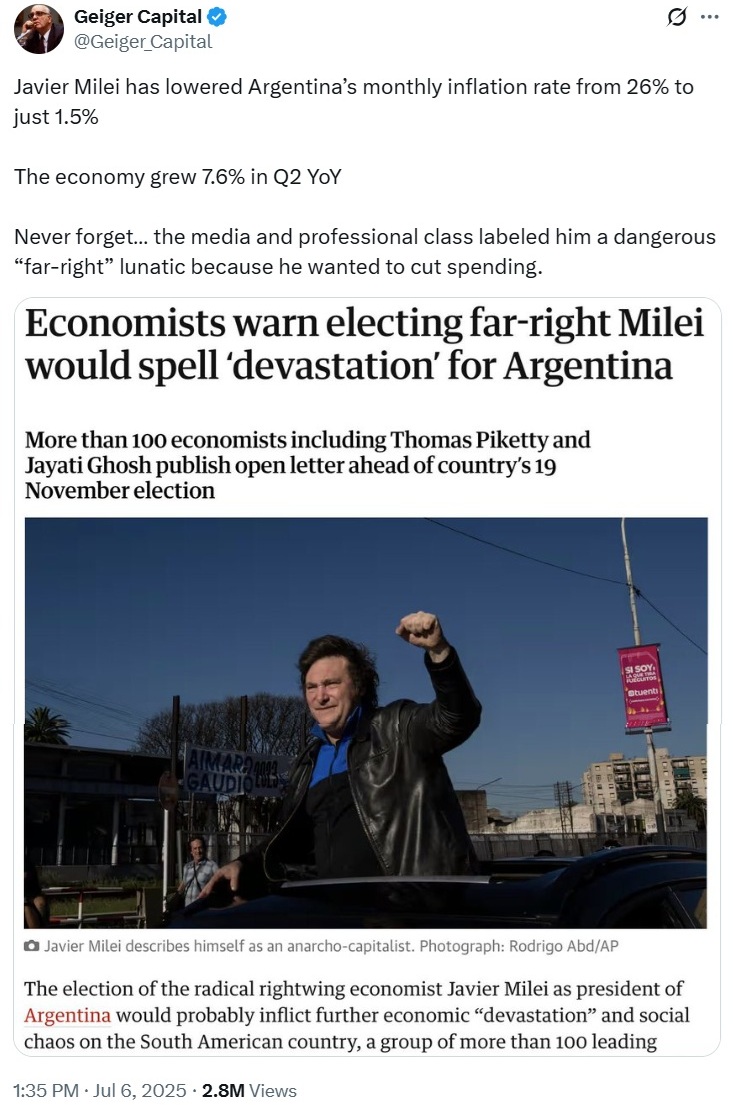
In the days leading up to the August 2023 presidential election in Argentina, a hundred “leading” economists from around the world, including progressive favorite Thomas Piketty, published an open letter warning that “radical right-wing economist” Javier Milei would inflict “devastation” and social chaos on his country.

However, they said it like it was a bad thing.

By the time Milei unexpectedly won the presidency, Argentina, once one of the wealthiest nations in the world, had a poverty rate of over 40% and the third-highest inflation rate in the world. After decades of Peronism, a toxic melding of fascism, socialism, and unionism, the nation bankrupted its central bank, and the peso was depreciating at warp speed. Do you think your mortgage rate is bad? Interest rates hit 118% in Argentina weeks before the election. The country was on its way to becoming another Venezuela. Milei wanted to blow it up.

After Milei’s unlikely victory, political scientist Ian Bremmer warned, “Economic collapse is coming imminently”. Felix Salmon, the chief financial correspondent at Axios, argued that Milei’s policies would plunge Argentina into “a deep recession”.

Seven months later, Argentina was out of a recession that had set in before Milei’s victory. The chainsaw-wielding economist, “el Loco” to friends, followed through on his promise of “shock therapy”, prioritizing taming inflation by cutting spending and deregulating the economy.

Almost all problems in modern Keynesian fixes are prominent features of governance in the modern West. Governments are always bragging about spending their way out of economic tribulations (tribulations they usually instigate). If a person suggests that free-market economic policy would have been more beneficial in the long term, they are forced to rely on a counterhistory. This is one reason why lots of elites are rooting against Milei, who argues that most of the West’s economic ills lie in Keynesian economics. They want him to fail.

As we all know, most panic-inducing cases of “austerity” are just minuscule reductions in the trajectory of spending growth. Not Milei’s plan, which entailed shutting down 13 government agencies and firing over 30,000 public workers — around 10% of the federal workforce. That is an unrivaled political revolution. Argentina’s federal budget was reduced by 30%. Even if the Department of Government Efficiency accomplished everything Elon Musk and Vivek Ramaswamy are talking about doing, they wouldn’t come close to 3%, much less 30%, in spending cuts. There has likely been no comparable austerity program in any Western economy.

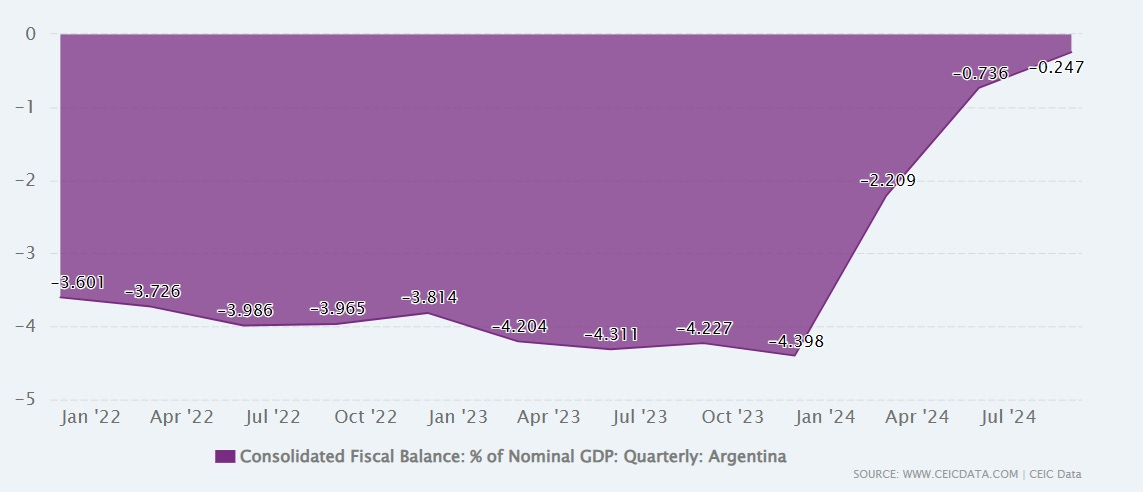
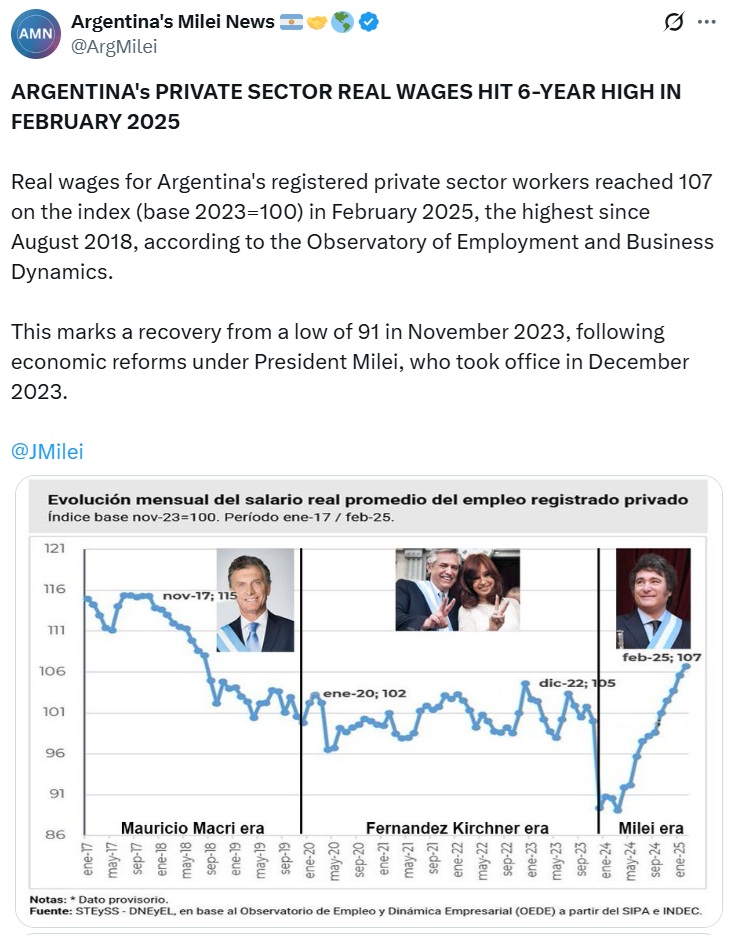
By May 2024, Argentina recorded its first quarterly budget surplus since 2008. Inflation, still high, dropped from a debilitating 25% at the end of 2023 to 2.4% by the end of 2024. Per capita salary, having plunged, is now also recovering.

Dan Mitchell agrees that it’s easy to mock economists for their hair-on-fire reaction to Milei’s election:

Consider the supposedly prestigious left-leaning academics who asserted in 2021 that Biden’s agenda was not inflationary. At the risk of understatement, they wound up with egg on their faces.1

Today, we’re going to look at another example of leftist economists making fools of themselves.

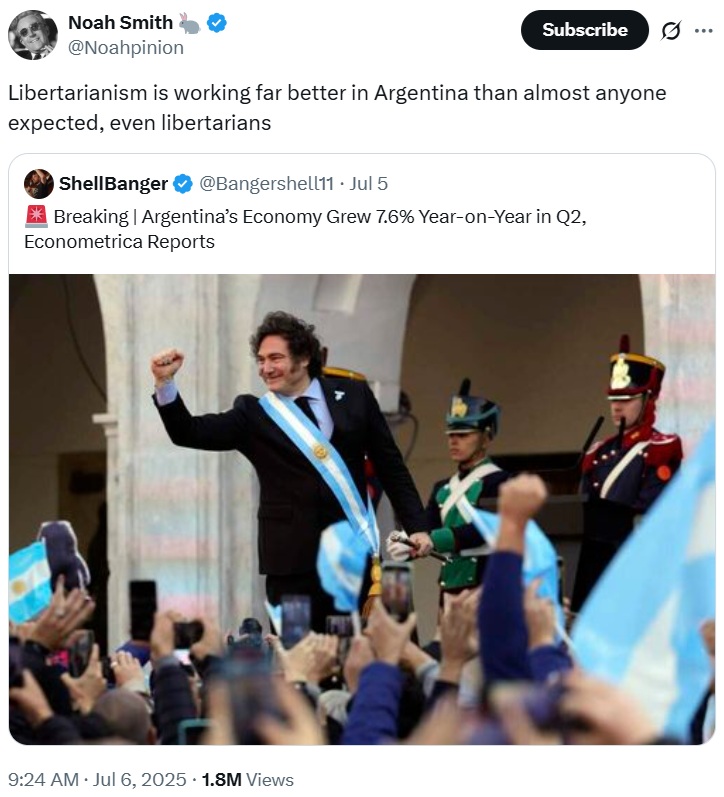
It involves Argentina, where President Javier Milei’s libertarian agenda has yielded amazingly positive results in just one year.

Some of us knew that good policy would lead to good results.

Others, like the editors at Bloomberg, perhaps did not expect such a quick turnaround. But, to their credit, they just acknowledged the amazing progress in an editorial.

The U.K.-based Telegraph leans to the right, so this headline can probably be interpreted as a victory dance.


January 4, 2025

Can Javier Milei Make Argentina Great Again?

Adam Smith Institute
Published 3 Jan 2025

In November 2023, Argentina elected Javier Milei, a libertarian economist armed with a chainsaw and a bold plan to rescue the country from decades of decline. Facing 142% inflation, a crumbling peso, and 40% poverty, Milei slashed spending, deregulated markets, and delivered a historic budget surplus — all within a year.

Sam Bidwell dives into Milei’s radical reforms, exploring the challenges that have made them necessary. He traces the country’s rise as a global economic powerhouse in the early 20th century, its decline through years of government intervention and Peronism, and its resurgence under Milei’s leadership.

Discover how this fiery libertarian turned Argentina’s economic fortunes around — and what the world can learn from his audacious blueprint for recovery.

🔗 Subscribe for more insights on global economics, history, and leadership!
🔗 Check out our website for more economics content: https://www.adamsmith.org/

TIMESTAMPS

00:00 Start
00:53 Golden Years
02:59 Decline of Argentina
05:20 Peron
08:47 The Legacy of Peronism
11:56 After the Falklands
15:38 Javier Milei
18:17 Challenges
24:31 Lesson for the UK and the wider world

November 28, 2024

How is Argentina doing after a year under Javier Milei?

I don’t normally follow South American news all that closely, as despite being in the same hemisphere, little that happens there has much importance to us here in Canada or the United States. The election of Argentinian President Javier Milei, however, has made Argentina a much more interesting place to watch as Milei valiantly attempts to turn the economy around from its near-century-long decline. Here, Dan Mitchell provides his assessment of Milei’s efforts so far:

… let’s focus today on Milei’s goal of maximizing economic liberty.

The bad news is that if he wants Argentina to become the new Hong Kong, Milei has a long journey. According to Economic Freedom of the World, Argentina ranked a lowly #159 out of 165 nations in 2022.

As you can see from the EFW rankings, Milei’s country gets especially bad scores for Sound Money, Trade and Regulation (dead last for Sound Money and in the bottom-10 percent of the world for the other two categories!).

The good news is that you don’t have to be libertarian Nirvana (or even Liberland) to make a big jump in the rankings.

You don’t even need to be Hong Kong (which used to be very good with scores above 9 but has now declined to 8.58 thanks to Beijing’s intervention).

Heck, almost every country in the western world has experienced a significant decline in economic liberty this century.

Milei actually could put Argentina in first place today merely by achieving the same level of economic liberty (8.67) that the United States had in 2004.

For what it’s worth, I think it would take several years of good reforms to climb that high.

That being said, dramatic improvements are nonetheless possible in a very short period. Here’s my back-of-the-envelope estimate of where Argentina could be by the end of next year.

October 2, 2024

Duelling reports on how Javier Milei’s Argentinian “shock therapy” is working

At Astral Codex Ten, Scott Alexander tries to find something approaching the truth between the pantingly enthusiastic libertarian reports and the angrily negative progressive reports:

How is Javier Milei, the new-ish libertarian president of Argentina doing?

According to right-wing sources, he’s doing amazing, inflation is vanquished, and Argentina is on the road to First World status.

According to left-wing sources, he’s devastating the country, inflation has ballooned, and Argentina is mired in unprecedented dire poverty.

I was confused enough to investigate further. Going through various topics in more depth:

1: Government Surplus

When Milei was elected, Argentina went from constant deficits to almost unprecedented government surplus, and has continued to run a surplus for the past six months.

This wasn’t fancy macroeconomic magic. Milei just cut government spending:

This source says he cut the size of government by about 30% overall. Unsurprisingly, this eliminated the Argentine deficit.

[…]

6: Overall

When Javier Milei took office, he promised to do shock therapy that would short-term plunge Argentina into a recession, but long-term end its economic woes.

He has fulfilled his campaign promise to plunge Argentina into a recession. Whether this will long-term end its economic woes remains to be seen.

I think he gets credit for some purely political victories (completing the budget cuts he said he would complete), for decreasing inflation, and for improving the housing market. But in the end, history will judge him for whether his shock therapy eventually bears fruit. I don’t think that judgment can be made yet, and I don’t see many economists eager to go out on a limb and say that there are strong signs that his particular brand of shock therapy will definitely work/fail.

There are disappointingly few Milei prediction markets, probably because it’s hard to operationalize “he makes the economy good”. This multi-pronged mega-market has few traders, and weakly predicts a mix of good and bad things, maybe leaning a little good. But here is a more specific one:

… which compared to Argentina’s historical GDP growth rate seems — no, sorry, Argentina’s historical GDP growth rate is too weird to draw any conclusions.

And maybe the most important test:

September 11, 2024

QotD: The preposterous tactics of George R.R. Martin’s Dothraki nomads

We do not see the Dothraki engage in large-scale warfare in the books; we see the aftermath of such fighting (AGoT, 555ff) or it occurs “off-screen” (ASoS, 487), but we do not see it. The closest we get is Jorah’s description of them, that they are “utterly fearless … [they] fire from horseback, charging or retreating, it makes no matter, they are full as deadly … and there are so many of them” AGoT, 325-6). Evidently they also scream on the attack, since their warriors are repeatedly called “screamers”.

As a description, it is hard for this to be very much wrong because it is so very vague, but the attentive reader will note that Jorah’s assertion that there are “so many” must be wrong for either Eurasian Steppe Nomads or Great Plains Native Americans, both of whom were routinely outnumbered by settled enemies, often dramatically so. Let’s put a pin in that, though, because of course while Martin gives only vague description of Dothraki warfare, the show, Game of Thrones, shows it to us on screen quite vividly.

We see a bit of Dothraki warfare in S6E9 when Daenerys’ Dothraki charge down the Sons of the Harpy at Mereen, but the really sustained look at how they fight has to wait for S7E4 and the Loot Train Battle and S8E3 and the Battle of Winterfell, both of which, happily, we have already discussed! In all three cases, the Dothraki do exactly the same thing. They charge, in a pell-mell rush, while giving high-pitched war-calls. While some of the Dothraki may fire arrows on the approach (they have them stand up to do this, which is not how actual Mongols or Native Americans fired from horseback; it looks cool and is stupid, like most of Game of Thrones season 7 and 8), they otherwise charge directly into contact and begin fighting from horseback with their arakhs as the primary weapon.

This is not how horse-borne nomads fought.

As we’ve discussed repeatedly before, the key weapon for Steppe nomads was the bow, shot from horseback at high speed (on this, note May, “The Training of an Inner Asian Nomad Army” JMH 70 (2006) and Mongol Art of War (2007)). Thus the crucial maneuver was the caracole, where the rider approaches the target at high speed, firing arrows as he goes, before making an abrupt turn (it is actually the turn that is technically called a caracole, but the whole tactic goes by this name) and retreating, before trying again. Pulling this tactic off en masse required a great deal of both individual skill at horsemanship and archery, but also quite a lot of group cohesion and coordination, since a collision of horses at speed is very likely to be fatal for everyone – humans and horses – involved.

This tactic can then be repeated – charge and retreat, charge and retreat – until the psychological toll on the defender becomes too great and they either break and retreat or else charge out to try to catch “retreating” nomads. In either case, it was at that moment when the Steppe nomads could press home and destroy the disorganized enemy. These tactics were brutally effective, but they were also a necessary casualty control measure. Shock combat – that is massed melee combat in close quarters – is simply far too lethal for low-population nomadic societies to sustain in the long-term on the regular (a hoplite battle might result normally in c. 10% casualties for instance (but note this discussion of that figure) – think of what that would mean in a society where 100% of adult males participate in each battle – you’d run out of men pretty quickly!).

And fascinatingly, we can actually see that calculus play out in North America, where the arrival of firearms, which suddenly make pitched “missile exchange” battles (especially on foot) as lethal as shock combat (it seems notable that the introduction of musketry into Old World warfare did not come with a significant increase or decrease in battlefield lethality, at least until the rifled musket – on that, see B. Gibbs, The Destroying Angel (2019), but also note E.J. Hess, The Rifle Musket in Civil War Combat: Reality and Myth (2008)), the pitched battle vanishes. It was simply too lethal to be a viable option in the long term for societies with low population density and very high military participation rates.

Instead, the raid came to dominate warfare on the Great Plains, with mass-casualty events generally being restricted to situations where a raiding party caught an enemy group unawares (McGinnis, op. cit., 45-6, 57-9). To be clear, that’s not to say the Great Plains Native Americans were peaceful, after all the goal of all of this raiding was to cause one of those rare mass-casualty surprise attacks and – as McGinnis notes again and again, warfare was part of the Plains Native American way of life, as the social status of males was directly and powerfully tied to success in war.

In short, the need to keep lethality relatively low is one of the most important factors which shaped nomadic horse-borne warfare, both on the Steppe and on the Great Plains. And here is where I think that even Martin’s description – which could, if read with friendly eyes, be taken as a description of the Steppe caracole described above – falls short: the Dothraki are dangerous because they are so many. But actual nomadic warfare was fundamentally conditioned by the shortage of men created by the low population density of the Steppe or the Great Plains. This weakness could be somewhat made up for by making every male into a warrior, but only if casualty rates remained low. A war of attrition with settled peoples would wear the nomads out quickly, which is why such attritional warfare was avoided (unless you are the Mongols, who use the sedentary armies of conquered states, notably using the armies of Northern China to conquer Southern China; that said, Drogo is clearly not Chinggis Khan or any such sort of Khal-of-Khals)

So where does this model of warfare come from? Well, when it comes to the show, we needn’t actually look far, because the creators tell us. The director of the episode, Matt Shakman, noted in an interview that his primary reference for the Dothraki charge was John Ford’s Apache attack in his 1939 film Stagecoach (you can see the scene he means here). And in the S7 special feature, “Anatomy of a Scene: The Loot Train Attack”, David Benioff notes that the charge “definitely got a bit of that western feel” while VFX producer Steve Kullback says, of the battle, it’s “sort of like Cowboys and Indians”.

In Stagecoach (1939), the Apache aren’t a real humanized culture, but an elemental force of destruction. Their charge at the titular stagecoach is essentially mad and heedless of all losses (in the same featurette, Camilla Naprous, Game of Thrones‘ horse master, describes the Dothraki as “they’re just these absolute mad men on horses”, in case you thought that connection was only subtext). The position of “Indians” as particularly “rapey” is also explicit in Stagecoach, where the one of the white male defenders of the coach saves his last bullet to spare the one woman, Mrs. Mallory, from being captured and raped by the approaching cavalry [NR: I think Dr. Devereaux means “Indians” here, but given the historic reputation of the cavalry …] (the concern about white women being raped by non-white men being a paramount fixation of early American film; see also The Birth of a Nation (1915); or, you know, don’t.) And the tactics (or lack thereof) of the Dothraki, charging madly forward with no order or concern for safety, also map neatly on to Stagecoach‘s Apache attack (and not on to actual Apache attacks).

I don’t think this lazy use of old Western tropes is limited to merely the show, however. Having written this far, I find myself convinced that there is a longer article or perhaps a video-essay waiting to be written by a different sort of scholar than myself – that is, a film historian – on how Martin’s depiction of the Dothraki and their world is fundamentally rooted in the racist tropes of the Hollywood Western and its portrayal of Native Americans in a frontier environment where, as Sergio Leone put it, “life has no value“. Quite a lot of parallels with Martin’s Dothraki emerge after even a brief overview of the representation of Native Americans in film. The emphasis on taking captives (especially white women) to no apparent purpose besides sexual violence, the distinctive “screaming” of Dothraki warfare (which, yes, Native Americans used a range of intimidating war cries, but so did basically everyone else in the pre-modern world, so why are the Dothraki the only ones who do it in Westeros?), its lack of tactics or order, and – as we’ve discussed already – the grossly simplified form of dress all seem to have their roots in racist Hollywood depictions of Native Americans. The Dothraki Sea is, essentially a “Cavalry and Indian Story” with the cavalry removed.

That is not a pure creation of Benioff and Weiss. The show simply takes that subtext and makes it text.

Bret Devereaux, “Collections: That Dothraki Horde, Part IV: Screamers and Howlers”, A Collection of Unmitigated Pedantry, 2021-01-08.

September 4, 2024

The History of Barbecue

Filed under: Americas, Food, History, USA — Tags: , , , , , , — Nicholas @ 02:00

Tasting History with Max Miller
Published May 28, 2024

Slow-cooked molasses barbecued pork with a vinegary sauce

City/Region: United States of America
Time Period: 1839 | 1879

“Barbecue” the cooking technique has been around for a lot longer than “barbecue” the word, but it has always been a delicious way to prepare meat. This is the earliest recipe I could find for something called barbecue, and I paired it with a sauce from 40 years later that seems to me to be a precursor to vinegar-based Carolina style barbecue sauces.

The meat is super tender and falls apart. I ended up needing to cook mine for about 12 hours, but it was worth it. You really don’t need anything besides a bit of salt to go with it, but the sauce is a delicious pairing. It packs a spicy, flavorful punch, but it’s surprisingly not too vinegary.

    To Barbecue Shoat.
    Take either a hind or fore quarter, rub it well with salt, pepper, and a small portion of molasses, and if practicable, let it lie for a few hours; then rinse it clean, and wipe it dry with a cloth, and place it on a large gridiron, over a bed of clear coals. Do not barbecue it hastily, but let it cool slowly for several hours, turning it over occasionally, and basting it with nothing but a little salt-water and pepper, merely to season and moisten it a little. When it is well done, serve it without a garnish …”
    The Kentucky Housewife by Lettice Bryan, 1839.

    As the housekeeper is sometimes hurried in preparing a dish, it will save time and trouble for her to keep on hand a bottle of meat-flavoring compounded of the following ingredients.
    2 chopped onions. 3 pods of red pepper (chopped). 2 tablespoonfuls brown sugar. 1 tablespoonful celery seed. 1 tablespoonful ground mustard. 1 teaspoonful turmeric. 1 teaspoonful black pepper. 1 teaspoonful salt. Put it all in a quart bottle and fill it up with cider vinegar.
    Housekeeping in Old Virginia edited by Marion Cabell Tyree, 1879.

(more…)

« Newer PostsOlder Posts »

Powered by WordPress