
In The Critic, Sebastian Milbank reflects on the sage words of Adam Smith during that eighteenth century unpleasantness with some of the North American colonies:
In 1777, Britain lost the battle of Saratoga — a decisive defeat that would spell the end of its rule over the 13 Colonies. A young John Sinclair declared that the nation would soon be ruined. An older and wiser Adam Smith replied that “there is a great deal of ruin in a nation”.
Smith would be vindicated. Despite losing 60 per cent of its North American territories, Great Britain would go on to become the leading economic and military power of the 19th century. But history does not necessarily repeat itself. Today, as the mistakes and catastrophes pile up one on another, one starts to wonder if a nation can run out of ruin.
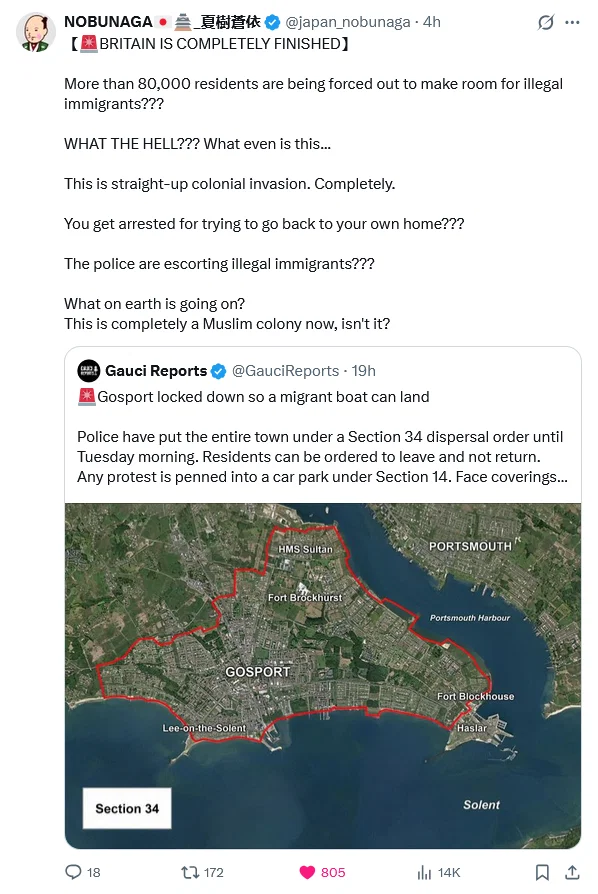
Consider the news of the past week. The most dramatic scene played out late Sunday night in Gosport, as illegal immigrants were ferried onto shore by the coast guard. Overlooked by the remaining might of the Royal Navy, in sight of HMNB Portsmouth which two thirds of the surface fleet call home, illegal migrants were delivered to tax-payer funded accommodation by the British state. The full coercive power of that state was on display, but it was not directed towards the young men seeking to invade English waters, but against the people of Gosport. The entire town was locked down, and the right of assembly suspended, using a law usually deployed against vagrants and vandals. Legions of high-vis jacked police were deployed across the town, clashing with protestors in the streets of a once-sleepy seaside community.
This is bad enough, but consider what else is going on across the country. Prisoners were being released early, not because of their exemplary behaviour or reformed characters, but simply because we had run out of room to safely house them. The parole services openly admit they cannot cope, and parolees could wait weeks before they are fitted with electronic tags.
The economic situation is no happier. There is a global surge in bond yields, meaning higher costs of borrowing and straitened circumstances for our government as it prepares for the autumn budget later this month. War in the Gulf and the Arabian peninsula looks set to cause a surge in fuel prices over the coming winter, hitting consumers and business alike. Far from being prepared to weather this storm, Britain has some of the lowest diesel reserves in the developed world. Our domestic supplies of oil and gas, already squeezed by reckless environmental policies, could now face strike action that could see a third of production shut down.
If you have faith in British civil society and public life to respond with stoicism and solidarity, one can think again. The country recently had a hysterical and ugly debate over whether Rishi Sunak was a real Englishman, in which a number of right wing ethnic minority figures claimed not to be, and a number of progressives suggested that there is no ethnic English identity at all. In the latest horrific chapter of our coming apart as a culture, the Green Party passed a motion at its conference declaring that Zionism is “racist” and that Israel should be entirely annexed by a Palestinian state. During the same vote, they rejected a proposal promising not to engage in disciplinary proceedings against Jewish party members for affiliation with synagogues or Jewish organisations that support Israel. Given that the majority of British synagogues could be described as Zionist by some definition, this was effectively a declaration that observant Jews were no longer welcome in the party. Nothing like this has been seen in British society for a century.
As a country, we are running up against hard limits to how far we can manage decline and stifle unrest. The patience of the public, the confidence of markets and the state’s own capacity to enforce order are all reaching breaking point. Britain is indeed on the brink of ruin.
But what does ruin look like? Writing three years ago, and looking ahead to a likely Labour government, I warned that temporary disasters can become long term realities: “Argentina, a country economically competitive with the USA in 1900, proceeded to politically wreck itself for over a hundred years, with cyclical economic crises destroying hard-won prosperity. In Argentina, the situation of the ‘precariat’ is all that most of today’s middle-class families have ever known.”


