
On the social media site formerly known as Twitter, Tom Kratman shares some thoughts on lynching:
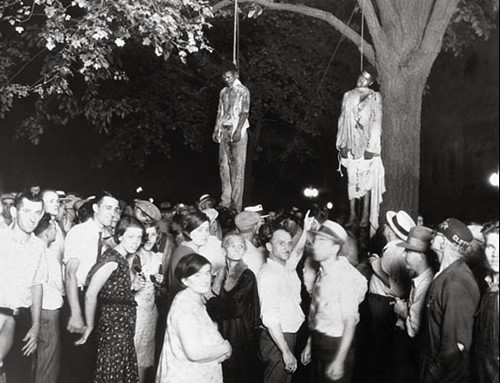
“1930 Lynching” by e-strategyblog.com is licensed under CC BY 2.0 
 .
.
So, in honor of the white liberal idiots (Lord, forgive us our redundancies) and black race grifters, who seem to infest X, some old thoughts on lynching:
So I was musing on lynching. It occurred to me that merely because someone was lynched it does not necessarily follow that they were either innocent, nor that the lynching was improper or wrong. Of course, we think of it, or most of us do, today, as being a purely racist phenom, applied entirely to innocent black folks. Neither of those is true.
I think we can divide lynching into several different levels and levels of legitimacy.
1. In a place of high crime where the law does not exist. In this case, yes, of course, do what you must to preserve life, liberty, and property, to protect your friends, neighbors, and family.
2. In a place of high crime where the law exists but has become purely notional, where criminals are not generally pursued, tried, convicted, or punished, and where this is no real hope for improvement. In this case, too, lynching is likely legitimate, for two reasons, the ones set out above and, further, to humiliate the arms of the law and the political branches into doing their jobs.
3. In a place where the law exists, where criminals are pursued, tried, and convicted, things become murkier. Note that I left off “punished”. In this case, I would argue, the law has become as ineffective as #2, above. Parts of California under Soros-supported prosecutors, I am looking at you. On the whole, in these places, I would suggest that lynching has at least some legitimacy.
4. Illegitimate lynching starts where the law is operative, and largely works, but where people — and this is where black folks tend to come in — are both impatient and want to terrorize some folks into general acquiescence. I am thinking here of people dragged from jail, after conviction, and put to death. It’s been done to both whites and blacks, but more to blacks.
This is wrong both because of the terrorizing aspect AND because you have just, from the perspective of those same black folks, changed matters into something highly analogous to #1, above, the law doesn’t apply to or defend them, so of course they can legitimately engage in self-help.
5. The least legitimate form, indeed, it is totally illegitimate, is when the law works, but people just want to engage in self-help, largely for the reasons in #4, and without there ever being an indictment, presentation of evidence, conviction, or anything but a mob operating with a mob’s IQ, which is roughly that of a none-too-bright earthworm.
There are some odd nuances here. For example, take someone with diplomatic immunity who kills your child. I have no answer, yet, for this, but, as a practical and personal matter, have to say that I would personally hunt the son of a bitch down and have lumber and nails handy.



I don’t know where this fits, but I have a complicating scenario: the government wants to but cannot terrorize the population, for whatever reason, and encourages extra-legal violence against its enemies and then chooses not to prosecute the terrorists. The two examples I’d cite are the Nazi party on Krystallnacht and the KKK in the South. The Nazi Party’s arranged/encouraged/primed for its activist youth section, the Hitler Youth (the “brown shirts”), to riot, precipitated in specific by a murder by a Jew of German officials in Paris, and then the SS ensured they were not prosecuted. The KKK often enjoyed the same protection in the South (there’s a reason movies about the Old South always had the Sheriff refusing to go after the Klan; it was often true) The Nazi Party feared losing legitimacy if they used German troops to burn Jewish ghettos. The Southern state governments had the same problem, plus Federal forces would get involved if they moved overtly against Blacks. A lot of Southern lynchings weren’t commoners frustrated at state inaction; they were often proxy forces of the Democratic Party, the party that controlled the state, taking extra-legal action that they couldn’t be seen condoning officially but were arranging what they wanted through non-state actors. See: the governor’s office involvement with the anti-ICE forces in Minneapolis (but lynching people rather than antagonizing Feds).
I’d argue this looks like #2, but is less legitimate, due to involvement of the state and the implication that, if the population would accept the action, they wouldn’t be hiding it, so the state is clearly not representing the people.
Comment by Jonathan Card — May 14, 2026 @ 11:54