Quotulatiousness

January 31, 2026

“… nations are what Kurt Vonnegut would call a ‘granfalloon'”

Filed under: Economics, Europe, History — Tags: , , , , , , , — Nicholas @ 05:00

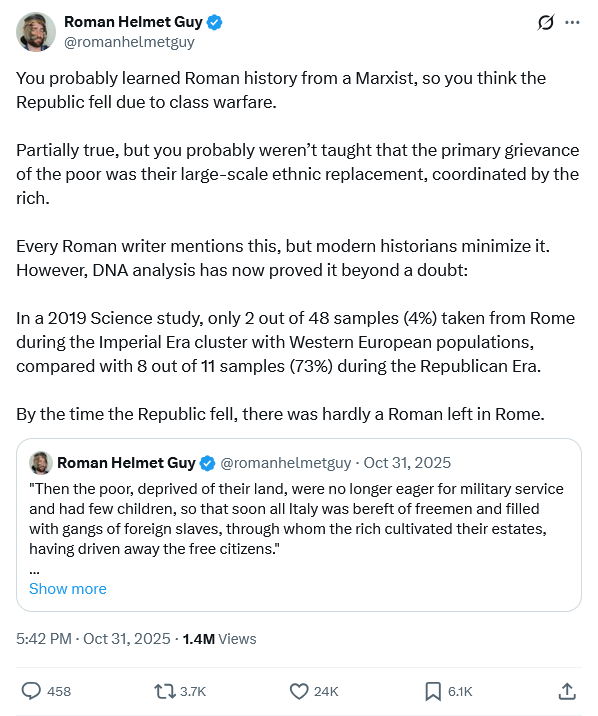
On the social media site formerly known as Twitter, Devon Eriksen responds to an older tweet about the replacement of “original” Romans during the Republic with other ethnicities over the course of the Empire:

Any time a nation allows slavery, de jure or de facto, the business owning class immediately tries to replace the working class with slaves.

If they succeed, the nation collapses and everyone dies. A nation cannot survive if it’s populated by slaves.

Why?

Because nations are what Kurt Vonnegut would call a “granfalloon” … his word for an association that only exists because people believe in it.

Now Vonnegut, who was a liberal and therefore wrong about everything important, meant to mock the concept of nations and tribes by coining this term. He believed them to be unnecessary throwbacks to humanity’s primitive past … a delusion he was able to sustain because he never had to try existing without one.

Granfalloons are indeed arbitrary — you could base them on anything — but humans cannot survive without them. Because humans are a pack animal.

If you drop your cat off somewhere in the woods at night, assuming he is a healthy and physically fit cat, he will likely survive, regardless of his unhappiness at the sudden deficiency of chin scratches and clean laundry to sleep on.

Try that experiment with your dog, and he’ll die.

Why? It’s not because cats are smarter than dogs. They’re about the same.

It’s because cats are not a pack animal. A cat doesn’t need other cats to survive. The basic unit required to execute all cat survival strategies is one cat.

Dog survival strategies work just fine, too, but they require multiple dogs. A lone dog will die because he cannot execute his survival strategies by himself.

And so it is with humans.

The great error of the classical liberal worldview is that, because history is full of tribes fighting wars over scarce resources, that it was the tribes, not the scarcity, that caused conflict.

So they decided they were going to get rids of tribes, and nations, and religions, all the granfalloons, and just glue everything together with economics. And there would somehow be world peace.

Kurt Vonnegut was a dreamer.

Unfortunately for all of us, he was not the only one.

So the experiment was carried out, and in every single place it was carried out, things got observably, obviously worse. Sometimes “gosh the boomers had it way easier than us” worse, and sometimes “what shall we do these corpses, Comrade Commissar” worse, but always worse.

Because economic incentives alone cannot hold a society together.

Economic incentives, without ethnic or cultural solidarity, get you nothing but massive robbery and fraud.

It’s why the Biden Administration let millions of third world savages into America. It’s why Proctor and Gamble sells you poison food, and why the American Heart Association takes their money to lie to you and say it’s healthy. It’s why every product you buy, from your Tesla to your laptop to your security camera system, tries to spy on you and control how you use the thing you paid for and theoretically own. It’s why you’ve never held the same job for more than three years, because they either laid you off or gave you two percent raises every year until you had to find a new company to pay you what you’re actually worth.

When there is no granfalloon, there is no incentive not to cheat. And no, fear of punishment doesn’t work. The police cannot arrest, try and convict everyone. And when there is no granfalloon, the enforcers themselves have no incentive to actually perform, instead of looking just busy enough to get paid, or taking bribes to look the other way.

An atomized group of individuals, unconnected by a granfalloon, have no morality, because morality isn’t something an individual has. It’s something a tribe has, because what the word “morality” actually means is the system of behavior that tribe members display towards each other.

A slave has no morality. He has no sense of responsibility, not only for the nation, not only for his masters, but even for his fellow slave. He is homo economicus, the man who responds purely to incentives of reward and punishment.

A slave has no granfalloon.

Kurt Vonnegut famously wrote “If you wish to examine a granfalloon, just remove the skin of a toy balloon.” By which he meant that such associations are nothing but a puff of air, and therefore unimportant.

But having been surrounded by air all his life, in abundant supply, Kurt had forgotten that air is important.

You need it for breathing.

Try removing the skin of a SCUBA tank.

A new homily from Saint Hillary

Filed under: Media, Politics, USA — Tags: , , , , , — Nicholas @ 04:00

Chris Bray fondly remembers how the late Michael Kelly pin-pointed the moral character of Hillary Clinton very early in the first Bill Clinton term, where he named her “Saint Hillary”. She’s back in her bully pulpit again:

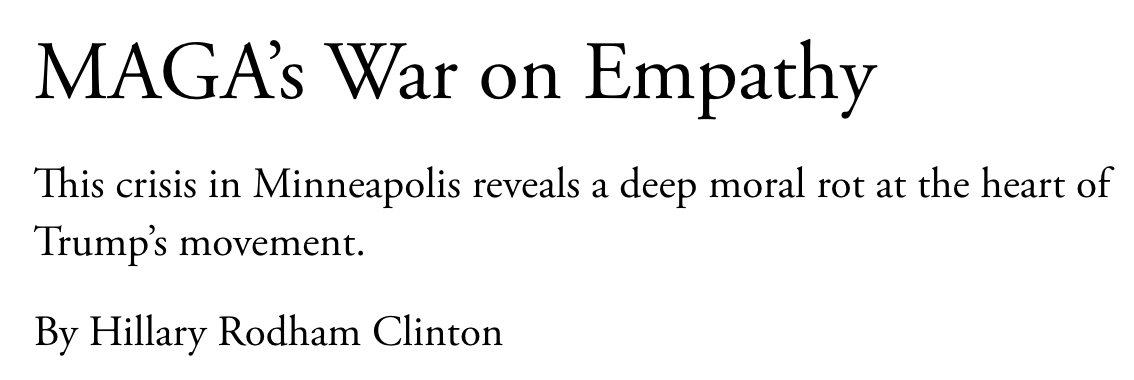
It’s a moral lecture on the true meaning of Christianity from Hilly Rodham Clinton, from Saint Hillary. All credit to Michael Kelly: Mrs. Clinton is still struggling with words. This is as dull a performance of narrative ineptitude as a human thing could possibly manage without actually turning into Tom Nichols:

    That compassion is weak and cruelty is strong has become an article of MAGA faith. Trump and his allies believe that the more inhumane the treatment, the more likely it is to spread fear. That’s the goal of surging heavily armed federal forces into blue states such as Minnesota and Maine — street theater of the most dangerous kind. Other recent presidents, including Joe Biden, Barack Obama, George W. Bush, and Bill Clinton, managed to deport millions of undocumented immigrants without turning American cities into battlegrounds or making a show of keeping children in cages.

    “The cruelty is the point,” as The Atlantic‘s Adam Serwer memorably put it during Trump’s first term. The savagery is a feature, not a bug. By contrast, as Serwer noted recently in these pages, the people of Minnesota have responded with an approach you could call “‘neighborism’ — a commitment to protecting the people around you, no matter who they are or where they came from”. To my ears, that’s as Christian a value as it gets.

First you notice the complete failure to land the facts, like the one about the way Barack Obama deported lots of people, but he didn’t make a show of keeping children in cages. The Obama administration built the cages, and this isn’t obscure. Similarly, and obviously, all those other presidents didn’t turn American cities into battlegrounds because no one fought against deportation during their terms. Nor have the Trump administration’s ICE operations turned “American cities” into battlegrounds. Dallas isn’t. Miami isn’t. The cities that are battlegrounds are cities where organized left-wing activism has manufactured a series of battles. Does Hillary Clinton notice that some cities are battlegrounds, but many cities are not? She most assuredly does not. It doesn’t help her to notice that, so her mind omits it. More box wine, and then more typing.

But since we’re talking about an argument made by Hillary Clinton, never mind about mere facts. Start with the fact that these are back-to-back paragraphs. First paragraph, assurance that previous administrations “managed to deport millions of undocumented immigrants”. Next paragraph, depiction of resistance to deportation as “a commitment to protecting the people around you, no matter who they are or where they came from”. How does one square a depiction of Clinton-era mass deportations as reasonable behavior with the placement of organized resistance to deportation under the umbrella of “neighborism”, real Christianity, and more specifically how does Hillary Clinton explain how she squares those opposing things? Short answer: She doesn’t even notice she’s done this. She doesn’t know there’s anything to square. She’s making word-sounds. She has no idea what any of it means.

Several decades ago, Michael Kelly told us that Hillary Clinton didn’t hear herself at all. And I still miss Michael Kelly. Hillary speaks, but she doesn’t listen. She half-absorbs events and the lives of other people, and coughs out a kind of instinctive Reader’s Digest annotated version, but mangles all the details as efficiently as bad AI. I could go on about this at great length, showing paragraph by paragraph how she misrepresents and misunderstands everything she discusses. Her discussions of toxic empathy and the ordo amoris show with great plainness that she doesn’t have the foggiest idea what the most basic outline of the discussion might be. But “the message of the preacher” persists, rising out of the least appropriate messenger you could ever ask for an essay on moral decency.

You have to give her credit. It can’t be easy to play a vampire for four straight decades.

Only one comment, Mr. Bray: she’s not playing.

Update, 2 February: Welcome, Instapundit readers! Have a look around at some of my other posts you may find of interest. I send out a daily summary of posts here through my Substackhttps://substack.com/@nicholasrusson that you can subscribe to if you’d like to be informed of new posts in the future.

La trahison des comédiens (The treason of the comedians)

Filed under: Britain, Media, Politics — Tags: , , , , , — Nicholas @ 03:00

In the above-the-fold portion of this post, Andrew Doyle points out that it’s the comedians who should be leading the charge to ridicule the excesses of the powerful, yet they shrink from their cultural duties and avoid offending those who most need to be taunted:

Holly Valance is an unlikely satirist. Yet the pop singer’s latest track, “Kiss Kiss (XX) My Arse”, takes aim directly at the pretence that human beings can change sex, and that a man need only declare himself a woman for it to be true. Upon its release the song immediately reached the top of the iTunes bestsellers chart, only to be swiftly deleted by Apple Music. Valance had committed the cardinal sin of ridiculing the establishment.

The song is based on Valance’s 2002 number one hit “Kiss Kiss”, now reworked with new lyrics for Pauline Hanson’s animated satire A Super Progressive Movie. This is the song’s opening verse:

    They say that I’m a he but I’m a she,
    Cos I gotta V and not a D,
    And I don’t care what people say,
    I’ll never be a him or them or they.

Unsubtle? Perhaps. But let’s not forget that its target is the least subtle ideology that has ever been birthed. This is satirical mimesis; the essence of parody. For Apple Music to delete the track (only to reinstate it after multiple news outlets drew attention to the deletion) surely proves Hannah Arendt’s point that the “greatest enemy of authority” is “contempt, and the surest way to undermine it is laughter”.

It is an indictment of the state of the comedy industry that pop singers are left to do the work of comedians. Television panel shows are now bland affairs thanks to the sheer lack of courage on display. The woke movement represents one of the most authoritarian, intolerant and illiberal developments in the recent western world. It demands conformity, peddles fantasy at the expense of truth, and punishes freethinkers. And yet most of today’s comedians are eager to prop it up rather than see it tumble.

They are called “regime comedians” for good reason. They have willingly turned themselves into cheerleaders for the powerful, bolstering those who have bullishly set the agenda, or – as the satirist Chris Morris once put it – “doing some kind of exotic display for the court”. It is a great shame that so many of Morris’s former collaborators now fall squarely into this category.

To put this cowardice into perspective, consider the example of the satirical magazine Charlie Hebdo. Just one year before he was gunned down by Islamic terrorists, the cartoonist and editor-in-chief Stéphane Charbonnier (known as “Charb”), was profiled in Le Monde. Was he not worried, the interviewer asked, about possible reprisals for drawing cartoons of Mohammed? For his answer, he paraphrased the Mexican revolutionary Emiliano Zapata: “I would rather die standing than live on my knees”.

If a man like Charb refused to back down from criticising an oppressive ideology – in spite of the death threats he received on a daily basis – why is it that so many of our comedians are too afraid to tackle the woke? These activists may talk tough online, but in real life they are about as intimidating as a sea sponge. While the impulse to preserve a mainstream career is understandable, it does suggest a lack of genuine vocation if that means ignoring the target that is most in need of skewering.

WW1: Hell in the Trenches | EP 4

Filed under: Britain, France, Germany, History, Military, WW1 — Tags: , , , — Nicholas @ 02:00

The Rest Is History
Published 4 Sept 2025

What happened at the crucial, bloody, Battle of Ypres in October 1914? How did the battle come about? Why did the Germans and the British fight each other so brutally and for so long to take Ypres? What made the fighting so particularly violent? How were the British able to repel the relentless German onslaught time after time? What was the famous “Kindermord” — “the Massacre of the Innocents” — in the German army, and how true was it? And, what would be the outcome of this almighty clash?

Join Dominic and Tom as they discuss the terrible Battle of Ypres; its significance to the First World War overall, and its consequences for the rise of Hitler in Germany later on….

0:00 – Adobe Express AD
0:49 – Intro: To the Front
3:26 – The Kindermord Myth
5:02 – Race to Ypres
11:04 – The Ypres Salient
17:07 – Crisis at Gheluvelt
23:29 – Uber & Folio Society ADs
25:43 – November Slaughter
32:05 – The Langemark Legend
44:02 – Why the War Didn’t Stop
(more…)

QotD: Liberal principles according to Karl Popper

Filed under: Government, Liberty, Quotations — Tags: — Nicholas @ 01:00

As usual when Popper addressed a meeting, his aim was to challenge and provoke thought, rather than simply endorsing the assumptions that he shared with his audience. […] It may help to start with a summary of the liberal principles that Popper spelled out in section 3. This will be helpful for a general readership (unlike the Mont Pelerin meeting) where there are likely to be many people who do not hold non-socialist liberal principles and some who are not be clear about what these principles are.

(1) The state is a necessary evil and its powers should be kept to the minimum that is necessary.

(2) A democracy is a state where the government can be changed without bloodshed.

(3) Democracy cannot confer benefits on people. “Democracy provides no more than a framework within which the citizens may act in a more or less organised and coherent way.”

(4) Democracy does not mean that the majority is right.

(5) Institutions need to be tempered and supported by traditions.

(6) There is no Liberal Utopia. There are always problems, conflicts of interests, choices to be made between the lesser of evils.

(7) Liberalism is evolutionary rather than revolutionary. It is about modifying or changing institutions and traditions rather than wholesale replacement of the existing order. The exception to this is when a tyranny is in place, that is a government that can only be changed by violence and bloodshed.

(8) The importance of the moral framework.

“Among the traditions that we must count as the most important is what we may call the ‘moral framework’ (corresponding to the institutional ‘legal framework’) of a society. This incorporates the society’s traditional sense of justice or fairness, or the degree of moral sensitivity that it has reached … Nothing is more dangerous than the destruction of this traditional framework. (Its destruction was consciously aimed at by Nazism.)”

Rafe Champion, “Summary and commentary on a paper on public opinion and liberal principles delivered by Popper to the Mont Pelerin Society”.

January 30, 2026

Corruption – there … and also here

Filed under: Bureaucracy, Business, Education, Government — Tags: , , , , — Nicholas @ 04:00

Copernican draws some examples of life in a corrupt authoritarian society (the old Soviet Union) and compares them with similar situations in the western world today. Depressingly, we have been converging on how Soviets used to have to work the system just to get access to the people they had to get permission slips and permits from:

Corruption is one of the largest issues of our time. Particularly in places like Minnesota, but also nationally. For that reason, it’s necessary to understand corruption, what it is, and how to utilize its benefits. The United States exists in a political hybridization of Soviet Managerialism and Libertarian Corporatism. In both cases, corruption is a common feature of our society, but we don’t see it on the ground the same way that Mexican business owners do or Russian gangs.

Thus, I pose the following question: Are our societies so different that we cannot also benefit from corruption while our culture is ground to dust beneath it?

I recently saw a video from this YouTube channel that discusses Russia and the psychology of living in an oppressive state. A nation not of law, but of management, public policies, and mercurial Karens at every level. I’m not sure how it feels to be Western European (I get the impression the progenitor of the videos is now living in Western Europe), but I can say that, being an American, life seems similar to what’s described therein: Hope seems dangerous. Liberty seems like a time bomb until you step on the wrong bureaucrat’s toes, and your entire future and that of your family is held hostage by the proclivities of unaccountable bureaucrats that you’ve never spoken to1.

Meanwhile, at the top of government, billions of dollars are being laundered by corrupt politicians like Tim Walz, who will lie to your face. Import demographics that hate you. And if you dare defend yourselves, a lynch mob may well try to kill you. How do I get my hands on that money spigot that seems to be free-access for people who want to kill me?

Corruption, or lack thereof, is another one of those American Myths that needs to be deconstructed in the psyche of the population. To do that, we need to understand what corruption really is. Not at the national level of billions of laundered dollars for foreign pirates, but at the personal level. What is corruption for us stuck in the limbo of a faltering civilization?


    When I was young, I witnessed corruption for the first time. I was a child, and I was just entering the primary school system in my home country of Russia. Like all things, there was government paperwork to fill out and submit. When we arrived at the office, an old woman sat behind a glass barrier to help people with their paperwork. My mother knocked on the glass to get her attention. The clerk ignored my mother. My mother knocked again and then took a chocolate bar out of her bag. She passed it through a window into the barrier to the clerk. The clerk looked up and took the chocolate bar, hiding it in a stack of forms. Then she asked, “How can I help?” and filed the papers so that I could attend school.


Corruption doesn’t have to solely give an advantage to those politicians and billionaires sitting atop the society. Corruption can act at every level, from top to bottom. The West exists in a system that is corrupt from the top down, while the Russians exist in a system that is corrupt from the bottom up. Corruption doesn’t need to take the form of extortion payments or threats of ending careers. Corruption can be small, personal, and in many ways more honest than managerial formalization.

Maybe a manager will find some problem with your paperwork, any paperwork you hand in. So to smooth over the process, you bring her a coffee or a chocolate bar. Maybe your academic advisor will help you make the right connections if you gift him a bottle of whiskey or schnapps for Christmas. Maybe you want a teacher to treat your child better at school, so you give her a cupcake or school supplies as a gift.

You don’t need police officers on the take to be advantaged by corruption.

Most people here on substack are underemployed. I am one of them for the time being. I can state with certainty that I have never gotten a job by applying for a job. Never once have I sent out a resume and heard back anything besides an automated “dear applicant, kindly go fuck yourself” from the HR manager. Maybe it’s a byproduct of being a White guy. Lord knows I have enough degrees to find work.

Rather, the only way I’ve ever found employment is through direct connection: I have a friend who has a friend who knows someone who needs an employee. I’m close to fitting the bill, so they’ll hire me. Sometimes they have to dip and duck around hiring-managers and HR to do it:

    Here’s where we’re going to post the job. We’re legally required to leave the posting up for two weeks, but apply with these five keywords in your Resume. When I review the resumes submitted, I’ll be able to pick out yours.

It seems quite conspiratorial when you say it out loud, though that’s the way it has to be in more than a few companies. If they want to hire a White guy, there are hoops to jump through. The addition of “hiring policies” and “diversity” quotas has just added a few hoops, but did not limited one’s acrobatic ability.

Corruption is an individual or a small group of individuals acting in their own interests by ignoring or subverting legal or social rules of conduct.

If you have a friend you’d rather hire than some Indian with a slightly nicer resume? That’s corruption. When the boss hires his nephew, that’s corruption. When you give the DMV associate a chocolate bar, and she helps you with your paperwork instead of telling you to go fuck yourself, that’s corruption. When you hand the inspector of your 40-year-old truck a fifty so that he marks “passed” on your emissions inspection, that’s corruption.


  1. “I am Russian. Here’s how corruption really works.” I highly recommend a look. – https://youtu.be/v21toLzcCgg

“… now that the legend is fully established, good luck trying to convince people of the facts”

Filed under: History, Media, Politics, USA — Tags: , , , , — Nicholas @ 03:00

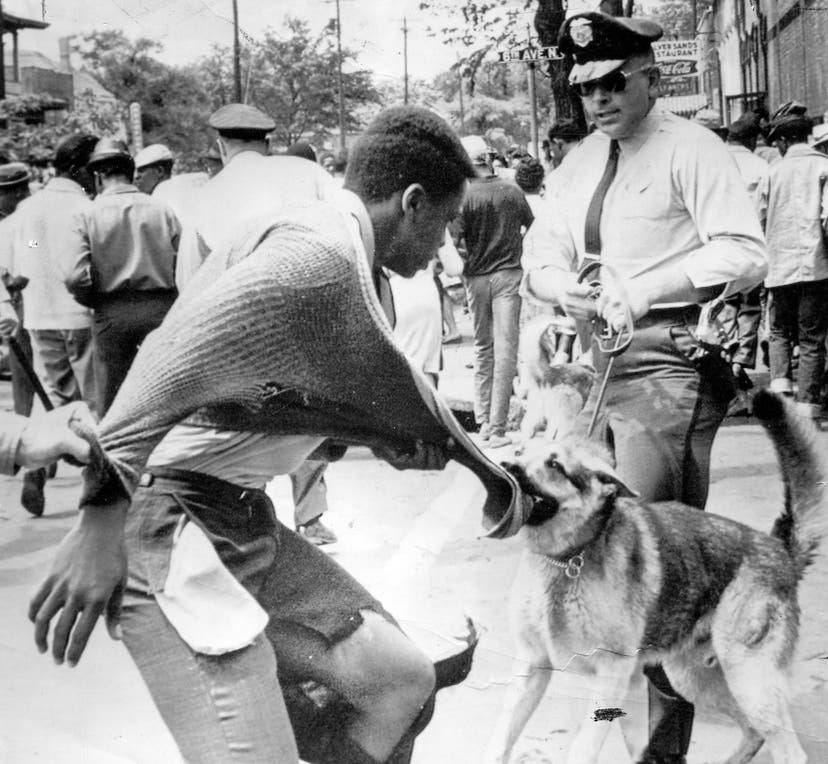
On Substack, The Scuttlebutt looks at an iconic photo, a sculpture based on the photo, and shows that the line from The Man Who Shot Liberty Valance is still quite true: “When Legend becomes Fact, print the Legend”

In an old black and white John Wayne, Jimmy Stewart movie called The Man Who Shot Liberty Valance, a newspaper man tells the hero of the piece “When Legend becomes Fact, print the Legend”. Meaning; tell the people what you want them to know, even if it’s not true. We’re going to talk about that today; but first, Get in out of the cold damn it! Seven degrees is cold even by my standards. Grab a cup of coffee, or cocoa, tea if you must, pollute it as you will, and have a seat, Dinner is Chili, please remember the tip jar where we collect for the mess. Let’s begin!

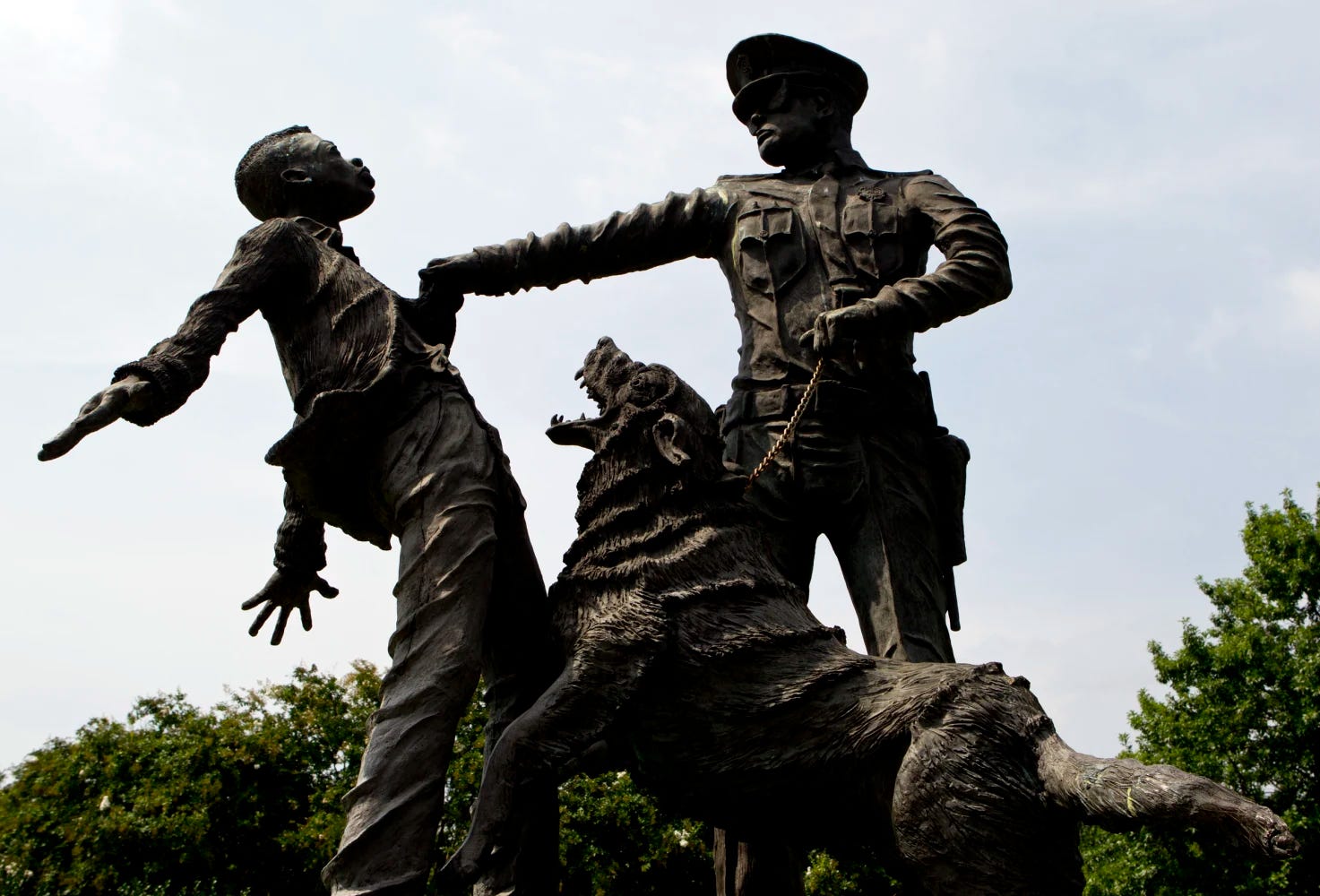
I referred to the picture above last week, though I didn’t include it. I’m going to include it now, because of something that a reader and good friend of some four decades sent me, in regard to it. See, she lives in Birmingham, where there is a statue commemorating this event, titled Foot Soldier. This is it:

Notice any differences from the photo of the event? Yeah, the cop is the one grabbing the kid, and the dog is threatening, the kid is defiant, and the cop looks like they pulled him out of a Soviet or Nazi recruiting poster. (The article I will reference also calls out the fact that the kid in the sculpture has emphasized black racial features. The kid it happened to, is so Anglo in feature he could be a white guy in “blackface”. Oh and the kid in real life is every bit as big as the cop.) Those are just the initial things, there’s more, but I’ve made my point.

Yeah, you in the back, with the purple hair and the septum ring? What’s that? “But that’s art” you say? “Putting artistic license on the sculpture is reasonable” you say?

Well, Ma’am? I think you’re a Ma’am? Yes, it is. It’s propaganda, but “Art” is allowed to be propaganda, and in fact most art is just that. From the formal paintings of Kings and Heads of State, to Andy Warhol’s stuff, images are altered to make a point. Maybe to emphasize a chin that’s pretty weak in the real guy, making him look “tougher” or putting more jewelry on the woman than the family owns to make them look richer … Most art that isn’t just “an exercise for the student” has some sort of statement. (Note, I consider “still life with fruit”, and such things to be an exercise, teaching proportion and play with light.) Political caricatures are the ultimate expression of this point, and that cop is a political caricature.

Ah, but here’s the thing. While the “art” is reasonably a political statement, the news story, and the photograph are supposed to be news, and we have been told that “News is facts, not Op-ed”.

Well, we all know that lately, that’s just not so, but here’s the thing: It never was!

It’s not that the Media is lying to you today, it’s that the media has NEVER told the truth. It’s just that by the time the truth comes out, usually, it’s decades later, and no one cares.

But you SHOULD care. Take this event enshrined in legend (Remember that quote “print the legend”?) There’s a gentleman named Malcom Gladwell. He does a podcast called Revisionist History. The transcript of the relevant show is HERE as done by Emily Maina. The whole piece is really well done, and worth your time, but it’s about twenty minutes worth of reading, so I’m pulling out a couple of points to help make my point.

Mr. Gladwell was invited by the widow of the cop, to learn, as the late Great Paul Harvey used to put it, “The Rest of the Story”. This drove him to track down the artist that did the sculpture, the actual kid that was involved, friends of the cop in question, caused him to listen to the interviews done when the statue was commemorated, and so on. It seems the legend is far different from the truth. The kid in the picture wasn’t even part of the damn protest. He was a lookie-loo who had skipped school to come see “the great man” Martin Luther King.

The protests had at this point been going on for months. Constantly getting bigger, constantly drawing more spectators. The cops, specifically “the Birmingham Chief of Police, a troglodyte named Bull Connor”, in the words of Gladwell, have been tasked with keeping the spectators separated from the protesters. There was, after all, a legitimate fear that someone in the spectators might just be a Klansman, and might be aiming to take out some of MLK’s folks.

Well, that gets harder and harder to do, and the protester numbers keep growing, the spectators keep growing, until finally, Conner decides to use the K9 units to keep the peace. This is all a part of “the plan”. The protestors are trying to get the cops to do something that can be blown up and make international headlines. Finally, they succeeded.

The third of May, 1963. A photographer, Bill Hudson, gets a picture of a kid with a cop dog on him. White officer, black victim, mean dog. That’s what the narrative is. The New York Times runs it, three columns above the fold, and makes up a story to go along with it. The trouble is, no one talked to the cop, or to the kid.

The cop was Richard Middleton, his last gig had been escorting black kids to school, to keep them from being killed by whites. He’s been assigned now, to keep the separation line between the protesters and the populace. The kid’s name is Walter Gadsden, according to the person that interviewed him at the dedication of the statue, he’s now “a grumpy old man still wedded to some of the oldest and most awkward of Black prejudices”. She sees him as Stockholmed basically.

Walter, he sees himself as a dumb kid who skipped school, went where he wasn’t supposed to, and damn near got bit by a K9 because of it. Middleton was trying to pull the dog off, you can see it in the photo, if you actually look. But that’s not the legend, and the media prints “the legend”. The artist admits:

    Well, I saw that the boy was being about 6’4, the officer was maybe 5’10, 5’9. And I said, “This is a movement about power”. So I made the little boy younger and smaller, and the officer taller and stronger. The arm of the law is so strong, that’s why his arm is almost, like, straight. And the dog is more like a wolf than a real dog. Because if I’m a little boy, that’s what I would see. I would see like this superman hovering over me, putting this big old giant monster of a dog in my groin area, in my private area. And so, that’s what I envisioned when I first saw the photograph.

Of course, the artist is a black man. He continues: “So he’s almost like a blind officer. He doesn’t even see the kid, because he’s so far beyond that. ‘Killed this nigger. Attack this nigger.’ He saw past the reality of this is a hu-, innocent chi-, human child, a human being, that’s why he was wearing blind people glasses like that.”

Well, it’s art, the artist wasn’t there, never talked to anyone involved, and he told the story he wanted to tell. OK, that’s what art does. The trouble is, that’s also what the news media did.

And they got away with it, until July 6 2017, which is when the article in question came out. Actually, they are still getting away with it, because now that the legend is fully established, good luck trying to convince people of the facts.

Japanese Last-Ditch Pole Spear Bayonet

Filed under: History, Japan, Military, Weapons, WW2 — Tags: , — Nicholas @ 02:00

Forgotten Weapons
Published 8 Sept 2025

Japanese bayonets followed the same trend of simplification as Arisaka rifles towards the end of World War Two, culminating in what is today called the “pole bayonet”. Abandoning even the fittings to mount to a rifle, these bayonets were intended to be lashed to a pole to create a spear. The Japanese government did not have the military forces to repulse an American invasion of the home islands, and was actively planning to sacrifice millions of Japanese civilians in a hopeless defense, literally having them charge American machine guns with spears. Some of this was done on outer island battles, like Saipan and Okinawa but the scale in Japan itself would have been unimaginable. It was the nuclear bombs on Hiroshima and Nagasaki that led to a Japanese surrender and prevented this from becoming a reality.
(more…)

QotD: Slavery in the Islamic world

Filed under: Africa, Books, History, Middle East, Quotations, Religion — Tags: , , , , — Nicholas @ 01:00

As one recent study of the 19th century slave Fezzeh Khanom puts it, “The history of slavery in Iran has yet to be written”. A general history of slavery in the wider Islamic world had yet to be written, too — until Justin Marozzi took up the task.

The widespread neglect of the history of slavery in North Africa and the Middle East, which Captives and Companions seeks to redress, partly reflects a culture of American exceptionalism; slavery in other parts of the Americas (it was abolished in Brazil only in 1888) also receives little attention.

Partly, too, it reflects a tradition of denial in the Islamic world itself. Marozzi recalls a professor at Bilkent University in Turkey admonishing a younger historian not to dig too deep: “Our ancestors treated their slaves very well; don’t waste your time”.

In the West, meanwhile, Islamic slavery is an unfashionable — and often suspect — subject: one is reminded of West Germany in the 1980s, when any overemphasis on Soviet crimes against humanity could appear as an attempt to whitewash or relativise the Holocaust. Marozzi is careful not to dwell too much on comparisons between Islamic and Atlantic slavery, except as regards the scholarly attention which they have received. Still, many readers will pick up his book hungry for such comparisons. So here they are.

In both Islamic and Atlantic slavery there was a marked racial — anti-black — component. Slavery was sustained by similar religious and philosophical justifications: the biblical “curse of Ham”, for example, and the idea that geography and climate made sub-Saharan Africans naturally suited for servitude. “Chattel slavery”, Marozzi emphasises, existed in the Islamic world too. Both involved horrific violence and displacement. Both were complex and sophisticated enterprises, often with serious money at stake.

People have always been hesitant to draw any comparisons between Islamic and Atlantic slavery, albeit often for entirely opposite reasons to historians today. Whereas the Jewish-American writer Mordecai Manuel Noah was a vocal supporter of the enslavement of Africans in America, he was also bitterly opposed to the enslavement of Americans in North Africa — and therefore a strong supporter of America’s involvement in the Barbary wars.

Gladstone, meanwhile, thought that Turks killing and enslaving Europeans was far worse than “negro slavery”, which had at least involved “a race of higher capacities ruling over a race of lower capacities”. However dubious his family connections, Gladstone was born after Britain had abolished the slave trade.

The lack of attention given to Islamic slavery is all the more dismaying when one considers just how much longer it survived.

Most of slavery’s 20th century holdouts were in the Islamic world. Iran abolished slavery in 1928; Yemen and Saudi Arabia in 1962; Turkey — which we like to consider more “Western” than the others — in 1964. Mauritania half-heartedly abolished slavery in 1981. Slavery was still a feature of elite life in Zanzibar as late as 1970. When 64-year-old President Karume took an underage Asian concubine, he justified it by declaring that “in colonial times the Arabs took African concubines … now the shoe is on the other foot”.

The Royal Harem in Morocco, meanwhile, was only dissolved on the death of Hassan II in 1999. In the Islamic world, human beings were bought and sold, and forced to do demeaning and painstaking labour, within living memory; some people languish there still.

The key difference between Atlantic and Islamic slavery concerned status. Slaves in the Islamic world could rise to high places: 35 of the 37 Abbasid caliphs were born to enslaved concubine mothers; the slave eunuch Abu al Misk Kafur was regent over Egypt from 946 to 968. Slave dynasties, most notably the Mamluks, were amongst the most powerful in the Islamic world.

The polyglot governor of Hong Kong, Sir John Bowring, when he inveighed against “slavery in the Mohamedan states”, had no choice but to acknowledge that a slave in the East could attain the “highest social elevation” — a far cry from the black slaves of the West Indies. Some slaves, too, were amongst the worthies of Islam, such as the first Muslim martyr, Sumayya bint Khabat.

Slavery occupied a complex place in Islamic law. The Quran, on the one hand, permits men to have sex with female slaves. But on the other, the emancipation of slaves is smiled upon as one of the noblest things a Muslim can do. The Abyssinian slave Bilal ibn Rabah was freed by Abu Bakr and became the first caller to prayer; another freed slave, Zayd ibn Haritha, was briefly the Prophet’s adopted son.

The Quran also expressly forbids Muslims from enslaving fellow Muslims. Nonetheless, as Marozzi shows, this prohibition has not always been strictly observed. The Mahdi (of General Gordon fame) claimed to represent pure, Islamic orthodoxy, but he had no qualms about enslaving Muslim Turks.

Likewise, it mattered little that the Prophet Muhammad had explicitly forbidden castration of male slaves. For over a millennium his tomb in Medina was guarded by a corps of eunuchs. This, too, was an institution which survived into living memory: in 2022 a Saudi newspaper reported that there remained one living eunuch guardian.

Samuel Rubinstein, “The dirty secret of the Muslim world”, The Critic, 2025-10-17.

January 29, 2026

The steel industry in North America didn’t die … but it had to re-invent itself

Filed under: Business, Cancon, Technology, USA — Tags: , , , — Nicholas @ 05:00

When I first started paying attention to the news in the early 70s, one of the big stories both in the US and in Canada was the plight of the steel industry. It had been an enormously important part of the industrial economy for over a century, but every new story painted the picture blacker. Mergers, plant closings, consolidations, bankruptcies, and layoffs were consistent themes. Yet there is still a significant steel industry in North America. Tim Worstall explains what happened:

Dofasco’s steel plant on the harbourfront in Hamilton, Ontario

A little digression. To make steel from iron ore you use a blast furnace first. This uses coke (from coal), iron ore and limestone (moderns might use more than just limestone) to produce pig iron. You feed the pig iron into a basic oxygen furnace to make the steel. Yes, we can get much more complicated than that but let’s not.

The US now makes mebbe 20 million tonnes of pig iron a year. Imports are up, a bit, but nowhere near enough to make up the difference. That’s the big change because that’s from the 80 and 90 million tonnes a year of the 1970s. The change is the same whether we measure by domestic production of pig iron or by apparent consumption. Well, the change is the same either way close enough for this to be the big point to make.

What’s actually happened is a change in technology, not a change in trade. Nucor is now 50% or so of US steel output (no, not US Steel, but US steel). Nucor has never used a blast furnace in its corporate life. It collects scrap steel and makes new steel by recycling that. It skips, entirely, the blast and BoF stages. Back in the 1950s Nucor was a couple of scrap yards and a gleam in the corporate eye — now it’s that half the market.

Again, yes, we can get more complex if we wish to. But this is the basic pencil sketch. Yep, we’re more economic in our use of steel these days. Imports of steel are up and so is the importation of things made with steel. But the real change in the steel business over the past 60 to 80 years is the replacement of the steel making business with the steel recycling business. We don’t — and by this I mean the rich countries in general — make all that much steel these days. We recycle an awful lot of steel these days. And that’s what’s really changed.

That’s also what has near entirely screwed over the steel industry of places like Gary, Indiana. For they ran those basic steel making processes, iron ore in, basic steel out. Which isn’t something that has been replaced by imports, it’s something that has been replaced by just not doing it at all.1

Arnade goes on to point out that there are plenty of people still using steel to do things with, make things out of, which is all entirely true. But this idea that the Japanese, or China, killed the traditional US steel industry just isn’t true, not at all. It was Nucor.

All of which makes it just so much fun when it’s Nucor that shouts the loudest about the need for tariffs on steel imports. For Nucor points to the collapse of the traditional industry as its proof. Yet Nucor benefits from those tariffs — they can charge higher domestic prices as a result — even while Nucor is in fact the cause of the traditional collapse.


  1. “not at all” is rhetorical hyperbole, not a factual statement.

This is how woodworkers carried their entire shop (for centuries)

Filed under: Tools, Woodworking — Tags: , , — Nicholas @ 04:00

Rex Krueger
Published 28 Jan 2026

Patrons saw this video early: / rexkrueger
Join the Mailing List: http://eepurl.com/g3rkmv
Take a course: https://www.rexkrueger.com/courses
Compass Rose Toolworks: https://www.compassrosetools.com/
Get my woodturning book: http://www.rexkrueger.com/book
Get My Book, Everyday Woodworking: https://amzn.to/3oyjC0E
Follow me on Instagram: @rexkrueger

“The meme works because Amelia has perfectly normal, mainstream opinions”

Filed under: Britain, Government, Humour, Liberty, Media, Politics — Tags: , , , , , , — Nicholas @ 03:00

On the social media site formerly known as Twitter, The Little Platoon responds to a lamestream media report on the Amelia phenomenon:

This story was quite funny enough before it got noticed by the rickety old goblin creatures of the mainstream media.

Amelia is not a “purple-haired AI goth girl”, she is a government-created videogame character designed to teach kids that “liking the national flag” and “attending protests where that flag might be seen” makes you a potential terrorist.

That really was the extent of it. The game she comes from is extremely non-specific about the content you’ve been radicalised by. At no point do you think, “yes, I can see why this was terrorist behaviour”.

The actual storyline is not a million miles away from Winston Smith and Julia in Nineteen Eighty-Four.

So the effect is: you have this totally normal opinion that most people have? You’ve been seduced by Amelia and now the Hijabi Hero (IRONY) at Prevent is going to send you to jail.

Amelia hasn’t been “hijacked by the far-right”, she’s just a textbook example of Death of the Author.

The government wanted to have her demonstrate the dangers of online radicalisation. But because this is the British government, they made it seem cool, justified, and you’ll probably get a hot goth girlfriend out of it.

The meme works because Amelia has perfectly normal, mainstream opinions.

She can say “I like pork sausages and dogs”, like roughly 98% of British people, and this will send a certain sort of person — the government, the Anti-Extremism Lead at Generic NGO — into a full-on panic attack.

It’s about the disconnect between the values of the government and those of the people they govern. The joke is that Amelia could ever be considered “Far Right”.

(Ironically, the interviewee in this clip is just as AI-coded as the actual AI clip they play. He’d probably require fewer tokens to generate.)

Meme coins remain extremely cringe, however.

At The Hungarian Conservative, Joakim Scheffer discusses the reaction of the caught-flat-footed mainstream media as their attempts to downplay Amelia’s impact serve to increase interest and attention:

British outlets The Guardian and LBC published strikingly similar articles about Amelia in recent days, both concluding that the purple-haired goth girl, who stands against mass migration and in favour of traditional British values and culture, is, in fact, racist and fuels hatred.

The Guardian introduces Amelia as a girl “who proudly carries a mini Union flag and appears to have a penchant for racism“, before lamenting the “plethora of increasingly sophisticated AI-generated iterations” of her, including “real-life” encounters between Amelia and movie characters, “accompanied by racist language and far-right messaging”.

Since her “birth”, Amelia has indeed become increasingly popular. From an average of around 500 posts a day when she was first introduced, the figure rose to roughly 10,000 daily posts starting on 15 January, when the meme broke through to international audiences. Amelia has since reached the highest levels of the right-wing internet ecosystem, even being reposted by Elon Musk himself.

Starship Troopers: Service Isn’t The Point

Filed under: Books, Government, Media, Politics, USA — Tags: , , , , — Nicholas @ 02:00

Feral Historian
Published 5 Sept 2025

There’s a long-running argument over whether Heinlein’s book describes military service as the exclusive path to citizenship, or if “federal service” is a much broader basket of enfranchisement. While a close read of the book makes it unquestionably clear which is correct, it misses the greater point. Heinlein was writing about the role of civic virtue in the stability of a republic, his citizenship-through-service framing is the literary conceit for discussing that larger question.

For a more detailed examination of the nature of Federal Service, I recommend James Gifford’s essay on the subject: https://www.nitrosyncretic.com/rah/ft…

00:00 Intro
00:45 What is Federal Service?
02:18 An Exploration of Enfranchisement
03:13 Expanded Universe
05:38 But Why?
06:59 Starside R&D
09:07 “Unreasonable Facsimile”
10:54 Filtering Civic Virtue
(more…)

QotD: Nitpicking the Roman army in Gladiator (2000)

Filed under: Europe, History, Military, Quotations, Weapons — Tags: , , , , , , , — Nicholas @ 01:00

We pick up in an improbably mud-soaked clearing with a title card informing us that we’re in “Germania”, which is correct in a very broad sense that this is the Second Marcomannic War and the enemies here are the Marcomanni and Quadi, who are Germani (Germanic-language speakers), but the army here isn’t operating out of the Roman provinces of Germania (superior and inferior) which are on the Rhine, but rather on the Danube, from the provinces of Noricum and Pannonia (Superior). But in the sense that we’re in Germania magna, the greater zone of Germanic cultural influence, sure, fine.

In the process of Maximus riding up, the failure of negotiations and Maximus riding to join his cavalry, we get something of an overview of the Roman army and its position and both are wrong. Let’s start with the soldiers: we see a very clear distinction between two kinds of soldiers, the mail-clad auxilia, all archers, and the legionaries wearing the lorica segmentata and there appear to be about the same number of both groups. And here is where we first see the clear influence of the Column of Trajan (and to an unfortunately lesser degree, the far more appropriate Column of Marcus Aurelius) on the depiction, because this use of armor to distinctly signal the Roman citizen legionaries and non-citizen auxilia is straight from the Column of Trajan, completed probably around 113 and commemorating Trajan’s two Dacian Wars (101-102, 105-106).

What this sequence gets correct is that the Roman army was divided into those two groups, they were roughly equal in number (by this period, the auxilia probably modestly outnumber the legions in total manpower)1 and Trajan’s Column does use that visual signifier to distinguish them. This component is the crux of the verisimilitude that leads people to trust the rest of this sequence.

The problems start almost immediately from there. Roman auxilia were far more varied than what we see here in terms of equipment and tactics and only very few of them were archers. So let’s break down Roman auxiliary contingents. With all due caveats about the limits of our evidence, infantry auxilia outnumber cavalry by about 2:1 in attested auxilia units (auxilia were grouped into cavalry alae and infantry cohortes, generally of 480 men (sometimes around 800), but unlike for legionary citizen-infantry, these cohorts were not grouped into larger legions).2 So we ought to expect about a third of our auxilia to be cavalry, which is important because the cavalry detachments of Roman legions were very small (and mostly for scouting and messenger duties). Auxilia cavalry ranged in equipment and could include horse archers and even ultra-heavy cataphract cavalry, but most were mailed shock cavalry, equipped quite a lot like how Gallic or Germanic warrior-aristocrats or Roman legionary cavalry would be.

Of the remainder, the most common kind of infantry auxilia by far seem to have been heavy infantry, fighting in fairly heavy armor. These fellows get depicted in Roman artwork generally in mail armor, with flat oval shields (as opposed to the curved, rectangular imperial-period Roman scutum), spears and swords. These fellows, totally absent in this sequence are all over the Column of Trajan, with their flat oval shields being frequently seen (although one must distinguish them from Dacians who carry the same shield; the auxilia stick out for their mail and helmets). A bit less than 10% of auxilia units are attested as cohortes sagittariorum (“cohort of archers”). We also know the Romans used slingers within the auxilia, but as far as we can tell, not in specialized units; they may have been brigaded in with other auxilia cohorts. In either case, they appear in fairly small numbers. Finally, we also see on things like the Column of Trajan Roman allied or auxiliary units that are substantially lighter infantry: on the Column of Trajan, these are local troops shown wielding large clubs and stripped to the waist, presumably representing troops local to the Danube region, fighting in local (unarmored, with heavy two-handed weapons) style.

So whereas the army we see is a nearly even split between legionary heavy infantry and auxilia archers (with a small amount of legionary cavalry waiting for Maximus to show up to lead them), in practice a typical Roman field army would have far fewer archers, indeed around ten times fewer: not almost 50% of the force, but in fact probably a bit less than 5% of the force (since they’re less than 10% of the auxilia who would make up around half of a Roman field army). Meanwhile we’re simply missing the – by far – two most common sorts of auxilia cohorts, those of heavy infantry or heavy cavalry. This mangling of the structure of a Roman army is going to have implications when we get to Maximus’ overall plan for the battle as well.

Meanwhile, the legionary infantry are also much too uniform, literally. This is easily the most pardonable error, because what has happened here is that director Ridley Scott has copied the Column of Trajan but far too uncritically. After all, the Column of Trajan is not a photograph and thus has space for the artists producing it to take liberties, particularly in the name of imperial ideology and propaganda. In this case, showing large numbers of identically equipped soldiers, often moving in unified formation, serves the same rhetorical purpose in antiquity as it does today, suggesting an impressive, inhumanly uniformed and disciplined source. Moreover, the segmented Roman body armor, which we call the lorica segmentata (we don’t know what the Romans called it), was very distinctive to the legions, as it was the one armor that it seems like the auxilia probably (the evidence here can be tricky) didn’t share. And keeping the legions distinct from the auxilia also matters, as the legionary soldiers are higher status citizens who thus get “higher billing” in the imagery, as it were, than the auxilia. So showing all of the legions equipped neatly with this armor makes them seem distinct, impressive and uniform.

In short, it served Trajan’s image (and thus the artists aim) to suggest that all of his legions wore this armor.

Archaeology tells us quite clearly it was not so. Indeed, the lorica segmentata, so iconic because of its use in this way on the Column of Trajan, was probably the least common of the three major types of Roman legionary body armor in this period. The most common armor of the Roman legions was almost certainly still – as it had been in the Late Republic – mail, exactly the same as we see the auxilia wearing. We find fragments of Roman mail in legionary sites in all corners of the Empire and it remained common everywhere. To head off a standard question: no, it does not seem that the Romans ever got the idea to layer other defenses over mail, so when it was worn, it was the “primary” armor (worn over a padded textile defense called a subarmalis, but not under any other armor).3 We also see mail represented in Roman artwork, including on very high status soldiers, like senior centurions.

The next most common armor was probably scale armor, which we find very frequently in the East (that is, on the frontier with the Parthians/Sassanids) and often enough (if less frequently) in the West (that is, the Rhine/Danube frontier). We also know that some auxilia units wore this armor too and we see quite a bit of scale armor – wholly absent in this sequence – on the Column of – wait for it – Marcus Aurelius (completed c. 193). That’s the column that commemorates this war. Contemporary with this fictional battle. But it is less famous and somewhat less well-preserved than 70-years-earlier Column of Trajan, which they pretty evidently used quite a bit more of.

The lorica segmentata shows up the least often and – to my knowledge – effectively exclusively in the west on the Rhine/Danube frontier, where it is still probably not the most common (although it may have been more common than scale on that frontier). So what we ought to see in this army are legionaries who are marked out by their large scuta (the big Roman shield, by this period distinctly rectangular and also (as in the republic) curved), but in a range of mail, scale and lorica segmentata (with mail and segmentata being the most common, because we are on the Danube frontier, but scale hardly rare), along with auxilia divided into specialist cohorts (480 man units) each with different sets of armor and weapons: a few missile cohorts (archers, slingers), a lot more heavy infantry cohorts with spears and long shields, some lighter troops, and so on. The auxilia ought to be wearing basically every armor under the sun except for the lorica segmentata (which to my knowledge we’ve only ever found in sites associated with the legions).

Finally, these units are backed up by a whole load of catapults. We see two kinds, dual-arm arrow-throwing machines (which most folks would casually call ballistae) and single-armed pot-throwing machines (which most folks would casually call catapults), all of them in stationary mounts. Now on the one hand, “the Romans use lots of torsion-based catapults as artillery” is a true statement about the Roman army of this period, but on the other hand once again beyond that basic idea, most of this is wrong. Once again there’s an issue of verisimilitude here: the appearance of strange catapults and the true fact that the Romans used a lot of unusual catapults is likely to lead the viewer to assume some research has been done here and thus that these are the right catapults. For the most part, they are not.

We can start with the easy one, the larger single-armed pot-throwers. These are onagers, a late-Roman simplified single-arm torsion catapult, named for their fearsome “kick” (like an ass, an onager). These are popular favorites for Roman artillery, for instance showing up in both Rome: Total War and Total War: Rome II (both of which have main campaigns set during the Late Republic). There’s only one problem, which is that Gladiator (much less the even earlier Total War games) is set substantially too early for an onager to appear. Our first attestation of the onager is in Ammianus Marcellinus, writing in the last two decades of the 300s AD about the events of 353-378 (his work was broader than this, but only the back end survives). Vegetius, writing roughly contemporary with Ammianus also mentions them. But before the late fourth century, we don’t have any evidence for this design and it doesn’t show up on the Columns of Trajan or Marcus. So this isn’t just a little bit too early for these catapults but, given the evidence we have, around 150 years too early, the equivalent of having a line of M1 Abrams show up in a film about the Battle of Gettysburg.

What we do have are a number of twin-armed bolt or arrow-throwing machines and the Romans certainly had those, though what we see doesn’t match up well with what the Romans used. What we see is a single size of fairly large arrow-throwing engines, aimed upward to fire in fairly high arcs and built with large metal cases containing the torsion springs (generally made of hair or sinew, tightly coiled up; it is the coiling of these springs which stores the energy of the machine).

These two-armed torsion catapults came in a wide range of sizes and could be designed to throw either arrows/bolts or stones (the latter carved into spheres of rather precise caliber for specific machines). And we ought to see a pretty wide range of sizes here, from massive one-talent engines, which threw a 1 talent (26kg) stone and stood about three times the height of a man, to much smaller anti-personnel weapons (scorpiones) that were more like a “crew served” weapon than a large artillery piece. By Trajan’s time, the Romans had even taken to mounting these smaller crew-served engines on mule-drawn carts (called carroballistae) to allow them to be rapidly repositioned, something like early modern “horse artillery” (they were not meant to fire on the move; when we see them on Trajan’s Column, at least one of the operators is usually standing on the ground outside of the cart to winch the machine). These smaller machines, which would have made up the bulk of those deployed in a field battle, seem mostly absent in the sequence.

The result of all of this is that the Roman army presented in the opening moments of Gladiator manages to strike a remarkably unhappy balance: having just enough of the appearance of accuracy to decisively influence two decades of subsequent depictions of the Roman army without actually being particularly correct about anything beyond a very surface level. But subsequent pop-culture (again, I think Rome: Total War played a significant role here) would codify this vision of the Roman army – fire-throwing onagers, lots of auxilia archers, legionary rather than auxiliary cavalry, uniform use of the lorica segmentata – as the dominant model for quite some time.

But the army isn’t the only thing that’s wrong.

Bret Devereaux, “Collections: Nitpicking Gladiator’s Iconic Opening Battle, Part I”, A Collection of Unmitigated Pedantry, 2025-06-06.


  1. See figures in P. Holder, Auxiliary Deployment in the Reign of Hadrian (2003).
  2. There’s some complexity here because some infantry auxilia cohorts had small attached cavalry contingents too.
  3. I suppose I should note that is an odd exception for a type of very fine armor sometimes called lorica plumata (“feathered armor”) by modern writers where metal scales were mounted on mail armor (typically with extremely fine, small rings), rather than on a textile backing. This armor type seems to have been rare and must have been very expensive.

January 28, 2026

An ADA unintended consequence in Los Angeles

Filed under: Government, Law, USA — Tags: , , , , , — Nicholas @ 05:00

I’ve heard many people refer to the Americans with Disabilities Act as the worst piece of legislation in US history, and stories like this one make it easy to agree:

Los Angeles’s streets are in notoriously bad shape. Fewer than two-thirds are considered in a state of good repair, according to the city’s Department of Public Works. Broken sidewalks have spawned years of costly litigation, and Los Angeles pays out millions of dollars each year to drivers whose cars are damaged by potholes.

Many cities would see this situation as a mandate for change. And Los Angeles has indeed made a change: last summer, the city quietly stopped repaving its streets. Not slowed. Not fell behind. Stopped completely.

The Bureau of Street Services (StreetsLA) has not repaved a single street since last June, and the city’s latest budget practically zeros out repaving for next fiscal year. StreetLA crews are still doing some road repairs, fixing potholes and patching problem areas. But the most basic form of urban maintenance — full street resurfacing — has all but disappeared in America’s second-largest city.

Why has Los Angeles stopped repaving its streets? The answer, it turns out, has to do with federal disability rules that, paradoxically, have made fixing roads legally riskier than letting them fall apart. Though well-intentioned, L.A.’s shift shows how such policies can unintentionally worsen urban quality of life.

The clearest explanation of the city’s shift comes from L.A.–based housing and transportation advocate Oren Hadar. Digging through budget documents and engineering classifications, Hadar explained in an essay from late last year that the city didn’t necessarily abandon street work so much as reclassify it out of existence.

The city seems to have invented a new category of repair specifically designed to avoid triggering costly federal accessibility mandates. Instead of repaving streets, StreetsLA now performs what it calls “large asphalt repairs”. As Hadar explained, these repairs address localized damage — areas larger than a pothole but smaller than full resurfacing. Essentially, the city repaves only part of a street rather than the entire width, as shown below.

A “large asphalt repair” on L.A.’s Century Boulevard. Courtesy: StreetsLA on X

But, as Hadar wrote, “the thing about large asphalt repair is that it’s … not a real thing. It appears to be a term made up by the city some time in the last year.”

Why invent a new classification? The reason lies in federal disability law. Under regulations implementing the Americans with Disabilities Act, when a city alters a street, it must also bring associated pedestrian infrastructure into compliance. That means installing ADA-compliant curb ramps at every intersection along the way.

Repaving is considered an alteration that triggers these requirements. Maintenance activities, such as filling potholes or making minor repairs, are not. The city claims that large asphalt repairs are “pavement maintenance activity” and therefore do not require ADA upgrades.

That distinction carries enormous financial and logistical consequences. Hadar found that each curb ramp costs roughly $50,000, totaling about $200,000 per intersection. With roughly ten intersections per mile, curb ramps alone can add around $2 million per mile to the cost of repaving — a figure that often exceeds the cost of the asphalt itself. Design and construction typically take 9 to 12 months per ramp, and federal rules require the ramps to be completed by the time the street is resurfaced.

Update, 29 January: Welcome, Instapundit readers! Have a look around at some of my other posts you may find of interest. I send out a daily summary of posts here through my Substackhttps://substack.com/@nicholasrusson that you can subscribe to if you’d like to be informed of new posts in the future.

Older Posts »

Powered by WordPress