Quotulatiousness

September 27, 2025

Canada’s supply management cartels benefit “an affluent few, burdening the poorest, and creating needless friction with allies and trading partners”

In Reason, J.D. Tuccille explains to an American audience why Donald Trump has been playing hardball with Canada on trade issues:

President Donald Trump justifies his enthusiasm for prohibitively high tariffs by insisting the U.S. is being “ripped off” by other countries. It’s a strange argument, since people only trade with one another if they see benefit in the deal. But the president is right to complain that other governments impose trade barriers of their own that are often every bit as burdensome as the high taxes Americans pay on imports. If foreign officials honestly wish to restore something like free trade, they should emphasize dropping their own barriers in return for lower U.S. levies. Case in point: Canada, which sends three-quarters of its exports across its southern border but imposes damaging restrictions on imports.

In a February proclamation of trade war on the world, Trump announced, “the United States will no longer tolerate being ripped off” and complained that “our trading partners keep their markets closed to U.S. exports”. The first part of that claim is silly. But the second part has a kernel of truth.

A glimpse at that truth came in June when Trump angrily posted that Canada “has just announced that they are putting a Digital Services Tax on our American Technology Companies” and, as a result, “we are hereby terminating ALL discussions on Trade with Canada”.

The threat had the desired impact. Canada rescinded the tax immediately before it was supposed to take effect. While nominally targeted at all large tech companies, in practice that meant American companies and everybody knew it, since U.S. firms dominate the industry.

But that was only the tip of the iceberg when it comes to Canada’s trade barriers. Also in June, international trade attorney Lawrence Herman, a senior fellow at Canada’s C.D. Howe Institute, bemoaned proposed legislation in the Canadian parliament that he characterized as “yet another regrettable effort to enshrine Canada’s Soviet-style supply management system in the statute books.”

He added, “the bill would prohibit any increase in imports of supply-managed goods – dairy products, eggs and poultry – under current or future trade agreements”.

The legislation about which Herman complained has since become law.

[…]

More skeptically, Fraser Institute senior fellow Fred McMahon notes, “supply management is uniquely Canadian. No other country has such a system. And for good reason. It’s odious policy, favouring an affluent few, burdening the poorest, and creating needless friction with allies and trading partners.”

McMahon elaborates that the supply management process is controlled by agricultural management boards which “employ a variety of tools, including quotas and tariffs, and a large bureaucracy to block international and interprovincial trade and deprive Canadians of choice in dairy, eggs and poultry”.

But as we’ve seen so many times over the years, it disproportionally benefits Quebec, and the Liberals desperately need those Quebec votes to stay in power, so the government would rather destroy the national economy rather than give up on our Stalinist supply management cartels.

Dislike of Trump prompts the CBC to spread faulty medical advice

Filed under: Cancon, Health, Media, Politics, USA — Tags: , , , , — Nicholas @ 03:00

It’s a long-running joke that US progressives — and the legacy media, BIRM — are programmed to respond to anything Donald Trump says by doing the exact opposite of what he says:

The CBC apparently felt the need to do the meme:

It was not controversial for news outlets like CBC to report in 2016, and later 2021, on new medical research raising concerns about the impact of Tylenol use on pregnancy and fetal development. But in 2025, those studies (among others) have become the basis for a new cautionary approach by the U.S. government that critics and media are trying to debunk.

On Monday, the U.S. Department of Health and Human Services announced that, as part of a bigger strategy in quelling autism, it would be issuing a “physician notice and begin the process to initiate a safety label change for acetaminophen”.

President Donald Trump relayed this to the press, stating the medication “can be associated with a very increased risk of autism”.

“So taking Tylenol is not good, all right? I’ll say it; it’s not good. For this reason, they are strongly recommending that women limit Tylenol use during pregnancy unless medically necessary. That’s, for instance, in cases of extremely high fever that you feel you can’t tough it out.”

[…]

The statement was reported in the mainstream news — including CBC, which found Canadian doctors who seemed to support the cautionary approach. The impression from these experts was that this wasn’t cause for panic and that more evidence was needed, but it was an occasion for discussion. The advice back then? Take the smallest amount for the shortest period of time, and don’t use it as a first resort to managing pain, which is consistent with the U.S. guidance.

Indeed, no major figure in this story is advocating for total avoidance because unmitigated pain and fever are bad for pregnancy, and in small amounts, Tylenol seems to be fine. That said, the manufacturer doesn’t recommend it for pregnant women (which they can’t really do without extensive testing, even if doctors generally consider it safe for mothers in minimized amounts when medically indicated).

More recently, a review of other studies by a team including Harvard University’s public health dean found similar “evidence of an association” between the drug and neurodevelopmental conditions. The dean released a statement saying that the “association is strongest when acetaminophen is taken for four weeks or longer”. That should be uncontroversial, because nobody is supposed to take Tylenol for that long, pregnant or not.

But perhaps, as the Babylon Bee suggests, it’s all Trumpian 4D Chess:

AK4: Sweden’s Beefed-Up Take on the G3

Filed under: Europe, Germany, History, Military, Weapons — Tags: , , , , , — Nicholas @ 02:00

Forgotten Weapons
Published 19 May 2025

When Sweden decided to replace its bolt action Mausers and Ljungman semiautomatic in the 1960s, it had four main choices to pick from. One was the domestic GRAM-63, a modernized version of the Ljungman, the FAL and the G3. They ended up choosing the G3, but not without a number of changes.

Mechanically, the Swedes insisted on a longer service lifespan of the rifle than H&K rated it for. To this end, the Swedish model got a heavier recoil buffer, extending its life to 15,000 rounds. There were also changes to the stock, sights, bayonet attachment, and bolt carrier as well as the use of a clip-on rubber case deflector.

The initial batch of Swedish AK4 rifles was purchased directly from H&K, while domestic licensed production was set up at (eventually) both the star-owned Carl Gustaf factory and also the Husqvarna company.

Thanks to the Supply Battalion of the Estonian Defense Forces Support Command for giving me access to film this surprisingly hard-to-find rifle!
(more…)

QotD: Utopian revolution

One of the virtues of You Say You Want a Revolution is that it admits and illuminates, though it does not altogether explain, the failure of post-colonial regimes in Africa — even those that were established without much in the way of violent struggle. The first generation of post-colonial leaders were so taken by the prestige and perhaps by the glamour of revolution that they employed revolutionary rhetoric themselves, and sometimes went in for utopian schemes of their own. Julius Nyerere of Tanzania, for example (he is not mentioned in the book), was bitten by the bug of utopianism, caught in part from socialists at the University of Edinburgh, calling the sole permitted political party in Tanzania the Party of the Revolution. In the name of creating a just and equal society, he forcibly removed at least 70 per cent of the population from where it was living and herded it into collectivised villages. This was, all too predictably, an economic disaster, famine having been prevented only by large infusions of foreign aid, but it served the interests of members of the Party. Tanzania was saved from being much worse than it was by the fact that Nyerere, though perfectly capable of ruthlessness, was not personally a monster, and also by the peaceful nature of the Tanzania people themselves. Another saving grace was that there was no ethnic group that could have become dominant, so ethnic antagonism could not be added to the witches’ brew.

This illustrates a point that Professor Chirot makes clear in his discussion as to why the Vietnamese communist regime, though often brutal, never descended to anything like the level of horror of neighbouring Cambodia. Among the factors must surely have been the character and personality of the leaders as well as of the countries themselves. In other words, the fate of countries cannot be reduced, either in prospect or in retrospect, to an invariable formula. Human affairs will, to an extent, always be incalculable.

Still, some degree of regularity is possible. I was rather surprised that Professor Chirot overlooked one such. He writes the following of the corruption endemic under communist regimes: “a function of a deliberately exploitative, thieving elite that staved the general economy by its dishonesty than it was the essence of the system itself. Avoiding corruption was impossible because without it the society could not function.”

What is surprising here is that he does not mention why it could not function, but the answer seems to me perfectly obvious: it was because the communist system abolished the price system and substituted political decision-making in its place. This explanation is sufficient, for where there are no prices, and the economy is thereby largely demonetarised, goods and services can be distributed only by corruption. This is not to say that where there is a price system there will automatically be no corruption, obviously this is not the case; but such corruption will be limited by the very need for money to retain its value where such a price system exists. To that extent, it imposes at least a degree of honesty. The mystery of the Soviet Union or any other communist country is not why it produced so little, but why it produced anything at all: and here Professor Chirot is quite right. The answer is because of corruption: an “honest” communist state would produce nothing. It could not survive.

Theodore Dalrymple, “Longing for Revolution”, New English Review, 2020-05-13.

September 26, 2025

John Carter revisits the cancellation debate

Filed under: Media, Politics, USA — Tags: , , , , , , , — Nicholas @ 05:00

As part of a much longer essay, covering a lot more ground, John Carter considers the pro and con arguments for the much-cancelled right to fully indulge in cancelling figures on the left in the wake of the Charlie Kirk assassination and the widespread celebration of the murder by leftists:

Talking heads on network television are whining that it’s getting out of hand, while abruptly unemployed leftists take to GoFundMe to beg for support.

The purge has started, and yes, thank you, I’m feeling quite vindicated right now.

Repeating myself is boring, so I’m not going to rehash the arguments in favour of turning cancellation against the left. Suffice to say, they have it coming. It’s also worth pointing out that there’s an important distinction to be made between getting a labourer fired because he made the OK sign, and removing a medical professional who openly celebrates the death of a man for having opinions shared by half the country. Can a bloody-minded leftist doctor be trusted to give medical care to a Trump voter, when he’s on the record as advocating the execution of Trump voters? The doctor should certainly be allowed to say what he pleases, and he should have the same right to use a social media account as anyone else, but he probably shouldn’t be allowed to practice medicine.

But I don’t want to rehash that. Instead, I want to focus back in on human water fountain women as an exemplar of that choir of liars suddenly singing hymns to the sacred practice of freedom of speech. People would be shocked by this self-serving mendacity if long experience had not accustomed them to it.

We aren’t shocked because we’ve seen this before, repeatedly. The left screamed about the spontaneous unguided tour of the capitol on J6 as an insurrection and an unforgivable attack on our democracy, conveniently forgetting that the Weather Underground were bombing federal facilities, including the Capitol, back in the 70s, or that the state capitol of Wisconsin was occupied by protesters in 2011 … or that they’d attacked the White House in 2020 … to say nothing of the nation-wide Burning Looting and Murdering they committed in the wake of Floyd’s fentanyl overdose.

The curious phenomenon of leftist narrative blindness was repeatedly demonstrated during the COVID years, in which the entire professional-managerial caste would switch from one narrative to its opposite like a school of fish, confidently proclaiming on one day what they had denounced as anti-scientific misinformation just the day before.

Sure enough, in the wake of Kirk’s murder, with his blood still on the ground and their gleeful cries ringing in the world’s ears, the left went on an immediate disinformation counter-offensive. They adopted the narrative that Tyler Robinson was a right-wing groyper – an online follower of Nick Fuentes – who had assassinated Kirk for not being based enough, or for supporting Israel, or something. It was for lying about this that Kimmel was pulled off the air. The evidence for Robinson’s right-wing sympathies were that he’d been raised in a conservative Mormon household by a police officer father, and that he’d dressed up as a gopnik once or something. Robinson’s live-in relationship with a troon, the Antifa slogans he’d carved into the bullet casings, and his friends and family attesting to his left-wing radicalization were waved away. This is what abusive narcissists do: “I didn’t do the thing you just saw me do to you, and anyhow you deserved it”. Sure enough, as I wrote this, another leftist sniper attacked an ICE facility in Dallas; sure enough, leftists immediately began insisting that he couldn’t possibly have been a leftist, this time on the grounds that the shooter inscribed “Anti-ICE” rather than “Fuck ICE” on his bullets.

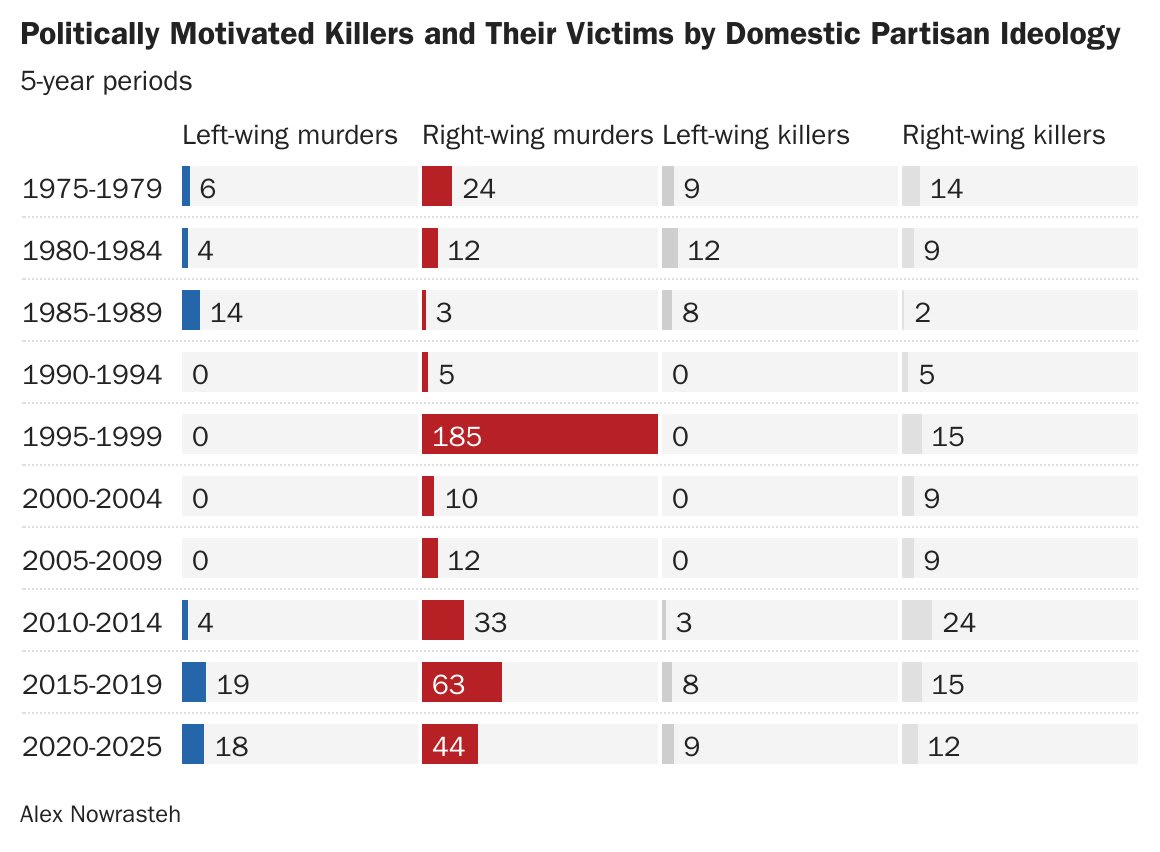
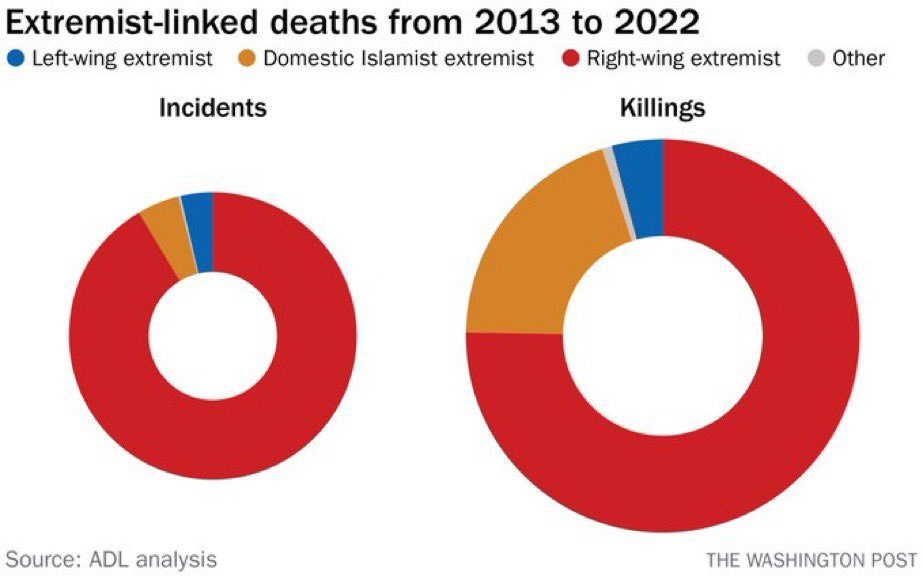
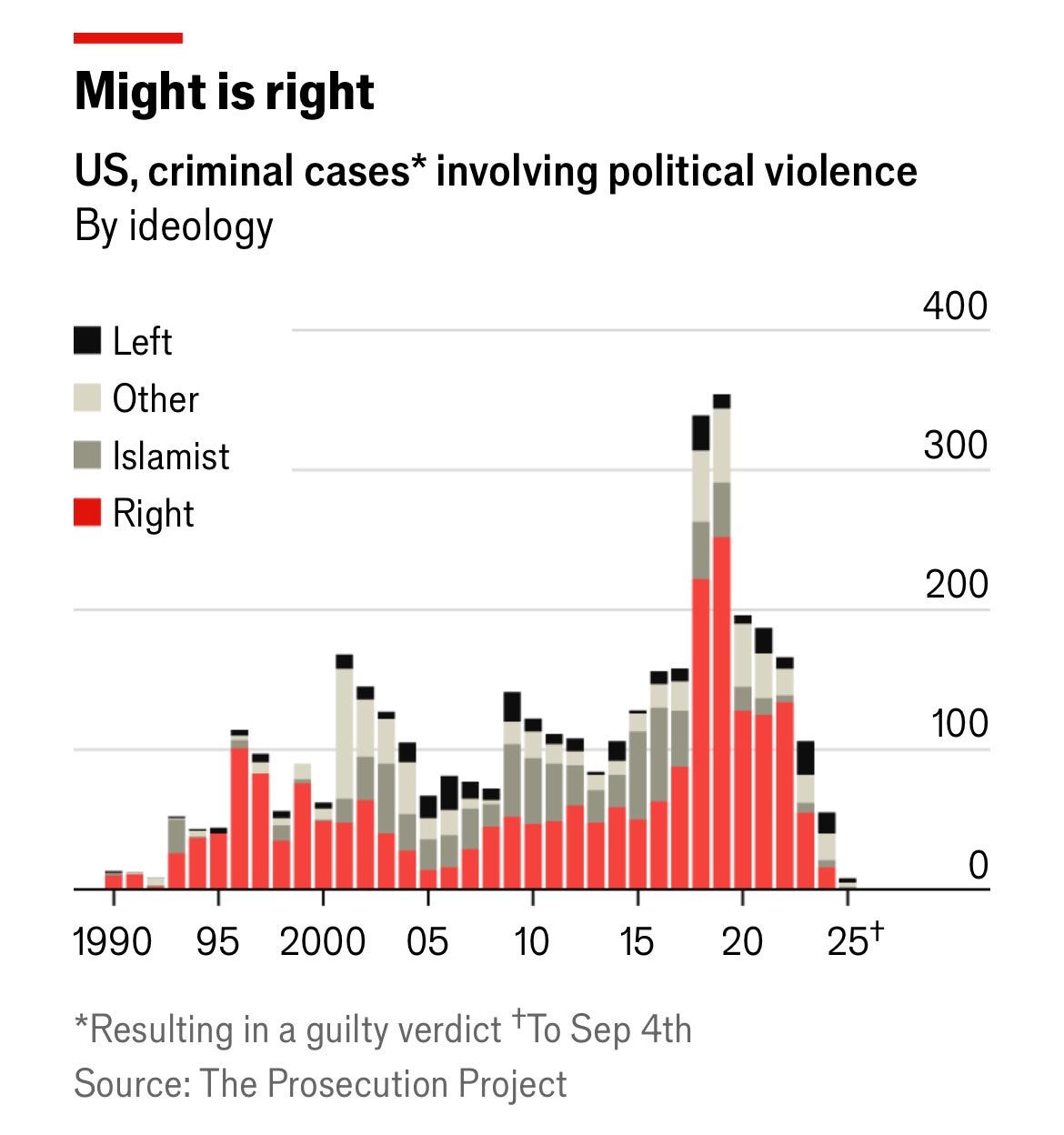
The left also tried to change the conversation to the supposed problem of right-wing violence. Professional-looking infographics flooded onto social media, pushed by Alex Nowrasteh of the Cato Institute, Ilhan Omar, and the Economist.

Ilhan Omar (note that the data are from the ADL).

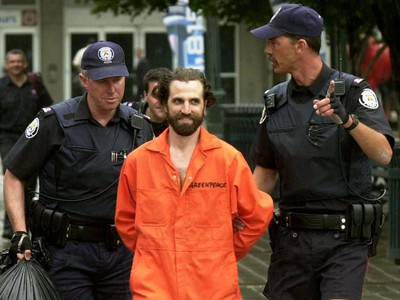
The infographics make it look like there’s an epidemic of right-wing political violence being waged against a peaceful, tolerant, and defenceless left. This is of course nonsense. Every time someone dug into their data, it turned out that they were basically doing this:

It isn’t even necessary to subject the datasets to close scrutiny. Look at the Economist graphic. See that little black rectangle in 2020? The Economist would have you believe that there was practically no left-wing political violence at all in 2020, which as everyone remembers was a fiery but mostly peaceful year. The Economist dataset turns out to have been curated by an Antifa activist, by the way, which I suppose makes the Economist an affiliate of an international terrorist organization, now.

Now, you can say “they’re just lying”, and yes, quite a few of them know exactly what they’re doing.

[…]

In a lot of cases, however, calling them “liars” isn’t quite accurate. Lying implies conscious deception. If you’ve talked to these people, which I know you have to the point where you have post-traumatic stress disorder, you know that they seem to really believe the things they say. It does not matter in the slightest if they contradict the thing they said yesterday. They apparently have no memory of their previous statements. Their present belief is always entirely sincere. It does not matter if observable reality is in stark contradiction to their belief. They have lost the ability to distinguish between fact and fiction, with the result that they routinely mistake their own pop culture propaganda for reality.

That they do not even seem to notice when they contradict themselves suggests a void of self-awareness. This is the origin of the NPC meme, which depicts leftists as Non-Player Characters, effectively no more than computer programs that emulate human behaviour. When the meme first began to spread a few years ago, there was a purge of Twitter accounts that posted it. The NPC meme cut leftists to the quick because they instinctively recognized – as everyone did – the truth in it. Leftists complained that the NPC meme was dehumanizing, which is actually perfectly correct. An NPC is not really human.

We see evidence for this NPC absence of self-awareness everywhere. A self-aware person who had spent a decade viciously persecuting anyone who publicly contradicted leftist orthodoxy would understand that an appeal to freedom of speech once they themselves were persecuted for their words would garner mockery rather than sympathy. A clever Machiavellian would therefore preface their entreaties with expressions of contrition for their past behaviour, however insincere. Not one of them has done this, which makes it less likely that their attempt to appeal to freedom of speech is mere calculated cynicism. It is instead as though they themselves are not aware of their own previous actions.


A ministry for “Heritage” should not be funding hate publications

Filed under: Cancon, Government, Media, Politics — Tags: , , , , — Nicholas @ 04:00

I’m with Dan Knight that the government shouldn’t be funding any private networks, magazines, or newspapers, but since it does provide a lot of funds through various programs, it should at the very least strive to avoid funding open hatred toward ordinary Canadians:

Steven Guilbeault at a happier stage of his life, before joining the Liberal cabinet.

In a fiery exchange at the Standing Committee on Canadian Heritage (CHPC), Conservative MP Rachel Thomas dismantled Liberal Minister Hon. Steven Guilbeault, P.C., M.P., Minister of Canadian Identity and Culture and Minister responsible for Official Languages, over taxpayer money funneled into groups publishing hate-laced screeds and smearing everyday Canadians.

Thomas zeroed in on Cult MTL, a publication receiving federal heritage funds. She read into the record a headline published the very day after reports of Charlie Kirk’s assassination attempt: “To Hell with Charlie Kirk”.

“Minister, do you think that is wrong? Taxpayer dollars are funding this group. Will you revoke their funding?” Thomas demanded.

Guilbeault looked blindsided. He admitted he had no idea the government was bankrolling a tabloid openly celebrating political violence. His answer:

    I have not been made aware of this. I will verify with the department and report back to you. Obviously, spreading hate has no place in Canada, and if this is the case, we will make the necessary verifications and take the necessary steps.

Thomas didn’t stop there. She turned to the Canadian Anti-Hate Network, which she said has already pocketed about $1 million from Guilbeault’s department. Documents show the group paid an “investigative journalist” to hunt down so-called “far-right” targets — defining the term so broadly it included Catholics and pro-life Canadians — before seeding the stories into mainstream news outlets.

[…]

Conservative MP Rachel Thomas quoted former CBC anchor Travis Dhanraj, who launched a human rights complaint this summer […]

    To be honest, this has been the hardest period of my life. What happened at CBC really broke me.

Then she put it directly to Guilbeault:

    Have you reached out to the CEO of the CBC regarding this situation and the toxic work environment that is being accused there?

Guilbeault’s answer? Bureaucratic shrugging:

    The government role is not to get mixed into the daily operations and management of the organization. That is the purview of the organization, in this case, the public broadcaster.

Translation: $1.4 billion of your money flows into CBC every year, but the minister says he can’t pick up the phone when staff say they’re being harassed.

“Create no-go zones for federal forces”

Filed under: Government, Media, Politics, USA — Tags: , , , , , — Nicholas @ 03:00

On the social media site formerly known as Twitter, ESR responds to a comment about his three possible futures after the Charlie Kirk assassination (linked here):

    Mike Benz @MikeBenzCyber

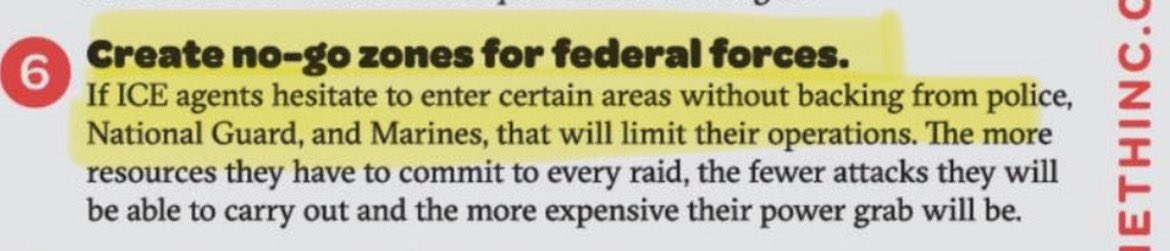
    Antifa websites totally open to the public explicitly call to so utterly terrorize ICE that federal agents are physically afraid to enter a city. If the Proud Boys wrote this about the FBI how fast would every single person around that website be indicted by Merrick Garland.

“Create no-go zones for federal forces.’

In one of my previous analysis postings, I outlined three possible scenarios for the future after the assassination of Charlie Kirk.

This corresponds to scenario 3, the one where insurrection edges into a simmering civil war a la Bosnia. I caught some flak in my replies at the time from people who thought an insurrection based in urban areas isn’t practical under modern conditions.

Antifa thinks it is. It’s what they’re planning for.

One of the things I have to remind myself of occasionally is that most people know essentially nothing about Communist theory and Communist revolutionary tactics.

Antifa is running the classic Communist playbook. Make the enemy fight you where you are strong and they are weak — where you have support among the people and (when possible) cover from sympathetic local officials.

Historically that has usually meant fighting from rural areas where the reach of the government is weak. But the Russian Revolution was an exception, and the revolution Antifa is trying to fight is another. Their natural home ground is large coastal cities run by left-wing Democrats.

School Cafeteria Sloppy Joe from the 1980s & ’90s

Filed under: Education, Food, History, USA — Tags: , , , , , — Nicholas @ 02:00

Tasting History with Max Miller
Published 22 Apr 2025

Ground beef in a delicious tomato-based sauce on a hamburger bun, part of a classic 90s American school lunch

City/Region: United States of America
Time Period: 1988

Today we know sloppy joes as a saucy ground beef sandwich, but the term sloppy joe has referred to many things over the years. A sloppy joe could be other kinds of sandwiches, a nickname for a messy friend, or women’s fashion from the 1940s and 50s that included pants and looser fitting styles.

For me, though, it is this style of sandwich. Really, it is this version of this sandwich. Sloppy joes were a larger part of my adolescent diet than was healthy, and these taste exactly like the ones I remember from middle school.

Be sure to get the cheapest hamburger buns possible to authentically recreate this nostalgic lunchtime favorite.

    Sloppy Joe on a Roll (50 servings)
    Raw ground beef (no more than 24% fat) … 17 lb 4 oz
    Dehydrated onions … 2 1/4 oz … 2/3 cup
    OR Fresh onions, chopped … 1 lb 2 oz … 3 cups
    Garlic powder … 2 Tbsp
    Tomato paste … 3 lb 8 oz … 1/2 No. 10 can
    Catsup … 3 lb 9 oz … 1/2 No. 10 can
    Water … 2 qt 3 1/2 cups
    Vinegar … 2 1/4 cups
    Dry mustard … 1/4 cup
    Black pepper … 2 tsp
    Brown sugar, packed … 5 1/2 oz … 3/4 cup
    Hamburger rolls…100
    Quantity Recipes for School Food Service by the United States Department of Agriculture, 1988

(more…)

QotD: Men and women

Filed under: Humour, Quotations — Tags: , , , , — Nicholas @ 01:00

A man’s women folk, whatever their outward show of respect for his merit and authority, always regard him secretly as an ass, and with something akin to pity. His most gaudy sayings and doings seldom deceive them; they see the actual man within, and know him for a shallow and pathetic fellow. In this fact, perhaps, lies one of the best proofs of feminine intelligence, or, as the common phase makes it, feminine intuition.

H.L. Mencken, In Defense of Women, 1918.

September 25, 2025

An unanticipated danger of AI – “classified” videos for decision-makers

Until fairly recently, even the least tech-savvy among us could distinguish AI-generated videos from the real thing … but most of the leaders and decision-makers in western governments aren’t very tech-savvy and put into high-pressure environments may be uniquely susceptible to AI manipulation:

What If I Told You … One of the biggest applications of AI for misinformation hasn’t been online but in the halls of power.

Aging boomer politicians, generals, and major figures are manipulated by showing them AI videos they can’t tell, can’t pause to look at, and certainly can’t digitally examine or geolocate …

“And as you saw Mr President.”

Pay attention. All of them reference seeing “videos” that you aren’t allowed to see, of events which they claim are public record, but appear no-where and no reporting supports …

Sean Hannity was interviewing a world leader and even said “You should show the public the video you showed me it’d really change everyone’s opinion. it changed mine” LIVE ON AIR. And the world leader said some non-committal maybe, then released nothing.

These aging politicians, media figures, corporate personalities, etc. all casually reference seeing insane videos that would CHANGE EVERYTHING and would have been immediately released to sway public opinion if they existed or would have been leaked if it would have been in poor taste to be seen directly releasing them (like gore films)

But of course they aren’t released because they’re faked and the internet would immediately piece together that they’re faked with AI, video game, and archival footage from old conflicts … But the aging 60- and 80-year-olds who run the world can’t tell.

There was a case where they challenged Greta Thunberg “Would you watch this video it’d change your mind” and she refused telling them to just release it … Then they didn’t and attacked her for not being willing to view evidence contrary to her views … in a controlled environment where she couldn’t scrutinize it or check its authenticity against anything else …

It sounds insane! But if you pay attention all of these politicians, media figures, and even influencers … People who often have ZERO security clearance or any official attachment of real trust or allegiance to the governments showing them this “classified” or “controlled” footage … Regularly reference seeing footage which does not exist in the public domain, for events which are viciously contested in which any of the footage they claim to have seen would be WORLD CHANGING news … Yet all these figures are just left out in the wind repeating “Trust me bro”s for some of the most important occurrences of the past decade.

“Intentionally elevating strangers above ourselves, xenophilia, is artificial”

Filed under: Health, Media, USA — Tags: , , , — Nicholas @ 04:00

In Aporia, Spaceman Spiff explains the function and value of what are called “dead man’s switches” both for railway locomotives and societies:

Image from Aporia

A dead man’s brake is a safety feature found in dangerous machines such as lifts or trains. With this mechanism, a brake is always on, preventing action or movement. A conscious choice or effort must be made to override it.

On a train, a human driver must be present to depress a foot pedal that disengages the brake so the train can move at all. If he is absent the train cannot move. If he withdraws his foot while the train is in motion — if he dies, for instance — the train stops. Hence the name.

The key feature of a dead man’s brake is that it requires energy to operate. Its default zero-energy position is OFF; only with energy can it go to ON.

Wariness of strangers, xenophobia, is the default position for most human beings. This is a hardwired evolutionary response to protect us. It served us well. It requires no energy to operate. Children quickly point out people who seem different.

Intentionally elevating strangers above ourselves, xenophilia, is artificial. We must be educated to make it happen, and explicitly taught to overlook differences. It must be reinforced to remain in operation as our instincts typically push against it.

This requires energy. In parts of the world not subject to Western educational norms, they do not teach it to children. Consequently, they do not usually adopt policies like mass immigration or asymmetric multiculturalism.

It is worth noting that xenophobia denotes a wariness of strangers, not hatred or disdain of them. In practice, our working assumption is people different from us may be a threat, and our actions should reflect this until proven otherwise.

Xenophobia is not the racial animosity the propaganda wishes us to believe, such as harming others based on visible differences like skin colour. Such extreme views are in fact rare. The underlying drive of xenophobia is caution, not aggression. Xenophilia attempts to ignore this sensible restraint, which is why it often fails without external pressure.

These instincts are deeply embedded within us because a cautious approach is a strong foundation upon which to preserve our lives and our cultures. It is the reason we have a nation and a culture in the first place.

Xenophilia, then, is a dead man’s brake. It requires energy applied to something that would not typically occur in nature. It makes us ignore differences in order to get along. Or so the theory goes.

Update, 26 September: Welcome, Instapundit readers! Please do have a look around at some of my other posts you may find of interest. I send out a daily summary of posts here through my Substackhttps://substack.com/@nicholasrusson that you can subscribe to if you’d like to be informed of new posts in the future.

Streaming subscriptions rising far faster than official inflation rate

Filed under: Media, USA — Tags: , , — Nicholas @ 03:00

I haven’t been a regular TV watcher for a long time, but I still watch the Minnesota Vikings meaning that I need to pay for a streaming service … which has definitely been going up every year at a significantly higher-than-inflation rate. At The Honest Broker, Ted Gioia shows that this is now a very common thing indeed:

It’s not every day that I get an email from Apple. But yesterday the Cupertino leviathan reached out to me.

Can you guess why? Do they have some cool new gadget that will make my life better? Are they opening an Apple Store in my neighborhood? Does Tim Cook want to take me out to dinner?

None of the above. Apple is raising my subscription price for Apple TV by a whopping 30%.

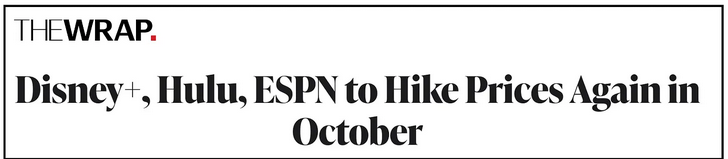
Apple is not alone. The very next day, Disney announced a similar move.

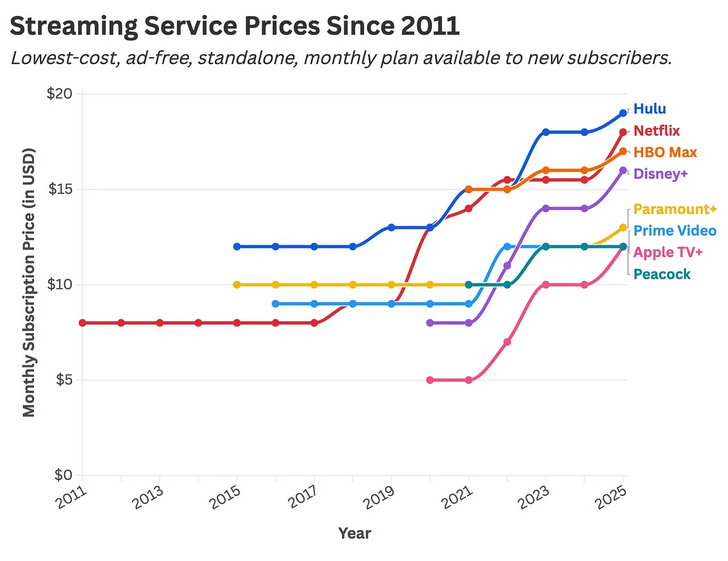
This is the fourth straight year that Disney+ has forced a price increase on viewers. The ad-free subscription price has almost tripled in just six years. During that same period, Disney’s movies have gone from bad to worse — but you pay more to stream them.

The company is truly tapping into its inner Scrooge McDuck. Inflation is just 3% now (according to official, if somewhat dubious, sources). But the ad-free subscription to Disney+ was jacked up 14% last year and is now getting another 19% boost.

Take a look at the larger picture, via this chart from Daniel Parris of Stat Significant (a friend of The Honest Broker). This stuff is reaching greed-is-good levels of abuse.

Meanwhile, the number of scripted shows commissioned by these streamers has dropped significantly. So the audience is asked to pay more for less.

David Friedman on markets, governments and whether we need either?

Filed under: Economics — Tags: , , , , — Nicholas @ 02:00

Adam Smith Institute
Published 16 May 2025

​When markets go awry, who is to blame? Some blame greedy profiteers, whilst others blame governments for tinkering with incentives and supply chains. Where does the truth lie? And what role should the government play when markets go wrong?

​​​Professor David Friedman is a physicist, leading free-market economist and Professor Emeritus of law at Santa Clara University. The son of Nobel Prize-winning economist Milton Friedman, David has authored many textbooks on free-market and libertarian theory. In 1973, he published The Machinery of Freedom, which has been ranked by Liberty magazine as one of the “Top Ten Best Libertarian Books” of all time.

TIMESTAMPS

0:00 – Intro
1:00 – What is a market failure?
2:44 – Restaurant analogy
4:15 – Negative externalities
5:00 – Positive externalities
5:50 – Malls
6:55 – Radio
7:40 – Price System
8:48 – Why most economists aren’t libertarians?
9:26 – Government action is a political market
12:30 – Secure property rights for future benefits
15:27 – Stalin
16:15 – Military examples
18:20 – Teaching
19:47 – Desert example
20:55 – Conclusion
22:19 – End

QotD: The Clinton years

Filed under: Humour, Politics, Quotations, USA — Tags: , , — Nicholas @ 01:00

… in a weird way I feel bad for the young folks who never got a chance to experience life under Bill Clinton. Back then, we — as a society — still acknowledged that there was such a thing as “the truth”. You know, statements about the world that actually correspond to the world in a meaningful and systematic way. Watching Bill Clinton lie was great practice. You young folks are used to everyone, everywhere, in power being an utter sociopath, but it was a novelty back then.

Bill Clinton, some wag observed, would rather climb to the top of Mt. Everest to lie to you than stand still and tell you the truth. He lied when it was to his advantage, and he lied when it was to his very obvious disadvantage. He lied when there was absolutely no point to lying — indeed, like climbing Mt. Everest, when it took enormous effort and real planning to lie. He lied just for the fun of it, and if you saw him do it enough, you realized what that little smirk on his greasy, chicken-fried mug actually was: Orgasm. Bill Clinton got off on lying. That’s why he did it. Every press conference the man ever did was frottage.

Severian, “Party like it’s 1999”, First Questions, 2022-01-13.

September 24, 2025

The Korean War Week 66: The Hell of Heartbreak Ridge – September 23, 1951

Filed under: China, History, Military, USA — Tags: , , , , , — Nicholas @ 04:00

The Korean War by Indy Neidell
Published 23 Sep 2025

The Korean War reaches one of its bloodiest battles as UN forces clash with North Korean defenders on Heartbreak Ridge. The US 2nd Division suffers heavy losses, with entire companies wiped out to the last man. At the same time, the Marines introduce a revolutionary new tactic in modern warfare — transporting troops via helicopter right to the front lines during battle. Meanwhile, UN Commander Matt Ridgway refuses to resume peace talks in Kaesong, sparking further tension with the Communist side. As the battle rages, the question remains: can there be peace in Korea, or only more heartbreak?

Chapters
00:00 Hook
00:43 Recap
01:14 Heartbreak Ridge
04:02 To The Last Man
06:06 What Ridgway Wants
08:00 Effects of the Treaty
10:13 New Strategy
11:29 Supply by Helicopter
12:31 Summary
12:45 Conclusion
15:34 Call to Action
(more…)

« Newer PostsOlder Posts »

Powered by WordPress