Quotulatiousness

June 3, 2025

Ukraine’s strategic strikes against Russian airbases

Filed under: Military, Russia — Tags: , , , , — Nicholas @ 04:00

CDR Salamander on the lessons to be learned from the latest dramatic turn in the Russo-Ukrainian war with Ukraine carefully avoiding letting their American supporters know about the attack before it went in:
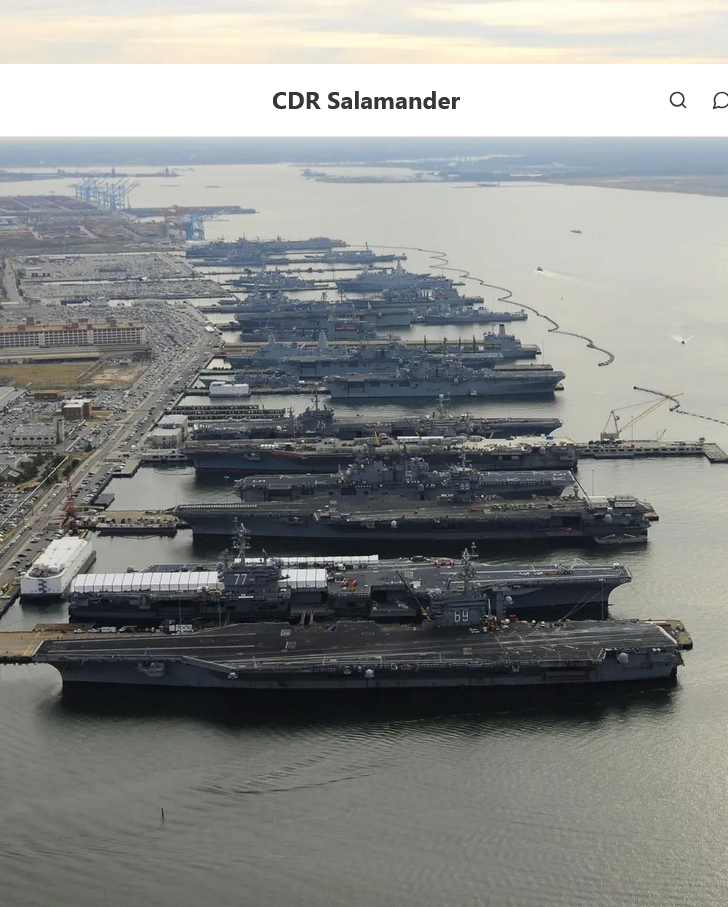
[This] picture from 2012 of Norfolk is what I want you to think about.

We talked about the superbly executed Ukrainian attack on Russian bomber bases for most of yesterday’s Midrats, and what keeps coming to mind for me is not the details of that attack, but the stark warning it is giving us.

The threat of drone strikes isn’t a new warning, but in my mind it intersect almost perfectly with the self-inflicted vulnerability of the US Navy’s fleet — its concentration.

The growing utility of attack drones isn’t an insight that is unique to the Russo-Ukrainian War. The topic has come up here and on Midrats for almost two decades. We’re not alone. Heck, broad thinking people like our friend Matt Hipple was pondering it over at CIMSEC thirteen years ago a few months before the picture at the top of the post was made.

I’ll tie in the picture a bit, but let’s take a moment to give the Ukrainians credit where credit is due. They executed precision strikes against the RUS bomber fleet across the entire two-thirds of the Euro-Asian landmass.

We will find out more details, a dozen or 40+ high-demand/low-density strategic bombers were taken off the battle line. RUS is not building any more of them. As missile carriers, they have been a cornerstone of the city terrors for most of the last four years. You would be hard-pressed to find a more honorable, or legitimate target.

Streiff over at Red State has a good summary with what we think we know as of Sunday afternoon:

    The airbases are the home to Russia’s fleet of Tu-22, Tu-95M, and Tu-160 nuclear-capable strategic bombers as well as AS-50 battle management aircraft. They were located from the Siberian Far East to the Arctic Circle. The furthest target, Belaya Airbase in Irkutsk, is over 2700 miles from Ukraine.

    Reports indicate that at least 41 aircraft were hit. The unofficial tally indicates 24 Tu-22, 8 Tu-95MS, and 5 Tu-16 were hit. MiG-31 fighters and Il-76 transports were also hit. To put this in context, open-source data says Russia’s bomber inventory is about 58 Tu-22, 47 Tu-95MS, and 15 Tu-160. These planes are the ones used to launch most of the missiles fired at Ukrainian cities.

    By any standard, this was a devastating attack. Nearly half of the Tu-22, a quarter of the Tu-95MS, and a third of the Tu-160 fleet, representing just over 30 percent of Russia’s strategic bomber force, were damaged or destroyed in one attack. When you consider the operational readiness rate, Russia probably has less than 50 aircraft capable of flying … on the bright side, they have plenty of aircraft to cannibalize for parts. The Tu-22 and Tu-95MS production lines are closed, and the Tu-160 production is one, yes, one per year. For all intents and purposes, this represents a permanent decrease in the size of the Russian strategic bomber fleet.

Before we discuss what the USA needs to take away, let’s look at the top-4 primary and second-order effects this will have on the Russian Federation.

First Order Effects

  • Fewer raiding assets to use against UKR.
  • The weakest leg of their nuclear triad (bombers are dual use) is even weaker.
  • PSYOP defeat as RUS now know even their most valuable weapons, stationed deep into RUS rear, are vulnerable.
  • Paranoia elevated into an already paranoid national psyche under duress of year four of a grinding war.

Second Order Effects

  • Inefficiencies in both civilian logistics and manpower are the natural response to every tractor-trailer being a weapons delivery vehicle at range … and the need to defend important bases as a result, sinks into an already stressed nation.
  • Loss of face. RUS launched a war of choice against nation 1/4th its size and much weaker than it from any measure, and four years on, still has only made marginal progress. Now that nation proved it can operate with impunity anywhere inside RUS. The “R” in BRICS is not impressing its friends.
  • It shouldn’t, but this is going to get the nuclear autists the jitters. All theory, but yes, UKR took out one-third or more of the fully mission capable nuclear capable bombers that form one leg — but as mentioned above the weakest leg — of RUS’s nuclear deterrence. Those who work in the theory-dominated nuclear world will have all their gauges twitching, yes, but in the end analysis, it won’t matter.
  • UKR morale just got a big boost. Wars of attrition usually last until one side or the other loses either the material ability or the will to fight. At least from the “will” line of operation, that decisive point just shifted to the right.

Simply a superb operation. How do you defend against weapons like this disguised in a trailer’s false roof?

Canadian immigration numbers go even higher in 2025

Filed under: Cancon, Government — Tags: , , , , — Nicholas @ 03:00

Although the new Liberal government in Ottawa made some slight noises about bringing immigration numbers back down to something closer to sustainable … there’s less than zero evidence that they actually meant it:

Despite all promises to the contrary, all the sudden and supposed interest in nation-building efforts that stretch from Victoria’s Inner Harbour to the Bay of Fundy, all the “Buy Canadian” horseshit lapped up by a portion of the electorate that votes like a long-tailed cat in a room full of rocking chairs, Canada’s once-in-a-generation betrayal of its labour market — and its very present and future — continued at pace to begin 2025.

The numbers are pants-shitting-ly grim.

    The latest federal immigration data shows that Canada welcomed more than 817,000 newcomers in the first four months of 2025 when tallying up permanent and non-permanent streams.

    Between January and April 2025, 132,100 people were granted permanent residency, while 194,000 study permits and 491,400 work permits (including extensions) were finalized by Immigration, Refugees and Citizenship Canada. (Juno News)

At a time when 89% of Canadians under 34 have been beaten into believing that “owning a home is only for the rich” (Ipsos poll), along comes the worst summer job market in two decades to match the continued Liberal failure to course-correct on the mass-immigration, replacement-caste grift.

The two are of course inextricably linked.

With even the Bank of Canada speaking uncomfortable truths, that the foreign “student” surge and “temporary” foreign worker bacchanal lead to wage suppression and job displacement for Canadian workers, for 2025’s numbers to continue to blow through any semblance of well-meaning, sustainable targets, is as “bonkers” as it is seditious towards any citizen with an investment in Canada’s future.

The grift, the very lie, that “shortages” drive corporate Canada’s need for a basement-apartment economy has been disproved time and time again.

“All we hear about are labour shortages, [but] we have to begin to recognize that this really is a self-serving narrative mostly coming from corporate Canada,” said Mikal Skuterud, labour economics professor at the University of Waterloo.

Exercise Tiger: The WW2 Cover-Up Before D Day

Filed under: Britain, Germany, History, Military, USA, WW2 — Tags: , , , , , — Nicholas @ 02:00

The History Chap
Published 23 May 2024

Exercise Tiger 1944, was a large-scale dress rehearsal for the D-Day landings, off the Slapton Sands in England, that went horribly wrong. Over 700 US servicemen were killed, more than were killed on Utah beach on D-Day itself! With D-Day imminent, Allied Supreme Commander, General Dwight Eisenhower, ordered the disaster to be hushed up.

Following a friendly fire incident on Slapton Sands on the 27th April 1944, a convoy carrying US troops was attacked in the early hours of the 28th by German E-Boats. In what is called the Battle of Lyme Bay, two ships in the convoy were sunk resulting in the loss of over 700 US servicemen. Whilst rumours suggest that there were many casualties resulting from the friendly fire on Slapton Sands, the US Army has always remained tight-lipped. To this day, the mystery remains as to what extent the casualty figures were covered up.

In the 1980’s, a Sherman tank was raised from the seabed. It now stands at the end of Slapton Sands (near the village of Torcross) as a memorial to the young men who died 6 weeks before D-Day during Exercise Tiger.

Chapters
0:00 Intro
0:42 D-Day 1944
1:40 Slapton Sands
2:30 Civilian Evacuation
3:22 Military Build-up
4:58 Exercise Tiger
6:07 Live Fire Disaster
7:37 Convoy T-4
9:15 Spotted by Germans
10:03 E-boat attack
11:41 Battle of Lyme Bay
14:06 Casualty Figures
14:43 D-Day Compromised?
15:37 Cover-up?
17:00 D-Day Success
18:08 Exercise Tiger Remembered
(more…)

QotD: Heinlein’s opinions on the right to bear arms

Filed under: Books, History, Liberty, Quotations, USA, Weapons — Tags: , , , , , , — Nicholas @ 01:00

Robert Heinlein was a complex man whose views evolved greatly over time. The Heinlein of 1942, who put into the mouth of one of his characters the line “Naturally food is free! What kind of people do you take us for?” was only five years on from having been enchanted by social credit theory, which underpins his “lost” novel For Us, The Living; in later years he was so embarrassed by this enthusiasm that he allowed that manuscript to molder in a drawer somewhere, and it was only published after his death.

Between 1942 and 1966 Heinlein’s politics evolved from New Deal left-liberalism towards what after 1971 would come to be called libertarianism. But that way of putting it is actually misleading, because Heinlein did not merely approach libertarianism, he played a significant part in defining it. His 1966 novel The Moon Is A Harsh Mistress was formative of the movement, with the “rational anarchist” Bernardo de la Paz becoming a role model for later libertarians. By 1978, we have direct evidence (from an interview in Samuel Edward Konkin’s New Libertarian magazine, among other sources) that Heinlein self-identified as a libertarian and regretted his earlier statism.

But if Heinlein’s overall politics changed considerably and wandered down some odd byways during his lifetime, his uncompromising support of civilian firearms rights was a constant on display throughout his life. Brin observes that was already true in 1942, but attempts to attribute this position to John W. Campbell. Multiple lines of evidence refute this claim.

[…]

Heinlein, on the other hand, was a vocal and consistent advocate of civilian weapons ownership both during and after his association with Campbell. This is perhaps clearest in his 1949 novel Red Planet, written after their parting of the ways. In that novel, the bearing of personal weapons is explicitly connected to the assumption of adult responsibilities.

Red Planet is also interesting because, although we might consider the views of Heinlein’s characters an unreliable guide to Heinlein’s own, Heinlein’s letters about the novel reveal much more. His editor at Scribner attempted to delete the section of argument in which weapons-bearing is connected to adult responsibility; Heinlein rejected this, objecting that it eviscerated the book’s ethical core and making very clear that the views of the pro-gun mentor figures in the novel were his own.

Heinlein was to reiterate similar views not only in his later fiction but in the posthumous nonfiction collection Grumbles From The Grave – by which time they were no surprise to any Heinlein fan. And it would be difficult to overstate the influence they had on firearms-rights activists during the dark years between the Gun Control Act of 1968 and our vindication in the 2008 District of Columbia v. Heller ruling.

Heinlein’s gift to firearms-rights activism during that bleak four decades was to be able to draw on the principled case for civilian firearms going back to the framers of the U.S. Constitution and English Republican sources and restate it in language appealing to the brightest children of post-WWII America. But he did more than that, because in Red Planet and elsewhere firearms rights were presented as an inextricable part of a philosophical whole, with the personal firearm both as instrument and defining symbol of personal liberty and responsibility.

Eric S. Raymond, “Brin on Heinlein on guns is dead wrong”, Armed and Dangerous, 2011-07-18.

Powered by WordPress