In the National Post, Tristin Hopper rounds up American reactions to the Liberal victory in the Monday election, as many Americans seem to agree that Carney’s win was at least partly their doing:

As the U.S. awoke to a renewed Liberal government on their northern border, Americans of all political persuasions embraced the view that they — for better or worse — had caused it.
“Carney owes his job to President Donald Trump,” was the Tuesday view of the Washington Post editorial board, declaring that the U.S. president had singlehandedly thwarted the election of a populist Conservative government in Canada.
The Centre for American Progress Action Fund — a left-wing Washington, D.C.-based think tank — framed Carney’s win as a model for how anti-Trump rhetoric can win elections.
“Prime Minister Carney’s success demonstrates that resistance to President Trump’s bullying has mass popular appeal,” read a statement.
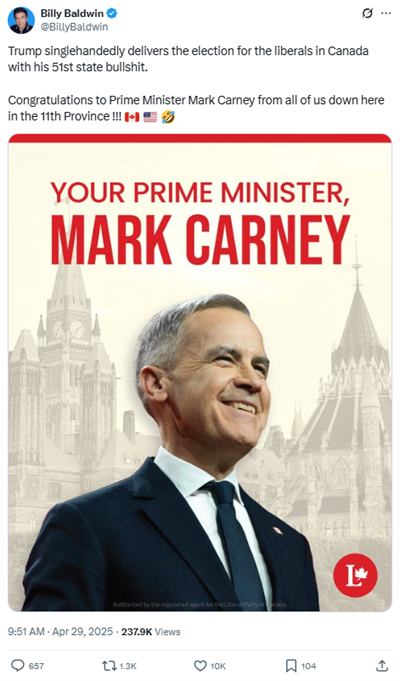
Actor Billy Baldwin, a perennial backer of progressive causes, cheered Carney’s victory with a viral social media post declaring “Trump singlehandedly delivers the election for the liberals in Canada with his 51st state bullsh-t.”
Even Rolling Stone, which put Justin Trudeau on the magazine’s cover in 2017, opined that Canada’s newest Liberal government was effectively a Trump creation. “Donald Trump single-handedly elected a new Canadian Liberal Government that was down 25 points in January with his endless ’51st State’ bloviation,” wrote the publication.
Conservative podcaster Ben Shapiro broke down the Canadian election in an extended segment on his Tuesday show, framing it as a direct failure of Trump’s foreign policy.
“Let’s be real about this; the rhetorical attacks on Canada have not actually resulted in a net good for the United States,” said Shapiro. A perennial critic of Trump’s tariff policy, Shapiro said that the White House’s habit of “yelling at Canada” had helped install a “far left-leaning internationalist” hostile to U.S. interests.
“All of this started off as a joke, and I think President Trump is so committed to the bit at this point that he couldn’t get off the train,” said Shapiro, in reference to Trump’s repeated pledges to turn Canada into the “51st state”.
A Republican consultant quoted anonymously by Politico on Tuesday was of a similar view, saying the outcome in Canada was a “pretty specific result based on the tariffs and 51st state trolling.”
On his Substack, Paul Wells offers some advice to Mark Carney about his dealings with Pierre Poilievre at this awkward time for the Conservative leader:

Stornoway in the Rockcliffe Park area of Ottawa, Ontario. It has been the official residence of the leader of the Official Opposition in Parliament since 1950.
One danger for Mark Carney is that he will be taught how to be a terrible politician by terrible politicians. A low-stakes test case is at hand. In this as in all things, a decent guiding principle should be: Don’t be like your opponent, and don’t be like your predecessor.
The test at hand is the uncomfortable predicament of Pierre Poilievre, who used to be a Member of Parliament and may want to be one again. In the meantime he is still the leader of the Conservative Party of Canada.
Poilievre lost his seat in Carleton on Monday night. This is not entirely his fault. Liberal campaign teams from neighbouring ridings were invited to spend part of their time door-knocking in Poilievre’s riding. But candidates should try to win even when their opponents work hard to defeat them. I bet this thought has occurred to Poilievre since Monday.
The usual route to the Commons, for a leader who is not yet an MP, is to run in a by-election. Often new leaders find a sitting MP somewhere to vacate their seat and enable a by-election. Brian Mulroney ran in Central Nova in 1983, Jean Chrétien in Beauséjour in New Brunswick in 1990, Stephen Harper in Calgary Southwest in 2002.
Assume Poilievre can find some Conservative MP-elect willing to abandon a seat they just won so Poilievre can try his chance (again). How should Carney react?
It’s really a question in three parts. Should a by-election be held quickly or much later? Should the Liberals run a candidate? Should the Poilievre family keep living at Stornoway, the Opposition leader’s official residence, in the meantime?
I’m hearing from a lot of people who say Carney should wait as long as the law permits — up to a half year after a seat opens — before calling the by-election; that the Liberals should definitely run a candidate; and that Poilievre and his family should be evicted from their current fancy abode.
I spent part of Wednesday debating these questions with readers on Substack Notes. Most of the people offering this advice — let him twist, then hit him hard — pointed out that if Poilievre had a say about an adversary’s career plans, he would do everything in his power to make that adversary hurt.
I think it’s bad advice. It manages to be bad tactics and bad for the soul. The two considerations don’t always line up, but here they do.
Carney should call a by-election as soon as possible after a sitting MP resigns — 11 days after the notice of vacancy is received, the minimum permitted in law. If asked, he should prefer that the Poilievre family stay at Stornoway in the meantime. And while the third question is less clear, I’d argue that the Liberals should refrain from running a candidate in the by-election.
This plan would have Poilievre back in the Commons as soon as possible, with minimal risk and discomfort. He’ll be lucky to receive such generous treatment and, while I’m less confident than ever that I know how he thinks, what he should feel is gratitude. I suspect the feeling would confuse him.