Quotulatiousness

May 3, 2021

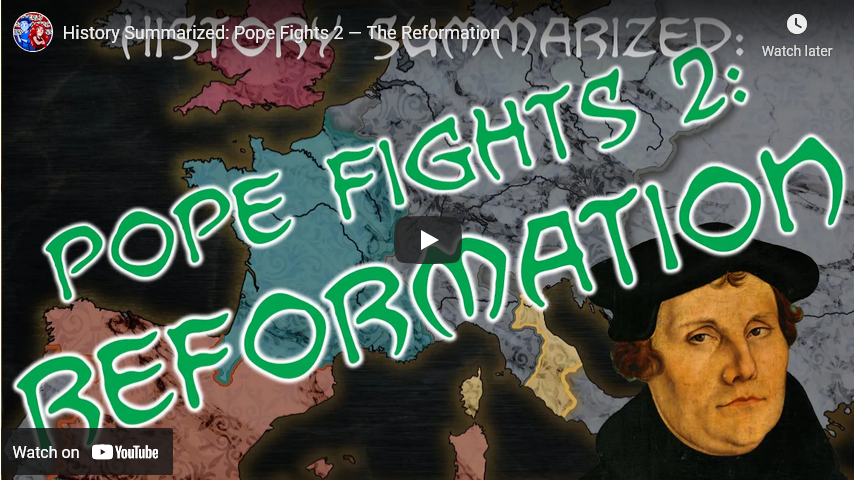
History Summarized: Pope Fights 2 — The Reformation

Overly Sarcastic Productions
Published 26 Apr 2019

Thank you to our Patron Peter Bemis for commissioning this video! To support the channel, head over to Patreon.com/OSP

You’ve seen the Double-Pope matchup, but what about the Double-Christianity face-off? Today’s Pope Fights covers the history and aftermath of the Protestant Reformation and Catholic Counter-Reformation.

FURTHER READING, from shortest to longest books:
The Reformation: A Very Short Introductionhttps://www.amazon.com/Reformation-Ve…
Christianity In The West (1400-1700)https://www.amazon.com/gp/product/019…
The Reformation: A Historyhttps://www.amazon.com/The-Reformatio…

DISCORD: https://discord.gg/ZufVWse — Come one come all to the official OSP discord server!

MERCH LINKS:
Shirts – https://OverlySarcasticProducts.Threa…
All the other stuff – http://www.Cafepress.com/OverlySarcas…

OUR WEBSITE: https://www.OverlySarcasticProductions.com

Find us on Twitter @OSPYouTube!

QotD: Marcus Aurelius and the “Mandate of Heaven”

A much more interesting scenario happens when seemingly legitimate, competent rulers find themselves at the helm during a major crisis. Marcus Aurelius has an overinflated rep among the laity, but he was decent at his job … until he wasn’t, thanks to things like the Antonine Plague. This, and a large barbarian invasion, brought all the Empire’s long-term structural problems into sharp focus. Yeah, Marcus is overrated, but it’s no knock on him that he didn’t fix these problems, or cure the plague; those were probably beyond the skill of even the most extraordinary man. His reaction, though, and the reaction of his subjects, is instructive.

Marcus faced no rebellion; no one sought to usurp him. For one thing, Marcus won his wars — no mean feat, considering the plague etc. But for another, it’s hard to blame Marcus for the plague, the weakness of the army staffing system, the structural weakness of the currency. And that’s where it gets interesting, because even though you can’t consciously blame Marcus for this, all those things create excessive anxiety among the people, and that anxiety has to go somewhere

… so they persecuted Christians.

“The extent to which Marcus Aurelius himself directed, encouraged, or was aware of these persecutions is unclear and much debated by historians,” Wiki informs us, but it doesn’t matter if he had a hand in them or not. The important thing is that the Christians were the perfect target for free-floating anxiety, since plagues etc. were supernatural events and the Christians were ostentatiously opposed to the official belief system. Perhaps Marcus didn’t lose the Mandate of Heaven; perhaps it was stripped from him. Burn the unbelievers, and maybe the world gets back into focus.

This is the pattern whenever the Powers That Be find themselves trying to ride out a massive, structural sea-change — one where it’s obvious to the stressed-out public that something HAS to change, but a mere change in leadership won’t cut it. You’ll have to trust me on this, I guess, unless you’re up on your Chinese history, but almost all their “rebellions” had this mystical character — widespread banditry was assumed, in itself, to be a sign that the Emperor had lost the Mandate of Heaven, and the bandit groups usually ended up looking like the White Lotus sect, who caused endless trouble for something like 300 years. And then there’s the Taiping Rebellion — led by Jesus Christ’s brother! — and by now I’m sure y’all take my point. You can’t really blame the Qing for everyone’s opium addiction, or getting stomped by the British, but you’ve got to blame someone – hence the mystical character of pretty much all Chinese rebellions, certainly including the Maoist.

Severian, “Witch Trial Syndrome”, Rotten Chestnuts, 2021-01-27.

May 2, 2021

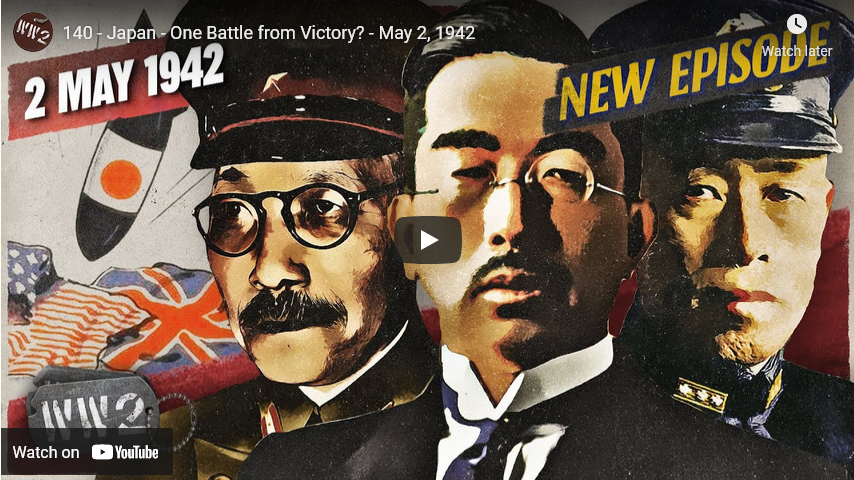
Japan – One Battle from Victory? – 140 – May 2, 1942

Filed under: Britain, China, Germany, History, Japan, Military, Pacific, Russia, USA, WW2 — Tags: , , , , , — Nicholas @ 04:00

World War Two
Published 1 May 2021

Now Burma and control of the Burma Road have fallen to the Japanese. Can nothing stop them? The Allies are thinking about maybe using the Solomon Islands as a base to build to try and fight back, but to do that they’ll need control of the Coral Sea, but both sides are sending warships there since the Japanese plan to take Port Moresby. The Allies are aware of this, however, since they have the advantage of being able to read a substantial part of Japan’s radio traffic. It is a week of foreshadowing not just there, but also as the Allies send ships to take Madagascar from the Vichy French and the Soviets prepare to launch an offensive in the south of the Eastern Front.

Join us on Patreon: https://www.patreon.com/TimeGhostHistory
Or join The TimeGhost Army directly at: https://timeghost.tv

Follow WW2 day by day on Instagram @ww2_day_by_day – https://www.instagram.com/ww2_day_by_day
Between 2 Wars: https://www.youtube.com/playlist?list…
Source list: http://bit.ly/WW2sources

Written and Hosted by: Indy Neidell
Director: Astrid Deinhard
Producers: Astrid Deinhard and Spartacus Olsson
Executive Producers: Astrid Deinhard, Indy Neidell, Spartacus Olsson, Bodo Rittenauer
Creative Producer: Maria Kyhle
Post-Production Director: Wieke Kapteijns
Research by: Indy Neidell
Edited by: Iryna Dulka
Sound design: Marek Kamiński
Map animations: Eastory (https://www.youtube.com/c/eastory​)

Colorizations by:
– Daniel Weiss
– Norman Stewart – https://oldtimesincolor.blogspot.com/​

Sources:
– IWM JAR 1240, A 9483

Soundtracks from the Epidemic Sound:
– Rannar Sillard – “Easy Target”
– Jo Wandrini – “Dragon King”
– Fabien Tell – “Other Sides of Glory”
– Brightarm Orchestra – “On the Edge of Change”
– Edward Karl Hanson – “Spellbound”
– Johan Hynynen – “Dark Beginning”
– Rannar Sillard – “Split Decision”
– Dream Cave – “The Beast”

Archive by Screenocean/Reuters https://www.screenocean.com​.

A TimeGhost chronological documentary produced by OnLion Entertainment GmbH.

“The PMO was told that Canada’s top soldier was accused of sexual misconduct, and they ignored it. It just didn’t move their give-a-shit needle.”

Filed under: Cancon, Government, Military — Tags: , , , — Nicholas @ 03:00

The weekend edition of The Line looks at the outrageous failure of Canada’s military high command and the government officials charged with oversight of the Canadian Armed Forces:

Canadian Defence Minister (at least for the moment) Harjit Sajjan.

This week saw a mealy mouthed political non-apology for the record books from Minister of National Defence Harjit Sajjan, who wants any women in the military who feel like they were let down to know that the government is very, very sorry. Gee, thanks, Minister. What a profile in courage that is. How reassuring to the women — and some men! — in the military either living with the reality or memory of sexual misconduct in the ranks.

And then there was the double-double approach to Supreme Court justices. Marie Deschamps wrote a detailed report on sexual misconduct in the military in 2015 (this report was discussed in depth here at The Line previously). Some of the action items in that report have been enacted, and things are therefore slightly better. But there is a lot more that could be done, that was already spelled out by Deschamps, and the report is just sitting there, neglected by all comers like those weird bagels with raisins in them. Now that the Minister has gotten the non-apology monkey off his back, maybe he’d like to grab the goddamn report he already has and, like, you know, do something with it?!

No. No, dear readers, he does not. What he’d like to do is appoint another former Supreme Court justice to write another report.

LOL! Just kidding. What he wants to do is buy time. The minister is hoping — and he will probably be proven right! — that Canadians won’t care about some lady soldiers getting harassed or outright raped in the military, not if his government can stick the vaccine landing, as seems increasingly likely. Sajjan has had literally years to take on the well-known issues inside the Canadian Forces, and he’s nibbled around the edges a bit, and no more. Only now that his ass is hanging out in the wind, along with a bunch of PMO staffer asses, and perhaps the prime minister’s, has the party rediscovered the urgency of the issue.

Pointing out the many ways that Trudeau and his government fail to live up to their own branding is almost a joke these days. Like, gosh, what more can we say? But if you have any capacity for shock and outrage left, and yeah, we know that’s a big if, this should set you off. The facts are plain. There’s no longer any dispute. The PMO was told that Canada’s top soldier was accused of sexual misconduct, and they ignored it. It just didn’t move their give-a-shit needle. That needle didn’t quiver for three years, until some great reporters at Global News dug this up and put the PM in danger of yet again being revealed to be a hypocritical fraud on women’s issues.

And we can’t have that! So let’s call in a retired Supreme to get to the bottom of all this. A few years from now.

Sorry, ladies of the armed forces. Better is always possible for you. But under Trudeau and Sajjan, it’s possible only in theory, and only when they get nervous about their own fates.

Thanks for your service, though.

“Stairway To Heaven” – Medieval Style

Filed under: Media — Tags: , , , — Nicholas @ 02:00

Early Style
Published 29 Aug 2020

Original theme from Led Zeppelin (1971) in medieval – renaissance instruments

#StairwayToHeaven #MedievalStyle #Bardcore

From the comments:

Christopher Merlot
2 months ago
Led Zeppelin did a really good cover of this.

QotD: The “I don’t watch sports” bore is even more rare than the Libertarian bore

Filed under: Humour, Media, Quotations, Sports, USA — Tags: , — Nicholas @ 01:00

I have always believed that I am the kind of person who doesn’t like sports. I don’t like playing them, and I don’t like watching them. Despite growing up in a sports-friendly household, I don’t think I have ever watched a complete game of professional basketball. I enjoy the over-the-top production values of the Super Bowl, but not football itself. I appreciate baseball as an exercise in the generation of discrete statistical outcomes, but I can’t bring myself to feel any passion about the game. All I know about hockey is that there’s something called the icing rule, which sounds delicious.

Only about 7 percent of American adults don’t watch sports at all. That means that non-sports-watchers are, by some counts, even rarer than libertarians. What I’m trying to say is, I’m fun at parties.

Peter Suderman, Call of Duty Is the Best Sporting Event in the World”, Reason, 2018-10-19.

May 1, 2021

The more we ask governments to do, the less well they do … everything

Filed under: Cancon, Government, Media, Politics — Tags: , , , , , , — Nicholas @ 05:00

Matt Gurney’s latest Code 47 post reflects on the good and bad of Canadian governance right now (and yes, I agree with his basic take that despite buffoonery and incompetence at all levels of government, Canadians still generally have it good):
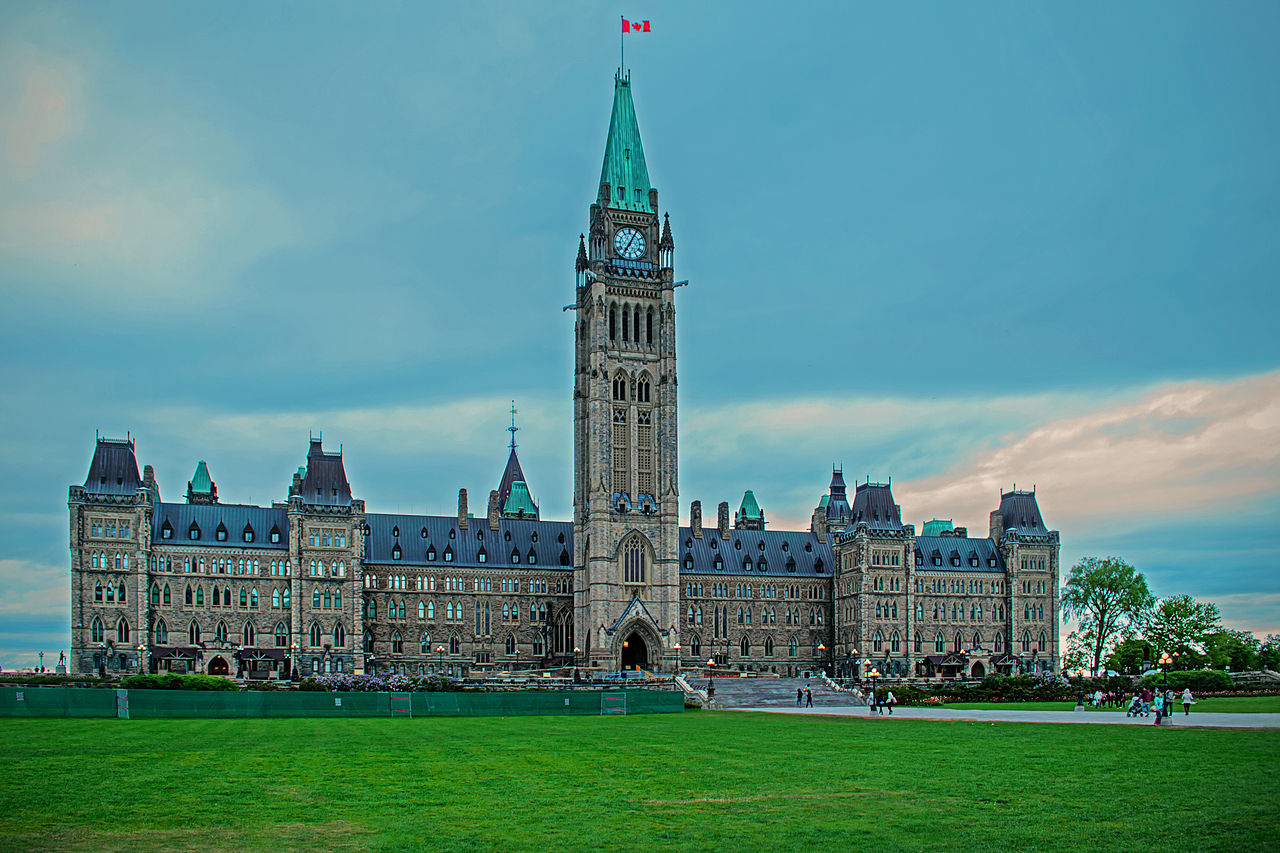
Parliament Hill in Ottawa.
Photo by S Nameirakpam via Wikimedia Commons.

In some ways, absolutely. Canada’s relative awesomeness is not an accident. We rest on the accomplishments of prior generations and some of what we do today contributes directly to the common prosperity. A ton of stuff happens behind the scenes, every day, that contribute enormously to our way of life — really, make it possible. But in other ways, the pandemic has revealed just how incompetent and inept our governments have become meeting new challenges. It’s like every last bit of bandwidth our governments have is used up just keeping the status quo running along, and if we ask it to do anything new, it’s like hitting a computer with one process too many for its CPU. It just locks up.

Real-life example: I was watching today as the Ontario and federal governments continued bickering about the proper border controls we should have during what will probably be the last phase of this crisis. And what struck me was the sheer insanity of not having settled this a long time ago. I’m not even saying what I think the answer should have been. There’s a lot of genuinely competing interests there. I have my opinion, you can have yours. But can we at least agree that what to do about the goddamn borders ought not to still be under active decision 14 frickin’ months after this all began?

The federal government, in particular, seems to have fallen into a trap of its own making in that it corporately seems to believe that saying they’ll do something is exactly the same as actually doing something. Often enough, I’m pleased and relieved to find that Trudeau Jr.’s latest brain fart never got further than the press release and obligatory photo op, but it has become a constant in federal affairs. Optics matter far more than achievements, as long as the tame Canadian media play along — and they always played along with their boyfriend PM even before he bought them off with real money — nothing really changes. And everyone seems generally okay with this … except that real problems are not being addressed (ask any First Nations representative about how well the feds are helping with long-standing, known issues, for instance).

Certain provinces have done better than others. It’s tempting to point at them and go, ah ha, there’s what we should have done. And I think this is in large part fair and true. But it’s hard to make direct comparisons. Nova Scotia is not Ontario, and what worked in Nova Scotia wouldn’t necessarily have worked here. Believe me, if I could have swapped in their leaders for ours, I would have. It would have been an upgrade for sure. But the right solution, and personalities, for one crisis, in one time and place, aren’t necessarily the right solution for even that same crisis, at the same time, in a different place. I suspect we’ll spend a long time arguing about this once it’s all over, but I think that’s more or less where I’ve landed. Most of us would have been better off trying to be more like the Atlantic, but that doesn’t mean it would have recreated Atlantic-like successes everywhere.

But all that being said, there have been enormous basic failures, both in leadership and execution. You’ve all heard the joke about how someone new to government is shocked and dispirited to finally seize the levers of power, only to discover they’re not connected to anything. You can push and pull the levers all day long. But they don’t do anything. In Canada, both federally and in some of the provinces, we’ve been shockingly slow, again and again, to pull those levers. And sometimes, even after they’re pulled, nothing happens.

I don’t know if I have this thought through yet in a meaningful, useful way. This is a big, big idea that I’m starting at from different angles, trying to even conceive of its dimensions and scope. But if there is one problem we have — we have more, but if there is a meta-problem — I think it is that Canadian governments have lost the ability to execute new policy agendas. What we already have will generally work, more or less. But new things, or updates to old things? We routinely accept that failure is an option, or that even our successes will be late and overbudget — beyond acceptable real-world margins. (Life is always more complicated than theory.) There are things in my life that I just take for granted will work. If I get into my car and it doesn’t start, that surprises me, even though I am intellectually aware that that’s a possibility every time I try. But too often, with government, there is an entirely justified skepticism that it’ll succeed at all, let alone as intended, and yet, we shrug, because, hey. It’s Canada. Things are still good. How upset can I get about another program failure when I can just go fire up the barbecue and watch some hockey or something.

Governments are generally not very good at solving problems, especially novel problems that don’t already have a template to follow for success in similar circumstances. Set up a bureaucracy, establish processes and procedures, and set it in motion and it’ll carry on until the final Trump, but don’t ask it to cope with a crisis or even just an unexpected event or six. That’s not what they’re good at and they generally lack the organizational flexibility to adapt on the fly. Or at all.

Rulers Who Were Actually Good — History Hijinks

Overly Sarcastic Productions
Published 30 Apr 2021

History is full of Rulers, but most of them (especially some famous ones) can be Kind Of Terrible upon closer inspection. So let’s take a look at two kings we can actually consider to be Good — not perfect, not blameless, but a heck of a lot more virtuous than the average ruler, that’s for sure.

This topic was requested by our patron Duncan! Thank you for your patronage, and for the topic suggestion.

SOURCES & Further Reading: The Great Courses Plus lectures “Being Persian” by Robert Garland, “The Persian Era” by Jean-Pierre Isbouts, “Saladin: Chivalry and Conquest – 1187” by Eamonn Gearon, and “Saladin and the Defeat of the Crusaders” by Dorsey Armstrong.

Our content is intended for teenage audiences and up.

TRACKLIST: “Monkeys Spinning Monkeys,” “Pippin the Hunchback” Kevin MacLeod (incompetech.com)
Licensed under Creative Commons: By Attribution 4.0 License
https://creativecommons.org/licenses/…

PATREON: https://www.Patreon.com/OSP

PODCAST: https://overlysarcasticpodcast.transi…​

DISCORD: https://discord.gg/osp​
MERCH LINKS: http://rdbl.co/osp​

OUR WEBSITE: https://www.OverlySarcasticProductions.com
Find us on Twitter https://www.Twitter.com/OSPYouTube​
Find us on Reddit https://www.Reddit.com/r/OSP/

When the libraries failed

Filed under: Books, History, USA — Tags: , , , , — Nicholas @ 03:00

In another of a series of book reviews by Astral Codex Ten readers, Scott Alexander posted this review of Double Fold by Nicholson Baker, which helps to indicate just when libraries — and librarians — lost their mojo:

“Nottingham central library” by JuliaC2006 is licensed under CC BY 2.0

If you enter a major research library in the US today and request to see a century-old issue of a major American newspaper, such as Chicago Tribune, The Wall Street Journal, or major-but-defunct newspapers such as the New York “World”, odds are that you will be directed to a computer or a microfilm reader. There, you’ll get to see black-and-white images of the desired issue, with individual numbers of the newspaper often missing and much of the text, let alone pictures, barely decipherable.

The libraries in question mostly once had bound issues of these newspapers, but between the 1950s and the 1990s, one after another, they ditched the originals in favor of expensive microfilmed copies of inferior quality. They continued doing this even while the originals became perilously rare; the newspapers themselves were mostly trashed, or occasionally sold to dealers who cut them up and dispersed them. As a consequence, many of these publications are now rarer than the Gutenberg Bible, and some 19th and 20th century newspapers have ceased to exist in a physical copy anywhere in the world.

When Double Fold by Nicholson Baker came out in 2001, it was described as The Jungle of the American library system. After 20 years, the book remains universally known, sometimes admired but often despised, among librarians. The reason for their belligerence is that Baker publicly revealed a decades-long policy of destruction of primary materials from the 19th and 20th centuries, based on a pseudoscientific notion that books on wood-pulp paper are quickly turning to dust, coupled with a misguided futuristic desire to do away with outdated paper-based media. As a consequence, perfectly well preserved books with centuries of life still ahead of them were hastily replaced with an inferior medium which has, at the moment that I am writing this review, already mostly gone the way of the dodo. Despite its notoriety among librarians, however, Double Fold is little-known among the general public, even compared to Baker’s other non-fiction and his novels.

This is a shame, since the mass destruction of books and newspapers by libraries in the post-war era deserves to be better known as one of the most egregious failures of High Modernism, comparable with the wackiest plans of Le Corbusier. The story combines an excessive reliance on simplistic mathematical models, wilful ignorance to the desires of actual library-users and scholars, embracement of miniaturization and modernization as terminal values, and an almost complete disregard of 19th century books as historical artefacts. Unlike industrial farms, which can be broken up, and Brasília-style skyscrapers, which can be torn down and replaced with something else, the losses caused by the mass deaccessioning of books and newspapers from libraries were often irreplaceable.

As part of the uproar that followed the book’s publication, the Association of Research Libraries published an online anti-Baker FAQ, and in 2002, the book Vandals in the Stacks? by Richard J. Cox came out, presenting an attempted refutation of Baker’s theses. I have read both of these and discuss Cox’s arguments later on, but I must admit in advance that I was mostly convinced by Baker’s argumentation much more than by that of his opponents. Nonetheless, it is uncommon to have a polemical book receive a book-length response, and anyone interested in Baker’s thesis is advised to check out Cox as well.

SMLE MkIII: The Iconic Smelly of World War One

Filed under: Australia, Britain, History, Military, Weapons, WW1 — Tags: , , — Nicholas @ 02:00

Forgotten Weapons
Published 20 Jan 2021

http://www.patreon.com/ForgottenWeapons

https://www.floatplane.com/channel/Fo…

Cool Forgotten Weapons merch! http://shop.bbtv.com/collections/forg…

In 1907, the British adopted the final major pattern in the evolution of the Short, Magazine, Lee Enfield. Designated the ShtLE MkIII (Short Lee Enfield) at the time, it would be retroactively renamed Rifle No1 MkIII in the 1920s. This new design was simpler and more durable than its predecessors while actually improving the practical accuracy of the rifle. The rear sight protector wings were substantially strengthened, the front sight became a square post, the front sight protectors were opened up to allow more light in, and the rear sight windage adjustment was simplified — while retailing 1 MOA adjustment clicks and 25m elevation adjustments. A new bayonet was also adopted in 1907 for the MkIII. The previous 1903 pattern bayonet was deemed too short, and the British essentially copied the Japanese Type 30 Arisaka bayonet as its new Pattern 1907 — hooked quillion and all.

The example we are looking at in today’s video is a fantastic specimen, as it was sold out of service to an Australian reservist in 1912 having not received any post-production modifications or updates. It is still sighted for the early MkVI round-nose ammunition, for example, and its bayonet retains the hooked quillion. The rifle’s owner died prior to World War One, and the gun remained stored away and forgotten through both World Wars, where virtually all existing service rifles were taken back into service and updated. Only in the 1960s was this one found, making it a pristine collector’s example to show how the MkIII was originally produced.

Contact:
Forgotten Weapons
6281 N. Oracle #36270
Tucson, AZ 85740

QotD: “WOLF! Film at 11”

Filed under: Media, Politics, Quotations, USA — Tags: , , , , , — Nicholas @ 01:00

Yes, false conspiracy theories are dangerous. One of the best defences a polity has against them is a reasonable level of trust in the authorities and the media. In the long run the only way to gain this trust is to be worthy of it, i.e. not to lie and not to hide the truth. By their promiscuous propagation of any story, however baseless, that might harm the Republicans and their enthusiastic censorship of any story, however credible, that might make the Democrats look bad, the American Woke Media, old and new, have lost this trust. As a result reality ensues, to quote TV Tropes. Or if you prefer the same truth in an older format, take your quote from William Caxton’s summary at the end of his retelling of the fable of the boy who cried wolf, “men bileve not lyghtly hym whiche is knowen for a lyer“.

Natalie Solent, “Why do Americans think the media might be hiding things from them? Let’s try asking Tony Bobulinski on Twitter”, Samizdata, 2021-01-13.

« Newer Posts

Powered by WordPress