Quotulatiousness

November 7, 2020

Major Fosbery’s Breechloading Prototype Rifle

Filed under: Britain, History, Military, Weapons — Tags: , — Nicholas @ 02:00

Forgotten Weapons
Published 5 Aug 2017

http://www.patreon.com/ForgottenWeapons

Cool Forgotten Weapons merch! http://shop.bbtv.com/collections/forg…

George Fosbery was the British officer (Major, at the time of this particular design) responsible for the quite famous Webley-Fosbery self-cocking revolver, as well as the Paradox system for shotgun slugs and many other lesser known firearms inventions. This rifle was his entry into British trials in the late 1860s for a cartridge firing rifle. Ultimately the Martini-Henry would be chosen, but nine different guns were put through testing including Fosbery’s.

One of the aspects that Fosbery’s design was particularly well suited for was the requirement that the gun be able to be loaded with a minimum amount of movement required that might interfere with men standing in close formation. Despite this, Fosbery only managed to come in 6th place in the trials, and only a small number of his guns were sold on the civilian market afterwards.

If you enjoy Forgotten Weapons, check out its sister channel, InRangeTV! http://www.youtube.com/InRangeTVShow

QotD: “Hate speech”

Filed under: Humour, Law, Liberty, Quotations — Tags: , , — Nicholas @ 01:00

In an attempt to put down “racism”, the concept of “hate terms” was introduced into English law for the first time. This makes many words and expressions unlawful, and punishable by fines and imprisonment. It is the most comprehensive system of censorship since the days of Hitler’s Germany and Stalin’s Russia, and means there are more restrictions on freedom of expression in England than at any other time since Hogarth’s days.

It is, of course, fatal to humour, if enforced and persisted in. For one vital quality of humour is inequality, and striking visual, aural, and physical differences. Differences in sex, age, colour, race, religion, physical ability, and strength lie at the source of the majority of jokes since the beginning of human self-consciousness. And all jokes are likely to provoke discomfort if not positive misery among those laughed at. Hence any joke is liable to fall foul of those laws. The future for humourists thus looks bleak, at the time I write this. The ordinary people like jokes, often crude ones, as George Orwell pointed out in his perceptive essay on rude seaside picture postcards. But are ordinary people, as opposed to minor officials, in charge any more? Democracy doesn’t really seem to work, and people are insufficiently dismayed at its impotence.

Paul Johnson, Humourists: From Hogarth to Noël Coward, 2010.

November 6, 2020

An American Globalist – Cordell Hull – WW2 Biography Special

Filed under: Americas, History, Japan, USA, WW2 — Tags: , , , , , , — Nicholas @ 06:00

World War Two
Published 5 Nov 2020

Cordell Hull is the face of American diplomacy in 1941 as it navigates the precarious road to war against Imperial Japan.

Join us on Patreon: https://www.patreon.com/TimeGhostHistory
Or join The TimeGhost Army directly at: https://timeghost.tv

Follow WW2 day by day on Instagram @ww2_day_by_day – https://www.instagram.com/ww2_day_by_day
Between 2 Wars: https://www.youtube.com/playlist?list…
Source list: http://bit.ly/WW2sources

Hosted by: Indy Neidell
Written by: Francis van Berkel and James Newman
Director: Astrid Deinhard
Producers: Astrid Deinhard and Spartacus Olsson
Executive Producers: Astrid Deinhard, Indy Neidell, Spartacus Olsson, Bodo Rittenauer
Creative Producer: Maria Kyhle
Post-Production Director: Wieke Kapteijns
Research by: James Newman
Edited by: Miki Cackowski
Sound design: Marek Kamiński
Map animations: Eastory (https://www.youtube.com/c/eastory)

Colorizations by:
Norman Stewart – https://oldtimesincolor.blogspot.com/
Mikolaj Uchman
Spartacus Olsson

Sources:
Naval History & Heritage Command
http://maps.bpl.org
FDR Presidential Library & Museum
Picture of MS St. Louis in Hamburg, United States Holocaust Memorial Museum, courtesy of Herbert and Vera Karliner
from the Noun Project: Skull by Muhamad Ulum, Handshake by priyanka, Pickaxe by Luke Anthony Firth, oil barrel by BomSymbols

Soundtracks from the Epidemic Sound:
Howard Harper-Barnes – “London”
Johannes Bornlof – “The Inspector 4”
Farell Wooten – “Blunt Object”
Philip Ayers – “Trapped in a Maze”
Johannes Bornlof – “Deviation In Time”

Archive by Screenocean/Reuters https://www.screenocean.com.

A TimeGhost chronological documentary produced by OnLion Entertainment GmbH.

A Swedish Trilogy Pt. 1 – A New Hope – Sabaton History 092 [Official]

Filed under: Europe, History, Media, Military — Tags: , , , , , — Nicholas @ 04:00

Sabaton History
Published 5 Nov 2020

The Swedish nation was in turmoil, as news spoke of King Gustavus Adolphus’ death on the battlefield of Lützen in 1632. The Lion from the North was slain — but who would reign in his stead? Gustavus had fathered a young daughter, the 6-year old Christina. Torn between a grief-stricken Queen Mother and the overbearing duties to monarchy and country, Christina grew into an unhappy and troubled woman. Much was expected of her, as she was still the daughter of the legendary warrior-king. But was she able and willing to continue his legacy? Or would she rather forsake her throne in order to find her own future far away from Sweden?

Support Sabaton History on Patreon: https://www.patreon.com/sabatonhistory

Listen to Sabaton on Spotify: http://smarturl.it/SabatonSpotify
Official Sabaton Merchandise Shop: http://bit.ly/SabatonOfficialShop

Hosted by: Indy Neidell
Written by: Markus Linke and Indy Neidell
Directed by: Astrid Deinhard and Wieke Kapteijns
Produced by: Pär Sundström, Astrid Deinhard and Spartacus Olsson
Creative Producer: Maria Kyhle
Executive Producers: Pär Sundström, Joakim Brodén, Tomas Sunmo, Indy Neidell, Astrid Deinhard, and Spartacus Olsson
Community Manager: Maria Kyhle
Post-Production Director: Wieke Kapteijns
Editor: Karolina Dołęga
Sound Editor: Marek Kaminski
Archive: Reuters/Screenocean – https://www.screenocean.com

Sources:
– Nationalmuseum
– Statens Museum for Kunst
– Livrustkammaren
– Herzog Anton Ulrich Museum
– Swedish capture of Kauzenburg 1631 colorized by Dextwin

All music by: Sabaton

An OnLion Entertainment GmbH and Raging Beaver Publishing AB co-Production.

© Raging Beaver Publishing AB, 2019 – all rights reserved.

“[T]he inability of election authorities to do something as simple as gather and count votes is undermining Americans’ faith in the constitutional system”

Filed under: Bureaucracy, Government, Politics, USA — Tags: , , — Nicholas @ 03:00

There have been many accusations of ballot fraud since the polls closed in the recent US federal election — not helped by Joe Biden’s Kinsley gaffe about creating the “most extensive and inclusive voter fraud organization in the history of American politics” — but that’s not the only thing holding up the process of determining who won say Jon Miltimore and Dan Sanchez:

“Polling Place Vote Here” by Scott Beale is licensed under CC BY-NC-ND 2.0

Elections are a nasty business, but sometimes they can be clarifying.

We don’t yet know who won the US presidential election, and we may not for days or weeks to come. This stems largely from the ineptitude Americans witnessed on Election Tuesday.

It wasn’t just the fact that pollsters once again failed disastrously, or that networks fumbled their election coverage.

The bigger issue is that America’s governing bodies look incapable of managing something as simple as a vote, something Americans have managed to do efficiently for centuries without the benefit of computers, digital communication, and mass transportation.

As an American, I find this a tad embarrassing. As the journalist Glenn Greenwald observed Wednesday, countries with far fewer resources and less advanced technology regularly manage to hold speedy, efficient elections. This is something the US failed to do on Tuesday, Greenwald noted.

[…]

The most prosperous country in the world cannot manage to do something as simple as collect and count ballots. Think about that for just a moment.

Unfortunately, this incompetence carries consequences that are quite real. Americans are beginning to lose faith in the integrity of elections. I’m not just talking about voters in the fever swamps of Twitter.

Many impressive journalists, thinkers, and students of various political stripes have expressed alarm at what they witnessed in the last 24 hours.

The World’s Most Recycled Material

Filed under: Economics, Technology — Tags: , , , — Nicholas @ 02:00

Practical Engineering
Published 6 Aug 2020

Exploring the complexities that go into the creation and application of asphalt concrete.
Use code 80PRACTICAL to get $80 off with purchase, including free shipping on your first box https://bit.ly/30sYo7c Go to HelloFresh.com for more details.

Of all the ubiquitous things in our environment, roads are probably one of the least noticed. Our roads see tremendous volumes of traffic and withstand considerable variations in weather and climate, and they do it on a pretty tight budget. That’s really only possible because of all the scientists, engineers, contractors, and public works crews keeping up with this simple but incredible material called asphalt.

-Patreon: http://patreon.com/PracticalEngineering
-Website: http://practical.engineering

Writing/Editing/Production: Grady Hillhouse
Editing and Direction Help: Wesley Crump

This video is sponsored by HelloFresh.

QotD: When you use a racist lens, everything looks like racism

Filed under: Books, Media, Politics, Quotations, USA — Tags: , , , , — Nicholas @ 01:00

[White Fragility author Robin] DiAngelo uses similar techniques to support her second core theory that all white people are racist. For example, DiAngelo lays another trap that makes it impossible for white people to speak ill of any neighborhood with high crime rates in which many people of color reside. When DiAngelo’s friends warned her not to buy a home in neighborhoods with relatively high crime rates and poorly rated schools, DiAngelo later discovered that the neighborhoods had a high percentage of black and brown residents. From this, she concluded that her friends’ warnings were racially motivated and that “my fellow whites had communicated the racial boundaries to me.” Did you spot the trap?

If DiAngelo’s friends had told her not to live in the neighborhoods because they had black and brown residents, she could call them out for overt racism. But even when her friends made no mention of race whatsoever, DiAngelo attributed their warnings to racism as well. There was no way for her friends to mention the neighborhood’s high crime rates without DiAngelo finding them guilty of racism.

DiAngelo also supports her theory that all white people are racist by interpreting ambiguous events to support her conclusions, despite other plausible explanations. In one anecdote, DiAngelo describes an incident in which a white female teacher had two black students at her desk. The teacher prefaced something she said with the word “girl.” One student felt that the use of the word “girl” was racist. The other student disagreed, saying that the teacher called all her students “girl” regardless of their race.

Any reasonable person would conclude that if the teacher called every student — white, black, Asian, Latinx — “girl,” the teacher’s use of the word resides somewhere between “not racist” and “open to interpretation.” But DiAngelo reached a different conclusion, demonizing the teacher’s lack of concern for the offended student’s feelings, and calling the teacher arrogant for thinking the use of “girl” was not racist. To be clear, while teachers should listen to their students’ concerns, there is no proof this teacher’s word choice was racially motivated. And ironically, DiAngelo is guilty of everything she criticizes the teacher for because DiAngelo arrogantly ignores the other black student who did not think the comment was racist.

David Edward Burke, “The Intellectual Fraud of Robin DiAngelo’s White Fragility“, The Logical Liberal, 2020-06-13.

November 5, 2020

Make perfect, square boards with the Advanced Shooting Board // Essential Hand Tool Jig

Filed under: Tools, Woodworking — Tags: , , — Nicholas @ 06:00

Rex Krueger
Published 4 Nov 2020

Make an adjustable shooting board that never goes out of square with this simple build.

More video and exclusive content: http://www.patreon.com/rexkrueger
(more…)

America on the Brink of Revolution? | BETWEEN 2 WARS: ZEITGEIST! | E.02 – Winter 1919

Filed under: Britain, Business, France, History, Media, USA — Tags: , , , , , , , — Nicholas @ 04:00

TimeGhost History
Published 4 Nov 2020

There is revolution and fear of revolution throughout the world in the winter of 1919. But cultural and technological revolutions are also bringing hope to many. A new age of Jazz and Cinema is about to reach America and Europe.

Join us on Patreon: https://www.patreon.com/TimeGhostHistory

Hosted by: Indy Neidell
Written by: Indy Neidell, Francis van Berkel, and Spartacus Olsson.
Director: Astrid Deinhard
Producers: Astrid Deinhard and Spartacus Olsson
Executive Producers: Astrid Deinhard, Indy Neidell, Spartacus Olsson, Bodo Rittenauer
Creative Producer: Maria Kyhle
Post-Production Director: Wieke Kapteijns
Research by: Indy Neidell, Francis van Berkel, and Spartacus Olsson.
Archive Research: Daniel Weiss
Edited by: Daniel Weiss
Sound design: Marek Kamiński

Colorizations:
Daniel Weiss – https://www.facebook.com/TheYankeeCol…
Mikołaj Uchman
Norman Stewart – https://oldtimesincolor.blogspot.com/

Sources:

From the Noun Project:
– Money by Gilberto
– lightbulb By Maxim Kulikov

Soundtracks from Epidemic Sound and ODJB:
– “One More for the Road” – Golden Age Radio
– “The Last Journey” – Line Neesgaard
– “Tiger_Rag” – ODJB
– “Not Safe Yet” – Gunnar Johnsen
– “Please Hear Me Out” – Philip Ayers
– “Dark Shadow” – Etienne Roussel
– “The Inspector 4” – Johannes Bornlöf
– “I Won’t Give You Up” – Almost Here
– “The Charleston” – Macy’s Voice
– “Defeated” – Wendel Scherer

Archive by Screenocean/Reuters https://www.screenocean.com.

A TimeGhost chronological documentary produced by OnLion Entertainment GmbH.

From the comments:

TimeGhost History
2 days ago (edited)
As in life, this series will always be a curious balance of light and dark. In the winter of 1919, one Parisian might have tickets to see the Original Dixieland Jass Band while their neighbour lies destitute after the war, and a well-to do man in Glasgow might be at the cinema while tanks rolls into his city to quell industrial unrest.

Troubled and fascinating times then and troubled fascinating times now here in 2020. All of us here at TimeGhost hope that all of you are healthy and staying safe. And hey, if you need some entertainment to pass the time, you can find plenty of Between 2 Wars episodes alongside WW2 In Real Time and BIO Specials!

Fallen Flag — the New York, Ontario and Western Railway

Filed under: Business, History, Railways, USA — Tags: , , , — Nicholas @ 03:00

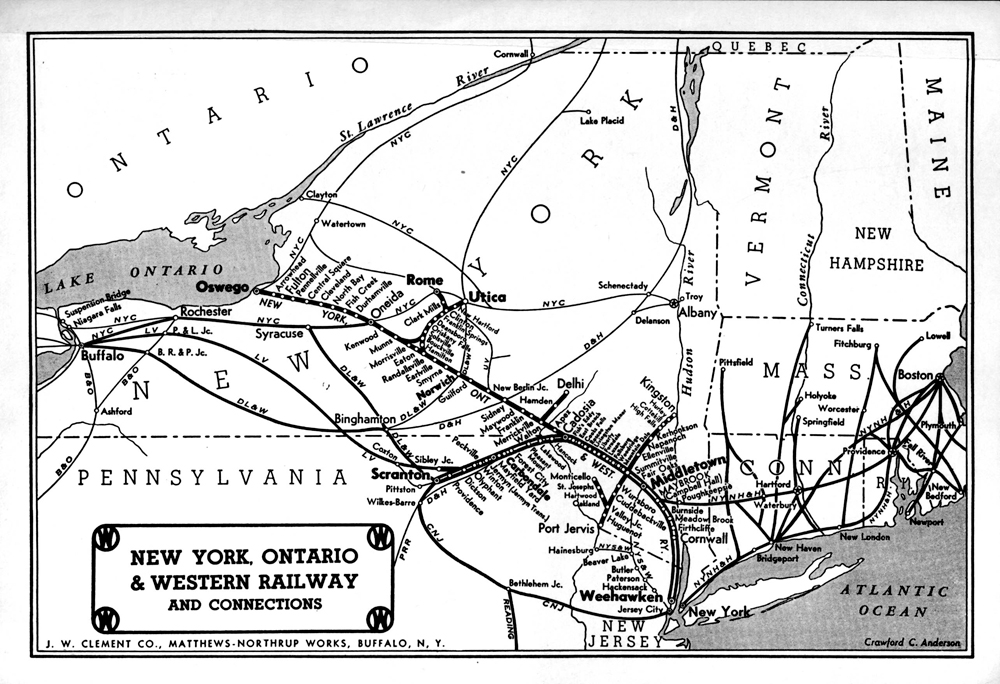
This month’s Classic Trains featured fallen flag is the New York, Ontario and Western, which ran from Oswego on the south shore of Lake Ontario down into the New York City megalopolis. Sadly, the line is best remembered as the only Class 1 US railway to be completely abandoned. John R. Taibi outlines the history of the NYO&W from formation to abandonment in 1957:

Preserved NYO&W General Electric 44-ton switcher number 104 preserved at the Southeastern Railway Museum in Duluth, GA.
Photo by Harvey Henkelmann via Wikimedia Commons.

The New York, Ontario & Western Railway struggled to find its place among the many transportation systems serving New York City, but in the end it was able only to secure a place in history as the first Class I railroad to be abandoned in entirety. Despite this unenviable status, “the O&W,” as it was known, did endear itself to the communities along its line. After all, it was the carrier that had brought boxcars full of prosperity to every community along the line during its 76-year life.

Begun on January 21, 1880, the O&W set a goal of improving the Oswego–New York corridor, as well as the branches to New Berlin, Delhi, and Ellenville, N.Y., it had inherited from the New York & Oswego Midland. The O&W developed a new entrance to Gotham from Middletown, N.Y., that ran to Cornwall on the Hudson River, thence to Weehawken, N.J., by rights on the New York, West Shore & Buffalo Railway (later New York Central).

[…]

As it improved its physical characteristics, the O&W also acquired modern motive power to haul its numerous coal, milk, passenger, and general freight trains. Where previously Camelback 4-4-0s, 2-6-0s, and 2-8-0s were as common as the road’s wooden coaches and country depots, a corps of end-cab locomotives helped usher in the new era. E-class Ten-Wheelers (1911), W-class Consolidations (1910-11), X-class 2-10-2 “Bull Mooses” (1915), and Y-class Mountains (1922 and ’29) provided the power for passenger trains to the Catskills, milk trains to Gotham, and coal trains to Oswego, Cornwall, and Weehawken. Still, many Camelbacks worked into the mid-1940s.
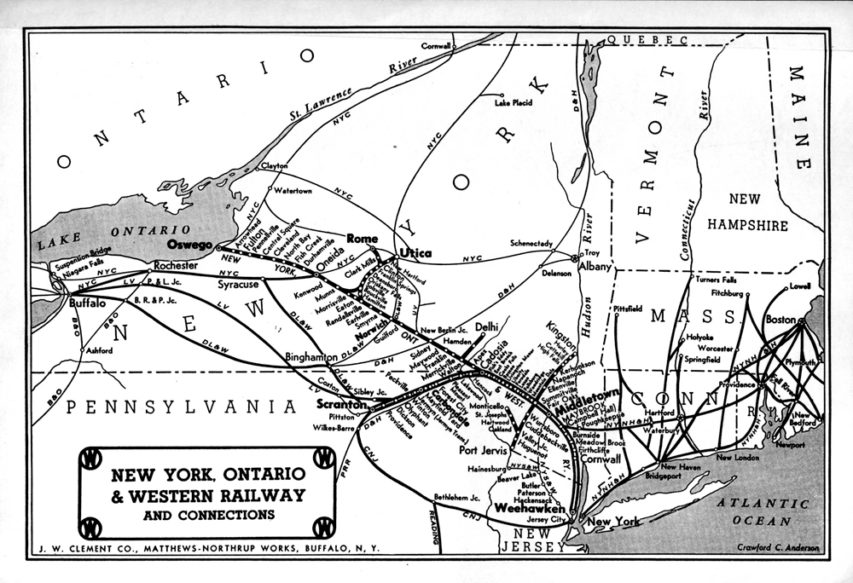
This familiar, widely circulated O&W map was created by cartographer Crawford C. Anderson.
Classic Trains.

[…]

Dieselization was hoped to be a savior, and under [O&W bankruptcy trustee, Frederick E.] Lyford’s direction a handful of GE 44-ton switchers arrived in 1941. Nine two-unit EMD FTs came in 1945 and were put into fast merchandise service between Scranton and Maybrook, and Scranton and Norwich. Lyford’s successors in 1948 acquired additional F3 and NW2 diesels, enough to banish steam locomotives from service by that summer.

By that time, though, O&W’s accumulated losses amounted to $38 million. It was beyond the ability of trustees, the reorganization court, and diesel locomotives to extricate the carrier from financial ruin. Nevertheless, passenger trains from Weehawken to Walton (then only to Roscoe) kept running until mail contracts gave out in 1950; the service was suspended in September 1953. Although milk and coal trains were a memory, gray-yellow-and-orange diesel locomotives soldiered on, leading a dwindling number of ever-shorter freight trains.

By the mid-1950s, the reorganization court — which had been searching for a buyer for the road now truly earning another of its nicknames, the “Old & Weary” — was advocating total abandonment. Additionally, the U.S. government was suing for taxes and retirement payments that were in arrears, and New York state began planning on how best to use the O&W right of way for highway improvements.


The Range Rover Story

Filed under: Britain, Business, History — Tags: , , , — Nicholas @ 02:00

Big Car old account
Published 26 Feb 2019

To help me continue producing great content, please consider supporting me: https://www.patreon.com/bigcar

Help support my channel through these Amazon UK affiliate links:
Range Rover t-shirt: https://amzn.to/2WVHiLX
Land Rover baseball cap: https://amzn.to/2D4DP67
Range Rover diecast model car: https://amzn.to/2U3tTzk
Range Rover keyfob: https://amzn.to/2D4HmRQ

If Maria Von Trapp had driven a Range Rover, she’d have climbed every mountain, forded every stream and driven to every Austrian folk festival with the entire Von Trapp family singers in the back. Her and the Captain would have been able to roll up to the fanciest Salzburg dinner party in their finest glad rags after a day yodeling sweet nothings to each other on top of a mountain.

The Range Rover is the ultimate go-anywhere luxury SUV. It was born out of Rover’s desire to sell more cars in the USA, and its design was a complete accident. So how did a company known for saloon cars and agricultural off-roaders invent a car that created a brand-new market segment?

Much credit for this video has to go to aronline.co.uk for their excellent articles.

#RangeRoverClassic

QotD: The idiocy of tariffs

Filed under: Business, Economics, Government, Politics, Quotations — Tags: , , , — Nicholas @ 01:00

The entire point of trade, the very purpose of it, is to gain access to the imports. Those things which Johnny Foreigner makes cheaper or better than we do. To tax ourselves because he makes things cheaper or better than we do is simple idiocy. […] Over and above this stupidity there’s the depressing point that trade and trade protection really is a spiral. Here we’ve got the two largest economies on the planet tripping over themselves to punish their own citizenry for their temerity in buying foreign. And as we can see, it is a tit for tat spiral. A little bit of sabre rattling, a response, a larger amount of shouting, a response, then truly impoverishing levels of rock throwing into own harbours and off we go into making our own people less wealthy.

The true sadness here being that the spiral works the other way too. But hugely, vastly, more slowly. GATT was founded in 1947, it became, the process was transferred to, the WTO and it has taken them since then, that two generations, to reduce tariff levels to where they’re not really all that important in trade matters. Something that is being undone in just a couple of months of foolishness. GATT being something of a response to the economic demolition work done by Smoot Hawley of course.

Trade protection does spiral up and spiral down, the sadness being that here’s an asymmetry to the process. The reductions that make us richer take very much longer than the nonsenses that impoverish.

Tim Worstall, “The China, US, Trade War – It’s All Mutual On The Way Down As Well As Up”, Continental Telegraph, 2018-07-11.

November 4, 2020

How Mighty is the Red Army? – WW2 Special

Filed under: History, Military, Russia, WW2 — Tags: , , , , — Nicholas @ 04:00

World War Two
Published 3 Nov 2020

Hitler and German High Command had expected the invasion of the Soviet Union to be an easy victory and for the Red Army to quickly collapse. Yet here we are, with millions of Soviet soldiers captured, wounded or killed and the Red Army still holding fast.

Join us on Patreon: https://www.patreon.com/TimeGhostHistory
Or join The TimeGhost Army directly at: https://timeghost.tv

Follow WW2 day by day on Instagram @ww2_day_by_day – https://www.instagram.com/ww2_day_by_day
Between 2 Wars: https://www.youtube.com/playlist?list…
Source list: http://bit.ly/WW2sources

Hosted by: Indy Neidell
Written by: Francis van Berkel, Ian Irungu, Shaun Harrison, Dennis Stepanov
Director: Astrid Deinhard
Producers: Astrid Deinhard and Spartacus Olsson
Executive Producers: Astrid Deinhard, Indy Neidell, Spartacus Olsson, Bodo Rittenauer
Creative Producer: Maria Kyhle
Post-Production Director: Wieke Kapteijns
Research by: Francis van Berkel, Ian Irungu, Shaun Harrison, Dennis Stepanov
Edited by: Karolina Dołęga
Sound design: Marek Kamiński

Colorizations by:
– Klimbim
– Norman Stewart – https://oldtimesincolor.blogspot.com/
– Julius Jääskeläinen – https://www.facebook.com/JJcolorization/
– Carlos Ortega Pereira, BlauColorizations – https://www.instagram.com/blaucolorizations

Visual Sources:
– Mil.ru
– ANRM, Fototeca, 24945
– Map from December 1941 provided with GNU Free Documentation License by Wikimedia

Archive by Screenocean/Reuters https://www.screenocean.com.

A TimeGhost chronological documentary produced by OnLion Entertainment GmbH.

The replication crisis in all fields is worse than you imagine

Filed under: Media, Science — Tags: , , , — Nicholas @ 03:00

It may sound like a trivial issue, but it absolutely is not: scientific studies that can’t be replicated are worthless, yet our lives are often impacted by these failed studies, especially when politicans are guided by junk science results:

More than 70% of researchers have tried and failed to reproduce another scientist’s experiments, and more than half have failed to reproduce their own experiments. Those are some of the telling figures that emerged from Nature‘s survey of 1,576 researchers who took a brief online questionnaire on reproducibility in research.

The data reveal sometimes-contradictory attitudes towards reproducibility. Although 52% of those surveyed agree that there is a significant ‘crisis’ of reproducibility, less than 31% think that failure to reproduce published results means that the result is probably wrong, and most say that they still trust the published literature.

Data on how much of the scientific literature is reproducible are rare and generally bleak. The best-known analyses, from psychology and cancer biology, found rates of around 40% and 10%, respectively. Our survey respondents were more optimistic: 73% said that they think that at least half of the papers in their field can be trusted, with physicists and chemists generally showing the most confidence.

The results capture a confusing snapshot of attitudes around these issues, says Arturo Casadevall, a microbiologist at the Johns Hopkins Bloomberg School of Public Health in Baltimore, Maryland. “At the current time there is no consensus on what reproducibility is or should be.” But just recognizing that is a step forward, he says. “The next step may be identifying what is the problem and to get a consensus.”

Failing to reproduce results is a rite of passage, says Marcus Munafo, a biological psychologist at the University of Bristol, UK, who has a long-standing interest in scientific reproducibility. When he was a student, he says, “I tried to replicate what looked simple from the literature, and wasn’t able to. Then I had a crisis of confidence, and then I learned that my experience wasn’t uncommon.”

The challenge is not to eliminate problems with reproducibility in published work. Being at the cutting edge of science means that sometimes results will not be robust, says Munafo. “We want to be discovering new things but not generating too many false leads.”

Suppressing 9mm Carbines: Dead Air Wolfman on an AR, AK, and HK

Filed under: Weapons — Tags: , — Nicholas @ 02:00

Forgotten Weapons
Published 25 Jul 2020

http://www.patreon.com/ForgottenWeapons

https://www.floatplane.com/channel/Fo…

Cool Forgotten Weapons merch! http://shop.bbtv.com/collections/forg…

Contact:
Forgotten Weapons
6281 N. Oracle #36270
Tucson, AZ 85740

From the comments:

ArfurFaulkesHake
44 minutes ago (edited)
It’s a shame that we can’t really hear how quiet this suppressor actually is, since the normalisation of the microphone doesn’t transmit how earshatteringly loud a normal shot is. But the fact that I could hear the bullets ricochet of the targets (4:01) speaks volumes about how good this suppressor is.

« Newer PostsOlder Posts »

Powered by WordPress