
When I heard that Sen. Tommy Banks had died of leukemia at age 81, I thought maybe the newspaper notices ought to be left to the people who knew him better — and in Edmonton that number comes to thousands upon thousands of people. I interviewed Banks a few times as a young political reporter. I think every such person has learned the procrastinator’s trade secret that if you’re doing an issues story, senators are easier to get hold of on a short deadline than elected MPs, and a lot easier than cabinet ministers, especially if you’re an unknown lightweight.
This, at least, used to be the case. I am not sure whether it applies to the Brave New Senate that now exists after the somewhat cynical appointments of Stephen Harper and the experimental renovations of Justin Trudeau. But if you have ever wondered why political beat writers and old codger columnists often have surprisingly positive sentiments about the Senate, which nine-tenths of the people reading these words despise, this is probably one reason: a senator might call you back soon enough to be of some use.
And there’s another, related reason. In phoning a senator to chat about issues because you can’t get a “real” politician to return your inquiry, you would (or, anyway, I would) sometimes find surprisingly strong evidence that the Senate quietly lives up to its original constitutional promise. Spared the effort of endless electioneering and toilsome constituent service, senators do have time for deep study of projects and problems, and some freedom to develop independent opinions. I do not say that most of them use the time and the freedom, but it was, and I’m sure it still is, fairly easy to avoid the duds.
Colby Cosh, “R.I.P. Senator Tommy Banks, a figure from Edmonton’s pantheon”, National Post, 2018-01-26.
April 3, 2020
QotD: Canadian senators
April 2, 2020
Testing the English Joiner’s Bench
Rex Krueger
Published 1 Apr 2020Can my fast and easy Joiner’s Bench survive the toughest tests in the shop?
More Video and Exclusive Content: http://www.patreon.com/rexkruegerComplete Joiner’s Bench Bundle (40 pages, full color, only $10): https://bit.ly/2QZls9T
(more…)
What exactly is one second? | James May’s Q&A (Ep 2) | Head Squeeze
BBC Earth Lab
Published 10 Jan 2013James May discusses what exactly a seconds is. He also delves into how time as we know it could have been totally different. This is because the second had many “rivals” over the years that never got their way.
Outtakes from this video: http://www.youtube.com/watch?v=kLpGHt…
James May’s Q&A:
With his own unique spin, James May asks and answers the oddball questions that we’ve all wondered about from “What exactly is one second?” to “Is invisibility possible?”

A Soviet-Nazi Alliance – The Molotov-Ribbentrop Pact | BETWEEN 2 WARS I 1939 Part 2 of 3
TimeGhost History
Published 1 Apr 2020In 1939, two bitter rivals sign a non-aggression pact. But the treaty is something more than just a simple pledge of neutrality. Nazi Germany and the Soviet Union have also secretly agreed on how they will carve up Eastern Europe between them.
Join us on Patreon: https://www.patreon.com/TimeGhostHistory
Hosted by: Indy Neidell
Written by: Francis van Berkel
Directed by: Spartacus Olsson and Astrid Deinhard
Executive Producers: Bodo Rittenauer, Astrid Deinhard, Indy Neidell, Spartacus Olsson
Creative Producer: Joram Appel
Post-Production Director: Wieke Kapteijns
Research by: Francis van Berkel
Edited by: Daniel Weiss
Sound design: Marek KamińskiSources:
Bundesarchiv_Bild:
102-14436, 146-1977-159-11, 146-1982-159-22A,
146-1997-060-33A, 183-2006-1010-502, 183-H27337,
183-H28422, 183-R09876, 183-R14433, 183-S52480, RH 2/2292,
Novosti archive, image #409024 / Vladimir GrebnevFrom the Noun Project:
killer with a gun By Arthur Shlain
guns by By Cards Against Humanity,
Shield By Laili Hidayati,Photos from color by klimbim.
Colorizations by:
– Owen Robinson – https://www.instagram.com/owen.colori…
– Dememorabilia – https://www.instagram.com/dememorabilia/Soundtracks from Epidemic Sound:
– “Last Point of Safe Return” – Fabien Tell
– “The Inspector 4” – Johannes Bornlöf
– “Easy Target” – Rannar Sillard
– “Split Decision” – Rannar Sillard
– “Death And Glory 1” – Johannes Bornlöf
– “First Responders” – Skrya
– “Disciples of Sun Tzu” – Christian Andersen
– “Mystery Minutes” – Farrell Wooten
– “Split Decision” – Rannar Sillard
– “Death And Glory 3” – Johannes Bornlöf
– “The Charleston 3” – Håkan ErikssonA TimeGhost chronological documentary produced by OnLion Entertainment GmbH.
From the comments:
TimeGhost History
1 day ago (edited)
If you didn’t think this topic is controversial enough already, we have an even more contentious question for you: Is the Soviet Union basically an Axis Power between 1939 and 1941?Technically the answer is a definite “no” because the USSR will never sign the Tripartite Pact, but it’s still worth thinking about. The USSR and Nazi Germany will cultivate a pretty productive relationship after they sign the Non-Aggression Treaty, not only prompting a joint occupation of Poland but also allowing Hitler to invade Western Europe without having to worry about his eastern borders. So when you look at it like that, the USSR directly supported the Nazi war machine. On the other hand, it is probably a bit of a leap to blame the USSR for Nazi expansionism, and Stalin is forced by circumstances to enter into the Pact. The USSR is not ready to fight a war at this point, and the treaty buys not only time but also space, creating a virtual buffer zone between Germany and the Motherland in the form of Poland. Cynical and calculated, yes, but that’s diplomacy for you. Stalin will obviously offer a very extreme interpretation of this second argument after the war, casting Soviet actions as a necessary defensive measure against the imperialism of the Western Powers and their supposed encouragement of Nazi Germany. Stalinist myth-making aside, the argument that defensive considerations is a significant factor in the Soviets signing of the Pact does have some merit.
This question is more than just an academic exercise. The USSR rightfully gets credit for bearing the brunt of the Nazi onslaught, but would we think differently about it as an Allied power if we also understood as a former Axis power? Let us know what you think below. Stay safe out there.
Cheers, Francis.
Fallen flag — the Pere Marquette Railway
This month’s fallen flag article for Classic Trains is the story of the Pere Marquette Railway by Kevin P. Keefe:

C&O’s formal acquisition of the Pere Marquette in 1947 did more than help usher in the postwar merger era; it also closed the book on a railroad with a colorful and quirky history. PM was created in 1900 by the consolidation of three roads: Flint & Pere Marquette; Detroit, Grand Rapids & Western; and Chicago & West Michigan. (The town of Pere Marquette; today we know the place as Ludington. Jacques Marquette, the French missionary and explorer, died and was buried here in 1675, and the name Pere Marquette had been given to the inlet lake off Lake Michigan, the river that feeds into it, and an 1847 community there.)
All three carriers had roots in the lumber industry, so the new Pere Marquette Railroad not only connected important Michigan cities, it also operated a branchline network covering much of the state’s Lower Peninsula. PM’s early corporate history was chaotic, marked by receivership and ownership changes. The Cincinnati, Hamilton & Dayton acquired PM in 1904 and for a time leased it to various parties, including the Erie Railroad. Thus did Baltimore & Ohio briefly control the PM through its ownership of the CH&D. When Pere Marquette came out of a receivership in 1907, it would be for only five years.
Those early, troublesome times, however, were marked by two strategic steps forward. One was the chartering of the Pere Marquette of Indiana, which built from New Buffalo, Michigan, southwest to Porter, Indiana, allowing PM to reach Chicago, via trackage rights on the Lake Shore & Michigan Southern (NYC). The second was the lease of the Lake Erie & Detroit River Railway, pushing PM eastward from Walkerville (Windsor), Ontario, to St. Thomas, thence to Suspension Bridge (Niagara Falls), New York, via rights on Michigan Central affiliate Canada Southern, and on to Buffalo on the NYC. Patched together as they were, these additions allowed PM to position itself as a Buffalo–Chicago bridge carrier.
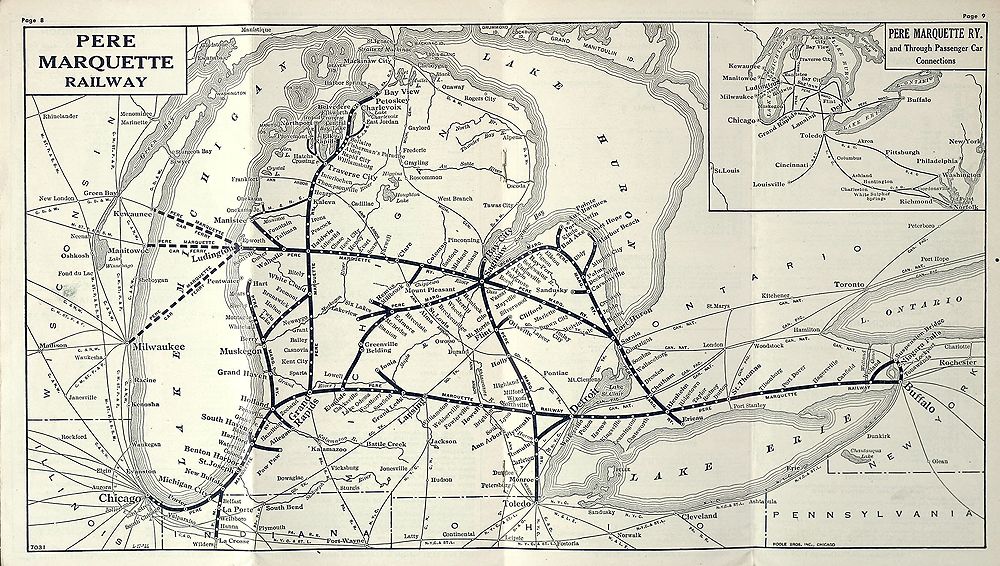
Pere Marquette route map from a 1944 timetable.
Via Classic Trains.
In the ensuing years, the rectangular PM logo would largely disappear from view, although the road’s eventual 12 E7’s wore the script Pere Marquette train name, along with C&O identification, into the mid-1950s, thanks to equipment trust restrictions. PM’s three GE 70-tonners of 1947 were sold, but a few of its 16 EMD switchers (2 SW1’s of 1939 and ’42, 14 NW2’s of 1943–46) carried PM lettering into the 1960s, and C&O kept PM’s color pattern of yellow front-end bands with red pinstriping on a blue body on 11 more EMDs of 1948 that came fully lettered C&O: NW2’s 1850–1856 and E7’s 95–98.
As for the famous Berkshires, they, along with all of Pere Marquette’s steam locomotives, were retired by 1951. Eleven found a temporary reprieve on C&O’s Chesapeake District in Kentucky and West Virginia, but only for a few months. Two, 1223 and 1225, survived as display items in Michigan, and as a student at Michigan State University, I became involved with the restoration of the 1225, which today occasionally operates on excursions.
Perhaps it’s fitting that the Pere Marquette’s last equipment order as an independent railroad was in 1947 for six of EMD’s 1,500 h.p. BL2 “branchline” diesels, Nos. 80–85. Chosen to negotiate PM’s web of secondary lines — most of them rooted in the road’s origins as a logger — the homely diesels were as quirky and as singular as the PM itself. Pointedly, even though they sported the “speed striping” as found on the E7’s, the BL2’s were delivered in full “Chesapeake & Ohio” lettering.
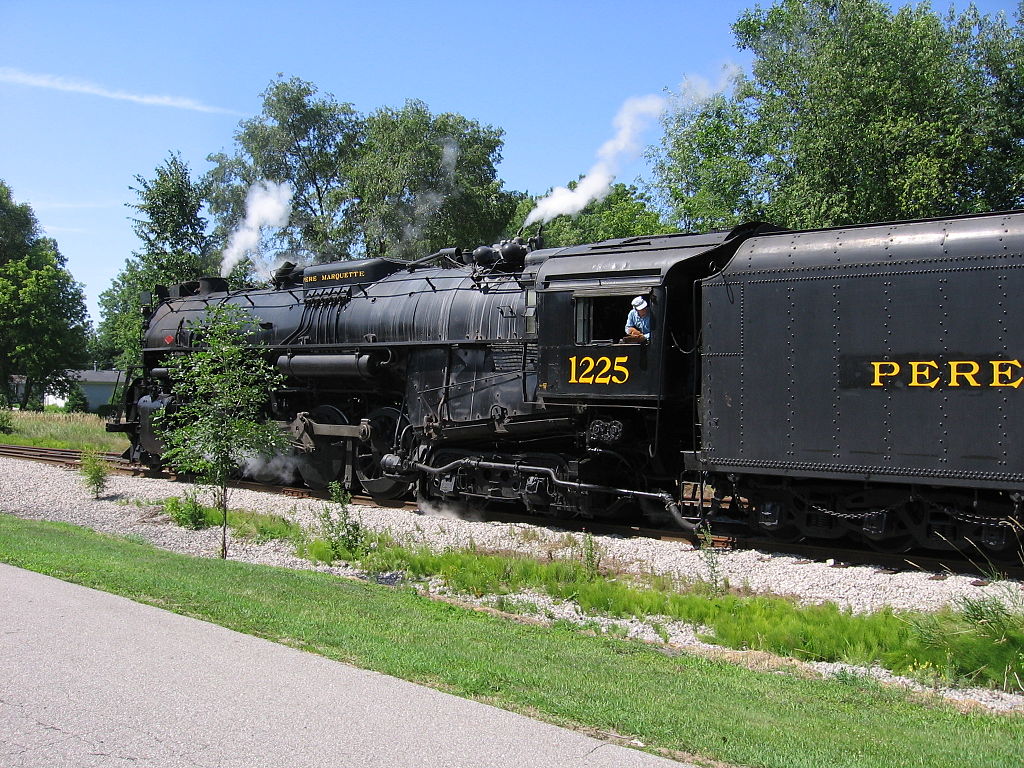
Pere Marquette 1225, a Berkshire 2-8-4 steam locomotive, passes through Alma in March 2009.
Photo by Chelseyafoster via Wikimedia Commons.
The Pere Marquette also had a maritime division and one of their ships had a disastrous voyage (via Wikipedia) 110 years ago:
The Pere Marquette operated a number of rail car ferries on the Detroit and St. Clair Rivers and on Lake Erie and Lake Michigan. The PM’s fleet of car ferries, which operated on Lake Michigan from Ludington, Michigan to Milwaukee, Kewaunee, and Manitowoc, Wisconsin, were an important transportation link avoiding the terminal and interchange delays around the southern tip of Lake Michigan and through Chicago. Their superintendent for over 30 years was William L. Mercereau.
Pere Marquette 18
On September 10, 1910, Pere Marquette 18 was bound for Milwaukee, Wisconsin, from Ludington, Michigan, with a load of 29 railroad freight cars and 62 persons. Near midnight, the vessel began to take on massive amounts of water. The captain dumped nine railroad cars into Lake Michigan, but this was no use — the ship was going down. The Pere Marquette 17, traveling nearby, picked up the distress call and sped to assist the foundering vessel. Soon after she arrived and she could come alongside, the Pere Marquette 18 sank with the loss of 28 lives; there were 33 survivors. Her wreck has yet to be located and is the largest unlocated wreck of the Great Lakes.
1884 Tacticool: Silver & Fletcher’s “Expert” Auto-Ejector
Forgotten Weapons
Published 1 Dec 2019In 1884, Hugh Silver and Walther Fletcher patented a system to rapidly unload a gate-style revolver. They negotiated an agreement to have their system integrated into Webley revolvers (specifically the New Model RIC) as an option, and sold about 350 of them, including some to both the Royal Irish Constabulary and the Metropolitan London Police, under the name “The Expert”. Not so different from today’s tactical widget market, eh? The practical use of the system was to bypass the glacially-slow manual ejector rod and instead unload a cylinder full of empty cases simply by pulling the trigger six times in rapid succession. To avoid the obvious potential safety hazard this entailed, they also added a safety to retract the firing pin. It’s this firing pin safety that people usually notice when seeing the guns, as it is much more visible than the ejection mechanism.
The system could also be used to eject empty cases one by one as the gun was fired, although doing so required leaving the loading gate open while firing. The Webley revolvers made with the system are devoid of Webley company markings, although they do have both a Webley serial number (most being in the 33,000 – 36,000 range) and a Silver & Fletcher number (between 1 and about 350).
http://www.patreon.com/ForgottenWeapons
Cool Forgotten Weapons merch! http://shop.bbtv.com/collections/forg…
Contact:
Forgotten Weapons
6281 N. Oracle #36270
Tucson, AZ 85704

QotD: “To translate is to betray a little”
Although I had studied French and English and German, the translations I’d done so far were of the “I took the pen of my neighbor” variety. I thought the class would teach me to smooth out the sentence to “I took my neighbor’s pen” and that would be that.
I was wrong. Oh, it taught that also, but that was a minor portion of it. The class mostly hinged on the moral, ethical and — most of all — professional dilemmas of being a translator. I know any number of you are translators, formal or informal, but any number of you are also not. So, for the ones who are not, let me break the news with my usual gentleness:
There is no such thing as translation.
The French have a proverb “to translate is to betray a little” — or at least that’s the closest meaning in English. It’s fairly close to the true meaning, but slightly askew, of course. Every language is slightly askew to other languages.
The idea that there exists in every language a word that is exactly the equivalent of other languages is sort of like assuming that aliens will — of course — live in houses, go to school, ride buses, understand Rebecca Black’s “Friday”.
Language is how we organize our thoughts, and each word, no matter how simple, carries with it the cultural freight and experience of the specific language. Oh, “mother” will generally mean “the one who gave birth to” — except for some tribal, insular cultures where it might mean “the one who calls me by her name” or “my father’s principal wife” — but the “feel” behind it will be different, depending on the images associated with “mother” in the culture.
So, when you translate, you’re actually performing a function as a bridge. Translation is not the straightforward affair it seems to be but a dialogue between the original language and the language you translate into. If you’re lucky, you meet halfway. Sometimes that’s not possible, and you feel really guilty about “lying” to the people receiving the translation. When on top of language you need to integrate different cultures and living systems (which you do when translating anything even an ad) you feel even more guilty, because you’re going to betray, no matter how much you try. At one point, a while back, I had my dad on one phone, my husband on the other, and I was doing rapid-fire translation about a relatively straight forward matter. And even that caused me pangs in conscience, because my dad simply doesn’t understand how things are done here. I had to approach his experience and explain our experience in a way he wouldn’t think I was insane or explaining badly. That meant a thousand minor lies.
Sarah Hoyt, “Betraying A Little – A Blast From The Past From June 2011”, According to Hoyt, 2018-01-09.
April 1, 2020
The end of US neutrality? The Lend-Lease Act – WW2 Special Episode
World War Two
Published 31 Mar 2020The United States of America aims to remain neutral during World War Two. But they see it in their best interest to aid the British in their fight against Nazism. The Lend-Lease Act is designed to do exactly that.
Join us on Patreon: https://www.patreon.com/TimeGhostHistory
Or join The TimeGhost Army directly at: https://timeghost.tvFollow WW2 day by day on Instagram @World_war_two_realtime https://www.instagram.com/world_war_t…
Between 2 Wars: https://www.youtube.com/playlist?list…
Source list: http://bit.ly/WW2sourcesHosted by: Indy Neidell
Written by: Joram Appel
Produced and Directed by: Spartacus Olsson and Astrid Deinhard
Executive Producers: Bodo Rittenauer, Astrid Deinhard, Indy Neidell, Spartacus Olsson
Creative Producer: Joram Appel
Post-Production Director: Wieke Kapteijns
Research by: Scott Grimwood and Joram Appel
Edited by: Mikołaj Cackowski
Map animations: Eastory (https://www.youtube.com/c/eastory)Colorizations by:
Norman Stewart – https://oldtimesincolor.blogspot.com/
Adrien Fillon – https://www.instagram.com/adrien.colo…
Dememorabilia – https://www.instagram.com/dememorabilia/Sources:
Plane by Graphic Enginer from the Noun Project
people by ProSymbols from the Noun Project
Allierte soldater under kampene om Narvik, courtesy Arkiv i Nordland https://flic.kr/p/a829tgSoundtracks from the Epidemic Sound:
Johannes Bornlof – “Deviation in Time”
Rannar Sillard – “March Of The Brave 4”
Phoenix Tail – “At the Front”
Hakan Eriksson – “Epic Adventure Theme 3”
Johannes Bornlof – “The Inspector 4”Archive by Screenocean/Reuters https://www.screenocean.com.
A TimeGhost chronological documentary produced by OnLion Entertainment GmbH.
From the comments:
World War Two
1 hour ago (edited)
On 11 March, 1941, American President Roosevelt signed the Lend-Lease Act, as Indy has covered in the weekly episode on that week. We wanted to revisit that bill in a special episode since it is arguably one of the most consequential American actions of the war before December 1941. Now, the effects of the bill are not visible immediately, but later in the war we will definitely revisit some of the materiel that entered British service under Lend-Lease. We hope you all remain safe and healthy!
Cheers, Joram

Curator’s Tank Museum Tour: Tank Story Hall – WW1 | The Tank Museum
The Tank Museum
Published 31 Mar 2020Join Curator David Willey as he takes you on a tour of The Tank Museum’s Tank Story Hall, which houses over 30 key vehicles from Little Willie to Challenger 2. In this section he looks at the First World War vehicles and gives you a potted history of WW1.
Support the work of The Tank Museum on Patreon: ► https://www.patreon.com/tankmuseum
Visit The Tank Museum SHOP & become a Friend: ► https://tankmuseumshop.org/Twitter: ► https://twitter.com/TankMuseum
Instagram: ► https://www.instagram.com/tankmuseum/
Tiger Tank Blog: ► http://blog.tiger-tank.com/
Tank 100 First World War Centenary Blog: ► http://tank100.com/
#tankmuseum #tanks

The Orient Express: King of Trains, Train of Kings
Geographics
Published 29 Nov 2019The journey to the Express was not a simple one. For upper class travellers to enjoy a luxury, non-stop train ride across seven nations, it would take the dream of a lovesick Belgian engineer, with his rather interesting supporting cast: an American industrialist, the inventor of US tabloid journalism, the Prince of Wales, and one of the most prolific mass murderers of the 19th and 20th Centuries.
Credits:
Host – Simon Whistler
Author – Arnaldo Teodorani
Producer – Jennifer Da Silva
Executive Producer – Shell HarrisBusiness inquiries to admin@toptenz.net

Getting the federal government out of the media business
Far from subsidizing the faltering mainstream media, the Canadian government should follow Ted Campbell’s advice here:

Direct subsidies will make many Canadians suspicious that the media has been bought and paid for and is little better than a government PR agency. Government advertising will bring charges of taxpayers’ money being used to publish propaganda. I wonder if tax breaks might help … maybe, as long as they are available, equally, to The Star and Rebel Media, and the North Renfrew Times, too I suppose. But where does it stop? Is my blog a news source? No, quite clearly not, it is almost 100% opinion, but what about blogs like Vivian Krause’s Fair Questions? It looks a lot more like reporting than what I do. In fact, some of her reporting looks a lot better than what the CBC does, doesn’t it? So where would the bureaucrats who draft the laws and regulations and then implement them draw the lines? Let’s assume that the traditional, mainstream media ~ the Globe and Mail and Global TV and so on ~ get tax breaks, and let’s assume that I don’t qualify. Who else does? Who makes that decision? Is it a politician, someone like the current Heritage Minister Steven Guilbeault? Is it another the so-called “arm’s-length” boards that act as surrogates for the ministers? Or is it a team of bureaucrats? Who do we trust? None of the above?
The better answer, it seems to me, is to do pretty much exactly the opposite of what Daniel Bernhard recommends:
- First: defund most of the CBC. Make it a national (and international) radio network (actually, two networks: one English and one French). Sell off ALL of the CBC’s TV broadcast licences and ALL of its TV production facilities and many of its major radio production facilities, too. Keep a fair number of local studios, especially in rural and remote regions, and a handful (five or six?) larger regional news centres and two (one English, one French) national and international newsrooms that will provide both voice and text reports ~ over the air and on the internet, free for all Canadians and totally free of copyright so that any news agency can use them;
- Second, provide no, zero, nada, zilch funding to any news organization. Watch and see how they shake out in this rapidly changing environment. Remove or reduce most foreign ownership restrictions. Encourage “bundling” ~ allow e.g. telecom companies like Bell and Rogers to own and to integrate newspapers and TV stations and radio stations and internet platforms and entertainment sources, too; and
- Third, get the CRTC out of the business of the internet and cable. There is a legitimate role for an independent regulator to manage scarcity. Over-the-air radio and TV channels are always in limited (and often in short) supply and they need to be allocated (licensed) to individual broadcasters; that’s a useful job for the CRTC. There is no scarcity of capacity on the landlines, cables and even satellite links in Canada. The market does a first-rate job of regulating them; the CRTC does, at best, a third-rate job.
I am certain that there are useful, profitable business models for media out there. The fact that we don’t seem to have one in Canada is, in my opinion, because of the existence of the CBC, which distorts the market too much, and the constant efforts of governments (national, provincial and even local) to try to “support” commercial favourites. The right move is to stand back and remove the heavy hand of bureaucracy and let the media find its own, profitable business model. There is a very limited role for government but Canada does not need a Ministry of Truth.
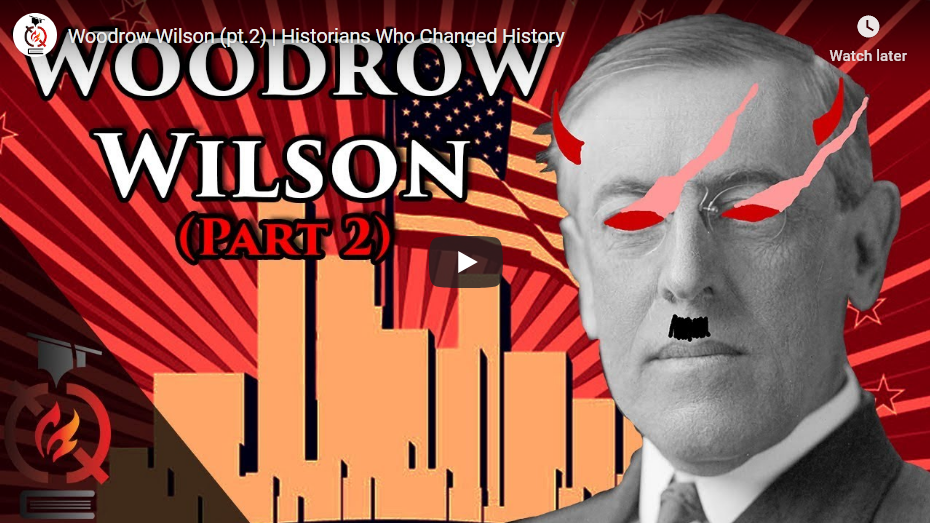
Woodrow Wilson (pt.2) | Historians Who Changed History
The Cynical Historian
Published 8 Feb 2018This is the second part of a 2 part episode. The first covered Woodrow Wilson from his early years to the 1912 election. This episode is covering his presidency. I highly recommend you go see the previous one, because I’m going to refer to stuff in it a lot here.
They only allow 5 cards, so here are all the previous episodes referenced:
Wilson Part 1: https://youtu.be/Hm0Gzz53YJo
Birth of a Nation: https://youtu.be/zzsvOBjRXew
Philippine Insurrection: https://youtu.be/mmYk0xxjDDA
WWI causes: https://youtu.be/NTrk7XktTrc
WWI effects: https://youtu.be/G3vKUgoTghg
Border Wars: https://youtu.be/qs4Lp39Y8W8
Russian Intervention: https://youtu.be/1mC1bmzbgxY
1919 Red Scare: https://youtu.be/S4Pi2nYcYNw
————————————————————
[Full references in the YouTube description]Support the channel through Patreon:
https://www.patreon.com/CynicalHistorian
or pick up some merchandise at SpreadShirt:
https://shop.spreadshirt.com/cynicalh…LET’S CONNECT:
https://twitter.com/Cynical_History
————————————————————
Wiki:
The presidency of Woodrow Wilson began on March 4, 1913 at noon when Woodrow Wilson was inaugurated as President of the United States, and ended on March 4, 1921. Wilson, a Democrat, took office as the 28th United States president after winning the 1912 presidential election, gaining a large majority in the Electoral College and a 42 percent plurality of the popular vote in a four–candidate field. Four years later, in 1916, Wilson defeated Republican Charles Evans Hughes by nearly 600,000 votes in the popular vote and secured a narrow majority in the Electoral College by winning several swing states with razor-thin margins. He was the first Southerner elected as president since Zachary Taylor in 1848, and the first Democratic president to win re-election since Andrew Jackson in 1832.
————————————————————
Hashtags: #History #WoodrowWilson #PresidentWilson #KKK #BirthOfANation #Segregation #JimCrow #Wilsonianism #Interventionism #EspionageAct #SeditionAct
QotD: Government spending in theory and practice
Steven Kates, “Classical economic theory and the American recovery”, Catallaxy Files, 2018-01-15.


