Quotulatiousness

September 6, 2018

Trans-partisan planning

At Coyote Blog, Warren Meyer offers a plan to address man-made climate change, pitched to avoid being dismissed as “typical” of one or the other side:

While I am not deeply worried about man-made climate change, I am appalled at all the absolutely stupid, counter-productive things the government has implemented in the name of climate change, all of which have costly distorting effects on the economy while doing extremely little to affect man-made greenhouse gas production. For example:

  • Corn ethanol mandates and subsidies, which study after study have shown to have zero net effect on CO2 emissions, and which likely still exist only because the first Presidential primary is in Iowa. Even Koch Industries, who is one of the largest beneficiaries of this corporate welfare, has called for their abolition
  • Electric car subsidies, 90% of which go to the wealthy to help subsidize their virtue signalling, and which require more fossil fuels to power than an unsubsidized Prius or even than a SUV.
  • Wind subsidies, which are promoting the stupidist form for power ever, whose unpredictabilty means fossil fuel plants still have to be kept running on hot backup and whose blades are the single largest threat to endangered bird species.
  • Bad government technology bets like the massive public subsidies of failed Solyndra

Even when government programs do likely have an impact of CO2, they are seldom managed intelligently. For example, the government subsidizes solar panel installations, presumably to reduce their cost to consumers, but then imposes duties on imported panels to raise their price (indicating that the program has become more of a crony subsidy for US solar panel makers, which is typical of these types of government interventions). Obama’s coal power plan, also known as his war on coal, will certainly reduce some CO2 from electricity generation but at a very high cost to consumers and industries. Steps like this are taken without any idea of whether this is the lowest cost approach to reducing CO2 production — likely it is not given the arbitrary aspects of the program.

These policy mess is also an opportunity — it affords us the ability to substantially reduce CO2 production at almost no cost.

Feature History – Chinese Civil War

Filed under: China, History, Japan, Military — Tags: , , , , , — Nicholas @ 02:00

Feature History
Published on 25 Jul 2017

Hello and welcome to Feature History, featuring a civil war that done happened in China.

Help me recognise Taiwan (or not)
https://www.paypal.me/FeatureHistory
Patreon
https://www.patreon.com/FeatureHistory
Discord
https://discord.gg/Zbk4CvR
———————————————————————————————————–
I do the research, writing, narration, art, and animation. Yes, it is very lonely

QotD: Freedom of speech

Filed under: Liberty, Quotations — Tags: , — Nicholas @ 01:00

A metaphor: we have freedom of speech not because all speech is good, but because the temptation to ban speech is so great that, unless given a blanket prohibition, it would slide into universal censorship of any unpopular opinion.

Scott Alexander, “You Are Still Crying Wolf”, Slate Star Codex, 2016-11-16.

September 5, 2018

Mind Your Business Ep. 1: Breaking the Mold

Filed under: Business, Environment, Food, Health — Tags: , , — Nicholas @ 04:00

Foundation for Economic Education
Published on 4 Sep 2018

Join host Andrew Heaton as we profile the stories of interesting entrepreneurs from around the country for FEE’s newest series, Mind Your Business.

In this episode, we’ll meet Jeremy Umansky. He’s a chef with a true passion for unusual food and his unique brand of cuisine is making a big splash in the culinary world.

The continuing paranoid style in American politics

Filed under: Media, Politics, USA — Tags: , , , — Nicholas @ 03:00

John Gray discusses the mass psychosis that gripped the left in November 2016 and still has not slackened that grip:

Visiting New York a few weeks after Trump’s victory in the presidential election, I found myself immersed in a mass psychosis. The city’s intelligentsia was possessed by visions of conspiracy. No one showed any interest in the reasons Trump supporters may have had for voting as they did. Quite a few cited the low intelligence, poor education and retrograde values of the nearly 63 million Americans who voted for him. What was most striking was how many of those with whom I talked flatly rejected the result. The election, they were convinced, had been engineered by a hostile power. It was this malignant influence, not any default of American society, that had upended the political order.

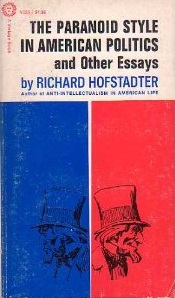
Conspiracy theory has long been associated with the irrational extremes of politics. The notion that political events can be explained by the workings of hidden forces has always been seen by liberals as a sign of delusional thinking. A celebrated study by the political scientist Richard Hofstadter, The Paranoid Style in American Politics (1964), linked the idea with the far Right. Yet in New York in December 2016, many of the brightest liberal minds exhibited the same derangement. Nearly two years later, they continue to reach to conspiracy theory as an explanation for their defeat.

The former lead book reviewer at the New York Times, Michiko Kakutani, devotes several pages to Hofsfadter’s work in her short polemic, The Death of Truth. Citing him approvingly, she notes that “the modern right wing” has “tended to be mobilised by a sense of grievance and dispossession”. As Hofstadter put it, they feel that “America has been largely taken away from them.” The charm of this citation is the lack of self-awareness it reveals. It would be difficult to find a better description of the anguish of liberals such as Kakutani, who feel they have been robbed of their historically appointed role as the moral and intellectual leaders of society.

For those who embrace it, a paranoid style of liberalism has some advantages. Relieved from any responsibility for the debacles they have presided over, the liberal elites that have been in power in many western countries for much of the past 30 years can enjoy the sensation of being victims of forces beyond their control. Conspiracy theory implies there is nothing fundamentally wrong with liberal societies, and places the causes of their disorder outside them. No one can reasonably doubt that the Russian state has been intervening in western politics. Yet only minds unhinged from reality can imagine that the decline of liberalism is being masterminded by Vladimir Putin. The principal causes of disorder in liberal societies are in those societies themselves.

Germany’s New Light Howitzer: the 7.5cm le.IG 18

Filed under: Germany, History, Military, Technology, WW2 — Tags: , , — Nicholas @ 02:00

Forgotten Weapons
Published on 15 Aug 2018

More info: https://www.forgottenweapons.com/germ…

http://www.patreon.com/ForgottenWeapons

In the aftermath of World War One, every military force immediately began to assess what they thought was most important to improve in their arsenals for the next war. For Germany, one thing they felt lacking was a light howitzer that could be organic to infantry units, mobile enough to remain with the front lines in an advance to provide easy and immediate supporting fire. The Rheinmetall company would develop just such a gun and the German military adopted it in 1932 under the designation 7.5cm leichtes Infanteriegeschutz 18.

The 7.5cm le.IG 18 fired a roughly 12 pound (5.5-6 kg) 75mm high explosive shell out to 4,000 meters, and was capable of both direct and indirect fire (elevation maxed out at 90 degrees). These guns would see service on all fronts with the German military in World War Two, remaining inservice throughout the entire war.

The mechanical operation of the gun is rather unusual for an artillery piece, with a fixed breech and a barrel which tips up from the muzzle for loading and ejection. This did not really convey any particular advantage, but it also did not have any particular weakness and was quite satisfactory in action.

If you enjoy Forgotten Weapons, check out its sister channel, InRangeTV! http://www.youtube.com/InRangeTVShow

QotD: Why did appeasing the Fascist dictators seem such a sensible policy?

Filed under: Europe, History, Quotations — Tags: , , , , , — Nicholas @ 01:00

It is a familiar student essay question, whether the revolution could have been averted, but for the world war and resultant loss of up to three million Russian lives. It seems more useful merely to suggest that, in the political and ideological climate of the early 20th century, the collectivist experiment was bound to be attempted somewhere, and Russia or China were obvious testbeds. The consequences for millions of Russian peasants, together with the ferocity of Soviet oppression, were successfully concealed from most western eyes for half a century. The 1789 French revolution killed only a few thousand aristocrats and transferred land to peasants, who thus became ardent upholders of property rights. The Russian version required liquidation of the entire governing class and transfer of land to collective ownership, an incomparably more radical proceeding. Douglas Smith’s 2012 book Former People gives a harrowing account of the fate of the Tsarist aristocracy.

In the West, the gullibility of the Webbs, Bernard Shaw and the rest of the ‘true believers’ was fed by a desperation to suppose the Soviet example viable. ‘Looking around us at our own hells,’ wrote the historian Philip Toynbee, who became a communist at Cambridge, ‘we had to invent an earthly paradise somewhere else’. As late as 1945, the leftist publisher Victor Gollancz brought posterity’s contempt upon himself by declining to publish Animal Farm, George Orwell’s great satire on Bolshevism.

For a counter-revolutionary contemporary perspective, it is impossible to understand the 1930s appeasement of the dictators without grasping the traumatic impact of events in Russia on the propertied classes everywhere. The Winter Palace was stormed only 16 years before Hitler came to power. For at least two decades, Europe’s ‘haves’ were far more frightened of Bolshevism than of fascism.

The ‘clubland hero’ novels of John Buchan and Sapper offer embarrassing glimpses of the British bourgeois view of Lenin’s people and their followers in the decades following the revolution. A belief took hold in polite circles that the bloodiest revolutionaries were not merely communists but also Jews, which meant they were doubly damned in St James’s clubs.

Max Hastings, “The centenary of the Russian revolution should be mourned, not celebrated”, The Spectator, 2016-12-10.

September 4, 2018

Grad school mafia

Filed under: Bureaucracy, Education — Tags: , , — Nicholas @ 05:00

In the Chronicle of Higher Education, Andrea Long Chu recounts her experience as a teaching assistant to Professor Avital Ronell, and the disturbing psychological world inhabited by grad students at New York University:

Structural problems are problems because real people hurt real people. You cannot have a cycle of abuse without actually existing abusers. That sounds simple, which is why so many academics hate it. When scholars defend Avital — or “complicate the narrative,” as we like to say — in part this is because we cannot stand believing what most people believe. The need to feel smarter is deep. Intelligence is a hungry god.

In this way, Avital’s case has become a strange referendum on literary study. Generations of scholars have been suckled at the teat of interpretation: We spend our days parsing commas and decoding metaphors. We get high on finding meaning others can’t. We hoard it, like dragons. We would be intellectually humiliated to learn that the truth was plain: that Avital quite simply sexually harassed her student, just as described. Sometimes analysis is simply denial with more words. Sometimes, as a frustrated student in a first-year literature course always mutters, the text just means what it says it means.

My department has been largely silent since the news broke. Faculty members have said nothing to us. Upset and ashamed, my fellow graduate students and I speak with one another cautiously. We heal, or don’t, alone. People I know are afraid to make any public comment, even on Facebook, where they are friends with older, richer scholars who might one day control their fates. Even I, who have by extraordinary luck options outside of academia, fear what being vocal will bring.

A culture of critics in name only, where genuine criticism is undertaken at the risk of ostracism, marginalization, retribution — this is where abuses like Avital’s grow like moss, or mold. Graduate students know this intuitively; it is written on their bones. They’ve watched as their professors play favorites, as their colleagues get punished for citing an adviser’s rival, as funding, jobs, and prestige are doled out to the most obedient and obsequious. The American university knows only the language of extortion. “Tell,” it purrs, curling its fingers around your IV drip, “and we’ll eat you alive.”

Avital conducts herself as if someone somewhere is always persecuting her. She learned this, I imagine, in graduate school. No woman escapes the relentless misogyny of the academy. The humanities are sadistic for most people, especially when you aren’t a white man. This is understood to be normal. When students in my department asked for more advising, we were told we were being needy. “Graduate school should destroy you,” one professor laughed.

The irony is that those who survive this destruction often do so at the cost of inflicting the same trauma on their own students. Avital, now a grande dame of literary studies, who Reitman alleges bragged to him of a “mafia”-like ability to make or break the careers of others, still feels persecuted. She makes it the job of those around her to protect her from that persecution: to fawn, appease, coddle. The lawsuit against her reads as a portrait, not of a macho predator type, but of a desperately lonely person with the power to coerce others, on pain of professional and psychic obliteration, into being her friends, or worse.

Debunking claims from The Technology of Orgasm

Filed under: Books, Health, History — Tags: , , , — Nicholas @ 05:00

Alex Tabarrok linked to this paper [PDF] examining the claims that have long since become embedded in academia but appear to have no factual basis at all:

You know the story about the male Victorian physicians who unwittingly produced orgasms in their female clients by treating them for “hysteria” with newly-invented, labor-saving, mechanical vibrators? It’s little more than an urban legend albeit one transmitted through academic books and articles. Hallie Lieberman and Eric Schatzberg, the authors of a shocking new paper, A Failure of Academic Quality Control: The Technology of Orgasm, don’t quite use the word fraud but they come close.

    The Technology of Orgasm by Rachel Maines is one of the most widely cited works on the history of sex and technology. Maines argues that Victorian physicians routinely used electromechanical vibrators to stimulate female patients to orgasm as a treatment for hysteria. She claims that physicians did not perceive the practice as sexual because it did not involve vaginal penetration. The vibrator was, according to Maines, a labor-saving technology to replace the well-established medical practice of clitoral massage for hysteria. This argument has been repeated almost verbatim in dozens of scholarly works, popular books and articles, a Broadway play, and a feature-length film. Although a few scholars have challenged parts of the book, no one has contested her central argument in the peer-reviewed literature. In this article, we carefully assess the sources cited in the book. We found no evidence in these sources that physicians ever used electromechanical vibrators to induce orgasms in female patients as a medical treatment. The success of Technology of Orgasm serves as a cautionary tale for how easily falsehoods can become embedded in the humanities.

I was not surprised when I ran a quick search for the cover of the Maines book (embedded above) and the vast majority of images returned were NSFW.

WW1 Trucks and Logistics I THE GREAT WAR On The Road

Filed under: Britain, History, Military, WW1 — Tags: , , — Nicholas @ 04:00

The Great War
Published on 3 Sep 2018

Indy and David Willey of the Tank Museum talk a bit about trucks and logistics during WW1 while sitting in some sweet vintage World War 1 trucks.

“So now we know what ‘the resistance’ really is. It’s the establishment”

Filed under: Government, Media, Politics, USA — Tags: , , , — Nicholas @ 03:00

Brendan O’Neill on the funeral of “maverick” Republican senator John McCain:

So now we know what ‘the resistance’ really is. It’s the establishment. It’s the old political order. It’s that late 20th-century political set, those out-of-touch managerial elites, who still cannot believe the electorate rejected them. That is the take-home message of the bizarre political spectacle that was the burial of John McCain, where this neocon in life has been transformed into a resistance leader in death: that while the anti-Trump movement might doll itself up as rebellious, and even borrow its name from those who resisted fascism in Europe in the mid 20th-century, in truth it is primarily about restoring the apparently cool, expert-driven rule of the old elites over what is viewed as the chaos of the populist Trump / Brexit era.

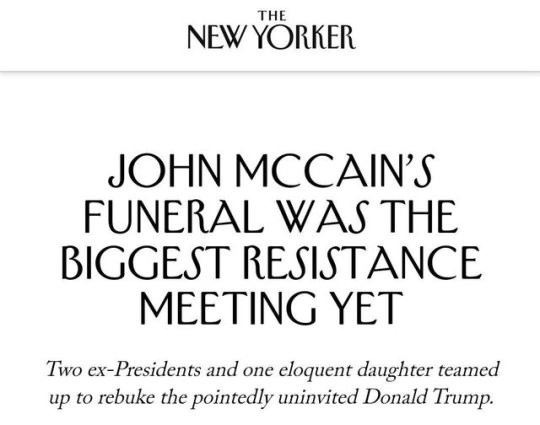
The response to McCain’s death has bordered on the surreal. The strangest aspect has been the self-conscious rebranding of McCain as a searing rebel. In death, this key establishment figure in the Republican Party, this military officer, senator, presidential candidate and enthusiastic backer of the exercise of US military power overseas, has been reimagined as a plucky battler for all that is good against a wicked, overbearing political machine. ‘John McCain’s funeral was the biggest resistance meeting yet’, said a headline in the New Yorker, alongside a photo of George W Bush, Bill Clinton, Hillary Clinton, Al Gore, and soldiers from the US Army, the most powerful military machine on Earth. This is ‘the resistance’ now: the former holders of extraordinary power, the invaders of foreign nations, the Washington establishment.

The New Yorker piece, like so much of the McCain commentary, praises to the heavens the anti-Trump theme of McCain’s funeral. McCain famously said Trump couldn’t attend his funeral. And that in itself was enough to win him the posthumous love of a liberal commentariat that now views everything through the binary moral framework of pro-Trump (evil, ill-informed, occasionally fascistic) and anti-Trump (decent, moral, on a par with the warriors against Nazism). Even better, though, was the fact that orators at the funeral, including McCain’s daughter Meghan and both Bush and Obama, used the church service to slam Trumpism, without explicitly mentioning it, and in the process to big-up what came before Trumpism, which of course was their rule, their politics, their establishment. The Washington political and media set might seem bitterly bipartisan, said the New Yorker writer, but it is also ‘more united’ in one important sense – ‘in its hatred of Donald Trump’.

[…]

The religious allusions, the talk of vengeance against Trump, the misremembering of McCain’s life so that it becomes a moral exemplar against the alleged crimes of Trumpism, exposes the infantile moralism of the so-called resistance. Albert Burneko, assessing some of the madder McCain commentary, says there is now a ‘condition’ that he calls ‘Resistance Brain’, where people display an ‘urge to grab and cling on to anything that seems, even a little bit, like it might be the thing that Finally Defeats Donald Trump’. Even if the thing they’re grabbing on to is actually a bad thing. Like a seemingly endless FBI investigation into the elected presidency. Or George W Bush, whose moral rehabilitation on the back of Anti-Trumpism has been extraordinary. Or neoconservatism: this was the scourge of liberal activists a decade ago, yet now its architects are praised because they subscribe to the religion of Anti-Trumpism. Being against Trump washes away all sins.

How do plasma TVs work? I James May Q&A I Head Squeeze

Filed under: History, Technology — Tags: , — Nicholas @ 02:00

BBC Earth Lab
Published on 18 Oct 2013

So how do plasma TV’s work? Believe it or not the concept of plasma displays had been invented as long ago as the 1930’s, Not quite 21st cutting edge technology! The idea is that instead of using electrons to create lines, the plasma screen uses three fluorescent light cells, one in each primary colour.

Plasma displays are considerably shallower than older TVs, you can mount them on a wall and conveniently hide them behind a well-placed curtain. They can also be scaled up by adding more pixels and enough power to run them. The biggest plasma TV we found was a 152 inch! That’s pretty much 3 meters long and will set you back a measly £380,000.

I bet your TV is not as big as 152 inches! If you enjoyed this vid then why not give us a thumbs up or share it with your friends.

QotD: Law and morality

Filed under: Law, Liberty, Quotations — Tags: , , — Nicholas @ 01:00

In the first place, it would efface from everybody’s conscience the distinction between justice and injustice. No society can exist unless the laws are respected to a certain degree, but the safest way to make them respected is to make them respectable. When law and morality are in contradiction to each other, the citizen finds himself in the cruel alternative of either losing his moral sense, or of losing his respect for the law — two evils of equal magnitude, between which it would be difficult to choose.

Frédéric Bastiat, The Law, 1850.

September 3, 2018

WW2 – September 1 1939 – The Polish German War

Filed under: Europe, Germany, History, Japan, Military, WW2 — Tags: , , , — Nicholas @ 04:00

World War Two
Published on 1 Sep 2018

When Germany invades Poland on September 1 1939, the world is already at the brink of a new world war…

Between 2 Wars: https://www.youtube.com/playlist?list…

Written and Hosted by: Indy Neidell
Produced and Directed by: Spartacus Olsson and Astrid Deinhard
Executive Producers: Bodo Rittenauer, Astrid Deinhard, Indy Neidell, Spartacus Olsson
Research by: Indy Neidell
Edited by: Spartacus Olsson

Join us on Patreon: https://www.patreon.com/TimeGhostHistory
Or join The TimeGhost Army directly at: https://timeghost.tv

A TimeGhost chronological documentary produced by OnLion Entertainment GmbH

Apologies for this going out a day later than usual … I was out of town on the weekend with very limited internet connectivity. Future TimeGhost/Between2Wars episodes will appear closer to their release days (usually the next day).

Montreal to host urban combat

Filed under: Cancon, Military — Tags: , , — Nicholas @ 03:00

… oh, sorry, that should be that Montreal will be hosting an experiment involving new technologies for urban combat:

Defence scientists from a number of countries will be in Montreal in mid-September to participate in an experiment to look at new technologies for fighting and conducting operations in cities.

The Contested Urban Environment 2018 experiment will take place from September 10 to 21, and involve Canadian defence scientists and Canadian Forces personnel conducting a series of technology research experiments in the city. They will be joined by participants from nations including Australia, New Zealand, the United Kingdom and the United States. The experiment is being conducted in support of advancing research around how to best conduct military operations in what is being called “complex urban environments,” according to the Department of National Defence.

Postmedia reported last year that Canada will contribute to specific areas of expertise in this field, including technologies in intelligence, surveillance, reconnaissance, communications and small arms.

Canada participated in a similar experiment last year in Australia. Approximately 80 scientists from the U.S, Australia, Canada, New Zealand and the UK took part in that experiment, which began Nov. 20 and ended Dec. 1. The Canadian contingent consisted of 10 staff from Defence Research and Development Canada. In addition, around 100 personnel from the Australian Defence Force were involved.

« Newer PostsOlder Posts »

Powered by WordPress