Published on 10 May 2017
This week, James & Antony tackle minimum wage laws and present some hard facts that might surprise a lot of people.
See the YouTube description for a long list of links related to this discussion.

Published on 10 May 2017
This week, James & Antony tackle minimum wage laws and present some hard facts that might surprise a lot of people.
See the YouTube description for a long list of links related to this discussion.
A recent email from Sears Canada promises that your lace underwear should not only provide comfort, but also empowerment:
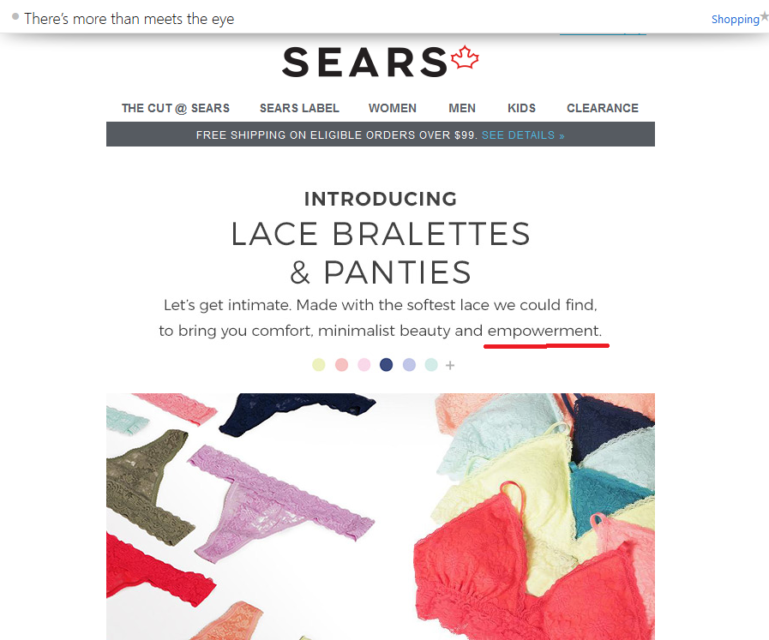
How will you go back to your ordinary non-empowering bras and panties after wearing those?
Published on 24 Feb 2015
Before commenting about glue, please see the followup: http://www.youtube.com/watch?v=WMi6W2cvw7g
More about these tests here:
http://woodgears.ca/joint_strength/pockethole.html
Stereotypes are of course a tool of the trade for writers. We have to know what the stereotypes are in people’s minds, and therefore use them to suggest things we can’t thoroughly describe. (No one can thoroughly describe everything, even in a long book. Nor would you want them to. It would get truly tedious.)
Sometimes I fail at this, the same way I have trouble picking fonts for covers, because the stereotypes in my head are not the same as in most of my readers’. Take Irishmen for instance. I actually know something about the stereotype here, because it’s all over the books everywhere. However, if I’d tried to write an Irishman (or woman) when I came here, and assumed that my readers knew to round out the character with extreme politeness, drive and organization, it would backfire, and at best people would think I was being creative. At worst it would be a “wait, what?”
I suspect the Portuguese stereotype for Irish tells you rather more than you want to know about Portugal, but also about the sort of Irish we got in Portugal. Here you go people looking to make a new living, perhaps not drawn from the higher echelons of society. There you got either rich people, or people who came over as upper servants to British residents. In either case, the unruly Irishman stereotype doesn’t apply, even if both agree on song and poetry.
In the same way I often disappoint on the Portuguese stereotype, because my family runs to relatively tall, I haven’t been in the sun much the last few years, and oh, yes, I fail to be outwardly and loudly pious.
Sarah A. Hoyt, “Dealing in Stereotypes”, According to Hoyt, 2015-07-28.
Published on 10 May 2017
“I’ve lived my life as a pro free enterprise person,” explains Flying Dog Brewery CEO Jim Caruso. “Not pro business. Pro free enterprise, pro consumer choice, artisanal manufacturing.”
—
A central player in America’s craft beer revolution, Caruso is dedicated to creating something special both inside and outside the bottle. Famed artist Ralph Steadman, best known for his iconic illustrations for work by Hunter S. Thompson, creates all of Flying Dog’s labels. It was Steadman who spontaneously wrote on his first commissioned label “good beer, no shit.” And it was this label that kicked of Flying Dog’s first — but not last — fight with government censors.Caruso sat down with Reason’s Nick Gillespie to talk about his run-ins with the state, why he is a libertarian, and the how his values keep him happy.
“I’m a happy person. And I attribute that to living as an individual, taking self responsibility, self reliance, but connected to society. It’s not a lone ranger sort of thing.”
Cameras by Meredith Bragg, Todd Krainin, and Mark McDaniel. Edited by Bragg.
Jay Currie explains why, even though they didn’t “win” the election, the BC Green Party is the biggest winner from yesterday’s general election in the province:
There are two losers tonight: the Liberals and the NDP. And there is one winner: the Greens. They managed to split the NDP vote and likely cost the NDP a majority government.
However, where the NDP and the Liberals have no obvious room to grow their electorate, the Greens have a very good shot at expanding theirs. The fact is that the people who shop at Whole Foods, send their kids to “French Immersion” if they can’t afford private (not for racist reasons of course) and think recycling is an act of benediction are legion. They used to vote NDP, now they have an alternative.
Andrew Weaver may be a lousy climate scientist but he is not an unintelligent man. He can count (so long as it does not involve climate change time series) and there are six ridings where the Greens came second. A rational, non-coalition, support of the Liberals would let him pass legislation of greater consequence than a ban on mandatory high heels for women in serving jobs. The Liberals, who will likely be reduced to a rural rump despite having likely won the most seats, are basically being elected by BC’s version of “deplorables”. Nice people think they are a bit, well, common.
Dr. Weaver, well educated, Oak Bay resident and articulate guy that he is should be able to target those nice, white, very liberal people and peel them away from both the Liberals and the NDP. Plus, Weaver has the children who have grown up on Green ideology masquerading as education.
One winner tonight: the Greens.
Blogs aren’t as relevant today as they were a decade ago, but I’m still recording over 1.7 million hits every year (1,701,503 according to my WordPress stats page, which translates into 1,287,505 unique visitors). Those numbers are down a bit from 2014, which is still my peak year for overall traffic, when 1,766,068 visits were logged (2015 was down to 1,741,859, but it was the first decline in traffic year-over-year since I started blogging in May 2004).
While I’ve (almost) always had a daily quote of the day post, in the last few months, I’ve been adding a video of the day as well — I know a lot of people are more visually oriented than I am, so I’m trying to avoid the “wall of text” look that the blog sometimes gets when there’s a lot of written material unrelieved by graphics, photographs, or videos. Am I striking the right balance for you, the readers? Should I be scraping the Wikimedia archives for more graphics to spice up the postings visually?
Earlier anniversary postings:
Published on 22 Jul 2016
Confused by all the wood choices for woodworking? Here is all the basic info you need to get started buying lumber. Woodworking for Mere Mortals BASICS series. Read the full article here ►► http://bit.ly/WoodBasics
“Reality”-based game shows, by no means a U.S.-driven or U.S.-invented phenomenon, may recruit individuals who appear truly random. In practice, the contestants are selected for extreme personality features that the format elicits quickly. The future annals of reality TV will tell how little time it took for shows like Survivor to abandon their original regular-folks pretense — it was a matter of weeks in the case of the U.S. Survivor. Within months the more typical reality-competition show was something like Real World/Road Rules Challenge, i.e., a cauldron of freewheeling pathology spiced with sex and violence.
At any rate, everyone who appears on an actual television program has passed an implicit “can be on television” test for looks. The test is not strict: I was a semi-regular on a deep-cable panel show, and look at me. But try walking in the downtown of any major city and counting the number of people who have tics or wens or facial asymmetries that would disqualify them outright from TV. Needless to say, you don’t hear quite the same range of accents you do at a food-court MacDonald’s, either. It is probably to the good that we are disconnecting from television as a total environment, a multidimensional image of society plunged into at birth: those of us who were reared under those conditions must have weird, unfixable blind spots.
Colby Cosh, “On the ignominious downfall of Jared from Subway”, National Post, 2015-08-20.
Megan McArdle reports on the state of the two former mainstream parties in France after both were unable to get their presidential candidate past the first round of voting:
When I arrived in France a week ago, many Americans were asking whether this election was going to be the French Brexit, and Marine Le Pen the French Trump. Given the strength of Emmanuel Macron’s lead in the polls, I thought this was the wrong question. France, in fact, already had a Brexit-sized political earthquake, when neither of the two mainstream parties of left and right made it into the second round.
The center-right Republican Party currently seems to be flailing around, trying to decide where it goes next. It is nonetheless in better shape than the left’s Socialist Party, whose devotees are currently standing around its sickbed, speaking in hushed tones. Jean-Luc Mélenchon pinched many Socialist voters, particularly lower-income and unemployed urban dwellers, with his “France Insoumise” (France unbowed) platform; Macron won over the prosperous by coming out full-bore for Europe, globalization, economic reform, and immigration. Even Le Pen got a few in the second round, mostly those who identify as “far left.” One hates to prematurely report a death, of course, but it’s certainly hard to see how the Socialists manage to recover from their humiliating single-digit performance in the first round of this election.
With both major parties in disarray, the question naturally arises: If Emmanuel Macron’s brand of ardent globalization becomes the focal ideology for one side of the political spectrum, what will constitute the natural opposition?
[…] Right now French politics doesn’t have two poles; according to political scientist Arun Kapil, it has five: the far left, the small and hardy band of loyal Socialists, En Marche!, the Republicans, and the National Front. And one possibility is that these poles winnow somewhat, but never come back to the old intra-right and intra-left alliances that stabilized French politics into something approaching a two-party system. Mélenchon is a true believer who so far seems unwilling to make strategic alliances, and the National Front is similarly uncooperative, even if other parties wanted to cooperate with them, which they don’t. If those blocs hold onto enough voters to tip an election, but never quite enough to win one, future French elections may get kind of wild.
It’s too early to tell yet which of these possible futures will hold. But we may start to get some guess in June’s legislative elections. How well En Marche! does will provide clues to just how big a shift Macron has actually achieved in French politics. How well the Republicans do will give us some sign of whether they can get their mojo back. And the performance of the far left and the far right will indicate whether France is on its way to establishing a “new normal” not that much different from the old — or striking out for uncharted territory, where there may well be some dragons lurking.
Published on 8 May 2017
After a rather quiet winter, the war erupts into action in 1917. Not only do the United States join the war after weeks of unrestricted submarine warfare and the uncovering of the Zimmermann Telegram. The British and French launch their own spring offensives. In the East, chaos spreads in post-revolutionary Russia and Lenin returns from exile. And in Mesopotamia the British take Baghdad.
In the latest Libertarian Enterprise, D.J. Webb asks what Europe — individual European nations, not the EU — owe to Britain:
I do believe that historical perspective is important, and that we should deal with other nations on the basis of historical memory. For example, we recall in our dealings with Greece and Italy that these countries have been of vital importance to the historical development of civilization in Europe, and at a long remove, we should be cognizant of the cultural and economic advantages bestowed on the Roman province of Britannia by the Romans. At a minimum, they evoke in us a residual affection. Of course, as history recedes, the ability of these countries to demand a special status owing to their illustrious history has to decline too. But some recognition of the achievements of the most glorious nations and what they have done for all of European civilization is in order.
Britain is a special country — we are told in the media and in the schools today that this is not the case — but a cursory reading of history shows that we are of vital importance to Europe. Economically, we gave the world the industrial revolution and capitalism. Politically, democracy and human rights (even where absurdly misinterpreted) are among our gifts to the world. Culturally, literature, drama and film are among the arts to which we have made great contributions that remain to this day part of the canon of world literature. Scientifically, Europe looks to us for having provided electricity, railways, automobiles, planes, computers, the telephone, television and the Internet. It is not an exaggeration to state that the prosperity of the whole of Europe, and indeed of every country in the world, comes on the back our our ancestors’ — and not their ancestors’ — achievements. English children should grow up with a knowledge of and pride in this.
Geopolitically, we have always sought to prevent combinations on the Continent, and stood against the Habsburgs and Imperial Spain, Napoleonic France, the Kaiser’s Germany and Nazi Germany. We also made an outsized contribution in the Cold War. Numerous European countries owe their freedom to us. I do not deny that historical memory works both ways. Maybe — I say this for the purpose of discussion — the prominence of Polish airmen in the Battle of Britain provides us with good reason to take, if possible and where facilitated by Poland’s own foreign policy, a pro-Polish view of modern international affairs, and if we need immigrants going forward, we could well consider prioritising Poland, as well as Czechs, Belgians, Frenchmen, Canadians, Australians and New Zealanders, all represented in the Battle of Britain. However, there is no other European country that can lay claim to being the author of European freedom. True, Russian blood was expended to an immense degree in the defeat of Germany, but many European countries will be mindful that Russia was ultimately engaged in its own war of imperial conquest of Eastern Europe.
We are special, and do deserve recognition in Europe. Yet we get none. Or less than none, as all 27 EU countries have agreed to try to punish Britain for asserting its sovereignty. Would Luxembourg be free today without Britain? Jean-Claude Junker’s treatment of Britain is disgusting from a Luxembourgeois national. Does he not know that Luxemburgers huddled round the wireless in the 1940s listening to the World Service, hoping or praying that Britain or America would come to their salvation? I cannot abide the continental Europeans who refuse to acknowledge this. They will end up making an enemy of Britain, with long-term consequences.
It’s time to realise that the European nations we liberated were not worth it. They turned out to be ingrates. We need to face up to this. We wasted the lives of our servicemen for nothing. Who would wage war to liberate Belgium now?
Published on 8 Apr 2017
Hunted by the police, the Kelly Gang decided to strike back instead of hiding. Since he blamed the rich for all his troubles, Ned took aim at the banks and pulled off a pair of brazen robberies that helped win him renown across the countryside.
[Progressives] tend to favor policies such as New York City’s rent controls, and the new $15 minimum wage being gradually phased in in some western cities. I like to think of these policies as engines of meanness. They are constructed in such a way that they almost guarantee that Americans will become less polite to each other.
In New York City, landlords with rent controlled units know that the rent is being artificially held far below market, and thus that they would have no trouble finding new tenants if the existing tenant is unhappy. So then have no incentive to upgrade the quality of the apartment, or to quickly fix problems. They do have an incentive to discriminate against minorities that, on average, are more likely to become unemployed, and hence unable to pay the rent. Or young people, who might damage the unit with wild parties.
Wage floors present the same sort of problem as rent ceilings, except that now it’s the demanders who become meaner, not the supplier. Firms that demand labor in Los Angeles in the year 2020 will be able to treat their employees very poorly, and still find lots of people willing to work for $15/hour.
Scott Sumner, “How bad government policies make us meaner”, Library of Economics and Liberty, 2015-08-25.
Nick Gillespie on the outcome of the most recent battles in the culture wars:
Spoiler alert: I think libertarians have already won the culture war in the most important ways possible. Whether it’s businesses like Whole Foods, Overstock, and Amazon; the massive and ongoing proliferation of platforms such as Netflix, YouTube, and Twitter; or gig-economy titans such as Uber and Airbnb, capitalism and entrepreneurship has been recast as an innovative, disruptive, liberatory system that allows us all to produce and consume whatever we want under increasingly personalized and individualized circumstances. What we need to do next to nail down what Matt Welch and I have dubbed The Libertarian Moment is to articulate the ways in which our society’s cultural, economic, and even political operating system has already bought into the idea that decentralization, individualism, innovation, and freedom to experiment.
If the medium is the message (all props to Marshall McLuhan) — if an operating system is more important than any specific content generated within that system — what has been abjured as “late capitalism” for decades has effectively ended all debates about how libertarian policies and mind-sets have freed us from bland top-downism in all parts of our lives. This isn’t to suggest that we are in any way living a utopian dream. It’s simply to point out that even after 15 years of drowsy economic growth and a massive expansion of state (and in many ways, corporate) power, our living standards continue to rise. Add to that huge advances in tolerance and change when it comes to racial, ethnic, and gender disparities and transformative shifts on topics as varied as drug policy, sexual orientation, criminal-justice reform, and gun rights too.
Cultural and political pessimism isn’t just a losing strategy, it’s a misimpression. Again, that’s not to say that massive problems don’t exist and need to be confronted. Will we ever see an actual federal budget again, much less that cuts government spending? U.S. foreign policy remains a shameful, disastrous, and destructive hodgepodge of hubris and stupidity. Speech and expression are under attacks from the right and the left, and the bipartisan turn against free trade and the easy movement of people across borders needs to be beaten back. As the late, great Arthur Ekirch explained in his neglected masterpiece The Decline of American Liberalism, forces of decentralization and centralization — of liberation and authoritarianism, of individualism and collectivism, of choice and coercion — have been slugging out in the United States since before there was a United States. The question is whether we are moving generally in a direction of more autonomy and less restriction on how we live our lives.



Powered by WordPress