Steve Kates posted this at Catallaxy Files, saying it was everything you need to know about public spending:
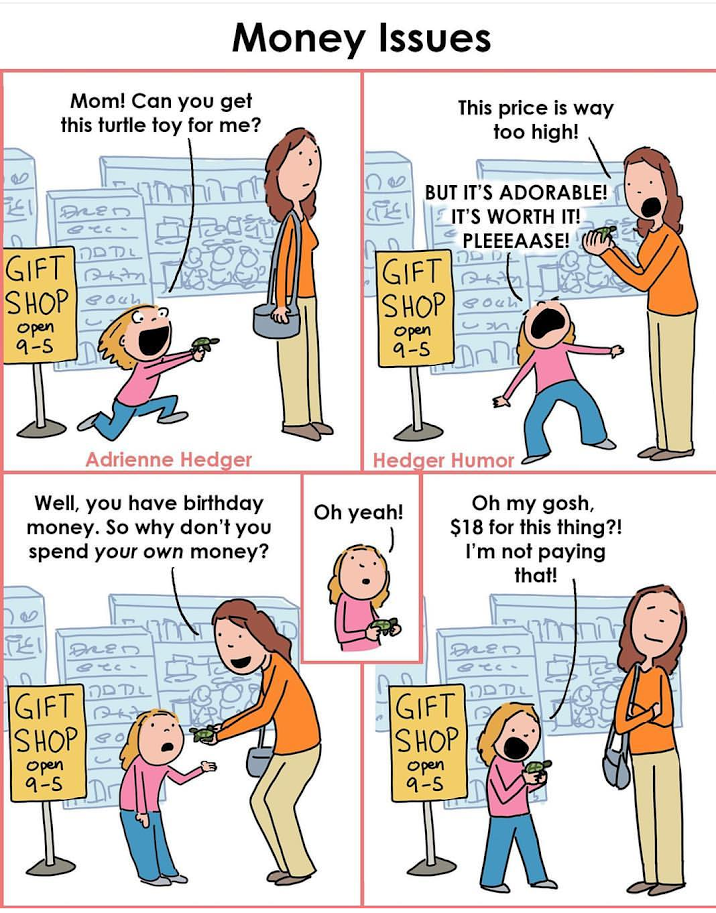

Steve Kates posted this at Catallaxy Files, saying it was everything you need to know about public spending:
Published on 13 May 2017
Chair of Wisdom Time! This week Indy talks about Junkers fighter planes, the plans for an invasion of Switzerland and he Whiter Feather Movement.
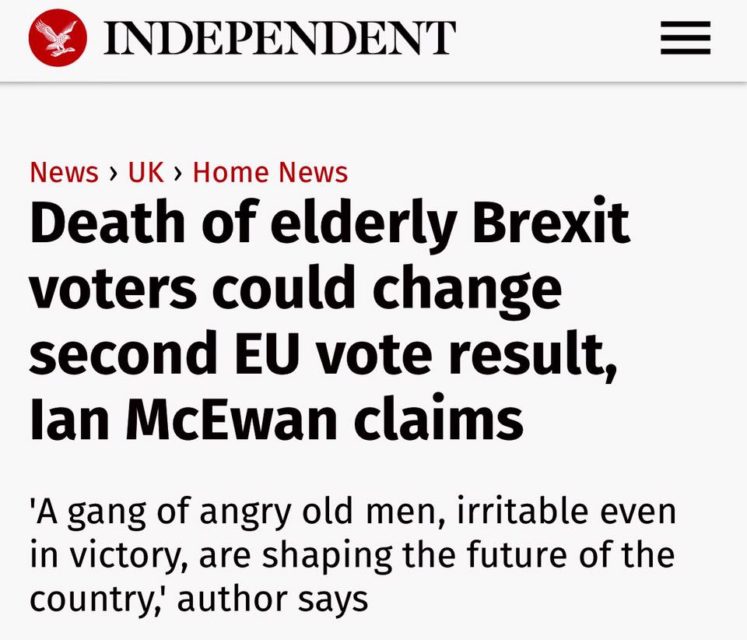
On Facebook, Brendan O’Neill responds to an article in the Independent, calling for elderly pro-Brexit voters to just die already:
Ian McEwan says the death of ageing voters, “angry old men”, will help swing Britain back to being pro-EU. Maybe we should hurry them along? Start a “Die for Britain” scheme, where old anti-Brussels bastards could sign up to have themselves put down? Make them feel so guilty for having plunged Britain and their grandchildren’s futures into uncertainty that they will lose the will to live, or certainly to vote? Initiate a cleansing of the demos, giving over-65s the option to croak it for the sake of their grandkids’ right to study in France for six weeks? Create a Euthanised For The EU scheme? We could call it EU-thanasia, perhaps get funding for it from Brussels.
I think we sometimes fail to grasp how nasty elite Remainers are. How misanthropic, anti-old, anti-working-class and of course anti-democratic they can be. Openly fantasising about old people dying is the first step towards helping old people die. It tells old people they are scum and Britain would be better off without them. Just imagine how that makes them feel. The elitist anti-Brexit outlook is the ugliest strain in British politics right now, and the ugliest I can remember in my lifetime.
Published on 4 May 2017
From astrology to the temperature in space, Dom counts down the top 5 space myths and explains why they are baloney.
1 http://astronomy.swin.edu.au/cosmos/N/Neutron+Star
2 http://www.universetoday.com/77070/how-cold-is-space/
3 https://www.wired.com/2007/11/no-dark-side-of/
4 http://www.livescience.com/34212-great-wall-of-china-only-manmade-object-visible-from-space.html
5 http://www.universetoday.com/25364/can-you-see-the-great-wall-of-china-from-space/
6 https://www.scientificamerican.com/article/fact-or-fiction-nasa-spen/
7 https://www.cambridge.org/core/journals/proceedings-of-the-international-astronomical-union/article/div-classtitleastronomy-and-astrologydiv/3171E9B009B4E8421B1913AC0A08AB32
Now, Pope Francis has the beginnings of a point about large “private corporations” (note the oxymoron), which in their wealth may grow (though only temporarily) to a size rivalling the smaller national governments. And I would add, they become nearly as centralized and monopolistic (through “regulatory capture”), and faceless and bureaucratic as the agencies of State. Whenupon, unlike the self-perpetuating agencies of the State, they begin to disintegrate from their own lack of enterprise.
It is not enough, as the libertarians suppose, to leave them to their fate, in the knowledge that if they are inefficient they’ll be gone tomorrow. For new large corporations rise to take their place, and at every moment the great majority of people are reduced to wage-slaves of one large corporation or another. Indeed, part of the power of large corporations comes from their scale as employers. A democratic government which tries to stand up to them will quickly relent, and switch to subsidies instead, when they threaten to create mass unemployment.
The question must be asked: What makes vast, morally obtuse, centralized corporations possible? And the answer should be easy to see. It is vast, morally obtuse, centralized governments, which command regulatory regimes that are consistent over huge areas. That has actually become our model for global “free trade”: making regulations and taxation consistent not only across nations, but across continents. This creates an order which large corporations, and only large corporations, are well-equipped to exploit.
Imagine instead they were to face different regulatory regimes, parish by parish. They could still operate, but would have to adapt each franchise to local conditions, as defined by the sovereign local authority. This immediately flips the onus, and gives the local merchant or producer the advantage over his multinational competitor, in being on the spot. It reduces that competitor’s economy of scale, while also imposing upon him a new model of corporate governance, as network, that must of necessity become decentralized and responsive (just as creatures in nature) to every single environmental niche.
The re-focusing on what is local, and what is doable locally, would have tremendous ramifications on “the environment” at large — overwhelmingly positive, given some time. Yet it would also have the happy effect of disempowering the ecological whack cases.
David Warren, “Five thousand max”, Essays in Idleness, 2015-06-19.
Published on 12 May 2017
LSD, mushrooms, and ecstasy are finally getting attention from serious medical researchers. And their findings are astounding.
—-
A recent study found that MDMA-assisted therapy could help veterans suffering from PTSD. Another paper from Johns Hopkins presented evidence that therapy in conjunction with psilocybin mushrooms can help ease the mental suffering of terminal cancer patients.These findings, among others, were presented at the 2017 Psychedelic Science Conference in Oakland, California, where researchers gather every few years to discuss the potential medical applications of psychedelics, including LSD, psilocybin mushrooms, and MDMA. The field has exploded thanks to reforms at the Food and Drug Administration that allow researchers, for the first time in decades, to study the effects of these drugs.
The organizer of the conference was the Multidisciplinary Association for Psychedelic Studies (MAPS), which is also funding much of this breakthrough research.
“It’s a fundamental right to explore one’s own consciousness,” says MAPS founder Rick Doblin. “We have the freedom of the press, the freedom of assembly, and the freedom of religion, and all those are based on the freedom of thought.”
At this year’s conference, Reason talked to researchers about the past, present, and future of this controversial and promising area of medical research.
Produced by Zach Weissmueller. Shot by Alex Manning and Weissmueller. Music by Kai Engel, Selva de Mar, and Lee Rosevere.
As we have learned over the last few years, university campuses are worse than active war zones for women at risk of sexual assault with one in five four three suffering an assault during their time there every year. However, it now appears that American campuses are also dystopian hotbeds of hunger:
Over the last generation or so, major progress has been made in reducing hunger and malnourishment worldwide. Working together, governments, NGOs, and the private sector have almost halved the proportion of hungry people around the world—from 23 percent in 1990 to under 13 percent in 2014. And yet, if some recent studies are to be believed, one group appears to be suffering disproportionately: American college students. According to an October 2016 survey, “Hunger on Campus,” 48 percent of respondents “reported food insecurity in the previous 30 days,” which means that college students suffer this way in the same proportion as the population of countries like Ethiopia, Mozambique, Zimbabwe, and Congo. “There’s a Hunger Problem on America’s College Campuses,” CNN’s website reported late last year. Who knew that American universities were famine zones?
Well, not so fast. One problem with this discussion is the fuzzy definition of “food insecurity,” which many general readers might confuse with the more empirically rigorous, medically defined category of malnutrition. By contrast, food insecurity is a self-reported, broadly defined indicator, heavily influenced by how questions are asked in surveys (and how different cultures and populations respond to those inquiries). The USDA estimates that 12.7 percent of Americans are food-insecure, or what it defines as lacking “ready availability of nutritionally adequate and safe foods“ acquired in “socially acceptable ways (that is, without resorting to emergency food supplies, scavenging, stealing or other coping strategies).”
Of course, 12.7 percent is a far cry from 48 percent. The disconnect between the on- and off-campus numbers grows partially out of the fact that almost all the research behind the high collegiate numbers has been collected by partisan advocacy groups with a vested interest in portraying a campus hunger crisis. “Hunger on Campus,” for example, was put together by the College and University Food Bank Alliance, the National Student Campaign Against Hunger and Homelessness, the Student Government Resource Center, and the Student Public Interest Research Groups. These groups use much vaguer measures of food insecurity than the USDA does. “Hunger on Campus,” for instance, is based on self-reported responses to prompts such as “I worried whether my food would run out before I got money to buy more”; “The food that I bought just didn’t last, and I didn’t have money to get more”; and “I couldn’t afford to eat balanced meals.” Respondents were asked to indicate whether these statements were “sometimes true” or “often true” over the previous 30 days.
The imprecision of the questions is compounded by problems with statistical methodology. An appendix [PDF] to “Hunger on Campus” explains that the findings are based on convenience surveys, “collected through face-to-face outreach by staff and volunteers affiliated with the organizations that coordinated the research,” and that, as a result, the findings were “not directly generalizable to the U.S. student population at large” (emphasis mine). In social science, convenience sampling — sometimes known as “grab sampling” or “opportunity sampling” — is at best considered a preliminary, rough-cut approach, generally plagued by sampling bias and always lacking in statistical rigor. If careful probability sampling is the gold standard, convenience sampling is its distant, poorer cousin.
Published on 29 Apr 2017
If Star Wars was written by today’s establishment, Luke would have to be a girl who suffered oppression by the bigoted farm boys, then escaped to the Empire (which was, of course, politically correct and ruled by wise, learned Socialist oligarchs) to wield its military might against the hicks and unlearned morons of Planet Redneck.
Such disdain is everywhere, now. It’s not hard to find in the media, in entertainment, or social media. Some time ago, I remember watching a Youtube video where a man with a strong Southern accent went to great lengths to demonstrate his education and intelligence, discussing complex matters of science, history, and philosophy in an effort to disprove the notion that a Southern accent somehow implies stupidity. I remember wondering why this was even necessary. I’ve met many intelligent, educated individuals in the South, and I’ve encountered no more idiots here than in the other places I’ve been to. Why would this even have to be disproved?
Then it hit me. The new American myth, carefully constructed by the SJWs and their ilk, is that farmers are stupid. Mechanics are dumb. Plumbers only ply their trade because they are too stupid to take gender studies courses. And since they are all idiots, of course their children must be idiots too. Indeed, they are all far too stupid to be permitted a say in how their own lives are run. As Tom Nichols once explained to me: Americans are too stupid to read maps, so why bother informing them about terrorist incidents? Being something of a Centrist, Tom is more charitable than most of the Leftists, whose disdain is much more direct. To those folks, America (and by extension, Americans themselves) is nothing more than a backward nation full of bigots, greedy thieves, murderers, and utter morons in desperate need of extinction.
[…]
But now, a two and a half centuries later, we’re back to where we started. The anointed, ivory tower aristocrats telling us what’s good for us — when we all know it’s a steaming pile of horse manure constructed solely to fool enough good people to keep the nobles planted atop their wobbly thrones. Their underestimation of the regular folks in the world, the farm boys and plumbers, may be what saves us, in the end. After all, it’s worked for America before, time and time again. It’s why, despite all the agitprop to the contrary, today America still remains the most powerful nation on Earth.
Dystopic, “From Farm to Space: A Lost Cultural Myth”, The Declination, 2017-05-01.
Published on 11 May 2017
Italy, France, Serbia, Britain and Russia joined forces at the Macedonian Front and the “five nation army” wants to break through the lines held by Bulgaria with some German support. But the Bulgarian defences can withstand the attack and so Maurice Sarrail is forced to abandon all hopes for a breakthrough. Meanwhile another offensive is about to proceed at the Italian front which had been quiet all winter.
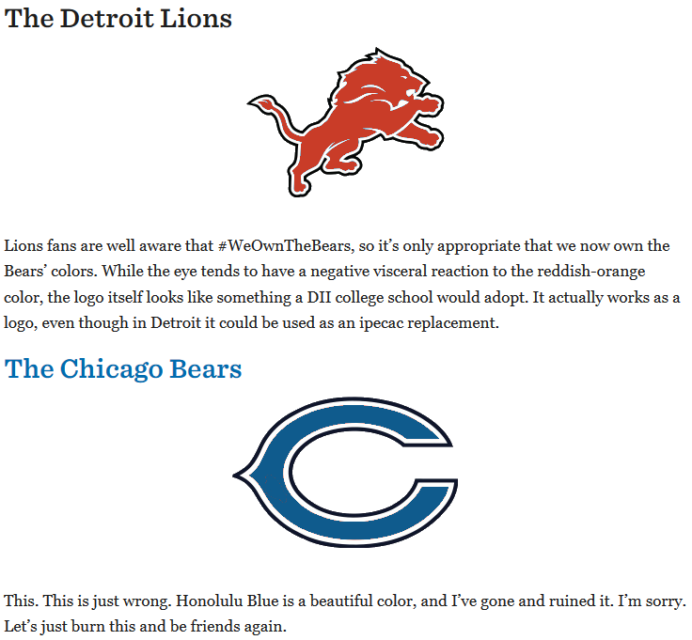
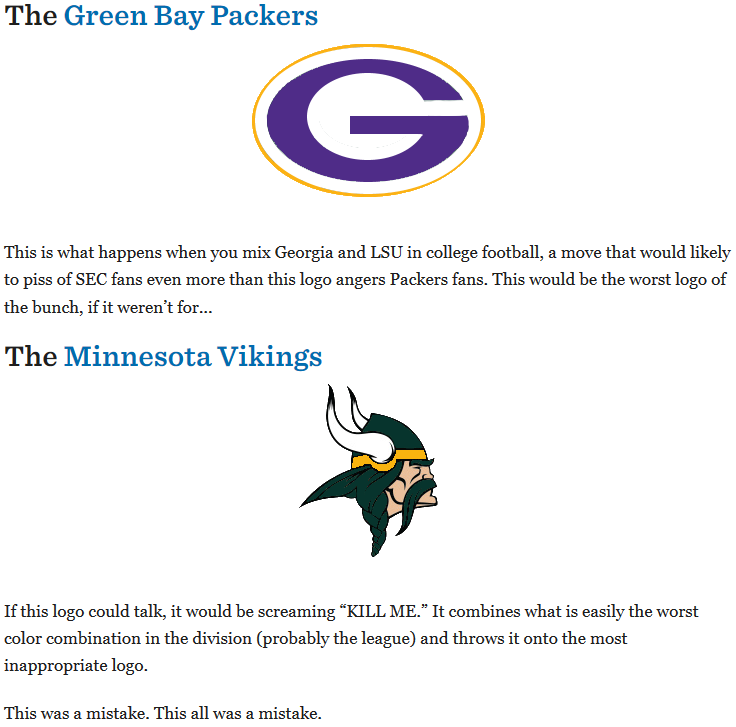
 The Detroit Lions fan site Pride of Detroit wondered if it was possible to enrage the fans of all four NFC North teams with one simple post. They had to come up with something instantly offensive, but uniform … there we go: change the uniform colours … naw, too much work. How about just change the logo colours? That’d rile up the rubes in no time! They more than accomplished their nefarious end:
Chris Selley on the neither one thing nor the other state of alcohol retailing in Ontario:
On Tuesday the government enumerated 76 new Ontario supermarkets where, by Canada Day, you will be able to buy beer. That will make a total of 206 Ontario supermarkets where you can buy beer — an artificially limited selection of beer, only in six packs and singles and only during the same bankers’ hours as the LCBO and Beer Store. But still. That’s about one-third as many supermarkets selling beer as there are LCBO outlets selling beer; add in the 212 rural agency stores that sell wine, liquor and beer, and you’ve got almost two-thirds as many private enterprises selling beer as you have government bottle shops.
This could help prove several useful concepts that deserve much wider acceptance in Ontario. One is that it’s very easy for the government to make money off liquor sales without retailing liquor itself. Indeed, it’s easier; that’s why so many governments do it. The supermarkets buy the beer wholesale from the LCBO; the LCBO doesn’t have to worry about paying civil servants to sell that beer or running the stores.
Another is that the private sector can be counted on to keep liquor out of children’s hands. Indeed, with inspections and draconian fines in place, it can probably be trusted more. My observations suggest LCBO employees certainly card everyone who should be carded, but it’s nothing like it is in the U.S. I’m almost 41, not in especially good nick, and I still get asked about half the time.
Might Ontarians develop a taste for all this convenience? The hard cap on beer-in-supermarket licences is 450; having doled them all out, including agency stores, that would mean about half the liquor outlets in Ontario were privately run. And people might start to notice the bizarre inconsistencies: why can the Walmart on Bayfield Street in Barrie sell only beer, and only in six packs, while the Walmart on Hays Boulevard in Oakville can sell beer and wine, and meanwhile Hope’s Foodland in Novar, Mac’s Milk in Craigleith, Redden’s campground in Longbow Lake and Lac des Mille Lacs Bait and Tackle in Upsala can sell beer, wine and hard liquor — and smokes and fireworks and beef jerky and bread and eggs? Why can scores of convenience stores sell everything alcoholic as agency stores, but other convenience stores aren’t even eligible to apply for the new wine and beer licences?
Uploaded on 12 Apr 2007
The Top Gear boys, Jeremy Clarkson, Richard Hammond and James May discuss the politics of speed cameras…
“Don’t talk to law enforcement without consulting a lawyer” is simple advice. Anyone can follow it. Most of us understand why it’s a good idea. But too many people reject the advice because of a common and misplaced fear. It’s the fear that if they don’t return that detective’s call immediately, if they don’t invite the FBI agents at their door in and answer their questions, if they don’t cooperate, they will be seen as the sort of person who wants a lawyer. They will be seen as someone suspicious. They will lose the opportunity to “clear all this up” by “cooperating.”
If I say I want to talk to a lawyer, won’t I make things worse?
No. Almost certainly not.
When you view any interaction as your only opportunity to “cooperate,” you’re accepting a false premise, a law enforcement pressure tactic calculated to get you to act against your best interests and better judgment. On television, cops constantly tell suspects “you have to talk now, talk first, or we’ll give a deal to your buddy.” On television, that proposition is presented as true. But real life isn’t like television. In real life, that “now or never” proposition is almost always false. In 21 years practicing criminal law, I have never seen a circumstance where stopping the interview and talking to a lawyer would have destroyed someone’s opportunity to talk to law enforcement and resulted in harm to their best interests. There’s always been another chance, once the client has talked to a lawyer and taken advantage of competent advice about the situation.
The police want you to talk immediately, now, when they are unexpectedly at your front door. They want you to be startled, nervous, out-of-sorts. They want you to blurt things out — either admit true things that they can use against you, or make false statements that they can disprove and use to show you’re a liar. They don’t want you to have time to collect your thoughts, to refresh your memory about the events they are asking about, to look at any relevant documents or evidence, or to figure out the legal significance of the situation. The police know that’s against your best interests. They know that you should talk to a lawyer first. How do you know that they know that? You know because police officers consistently push for state laws and union rules allowing them to talk to a lawyer, review evidence, and take advantage of a waiting period before being interviewed about use-of-force incidents.
Good people — honest people — tend to think “I’ve done nothing wrong, so if I tell the truth now, I can clear this up.” They think “talking can’t hurt me because I haven’t done anything wrong, and because I won’t lie.” It would be wonderful if that were true, but it’s not.
Ken White, “‘If I Just Talk To The Police I Can Clear This Up’ — The Dangerous Delusion”, Brown, White & Osborn, 2015-09-24.
Eric S. Raymond on the rising chatter about “identity”:
These criticisms imply a theory of “identity” that is actually coherent and useful. Here it is:
Your “identity” is a set of predictive claims you assert about yourself, mostly (though not entirely) about what kinds of transactions other people can expect to engage in with you.
As an example of an exception to “mostly”, the claim “I am white” implies that I sunburn easily. But usually, an “identity” claim implies the ability and willingness to meet behavioral expectations held by other people. For example, if I describe my “identity” as “male, American, computer programmer, libertarian” I am in effect making an offer that others can expect me to need to shave daily, salute the Stars and Stripes, sling code, and argue for the Non-Aggression Principle as an ethical fundamental.
Thus, identity claims can be false (not cashed out in observed behavior) or fraudulent (intended to deceive). You don’t get to choose your identity; you get to make an offer and it’s up to others whether or not to accept.
[…]
I can anticipate several objections to this transactional account of identity. One is that is cruel and illiberal to reject an offer of “I claim identity X” if the person claiming feels that identity strongly enough. This is essentially the position of those journalists from The Hill.
To which I can only reply: you can feel an identity as a programmer as strongly as you want, but if you can’t either already sling code or are visibly working hard on repairing that deficiency, you simply don’t make the nut. Cruelty doesn’t enter into this; if I assent to your claim I assist your self-deceit, and if I repeat it I assist you in misleading or defrauding others.
It is pretty easy to see how this same analysis applies to “misgendering” people with the “wrong” pronouns. People who use the term “misgender” generally follow up with claims about the subject’s autonomy and feelings. Which is well enough, but such considerations do not justify being complicit in the deceit of others any more than they do with respect to “I am a programmer”.
A related objection is that I have stolen the concept of “identity” by transactionalizing it. That is, true “identity” is necessarily grounded not in public performance but private feelings – you are what you feel, and it’s somehow the responsibility of the rest of the world to keep up.
But…if I’m a delusional psychotic who feels I’m Napoleon, is it the world’s responsibility to keep up? If I, an overweight clumsy shortish white guy, feel that I’m a tall agile black guy under the skin, are you obligated to choose me to play basketball? Or, instead, are you justified in predicting that I can’t jump?
You can’t base “identity” on a person’s private self-beliefs and expect sane behavior to emerge any more than you can invite everyone to speak private languages and expect communication to happen.



Powered by WordPress