
Quotulatiousness

February 12, 2013

Calvin Coolidge — The Great Refrainer

Filed under: Books, History, Media, Politics, USA — Tags: , , , , — Nicholas @ 11:37

Amity Shlaes has written a new biography on President Calvin Coolidge, reviewed here by Gene Healy:

If there was ever a time when the president could simply preside, it has long passed. As early as the Eisenhower era, political scientist Clinton Rossiter observed that the public had come to see the federal chief executive as “a combination of scoutmaster, Delphic oracle, hero of the silver screen, and father of the multitudes.” Under the pressure of public demands, the office had accrued a host of responsibilities over and above its constitutional ones: “World Leader,” “Protector of the Peace,” “Chief Legislator,” “Manager of Prosperity,” “Voice of the People,” and more.

To that daunting portfolio add “Feeler-in-Chief,” a term coined in all earnestness by The New York Times‘s Maureen Dowd in 2010 while lashing out at Barack Obama for being insufficiently emotive about the BP oil spill. Obama, she wrote, had “resisted fulfilling a signal part of his job: being a prism in moments of fear and pride, reflecting what Americans feel so they know he gets it.”

Poor MoDo would have kicked the cat in sheer frustration if confronted by the implacable, inscrutable Calvin Coolidge, whose reaction to the job’s more unreasonable demands was a Bartleby-like “I prefer not to.”

[. . .]

Here was “a rare kind of hero: a minimalist president,” Shlaes argues. And though history remembers “Silent Cal” mostly for his reticence and frequent napping, Shlaes reminds us that “inaction betrays strength.” In politics, it’s often easier to “do something,” however unwise, than it is to hold firm: “Coolidge is our great refrainer.”

Alas, after Coolidge‘s elegant introduction, the sledding gets much tougher. Long stretches of this 456-page tome read like an info-dump from Shlaes’s clearly formidable research files. Like the hardscrabble farmers of Plymouth Notch, you need to set your jaw grimly and persevere through a long winter of sentences that should have been left on the cutting room floor, like: “Coolidge met with [Budget Director Herbert] Lord six times and reduced a tariff on paintbrush handles by half, his second cut that year, the other a reduction in duty on live bob quail.” Shlaes should have followed the example of her famously taciturn subject, who in his 1915 opening address as president of the Massachusetts Senate delivered a crisp little homily of 44 words, ending in “above all things, be brief.”

Still, the level of detail she provides inspires reflection on the vast gulf between today’s GOP and the grand party of old. Presidents Warren Harding and Calvin Coolidge cut taxes and shrank spending. They were pro-peace and anti-wiretapping. They embraced “normalcy” instead of stoking fear. And — go figure — they were also popular. Today’s Republicans could profit from studying their example.

The State of the Union address is the political version of the NFL’s Pro Bowl

Filed under: Football, Humour, Media, Politics, USA — Tags: , , — Nicholas @ 11:05

Jim Geraghty explains:

If you said to me, “let’s end the NFL Pro Bowl,” I’d probably disagree. Because while I haven’t watched a Pro Bowl in its entirety in decades, I’d hate to see a tradition end. But as any football fan will acknowledge, the Pro Bowl is a quasi-necessary event that is executed in a fundamentally flawed fashion. For starters, it occurs at the end of the season, instead of at the halfway point of the season like in other sports. This is because of players’ legitimate fear of injury in a game that has only pride on the line; as a result, everybody plays at about half-speed. Selected players decline to go, so you get the second, third, and sometimes fourth-best players at each position. The NFL moved it to the week before the Super Bowl, to make it less of an afterthought to the season, but now the players on teams in the Super Bowl skip the game.

My friends, the president’s State of the Union Address is our national pro bowl — a simulation of the art of persuasion and politics featuring all the big stars, played at about half speed, with no real consequence.

[. . .]

You’ll recall Matt Welch’s discovery from last year about just how interchangeable the rhetoric is:

    Starting with John F. Kennedy’s address to a joint session of Congress in 1961, you could take one sentence from each SOTU since, in chronological order, and cobble together a speech that will likely resemble much of what you’ll hear tonight. So that’s precisely what I’ve done.

Every president uses the event as just another speech, and avoids anything resembling a hard-nosed assessment of where they’ve made progress and where they need to improve their performance. What’s fascinating is the ritual news articles about drafts of the speech and previews, as if you or I couldn’t predict a half dozen points and themes. This is why we have State of the Union drinking games — because people can often predict the precise phrases, never mind the topics or arguments.

Rules for the masses, but not for the bureaucratic elite

Filed under: Bureaucracy, Business, Europe, Law — Tags: , , , , , — Nicholas @ 10:33

The European Union’s rules on gender equality appear to apply to everything in the EU except the EU’s own bureaucracy:

Part of the aggrandised myth EU institutions like to propagate about themselves is that they are pioneers in promoting tolerance, gender equality, and diversity in the workplace. Read the promotional literature and you will find effusive descriptions of liberal workplace revolutions and the achievements of Soviet-style five-year plans. Yet, like the Soviet Union, there is an embarrassing mismatch between the trumpeted idealism and the reality.

Since its creation in 1967, DG Employment (Directorate-General for Employment, Social Affairs and Inclusion at the European Commission) has nominally been responsible for fair employment conditions in the European Union. Rising levels of workplace equality in member states (for which DG Employment take an undue amount of credit) are woefully incongruous with the situation of EU civil servants. Women occupy 19 per cent of senior management positions; compare this with the often decried 35.9 per cent of women in the top levels of the UK civil service.

Yet it is figures like the UK civil service’s that prompt EU proposals on affirmative action. One set of proposals has recently been discussed in the European parliament, for example, which if passed will introduce gratuitous and complicated legislation across the continent. That bureaucracy breeds bureaucracy is unsurprising, but it is hard to take seriously calls for equality from an institution endemically opposed to the concept.

The only European agency where women in management positions outnumber men is in the Institute for Gender Equality (the administration is 95 per cent female). Incontrovertibly, out of all the agencies, this is the one with the strongest prerogative for tackling equality in its workforce. But the message is clear: shout about equality to the world and create a dummy institute to anyone holding a mirror up to the EU bureaucracy itself. So far, the commission is on its fifth ‘action programme’ to tackle inequality within its institutions, taking the same form as every one that has come before it; vague guidelines forgotten until lobby group pressure becomes too annoying.

Palestine as a useful symbol, but Palestinians as inconvenient “guests”

Filed under: History, Middle East, Politics — Tags: , , , , , , — Nicholas @ 09:28

Strategy Page on the paradoxical Arab view of Palestine as worth fighting for, but actual living Palestinians as less-than-welcome pests (or worse):

While most Arabs will admit they hate Israel, they will also deny that this has anything to do with anti-Semitism and has everything to do with the Palestinians. This is not true, as Arabs have long demonstrated a hostility towards the Jews, something which is part of their religion. It’s in their scriptures, the stories of how Jews refused to support Mohammed, the founder of Islam. Long held grudges are popular in this part of the world.

Meanwhile, there are many more recent reasons for Arabs to dislike the Palestinians. When the state of Israel was established in 1947 there began a series of bad decisions by Arab governments that are setting records for failure. Although the UN tried to broker the creation of Israel, Arab nations misjudged their own power and told Arabs in Israel to flee their homes, so that the Arab armies could come in and kill all the Jews. When that didn’t work, the Arabs refused to absorb the 600,000 Arab refugees, and continues to treat (actually, mistreat) them as refugees. At the same time, the Arabs expelled 600,000 Jews who had been living among them for centuries. Most of these Jews went to Israel and become Israelis, and prospered.

Thus began decades of hostility between Palestinians and the rest of the Arab world. The Palestinians that fled to Lebanon proceeded to trigger a 15 year long civil war (1975-90) that devastated the country and left in place a Shia militia in the south (Hezbollah) that prevents the country from being truly united. The Palestinians that fled to Jordan eventually (1970) staged an uprising against the king, and were defeated and largely expelled. The Palestinians that went to Kuwait welcomed the Iraqi invasion of 1990 because Saddam Hussein had always been very loud about wanting to destroy Israel. When Arab and Western troops tossed Saddam out of Kuwait five months later, the Palestinians were forced to flee the vengeance of the Kuwaitis. The Palestinians that went to Iraq also had to flee in 2003, because they had helped Saddam terrorize the Shia and Kurdish majority and were, well, you know the story.

February 11, 2013

Senate report calls for tariff cuts

In the Financial Post, Terence Corcoran looks at the good and not-so-good aspects of a recent Senate report on the reasons Canadians pay so much more for goods than Americans (even when the goods are identical and the currencies are trading at par):

Retail prices in Canada, seemingly across the board, are higher. Even with the Canadian dollar at par, the price of everything from running shoes to televisions and Chevy Camaros to books is said to be above U.S prices. One bank report once put the Canada-U.S. price gap at 20%.

Somebody’s gotta do something, everybody agrees. Enter the Senate committee with one of the most hard-nosed, market-driven overviews of how and why Canadians pay more for goods at retail. The report dodges and fudges some key issues, especially farm product supply management, which was seen by the committee and the retail industry as too politically hot to handle.

[. . .]

Even in this, however, the committee pulls its first punch. The recommendation to “review” such tariffs — watery phrasing in itself — also suggests “keeping in mind the impact on domestic manufacturing.” Sorry, folks, but you can’t have it both ways. Tariffs are protectionist devices for manufacturers that consumers pay for. If you want to reduce the price to consumers, the $3.9-billion in protection for manufacturers has to go. End of discussion.

What makes The Canada-USA Price Gap even more valuable is its compact insights into the many causes of higher retail prices in Canada. The economy is a complicated and often unfathomable series of market and price relationships beyond the power and even understanding of policy makers. The report recognizes that fact time and again.

Police dogs as “probable cause on a leash”

Filed under: Law, Liberty, USA — Tags: , , , , , — Nicholas @ 11:19

Jacob Sullum on how credulous courts have granted police dogs the power to circumvent Americans’ right to be free from intrusive search and seizure by police officers on fishing expeditions:

The deputy and another officer who arrived during the stop nevertheless went through Burns’ truck for half an hour or so, reaching up into the boat, perusing his cargo, looking under the seats and the hood, examining the gas tank and the undercarriage. They found no trace of drugs, although they did come across the loaded pistol that Burns mentioned to them once it was clear they planned to search the truck.

“They were cool with the gun,” Burns says. “If it had been California, God knows what would have happened.” He was so relieved that he barely minded the delay and inconvenience, which stretched a brief traffic stop into more than an hour. “I’m not a lawyer, and I’m not a super-libertarian,” Burns says. “Once I realized that the pistol was not going to be an issue, man, they could have spent all day going over that car and under that car. My only concern was that one of the guys might have slipped something in to cover up for the fact that they didn’t find anything.”

That’s one way of looking at it. But even if you are neither a lawyer nor a super-libertarian, you might wonder 1) how often this sort of thing happens, 2) how it came to be that police can get permission from a dog to rifle an innocent man’s belongings, and 3) whether that state of affairs is consistent with the Fourth Amendment’s guarantee against “unreasonable searches and seizures.” The answers, in brief, are 1) fruitless searches based on dog alerts happen a lot more often than commonly believed, 2) dogs acquired this authority with the blessing of credulous courts mesmerized by their superhuman olfactory talents, and 3) this dog license is hard to square with the Fourth Amendment, unless it is reasonable to trust every officer’s unsubstantiated claim about how an animal of undetermined reliability reacted to a person, a suitcase, a car, or a house.

All of these issues come together in two cases the U.S. Supreme Court heard a few weeks after Bob Burns was pulled over. Florida v. Harris raises the question of how a judge knows that a dog’s alert is reliable enough to justify a search. Florida v. Jardines asks whether police need a warrant to use a drug-sniffing dog at the doorstep of a home. These cases, which will be decided by this summer, give the Supreme Court an opportunity to reconsider its heretofore unshaken faith in dogs, or at least limit the damage caused by the amazing canine ability to transform hunches into probable cause.

A boxplot of First Nations misery

Filed under: Cancon, Economics, Government — Tags: , , , , , — Nicholas @ 09:17

Over the weekend, Colby Cosh posted this depressing box-and-whisker plot (aka “boxplot”) from statistical data on First Nations communities:

First Nations boxplot

Why did I want to look at this information this way? Because Canada actually performed an inadvertent natural experiment with residential schools: in New Brunswick (and in Prince Edward Island) they did not exist. If the schools had major negative effects on social welfare flowing forward into the future we now inhabit, New Brunswick’s Indians would be expected to do better than those in other provinces. And that does turn out to be the case. You can see that the top three-quarters of New Brunswick Indian communities would all be above the median even in neighbouring Nova Scotia, whose FN communities might otherwise be expected to be quite comparable. (Remember that each community, however large, is just one point in these data. Toronto’s one point, with an index value of 84. So is Kasabonika Lake, estimated 2006 population 680, index value 47.)

On the other hand, and this is exactly the kind of thing boxplots are meant to help one notice, the big between-provinces difference between First Nations communities isn’t the difference between New Brunswick and everybody else. It’s the difference between the Prairie Provinces and everybody else including New Brunswick — to such a degree, in fact, that Canada probably should not be conceptually broken down into “settler” and “aboriginal” tiers, but into three tiers, with prairie Indians enjoying a distinct species of misery. (This shows up in other, less obvious ways in the boxplot diagram. You notice how many lower-side outliers there are in Saskatchewan? That dangling trail of dots turns out to consist of Indian and Métis towns in the province’s north — communities that are significantly or even mostly aboriginal, but that aren’t coded as “FN” in the dataset.)

I fear that the First Nations data for Alberta are of particular note here: on the right half of the diagram we can see that Alberta’s resource wealth (in 2006, remember) helped nudge the province ahead of Saskatchewan and Manitoba in overall social-development measures, but it doesn’t seem to have paid off very well for Indians. This isn’t a surprising outcome, mind you, if you live in Alberta; we have rich Indian bands and plenty of highly visible band-owned businesses, but the universities are not yet full of high-achieving members of those bands, and the downtown shelters in Edmonton, sad to say, still are.

“I don’t want to use the word buffoonery but it really is unbridled police lawlessness”

Filed under: Law, Liberty, USA — Tags: , , , , — Nicholas @ 08:57

There’s more than a little bit of “explaining” due from the LAPD over these incidents:

David Perdue was on his way to sneak in some surfing before work Thursday morning when police flagged him down. They asked who he was and where he was headed, then sent him on his way.

Seconds later, Perdue’s attorney said, a Torrance police cruiser slammed into his pickup and officers opened fire; none of the bullets struck Perdue.

His pickup, police later explained, matched the description of the one belonging to Christopher Jordan Dorner — the ex-cop who has evaded authorities after allegedly killing three and wounding two more. But the pickups were different makes and colors. And Perdue looks nothing like Dorner: He’s several inches shorter and about a hundred pounds lighter. And Perdue is white; Dorner is black.

“I don’t want to use the word buffoonery but it really is unbridled police lawlessness,” said Robert Sheahen, Perdue’s attorney. “These people need training and they need restraint.”

That incident is pretty bad, and thank goodness that David Perdue wasn’t shot in the Keystone Kops re-enactment. In this earlier incident, however, the innocent civilians didn’t get off without injury:

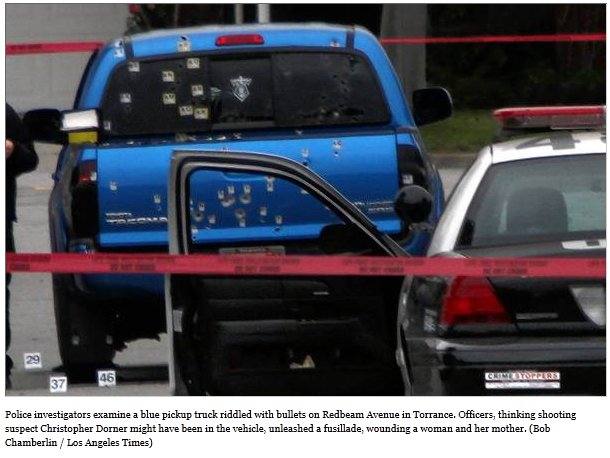
As the vehicle approached the house, officers opened fire, unloading a barrage of bullets into the back of the truck. When the shooting stopped, they quickly realized their mistake. The truck was not a Nissan Titan, but a Toyota Tacoma. The color wasn’t gray, but aqua blue. And it wasn’t Dorner inside the truck, but a woman and her mother delivering copies of the Los Angeles Times.

Pickup shooting by LAPD

In an interview with The Times on Friday, LAPD Chief Charlie Beck outlined the most detailed account yet of how the shooting unfolded. Margie Carranza, 47, and her mother, Emma Hernandez, 71, were the victims of “a tragic misinterpretation” by officers working under “incredible tension,” he said. Just hours before, Dorner allegedly shot three police officers, one fatally. And, in an online posting authorities attributed to him, Dorner threatened to kill more police and seemed to take responsibility for the slaying over the weekend of the daughter of a retired LAPD captain and her fiance.

Beck and others stressed that the investigation into the shooting is in its infancy. They declined to say how many officers were involved, what kind of weapons they used, how many bullets were fired and, perhaps most important, what kind of verbal warnings — if any — were given to the women before the shooting began.

H/T to Jon, my former virtual landlord, for the links to both articles and the urgent advice “You might want to park the Tacoma in the garage for awhile”.

February 10, 2013

QotD: The internet really did change everything

Filed under: Liberty, Media, Quotations — Tags: , , , , — Nicholas @ 00:01

For all of those thousands of years, most important communication in civilization has been vertical, and almost always from the top down.

Think of a church bell (or before that, and in other places, a drum or a gong): a means of communication far too expensive in a primitive society for an individual to own, one with extremely low bandwidth, conveying simple imperatives that individuals had been conditioned from earliest childhood to obey: wake up, serf! Come to prayer, serf! Go to work, serf! Come back to prayer, serf! Go to bed, serf!

There was no talking back to the commanding bells.

Over the centuries, nothing changed except the bandwidth. By turns we had Big Ben, Rudy Valee, D.W. Griffith, Arthur Godfrey, I Love Lucy; but there was no way to talk back to them, either. Nor to the “news” thrust upon us by media controlled or even owned outright by authority.

Then, suddenly, the whole situation, the entire 8000-year-old structure of human interaction, was pitched on its ear. The Internet landed with a crash and knocked communications sideways, making it an egalitarian — “peer-to-peer” — undertaking. Information traveled uncontrollably, in both directions, to the anger and distress of those who still believed that they were in authority. (One politician, a wealthy former governor and senator has recently announced that he’s leaving politics, having previously claimed society would be better off had the Internet never been invented.) And all the pus, 8000 years of dictatorial threats and dirty lies, burst out with the fall of power.

Humanity will never be the same again. This is change at the most fundamental level conceivable, barring the evolution of new limbs or individuals developing gills. As a student of history, I believe it to be more significant than Gutenberg’s invention of the printing press, possibly more important than the invention of writing itself. And authority, as it disintegrates, is striving hysterically to bring it all back under control. But it’s too late by at least a decade. We have the idea of laterality now, and it cannot be disinvented or unlearned.

L. Neil Smith, “‘And That’s the Way It Is…'”, Libertarian Enterprise, 2013-02-03

February 9, 2013

The domestic food desert

Filed under: Britain, Food, Health — Tags: , , , , — Nicholas @ 10:00

Theodore Dalrymple on one of the more likely culprits for obesity among poor British families:

With the decline of the family — wrought by the policies of successive governments — patterns of eating have changed. Meals in many households, especially those of the relatively poor, are no longer family or social occasions. It has been found that a fifth of children do not eat more than one meal a week with another member of their household; and in such households, which I used sometimes to visit as a doctor, the microwave oven was the entire batterie de cuisine, or at any rate the only cooking implement that was ever actually employed.

Moreover, there was no table at which a meal could have been eaten in common if anyone had thought of doing so. The result was that children became foragers or hunter-gatherers in their own homes, going to the fridge whenever they felt like it and grazing on prepared foods — high, of course, in the evil fructose. Not coincidentally, these households were also the least likely to have what would once have been considered the normal family structure.

Such households also tended to be in areas called “food deserts”, in which fresh produce is either not easily available or unavailable. But those who ascribe the dietary habits of the households I have just described to food desertification put the cart before the horse: for if heroin can reach these areas (and it can), surely the humble lettuce can do so?

It is also sometimes alleged that people buy prepared foods because they are cheap. This is nonsense. In fact, if you go to areas inhabited by poor Indian or Pakistani families you will find stores that sell an astonishing range of vegetables at equally astonishing prices. I used to shop in one such store, at a time when I did not have to concern myself too much over the price of food; I could hardly carry all that I could buy for a few pounds. I remember in particular a 10-kilo bag of onions costing £1.49.

The Indian and Pakistani women bought with discrimination and, taking a maternal interest in me, would sometimes indicate what to look for among what were for me the more exotic vegetables. But I never saw any poor whites shopping there: they went straight to the pie and pizza shops, without so much as a glance at the okra and aubergine.

In other words, food desertification and the supposed cheapness of industrially prepared foods is a consequence, not a cause of, the food habits I have described. Food desertification is a symptom of the culinary ignorance, incompetence and indifference of a substantial minority of our population: ignorance, incompetence and indifference unopposed by any attempt of our educational system to counteract it, for example by teaching girls the elements of cookery. Fat is indeed a feminist issue, but not in the sense that Susie Orbach originally meant it.

Crowdfunding the NanoLight

Filed under: Technology — Tags: , — Nicholas @ 09:51

Cassandra Khaw at TechHive on the attempt to crowdfund a new LED light:

NanoLight prototype

Part lightbulb, part spaceship component, the LED NanoLight (funding through March 8) is being touted as the world’s most energy efficient lightbulb.

Using just 12 watts of electricity, the NanoLight should generate 1600 lumens, the equivalent of a 100-watt lightbulb. The estimated cost of running a NanoLight (for three hours a day) is less than $2 a year, and the bulb is expected to last 25 to 30 years.

Aside from looking rather stellar and being economical with the usage of power, the NanoLight also differs from the average LED lightbulb in that it’s capable of emulating the omnidirectional nature of your classic lightbulb—but cool enough not to mimic its habit of scorching your flesh if you make the mistake of touching it when it’s been on for a while. And unlike most compact fluorescent (CFL) bulbs, the NanoLight provides full brightness as soon as you turn it on.

QotD: When God sticks his nose into public health and taxation issues

Filed under: Britain, Food, Health, Humour, Quotations, Religion — Tags: , , , — Nicholas @ 00:01

It is not an original thought to say that public health crusaders often resemble religious zealots, but seldom is the comparison more literal than in the case of Mike Rayner, director of the British Heart Foundation Health Promotion Research Group.

[. . .]

So far, so mundane. Another illiberal battler against the free market with a heightened sense of his own importance and his nose in the trough. The only point of interest is that Mr Raynor is a Church of England priest who is guided by voices.

    In all of this I see a sacred dimension. You may not believe that I have heard God aright but I think God is calling me to work towards the introduction of soft-drink taxes in this country and I am looking forward to the day when General Synod debates the ethical issues surrounding this type of tax rather than some of the other issues that august body seems obsessed by.

Golly. Where to begin? On a theological note, I do wonder whether Jesus would really be in favour of a deeply regressive stealth tax that would take from the poor to give to the rich. Perhaps the reason the General Synod does not debate tax policy is because they recall the old “render under to Caesar…” message and realise that it’s none of their business.

If we weren’t already sceptical about the documents coming from Mr Rayner’s team of would-be policy-makers, the fact that its director believes that God has told him to bring about a fat tax in this land should be enough to make us suspect that a tiny bit of research bias might have crept into his work. Considering that the Almighty has approved of the policy, what are the chances of his loyal servant producing evidence that would question its efficacy?

Christopher Snowdon, “Fat tax campaigner: ‘God told me to do it'”, Velvet Glove, Iron Fist, 2012-05-21

February 8, 2013

This week in Guild Wars 2

Filed under: Gaming — Tags: , — Nicholas @ 12:34

My weekly Guild Wars 2 community round-up at GuildMag is now online. The February patch has been announced and there’s lots of discussion about what is (and isn’t) going to be in it. All that plus the usual assortment of blog posts, videos, podcasts, and fan fiction from around the GW2 community.

Pinpointing the exact moment that the principled anti-war movement packed up its tents and decamped

Filed under: Media, Politics, USA — Tags: , , — Nicholas @ 10:34

Nick Gillespie helps us find that mystical moment when honourable, principled dissent became treason again:

Remember back in what was it — 2006 or thereabouts — when left-leaning critics of President Bush couldn’t stop talking about how nothing was more red, white, and blue than good old-fashioned American dissent? Why, our very country was founded by an act of dissent, didn’t you know! So back when Vice President Dick Cheney — routinely likened to Darth Vader and Voldemort — was running things, the very air was filled with cries of “not in our name” and all that, because it was so damned important that the United States not contravene its basic principles even in the name of self defense!

Those were good times, friends, and they stopped pretty much the minute that liberals and Democrats took control of the federal government. The antiwar movement disappeared once it became clear that Barack Obama wasn’t going to shut down Gitmo or stop bombing places or give a rat’s ass about that constitutional stuff he used to teach in law school.

But cheer up, because things can always get worse, as the last few days have demonstrated.

[. . .]

It’s sad, though never unexpected, when leaders such as Obama flip flop like a fish on the sand once they ascend power. Cromwell did it, the French revolutionaries did it, Castro did it, the Sandanistas did it, and on and on. It’s one of the oldest plots in history and infinitely adaptable to new conditions. How else to explain, as Jacob Sullum notes, that candidate Obama rejected the Bush administration’s position that it could detain U.S. citizens as enemy combatants without pressing charges while President Obama claims the right to kill U.S. citizens without laying charges? The guy may not be able to pass a budget but christ, give him credit for ingenuity and brass balls.

But Obama is a politician — what do you expect? Politicians are not just the bottom of the barrel — they’re what’s under the bottom of the barrel, right?

PM’s long awaited (ghostwritten) book on hockey to be published in the US due to Canadian publishing regulations

Filed under: Books, Cancon, Media, Sports — Tags: , , , , — Nicholas @ 09:47

A double-whammy from the Globe and Mail‘s John Barber: due to protectionist media rules brought in during the Mulroney years, Prime Minister Stephen Harper’s book on hockey — ghostwritten by G&M columnist Roy MacGregor — will have to be published outside the country. Inline Update: The G&M has retracted the claim that the book was ghostwritten. Thanks to commenter Dwayne for the update.

Prime Minister Stephen Harper’s upcoming book on the history of professional hockey will be published in the United States rather than Canada because of prohibitions embedded in the government’s own cultural policy.

Simon & Schuster, the U.S.-based company chosen to publish the English-language edition of the Prime Minister’s book, is banned from publishing books in Canada under the Investment Canada Act. But the act does permit foreign-owned companies to distribute titles they have published in their home territories.

A single edition edited and printed in the U.S. will likely appear simultaneously in both markets, so Canadians will not have to wait to buy a copy.

“It’s ironic that he is publishing with a company that is forbidden by his government to have a Canadian publishing program,” Toronto literary agent Denise Bukowksi said. “But if North American rights are contracted in the U.S.A., they can get away with it.”

Three years ago, the Harper government announced a review of the policy, which the government of Brian Mulroney adopted to promote the growth of Canadian publishers at the expense of the multinational companies that then dominated the domestic market. The government has yet to announce changes.

Update: Hmmm. The story gets a bit more confused, as Roy MacGregor is quoted in this story denying any involvement:

Roy MacGregor, who has written 40 books, including the popular Screech Owl series, has talked with the prime minister about the book and describes him as “fanatically” knowledgeable.

MacGregor, who has worked as a ghost writer, says Harper hasn’t employed one.

“I can guarantee you there’s no ghost,” he said. “I’m sure it would come up. The reason it would come up is I know of his stated determination that no matter how long it took, he wanted to be the one that did it. He had research help but it was going to be him plucking away at the computer keys.”

H/T to Colby Cosh for that URL.

« Newer PostsOlder Posts »

Powered by WordPress


