Quotulatiousness

August 6, 2012

Admiral Fisher: an excitable sort of man

Filed under: Britain, Germany, History, Humour, WW1 — Tags: , , , — Nicholas @ 10:41

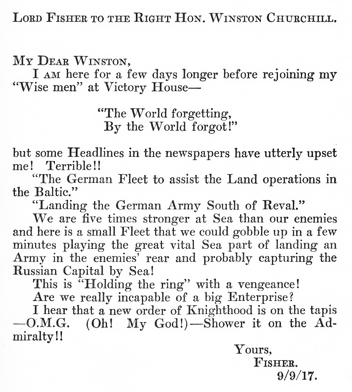
Admiral “Jackie” Fisher was a major historical figure in the Royal Navy, advocate of the modern dreadnought battleship and a tad high-strung (“…and on one occasion, the king asked him to stop shaking his fist in his face”). His relationship with Winston Churchill at the Admiralty must have been something to observe, as two of the most influential men in London worked together (for a while). After leaving the Admiralty for the last time, he still kept in touch with Churchill. Here is an example of his communication style:

This is believed to be the first documented use of the now familiar “OMG”.

H/T to Shaun Usher.

India’s blackouts are a sign that reform is desperately needed

Filed under: Economics, India — Tags: , , , , — Nicholas @ 10:20

The Economist on the massive blackouts in India recently:

FOR an aspiring economic superpower, there can be few more chastening events than electricity cuts as massive as those that struck northern and eastern India this week. An area (including the capital, Delhi) in which more than 600m people live faced blackouts over two days. Infrastructure, from traffic lights to trains, stopped working. Hospitals, sanitation plants and offices ground to a halt. Airports and factories had to rely on backup generators, often fuelled by truckloads of diesel.

The impact on India’s economy goes far beyond lost output. The blackout will badly damage the country’s reputation, and highlights the rotten infrastructure that is hobbling its efforts to catch up with China.

[. . .]

At one end, not enough cheap coal is being dug up and gasfields are sputtering. At the other, the national transmission grid needs investment. Meanwhile the “last mile” distribution companies, largely state-owned, that buy power and deliver it to homes and firms, are financial zombies. Much of their power is pinched or given away free. Local politicians put pressure on them to keep tariffs low, which leads to huge losses. Squeezed between a shortage of fuel and end-customers who are nearly bust, those private generating firms are now cutting back on vital long-term investment in new plants.

[. . .]

The solution is to cut graft, tackle vested interests and allow markets to work better. The coal monopoly needs to be broken up and local distribution firms privatised. Yet despite the looming crisis, for a decade the government has shirked doing what is clearly necessary, just as it has failed to implement key tax reforms, cut public borrowing or open the retail sector to competition. It has allowed corruption and red tape to damage other vital industries, such as telecoms.

CSIS considers what to do with information possibly obtained through torture

Filed under: Cancon, Government — Tags: , , , — Nicholas @ 09:48

The Canadian Security Intelligence Service (CSIS) partners with the intelligence services of our allies, which sometimes means they get information that may have been partly or completely obtained through torture of suspects. This is a problem:

A secret high-level committee at Canada’s spy agency is tasked with deciding whether information received from abroad is tainted by torture, declassified records show.

Internal Canadian Security Intelligence Service memos reveal the key role that the recently formed Information Sharing Evaluation Committee plays in determining if the spy agency makes use of the suspect material.

The committee — whose existence was previously unknown outside the intelligence service — also helps CSIS decide whether to send information to foreign agencies in cases where it might lead to mistreatment.

Detailed instructions direct committee members to comb through databases, consult human rights reports and weigh the particular circumstances of each case to arrive at a decision.

Ultimately, CSIS director Dick Fadden makes the final call when the committee decides information is likely derived from torture, of if sending Canadian material to an allied agency could result in someone being abused.

QotD: The modern British pub

Filed under: Britain, Humour, Quotations — Tags: , , — Nicholas @ 00:28

With some shining exceptions, of which my own local is one, the pub is fast becoming uninhabitable. Fifteen or twenty years ago, the brewing companies began to wake up to the fact that their pubs badly needed a face-lift, and started spending millions of pounds to bring them up to date. Some of the results of their refurbishings have been admirable: more and more comfortable seating, improved hygiene, chilled beers, snack lunches that in general have reached such a standard that, when in quest of a midday meal in unfamiliar territory, you will usually find quicker service and much better value for money in the pub than in the near-by trattoria.

But that is about as far as it goes. The interior of today’s pub has got to look like a television commercial, with all the glossy horror that implies. Repulsive “themes” are introduced: the British-battles pub, ocean-liner pub, Gay Nineties pub. The draught beer is no longer true draught, but keg, that hybrid substance that comes out of what is in effect a giant metal bottle, engineered so as to be the same everywhere, no matter how lazy or incompetent the licensee, and, in the cases of at least two well-known, lavishly advertised brews, pretty nasty everywhere. But all this could be put up with cheerfully enough if it were not for the bloody music — or that kind of uproar having certain connections with a primitive style of music and known as pop. It is not really the pop as such that I object to, even though pop is very much the sort of thing that I, in common with most of the thirty- or thirty-five-plus age-group, would have expected to go to the pub to get away from. For partly different reasons, I should also object to having Beethoven’s Choral Symphony blaring away while I tried to enjoy a quiet pint with friends. If you dislike what is being played, you use up energy and patience in the attempt to ignore it; if you like it, you will want to listen to it and not to talk or be talked to, not to do what you came to the pub largely to do.

Kingsley Amis, Everyday Drinking: The Distilled Kingsley Amis, 2008.

August 5, 2012

Raoul Wallenberg remembered

Filed under: Europe, Germany, History, Russia, WW2 — Tags: , , , , — Nicholas @ 11:05

Yesterday was what would have been Raoul Wallenberg’s 100th birthday. It was observed in Sweden:

Sweden on Saturday commemorated the life of a diplomat credited with saving thousands of Hungarian Jews from the Nazis in World War II, but whose fate remains one of the country’s greatest war-time mysteries.

Crowds gathered in the town of Sigtuna, 50 kilometers (30 miles) north of Stockholm to celebrate the centennial of the birth of Raoul Wallenberg, whose defiance of the Nazis has been commemorated worldwide in statues, streets names, and on postage stamps.

Wallenberg served as Sweden’s envoy in Budapest from July 1944 — where he saved the lives of at least 20,000 Jews by giving them Swedish travel documents, the so-called “shutzpass,” or moving them to safe houses. He is also credited with dissuading German officers from massacring the 70,000 inhabitants of the city’s ghetto.

But, in January 1945, the young Swede was arrested by the Soviet Red Army on leaving Budapest to go to the eastern part of the country, and suddenly disappeared.

The Soviets initially denied they had detained him, but later said he had died of a heart attack in prison on July 17, 1947.

Reason.tv: What is an Astronaut’s Life Worth?

Filed under: Bureaucracy, Space, Technology, USA — Tags: , — Nicholas @ 10:28

“You’re saying that you’re going to give up four billion dollars to avoid a one in seven chance of killing an astronaut, you’re basically saying an astronaut’s life is worth twenty-eight billion dollars,” says astronautical engineer and author Dr. Robert Zubrin.

Zubrin, the author of a popular and controversial article in Reason‘s space-centric February 2012 Special Issue, argues that the risk of losing one of the seven astronauts who repaired and rescued the Hubble Space Telescope was well worth it. “If you put this extreme value on the life of an astronaut…then you never fly, and you get a space agency which costs seventeen billion dollars a year and accomplishes nothing.”

NASA’s role, according to Zubrin, should be in the pursuit of ambitious missions such as “opening Mars to humanity,” rather than a bloated, safety-obsessed bureaucracy. “The mission has to come first.”

Angers still pushing for compensation for Plantagenet murder in 1499

Filed under: Britain, Europe, France, History, Law — Tags: , , — Nicholas @ 10:22

I mentioned this amusing little issue last month. The city of Angers is still trying to get the British crown jewels as compensation for Henry VII’s judicial murder of the last legitimate male Plantagenet claimant to the English throne. Lowering The Bar has more:

What’s the connection between these French people and the English throne? It looks like the first connection that mattered was between Matilda, the daughter of King Henry I, and Geoffrey of Anjou (the county in which Angers was located). Their oldest son became Henry II of England in 1154. After 331 years of exciting adventures, the ruling line ended with Richard III, who was killed in battle by the forces of Henry Tudor (Henry VII). (Since history is written by the victors, Richard III now appears in plays as a murderous hunchback and the Tudors got their own miniseries on Showtime.)

But Angers doesn’t appear to care about any of those guys (especially the hunchback), only about Edward, Earl of Warwick. He had a claim to the throne (he was Richard III’s nephew, or something), but was only 10 in 1485, and judging from this portrait was so poor that he could not even afford to be drawn from the neck down. But Henry threw him in the Tower of London anyway and kept him there until he was old enough to kill, basically, which happened in 1499. He was the last legitimate male Plantagenet.

Angers is sponsoring a petition drive about this 513-year-old outrage and will send the official results to Queen Elizabeth II (House of Windsor) in September. This will coincidentally coincide with Angers’s annual cultural festival. A spokesperson for the city admitted that the petition “had little chance of success” (the original crown jewels were done away with by Oliver Cromwell anyway), but said that the crime against the Plantagenets was worth remembering. According to the report, he also “encouraged British people to visit Angers, which has medieval buildings including a magnificent castle which recalls the glory days of the Plantagenets.”

Tolerance Is Different From Approval

Filed under: Business, Food, Law, Liberty, USA — Tags: , , — Nicholas @ 00:09

In his Forbes column, Tim Worstall explains his puzzlement over the ongoing Chick-Fil-A uproar in the US and why tolerance is not the same as approval:

As to the basic point about gay marriage I can only offer my personal opinion: all for it. On the grounds that everyone’s going to understand the miserableness of us middle aged heteros a great deal better after 20 odd years of societally enforced monogamy. Slightly more seriously gay marriage or not gay marriage has little to do with a business column.

What does have to do with a business column is that this whole idea of a market means that we don’t have to care about the personal beliefs of either those who supply us or whom we supply. It’s the very impersonality of market exchange that means that it just doesn’t matter a darn what anyone’s sexual (or indeed any other) preference is. We get to care only about whether it’s a good chicken sandwich or whether the customer has enough money for one.

[. . .]

The other point that occurs to me is that we seem to be separating tolerance from approval in a way that some in the US are not.

Just as background, in the country I live in, Portugal, there is as far as a legal marriage ceremony goes, only civil marriage. Any two consenting adults, in whatever mixture of genders and sexes makes sense to those two individuals, can be married by the State. Religion doesn’t even get a look in.

If you do want a religious marriage, according to the rites of a church, then off you go after your civil marriage and have one. That marriage will be limited by whatever that church decides the limitations upon marriage are. It has no legal effect at all.

At which point everyone tolerates gay marriage but no one demands approval of it. For the two are different. Tolerance being the necessary requirement for a free and liberal society: that you get to do what you want to do as long as everyone else is also given the same freedom to follow their path from cradle to grave. Approval is something else again. I, to take a very trivial example, certainly tolerate the existence of Simon Cowell and his shows but that doesn’t mean that anyone can demand that I approve of them.

A quixotic quest to rehabilitate the reputation of Richard Nixon

Filed under: History, Media, Politics, USA — Tags: , , , , , , — Nicholas @ 00:07

President Richard Nixon’s reputation could hardly be any worse: he’s seen as the most evil president if not of all time, certainly of the 20th century. Conrad Black attempts to correct the record:

Forty years after Watergate, as the agreed demonology of that drama begins to unravel and the chief authors of it, Bob Woodward and Carl Bernstein, struggle to keep the conventional wisdom about it intact as an article of righteous liberal faith, a factual review is timely. When Richard Nixon was inaugurated president in 1969, the United States had 550,000 draftees in Indochina with no plausible explanation or constitutionally legitimate reason for them to be there and 200 to 400 of them were coming back every week in body bags. President Lyndon Johnson had offered Ho Chi Minh deferred victory in his Manila proposal of October 1966: withdrawal of all foreign forces from South Vietnam. Ho could have taken the offer and returned six months after the Americans had left, saved his countrymen at least 500,000 combat dead, and lived to see a communist Saigon. He chose to not even give LBJ a decent interval for defeat and insisted on militarily humiliating the United States.

In January 1969, there were no U.S. relations with China, no arms control talks in progress with the U.S.S.R., no peace process in the Middle East, there were race or anti-war riots almost every week all over the United States, and the country had been shaken by the assassinations of Martin Luther King and Robert Kennedy (both in their early 40s). LBJ could not go anywhere in the country without demonstrations, as students occupied universities and the whole country was in tumult.

Four years later, Nixon had withdrawn from Vietnam, preserving a non-communist South Vietnam, which had defeated the North Vietnamese and Viet Cong in April 1972 with no American ground support, though heavy air support. He had negotiated and signed the greatest arms control agreement in world history with the Soviet Union, founded the Environmental Protection Agency, ended school segregation and avoided the court-ordered, Democratic Party-approved nightmare of busing children all around metropolitan areas for racial balance, and there were no riots, demonstrations, assassinations or university occupations. He started the Middle East peace process, reduced the crime rate and ended conscription. For all of these reasons, he was re-elected by the greatest plurality in American history, 18 million votes, and a percentage of the vote (60.7) equalled only by Lyndon Johnson in 1964 and Franklin D. Roosevelt in 1936. His term was rivalled only by Lincoln’s and FDR’s first and third terms as the most successful in U.S. history.

August 4, 2012

George Jonas: Israel is essential … to keeping Arab regimes in power

Filed under: Middle East, Politics, Religion — Tags: , , , — Nicholas @ 09:48

George Jonas in the National Post explains that Israel is essential to the dictators, strongmen, and demagogues of the many Arab and Muslim states that surround it:

An increase in hostility was predictable. Hatred against Israel, kept on a low boil, is the organizing principle of the Middle East. It’s the region’s main fuel of governance; often its only fuel. Some ruling regimes — kings, dictators, whatever — may have oil wells and sandy beaches, but other than hating Israel (and looking after their families and tribes) they have few if any ideas. If they do, chances are it’s to hate some other group in addition to Israel.

In the Middle East a country’s national purpose often amounts to little more than a list of its enemies. A feeling of being ill-done by dominates the consciousness of groups and individuals. Since it’s a self-fulfilling prophecy, it’s not necessarily baseless: The easiest way to have an enemy is to be one.

The centrality of hatred to the culture is remarkable. The Cartesian idea is “I hate, therefore I am.” Self-righteousness is overwhelming: each desire thwarted becomes an example of justice denied. It’s not a pretty place, but millions call it home.

[. . .]

We won’t understand much about the Arab Spring as long as we persist in looking at it through Western eyes. We see popular uprisings against dictatorships as moves in the direction of Western-style democracy. If they happened here, they probably would be. Where they’re actually happening they’re taking their societies in the opposite direction.

The Arab Spring is an attempt to return the region to its roots. It’s not to Westernize the Middle East and make it more democratic; it’s to Easternize it and make it more Islamic. If the early 20th century was about the East trying to join what it couldn’t lick, the early 21st may be about the East trying to lick what it hasn’t been able to join.

The tribal and political divisions of Afghanistan

Filed under: Asia, Military, Politics — Tags: , , , , , — Nicholas @ 09:31

A brief primer from Strategy Page on the volatile mix of tribal rivalries that makes Afghanistan such a difficult place to conduct business (or military operations):

The war against the Taliban is increasingly just another chapter in the centuries old conflict between the Pushtun and non-Pushtun tribes of Afghanistan. President Karzai and his allies are from Pushtun tribes that have long been rivals to the tribes that form the core of Taliban leadership and manpower. All this is made worse by the fact that the non-Pushtun Afghans (Tajiks, Hazara and Uzbek), who comprise 60 percent of the population, do not want to lose the increased power (more in proportion to their size of the population) they obtained once democracy was installed in 2002. While Pushtuns are 40 percent of the population, Tajiks are 24 percent, Hazara ten percent, Uzbek 9 percent and various other non-Pushtun minorities the rest. This struggle between Pushtuns and the rest has defined Afghanistan since its creation three centuries ago. The Pushtun are not happy with the recent revisions that gave the majority more power. For Pushtuns, that is just not right. The Taliban are seen as major players in the fight to right this wrong, and for many Pushtuns that makes up for a lot of the evil the Taliban does.

This tribal animosity played a role in the American reaction to Pakistan closing its border to NATO truck traffic last November. The U.S. played hardball with the Pakistanis and shifted truck traffic to the more expensive northern route. This was great for the non-Pushtuns up north, who got a lot more lucrative trucking business. It was a disaster for the mainly Pushtun trucking companies in the south, and the Taliban who extorted “protection money” from the truckers to avoid being attacked. Aware of all that, NATO traffic is not returning to its pre-November levels, and may be reduced still more if the Taliban become more troublesome because their cash flow has increased.

[. . .]

Afghanistan is different to the extent that it has a more violent (than the norm) tribal culture and heavy resistance to anti-corruption efforts. Most Afghans who reach a leadership position consider corruption (demanding bribes and stealing government funds) a right and stealing something of an obligation to make his family/clan/tribe stronger and better able to survive. Many Afghans have noted that countries with less corruption are more prosperous and peaceful, but this anti-corruption faction is still a minority. Corruption continues to be a major problem in Afghanistan and it will get worse when most foreign troops leave in 2014. At that point, the anti-corruption activists will be at more personal risk, as will auditors and other monitors of how foreign aid is spent.

Many (if not most) Pushtuns, and nearly all non-Pushtuns, are hostile to the Taliban and their alien radical Islamic ways. Aside from the lifestyle restrictions, Afghans don’t like the Taliban demand that Afghans put religion before tribal and family obligations and, worst of all, strive for Islamic world conquest. Most Afghans see the Taliban as a bunch of intolerant fanatics who like to execute (often by beheading or bombs) those who oppose them. The Taliban leadership has been aware of these attitudes for years and has tried to restrain its frontline fighters. But this has been difficult, as Pushtun teenagers with guns are prone to bullying less well-armed civilians, especially if they are from another tribe. Ancient cultural habits are hard to break.

British quirks, in brief

Filed under: Britain, History, Humour, WW2 — Tags: , — Nicholas @ 09:19

To provide assistance to all the benighted foreigners visiting Britain for the Olympics, BBC News Magazine solicited helpful bits of advice and information from their audience. Here are a few of the responses, explaining some of the odd and illogical quirks of Britons:

Avoiding terms of address

British speakers of English try to avoid addressing each other by any sort of title. While speakers of French politely address strangers as “monsieur” or “madame”, the British are tongue-tied at the point of interaction, hoping that simple proximity will indicate to whom they are talking. These days, it’s considered condescending to use “sir” or “madam”, unless the speaker is in a clearly-defined “service” role. To fill this gap, the locals have developed various colloquial circumlocutions. In London, for example, “guv[nor]”, “mate” and “squire” are employed by males (according to complex rules) to address unknown males, with “darling” or “love” (rather questionably) filling the gap for males speaking to females. Further north, “petal” is a possible variant on “love”, while in western Scotland “pal” is used to address unknown males. In south Hampshire, the guv/pal equivalent is the linguistically intriguing “moosh”. What the British never, ever do is follow the American tradition and address those driving taxis as “driver”, those serving at table as “waiter” or those working the hotel switchboard as “operator”. To our ears, this is the height of condescension, verging on rudeness, and will ensure that the cab stops on the wrong side of the road, drinks orders are unfilled and the call is misrouted. Y’all remember that now.

Nick Stevenson, London

[. . .]

Saying sorry

Visitors should be wary of the word sorry — it has endless nuances. For instance, if I inadvertently step on your toe we should both immediately say sorry. I’m sorry for having stepped on your toe — you say sorry to imply it was your fault really, or at least no one is quite sure, so both should say sorry. It also means no hard feelings. But when I say “sorry to bother you, but…” I’m not really apologising, just prefacing a request for some trivial favour, or bit of information. Such as: “Sorry to bother you, but do you have the time?” However, if you hear “sorry?” as a question you’re most likely being asked to repeat something not quite heard or understood. But don’t get carried away with your new knowledge. If someone pronounces sorry a “so-ree” with a strong emphasis on both syllables then that is bad news. They are not sorry at all, just being sarcastic. Maybe someone has mildly offended them — perhaps by accusing them of the unforgivable sin of queue-jumping. Their “so-ree” then means “shut it mate”. But occasionally, very occasionally, sorry really does mean sorry. If someone says: “I’m so sorry to hear your mother has died” they probably are sorry. Not always, but probably.

Mike Pollak, Birmingham

[. . .]

The War

The War — always meaning World War II — is as alive in the collective British consciousness as if it only ended five years ago. A melange of manic cheerfulness, stiff upper lips, atrocious food, doodlebugs, and muddling through. Equally evocative are the sounds of the time — big band dance numbers, and the warbling note of the air raid siren — and ladies’ fashions — severe, economically cut, but with a certain dour style, and neat, off-the-shoulder hairdos, topped (in my mother’s case) with a jaunty WAAF forage cap. It is an awful example of how propaganda can take hold and become history. History is laid down by the survivors – the images we all remember so well were composed with a good deal of thought by the powers that be — the Ministry of Information and the BBC — with a definite end in mind; to endure, to tough it out, to hang on until things got better. Something very similar was attempted during the Cold War, but met with far less success — the Cold War was nasty but theoretical, whereas WWII was nasty but actually happened. As a Baby Boomer, I just remember the post-war atmosphere — grey, tatty, somewhat regimented. We ate baked cod, mashed potatoes and boiled carrots off plates that did not match.

Luce Gilmore, Cambridge

Seeking Mars colonists for one way trip

Filed under: Space, Technology — Tags: , , , — Nicholas @ 09:00

Chris Brandrick on the first civilian recruitment drive for Martian colonization:

Just as NASA’s latest rover prepares to land on the surface of Mars, one Dutch company is looking to up the ante, with plans to send humans to the distant red planet. But before you sign up for travels to faraway lands, you may want to take note that the trip is a one-way deal, meaning you’ll never be able to return home to Earth.

Mars One, the ambitious company behind the planned mission, is hoping that a number of brave civilians will be willing to embark upon the mission to be the first to occupy the planet.

The company, founded by Bas Lansdorp, wants to send a number of humans to live on our neighboring planet indefinitely by 2023. The timeline for the mission will see Mars One send out a communications satellite in 2016, with a rover being sent in 2018 to find a suitable site for a settlement. Once the company finds a suitable location, it’ll send settlement units to Mars in 2020, which the existing rover will then set-up.

Once it gets the settlement established, Mars One hopes to send a small crew that would leave Earth in December of 2022, and arrive in April of 2023.

Visiting Mars would be fantastic, but I think I’ll wait until a return booking is possible.

This week in Guild Wars 2

Filed under: Gaming — Tags: , — Nicholas @ 08:53

My regular weekly community round-up at GuildMag has been posted. This week’s posts include a large number of videos from BWE3 plus the usual assortment of blog posts, podcasts, and videos from the Guild Wars 2 fan community.

You might also be interested in a brief summary I posted after Thursday’s GW2 stress test.

August 3, 2012

Did the Olympic badminton tournament format lead directly to four teams being ejected?

Filed under: Britain, Sports — Tags: , , — Nicholas @ 14:57

Scott Page and Simon Wilkie contend that the real responsibility for four badminton pairs being tossed out of the London Olympics should fall on the tournament organizers, not the players or their coaches:

Why though did teams try to lose? And specifically, why four teams? The answer lies in the organization of the Olympic tournament and provides an illustration of the importance of a field of economics known as mechanism design.

Here’s how the Olympics set up the tournament. In the “round robin” phase, the 16 teams were divided into four pools, each team playing all three other teams in its pool. The top two finishers in each pool would then advance to a playoff.

After pool play, the tournament becomes single elimination (also known as “win or go home,” with the lone exception that the semi-final losers would compete for the bronze medal). This single elimination portion would pit the winner of one pool against the runner-up in another pool. The winners and runners up were matched up in such a way that no two teams from the same pool would play in the first round.

The best teams advance, and by coming in first in your division, you play a runner up from another pool — an expected weaker team in the knockout round of eight. Not only does this make sense, it’s a tried and tested institution that has stood the test of time, from little league to the FIFA World Cup.

They offer some alternatives to the existing tournament format that might work better. On the players themselves, I see the point that Page and Wilkie are making, but I still agree with the BWF decision to sanction the players. For that matter, I’d support my local badminton club in this kind of decision in a local tournament. To have gotten away with what these teams attempted to do, they’d at least have to pretend to be seriously playing. I’ve seen better acting by seven-year-olds.

« Newer PostsOlder Posts »

Powered by WordPress