I wasn’t even old enough to vote when I first heard it said that votes don’t really matter because no matter who you voted for, the government would always win. Not so much the party, but the full-time government that barely noticed if a different party got into power. As government power increases — and it has increased substantially in pretty much every western country — the degree of change you can get through the electoral process has declined. Too much of what your government does is baked into the permanent bureaucracy, and a promised cut to spending on this or that might, at best, result in a slight decrease in the rate of increased spending if even that. Bureaucracies may be the only things humans have created that are truly immortal.
The system, as Spiff points out, will work to limit any actual change the pesky voters might think they want, and the system is very good at damage control and self-perpetuation:
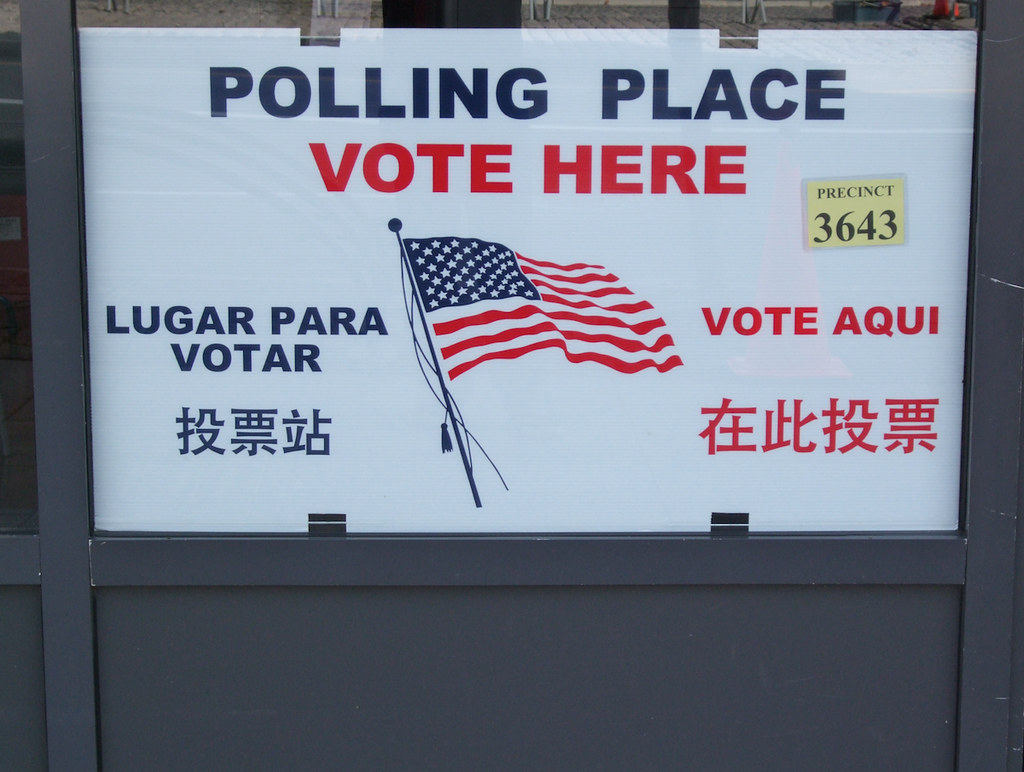
“Polling Place Vote Here” by Scott Beale is licensed under CC BY-NC-ND 2.0 


 .
Much of what we see today, from politics to media to collective outrage, is manipulated to serve the needs of the powerful.
A great deal of the control we think we have is an illusion.
Simple examples include the belief voting can change anything, that the media are there to inform us, and the notion big corporations are competing with others in a free market.
With only a little analysis we see this is not quite true.
It’s just an illusion
The most challenging to accept is democracy and voting have virtually no effect on anything. With all the pomp and energy we see in elections, it is difficult to comprehend they may be for nothing.
The elections do happen. People are elected. The issue is, what happens after that?
Experience tells us very little now changes. Promises are forgotten or ignored. Unforeseen difficulties emerge. Lessons are learned. The original pledge is quietly dropped or somehow morphs into its opposite position.
We do sometimes see legitimate change enacted by determined actors in a new administration. But the system has a robust immune response. Changes tend to be short-lived or successfully resisted. Radical change is rarely attempted and almost never persists. The power structures are resilient.
Democracy changes very little because the politicians have only superficial control. They also rely on campaign funds and are anyway interchangeable unlike the eternal fixtures of the civil service and NGOs that remain long after administrations are cleared out. These have a permanence the elected officials lack and minimal public scrutiny.
The media play a key part in the pantomime.
Many still imagine the traditional media exist to inform the public. They report news and offer informed opinion.
But this has not been true for a long time. The role of the traditional media is to shape the news environment, not accurately report it.
You will hear about the white cop who kills a black teen, but no black-on-white crime statistics for comparison. Celebrity scandals irrelevant to our lives become headline news for weeks while catastrophic bills with decades-long effects are passed without scrutiny or mention.
Stories that support approved narratives can be amplified while anything challenging power can be downplayed or omitted. This helps maintain narratives while providing the illusion of coverage.
The traditional media seems completely captured in this way with few exceptions. This is reflected in their declining market share as even the inattentive sense something is wrong.
Better understood is the lie of global corporations locked in mortal combat with rivals. They project an image of ruthless competition but in practice large entities often have shared interests with similar companies.
It is more accurate to say groups of corporations really constitute informal cartels. There is some competing at the edges, but the threats faced are shared by their rivals too, usually government regulation and the emergence of newer companies more in tune with market needs.
Anyone who studies global corporations is often surprised to discover it is usually them and not governments who push for regulation. Government interference keeps the state’s agents close to hand and prices out smaller rivals as the cost of business rises, a phenomenon that strengthens their position over time.
It is something of a scandal how many individuals from regulatory bodies often end up working in the industries they once oversaw as public sector employees. Naturally this incestuous practice is rarely investigated by the traditional media.
There are many examples. But they all point in one direction. Much of what we see is a stage-managed illusion to prevent any real change and to especially prevent populist, democratic mandates challenging existing power structures.