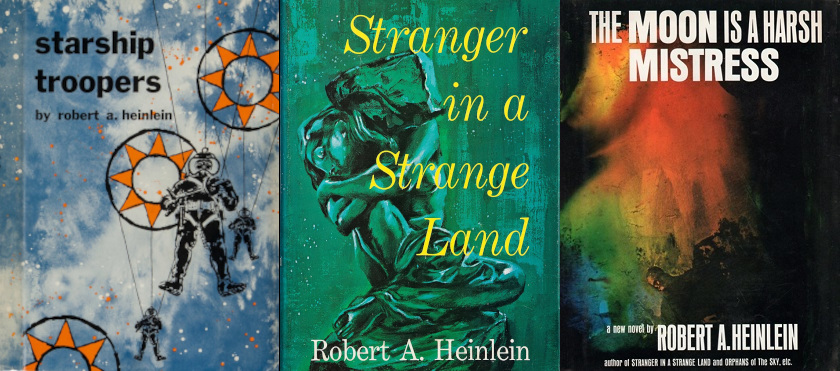
While I can’t claim to have read every word Robert A. Heinlein published, I’ve read most of his novels and short stories. I started with Starship Troopers in grade school. I was a still-wet-behind-the-ears army cadet and that book rocked my world. It’s still in that small group of early books I’ll re-read every few years. Stranger in a Strange Land was an outlier for me, even though it was the next book Heinlein wrote and it became much more relevant culturally by the time I read it (early 70s) it didn’t speak to me the way Starship Troopers had done. On the other hand The Moon is a Harsh Mistress is another one of my all-time favourites, but it helped that when I read it I was already interested in libertarian ideas. All that said, I pretty much felt obliged to share Derek Ryan Jacobs’ short essay on the three books:
There may be no single author in science fiction more persistently misread than Robert A. Heinlein. Depending on what you read and how you interpret it, he is a fascist militarist, a free-love mystic, or a libertarian firebrand. He writes novels that venerate duty and others that dissolve it, texts that praise hierarchy and others that work to dismantle it. Starship Troopers is cited by conservative politicians for its advocacy of earned citizenship; The Moon is a Harsh Mistress is direct rebellion. In between, Stranger in a Strange Land was adopted by communes as spiritual scripture. The contradiction seems total. How could one author plausibly inhabit all these roles at once — much less within a single decade?
0. Introduction
When read together and with care, Starship Troopers, Stranger in a Strange Land, and The Moon is a Harsh Mistress do not reveal an author in philosophical chaos. They reveal an author in methodical experiment. Each novel proposes a different relationship between the individual and the state, a different subgenre framework, and a different set of philosophical tools. But beneath these surface dissonances, all three are working toward the same end: to interrogate the legitimacy of power, and to dramatize the conditions under which agency becomes moral authority. Heinlein does not offer answers so much as simulations. He runs three models. He sets the parameters and variables, and lets the story prove — or fail to prove — the coherence of its system.
It is no accident that these books appeared in the order they did. Starship Troopers came first, a tightly structured martial bildungsroman that argues for citizenship earned through service. Stranger in a Strange Land followed two years later, its spiritual and structural opposite, casting off hierarchy in favor of intuitive communion. Then came The Moon is a Harsh Mistress, a revolutionary treatise dressed as a caper novel — neither ecstatic nor doctrinaire, but strategic, and committed to the long work of building something better. Rather than signaling a philosophical evolution, this sequence maps a series of aesthetic transformations. Each novel shifts genre to create a new laboratory and tell a story of outsiders confronting power. And each converges on a shared moral structure: legitimacy requires individual consent, and any illegitimate system is unfit to govern.
[…]
Conclusion — Three Systems, One Standard
It is tempting to treat Heinlein’s bibliography as a contradiction, or a drift, or an ideological muddle. It is none of those things. What Starship Troopers, Stranger in a Strange Land, and The Moon is a Harsh Mistress reveal — when read in dialogue — is a single philosophical theme rendered in three keys. Legitimacy must be earned. Authority without consent is counterfeit. Freedom without structure is meaningless.
The genre of science fiction gave Heinlein the tools to test that claim. Subgenre let him shift the boundaries, change the stakes, and vary the rules of engagement. But in every world he built, from the Mobile Infantry to the Martian mind to the lunar republic, the same truth holds: agency is a responsibility. And only those who accept its cost are fit to wield its power.