Quotulatiousness

May 8, 2013

Winnipeg’s Museum for Human Rights

Filed under: Cancon, Germany, History — Tags: , , , , — Nicholas @ 10:03

Mark Steyn talks about the spectacle of “bickering genocides” as the Canadian Museum for Human Rights attempts to pay equal attention to all victims of genocide:

My sometime boss the late Izzy Asper was a media magnate whose lifelong dream was a world-class Holocaust memorial in his home town of Winnipeg. For the usual diversity-celebrating reasons, it evolved into a more general “Canadian Museum for Human Rights,” and is now lumbering toward its opening date under the aegis of Izzy’s daughter, Gail. Having been put through the mill by Canada’s “Human Rights” Commissions, I naturally despise any juxtaposition of the words “Canadian” and “human rights.” But if you have to yoke them, this is the place: To paraphrase Justin’s fellow musician Joni Mitchell, they took all the rights and put ’em in a rights museum, and they charged the people a dollar-and-a-half just to see ’em.

But I’ve warmed up to what the blogger Scaramouche calls the Canadian Mausoleum for Human Rights. It could have been just the usual sucking maw of public monies had it not descended into an hilarious, er, urinating match of competing victimhoods. For those who thought “human rights” had something to do with freedom of speech, freedom of religion, and so forth, it turns out to be about which guy’s genocide is bigger. The Ukrainian-Canadian Congress was wary of the mausoleum from the get-go, suspicious that it would downplay the Holodomor, Stalin’s enforced famine in the Ukraine 80 years ago. The mausoleum assured them that they were going to go big on the Holodomor, but to guarantee the UCC came onboard offered to throw in a bonus exhibit of Canada’s internment of Ukrainian immigrants during World War I. This would be part of “Canada’s Journey,” a heartwarming historical pageant illustrating how the blood-soaked Canadian state has perpetrated one atrocity after another on native children, Chinese coolies, Japanese internees, Jews, gays, the transgendered, you name it. And, of course, the Ukrainians. Per Izzy’s wishes, the Holocaust would have pride of place in a separate exhibit, because, its dark bloody history notwithstanding, Canada apparently played a minimal role in the murder of six million Jews. However, the Holodomor would be included as a permanent featured genocide in the museum’s “Mass Atrocity Zone.”

Oh, you can laugh at the idea of a “Mass Atrocity Zone” tourist attraction in Winnipeg, but there isn’t an ethnic lobby group that doesn’t want in. The Polish-Canadian Congress complained that lumping all the non-Jew genocides in one Mass Atrocity Zone meant they’d have to be on a rotating schedule, like revolving pies on the lunch counter. The Armenian genocide was felt to be getting short shrift, considering it was the prototype 20th-century genocide. On the other hand, the Rwandan genocide, the last big 20th-century genocide, and the Congolese civil war don’t appear to have got a look-in at all. The Poles wanted room made for the Germans’ ill treatment of the Poles, which did not seem to be a priority of the mausoleum.

March 17, 2013

Celebrating 60 years of being Stalin-free

Filed under: History, Russia — Tags: , , , — Nicholas @ 11:19

In Reason, Cathy Young looks at the bloody legacy of the Soviet dictator and his startling popularity in modern day Russia (and the west):

The 60th anniversary of the death of one of history’s most murderous tyrants has passed with relatively little notice. Yet the shadow of Soviet dictator Joseph Stalin, who died on March 5, 1953, still hangs over post-communist Russia — and has yet to face proper judgment in the West. This is one bloody ghost still waiting for its final exorcism.

During the years of his absolute rule over the Soviet Union from 1928 to 1953, Stalin was responsible for the deaths of at least 20 million people. They included victims of state-engineered famines, particularly in Ukraine, intended to starve the peasantry into submission to collective farming; people from all walks of life shot on trumped-up charges of subversive activities; and others sent to the Siberian labor camps known as the gulag, never to return. Untold millions who survived lost years of their lives to the gulag. (Among the latter were my own paternal grandparents, who were arrested in 1947 and released after Stalin’s death; ironically, unlike most of their fellow prisoners, they were actually guilty as charged — of “betraying the motherland” by trying to escape the Soviet Union and go to Palestine.)

If there was ever a true devil in the flesh, Stalin was one of the prime candidates for the title. A tyrant with a deeply sadistic streak, he reportedly howled with laughter when told about the final moments of a former associate who had been promised clemency in exchange for a false confession and vainly begged his executioners to “please call Comrade Stalin” and clear up the misunderstanding. He jailed the wives of several men in his inner circle, presumably just for the pleasure of seeing his underlings squirm and showing them who’s boss.

Yet four years ago, this monster came close to being chosen as history’s greatest Russian in a nationwide Internet and telephone vote. Though the voting was not representative, actual polls also yield discouraging results. In a survey conducted last month by the Levada Center, a respected independent polling firm, almost one in 10 Russians said that Stalin’s role in Russia’s history was “entirely positive” while another 40 percent saw it as “mostly positive.” Fewer than a third believed it was entirely or mostly negative, while the rest were not sure.

August 24, 2012

Ukraine rejoins the submarine team

Filed under: Europe, Military — Tags: , , , — Nicholas @ 09:18

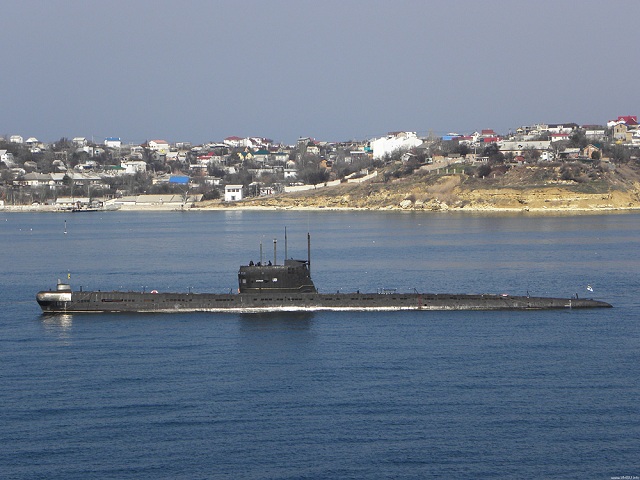
The only submarine in Ukraine’s navy is seaworthy again:

The Ukrainian Navy got its only submarine (the Zaporozhye) back into service. The 40 year old Foxtrot class boat has been out of action for 18 years and was recently refurbished. Zaporozhye is the only sub in the Ukrainian Navy, which mainly consists of small, Cold War era frigates (one) and corvettes (seven). There are also two amphibious ships and six minesweepers. The Foxtrot class diesel-electric subs were designed in the late 1950s and 58 were built until production ended in 1983. These are 1,900 ton boats with ten torpedo tubes and a crew of 78. Russia retired all of its Foxtrots by 2000, but they were all obsolete by the early 1980s. The Zaporozhye is the last Foxtrot still in service.

The Black Sea has not been kind to submarines. Three years ago the Russian Black Sea Fleet suffered a major blow when its only operational submarine, a 19 year old Kilo class boat, broke down at sea and limped back to port on partial power. The only other sub in the fleet, a 32 year old Tango class boat, was undergoing repairs (and still is, but will soon be scrapped.) During the Cold War, the Black Sea Fleet had thirty or more submarines.


Image from Navy Recognition.

Wikipedia says:

Zaporizhzhia (U-01) (Ukrainian: Запоріжжя) is a project 641 (“Foxtrot” class) submarine, the only submarine of the Ukrainian Navy at the moment. She formerly carried the Soviet Navy pennant number B435.

Zaporizhzhia is run by a naval crew of 78, commanded by 1st Rank Capt. Oleh Orlov.

June 11, 2012

QotD: Modern day racism’s cosmopolitan disguise

Filed under: Europe, Media, Politics, Quotations — Tags: , , — Nicholas @ 09:27

In the run-up to the Euro 2012 football championships, which are taking place in Ukraine and Poland this month, we Western Europeans have been bombarded with media stories about how uncultured and uncouth Ukrainians in particular are. In that strange Eastern land, ‘notorious for its extremist yobs’, stupid racial thinking is ‘socially endemic’, we are told, which isn’t surprising considering that, in the words of one British academic, Ukraine lacks the ‘cosmopolitan atmospheres’ of Western Europe. Something fantastically ironic is taking place here: under the banner of ‘anti-racism’, the presumed cultural superiority of Western Europe over backward, brutal Slavs is being loudly asserted, just as the racial superiority of Western Europe was asserted over the Slavs in the past.

Brendan O’Neill, “Euro 2012: are Ukrainians still Untermenschen?”, sp!ked, 2012-06-11

December 15, 2011

China’s first aircraft carrier at sea

Filed under: China, Military, Pacific — Tags: , , , — Nicholas @ 12:17

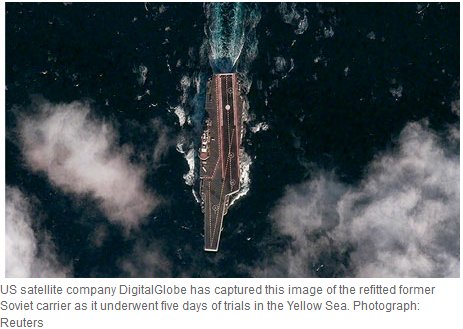
From the Guardian, including this satellite image:

A US satellite company says it has taken a photograph of China’s first aircraft carrier during trials in the Yellow Sea.



It is believed to be the first time the 300-metre ship, a refitted former Soviet carrier, has been photographed at sea since it was launched in August.

DigitalGlobe said one of its satellites took the picture on 8 December and an analyst at the firm spotted the ship this week while searching through images.

Stephen Wood, director of DigitalGlobe’s analysis centre, said he was confident the ship was the Chinese carrier because of the location and date of the image. The carrier has generated intense international interest because of what it might portend about China’s intentions as a military power.

The former Soviet Union started building the carrier, which it called the Varyag, but never finished it. When the USSR collapsed, the ship ended up in Ukraine.

June 9, 2011

Is the Shi Lang a naval “Potemkin Village”?

Filed under: China, Military, Russia — Tags: , , , , — Nicholas @ 17:30

David Axe is not losing any sleep over the soon-to-be commissioned Chinese carrier Shi Lang:

Leaving aside her modest size compared to American carriers, her incomplete air wing and escort force and the fact that she’ll sail without the company of allied flattops, Shi Lang could be even less of a threat than her striking appearance implies. Shi Lang’s greatest potential weakness could be under her skin, in her Ukrainian-supplied engines.

Powerplants — that is, jet engines for airplanes, turbines for ships — are some of the most complex, expensive and potentially troublesome components of any weapon system. Just ask the designers of the Pentagon’s F-35 stealth fighter and the U.S. Navy’s San Antonio-class amphibious ships. Both have been nearly sidelined by engine woes.

China has struggled for years to design and build adequate powerplants for its ships and aircraft. Although Chinese aerospace firms are increasingly adept at manufacturing airframes, they still have not mastered motors. That’s why the new WZ-10 attack helicopter was delayed nearly a decade, and why there appear to be two different prototypes for the J-20 stealth fighter. One flies with reliable Russian-made AL-31F engines; the other apparently uses a less trustworthy Chinese design, the WS-10A.

For Shi Lang, China reportedly purchased turbines from Ukraine. Though surely superior to any ship engines China could have produced on its own, the Ukrainian models might still be unreliable by Western standards. Russia’s Kuznetsov, also fitted with Ukrainian turbines, has long suffered propulsion problems that have forced her to spend most of her 30-year career tied to a pier for maintenance. When she does sail, a large tugboat usually tags along, just in case the carrier breaks down.

If Shi Lang is anything like her sister, she could turn out to be a naval version of the mythical “Potemkin village” — an impressive facade over a rickety interior.

H/T to Nicholas “Ghost of a Flea” Packwood for the link.

« Newer Posts

Powered by WordPress