Quotulatiousness

April 22, 2014

A “Western colony for gays and paedophiles” versus “a superpower empire that was not conquered by anybody”

Filed under: Europe, Military, Politics, Russia — Tags: , , — Nicholas @ 09:02

David Blair compares the two revolutionary movements in Kiev and in Donetsk:

They are bitter enemies, but they run revolutions in much the same way. Here in the “Donetsk People’s Republic” – as pro-Russian demonstrators like to call this part of eastern Ukraine – the protests look much the same as did in Kiev during the February Revolution.

Once again, everything happens around occupied government buildings, where you find barricades piled high with tyres, passionate speakers and vitriolic propaganda, all surrounded by masked men with clubs and iron bars. The pro-Russian protesters of Donetsk took up their cause in bitter opposition to the Maidan revolutionaries of Kiev, but their methods are pretty much identical.

Earlier today, I spent some time behind the barricades of what was once the administrative headquarters of Donetsk region. This 11-storey building is now the seat of power for the “Donetsk People’s Republic”, which plans to hold a referendum on whether to join Russia by May 11. A triple rampart made from tyres laced with barbed wire now protects the building, manned by sentries in miners’ helmets and black balaclavas.

From a wooden stage in front of the building, a constant relay of speakers calls down fury and vituperation on the new government in Kiev and their supposed masters in America and Europe. There is an epic imagination to the crudeness of the propaganda.

My favourite poster shows a crying baby above a picture of Adolf Hitler and an assortment of drag queens. “Where will your baby live?” asks the caption. “In a Western colony for gays and paedophiles? Or in a superpower empire that was not conquered by anybody?” The latter sentence is accompanied by a picture of a jubilant infant raising both tiny fists in triumph.

April 16, 2014

Russia’s long and brutal relationship with Crimea

Filed under: History, Russia, WW2 — Tags: , , , — Nicholas @ 10:39

In History Today, Alexander Lee talks about the historical attitude of Russia toward the Crimean peninsula and some of the terrible things it has done to gain and retain control over the region:

… Russia’s claim to Crimea is based on its desire for territorial aggrandizement and – more importantly – on history. As Putin and Akysonov are keenly aware, Crimea’s ties to Russia stretch back well back into the early modern period. After a series of inconclusive incursions in the seventeenth century, Russia succeeded in breaking the Ottoman Empire’s hold over Crimea with the Treaty of Küçük Kaynarca (1774), before formally annexing the peninsula in 1784. It immediately became a key factor in Russia’s emergence as a world power. Offering a number of natural warm-water harbours, it gave access to Black Sea trade routes, and a tremendous advantage in the struggle for the Caucasus. Once gained, it was not a prize to be willingly surrendered, and the ‘Russianness’ of Crimea quickly became a cornerstone of the tsars’ political imagination. When a spurious dispute over custody of Christian sites in the Holy Land escalated into a battle for the crumbling remnants of the Ottoman Empire in 1853, Russia fought hard to retain its hold over a territory that allowed it to threaten both Constantinople and the Franco-British position in the Mediterranean. Almost a century later, Crimea was the site of some of the bitterest fighting of the Second World War. Recognising its military and economic importance, the Nazis launched a brutal attempt to capture the peninsula as a site for German resettlement and as a bridge into southern Russia. And when it was eventually retaken in 1944, the reconstruction of Sevastopol – which had been almost completely destroyed during a long and bloody siege – acquired tremendous symbolic value precisely because of the political and historical importance of the region. Even after being integrated into the Ukrainian Soviet Socialist Republic and – later – acknowledged as part of an independent Ukraine after the fall of the USSR, Crimea’s allure was so powerful that the new Ukrainian President, Leonid Kraychuk, claimed that Russia’s attempts to assert indirect control of the peninsula betrayed the lingering force of an ‘imperial disease’.

[…]

The non-Russian population of Crimea was to suffer further even worse under the Soviet Union, and between 1921 and 1945, two broad phases of persecution devastated their position in the peninsula. The first was dominated by the fearsome effects of Stalinist economic policy. In keeping with the centralised aims of the First Five-Year Plan (1928-32), Crimean agricultural production was collectivised, and reoriented away from traditional crops such as grain. On top of this, bungling administrators imposed impossibly high requisition quotas. The result was catastrophic. In 1932, a man-made famine swept through the peninsula. Although agronomists had warned their political masters of the danger from the very beginning, the Moscow leadership did nothing to relieve the situation. Indeed, quite the reverse. As starvation began to take hold, Stalin not only prosecuted those who attempted to collect left-over grain from the few remaining collectivised farms producing grain, but also hermetically sealed regions afflicted by shortages. He was using the famine to cleanse an ethnically diverse population. A true genocide, the Holodmor (‘extermination by hunger’) – as this artificial famine is known – killed as many as 7.5 million Ukrainians, including tens of thousands of Crimeans. And when it finally abated, Stalin took the opportunity to fill the peninsula with Russians, such that by 1937, they accounted for 47.7% of the population, compared to the Tatars’ 20.7%.

The second phase – covering the period between 1941 and 1945 – compounded the terrible effects of the Holodmor. On its own, the appalling casualties caused by the savage battle for Crimea would have decimated the peninsula. Some 170,000 Red Army troops were lost in the struggle, and the civilian population suffered in equal proportion. But after the Soviet Union regained control, the region was subjected to a fresh wave of horror. Accusing the Tatars of having collaborated with the Nazis during the occupation, Stalin had the entire population deported to Central Asia on 18 May 1944. The following month, the same fate was meted out to other minorities, including Greeks and Armenians. Almost half of those subject to deportation died en route to their destination, and even after they were rehabilitated under Leonid Brezhnev, the Tatars were prohibited from returning to Crimea. Their place was taken mostly by ethnic Russians, who by 1959 accounted for 71.4% of the population, and – to a lesser extent – Ukrainians.

April 15, 2014

Ukraine suffering Russian version of “Death by A Thousand Cuts”

Filed under: Europe, Military, Politics, Russia — Tags: , , , — Nicholas @ 08:02

In the Telegraph, former UK ambassador Charles Crawford says that Vladimir Putin is using Ukraine as a testing ground for rebuilding a new Russian empire:


Russian President Vladimir Putin visits the Cosmonautics Memorial Museum on April 11, 2014 in Moscow, Russia. Russia celebrates the Cosmonaut Day, marking the pioneering flight into space of Yuri Gagarin on April,12,1961.

It is no exaggeration to say that the historic deal that ended the Cold War is now unravelling. That deal was simple. Russia itself (largely on its own initiative) ended the Soviet Union in favour of a bold democratic modernisation process to be achieved in partnership with Western capitals. Confrontation in Europe and around the world would be replaced by cooperation. Huge sums of Western money would be made available to Russia on generous terms, to help it move from communism to sane economic and security policies. All the other Soviet republics would become independent countries and begin their own transitions in a similar partnership spirit.

[…]

Outside Russia’s already vast borders Putin is throwing down a momentous challenge to the rest of the world: “What if Russia drops all this namby-pamby European soft-power rubbish and decides instead to reclaim one way or the other historic Russian lands?”

That question does not fit any category of thinking that today’s Western leaders and their advisers can muster. Western leaders have come to see agreed rules and interminable meetings as a source of strength. Putin sees agreed rules and boring meetings as a source of weakness. Hence the Western and wider international response is muted and uncertain. The focus is on stepping up “economic pressure” on Russia in general and key Russians in particular. There is logic to this. Europe needs Russian energy, but Russia needs European money. Russia really has moved on from the Cold War period and joined the international marketplace. It ought to be impressed by the threat of investment bans and other targeted financial measures.

That approach does not, however, address the key problem. Putin might see the Russian economy hurting and ask Russians another question: “What if we reclaim historic Russian lands but at the cost of eating turnips again for a while?” A noisy majority of Russians might think that that is a sacrifice well worth making. This gives Putin hard policy options unavailable to Western leaders, for whom any equivalent question would be electoral suicide.

Ukraine is now the luckless space where Putin is experimenting with different ways to roll back the Cold War settlement and then reassert Russian imperial power in other parts of the former Soviet Union. Crimea has been annexed, but the rest of Ukraine is far bigger and much more complicated. All sorts of methods are being deployed both in Ukraine and through a sophisticated global propaganda operation to destabilise Ukraine. The key immediate goal is to make Ukraine ungovernable except on Russia’s terms. This means preventing a new legitimate government emerging in the forthcoming elections.

April 8, 2014

Map of the day

Filed under: Europe, USA — Tags: , , — Nicholas @ 08:37

Here’s an interesting map. What do you think it shows? An epidemic? Outbreaks of zombies? Incidents of flashmobbing?

Click to see full-sized image at the Washington Post

Click to see full-sized image at the Washington Post

The real answer is this shows where participants in an American survey plotted the location of Ukraine. The headline of the story is “The less Americans know about Ukraine’s location, the more they want U.S. to intervene“.

Where’s Ukraine? Each dot depicts the location where a U.S. survey respondent situated Ukraine; the dots are colored based on how far removed they are from the actual country, with the most accurate responses in red and the least accurate ones in blue. (Data: Survey Sampling International; Figure: Thomas Zeitzoff/The Monkey Cage)

I’m not sure which responses worry me the most: the ones that show Ukraine in “flyover country”, Alaska, or Greenland or those that show Ukraine as an underwater modern-day Atlantis…

Update 10 April: I’m kicking myself for forgetting this Bierce quote.

March 26, 2014

Russia has seized 80% of the Ukrainian navy so far

Filed under: Europe, Military, Russia — Tags: , , — Nicholas @ 08:08

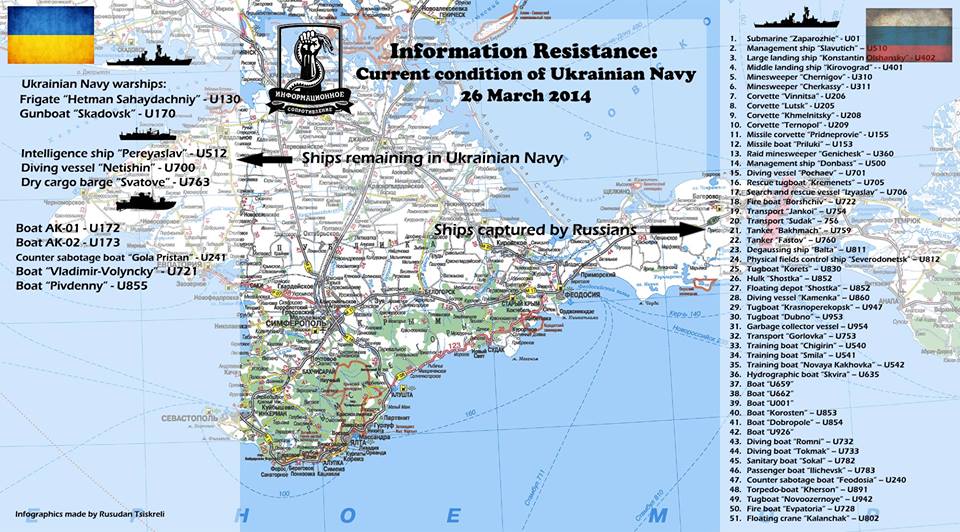
The Kyiv Post has a report including this graphic, showing the current state of Ukraine’s naval forces:

Ukraine ships captured by Russia - March 2014

Among the Ukrainian vessels reportedly captured by the Russians are submarine Zaporizhia, management ship Slavutych, landing ship Konstantin Olshansky, landing ship Kirovohrad, minesweeper Chernihiv and minesweeper Cherkasy.

The Cherkasy was the last of the ships to have been overtaken following weeks of threats and ultimatums to surrender. It was finally chased down and overtaken by the Russian navy on March 25 after failing to slip past a blockade of two ships intentionally sunk by the Russians to trap it and other vessels in a narrow gulf, keeping them from escaping into the Black Sea.

H/T to Tony Prudori for the link.

March 25, 2014

NATO’s existential moment

Filed under: Europe, Military, Russia — Tags: , , , , — Nicholas @ 09:35

In the Telegraph, Con Coughlin says that if NATO doesn’t stand up to Vladimir Putin’s aggressions, it’s done for:

For anyone who still takes the security of the West seriously — and I fear I am in a distinct minority — the manner in which Russian President Vladimir Putin has effortlessly achieved his audacious land grab in the Crimea should serve as a dramatic wake-up call for Nato.

And yet, to judge by the mood music coming from the meeting of Western leaders in The Hague this week, the likelihood of Nato doing anything to dissuade Moscow’s macho man from undertaking any further acts of military adventurism in central Europe or the Baltic states does not seem at all encouraging.

[…]

When faced with a crisis, the default position of Nato member states, as we have seen recently over Libya and Syria, is to bicker amongst themselves over how to respond, rather than coming up with an effective programme that safeguards its interests.

But if Nato leaders fail to come up with an adequate response to Putin’s new mood of military aggression, they might as well dissolve the alliance and start negotiating peace terms with Moscow.

NATO member states in blue, Ukraine in yellow, Russia in red (for tradition's sake)

NATO member states in blue, Ukraine in yellow (including Crimea), Russia in red (for tradition’s sake)

Update: Poland is recalling reservists for military refresher training.

Next time you take a tray of tea and custard creams to the nice gang of Polish builders renovating your semi, they may seem a little distracted and anxious. Ask them why, and they will answer that some of them have in the last few weeks received call-up papers as army reservists.

This happened to a friend of mine in London at the end of last week. At least 7,000 reservists have been recalled to the colours for immediate exercises lasting between 10 and 30 days.

They’re told by the Polish authorities that the call-ups are “routine”: but the men say they haven’t been asked before and they’re well aware of the growing alarm in Warsaw at President Putin’s aggression. Three weeks ago, their Prime Minister, Donald Tusk, called a press conference to warn that “the world stands on the brink of conflict, the consequences of which are not foreseen… Not everyone in Europe is aware of this situation.”

My own view is that Putin was initially more concerned with righting a specific historical wrong in Crimea than starting a new Cold War. This is still probably the case despite the dawning truth that the EU/Nato Emperor really has no clothes at all.

But in the worst case scenario of a truly revanchist Russia, Poland certainly has the borders from hell. Starting from the top, it abuts Kaliningrad (the Russian exclave on the Baltic carved at the end of the war from East Prussia), Lithuania, Belarus and Ukraine.

March 7, 2014

Gunboat diplomacy for the 21st century

Filed under: Europe, Military, Russia, USA — Tags: , , , — Nicholas @ 08:38

680News reports that a US warship will be patrolling the Black Sea:

A U.S. Navy warship is heading to the Black Sea as tensions in Ukraine continue to divide world powers, according to multiple published reports.

Turkey has given the USS Truxtun permission to pass through the Bosphorus into the Black Sea.

U.S. officials say it is a “routine” deployment that was scheduled before the crisis erupted in Ukraine.

However, the show of military hardware is coinciding with NATO’s show of military support over Baltic countries with its use of air patrols and F-15 fighter jets.

Meantime, President Barack Obama’s warnings to Russia are being brushed aside by Russian President Vladimir Putin, who appears to only be speeding up efforts to formally stake his claim to Ukraine’s Crimean Peninsula.

The USS Truxtun is a new Arleigh Burke-class guided missile destroyer, commissioned in 2009.
While we may be relatively sure that the Truxtun is a powerful vessel (the Wikipedia article describes the class as “larger and more heavily armed than most previous ships classified as guided missile cruisers”), no single ship is going to be particularly effective in putting pressure on Russia over their Ukraine deployment. The Black Sea is a small body of water, geostrategically speaking, and is totally dominated by land-based airpower. Should the situation turn grave, Truxton isn’t likely to weigh heavily in the military balance. She’s there as a token, not as a military asset.

March 5, 2014

Vladimir Putin and the “vertical of power”

Filed under: Europe, Politics, Russia — Tags: , , — Nicholas @ 09:31

The BBC‘s Steve Rosenberg says that to understand what Russia is doing, you have to get into the mind of the man who controls it all:

One thing that makes Vladimir Putin mad is the feeling that he is being deceived. We saw that with Libya in 2011. Moscow was persuaded not to block a UN Security Council resolution on a no-fly zone to protect civilians. But Nato’s military action led to regime change and the death of Col Muammar Gaddafi — far beyond what Russia had expected. It helps explain why Russia has been quick to veto resolutions on Syria.

On Ukraine, too, President Putin feels the West has tricked him. Last month he sent his envoy to Kiev to take part in negotiations on a compromise agreement between President Viktor Yanukovych and the opposition. That deal, brokered by foreign ministers from Germany, France and Poland, envisaged early elections, constitutional reform and a national unity government.

The Kremlin’s representative did not sign the deal, but Russia appeared to accept it as the best solution in a bad situation. It remained words only. Less than 24 hours later, Mr Yanukovych was on the run, the parliament removed him from power and appointed a new acting president from the opposition. The pace of events took Moscow completely by surprise.

The world according to Vladimir Putin is one in which Western powers are plotting night and day to destabilise Russia (and him, personally).

He remembers the Rose Revolution in Georgia in 2003, the Orange Revolution in Kiev the following year; Russia suspected the West of planning both.

More recently the Kremlin accused the West of funding and fuelling anti-government street protests in Moscow.

For months, Russia has been accusing the US and EU of meddling in Ukraine for geopolitical gains. On Tuesday President Putin said Viktor Yanukovych’s refusal to sign an association agreement with the EU last autumn “was simply used as an excuse to back opposition forces in their battle for power… it’s not the first time our Western partners have done this in Ukraine”.

March 4, 2014

QotD: Back to the 19th century in geostrategy

Filed under: Politics, Quotations, USA — Tags: , , , — Nicholas @ 10:37

… incrementally all these tiny tesserae began forming a mosaic, fairly or not, of the Obama administration as either weak or clueless or perhaps both.

Accordingly, Mr. Putin, in empirical fashion, after factoring in the rhetoric and the facts, has decided that it is time, in the fashion of 1979–80, to move with probable impunity. Others are, of course, watching what Obama derides as Cold War chess games. Should Iran now go full bore on its nuclear program? Should China test Japanese waters and airspace a bit more aggressively? Should North Korea try to gain new concessions from its nuclear lunacy? Should the failed Communists of Latin America try forcibly exporting their miseries to neighbors? And all are operating on the shared assumption that the American reaction will be another “outrageous,” “unacceptable,” “don’t cross this line,” or another solemn Kerry lecture about the existential threats of global warming.

For some, like the now furrow-browed Europeans who once giddily lapped up the Victory Column pabulum, there is irony. For the Baltic states, Georgians, the Persian Gulf sheikdoms, the Japanese, the Taiwanese, and the South Koreans, there is increased anxiety about regional strains of Putinism spreading to their own backyards. And among our allies such as the British, Israelis, Canadians, and Australians, there is still polite bewilderment.

This will probably end in either two ways: Either Barack Obama will have his 1980 Jimmy Carter revelatory moment as something like an “Obama Doctrine,” or we could see some pretty scary things in the next three years as regional thugs cash in their chips and begin readjusting the map in their areas of would-be influence.

Victor Davis Hanson, “The Stepping Stones to the Ukraine Crisis”, VDH’s Private Papers, 2014-03-03

March 2, 2014

Why the EU hesitates to do anything about Ukraine

Filed under: Europe, Politics, Russia — Tags: , , , , — Nicholas @ 09:50

Theodore Dalrymple:

Extreme wealth, whether honestly or dishonestly acquired, seems these days to bring forth little new except in the form and genre of vulgarity. Mr. Ambani’s skyscraper tower home in Bombay is a case in point: His aesthetic is that of the first-class executive lounge of an airport. Mr. Ambramovich’s ideal is that of a floating Dubai the size of an aircraft carrier. Only once have I been invited to a Russian oligarch’s home, and it struck me as a hybrid of luxurious modernist brothel and up-to-date operating theater. I saw some pictures recently of some huge Chinese state enterprise’s headquarters, and it appalled me how this nation, with one of the most exquisite, and certainly the oldest, aesthetic traditions on Earth, has gone over entirely to Las Vegas rococo (without the hint of irony or playfulness).

But it was the luxury and not the taste of Yanukovych’s homes that outraged the Ukrainians, for if by any chance they had come into money they would have done exactly the same, aesthetically speaking. Yanukovych may have been a dictator of sorts, but when it came to taste he was a man of the people. A horrified Ukrainian citizen, touring one of his homes after his downfall, was heard to exclaim, “All this beauty at our expense!”

As to politics, the Ukrainian crisis has once again revealed the European Union’s complete impotence. Physiognomy is an inexact science, but it is not so inexact that you cannot read the bemused feebleness on the faces of people such as Van Rompuy, Hollande, and Cameron, the latter so moistly smooth and characterless that it looks as though it would disappear leaving a trail of slime if caught in the rain. Mrs. Merkel has a somewhat stronger face, but then she has the advantage of having spent time in the Free German Youth (the East German communist youth movement), which must at least have put a modicum of iron in her soul.

Be that as it may, Russia holds all the trump cards in this situation. It can turn off Western Europe’s central heating at a stroke, and for Europeans such heating is the whole meaning and purpose of life—together with six-week annual holidays in Bali or Benidorm. Therefore Europe will risk nothing for the sake of Ukraine, except perhaps a few billion in loans of no one’s money, a trifle in current economic circumstances. If Bismarck were to return today, he would say that the whole of Ukraine was not worth the cold of one unheated radiator.

February 27, 2014

Ukraine and the EU – why the easy answer won’t work

Filed under: Economics, Europe, Russia — Tags: , , — Nicholas @ 09:09

At the Adam Smith Institute website, Eamonn Butler explains why there won’t be an easy economic fix for the EU/Ukraine trading relationship:

The trouble with EU membership is that it is such a big deal. A country that wants to be part of the club, and enjoy its free trade benefits also has to accept a mountain of regulation and to sign up for the common currency. It is all or nothing.

That puts countries like Ukraine in a fix, just as it put the UK in a bit of a fix in the early 1970s. The UK did not want to raise tariff barriers and lose its trading relationships with its historic trading partners such as Canada, Australia and New Zealand, from which it imported a great many agricultural products — butter, lamb, fruit, bacon and much else. But thanks to the Common Agricultural Policy, it did not have much choice. Today, the UK is inside the EU’s tariff wall, which makes trade with the rest of the world more expensive, and naturally focuses UK trade on Europe.

[…]

As a logical matter, that does not have to be. If the EU allowed Ukraine the same sort of status enjoyed by (neutral) Switzerland, the country would be free to trade with the EU as part of its customs-union club – but would remain free to preserve trading links to other countries as well. It would also be free to retain its currency and its legal and regulatory structure. A free trade pact with the EU that would help grow the Ukrainian economy, without threatening Russia or the Russian-speaking Ukrainians that the country would be wholly swallowed up into a Western political alliance.

A genuine free-trade deal, rather than full membership. That would probably be ideal for Ukraine (and for other nearby countries not already in the EU), but it won’t be on offer, because too many existing members of the EU would also prefer to have that kind of trading relationship without all the legislative/regulatory overhead that full membership requires. In many ways, the EU cannot afford to offer Ukraine such a deal, for fear of undermining the basis of the current integrated model.

Update: Daniel Hannan on the possibility of partition in Ukraine.

These two views — Ukrainians as a historic people, Ukrainians as a strain of Russians — frame the present quarrel. Most Russian nationalists allow, albeit reluctantly, that Ukrainian national consciousness exists. Alexander Solzhenitsyn grumpily accepted that western Ukrainians, after the horrors of the Soviet era, had been permanently alienated from Mother Russia; but he insisted that the frontiers were arbitrarily drawn under Lenin. If Ukrainians claimed independence on grounds of having a separate national identity, he argued, they must extend their own logic to the Russian-speakers east of the Dnieper.

[…]

Plainly a pro-Russian regime can’t govern the whole country: the recent uprising has put that fact beyond doubt. If the Slavophiles can’t rule the West, might the Westernisers win the East? The way of life they propose ought to be more attractive. But we should not underestimate the importance, in such a region, of blood and speech. Nor should we underestimate how much more Ukraine matters to Moscow than it does to Brussels. Vladimir Putin has mobilised troops on the border. Does anyone imagine any EU government, with the possible exception of Poland’s, contemplating a military response?

If neither the Slavophiles nor the Westernisers can carry the entire territory, some kind of separation starts to look inevitable. Such a separation might come about as paramilitary groups establish local supremacy. Or it might happen as a result of Russian intervention, as in Armenia, Moldova and, later, South Ossetia. It is easy enough to imagine Russian security forces crossing the border at the request of local proxies and establishing a de facto Russophone state. The Trans-Dniester Republic still exists, unrecognised but very much in force, on Ukraine’s western border; why not a Trans-Dnieper Republic to its east?

February 25, 2014

A contrarian speaks out on Ukraine

Filed under: Europe, Media — Tags: , , , — Nicholas @ 11:43

Brendan O’Neill isn’t comfortable with the widespread media descriptions of Ukraine’s change of government and calls it regime change instead:

Even in this era of rampant political spin and platitudes, where George Orwell’s claim that political language is used and abused to ‘make lies sound truthful and murder respectable’ has never been truer, the commentary on Ukraine stands out for its dishonesty. Western observers tell us there has been a revolution in that benighted nation. They claim revolutionaries have overthrown a dictator. They say the people of Ukraine have risen up and deposed their despot, and are now ‘experiencing the intense emotions expressed so eloquently by Thomas Paine in 1776 [in his writings on the American War of Independence]’. It is hard to remember the last time political language was so thoroughly used to obfuscate reality, to impose inappropriate historical narratives on to a messy modern-day event. For what we have in Ukraine is not revolution, but regime change, set in motion far more by the machinations of Western politicians than by the stone-throwing of Ukrainians.

Orwell was right – too much political writing is less about clarifying real-world events than it is a collection of pre-existing phrases ‘tacked together like the sections of a prefabricated henhouse’. So it has been in relation to Ukraine, where the words selected by Western observers tell us more about them and their prejudices than they do about events in Kiev. So the word ‘meddling’ is used to describe Vladimir Putin’s interventions in Ukraine, but never to describe Angela Merkel’s or John Kerry’s cultivation of the oppositional forces – that is ‘mediation’. Ousted Ukrainian leader Viktor Yanukovich is now widely referred to as a ‘dictator’, confirming how exhausted and meaningless that word has become through overuse: unlike serious dictators like Gaddafi or Assad, Yanukovich won a free and fair election, in March 2010. As for the word ‘revolution’ – that has been knackered by misuse for decades, but its deployment in Ukraine takes its bastardisation to a new low: there has of course been no replacement of one social order by another in Ukraine, or even the instalment of a people’s government; instead various long-established parties in parliament, some of which are deeply unpopular among certain constituencies in Ukraine, are forming an interim government. Revolutionary? Hardly.

The Western debate and coverage of Ukraine has cast a massive political fog over events there. It may not have quite made ‘murder seem respectable’, but it has certainly made externally generated regime change seem revolutionary, and the Western-assisted anti-democratic removal of an elected leader seem like an act of people’s democracy. It has exposed a severe dearth of independent critical thinking among the Western commentariat. Even those on the right who are normally passionately anti-EU are now lining up like lemmings behind Brussels’ dishonest moral narrative about being a mere observer to a glorious revolution in the East. And even those on the left who condemned regime change in Iraq or Libya are buying the idea that Ukraine has undergone a revolution of Paineite proportions, with the Observer giddily declaring that Ukraine is currently experiencing ‘an intoxicating sense of liberation from an old guard’. Across the political spectrum, narratives about Ukraine that don’t add up, and which are being promoted by people normally seen as untrustworthy, are being accepted as good coin – among both a right excited by the prospect of a return of the neat Cold War-era divide between good West and bad East, and a left so desperate for evidence of revolutionary behaviour in the twenty-first century that it will lap up even staid, grey, distinctly unrevolutionary Brussels’ claims about a revolution being afoot in Ukraine.

Note: This article is posted at Spiked Plus, which is normally a pay site. They’ve made the site available to non-subscribers for a limited time to mark their second anniversary. If you’re reading this post at a later date, the link to the whole article may not work unless you’re a member.

February 24, 2014

Euromaidan’s pseudo-medieval technological battle with Berkut

Filed under: Europe, Politics, Weapons — Tags: , , — Nicholas @ 10:59

Robert Beckhusen on the throwback to the Middle Ages in the fighting between the Euromaidan protestors and the paramilitary Berkut police:

But to understand why the protests succeeded in toppling Yanukovych, it’s worth taking a glance at its strategies and military-style tactics. The protesters not only built a broad and inclusive coalition, but innovated where it mattered most: on the streets.

Really, it turned medieval.

Protesters shot fireworks with makeshift launchers. In combination with throwing stones and using slingshots, they overwhelmed disoriented Berkut special forces units, who were pelted with flying objects as fireworks exploded around them.

Protesters wore military helmets and carried makeshift — or captured — shields. Wooden boards were used to protect their lower legs from shrapnel the police taped to exploding stun grenades.

Among the array of homemade weapons, some were perhaps a little too ambitious. A crude trebuchet — a type of medieval catapult which uses a counterweight to fling objects — was overrun and dismantled.

To shield themselves from the onslaught, the police special forces units known as Berkut adopted distinct tetsudo formations. This packed shield formation was used by the Roman Empire, developed to shield infantry units from arrows. The first line holds its shields forward, with each preceding line holding their shields towards the sky.

The problem with this tactic? It makes you much slower.

February 22, 2014

Ukrainian President flees coup

Filed under: Europe, Politics, Russia — Tags: , , , — Nicholas @ 11:09

The situation in Ukraine just got more fluid, as President Yanukovych is said to have fled from Kiev and the speaker of the Ukrainian parliament announced a vote to remove him from the presidency. James Marson, Alan Cullison and Alexander Kolyandr report for the Wall Street Journal:

Government authority appeared to melt away Saturday, leaving protesters in control of the capital’s center. President Viktor Yanukovych left the capital for a city in the country’s Russian-speaking east and vowed to remain in power.

In a television interview Saturday afternoon in Kharkiv, Mr. Yanukovych denounced the events in Kiev as a “coup d’etat” that he blamed on “bandits.”

“I have no plans to leave the country and I have no plans to resign. I am the legally elected president and all the international intermediaries I’ve talked to (over the last few days) have given me guarantees of security. We’ll see how those are fulfulled,” Mr. Yanukovych told a small TV station in Kharkiv.

Opposition leader Vitali Klitschko earlier had called on parliament to vote to oust Mr. Yanukovych and announce presidential elections in May, as police withdrew from the center of the capital Saturday.

Ukraine opposition leader and former Prime Minister Yulia Tymoshenko was expected to be released from prison within hours, according to a spokeswoman for the opposition.

Ukraine is divided politically and linguistically on almost the same line:

Ukraine language map

The BBC reports that new elections have been called for May 25:

Ukrainian MPs have voted to oust President Yanukovych and hold early presidential elections on 25 May.

Mr Yanukovych’s spokeswoman said he did not accept the decision.

Earlier on Saturday, protesters walked unchallenged into the president’s office and residential compounds.

Also on Saturday afternoon, prominent opposition leader Yulia Tymoshenko was freed from a hospital in the eastern city of Kharkiv where she was being held under prison guard.

A BBC correspondent saw Tymoshenko driven away in a car after leaving the hospital.

MPs had voted to pave the way for her release on Friday. She was sentenced to seven years in prison in 2011 for abuse of power.

Her supporters have always maintained this was simply Mr Yanukovych taking out his most prominent opponent, and her release has always been a key demand of the protest movement.

February 19, 2014

Euromaidan versus Berkut – it’s not a game

Filed under: Europe, Government, Liberty, Politics, Russia — Tags: , , — Nicholas @ 14:34

The situation in Ukraine is not getting the public attention it deserves in the West, and Zenon Evans provides a quick summary of the extent of the protests and government repression:

Violence between Ukraine’s opposition (known as Euromaidan) and the government’s SWAT-style police force (Berkut), has boiled over today. Fires are raging across protesters’ tent-towns and police stations in what is being described as “open warfare.” Estimates indicate that over 20 people are dead and over 1,000 are injured. The BBC reports that officers are using rubber bullets and stun grenades, while The Daily Beast says machine guns are their weapon of choice. Protesters are armed with an array of weapons, from bricks and molotov cocktails to firearms of their own.

Parliamentary member Lesya Orobets writes:

    The war is here. A real fierce war. It is impossible to grasp this emotionally, although the mind is working precisely and quickly quite apart from emotions. We are being exterminated because of our desire to have dignity and decide our lives independently. This simply makes no sense. My fellow Ukrainians are being killed by the creatures that not only resemble us biologically, but also carry Ukrainian passports.

Russian news website Slon.ru explains that mayhem was sparked because police blocked opposition members and their representatives from entering Ukraine’s parliamentary building, where they planned on introducing constitutional reforms to limit the authority of President Yanukovych, who has been consolidating power.

For more background, Joey DeVilla has assembled a primer on Euromaidan at his blog:

Ukraine language map

I continue to be surprised with how many people I keep running into who don’t know what’s going on in Ukraine right now. For those of you who haven’t been following the news or who’d like to know more, this article’s for you!

For the most basic introduction, check out the above video by the Washington Post, Ukraine’s crisis explained in 2 minutes. It starts with a question that you might be asking: What is Ukraine? (If you live in the Bloor West Village area of Toronto, you have no excuse for not knowing about Ukraine.)

« Newer PostsOlder Posts »

Powered by WordPress