
Published on 9 Sep 2017
Flush from his victories against Poland-Lithuania, Charles XII of Sweden sets his eyes on an even greater enemy: Russia. But its ruler, Peter the Great, is no pushover: as the Swedish troops advance, he burns down the countryside and leaves them starving and exposed as a ferocious winter sets in.
September 12, 2017
Great Northern War – III: Young and Violent – Extra History
Comments Off on Great Northern War – III: Young and Violent – Extra History
April 11, 2017
December 20, 2016
Exploring WW1 Forts in Ukraine I THE GREAT WAR Special
Published on 19 Dec 2016
Check out how Ryan explored the area of Przemysl: https://www.youtube.com/watch?v=9tRuMlWQiw0
We worked together with the Ukrainian authorities and got permission to film in some of the sub-forts of Przemsyl.
Comments Off on Exploring WW1 Forts in Ukraine I THE GREAT WAR Special
September 25, 2016
Galicia’s role in WWI (Live from Lviv) – Handguns for Pilots – Fight or run I OUT OF THE TRENCHES
Published on 24 Sep 2016
Sitting in the Chair of Temporary Insanity, Indy talks about Galicia’s big role in war on Location, if Pilots were issued guns, and a story from a viewers great grandpa.
Comments Off on Galicia’s role in WWI (Live from Lviv) – Handguns for Pilots – Fight or run I OUT OF THE TRENCHES
September 4, 2016
Our First Trip To WW1 Locations Was An Epic Journey I THE GREAT WAR Special
Published on 3 Sep 2016
Map of all the locations we went to: http://bit.ly/2bxRZCg
Indy & Flo talk about our first trip to original WW1 locations in Poland and Ukraine. The trip was a great experience for all of us and you will surely like the future episodes we will publish throughout the next months. Thanks again to everyone who made this possible.
Comments Off on Our First Trip To WW1 Locations Was An Epic Journey I THE GREAT WAR Special
March 26, 2015
Tsar Vladimir is merely following the pattern of Philip of Macedon and Napoleon
When he’s not droning on about domestic politics, Victor Davis Hanson has interesting historical patterns to point out:
Nothing that Vladimir Putin has done in gobbling up territories of the former Soviet Union is new. In fact, he simply apes every tyrant’s time-honored four-step plan of aggression.
From Philip of Macedon to Napoleon, aggressors did not necessarily have a grand timetable for creating an empire. Instead, they went at it ad hoc. They took as much as they could at any given time; then backed away for a bit, if they sensed strong opposition was building — only to go back on the offensive when vigilance waned.
Hitler did not realistically believe in 1936 that he would within five years create an empire from the Atlantic to the Volga. Instead, he started out by moving incrementally — in the Rhineland, Austria, and Czechoslovakia — testing where he might grab land without a war, always both surprised at the ease of his success and full of contempt for the appeasers who had so empowered him.
So too Putin. Once the Obama administration had reset the mild punishments of the Bush administration for carving out parts of Ossetia, Putin went back on the move. Obama’s reset was a green light for Putin. Who in the real world of serious diplomacy shows up in Geneva with a red plastic toy reset button, complete with a mistranslated Russian label? When Putin soon sized up the Obama administration’s appeasement around the globe — from fake red lines for Syria, to a scramble out of Iraq, to chaos in Libya — he moved into Crimea. And then he waited.
Western sermons followed; outrage grew. Then the Western hysterics predictably passed, as popular attention went back to the Kardashians and Miley Cyrus’s metamorphosis from Disney girl to vamp. After a bit of digestion, Putin was ready for his next Anschluss. He repeated the formula in Ukraine: a persecuted Russian-speaking minority, an anti-Russian illiberal government, civil unrest, denial of a just and much-needed new plebiscite, a need for paramilitaries to help out their brethren, a Russian army standing nearby just in case, a few bombers buzzing the West, and magnanimous promises to leave crumbs for the victims.
Comments Off on Tsar Vladimir is merely following the pattern of Philip of Macedon and Napoleon
February 13, 2015
Feeling nostalgic for Cold War-era Soviet propaganda? Don’t worry … it’s back!
Strategy Page on the disturbing resurrection of Soviet style “news”:
Westerners in Russia, especially those who speak and read Russian, report that state controlled Russian media has seemingly reverted to stories and attitudes right out of the Cold War. It is, in short, unreal but actually happening. Russian media is full of stories of NATO aggression against Russia and anything that is going wrong in Russia is blamed on a NATO conspiracy to destroy Russia. The Russian aggression in Ukraine is described as largely a fable created by a NATO conspiracy to take over the Ukrainian government and institute a terror campaign against the ethnic Russian minority in Ukraine, especially eastern Ukraine. There, the Russian media described ethnic Russians leading a rebellion against this NATO puppet government running Ukraine and NATO soldiers pretending to be Ukrainians doing most of the fighting. No captured NATO agents are presented which Russian media describes as proof of how clever and dangerous this NATO aggression is.
The reality is that Russian soldiers are regularly captured (dead and alive) and presented on Ukrainian TV but this is ignored and dismissed by Russian media as more insidious NATO propaganda. Those Russians familiar with their own history who point out the current government propaganda in Russia is similar to what went on in 1939 and 1941 are condemned as traitors. But it is a fact that in 1939 the communist Soviet Union signed a peace treaty with Nazi government of Germany and overnight Germany went from threat to valued ally according to Soviet media. That switched again in mid-1941 when Germany broke the treaty and invaded the Soviet Union. But during the time the treaty was in force Russian invaded Poland, the Baltic States and Finland. Russia was defeated in Finland and only got control of some territory just across the border. But eastern Poland was seized (as part of the 1939 treaty, with Germany taking most of Poland) as were the three Baltic States (Estonia, Latvia and Lithuania)
Comments Off on Feeling nostalgic for Cold War-era Soviet propaganda? Don’t worry … it’s back!
February 6, 2015
“Green men” finally triumph over the “Cyborgs”
Unfortunately, the “green men” are almost certainly Russian special forces troops, while the “cyborgs” were a rag-tag bunch of Ukrainian defenders of what remained of Donetsk’s modern airport terminal:
Late last week pro-Kremlin separatist militias — aided and very likely led by “green men” — defeated the last band of Ukrainian “Cyborgs” defending Donetsk’s airport. Two years ago the airport was touted as one of Eastern Europe’s most modern air hubs. Today it is, like many neighborhoods in the Donetsk region and villages along the Russia-Ukraine border, a miserable ruin.
For Ukrainians, Donetsk’s airport had become a national symbol. Media compared its stubborn Ukrainian defense to the legendary World War II Battle of Stalingrad, which pitted Red Army defenders against invading Nazis. In Ukraine’s narrative, the Ukrainians were defending Soviet forces, the Kremlin’s “green men” and their proxy militias the invaders.
Russian President Vladimir Putin, however, is an adept propagandist. In Putin’s insistent rendition, the Kremlin’s militias are Stalingrad’s glorious Russian soldiers reborn. Ukrainian defenders he scorns as “fascists.”
[…]
“The green men”: They wear green uniforms, without insignia, and masks. They pack sophisticated weaponry and gear. I associate their media nickname with, obviously, alien invaders, and invaders they are. They led the Russian invasion of Crimea; they appear, furtively, in Eastern Ukraine. They are Russian Army special operations troops. They advise the separatists. They seize key terrain. Credible sources have them participating in tactical combat.
The 1994 Budapest Accord leaves no doubt they are invaders. Putin wants the 1994 Budapest Accord to disappear down the global memory hole. Ukraine signed the Accord and gave up its nuclear arsenal in exchange for territorial security assurances by Russia. The U.S. (Clinton Administration) and Great Britain guaranteed the deal. If the U.S. had not guaranteed the Accord, I doubt Kiev would have signed it. In late February 2014 Putin shredded the Accord and invaded Crimea. Denuclearized, Ukraine’s resistance was futile.
But here’s the mistake Washington and London would like you to ignore: The U.S. (Obama administration) and Great Britain failed to support Ukraine.
Comments Off on “Green men” finally triumph over the “Cyborgs”
January 26, 2015
Tsar Vladimir I is making “dangerous history”
Austin Bay looks at the risky but rewarding path of aggression and propaganda undertaken by Vladimir Putin:
Russian president Vladimir Putin made dangerous history in 2014. His invasion of Crimea and subsequent annexation of the peninsula shredded the diplomatic agreements stabilizing post-Cold War Eastern Europe.
Then Putin ignited a low-level war in Eastern Ukraine. Despite a September 2014 ceasefire agreement, Putin’s overt covert war-making continues in Eastern Ukraine. The Kremlin has concluded that Western leaders, European and American, are weak and indecisive.
Putin, unfortunately, knows how to use specific tactics in operations designed to achieve his strategic goals.
Military analysts typically recognize three levels of conflict: the tactical, the operational and the strategic. The categories are general, and distinctions often arguable. Firing an infantry weapon, however, is a basic tactical action. Assassinating Austrian royalty with a revolver is a tactical action, but one that in 1914 had strategic effect (global war). U. S. Grant’s Vicksburg campaign (1862-63) consisted of several Union military operations around Vicksburg (many unsuccessful). The campaign’s concluding operation, besieging Vicksburg, was an operational victory that gave the Union a strategic military and economic advantage: control of the Mississippi.
Putin’s Kremlin uses propaganda operations to blur its responsibility for tactical attacks in Ukraine. International propaganda frustrates Western media scrutiny of Russia’s calculated tactical combat action. Local propaganda targets Eastern Ukraine. Earlier this month, Ukrainian journalist Roman Cheremsky told Radio Free Europe that despite suffering criminal bullying by pro-Russian fighters, Kremlin “disinformation” is convincing Eastern Ukraine’s Russian speakers that Ukrainian forces are “bloodthirsty thugs.”
[…]
Oil’s price plunge, however, has also slammed Putin, threatening the genius with political and economic problems that, if prices remain low, could erode his personal political power. Energy revenue declines do far more damage to Putin than the economic sanctions Western governments have imposed.
So what’s a brilliant, innovative, thoroughly unscrupulous and utterly amoral strategist to do?
According to the AP, this week (Jan. 20), Iran and Russia signed “an agreement to expand military cooperation.” Iran and Russia are old antagonists, but given current circumstances vis a vis the U.S. and Saudi Arabia, Tehran and Moscow may be following an old Machiavellian adage: “the enemy of my enemy is my friend.” The deal includes counter-terror cooperation, military training and “enabling each country’s navy to use the other’s ports more frequently.”
For years Iran has sought Russian air defense weapons, presumably to thwart a U.S. strike on its nuclear facilities. However, the agreement’s naval port clause attracts my interest. About a third of the globe’s exported oil moves on tankers through the Persian Gulf’s Indian Ocean outlet, the Strait of Hormuz. To spike oil prices, Iran often threatens to close Hormuz. If Iran actually tried to shut the Strait, Western nations have assured Gulf Arab oil producers that they will respond militarily.
Comments Off on Tsar Vladimir I is making “dangerous history”
September 13, 2014
Ukraine’s PM – “We are still in a stage of war and the key aggressor is the Russian Federation”
In the Guardian, Martin Williams reports on the situation in eastern Ukraine:
The Russian president, Vladimir Putin, wants to destroy Ukraine as an independent country and resurrect the Soviet Union, the Ukrainian prime minister Arseny Yatseniuk has said.
Yatseniuk told a conference of European politicians his country was “in a stage of war” with Russia, as renewed clashes broke out between the Ukrainian army and pro-Russian rebels in the east and Moscow sent a second convoy of trucks into Ukraine without Kiev’s consent.
Continuous rocketfire could be heard overnight in the eastern city of Donetsk. The city council said shells had hit residential buildings near the airport, although no casualties were reported.
Ukraine’s military said it had successfully repelled a rebel attack on the government-held Donetsk airport. But a column of three Russian multiple rocket launchers was seen moving freely through the rebel-held city on Saturday morning.
Speaking at a conference in Kiev attended by European and Ukrainian politicians and business leaders, Yatseniuk praised the economic sanctions imposed on Moscow. He said: “We are still in a stage of war and the key aggressor is the Russian Federation … Putin wants another frozen conflict [in eastern Ukraine].
“His aim is not just to take Donetsk and Lugansk. His goal is to take the entire Ukraine … Russia is a threat to the global order and to the security of Europe.”
Comments Off on Ukraine’s PM – “We are still in a stage of war and the key aggressor is the Russian Federation”
September 9, 2014
This is why NATO countries are not supplying weapons to Ukraine
It’s not about a sudden sensitivity to Russian feelings: NATO is not providing up-to-date weapons and ammunition for excellent practical reasons:
The Ukrainian armed forces use Soviet weapons systems. These are well-designed, solid, easy to use for a conscript army, and although the Ukrainian inventory may be aging, Soviet arms production was never geared to high-tech generational obsolescence. They build simple, solid and cheap because they have to. NATO countries are casualty-averse and never commit a platoon where a Hellfire missile is available. On the other hand, Soviet doctrine never varied much from the World War II stories of tank attacks shoving the flaming hulks of the first wave out of the way, for the second wave to be destroyed in turn, until the Germans ran out of ammunition. Almost anything NATO could supply would be very hard to employ on the battlefield without training, and time for training is what the Ukrainians do not have.
In this sense, “training” doesn’t just mean “here’s the operator’s manual.” It means that the whole operational and tactical doctrine of the army has to be redesigned around the new weapons systems.
It’s not just the actual weapons, training and doctrine, either. Not to be unkind about it but Ukraine’s armed forces are almost completely hollowed out by official neglect, underfunding, and corruption. Back in May, Sarah Chayes reported on the pitiful state of Ukrainian military preparedness:
In a 2012 analysis Leonid Polyakov, another senior defense official, detailed the corrupt workings with remarkable candor. Chronic underfunding “enhanced the role of the human factor” in choosing among operational priorities. Ostensibly outdated equipment was sold “at unreasonably understated prices” in return for kickbacks. Officers even auctioned off defense ministry land. Gradually, Kyiv began requiring the military to cover more of its own costs, forcing senior officers into business, “which is…inconsistent with the armed forces’ mission,” and opened multiple avenues for corruption. Commanders took to “using military equipment, infrastructure, and…personnel [to] build private houses, [or] make repairs in their apartments.” Procurement fraud was rife, as were bribes to get into and through military academies, and for desirable assignments.
So even if Ukraine had taken advantage of NATO equipment, training, and support, much of the new kit would have disappeared into the same criminal enterprises which sold off so much of the old kit.
Comments Off on This is why NATO countries are not supplying weapons to Ukraine
The Russian-Ukrainian War
Paul Goble summarizes Konstantin Gaaze’s ten questions and answers about the war between Russia and Ukraine:
Gaaze’s first question is “Why did we (they) act as we (they) did with them (us)?” His answer: “President Putin considers that the Ukrainian state exists only because he agrees to its existence.” Consequently, “Moscow has acted from the false hypothesis that ‘Ukraine is not a state,’” something for which several thousand people have already paid with their lives.
But Kiev, the Moscow writer says, has also operated from a false hypothesis.” Ukrainian leaders believed that “Russia will not provide essential assistance to the local uprising in the east of Ukraine because it is intimidated by Western sanctions.” But Moscow isn’t, and it has intervened. Consequently, Ukraine has had to fight, and many have suffered as well.
His second question is “What has been obtained and how did the war end?” In Gaaze’s view, “the east of Ukraine belongs to people whose names we in fact do not know. Kiev has lost part of its territory but forever have been marginalized the future of the non-existence Novorossiya.”
“It will never become part of Russia,” Gaaze says, but “in the near term, it will not be part of Ukraine either. Millions of people thus are condemned to live in an enormous Transdniestria, to live between two armies, one of which (the Russian) is committed to destroy the other (the Ukrainian).” The first is only waiting for the order to do so.
Gaaze’s third question is this: “Was Putin fighting with Ukraine or with the West?” the answer is with both, but the results are different. “Kiev did not lose the war, but it did not win it either. The West,” in contrast, “lost the first round of the new Cold War. Moscow did what it wanted,” while the West did not act decisively because of various fears about the future.
“But the first round of the cold war is not the entire war,” Gaaze says. The West can recover. NATO can rearm. “There will be other rounds,” and Russia “will not be able to win them.”
Comments Off on The Russian-Ukrainian War
September 7, 2014
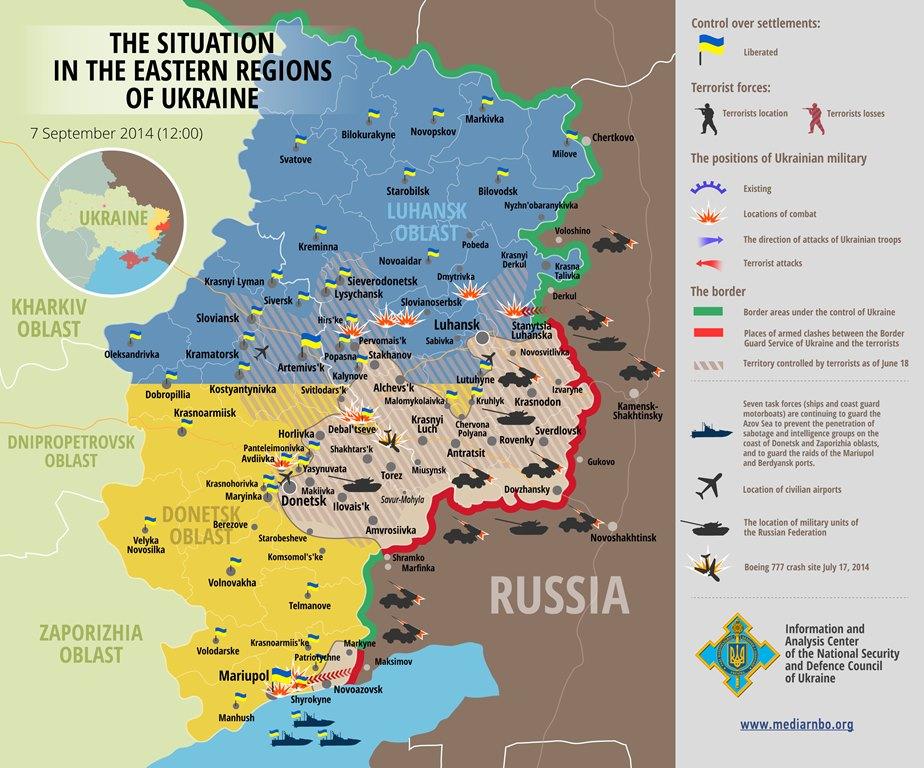
Combat situation in Ukraine
Current situation map released on Twitter by the Ministry of Foreign Affairs of Ukraine:
Comments Off on Combat situation in Ukraine
September 5, 2014
NATO – “they spent all their money on buying Ferraris and now they have no gas money”
Philip Ewing reports on the chances of improved military “readiness” among the NATO allies:
With President Barack Obama in Europe this week for a major NATO summit, the White House hopes the growl of the Russian bear on Europe’s eastern flank means the moment is right for some long-sought reforms to the alliance. But the outlook appears dim for anything beyond incremental steps at best.
The major reason is one that has frustrated policymakers over the past several administrations: Most European nations would love a stouter defense structure — so long as they don’t have to pay for it.
The North Atlantic Treaty Organization requires that member nations devote at least 2 percent of their economies to defense spending, yet today only four do: the U.S., Britain, Greece and Estonia. Although this week’s summit in Wales appears likely to yield a “pledge” in support of increased spending in the wake of Russia’s invasion of Ukraine, no one expects a serious effort from members other than those most directly threatened, including Latvia, Lithuania and Poland.
[…]
Obama and U.S. officials also are focused on bolstering European military “readiness,” particularly as U.S. spending declines. NATO relies on the U.S. for critical military capabilities such as surveillance, in-flight refueling and transportation. European militaries field top-rate troops, ships and aircraft but keep only weeks’ or even days’ worth of munitions on hand. In NATO’s 2011 campaign against Libya, many nations ran out of munitions and the French began dropping concrete bombs.
“It’s sort of like they spent all their money on buying Ferraris and now they have no gas money,” Benitez said. “There are many allies that literally aren’t flying their planes because they can’t afford to. They have very advanced fleets, but their fleets aren’t leaving port because they can’t afford to.”
Comments Off on NATO – “they spent all their money on buying Ferraris and now they have no gas money”


