Quotulatiousness

September 13, 2023

Michael Geist on the “relentless misinformation campaign that ignores the foundational principles of copyright law”

Filed under: Books, Cancon, Education, Law — Tags: , , , — Nicholas @ 05:00

Michael Geist discusses a recent public statement from the Canadian Federation of Library Associations on how changes to copyright rules in Canada may seriously impact the public:

Assignments of copyrights photostat copies by mollyali (CC BY-NC 2.0) https://flic.kr/p/5JbsPE

Last month, the Canadian Federation of Library Associations released a much-needed statement that sought to counter the ongoing misinformation campaign from copyright lobby groups regarding the state of Canadian copyright and the extensive licensing by libraries and educational institutions. I had no involvement whatsoever with the statement, but was happy to tweet it out and was grateful for the effort to set the record straight on what has been a relentless misinformation campaign that ignores the foundational principles of copyright law. Lobby groups have for years tried to convince the government that 2012 copyright reforms are to blame for the diminished value of the Access Copyright licence that led Canadian educational institutions to seek other alternatives, most notably better licensing options that offer greater flexibility, access to materials, and usage rights. This is false, and when the CFLA dared to call it out, those same groups then expressed their “profound disappointment” in the library association.

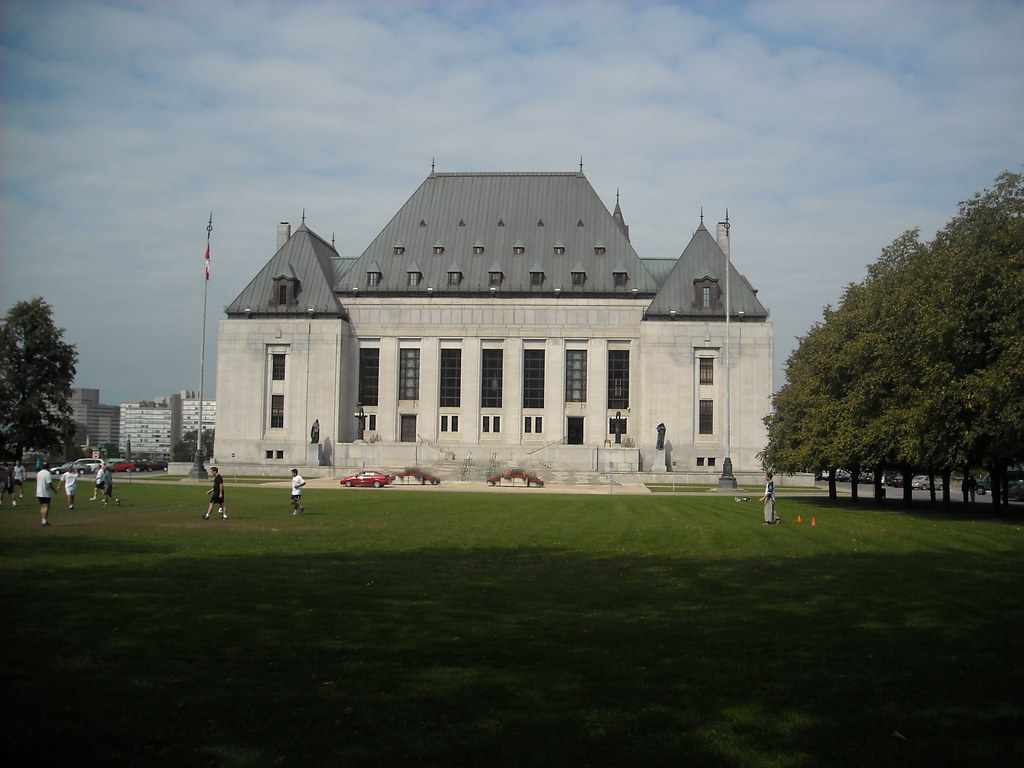
Yet what has been disappointing is that despite repeated Supreme Court of Canada decisions that have eviscerated the foundation of those groups’ claims, they insist on running back the same failed strategy again and again. The reality of Canadian copyright isn’t complicated: libraries and the education community spend more than ever before on licences that provide the right to access and use materials for teaching, course materials, text and data mining, and a myriad of other purposes. When combined with the gradual disappearance of course packs, the emergence of open access materials, and a reasonable interpretation of fair dealing consistent with Canadian jurisprudence, education and libraries are fulfilling their mandate by responsibly using public dollars to maximize public access, enable student learning, and ensuring fair compensation for authors.

The lobbying efforts to convince government to restrict fair dealing by requiring unnecessary licences would increase student costs, make education less affordable, and render Canada less competitive. Further, it would mean less access to materials for Canadian students. Universities spend hundreds of millions of dollars on licences that grant both access to materials (purchasing physical books has declined dramatically) and the ability to use them. The outdated Access Copyright licences only grant rights to use already acquired works for a limited series of purposes. Reverting back to the unnecessary Access Copyright licence would mean access to fewer works and reduced investment by the education sector and libraries in new works.

I wrote a six-part series on these issues earlier the year including posts on setting the record straight, the shift to electronic licensing, transactional licences, the disappearance of course packs, the emergence of open text books, and a fair reading of fair dealing. Once you get past the rhetoric, the data leaves little doubt that education and libraries are still actively paying for copyright materials through licensing and the claims of mass illegal copying in education in 2023 is a fabrication unsupported by the evidence.

June 12, 2023

It’s an insult to Chuck Barris and The Gong Show to compare it to the Justin Trudeau Show

In the weekly dispatch from The Line, the editors defend the honour of the original Gong Show and say that it’s not fair or right to compare that relatively staid and dignified TV show to the Canadian government’s performance art on the foreign interference file:

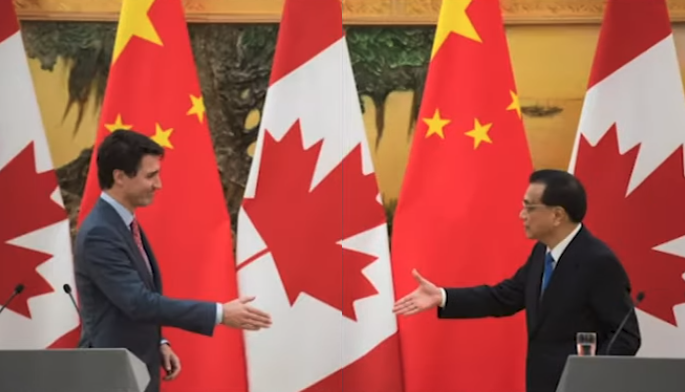
When the news broke late Friday afternoon that David Johnston was resigning from his position as special rapporteur on Chinese interference, the general reaction across the chattering class was a variable admixture of amusement and scorn. There’s probably a German word for it, but the security and intelligence expert Wesley Wark captured the tone of it with the headline on his Substack post, which said, simply: “Gong Show“.

We’re somewhat inclined to concur with Wark, except the three-ring train wreck that has marked Johnston’s time as Justin Trudeau’s moral merkin has been so disastrous that we think apologies are due to Chuck Barris, in light of the relative sobriety of his famous game show.

Reporters at the Globe and Mail and Global News started breaking stories about Chinese interference in Canadian elections a few months back, based largely on leaks from inside the Canadian intelligence apparatus. Almost immediately it was clear that the Liberals had a major problem on their hands, one that was going to require levels of transparency, good judgment and political even-handedness that this government has manifestly failed to achieve during its almost eight years in power.

Yet when Trudeau announced that he was going to appoint an “eminent Canadian” as “special rapporteur” to do an investigation and report back to the government with recommendations for how it should tackle the issue, we gave a collective groan here at The Line. Given the endless similar tasking of retired Supremes passim, it was clear that the pool from which Trudeau was going to fish his eminent personage was very shallow, and pretty well-drained. Indeed, at least one of us here was willing to bet large sums that it would be David Johnston.

What do we make of all this? Here’s the situation as we see it, in bullet form for brevity’s sake:

  • Johnston should never have been offered the position of special rapporteur
  • Having been offered the job of special rapporteur, Johnston should never have accepted it

And that is basically it. But given that Trudeau had the poor judgment to ask him, and Johnston had the poor judgment to accept, we think everything that has happened since was pretty much inevitable. We couldn’t have guessed at all the details of how this would have played out, especially the delicious elements beginning with the decision to hire Navigator to provide strategic advice (to manage what, exactly?), the revelation that Navigator had also provided strategic advice to Han Dong (who, recall, Johnston more or less exonerated), the firing of Navigator and the involvement of Don Guy and Brian Topp … this is really just gongs piled upon gongs piled upon gongs.

But the overall trajectory of Johnston’s time as special rapporteur? If you had told us ahead of time that this was more or less how things would go, we wouldn’t have been much surprised. Why? Because we live in Canada. And this is how Canada’s governing class behaves. It is a small, incestuous, highly conflicted and enormously self-satisfied group of people that is so isolated from the rest of the country they don’t even realize how isolated they are.

Honestly. What in heaven’s name gave Trudeau the idea that it would be smart to ask a former governor general to help launder his government’s reputation? And why on Earth did Johnston think it was a good idea to accept? Forget the Navigator stuff, this turkey was never going to fly. Johnston’s report was not accepted as the wise counsel of a wise man; instead it was seen as a partisan favour by a conflicted confidant. Sure, Johnston was subject to some pretty unfair attacks from the opposition, but what did he think was going to happen? Has he paid any attention over the last decade? But pride is a form of stubborness, and even after parliament voted for him to go, Johnston insisted he would stay on to finish his work. Until, on Friday afternoon, he decided he would not.

We’re not going to speculate about why Johnston finally pulled the chute. We’d like to think that the former GG in him thought it best to obey the will of the House of Commons. We rather hope it had nothing to do with some pointed (and unanswered) questions put to Johnston’s office by the Globe and Mail, asking whether Navigator had been given a heads-up on Johnston’s conclusions on the Dong file.

Maybe it doesn’t matter. As Paul Wells put it in a recent column, Trudeau sought to “outsource his credibility by subcontracting his judgment,” where credibility was supposed to flow from Johnston to Trudeau. Instead, and we would say, inevitably, the flow went in the opposite direction. If the prime minister had any credibility to lead the country on this issue, he wouldn’t need a special rapporteur in the first place. The fact that Trudeau felt the need to appoint one is a tacit admission that he knows he doesn’t have the trust of the people.

And that is the real problem here. The Johnston saga has ended where it was always going to, with a once-honorable man’s reputation in tatters and the problem he was brought in to address still unresolved. David Johnston has resigned, as he must have. In our view, that’s one resignation too few.

November 1, 2022

If it wasn’t for double standards, the legacy media wouldn’t have any standards at all

Filed under: Media, Politics, USA — Tags: , , , , , — Nicholas @ 03:00

At Spiked, Brendan O’Neill calls out the US mainstream media for their blatant double standards on political violence after the as-yet still mystery-shrouded attack on the husband of the Speaker of the House of Representatives over the weekend:

Paul and Nancy Pelosi, 16 February, 2022.
Detail of a photo by Amos Ben Gershom via Wikimedia Commons.

It was the mention of zip ties that got me thinking. Apparently the man who allegedly broke into the San Francisco home of Nancy and Paul Pelosi on Friday was carrying zip ties. A possibly crazed individual approaching the home of a powerful politician with plastic fasteners that can be used to bind a person’s hands – it was both a nightmarish prospect and a familiar one, too. Wasn’t another public figure in the US recently targeted by someone who had zip ties? And a gun, a knife, pepper spray and a crowbar? Yes. It was Brett Kavanaugh. But many don’t remember that. Because thanks to the media, certain acts of political hate get less traction than others.

People are rightly horrified by what happened to Paul Pelosi on Friday. David DePape allegedly broke into the Pelosi home and yelled “Where is Nancy?”. She wasn’t there. DePape then allegedly attacked Mr Pelosi, who is 82, with a hammer. Pelosi suffered a skull fracture and is still in hospital, though he is expected to make a full recovery. This was a horrific assault on an elderly person, as well as seeming to have been motivated by a deep political animus. Sadly, it was not a one-off. There was a creepily similar incident at the home of Supreme Court justice Brett Kavanaugh in Maryland in June.

A 26-year-old man from California travelled to Maryland allegedly with the intention of murdering Kavanaugh. That’s what he is charged with – attempted murder. He was armed with a tactical knife, a Glock 17 pistol, zip ties and other murderous paraphernalia. The difference between Kavanaugh’s alleged tormentor and the man who allegedly broke into the Pelosi home is that the former failed to gain entry. He spied two US marshals close to Kavanaugh’s home and called off his deadly mission. Kavanaugh was luckier than Paul Pelosi.

It is unquestionable that the assault on the Pelosi home has caused more waves and fury among the media elites than the mercifully thwarted attempted assassination of Kavanaugh did. The Kavanaugh incident swiftly faded from public consciousness. One observer wrote of the media’s “eerie silence” on Kavanaugh. It was pointed out that the “attempted assassination of Brett Kavanaugh” was being downplayed by the New York Times the very day after it happened. On the NYT‘s homepage, the Kavanaugh story was 16th in order of importance, behind stories about the new Jurassic Park movie and Kelly Clarkson’s singing skills. In that day’s paper, it was on page 20. Nate Silver said it was “crazy” that the targeting of Kavanaugh was not “treated as a bigger story”. “There’s often more bias in which stories are deemed to be salient than how they’re written about it”, he said.

That is well said. Media bias is apparent not only in the information and takes that the media publish but also in what the media decree to be important in the first place. And it would appear that the targeting of a right-wing, pro-life justice is less important – a lot less important – than the targeting of the home of a Democratic, pro-choice politician. Politics is clearly at play here. Kavanaugh’s moral outlook runs counter to that of the liberal media and coastal elites, and thus he makes for an unsympathetic character. Nancy Pelosi, on the other hand – she’s the crusading Democrat the chattering classes love. An assault on her home moves the liberal elites profoundly.

On the rapidly changing reported details of the attack on Paul Pelosi, Jim Treacher has some salient questions:

First things first: Paul Pelosi is currently in the hospital recovering from his attack, and here’s wishing him a speedy recovery. It sounds horrible and I wouldn’t wish it on anybody. Crime in America is spiraling out of control.

Now …

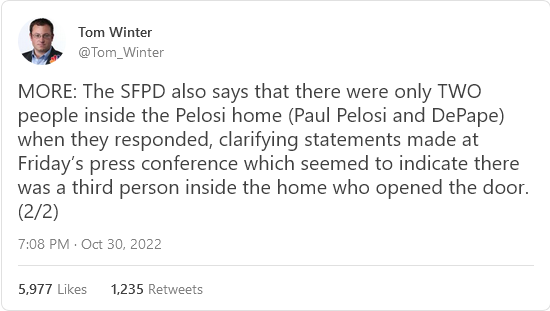
The Pelosis are worth somewhere north of $100 million. Nancy Pelosi is the speaker of the United States House of Representatives, and second in the line of presidential succession. You’re telling me her husband Paul was alone in a house with no security or surveillance cameras? This lunatic David DePape just walked right up to the house and broke in?

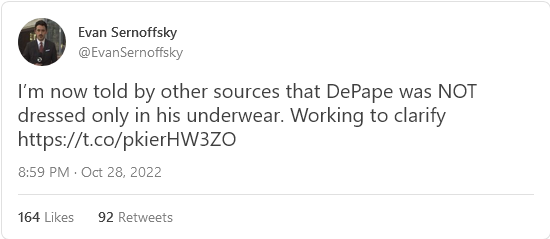
I’ve got other questions. The initial report was that DePape was in his underwear when the police caught him beating Pelosi with a hammer. Now we’re told that’s not true.

Wait, what? How do you get that detail wrong? Did it come from the police? I can understand misremembering the color of his pants. But the cops couldn’t tell whether he was wearing any?

And then there’s this:

Okay, I’m just trying to picture the scene that the two responding officers saw: They entered the Pelosi home, found DePape attacking Pelosi, and stopped him.

How did they get into the house? Did they break down the door? Was it unlocked, or already open? Did DePape or Pelosi open it?

The story is that the police encountered DePape in the middle of beating Pelosi. So if DePape opened the door for them … why? Or if Pelosi opened the door for them … how?

I see a lot of people speculating that this was some sort of lovers’ quarrel, or a Grindr date gone wrong, or something along those lines. Doesn’t seem likely to me, but is it really outside the realm of possibility? Are you a homophobe? I thought we were supposed to accept all genders and preferences and whatnot. It’s 2022.

October 12, 2022

Medically assisted suicide in Canada

Filed under: Cancon, Health, Law — Tags: , , — Nicholas @ 05:00

In Common Sense, Rupa Subramanya discusses how quickly MAID (Medical Assistance in Death) became a commonality in Canada:

Toronto General Hospital in 2005.
Photo via Wikimedia Commons.

When we think of assisted suicide or euthanasia, we imagine a limited number of elderly people with late-stage cancer or advanced ALS in severe pain. The argument for helping them die is clear: Death is imminent. Why should they be forced to suffer?

In 2015, Canada’s Supreme Court ruled that assisted suicide was constitutional. In June 2016, Parliament passed Bill C-14, otherwise known as the Medical Assistance in Dying Act. MAiD was now the law of the land. Anyone who could show that their death was “reasonably foreseeable” was eligible. In this respect, Canada was hardly alone: The Netherlands, Switzerland, Belgium, Spain, Australia, and New Zealand, among others, allow assisted suicide. So do ten states in the U.S.

In 2017, the first full year in which MAiD, which is administered by provincial governments, was in operation, 2,838 people opted for assisted suicide, according to a government report. By 2021, that figure had jumped to 10,064 — accounting for more than 3 percent of all deaths in Canada that year.

There have been a total of 31,664 MAiD deaths and the large majority of those people were 65 to 80 when they died. In 2017, only 34 MAiD deaths were in the 18- to 45-year-old category. In 2018, that figure rose to at least 49. In 2019, it was 103; in 2020, 118; and in 2021, 139.

Today, thousands of people who could live for many years are applying — successfully — to kill themselves.

Indeed, in some Canadian provinces nearly 5 percent of deaths are MAiD deaths. In 2021, the province of Quebec reported that 4.7 percent of deaths in the province were due to MAiD; in British Columbia, the number was 4.8 percent. Progressive Vancouver Island is unofficially known as the “assisted-death capital of the world”, doctors told me.

Why the dramatic increase? Over the past few years, doctors have taken an increasingly liberal view when it comes to defining “reasonably foreseeable” death. Then, last year, the government amended the original legislation, stating that one could apply for MAiD even if one’s death were not reasonably foreseeable. This second track of applicants simply had to show that they had a condition that was “intolerable to them” and could not “be relieved under conditions that they consider acceptable”. This included applicants like Margaret Marsilla’s son, Kiano.

In 2023, those numbers are almost certain to rise.

Next March, the government is scheduled to expand the pool of eligible suicide-seekers to include the mentally ill and “mature minors”. According to Canada’s Department of Justice, parents are generally “entitled to make treatment decisions on their children’s behalf. The mature minor doctrine, however, allows children deemed sufficiently mature to make their own treatment decisions.” (The federal government does not define “mature”, nor does it specify who determines whether one is mature. On top of that, the doctrine varies from one province to another.)

Dr. Dawn Davies, a palliative care physician who supported MAiD when it was first conceived, said she had “tons of worries” about where this might lead. She could imagine kids with personality disorders or other mental health issues saying they wanted to die. “Some of them will mean it, some of them won’t,” she said. “And we won’t necessarily be able to discern who is who.”

Hugh Scher, an attorney advising Margaret Marsilla, told me: “While other countries have explored extending assisted suicide to minors, those governments have insisted on substantial safeguards, including parental notification and consent. Canada is poised to become the most permissive euthanasia regime in the world, including for minors and people with only psychiatric illness, having already removed the foreseeability of death or terminal illness as an essential condition to access euthanasia or assisted suicide.”

October 1, 2022

QotD: The Left does not handle political reverses gracefully

Filed under: Law, Media, Politics, Quotations, USA — Tags: , , , — Nicholas @ 01:00

While this [recent progressive losses on religious school funding, gun control, voter ID, the repeal of Roe v. Wade] all may seem like fun and games to us, keep in mind that for the Left, this is the most serious business they’ve had to face since the 1960s. Being reversed in the courts — repeatedly, openly — represents a massive monkey wrench in their “march of progress”. And as I discussed last week, the Left has been accelerating the imposition of its agenda over the past two decades to the point that it cannot slow down or back off without the risk of losing everything. It’s truly all or nothing for these folks now. And they realise this.

The Left is absolutely right to fear all of this because these things represent the furtherance of a growing trend towards decentralisation that I’ve been talking about recently. This is bad for them because the Left’s whole program — and I’m talking about going back for at least two centuries — has been based on the centralisation of power into its own hands. Everything the Left does is predicated upon the “principle” of coalescing power into its hands in government, NGOs, woke corporations, and a constellation of other institutions that all coordinate together to advance the progressive agenda. Due to our place in our current demographic-structural secular cycle, this decentralisation is nigh inevitable, but that doesn’t mean the Left won’t (literally) burn through a lot of social capital fruitlessly trying to stop it.

These recent Supreme Court rulings represent real loses for their program at the most sovereign level in our government. This, in turn, signals openly their loss of control over that institution. This is why we’re seeing increasingly desperate ideas being floated for ploys to take back the SCOTUS, from packing the Court to (somehow) convincing 2/3 of the states to gut it completely. They know they’ve lost control over it as an institution, so they’re perfectly willing to dynamite it (hopefully not meaning that literally), like an ex-girlfriend who takes a baseball bat to a guy’s X-Box rather than just giving it back to him like a sane person would do. In the space of a few short years, the SCOTUS has gone from hero to zero in the Left’s eyes, since for them everything is situational in nature. Once something, anything, outlives its usefulness to them, it goes up against the wall.

The thing to understand from this is that these losses the Court has handed to the Left are real things. They’re not just some kind of plot to “mobilise their voters” to win the midterms in November. While lefties may often be cunning, they are also arrogant and in many ways kind of dumb. These people are really not out here playing some grandmaster game of four-dimensional chess. They’re desperate, which is why they’re willing to engage in such blatant attempts at gaming the system through naked procedural manipulation. They’re the ones who are suddenly finding themselves in the place of having to operate outside of “our sacred norms” by refuting the legitimacy of institutions that go against them.

Bear in mind that the Left’s entire view of legitimacy is predicated on this “ever-forward march of progress”. To “move backwards” is to show weakness, to reveal a chink in the armour of the dialectic of inexorable progress. This sense of legitimacy, in turn, was based upon their capture of the various power-generating and power-wielding institutions, including the Supreme Court, since the “right” people now had possession of the means to remake society. What a lot of people forget is that the whole “march of progress” since the mid-1960s occurred because of this institutional takeover. Their judicially imposed agenda has never really “won the argument” on any issue. They just used social and political force to achieve their goals, followed up by media-driven social pressure and anarchotyranny to “encourage” conformity among the general population. So yeah, especially with something like the repeal of Roe v. Wade, their whole program is in jeopardy. The post-Roe stance on abortion adopted in 1973 was the truly radical stance on this issue, but they don’t want you to realise this.

Theophilus Chilton, “The Left Is in a Precarious Place”, The Neo-Ciceronian Times, 2022-06-29.

August 18, 2022

MAID in Canada

Filed under: Cancon, Health, Law — Tags: , , , — Nicholas @ 05:00

In The Critic, Ben Woodfinden discusses the maple-flavoured slippery slope we’re gaining speed on: what’s known as “Medical Assistance In Dying (MAID)”:

Toronto General Hospital in 2005.
Photo via Wikimedia Commons.

Canada is widely seen as one of the world’s most progressive nations in the world, “leading the way” (depending on where you stand) on a variety of social issues. But in recent months, Canada has been garnering some less than savoury international attention because of the dark side of one of its recent progressive accomplishments, namely the assisted suicide regime that has been created since the Supreme Court struck down prohibitions on assisted suicide in 2015. The tragic situation that has developed in Canada offers a warning to Britain and other countries considering going down a similar path, both to be cautious about opening the assisted suicide floodgates and about empowering judges to decide whether such things should be allowed.

When Canada’s enlightened judicial philsopher kings and queens overturned criminal prohibitions on assisted suicide in Carter v. Canada, they overturned their own precedent. In 1993 a majority of the Supreme Court found that the criminal code provisions that prohibited assisted suicide did not ultimately violate the Canadian Charter. In 2015 the Court changed its mind. The law didn’t change, of course, but the court decided that “the matrix of legislative and social facts” surrounding the case had changed. Thus the interpretation of constitutional rights must change with them.

Plenty of the same people who were outraged that the United States Supreme Court would overturn precedent on seminal abortion decisions, seemingly had no problem with the overturning of precedent in this Canadian case. This is because implicit in the view of rights and judicial review that many progressives hold, is that it is perfectly acceptable to overturn precedent in the name of expanding or establishing some newly discovered right — but once this is done, the debate is settled and there can be no reasonable dissent or change of heart. History, it seems, only marches in one direction.

An important part of the Carter decision, where the court determined that relevant social facts had changed, was essentially a blithe dismissal of exactly what has come to pass in Canada less than a decade after the decision. The court rejected the concern that once assisted suicide was allowed in some rare cases, there would be a “slippery slope” from helping terminally ill people end their lives, to a system in which vulnerable people like the disabled were caught in a euthanising net.

Evidence presented in the case by a medical expert from Belgium that this might be possible, was dismissed by the court because “the permissive regime in Belgium is the product of a very different medico-legal culture”. Unlike those barbaric Belgians, enlightened Canada could avoid sliding down this slippery slope in which safeguards are easily gotten around. They would avoid the creeping expansion of eligibility by setting up a “carefully regulated scheme” that would keep its application narrow and exceptional.

Spoiler: No. No, we didn’t.

July 4, 2022

A first, tentative step to reining back the juggernaut that is the modern administrative state

Filed under: Bureaucracy, Government, Law, USA — Tags: , , , — Nicholas @ 05:00

Brad Polumbo has words of praise for US Supreme Court Justice Neil Gorsuch:

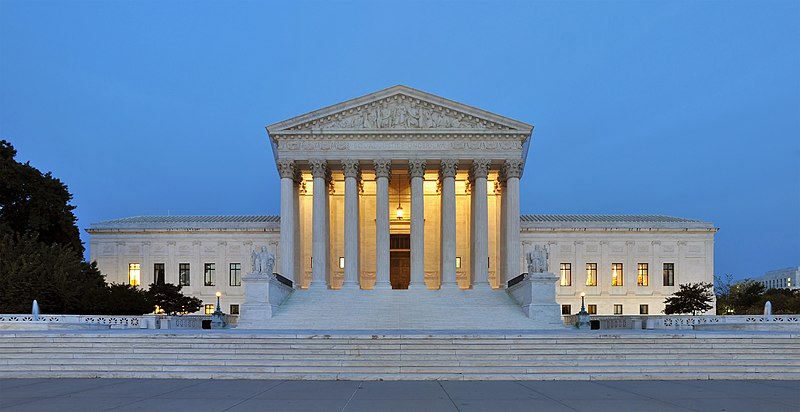
Panorama of the west facade of United States Supreme Court Building at dusk in Washington, D.C., 10 October, 2011.
Photo by Joe Ravi via Wikimedia Commons.

“Vesting federal legislative power in Congress [rather than bureaucrats]”, Gorsuch writes, “is vital because the framers believed that a republic — a thing of the people — would be more likely to enact just laws than a regime administered by a ruling class of largely unaccountable ‘ministers’.”

But what about those, like dissenting Justice Elena Kagan, who say that federal bureaucrats need wide latitude because Congress is failing to, in their view, adequately address climate change?

“Admittedly, lawmaking under our Constitution can be difficult,” Gorsuch acknowledges. “But that is nothing particular to our time nor any accident.”

“The framers believed that the power to make new laws regulating private conduct was a grave one that could, if not properly checked, pose a serious threat to individual liberty …” he said. “As a result, the framers deliberately sought to make lawmaking difficult by insisting that two houses of Congress must agree to any new law and the President must concur or a legislative supermajority must override his veto.”

With an empowered, unelected bureaucracy, “agencies could churn out new laws more or less at whim”, Gorsuch adds. “Intrusions on liberty would not be difficult and rare, but easy and profuse.”

This isn’t hypothetical speculation — it’s exactly what we’ve seen under the status quo.

For a glaring example, just consider the Centers for Disease Control’s pandemic-era “eviction moratorium”. The federal agency unilaterally declared that evictions nationwide were prohibited in many circumstances by citing an old statute that gave the CDC director the ability to order in specific places “such measures to prevent such spread of the diseases as he/she deems reasonably necessary, including inspection, fumigation, disinfection, sanitation, pest extermination, and destruction of animals or articles believed to be sources of infection.”

They went from that to a nationwide “eviction moratorium”. Stretch, much?

That’s right: Unelected government officials effectively commandeered the nation’s rental market, which caused tremendous dysfunction, trampled over property rights, and sabotaged the supply of rental housing. (For which prices are now surging. Shocker!) And, it was years before the courts finally stopped them and struck down the “moratorium”.

May 8, 2022

“… a majority of ‘pro-lifers’ are women, not men. So [Kamala] Harris is effectively saying: how dare women be allowed a voice in this debate?”

Filed under: Health, Law, Media, Politics, USA — Tags: , , , , — Nicholas @ 05:00

Andrew Sullivan comments on the leak of a draft US Supreme Court decision that would strike down Roe vs. Wade and the over-the-top reactions on social media from progressives:

Panorama of the west facade of United States Supreme Court Building at dusk in Washington, D.C., 10 October, 2011.
Photo by Joe Ravi via Wikimedia Commons.

To say that a leaked draft of a Supreme Court ruling prompted an elite meltdown would be a gross understatement. This was a culture war 9/11. “I have typed and deleted a great many comments,” Roxane Gay tweeted. “What do you say when nine people can dictate what happens to your body? It’s ridiculous and hateful.” The Atlantic‘s Adam Serwer, always the subtle one, announced that the court had abolished the entire 20th century. Yep: no more suffrage for women! Jim Crow now!

Taking the arguments of abortion opponents seriously was never an option: “Stripping women of their humanity and rights isn’t a consequence of the ‘pro-life’ agenda, it’s the entire point,” declared Jessica Valenti. Rebecca Traister confessed: “My teeth have been chattering uncontrollably for an hour. Bodies/minds are so weird. Like, not euphemistically — actually chattering. Audibly. And full shaking body. Though otherwise wholly, rationally, well and truly expecting it.”

Going further, freshly-minted critical gender theorist, Jennifer Rubin, argued that any restriction on abortion rights is a violation of secularism: “The right-wing justices and their supporters appear ready to reject one of the Founders’ core principles: that religion shall not be imposed by government edict.” Kurt Andersen went old school and worried about a papist cabal: “It really is kind of remarkable that only one in five Americans call themselves Catholic, but of the Supreme Court majority apparently about to permit abortion to be outlawed, all but one are Catholic and that one was raised Catholic.” Then there’s Vox‘s Ian Millhiser: “Seriously, shout out to whoever the hero was within the Supreme Court who said ‘fuck it! Let’s burn this place down.'” Fuck it! I’ll do it live!

Kamala Harris also found her voice:

    Those Republican leaders who are trying to weaponize the use of the law against women. Well we say, “How dare they?” How dare they tell a woman what she can do and cannot do with her own body? How dare they? How dare they try to stop her from determining her own future? How dare they try to deny women their rights and their freedoms?

The premise here is that all women support abortion rights. But there is no serious gender gap on this question. In fact, a majority of “pro-lifers” are women, not men. So Harris is effectively saying: how dare women be allowed a voice in this debate?

Within minutes of the SCOTUS leak, moreover, we were told it means that before long, interracial marriages will be banned … in a country where 94 percent support them! Imagine Clarence Thomas divorcing himself by jurisprudence. Here’s Traister again: “Voting rights were gutted in 2013. Marriage equality. Griswold. Loving. Don’t ever listen to anyone who tells you such fears are silly or overblown.” Actually, listen to them — if you can hear them over Traister’s permanent rage-tantrum.

What strikes me about all of this is not the emotive hyperbole — that’s par for the course in a country where every discourse is now dialed to eleven. What strikes me most in these takes is the underlying contempt for and suspicion of the democratic process — from many of the same people who insist they want to save it. How dare voters have a say on abortion rights! The issue — which divides the country today as much as it has for decades — is one that apparently cannot ever be put up for a vote. On this question, Democrats really do seem to believe that seven men alone should make that decision — once, in 1973. Women today, including one on SCOTUS? Not so much.

December 2, 2021

If there are no restrictions on voting age, what other expansions of the franchise might amuse the Supreme Court of Canada?

Filed under: Cancon, Law, Liberty — Tags: , , , , — Nicholas @ 05:00

In Wednesday’s NP Platformed newsletter, Colby Cosh suggests that, given the SCC’s demonstrated preference for getting rid of restrictions on voting rights, we may be in for some interesting legal times:

A band of plucky teens, we are told, are suing to have Canada’s voting age lowered. They are not the first to try, and it goes without saying that the youngsters are a front for a gaggle of do-gooder groups who think that it would somehow purify our democracy in the fires of justice if 16-year-olds could vote. NP Platformed thinks this is a terrible idea that has logical problems on its face. If the age-18 voting limitation can’t be defended, how can any such limit be defended?

Rest assured that the grown-up lobbyists who have a sore bum about the voting age won’t be recruiting four-year-old boys to articulate their cause or serve as litigants. It will all be photogenic, politically sophisticated, fantastically unrepresentative teenagers.

But let’s set the snark aside for a moment. You may be asking, as we here at NP Platformed world headquarters did, how a charter challenge to the voting age can happen at all. Surely there’s solid caselaw about this? If you look into the matter, as we did, you might find yourself saying “Uh oh.” As we did.

The most revealing discussion we could find is tucked away in a footnote in a 2019 paper by University of Ottawa Prof. Michael Pal. Within this wad of small print, Prof. Pal outlines the whole issue. The charter says flat out that “Every citizen of Canada” has the right to vote in elections, and various species of legal voting disability have been removed over time, leaving persons under 18 as the only citizens within Canada who cannot exercise this right.

[…]

“The analogy between youth voting restrictions and inmate disenfranchisement breaks down because the type of judgment Parliament is making in the two scenarios is very different. In the first case, Parliament is making a decision based on the experiential situation of all citizens when they are young. It is not saying that the excluded class is unworthy to vote, but regulating a modality of the universal franchise. In the second case, the government is making a decision that some people, whatever their abilities, are not morally worthy to vote — that they do not ‘deserve’ to be considered members of the community and hence may be deprived of the most basic of their constitutional rights. But this is not the lawmakers’ decision to make.”

We’re just gonna say it: “regulating a modality of the universal franchise” is drivel. If this is the bedrock on which age restrictions on voting rest, age restrictions on voting are in trouble.

The constitutionality of a voting age was also discussed in the Supreme Court’s 2019 Frank case, which annihilated the voting eligibility restrictions for Canadian citizens living abroad. In that case it was dissenters, specifically justices Suzanne Côté and Russell Brown, who brought the matter up. If legislatures can’t restrict the voting rights of Canadians who have been living in Cucamonga or Timbuktu, how can they impose any limit at all?

The dissenting pair quietly pointed out (at paragraph 144) that the phrase “regulating a modality” is gaseous nonsense, and that the Supreme Court, in its endless lust for making the franchise more inclusive, seems to have made any restrictions at all untenable. (Why, indeed, should the franchise be limited to citizens? Municipalities are already asking this question!)

November 17, 2021

The Supreme Court of Canada — four-ninths woke

Filed under: Cancon, Law, Liberty — Tags: , , , , — Nicholas @ 03:00

In The Line, Leonid Sirota discusses a disturbingly narrow victory for freedom of speech in the Supreme Court of Canada’s decision in Ward v Quebec (Commission des droits de la personne et des droits de la jeunesse):

The Supreme Court’s recent decision in Ward v Quebec (Commission des droits de la personne et des droits de la jeunesse) has attracted considerable public attention, and for good reason. Although no law was in danger of being found unconstitutional, the case did concern the limits of the freedom of expression, which have always been controversial, and are perhaps more controversial now than they had been in decades. In brief, the issue was whether nasty jokes by an “edgelord comedian”, as The Line‘s excellent editorial described Mr. Ward, at the expense of Jérémy Gabriel, a well-known disabled child artist, amounted to discrimination that could be punished by an award of damages.

Much has already been written about the Supreme Court’s narrow decision in favour of Mr. Ward; for my part, I have already commented on (mostly) the majority opinion on my blog. Here, I focus on the dissent, in which, as The Line put it, “[t]here’s an incredible amount of popular modern discourse seeping into judicial reasoning” that “culled plausible-sounding legalese from Twitter logic”. That sounds about right.

But let me put it slightly differently. The dissent is, in a word, woke. And I do not mean “woke” as a generic insult. Nor do I mean, incidentally, that Mr. Gabriel is a snowflake. I think he deserves sympathy on a human level, though not the protection of the law for his claim. Rather, what I mean by calling the dissent woke is that it embraces a number of specific tenets of contemporary social-justice ideology, which, if they become law ― and they were just one vote away from becoming law ― would be utterly corrosive to the freedom of expression.

For one thing, the dissent erases the line between words and actions, so that disfavoured words are treated as deeds and therefore subjected to vastly expanded regulation. Justices Abella and Kasirer (with whom two others agree) write:

    We would never tolerate humiliating or dehumanizing conduct towards children with disabilities; there is no principled basis for tolerating words that have the same abusive effect. Wrapping such discriminatory conduct in the protective cloak of speech does not make it any less intolerable when that speech amounts to wilful emotional abuse of a disabled child.

In what is going to be a theme of my comment, this twists the meaning of words beyond recognition. Conduct is conduct and speech is speech. Using words instead the proverbial sticks and stones is not just a disguise. It’s the better part of civilization. The law relies on a distinction between words and actions all the time. This is a principle, and a general one, but it has also been a cornerstone of the law of the freedom of expression in Canada since the early days of the Charter. I have criticized the majority decision for disregarding precedent and doctrine. The dissent does the same, only much worse.

Besides, as I once noted elsewhere, the negation of the distinction between speech and conduct often combines with a belief that violence against some politically heretical group or other is permissible with the toxic belief that “[w]hat one says, or does, is expression; what one’s opponents say, or do, is violence.” This, in turn, means that law dissolves into a raw competition for political power, with the ability to decide whose expression will be stripped of its “protective cloak” and proscribed as the prize.

September 12, 2021

QotD: The US Supreme Court’s Dred Scott decision of 1857

Filed under: History, Law, Liberty, Quotations, USA — Tags: , , , , — Nicholas @ 01:00

Scott was a slave who claimed to be free because his owners had taken him to U.S. states where slavery was outlawed; in ruling on the case, Chief Justice Roger Taney, writing for a 7-2 majority, found that Blacks were “beings of an inferior order” who, under the constitution, “had no rights which the white man was bound to respect.”

The Scott decision is now considered an important contributing cause of the U.S. Civil War, which began four years later. It proved, beyond anyone’s doubt, President Abraham Lincoln’s maxim that a sovereign nation could not survive half-slave and half-free. Northern states might be capable of abolishing slavery locally, but this “abolition” would never apply to imported slaves from elsewhere considered as property. One cannot fully understand U.S. history, never mind the progress of its law, without studying and appreciating Taney’s cruel language.

And, indeed, for the world at large, Dred Scott is an unsurpassed reminder of the distinction between law and justice, and of the limitations of a highly reverenced written constitution. Taney not only accepted the (irrefutable) argument that the constitution explicitly countenanced slavery: he wrote fawningly of the Founding Fathers as great men, “high in their sense of honour,” who could never have upheld absolute equality before the law on one hand while hypocritically denying it to Blacks in practice. The Declaration of Independence’s claim that “all men are created equal,” the ex-slaveowner Taney wrote, was never understood by anyone to include inferior races.

Abolitionists of the time saw the innate hypocrisy: the contemporary newspaper editor William Lloyd Garrison risked his life by calling the constitution “a league with hell.” But [University of Buffalo law professor Matthew] Steilen thinks it is better not to expose Black students to the details of that debate. Reading Taney’s “gratuitously insulting and demeaning” words and arguments, he tweeted, is likely to, and there is no other way to put this, injure their feelings. To inquire too deeply into the detail of slavery, and of the law that shielded it, would require Black students to “relive the humiliation” of Dred Scott.

Colby Cosh, “Another Day in a Feelings-First World”, NP Platformed, 2021-06-09.

June 3, 2021

John McWhorter on Affirmative Action

Filed under: Education, History, USA — Tags: , , , , , , — Nicholas @ 03:00

In the latest post at It Bears Mentioning, John McWhorter outlines the history of Affirmative Action in American schooling and explains why it’s no longer doing anything useful and should be re-oriented to actually help disadvantaged students of all races:

John McWhorter’s Twitter thumbnail image

I do not oppose Affirmative Action. I simply think it should be based on disadvantage, not melanin. It made sense – logical as well as moral – to adjust standards in the wake of the implacable oppression of black people until the mid-1960s.

When Affirmative Action began in the 1960s, largely with black people in mind, the overlap between blackness and disadvantage was so large that the racialized intent of the policy made sense. Most black people lived at or below the poverty line. Being black and middle class was, as one used to term it, “fortunate”. Plus, black people suffered open discrimination regardless of socioeconomic status, in ways for more concrete than microaggressions and things only identifiable via Implicit Association Testing and the like. In a sense, black people were all in the same boat.

Luckily, Affirmative Action worked. By the 1980s, it was no longer unusual or “fortunate” to be black and middle class. I would argue that by that time, it was time to reevaluate the idea that anyone black should be admitted to schools with lowered standards. I think Affirmative Action today should be robustly practiced — but on the basis of socioeconomics.

A common objection is that this would help too many poor whites (as if that’s a bad thing?). But actually, brilliant and non-partisan persons have argued that basing preferences on socioeconomics would actually bring numbers of black people into the net that almost anyone would be satisfied with.

I’m no odd duck on my sense that Affirmative Action being about race had passed its sell-by date after about a generation. At this very time, it had become clear, to anyone really looking, that the black people benefitting from Affirmative Action were no longer mostly poor – as well as that simply plopping truly poor black people into college who had gone to awful schools had tended not to work out anyway. It was no accident that in 1978 came the Bakke decision, where Justice Lewis Powell inaugurated the new idea that Affirmative Action would serve to foster “diversity”, the idea being that diversity in the classroom made for better learning.

I highly suspect that most people have always had to make a slight mental adjustment to get comfortable with this idea, as standard as it now is in enlightened discussion. Do students in classes with a certain mixture of races learn better? Really? Not that there might not be benefits to students of different races being together for other reasons. But does diversity make for better learning? Has that been proven?

As you might expect, it has not – and in fact the idea has been disproven, again and again. No one will tell you this when the next round of opining on racial preferences comes about. But this doesn’t mean it isn’t true.

April 21, 2021

QotD: Freedom of speech in Canada

Filed under: Cancon, Law, Liberty, Quotations — Tags: , , , — Nicholas @ 01:00

We have nothing like the First Amendment; our Supreme Court is a Leftist institution par excellence and has even decreed in effect that truth is no defense in cases where “protected groups” are insulted or offended. Paragraph 140 of a 2013 Judgment finds “that not all truthful statements must be free from restriction. Truthful statements can be interlaced with harmful ones or otherwise presented in a manner that would meet the definition of hate speech.” Section 15 (2) of the Constitution Act of 1982 abridges the rights that section 15(1) guarantees Canadian citizens.

Further, our Human Rights Tribunals are Soviet-style shadow courts that discard due process in adjudicating cases of supposed discrimination or “hate speech.” As Canadian Human Rights Commissioner Dean Steacy said: “Freedom of speech is an American concept, so I don’t give it any value.” Openness to everything except freedom of speech, chartered principle and practical reason is the hallmark of our justice system, as it is of the nation. As Carl Sagan quipped in The Demon-Haunted World: “It pays to keep an open mind, but not so open your brains fall out.”

David Solway, “The Canadian Mind: A Culture So Open, Its ‘Brains Fall Out'”, PJ Media, 2018-10-10.

January 30, 2021

Obey your technocratic elites, peasant!

Scott Alexander considers some historical (and current) examples of you peasants being steamrolled by the powers of the government at the behest of the technological elites of the day:

I am not defending technocracy.

Nobody ever defends technocracy. It’s like “elitism” or “statism”. There is no Statist Party. Nobody holds rallies demanding more statism. There is no Citizens for Statism Facebook page with thousands of likes and followers.

[…] it worries me that everyone analyzes the exact same three examples of the failures of top-down planning: Soviet collective farms, Brasilia, and Robert Moses. I’d like to propose some other case studies:

1. Mandatory vaccinations: Technocrats used complicated mathematical models to determine that mass vaccination would create a “herd immunity” to disease. Certain that their models were “objectively” correct and so could not possibly be flawed, these elites decided to force vaccines on a hostile population. Despite popular protest (did you know that in 1800s England, anti-smallpox-vaccine rallies attracted tens of thousands of demonstrators?), these technocrats continued to want to “arrogantly remake the world in their image,” and pushed ahead with their plan, ignoring normal citizens’ warnings that their policies might have unintended consequences, like causing autism.

2. School desegregation: Nine unelected experts with Harvard and Yale degrees, using a bunch of Latin terms like a certiori and de facto that ordinary people could not understand let alone criticize, decided to completely upend the traditional education system of thousands of small communities to make it better conform to some rules written in a two-hundred-year-old document. The communities themselves opposed it strongly enough to offer violent resistance, but the technocrats steamrolled over all objections and sent in the National Guard to enforce their orders.

US Highway System needs in 1965 from “Needs of the Highway Systems 1955-1984”, a letter from the Secretary of Commerce to the House Committee on Public Works, approved May 6, 1954.
US Government Printing Office via Wikimedia Commons.

3. The interstate highway system: 1950s army bureaucrats with a Prussia fetish decided America needed its own equivalent of the Reichsautobahn. The federal government came up with a Robert-Moses-like plan to spend $114 billion over several decades to build a rectangular grid of numbered giant roads all up and down the country, literally paving over whatever was there before, all according to pre-agreed federal standards. The public had so little say in the process that they started hundreds of freeway revolts trying to organize to prevent freeways from being built through their cities; the government crushed these when it could, and relocated the freeways to less politically influential areas when it couldn’t.

4. Climate change: In the second half of the 20th century, scientists determined that carbon dioxide emissions were raising global temperatures, with potentially catastrophic consequences. Climatologists created complicated formal models to determine how quickly global temperatures might rise, and economists designed clever from-first-principle mechanisms that could reduce emissions, like cap-and-trade systems and carbon taxes. But these people were members of the elite toying with equations that could not possibly include all the relevant factors, and who were vulnerable to their elite biases. So the United States decided to leave the decision up to democratic mechanisms, which allowed people to contribute “outside-the-system” insights like “Actually global warming is fake and it’s all a Chinese plot”.

5. Coronavirus lockdowns: The government appointed a set of supposedly infallible scientist-priests to determine when people were or weren’t allowed to engage in normal economic activity. The scientist-priests, who knew nothing about the complex set of factors that make one person decide to go to a rock festival and another to a bar, decided that vast swathes of economic activity they didn’t understand must stop. The ordinary people affected tried to engage in the usual mechanisms of democracy, like complaining, holding protests, and plotting to kidnap their governors – but the scientist-priests, certain that their analyses were “objective” and “fact-based”, thought ordinary people couldn’t possibly be smart enough to challenge them, and so refused to budge.

Nobody uses the word “technocrat” except when they’re criticizing something. So “technocracy” accretes this entire language around it – unintended consequences, the perils of supposed “objectivity”, the biases inherent in elite paradigms. And then when you describe something using this language, it’s like “Oh, of course that’s going to fail – everything like that has always failed before!”

But if you accept that “technocracy” describes things other than Soviet farming, Brasilia, and Robert Moses, the trick stops working. You notice a lot of things you could describe using the same vocabulary were good decisions that went well. Then you have to ask yourself: is Seeing Like A State the definitive proof that technocratic schemes never work? Or is it a compendium of rare man-bites-dog style cases, interesting precisely because of how unusual they are?

I want to make it really clear that I’m not saying that technocracy is good and democracy is bad. I’m saying that this is actually a hard problem. It’s not a morality play, where you tell ghost stories about scary High Modernists, point vaguely in the direction of Brasilia, say some platitudes about how no system can ever be truly unbiased, and then your work is done. There are actually a bunch of complicated reasons why formal expertise might be more useful in some situations, and local knowledge might be more useful in others.

November 10, 2020

The amazing mental gymnastics that lead to the US Supreme Court’s unanimous decision in Wickard v. Filburn in 1942

Filed under: Economics, Government, History, Law, USA — Tags: , , , — Nicholas @ 03:00

Antony Davies and James R. Harrigan explain how a farmer growing wheat on his own land to feed his own cattle somehow transmogrified into an interstate commerce activity that could be regulated by the federal government:

Panorama of the west facade of United States Supreme Court Building at dusk in Washington, D.C., 10 October, 2011.
Photo by Joe Ravi via Wikimedia Commons.

… who ended up being tasked with deciding what Article One, Section Eight actually meant? Herein lies the wrinkle that enables all manner of constitutional mischief in the United States. The institution that ended up deciding what the federal government is empowered to do is itself a branch of the federal government. And it should come as no surprise that when push comes to shove, the Supreme Court routinely finds in favor of empowering the federal government.

This sort of mischief flowered fully in the decade following ratification of the 21st Amendment. In 1942, the Supreme Court decided a case, Wickard v. Filburn, in which farmer Roscoe Filburn ran afoul of a federal law that limited how much wheat he was allowed to grow.

A careful reader might, and should, ask where the federal government’s right to legislate the wheat market is to be found — because the word “wheat” is nowhere to be found in the Constitution. Be that as it may, the federal government’s aim was clear enough. It was to keep the price of wheat high enough for farmers to remain profitable. The Agricultural Adjustment Act of 1938 put an upper limit on how much wheat farmers were allowed to grow, which would serve to keep prices high by limiting supply.

Roscoe Filburn had grown 12 more acres of wheat than the law allowed. But not only did he not sell the excess wheat outside of his home state, but he also didn’t sell it at all. He used the wheat from those 12 acres to feed his cattle. Filburn was very clearly not engaging in commerce, let alone interstate commerce, yet the Supreme Court found (unanimously) that because Congress had the authority to regulate interstate commerce, Congress also had the authority to prohibit Filburn from growing those 12 acres of wheat for his own use. The Supreme Court’s “reasoning”?

Had Filburn not fed his cattle that excess wheat, he would have been forced to purchase wheat on the open market. And even if he purchased wheat that was grown within his home state, doing so would have made less wheat available within his home state for other wheat buyers. Consequently, some wheat buyers within his home state would then have had to buy wheat from outside the state. Therefore, Filburn’s non-commercial activity was, according to the Supreme Court, interstate commerce.

The mental gymnastics that went into this ruling made just about any activity interstate commerce by definition. Since Wickard, any time Congress has wanted to exercise power not authorized by the Constitution, lawmakers have simply had to make an argument that links whatever they want to accomplish to interstate commerce. Why? Because they know they can get away with it.

« Newer PostsOlder Posts »

Powered by WordPress