
Published on 26 Apr 2016
*Sponsored* Hearts of Iron IV comes out on June 6!
A series of missed airstrikes resulting in the death of civilians sparked the no-holds-barred Battle of Britain. Germany launched a Blitz to bomb London into submission, but inadvertantly sparked more resistance and gave British industry a chance to bounce back.
On August 25, 1940, a group of German bomber planes got lost on a night-time mission over England. They wound up dropping bombs not on their industrial target, but on the city of London itself. Winston Churchill ordered a retaliatory strike against Germany, but this time it was the RAF who missed their target and hit civilians. Hitler was convinced this was intentional, so he rescinded his prohibition against targeting civilians. The Luftwaffe organized a massive attack against London, intending to break the British people’s will to fight. The Blitz backfired in several respects. First, it diverted Germany’s attention from strategic targets, which meant they were no longer putting real pressure on the British industrial war efforts. Second, they wound up bringing the British together and strengthening their will to fight on in the names of those who’d been lost to German bombs. Ultimately, the cost in men and material for Germany to wage the Battle of Britain exceeded the cost of damage they inflicted.
June 8, 2016
WW2: The Resource War – IV: Strategic Bombing – Extra History
February 9, 2016
Zeppelins – Majestic and Deadly Airships of WW1 I THE GREAT WAR Special
Published on 8 Feb 2016
Zeppelins pioneered the skyways, could fly long distances and reached heights like none of the British fighter-interceptor aircraft before. Because of that, they were used for scouting and tactical bombing early in the First World War. In this special episode we introduce these majestic floating whales and their usage in WW1.
April 19, 2014
The Doolittle Raid, 18 April 1942
I was busy with away-from-the-computer stuff yesterday, so I didn’t see this post until today:
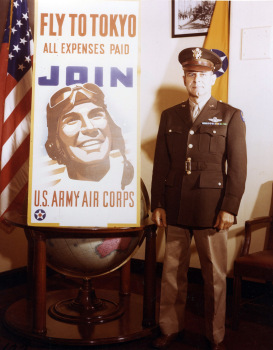
Less than 19 weeks after the U.S. Navy was attacked at Pearl Harbor on Dec. 7, 1941, the American military struck back. On April 18, 1942 – 72 years ago today – sixteen Army Air Force bombers launched from a Navy aircraft carrier to attack the enemy’s homeland.Brig. Gen. James Doolittle poses beside an Air Corps recruiting poster that alludes to his bombing raid on Japan in April 1942. (c) 1943
Led by Lt. Col. James H. Doolittle, the raid was launched from USS Hornet, commanded by Capt. Marc Mitscher and escorted by ships under the command of Vice Adm. “Bull” Halsey aboard his flagship, USS Enterprise.
The extraordinary joint Doolittle Raid showed Imperial Japan’s military leaders their vulnerability and America’s resolve.
The raid also demonstrated innovation, courage and resilience.
The five-man B-25 crews trained relentlessly prior to their mission, with specialized training led by Navy flight instructor Lt. Henry F. Miller. The Army Air Force made ingenious modifications so the bombers could have extra fuel but less weight.
Pilots, all volunteers, needed to be extremely fearless, taking off in their huge planes from a short flight deck. On rough seas they launched in bitter cold, 75-knot winds and foam-flecked spray, as Sailors aboard recalled.
Doolittle, as his team’s leader, took off first. His success inspired the other pilots just as their entire mission would inspire the nation – putting action to the nationwide words of resolve heard throughout the world: “Remember Pearl Harbor!”
[…]
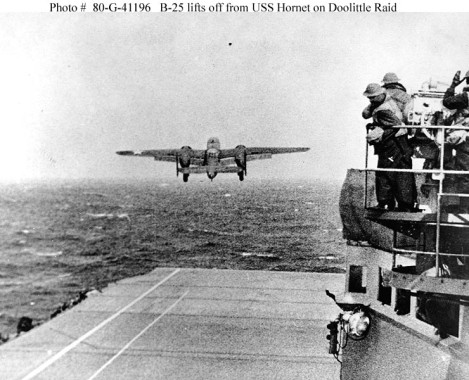
An Army Air Force B-25B bomber takes off from USS Hornet (CV 8) at the start of the raid, April 18, 1942. Note men watching from the signal lamp platform at right. (Official U.S. Navy Photograph, now in the collections of the U.S. National Archives – Courtesy of the NHHC Photo archives)
Seven Doolittle Raiders were killed in the mission: Two drowned and a third was killed by the fall after bailing out; eight were captured by the Japanese. Three of the eight POWs were executed Oct. 15, 1942, and another died of malnutrition Dec. 1, 1943. The surviving four POWs were released in August 1945.
The Raiders who landed in China were assisted by American missionary Rev. John M. Birch, whose contacts within Japanese-occupied China helped the Raiders to escape. Afterward, Birch was commissioned a lieutenant in the Army Air Force, continuing his work as a missionary while gathering intelligence on the Japanese. He was killed Aug. 25, 1945, at the age of 27, during a confrontation with Chinese Communists. The John Birch Society honors Birch, a recipient of both the Legion of Merit and the Distinguished Service Medal.
Even though the Doolittle Raiders bombed Tokyo, it was the Chinese who suffered the most from the raid. Furious the Chinese nationalists were protecting the Americans, the Japanese retaliated against several coastal cities suspected of harboring the Americans, killing an estimated 250,000 Chinese citizens.
Doolittle was so convinced his mission had been a failure, he was convinced he would face a court-martial upon his return to the United States. Instead, he was promoted to general, skipping the rank of colonel. He and all of his Raiders were awarded the Distinguished Flying Cross.
Mitscher served in a variety of command leadership positions for the rest of World War II, earning the rank of admiral and title as Commander in Chief, U.S. Atlantic Fleet.
March 22, 2014
Night Bombers, 1943
Published on 30 Dec 2012
A unique record of the nightly air raids made on Germany during World War II. Archive colour footage from No. 1 Group, Royal Air Force operating Avro Lancaster bombers, in action, winter 1943. In the winter of 1943, RAF Bomber Command was sending massive raids almost every night into the heart of Germany. This is the story of one of them, an attack on Berlin. Although certain scenes had to be re-created for technical reasons, make no mistake, the raid is a real one and there are no actors.
Made by Air Commodore H.I. Cozens while station commander at Hemswell. This is the Only known colour record of the Bomber Command during WWII documenting a bombing raid targeting Berlin.
Another great find from the folks at Think Defence.
November 14, 2012
From strategic nuclear bomber to “bomb truck”
The B-52 is still in service with the US Air Force and still finding roles to play:
The U.S. Air Force is continuing to upgrade its fifty year old B-52s. The latest upgrade will enable each B-52 to carry over 110 of the 130 kg (285 pound) Small Diameter Bombs (SDB, also known as the GBU-39/B). Six years ago the rotary bomb rack inside the B-52 was modified to carry 32 SDBs instead of 15 larger bombs.
The SDB was designed from the bottom up as a smart bomb. The SDB has a more effective warhead design and guidance system. Its shape is more like that of a missile than a bomb (nearly two meters, as in 70 inches, long, and 190mm in diameter), with the guidance system built in. The smaller blast from the SDB resulted in fewer civilian casualties. Friendly troops can be closer to the target when an SDB explodes. While the 500, 1,000 and 2,000 pound bombs have a spectacular effect when they go off, they are often overkill. The troops on the ground would rather have more, and smaller, GPS bombs available. This caused the 500 pound JDAM to get developed quickly and put into service. But it wasn’t small enough for many urban combat situations. The SDB carries only 17 kg (38 pounds) of explosives, compared to 127 kg (280 pounds) in the 500 pound bomb. The SDB is basically an unpowered missile, which can glide long distances. This makes the SDB even more compact. The small wings allow the SDB to glide up to 70-80 kilometers (from high altitude.) SDB also has a hard front end that can punch through nearly three meters (eight feet) of rock or concrete, and a warhead that does less damage than the usual dumb bomb (explosives in a metal casing.) The SDB is thus the next generation of smart bombs. The more compact design of the SDB allows more to be carried. Thus F-15/16/18 type aircraft can carry 24 or more SDBs. The SDBs are carried on a special carriage, which holds four of them. The carriage is mounted on a bomber just like a single larger (500, 1,000 or 2,000) pound bomb would be. However, this feature was rarely needed in combat situations.
This makes the B-52 even more effective as the cheapest to operate and most reliable “bomb truck” the air force has. With a max takeoff weight of 240-250 tons the BUFF (Big Ugly Fat Fellow) is basically a large aircraft designed to carry bombs cheaply and efficiently. Last year the readiness rate of these bombers was 78 percent. Although a half century old, most of the internal fear has been replaced with modern electronics and furnishings. It’s all flat screens and modern gear. Look closer and you see fifty year old metal.
May 22, 2012
Bombing campaigns against Nazi Germany were remarkably inaccurate
An article in History Today recaps the huge gap between what the RAF was thought to be accomplishing in the first half of World War 2 and what they actually achieved in the bombing campaign against Germany:
By 1941, after the winter Blitz in which the Luftwaffe had relentlessly bombed the cities of Britain, the British people wanted to know that the RAF were ‘giving it back’ to the Germans. Later that year, as [Michael] Paris describes, Harry Watt directed his film Target for Tonight for the Crown Film Unit. Made with actual RAF personnel performing a script written by Watt, Target follows the story of a single raid on an imaginary railway yard and oil depot somewhere near a bend in the Rhine. The film sought to celebrate the quiet heroics of the RAF, which is shown to have the ability to mount a precision raid with great success. Audiences no doubt cheered to see the (models of the) target ablaze and to know — or, rather, believe — that the RAF was creating havoc in the enemy’s heartland.
[. . .]
According to a secret Cabinet report, which analysed aerial photographs in the summer of 1941, the RAF failed to get even one third of its bombs within five miles of its targets. The Strategic Air Offensive was published much to the chagrin of wartime RAF leaders such as Sir Arthur ‘Bomber’ Harris and generated intense and widespread controversy.
By the 1980s it was largely accepted that, before new navigational aids were introduced in 1942, the RAF offensive had been a complete failure. Although the moral debate about the rights and wrongs of ‘area’ or ‘indiscriminate’ bombing has continued ever since, there are no serious historians today who challenge the accuracy of the Webster-Frankland account. And so, in 1990, Paris was able to point out the gulf between what the RAF pretended had been happening and what, in reality, was going on.
Before the war started, the air force always claimed that the “bomber would always get through”. What they didn’t say was that it couldn’t be predicted where the bomber would get through to.
However, it must be remembered that even the US Air Force, which carried out daylight air raids against German targets in the latter half of the war, had an accuracy issue too:
Gladwell began with the story of Carl Norden — a Swiss engineer, born in 1880, domineering and narcissistic, “who had very strong feelings about alternating current” and much else. Norden became obsessed with finding a more precise ways to deliver bombs from aircraft — and invented the Norden Mark 15 Bomb Sights. Its promise: that a bomb could be dropped into a pickle barrel from 20,000 feet.
The US military was excited; in fact, Washington spent $1.5 billion in 1940 dollars rolling out the devices, buying 90,000 of them and training 50,000 bombardiers to use them. Yet when America was brought into world war two, “it turns out they were not the holy grail”. They could only hit a pickle barrel under perfect conditions — and life is rarely perfect, it proved. They were hard to use, broke down, could not function in cloud without direct line of sight of the target, and were inaccurate. Plus, Norden had hired German engineers — who gave Berlin the complete blueprint by 1938.
March 18, 2010
Bombing of Dresden horrible, but not as horrible as we thought
The bombing raids which destroyed much of the fabric of the city of Dresden late in World War Two didn’t cause as many civilian casualties as has been claimed:
Up to 25,000 people died in the Allied bombing of Dresden during World War II – fewer than often estimated, an official German report has concluded.
The Dresden Historians’ Commission published its report after five years of research into the 13-15 February 1945 air raid by Britain and the US.
The study was aimed at ending an ongoing debate on the number of casualties in the German city.
Germany’s far-right groups claim that up to 500,000 people died.
They say the bombing – which unleashed a firestorm in the historic city when the Nazi Germany was already close to defeat – constituted a war crime.
Note that the “they” in that final paragraph refers to the “far-right groups” and not to the Dresden Historians’ Commission. It’s not the judgement of the commission that the bombing was a war crime.


