Quotulatiousness

June 16, 2022

Paul Wells takes in a current movie … and likes it

Filed under: Media — Tags: , , , , — Nicholas @ 03:00

I’ve never been much of a movie-goer, even before the neverending pandemic lockdown theatre landed on us in 2020, so the chances of me going to see something like Top Gun: Maverick were pretty low (especially as I never bothered to watch the original, back in the day). Paul Wells is in the middle of a European trip, so he did what every travelling North American would do somewhere on the continent of history and culture: he watched a current-release American movie:

The mystery of Maverick is why, by next weekend, it will pass Doctor Strange in the Convolution of Fan Service as the year’s biggest movie, why it is the biggest film of Tom Cruise’s charmed life — why it strikes such a chord in this moment, even though its premises, visual vocabulary and soundtrack are 36 years old. In terms of chronological distance from the original Top Gun, it’s as though the top-grossing movie of 1986 had been a sequel to 1950’s Annie Get Your Gun. (“And there has never been a star as sensational as Betty Hutton!” Annie‘s trailer proclaims. Switch Tom Cruise in for poor Betty and suddenly the claim may actually be true.)

The simplest hypothesis is that Maverick is just big and loud, so you can leave your brain at home and enjoy the spectacle. But lots of lousy movies nobody watched were big and loud, including Matrix: Resolutions and Ghostbusters: Afterlife, so there must be some fuller explanation.

This being a Substack newsletter, I suspect I’m contractually encouraged to argue that Maverick wins because it isn’t woke. I’m afraid I can’t oblige. I mean, the movie definitely makes only the barest acknowledgment of taking place in the 21st century. None of the hotshot young recruits pauses from the action to specify their pronouns. None decorates their flight helmets with empty square brackets to acknowledge their privilege. The film’s few concessions to cultural change since the MTV era have the effect, not of engaging today’s fights on provocatively old-fashioned terms, but of declining to engage. Joseph Kosinski, the journeyman special-effects technician brought in to direct this film in note-perfect homage to the style of the original Top Gun director Tony Scott, doesn’t even bother to make the film’s racial politics as minimally complex as Scott did in 1995’s Crimson Tide. Maverick‘s young recruits, diverse in gender and ethnicity, are awesomely interchangeable in every other way. One smirks, one has a moustache; the others have no identifying characteristics. (When half the recruits get cut from the big mission at the 90-minute mark, there is no dramatic payoff because it’s impossible to tell these people apart. “Sorry, Component A, I’ve decided to go with Component B.”) Nobody under 30 in this film has sex for either pleasure or procreation. Yearning for intimate touch is plainly something only old people do, like writing in cursive script or owning books.

As a cultural argument, Maverick is so close to being tabula rasa that there’s no real point interrogating it. But on another front, it succeeds resoundingly in popular art’s primary function of tantalizing simplification. It started to make sense when I realized that Cruise’s character, despite the denial inherent in his call sign, is a career civil servant.

This is a movie about the action of a large modern state. It’s a film about public policy. Its central claim is a cathartic feat of Avengers-level denial. Just as the superhero movies offer us a made-up universe in which we have any hope of telling the good characters and the evil characters apart, Maverick posits a world in which modern governments can get anything done at all.

I may be influenced in this reading by the fact that I work in contemporary Ottawa. I’ve been writing variations on a simple question — Can Justin Trudeau get big things built? — since 2017. I’m hardly alone. And it’s hardly just a question about Trudeau, Ottawa or Canada. It’s been fun reading about chaos at Toronto’s Pearson airport, but last week the Financial Times ran a “big read” feature story about global airport chaos that didn’t even mention Pearson, Toronto or Canada. Joe Biden promised to Build Back Better. It’s not going great. Here in France, Emmanuel Macron is the first president to be re-elected in 20 years, a genuine feat, but it’s not going great. Brexit? Don’t ask.

A generic term for the ability of governments to do stuff is “state capacity”, and there’s a vague sense in the quasi-academic literature that it’s in decline, although, the real world being the real world, every element of this claim — that state capacity is declining, that it can be measured, that it even exists in any measurable form — is open to dispute. Still, it feels true, don’t it? The world was never great. In important ways it was worse than today. But it used to feel like it was possible to improve the thing, and now it just feels like everyone’s just firing blind and hoping for the best. COVID is a dynamite demonstration of this. Three successive Canadian federal health ministers were told, by a prime minister who prides himself on his ability to read the room, to get cracking on plain-paper packaging for tobacco products. And then the biggest public-health disaster of our lifetimes opened up its jumbo can of whup-ass, and it wasn’t even in the mandate letters. And it’s hard to blame anyone involved. All the chaos that has ensued had its roots in the original chaos. Real life doesn’t have a plot. As Homer Simpson said, it’s just a bunch of stuff that happens.

May 20, 2022

High and low “state capacity” illustrated

In Law & Liberty, Helen Dale recounts a miserable experience getting out of a major US airport and says this is an example of America’s low state capacity:

“TSA Checkpoint” by phidauex is licensed under CC BY-NC-SA 2.0

At the other end, I found a stretch limo waiting for me. Getting ferried about in a limo after The Trip from Hell is something I’ve experienced before, in Damascus, before the Syrian civil war. Classic third world. Like Syrians, American hosts send limousines to the airport to pick you up because they know you flew in from JFK and will need to be appeased.

My experience is illustrative of something not confined to airports, however. Indeed, if it were only confined to airports, then the phrase I’m about to use (about the US) would be unfair (to the US). America’s dysfunctional airports are instances of widespread low state capacity. And this is bigger than airports. Low state capacity can only be used to describe a country when it is true of multiple big-ticket items, not just one.

State capacity is a term drawn from economic history and development economics. It refers to a government’s ability to achieve policy goals in reference to specific aims, collect taxes, uphold law and order, and provide public goods. Its absence at the extremes is terrifying, and often used to illustrate things like “fragile states” or “failed states”. However, denoting calamitous governance in the developing world is not its only value. State capacity allows one to draw distinctions at varying levels of granularity between developed countries, and is especially salient when it comes to healthcare, policing, and immigration. It has a knock-on effect in the private sector, too, as business responds to government in administrative kind.

Think, for example, of Covid-19. The most reliable metric — if you wish to compare different countries’ responses to the pandemic — is excess deaths per 100,000 people over the relevant period. That is, count how many extra people died beyond the pre-pandemic mortality rate on a country-by-country basis. For the sake of argument, drop the five countries leading this grim pack. Four of them are developing countries, and the fifth is Russia, which while developed, is both an autocracy and suffers from chronic low state capacity.

At the other end of the scale, ignore China, too. It may be lying about its success or, more plausibly, may have achieved it by dint of being an authoritarian state with high state capacity (notably, the latest round of draconian lockdowns in Shanghai commenced after the WHO collated that data).

The US has the worst excess death rate in the developed world (140 per 100,000). Australia has the best: 28 per 100,000. Yes, you read that right. Australia increased its life expectancy and general population health during the pandemic. So did Japan, albeit less dramatically. The rest of the developed world falls in between those two extremes: Italy and Germany are on 133 and 116 per 100,000 respectively, with the UK (109 per 100,000) doing a bit better. France and Sweden knocked it out of the park (63 and 56 per 100,000 excess deaths).

Recall, too, that not only did different countries adopt different approaches to pandemic management; sometimes there were large differences within countries. Like the US, Australia is a federal system, and as in the US, different states did things differently. Melbourne, capital of the state of Victoria, had the longest lockdown of any major city in the developed world. Other Australian states, meanwhile, locked down sparingly or not at all. In a European context, Sweden rejected most over-the-top Covid responses, the UK was somewhere in the middle, and Italy was thoroughly draconian, even barring unvaccinated people from supermarkets and groceries.

September 5, 2020

Beginning the transition from personal rule to the modern bureaucratic state

Anton Howes discusses some of the issues late Medieval rulers had which in some ways began the ascendency of our modern nation state with omnipresent bureaucratic oversight of everyone and everything:

… the bureaucratic state of today, with its officials involving themselves with every aspect of modern life, is a relatively recent invention. In a world without bureaucracy, when state capacity was relatively lacking, it’s difficult to see what other options monarchs would have had. Suppose yourself transported to the throne of England in 1500, and crowned monarch. Once you bored of the novelty and luxuries of being head of state, you might become concerned about the lot of the common man and woman. Yet even if you wanted to create a healthcare system, or make education free and universal to all children, or even create a police force (London didn’t get one until 1829, and the rest of the country not til much later), there is absolutely no way you could succeed.

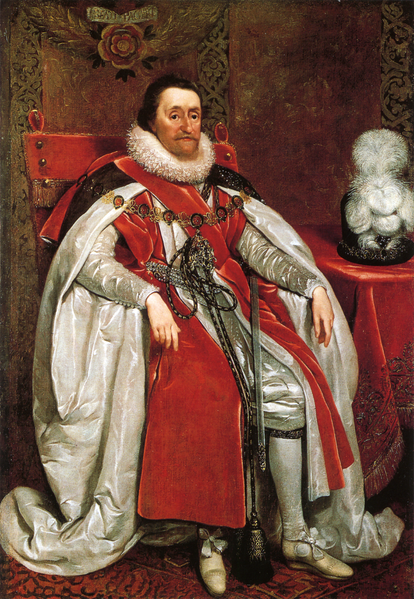
King James I (of England) and VI (of Scotland)
Portrait by Daniel Myrtens, 1621 from the National Portrait Gallery via Wikimedia Commons.

For a start, you would struggle to maintain your hold on power. Fund schools you say? Somebody will have to pay. The nobles? Well, try to tax them — in many European states they were exempt from taxation — and you might quickly lose both your throne and your head. And supposing you do manage to tax them, after miraculously stamping out an insurrection without their support, how would you even begin to go about collecting it? There was simply no central government agency capable of raising it. Working out how much people should pay, chasing up non-payers, and even the physical act of collection, not to mention protecting that treasure once collected, all takes substantial manpower. Not to mention the fact that the collecting agents will likely siphon most of it off to line their own pockets.

[…]

It was not until 1689, when there was a coup, that an incoming ruler allowed the English parliament to sit whenever it pleased. Before that, it was convened only at the whim of the ruler, and dispersed even at the slightest provocation. In 1621, for example, when James I was planning to marry his heir to a Spanish princess, Parliament sent him a petition asserting their right to debate the matter. Upon hearing of it, he called for the official record of parliamentary proceedings, personally ripped out the page with the offending vote, and promptly dissolved the Parliament. The downside, of course, was that James could not then acquire any parliamentary subsidies.

Ruling was thus an intensely personal affair, of making deals and finding ways to circumvent deals you had inherited. Increasing your capabilities as a ruler – state capacity – was thus no easy task, as the typical ruler was stuck in an essentially medieval equilibrium. Imposing a policy costs money, but raising money involves imposing policy. Breaking out of this chicken-and-egg problem took centuries of canny leadership. The rulers who achieved it most would today seem hopelessly corrupt.

To gain extra cash without interference from Parliament, successive monarchs first asserted and then abused their ancient prerogative rights to grant monopolies over trades and industries. They eventually granted them to whomever was willing to pay, establishing monopolies over industries like gambling cards or alehouses under the guise of regulating unsavoury activities. They also sold off knighthoods and titles, and in 1670 Charles II even made a secret deal with the French that he would convert to Catholicism and attack the Protestant Dutch, all in exchange for cash. Anything to not have to call a potentially pesky Parliament. At times, the most effective rulers even resembled mob bosses. Take Elizabeth I’s anger when a cloth-laden merchant fleet bound for an Antwerp fair in 1559 was allowed to depart. Her order to stop them had not arrived in time, thus preventing her from extracting “loans” from the merchants while she still had their goods within her power.

October 8, 2017

Despite the rhetoric, Trump can’t just “wave goodbye” to Puerto Rico’s debt

Filed under: Government, Politics, USA — Tags: , , , , , — Nicholas @ 05:00

Megan McArdle on the financial plight that Puerto Rico was facing even before the hurricane season began:

… the fact remains that Puerto Rico is not going to be able to pay all of its debts. Prior to the hurricane, the territory had $73 billion in outstanding debt, and a population of 3.4 million people. That’s approximately $21,500 for every man, woman and child on the island – just about enough to buy each of them a brand new Mini Cooper, provided that they don’t insist on the sport package or the heated seats.

Puerto Rico couldn’t afford to buy 3.4 million Mini Coopers before; they certainly can’t now that Maria has washed out so many roads. Even before the hurricane, Puerto Rico’s GDP was around $100 billion, meaning that repaying its debt would consume nearly nine months of everything the island earned. And while there will probably be a brief bump in economic activity as disaster relief funds pour in and the destruction is cleared away, over the long term the hurricane represents a huge setback: businesses destroyed, people killed or injured, funds that could be generating economic growth instead diverted to simply replacing what has been lost.

So whatever President Trump does, or does not do, investors in Puerto Rican bonds are going to have to take a substantial haircut. The problem is, we’re not going to wipe out the debt entirely. And even if we could, it wouldn’t be enough to get Puerto Rico back to economic or fiscal health.

“If it’s that bad,” you may be thinking, “surely we ought to simply wipe out the debt holders? After all, they’re investment professionals. They can afford to take the loss; ordinary Puerto Ricans can’t.” The problem is that most of the folks holding Puerto Rico’s debt aren’t vulture hedge funds sitting on wads of ill-gotten gains; the overwhelming majority of the debt is held by ordinary folks who buy bonds or bond funds. Like, say, your parents. Or maybe you. And also, a lot of Puerto Ricans, who would be hit very hard if the value of their investments were wiped out.

How did Puerto Rico get so deeply into debt? Step forward the federal and Puerto Rican governments to take a bow:

The operations of the Puerto Rico Electric Power Authority, for example, defy belief: It essentially gave unlimited free power to municipalities and government-owned entities, which used it to do things like operate skating rinks in the tropics. Everywhere you look, you see signs of a government struggling to perform basic tasks: collect taxes, maintain the infrastructure, improve the health system. In the jargon of development economists, the island lacks “state capacity”: It is simply unable to exert the amount of power over its operations that we on the mainland mostly take for granted.

But you can’t entirely blame the Puerto Rican government for the state of the underlying economy, which is what had plunged the island into a bankruptcy crisis even before the hurricane. For that you have to look to the federal government, which eliminated a tax break that had given companies incentives to locate in Puerto Rico, and then oversaw a financial crisis that sent them into an even deeper spiral. We also made sure that a relatively poor island was forced to adopt the federal minimum wage, which was too high for the local labor market. That has contributed to the 11.5 percent unemployment rate. And Puerto Rico uses the U.S. dollar, leaving it unable to adjust monetary policy to overcome economic stagnation.

« Newer Posts

Powered by WordPress