
Army University Press
Published Nov 13, 2023NATO: Partners in Peace follows the creation and impact of the North Atlantic Treaty Organization (NATO). Created in April 1949 with twelve founding members, this organization’s goal was to protect the inherent rights of individual states through collective defense. In this episode from The Big Picture series, General Dwight D. Eisenhower offers a speech before he deploys to Europe to become the first Supreme Allied Commander Europe (SACEUR). This is followed with footage of the buildup and training of European forces. Once Eisenhower leaves NATO to campaign for the presidency, General Matthew Ridgway replaces him as NATO commander. One significant problem NATO forces faced was the fact that each nation had its own weapon systems and ammunition, an issue the U.S. wanted to address with the standardization of the 7.62mm cartridge. Perhaps as a deterrent to the Soviet Union, NATO: Partners in Peace depicts new weapons that could be used against a large enemy force such as remote-controlled missiles, napalm bombs, and the massive atomic cannon.
February 15, 2024
The Big Picture – NATO: Partners in Peace (1954)
February 14, 2024
Soviet World War Two Swords? The M1927 Shashka
Cossack forces have long been a key cavalry element of the Russian military, and this did not change during the Soviet era. The Cossacks had their own rather distinctive style of sword, the shashka, and the Red Army maintained the tradition of issuing them to Cossack cavalry troopers. In 1927, a new pattern was adopted, and it was produced and issued from 1928 until 1946. The shashka has a slightly curved, single-edged blade and no handguard. The model 1927 military type was initially made with a rather decorative pommel, but this was simplified to just a plain 5-pointed star as German advances into Russia really stressed Soviet industrial production. However, production and issue of the shashka continued uninterrupted throughout the war.
Originally there were separate trooper and officer versions of the model 1927, with the trooper version including the ability to stow the trooper’s Mosin-Nagant rifle bayonet on the side of the shaskha scabbard. As cavalry, the Cossacks were not expected to carry their rifles with bayonets fixed, and this served in lieu of a bayonet sheath. By 1944 this feature was omitted, as the M91/30 was replaced by the M38 and M44 carbines and submachine guns, which did not use bayonets.
The decorations returned to the M1927 shashka in 1945, with a series made for the Victory Day parade celebrating the defeat of Germany. Today’s example is one of these, and in beautiful condition.
February 11, 2024
The Battle of Manila Begins – WW2 – Week 285 – February 10, 1945
World War Two
Published 10 Feb 2024The American advance on Luzon has reached the Philippine capital, and it looks like they have a real fight on their hands with the Japanese there. There are supposed to be two new Allied operations starting in Western Europe, but one is delayed by flooding. The Allies do manage to eliminate the Colmar Pocket in the west, though. On the Eastern Front, there are new Soviet attacks in Pomerania and East Prussia, as well as out of the Steinau Bridgehead to the south, and in Budapest, it looks like the Soviet siege might soon end in victory.
(more…)
February 4, 2024
Is the Red Army too fast for its own good? – WW2 – Week 284 – February 3, 1945
World War Two
Published 3 Feb 2024Soviet forces have reached the old German border in force, however, logistical issues and a strong enemy presence possibly threatening their flanks means that a drive on Berlin may not be doable just now. Heinrich Himmler is in charge of the new Army Group to defend the Reich, and he has a host of problems. On the Western Front, the Allies finally eliminated the Colmar Pocket, and in the Philippines, the American advance reaches Manila, and the battle for the city is about to begin.
(more…)
January 28, 2024
Himmler Takes Command – WW2 – Week 283 – January 27, 1945
World War Two
Published 27 Jan 2024A new German Army Group has been formed, tasked with protecting the Reich from the east and commanded by none other than Heinrich Himmler, who has never held such a command. The Soviets are really on the move in the east and have even begun reaching the prewar German border. In the west the Allies have cleared the Roer Triangle and are also working hard to eliminate the Colmar Pocket. In the Far East the Americans are advancing on Luzon, and in Burma the Allies have success on the Arakan and the Shwebo Plain, and finally manage to re open the Burma Road with China.
01:27 Soviet advances in East Prussia
09:23 Hungary and the fight for Buda
11:19 Operations Nordwind, Cheerful, and Blackcock
14:23 Block 5
16:14 American advances on Luzon
18:55 Allied successes in Burma
22:06 Summary
22:26 Conclusion
(more…)
January 27, 2024
QotD: McCarthy was right
It’s likely that just about everything you know about Joe McCarthy, his life, his political career and his work against the Soviet infiltration of American government is incorrect, the history having been almost without exception written by his staunch enemies, in turn building on the work of McCarthy’s contemporaries to delegitimise and destroy the junior Senator from Wisconsin. Even in the conservative circles, the memory of McCarthy is often treated as a bit of family embarrassment; in part the testament to how successful the left-wing narrative has been but also perhaps the faint memory that half of his own party (the so called liberal wing) despised him at the time and worked hand in hand with the Democrats to destroy him.
Yet McCarthy was right – not just in a general sense of clearly understanding that communism is not merely an alternative path to a brighter future but an evil and inhuman ideology at war with the liberal, democratic and Christian West, but also in focusing on the federal bureaucracy’s strangely ineffectual response to the presence in its ranks of many people, often in very senior and influential positions, suspected of working for the communist cause.
Contrary to the official version, it was never McCarthy’s role to unmask Red agents; a job more appropriately done by investigative agencies. In his legislative role overseeing federal bureaucracies, he made it his mission to inquire why so many individuals, whose loyalty has already been put under the question mark by numerous internal and external investigations, had no problems staying in sensitive jobs for years and moving unhindered from one agency to another. Those named by McCarthy (on the Democrat insistence) were not simply some random individuals with vaguely progressive sympathies; already at the time many of them have been identified as Soviet agents and security risks in the testimony of communist renegades (like Whitaker Chambers and Elizabeth Bentley) or through secret FBI surveillance. Others were suspects on the account of their associations with Eastern European or local communists and causes.
Over the following decades, most have been further incriminated from a variety of sources, including Soviet defectors and the deciphered Venona transcripts of secret Soviet intelligence cables, which mention some 400 individuals in the 1940s and 50s United States as active agents and contacts or abettors and helpers. The problem was not Reds under the beds, but Reds quite literally in positions of access to highly valued classified information or positions of influence over the shape of US policy, from the White House, through the State Department, to a host of other departments and agencies. All this is now beyond any dispute, but these weren’t mere idle speculations at the time either. Lauchlin Currie, Owen Lattimore, Harry Dexter White, Nathan Silvermaster, T.A. Bisson and dozens and dozens of others did conspire in small groups and networks to pass on classified information to the Soviets or steer the American foreign policy into the direction favourable to the communists (particularly in China during and after the war). And yet, despite all having serious question marks over them, they were allowed to work in government for years undisturbed. It was not because of some giant communist conspiracy at the highest levels of government but because of the bureaucratic inertia, old boys’ networks and the organisational reluctance to admit problems – but also because communist agents within protected and promoted each other. Time and time again mistakes got buried instead of rectified. McCarthy dared to shed the public spotlight on the continuing outrage and ask why. It was like a poor country cousin being invited to a formal dinner by his big city relatives and dropping a loud fart between the entree and the main.
But the story of McCarthy goes beyond these well-established historical facts to the campaign of character assassination and falsification of the record that succeeded beyond anyone’s wildest dreams. There is truly nothing new under the sun when the entrenched liberal establishment wants to protect its turf and fend off its enemies and as you read what McCarthy has been subjected to in relatively short period of 1950-54 you will no doubt experience a sense of deja vu from recent history: indiscriminate mud throwing in a hope that something sticks; blatant lies, misrepresentations and misinterpretations of evidence; politicians working hand in hand with public servants to coordinate the attacks; destroying and withholding of information and evidence (for example, the security information about the suspected individuals being physically transferred from the State Department to the Truman White House so that it could not be subpoenaed or otherwise accessed; a practice condemned by the Republicans and then continued by the Eisenhower White House); blackmailing witnesses or preventing them from testifying; biased media running the narrative (fake news is nothing new); whitewashing the accused and discrediting the accusers; incessant lawfare; trumped up charges and defamation. Coincidentally, McCarthy too was compared to Hitler while at the same time being accused of helping Russians. McCarthyism is not what McCarthy has done to his supposed victims; it’s what the left has done to him. It’s what it keeps doing to people who get in the way and threaten to disturb the business as usual.
Arthur Chrenkoff, “Before there was Trump, there was Joe McCarthy”, Daily Chrenk, 2019-09-30.
January 23, 2024
The Korean War: The First Year
Army University Press
Published Jan 22, 2024Created for the Department of Command and Leadership and the Department of Military History at the US Army Command and General Staff College, The Korean War: The First Year is a short documentary focused on the major events of the Forgotten War. Designed to address the complex strategic and operational actions from June 1950 – June 1951, the film answers seven key questions that can be found in the timestamps below. Major events such as the initial North Korean invasion, the defense of the Pusan Perimeter, the Inchon landing, and the Chinese intervention are discussed.
Timestamps:
1. Why are there Two Koreas? – 00:25
2. Why did North Korea Attack South Korea? – 02:39
3. How did the UN stop the Communist invasion? – 06:30
4. Why did MacArthur attack at Inchon? – 10:24
5. Why did the UN attack into North Korea? – 14:27
6. Why did China enter the Korean War? – 18:51
7. How did the UN stop the Communist invasion … again? – 21:44
T-34: The tank that won WWII
The Tank Museum
Published 27 Oct 2023The Soviet T-34 was the most prolifically produced tank of WWII. Basic and austere in design, it was highly effective and capable of being mass-produced. In this video we take a close look inside and out at the tank that made victory over Nazi Germany possible.
(more…)
January 21, 2024
The Red Army Overruns Poland! – WW2 – Week 282 – January 20, 1945
World War Two
Published 20 Jan 2024The huge new Soviet offensives charge ahead this week, taking Warsaw and Krakow; in the west the Battle of the Bulge is officially called over … though there is still fighting there. On Luzon, the Americans push out of their beachhead, though there is heavy fighting to secure their flank.
(more…)
January 14, 2024
Soviet and American Massive Attacks – Week 281 – January 13, 1945
World War Two
Published 13 Jan 2024In the East, the Soviets launch a massive series of new offensives. In the West, Monty holds an ill-judged press conference about the Battle of the Bulge. Operation Nordwind, the German offensive in Alsace, continues. In Hungary, there’s house to house fighting as the Red Army besieges Budapest. In Asia, the Allies wrestle with the Kamikazes, begin their landings on Luzon, and advance in Burma.
00:54 Intro
01:12 Recap
01:22 Montgomery’s Press Conference
05:53 Operation Nordwind
07:07 The battle for Hungary
09:38 The huge Soviet offensive begins!
12:22 American landings on Luzon
15:29 Anti-Kamikaze tactics
18:11 Slim’s advance in Burma
21:11 Conclusion
(more…)
January 12, 2024
Eastern Front Deployments, January 11, 1945 – a WW2 Special
World War Two
Published 11 Jan 2024The Soviets are just about to kick off a series of enormous offensives all along the Eastern Front. Here’s a look at the forces who are to attack, and those who will be defending.
(more…)
January 7, 2024
1945 Begins! – WW2 – Week 280 – January 6, 1945
World War Two
Published 6 Jan 2024The Germans launch a new offensive, Operation Nordwind, in Alsace, even as their offensive in the Ardennes is stalled. The Allies in the west don’t just have to fight these, they are also having serious issues amongst themselves in High Command that threaten their unity. The siege of Budapest is in full swing and is a hard, fought, bloody battle, and the Soviets and the Americans have big plans for new offensives soon to kick off in Eastern Europe and the Philippines (respectively).
00:00 INTRO
01:20 The Siege of Budapest
04:51 German defense plans in the East
06:38 Montgomery versus Eisenhower
08:32 Eisenhower versus the French
10:35 New German Offensive in Alsace
13:49 Monty’s plans for the press
15:04 The Battle of the Bulge
17:45 Preparations for the Luzon Landings
20:56 Notes to end the week
21:51 Summary and conclusion
(more…)
December 31, 2023
Budapest Under Siege – WW2 – Week 279 – December 30, 1944
World War Two
Published 30 Dec 2023In the west, the Allies break the siege of Bastogne, but the fight for the Ardennes continues. and British commander Bernard Montgomery is maneuvering to take command of the Western Front ground forces. In Hungary Budapest is cut off by the Soviets and under siege, with hundreds of thousands of civilians still in the city. The fight in Italy is winding down for the winter, but the fight in the Philippines continues. In fact, American landings on Luzon are planned to go off soon.
00:00 INTRO
01:22 The Siege of Bastogne
03:10 The failure of 5th and 6th Panzer Armies
06:11 Montgomery wants command
09:27 Guderian appeals to Hitler, “stop the Ardennes Offensive!”
12:11 Budapest surrounded and under siege
17:04 Wrapping up the Gothic Line Campaign
19:29 Churchill in Athens
20:30 The fight in the Philippines
23:07 SUMMARY
(more…)
December 29, 2023
The Soviet follow-on operation after Bagration
Big Serge discusses the state of the Germans on the Eastern Front at the end of the massive Soviet attacks that collapsed Army Group Centre in 1944:
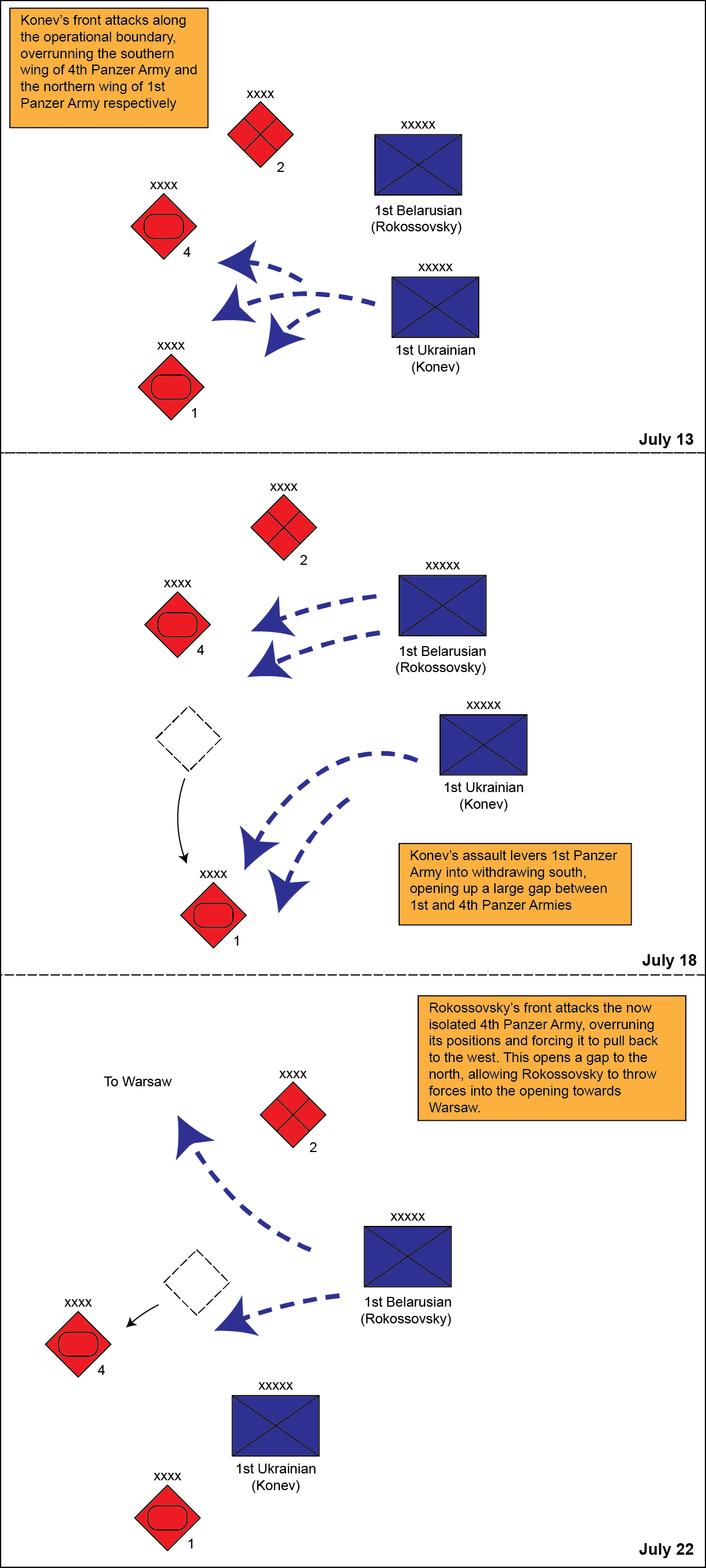
But now, as Bagration began to run out of momentum, the Soviets really did put Model’s army group in the crosshairs with an enormous follow up offensive — the second phase of their summer blockbuster. Model’s army group consisted of two Panzer Armies (the 4th and 1st), and an allied Hungarian force guarding the southern flank. On paper, a pair of Panzer Armies was a formidable force, but like all German units at this stage in the war they were understrength, and by this point they were already bleeding strength as panzer divisions were scrambled north to try and slow down Operation Bagration.
Arrayed against Model’s force were two Soviet Fronts (the equivalent of an Army Group) under a pair of the Red Army’s best operators. The lead off assault came on July 13, with Marshal Ivan Konev’s 1st Ukrainian Front forcing positions in the interstitial zone between Model’s two Panzer Armies. Konev’s intention was to split the two armies apart, force a penetration between them, and then curl into the rear to encircle one, or if possible both of them. Therefore, Konev’s initial assault was highly concentrated, with as much as 70 percent of his artillery and 90 percent of his armor assembled in a few narrow sectors selected for breaching.
With this level of force concentration by the attackers, there was really little that the Germans could do. Nevertheless, a somewhat lethargic and stiff German response helped make the disaster even worse. 4th Panzer Army headquarters initially believed Konev’s opening assault to be only a local attack – later defensively arguing that “there were as yet no signs of the attack being extended to other sections of the front” — and so attempted to respond with local counterattacks by its own reserves. As a result, by the second day of the Soviet offensive the Panzer Army had already committed all of its organic reserves while failing to withdraw from defensive positions that were already compromised. By the time they realized that Konev was launching a serious offensive operation, it was too late. Konev had already bashed into critical seams in the German front, turning his forces into a giant splitting wedge, in place to pry the whole front open.
[…]
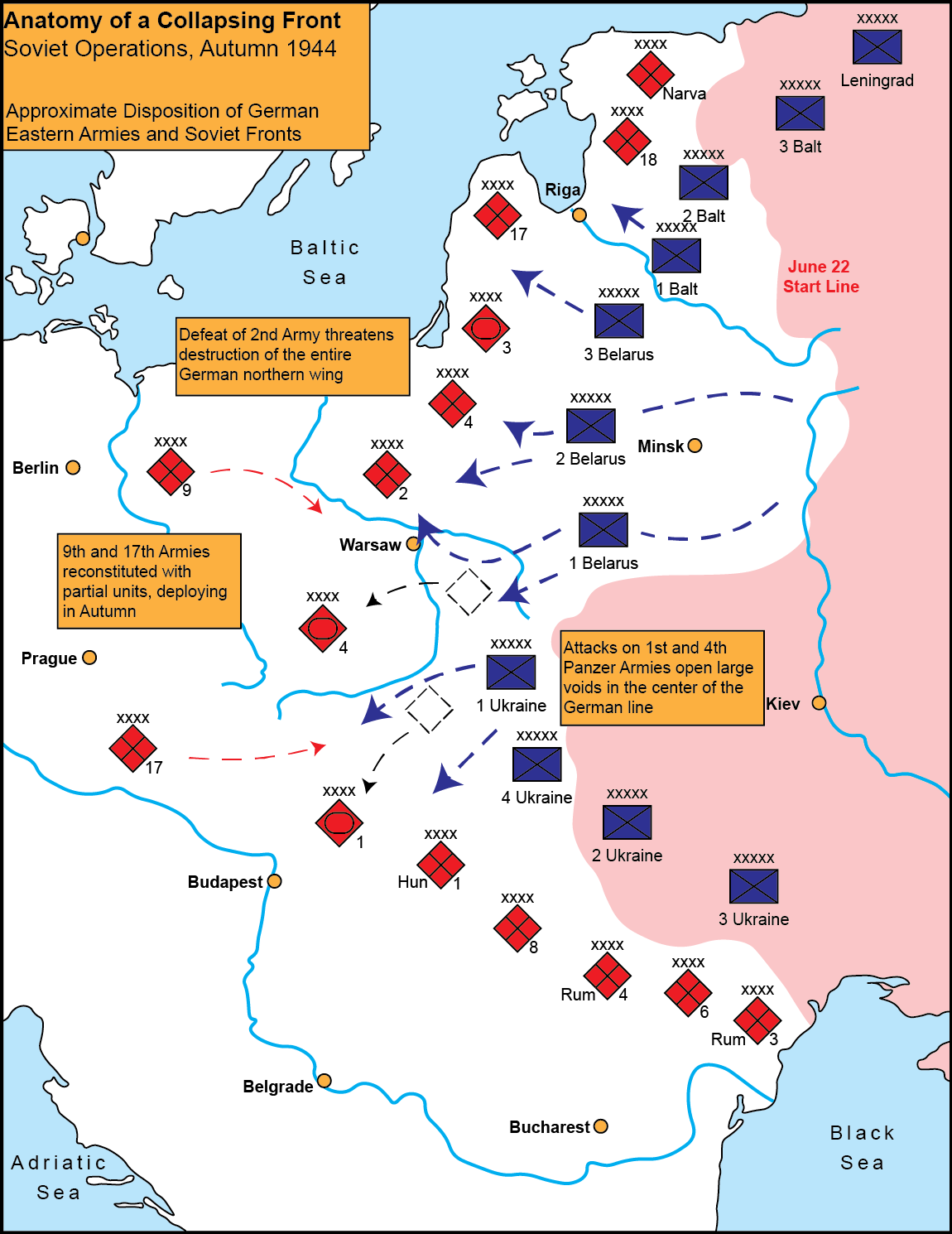
What the Soviets had achieved with their enormous assaults on Army Group North Ukraine was remarkable. By precisely targeting the seams in the German formations, the initial attacks had pried open the German position like a clam, forcing the two panzer armies to retreat in opposite directions — the 1st pulling back to the south towards Hungary, and the 4th withdrawing westward towards Krakow. These diverging withdrawals opened enormous voids in the German line — the official German history of the war simply refers to this sequence of events as “the loss of a continuous front”. In a war where the enemy wielded vast mechanized forces, such gaps were fatal.
Rokossovsky and Konev had essentially overrun an entire German army group — and the best equipped group in the east, at that — in the space of about ten days, wedging the German line open and creating vast voids to drive into. Most importantly, Rokossovsky now faced one of the more tantalizing opportunities of the entire war. A great space now beckoned him to drive north towards Warsaw, and in his path was only the tired remnant of German second army — a force with no armor whatsoever, caught completely out of position.
Any wargamer could look at the map as Rokossovsky saw it and see that the opportunity to win a seminal, world-historical victory was now within reach. A sharp drive on Warsaw would put him in position to not only capture the city (a major transportation, administrative, and supply base), but also smash through the threadbare German 2nd Army and drive to the Baltic Coast. If he could achieve this, fully half of the German eastern forces would be encircled — the entirety of Army Group North (still fighting on the Baltic Coast) and everything that remained of Army Group Center. Rokossovksy now saw little standing between his powerful Front and one of the greatest encirclements — perhaps the greatest — of all time. No less than six German armies were sitting, naked and vulnerable, on the proverbial silver platter.
The Eastern Front was on the verge of total collapse. If Rokossovsky could bash through Warsaw (a seemingly simple proposition, given the enormous overmatch that he enjoyed over German 2nd Army), he would wipe out half the German eastern army and face no meaningful German forces between him and Berlin.
December 24, 2023
The Siege of Bastogne Begins – WW2 – Week 278 – December 23, 1944
World War Two
Published 23 Dec 2023The German Ardennes Offensive, called by the Allies the Battle of the Bulge, is in full swing in Luxembourg and Belgium this week, and the Germans have the key junction town of Bastogne under siege. On the Allied side there comes a large American surrender, plans for counterattacks, and tension growing between British and American Commands. The fight in both Italy and the Philippines continues, and in Hungary the Soviets have nearly surrounded Budapest.
00:26 Intro
01:06 The Battle of the Bulge
03:54 The Malmedy Massacre
06:25 Bastogne
10:00 American Surrender on Schnee Eifel
12:06 Patton plans a counterattack
15:44 Bernard Montgomery and Omar Bradley
18:12 The Red Army advances around Budapest
21:39 Fighting in Italy and Greece
22:45 Leyte and Mindoro
25:07 Conclusion
(more…)


