Historia Civilis
Published 20 Dec 2014Patreon: https://www.patreon.com/HistoriaCivilis
Website: https://www.historiacivilis.com
Twitter: https://twitter.com/HistoriaCivilisMusic by audionautix.com


Historia Civilis
Published 20 Dec 2014Patreon: https://www.patreon.com/HistoriaCivilis
Website: https://www.historiacivilis.com
Twitter: https://twitter.com/HistoriaCivilisMusic by audionautix.com
Overly Sarcastic Productions
Published 11 Jan 2016The oracle at delphi simply tells him, “congratulations”. The standard of nudity was his idea. Narcissus gets shy around him. Patroclus was his boyfriend first. He is … the most interesting man in Ancient Greece.
Extra special thanks to Blue’s professor, Mr. Samons, who taught him about Greek history and the comedic potential of marshmallows and triremes.

Invicta
Published on 12 Sep 2016The Battle of Ecnomus in 256 BC is arguably the largest naval battle in history with 680 warships and an estimated 290,000 rowers and marines participating! This monumental clash was fought during the First Punic War between Rome and Carthage along the coast of Sicily.
Fleet Anatomy: https://www.youtube.com/watch?v=7PhRp…
Fleet Operation: https://www.youtube.com/watch?v=397-i…
Fleet Tactics: https://www.youtube.com/watch?v=VOc8m…More Classical Antiquity Documentaries: https://www.youtube.com/playlist?list…
Literary Sources:
Uniforms of the Roman World by Kevin Kiley
Republican Roman Warships by Osprey Publishing
The Fall of Carthage by Adrian Goldsworthy
Augustus by Anthony EverittGame Engine:
Total War: Rome IIGame Mods:
Devide et Impera
Realistic Ship Colors
Ave_Gigas.pak
From the comments:
Invicta
2 years ago
It has been a real pleasure to research and produce the documentary series on the Roman Navy. This video is a culmination of that exploration into the little-covered world of ancient naval combat which I hope has been equally enlightening and entertaining. It is also worth mentioning that the battle maps I created for this video individually show the 680 vessels from both sides. Though this was painstaking to do, it was worth it to convey the insane scale of this encounter at sea.I’d also like to point out that I tried using new effects in this video. I will continue to try new styles and adapt my presentations in the future and greatly appreciate any and all feedback. Thank you all for your support and help thus far. Its a true joy to have an audience for this passion of mine : )
On this day in 1943, the Allies invaded Sicily as their first step toward knocking Italy out of the war. It was the first major allied operation (other than the abortive Operation Jubilee in 1942) in which a major formation of the Canadian Army took part. The 1st Canadian Infantry Division under the command of Major General Guy Simonds was part of General Montgomery‘s Eighth Army, which landed on the southeast coast of the island.
The Canada History Project describes the Canadian participation in Operation Husky:
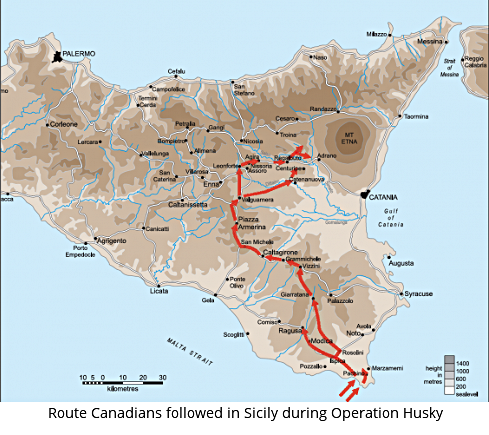
The men were young, of course, many just 18 to 24 years old. The roads were narrow dirt tracks switchbacking over steep, volcanic mountains. Temperatures hovered around 37 degrees, turning water bottles into hot water bottles, as one soldier put it. Three dry and dusty weeks into the campaign, there was a five-hour downpour, and all the troops relished the chance to shower off the dirt caked to their skin. By this time they were well into the middle of the island where their enemy was the fierce Hermann Goering division of the German army.
For six weeks, from July 10th to August 17th 1943, the Canadians, fighting as an independent unit for the first time, slogged through the interior of Sicily as part of Operation Husky, the first stage of taking back Europe from the Nazis after four years of war. Meanwhile, the Americans skirted the more level western coastline of the island and the British came up the east side, each competing with the other for glory.
American General Patton wrote in a letter, “This is a horse race in which the prestige of the US Army is at stake…we must take Messina before the British.”
That may be the way the generals saw it. For the soldiers, pushing through, village by village, mountaintop by mountaintop, it was no game.
Sicily, a rural mountainous island known for its orange groves and almond orchards, olives and the Mafia, sits strategically in the Mediterranean off the foot of Italy. The Canadian contingent was 25,000 strong. All men and materials were brought in by sea, making it the largest amphibious operation yet, though D-Day, a year later, would be bigger still.
In the first few days the Canadians passed through an area that is now a Unesco World Heritage site. Today tourists come to this southeast corner of Sicily to see the restored baroque architecture. But the young Canadian lads were eyeing the pillboxes, watching for snipers and lookouts. In the early days many Italian soldiers surrendered without too much resistance and the local people gave them grapes and oranges to quench their thirst in the scorching heat.
[…]
Operation Husky did succeed in gaining back the first European soil for the Allies. In the midst of it, Mussolini resigned and soon after Italy surrendered, another goal of the campaign. It started a second front forcing Hitler to back off his aggressive attack on our ally, Russia. And it provided a rehearsal for the larger amphibious landing on the beaches of Normandy, France in June of 1944. As well, it was the first time Canadians had fought as an independent unit. Their young commander was Guy Simonds. 1200 Canadians were wounded in Sicily and 562 died there. 490 of them are buried in the Canadian cemetery at Agira.
For their efforts, the soldiers fighting in Sicily and Italy became known as the “D-Day Dodgers”, a careless epithet supposedly delivered by Lady Astor, but embraced by the soldiers themselves who, with some sarcastic humour, turned it into the song, “We are the D-Day Dodgers, in sunny Italy…”
The Canadian part of the campaign from canadiansoldiers.com:
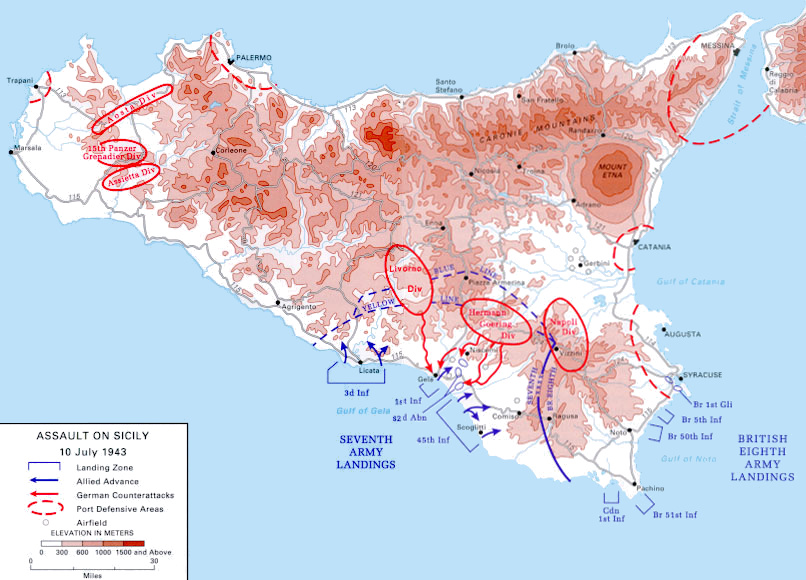
Sailing secretly at the end of June, the Division took its place on the left flank of General Bernard Montgomery’s famed Eighth Army for the Sicilian landings. The amphibious attack against Pachino peninsula was an unqualified success. The defenders were surprised and overrun with very few Allied casualties, and so began a controversial 38-day campaign. General Simonds’ troops advanced inland under difficulties:
The weather was extremely hot, the roads extremely dusty, and there was little transport; the troops were fresh from a temperate climate and a long voyage in crowded ships; and even though for a time there was scarcely any opposition, mere marching was a very exhausting experience under these conditions.
Continuing over the rocky terrain, they had their first fight with the Germans at Grammichele on 15 July. Three days later they captured Valguarnera. Both were rear-guard actions by a withdrawing enemy, and the first real tests came on the July 20 at Assoro and Leonforte. At the former, the 1st Brigade launched a surprise attack at night against an ancient Norman stronghold on the summit of a lofty peak. They seized and held their place in the face of fierce counter attacks, the records for the 15th Panzer Grenadier Division afterwards revealing generous tributes to the fieldcraft (Indianerkrieg) of the Canadians. Leonforte, an equally difficult situation, was captured by the 2nd Brigade after a bitter fight. These three days cost the Division about 275 casualties.
The advance then turned the east towards Adrano, at the base of Mount Etna. In their path stood Agira, “one of the most imposing of Sicily’s innumerable hill-towns,” and in the neighbouring hills the enemy put up a stubborn resistance. Both the 1st and 2nd Brigades were heavily engaged during the last week of July. The operations were, however, effectively supported by Canadian tanks and by the divisional artillery, reinforced by units of the Royal Artillery. General Simonds also had temporarily under his command the 231st British Infantry Brigade (the Malta Brigade), which threatened German communications from the south. After a bitter struggle Agira was captured on the 28th. Between Agira and Adrano the Hermann Goering Division made a stand at Regalbuto, using tanks as pillboxes in the debris of the town. While part of the 1st Division loosened the enemy’s grip on this town, the 3rd Brigade, temporarily under the command of the British 78th Infantry Division, assisted that formation in the Dittaino Valley.
American encircling operations in the western and northern districts of the island, combined with steady British pressure north of the Catania Plain, forced the enemy out of the defences based on Etna, and the campaign ended when the Allies entered Messina on 16-17 Aug. The 1st Division had performed all of its allotted tasks and had acquired valuable battle experience at a total cost of 2,155 casualties. The measure of the achievement was contained in General Montgomery’s statement: “I now consider you one of my veteran Divisions.”
The Division passed from XXX Corps to XIII Corps on 10 Aug, and moved to a concentration area in the rear on 11-13 Aug, relieved of operational responsibilities. Divisional headquarters moved to Francofonte. During the battle of Sicily they had travelled 120 miles, over largely rough and mountainous terrain.
At El Reg, Alistair Dabbs recounts some tales from a recent trip to Italy:
This isn’t the first time I have strayed into a Twilight Zone of cross-lingual and intercultural bafflement during this vacation. Throwing caution to the wind a few days earlier, I’d rashly allowed Google Maps to plot a walking route from the centre of Palermo to La Zisa. Why I did this, I cannot say, especially given my poor experience of Google Maps’ walking routes in the past. This is, after all, the app that once directed me to walk through the centre of an unlit Hyde Park at 2am and whose audio inexplicably but routinely barks “Turn left!” when you’re supposed to turn right.
On this occasion, Google Maps decided to take me on a scenic tour of the city’s most impoverished slums. Given that what few pavements existed along the way were knee high in refuse and canine excretia, it was less of a walking route than a wading route. The final 100 metres appeared to be some kind of theme park attraction along the lines of Disney World’s “Pirates of the Caribbean”, except this was “Dope-addled Inbreds of the Mediterranean”.
To access this den of iniquità, I had to pass through one of those pedestrian gates design to stop cyclists from riding through it. It was blocked by a tweenager who’d been trying to ride his bicycle through it and got stuck. The unlikely resolution of such an attempt was emphasised by two obvious challenges: it was an adult bike and the boy was so fat that he looked like an inflatable sofa. Both the bicycle and his body were at least two sizes too big for him.
By waving his arms around, he indicated that I was welcome to pass through the gate. By waving my arms back at him, I indicated that I would certainly do so after he had extricated himself. This attracted some shifty onlookers who helpfully grunted and waved their arms around at both of us until eventually we were all gesticulating like delegates at a semaphore convention.
Fearing an unfortunate outcome from this clash of cultures in unfamiliar territory, I coaxed the fat kid and his bike out of the gate and taught him to play the banjo he was carrying, ending with a spontaneous duet between the two of us. It was only by sheer luck that I’d remembered to pack my bagpipes.
I’d only ever encountered mentions of orichalcum as a rare metal in Guild Wars 2, but it was a real thing, and an underwater archaeology team found 39 ingots of orichalcum just off the coast of Sicily near Gela:
Gleaming cast metal called orichalcum, which was said by Ancient Greeks to be found in Atlantis, has been recovered from a ship that sunk 2,600 years ago off the coast of Sicily.
The lumps of metal were arriving to Gela in southern Sicily, possibly coming from Greece or Asia Minor. The ship that was carrying them was likely caught in a storm and sunk just when it was about to enter the port.
“The wreck dates to the first half of the sixth century,” Sebastiano Tusa, Sicily’s superintendent of the Sea Office, told Discovery News. “It was found about 1,000 feet from Gela’s coast at a depth of 10 feet.”
He noted that the 39 ingots found on the sandy sea floor represent a unique finding.
“Nothing similar has ever been found,” Tusa said. “We knew orichalcum from ancient texts and a few ornamental objects.”
Indeed orichalcum has long been considered a mysterious metal, its composition and origin widely debated.
According to the ancient Greeks, it was invented by Cadmus, a Greek-Phoenician mythological character. The fourth century B.C. Greek philosopher Plato made orichalcum a legendary metal when he mentioned it in the Critias dialogue.
Was the invasion of Sicily by the allies in 1943 a strategic error?
Seventy years ago this week, U.S. and British Commonwealth troops began Operation Husky, the invasion of Sicily. Foreshadowing D-Day 1944, Gen. Dwight Eisenhower served as overall Allied commander. Like D-Day, Allied airborne soldiers led the Husky assault by parachuting (on the night of July 9, 1943) into olive groves and rock-strewn fields along the island’s southeastern shores. On July 10, seven divisions — three U.S., three British and the 1st Canadian Infantry Division — launched an amphibious attack on a 100-mile long front. Despite several successful Axis air attacks on ships and a brazen Italian tank attack on U.S. positions near Gela, by midnight July 10 all seven divisions were ashore.
Putting seven divisions ashore so swiftly was an extraordinary coup. Oh, grievous errors occurred as the buildup proceeded, the most notorious being the July 11 downing of 23 U.S. transports by Allied anti-aircraft fire. The planes were ferrying paratroop reinforcements. Yet in its initial phases Husky demonstrated that the Anglo-American team had learned a great deal since the Operation Torch landings in November 1942. Planning and coordination had improved. North African combat had honed the skills of American forces.
[. . .]
The Sicily campaign placed Allied troops less than 10 miles (the strait’s width) from mainland Italy.
The oh-so-close proximity of large Allied forces to Italy was enticing. And that enticement leads to the biggest historical question tagging Operation Husky: Was taking Sicily the best strategic choice, since it made an invasion of Italy inevitable? From south of Naples to the Po Valley, Italy’s rugged and rocky terrain is a defender’s delight and attacker’s sorrow.
Winston Churchill had sold Sicily as the next logical step. Sicily was the classical route to Rome from North Africa, and knocking fascist Italy out of the war would deal Adolf Hitler’s Axis a heavy political loss.
Sicily geographically dominates the central Mediterranean. Husky’s advocates noted that for three millennia the island served as the stepping stone of to-and-fro commerce and war between North Africa and Europe.
American military leaders were not convinced. The decisive route to Berlin goes through France — make the all-out effort there. Churchill also claimed Europe had a “soft underbelly.” Italian and Balkan terrain is not soft. Several senior U.S. planners thought Churchill was really trying to defend British imperial interests.
Axis-controlled Sicily had served as a big aircraft carrier for attacking Allied shipping. Under Allied control, those bases would extend air cover to northern Italy and Sardinia. U.S. planners agreed that Husky made operational sense if the goal was securing air bases. But can we stop there, at the strait? Sicily’s hard slog was costly. A strategic thrust up Italy’s mountainous spine will be as just slow and deadly.
And indeed it was.



Powered by WordPress