
“Oh, certainly, you could produce quantities of infants — although it would take enormous resources to do so. Highly trained techs, as well as equipment and supplies. But don’t you see, that’s just the beginning. It’s nothing, compared to what it takes to raise a child. Why, on Athos it absorbs most of the planet’s economic resources. Food — of course — housing education, clothing, medical care — it takes nearly all our efforts just to maintain population replacement, let alone to increase. No government could possibly afford to raise such a specialized, non-productive army.”
Elli Quinn quirked an eyebrow. “How odd. On other worlds, people seem to come in floods, and they’re not necessarily impoverished, either.”
Ethan, diverted, said, “Really? I don’t see how that can be. Why, the labor costs alone of bringing a child to maturity are astronomical. There must be something wrong with your accounting.”
Her eyes screwed up in an expression of sudden ironic insight. “Ah, but on other worlds the labor costs aren’t added in. They’re counted as free.”
Ethan stared. “What an absurd bit of double thinking! Athosians would never sit still for such a hidden labor tax! Don’t the primary nurturers even get social duty credits?”
“I believe,” her voice was edged with a peculiar dryness, they call it women’s work. And the supply usually exceeds the demand — non-union scabs, as it were, undercutting the market.”
Lois McMaster Bujold, Ethan of Athos, 1986.
January 12, 2014
QotD: The real-world economics of children
January 1, 2014
Isaac Asimov’s predictions for 2014, written in 1964
VA Viper dug up an Asimov essay from 1964, where he speculated on what life would be like in 2014. It’s an interesting read:
What will life be like, say, in 2014 A.D., 50 years from now? What will the World’s Fair of 2014 be like?
I don’t know, but I can guess.
One thought that occurs to me is that men will continue to withdraw from nature in order to create an environment that will suit them better. By 2014, electroluminescent panels will be in common use. Ceilings and walls will glow softly, and in a variety of colors that will change at the touch of a push button.
Windows need be no more than an archaic touch, and even when present will be polarized to block out the harsh sunlight. The degree of opacity of the glass may even be made to alter automatically in accordance with the intensity of the light falling upon it.
[…]
Robots will neither be common nor very good in 2014, but they will be in existence. The I.B.M. exhibit at the present fair has no robots but it is dedicated to computers, which are shown in all their amazing complexity, notably in the task of translating Russian into English. If machines are that smart today, what may not be in the works 50 years hence? It will be such computers, much miniaturized, that will serve as the “brains” of robots. In fact, the I.B.M. building at the 2014 World’s Fair may have, as one of its prime exhibits, a robot housemaid: large, clumsy, slow-moving but capable of general picking-up, arranging, cleaning and manipulation of various appliances. It will undoubtedly amuse the fairgoers to scatter debris over the floor in order to see the robot lumberingly remove it and classify it into “throw away” and “set aside.” (Robots for gardening work will also have made their appearance.)
General Electric at the 2014 World’s Fair will be showing 3-D movies of its “Robot of the Future,” neat and streamlined, its cleaning appliances built in and performing all tasks briskly. (There will be a three-hour wait in line to see the film, for some things never change.)
The appliances of 2014 will have no electric cords, of course, for they will be powered by long- lived batteries running on radioisotopes. The isotopes will not be expensive for they will be by-products of the fission-power plants which, by 2014, will be supplying well over half the power needs of humanity. But once the isotope batteries are used up they will be disposed of only through authorized agents of the manufacturer.
An experimental fusion-power plant or two will already exist in 2014. (Even today, a small but genuine fusion explosion is demonstrated at frequent intervals in the G.E. exhibit at the 1964 fair.) Large solar-power stations will also be in operation in a number of desert and semi-desert areas — Arizona, the Negev, Kazakhstan. In the more crowded, but cloudy and smoggy areas, solar power will be less practical. An exhibit at the 2014 fair will show models of power stations in space, collecting sunlight by means of huge parabolic focusing devices and radiating the energy thus collected down to earth.
[…]
Communications will become sight-sound and you will see as well as hear the person you telephone. The screen can be used not only to see the people you call but also for studying documents and photographs and reading passages from books. Synchronous satellites, hovering in space will make it possible for you to direct-dial any spot on earth, including the weather stations in Antarctica (shown in chill splendor as part of the ’64 General Motors exhibit).
For that matter, you will be able to reach someone at the moon colonies, concerning which General Motors puts on a display of impressive vehicles (in model form) with large soft tires: intended to negotiate the uneven terrain that may exist on our natural satellite.
Any number of simultaneous conversations between earth and moon can be handled by modulated laser beams, which are easy to manipulate in space. On earth, however, laser beams will have to be led through plastic pipes, to avoid material and atmospheric interference. Engineers will still be playing with that problem in 2014.
Conversations with the moon will be a trifle uncomfortable, but the way, in that 2.5 seconds must elapse between statement and answer (it takes light that long to make the round trip). Similar conversations with Mars will experience a 3.5-minute delay even when Mars is at its closest. However, by 2014, only unmanned ships will have landed on Mars, though a manned expedition will be in the works and in the 2014 Futurama will show a model of an elaborate Martian colony.
December 26, 2013
December 12, 2013
Heinlein’s biographer talks to the Cato Institute Book Forum, 2010
Uploaded on 10 Jun 2011
Featuring the author William H. Patterson, Jr., Editor and publisher, The Heinlein Journal; moderated by David Boaz, Executive Vice President, Cato Institute.
Robert A. Heinlein is regarded by many as the greatest science fiction writer of the 20th century. He is the author of more than 30 novels, including Starship Troopers, Stranger in a Strange Land, and the libertarian classic The Moon Is a Harsh Mistress. According to biographer William H. Patterson Jr., Heinlein’s writings “galvanized not one, but four social movements of his century: science fiction and its stepchild, the policy think tank; the counterculture; the libertarian movement; and the commercial space movement.” This authorized biography, reviewed enthusiastically by Michael Dirda in the Washington Post, is the first of two volumes, covering Heinlein’s early ambition to become an admiral, his left-wing politics, and his first novels. Heinlein later became strongly libertarian.
November 22, 2013
Funding the Arthur C. Clarke award
Charles Stross has just posted a link to a recent short story of his (from 2011) which was written as part of a fund-raiser to help keep the Arthur C. Clarke awards going and an explanation of why most short stories can be improved by adding dinosaurs and sodomy:
Now, I don’t write many short stories these days, but I’m a sucker for the right kind of charity approach. And besides, I had a hypothesis I wanted to test: that every short story can be improved by adding dinosaurs and sodomy.
No, seriously: click that link, it’s work-safe but side-splittingly funny if you’ve ever been to a writers’ workshop. And probably utterly incomprehensible if you haven’t, so I shall have to unpack it for you …
In Michael Swanwick’s oeuvre — and he’s one of the most perspicacious, indeed brilliant, exponents of the short story form in SF today — dinosaurs are a short-hand signifier for action, adventure, thrills, and chases: whereas sodomy is a placeholder representing introspection into the human condition, sensitivity to emotional nuance, and a great big bottle of lube.
So when he’s telling students they need to add dinosaurs to their work, he’s eliptically hinting that sensitive emotional nuance needs to be balanced by a bit of GRAAAH!! BITE!!! CHASE!!!!1!!!ELEVENTY (sorry, I got a bit carried away there). And when he tells them to add sodomy, he’s hinting that there may be too much focus on the performance stats of the space super-dreadnought and not quite enough insight into the emotional trauma the steel-jawed captain is grappling with from her seat on the bridge.
Yeah, right. But what happens if you take the advice literally? After all, SF is the genre of the literal space ship, eschewing ironic metaphor in favour of naive wonder at the immanent apprehension of the unreal.
So I was thinking about dinosaurs, and Sodomy, and the challenge of writing a story in the style of Arthur C. Clarke that applied Swanwick’s principles in a deliberately naive and unmetaphorical manner, when I saw this video (which is definitely not safe for work, unless you’re me — you have been warned).
October 2, 2013
QotD: Day two
I don’t know who’s more foolish: the greeter standing there, cheerfully helping shoppers, or the other customers who weren’t panicking and hoarding like I was. Don’t these idiots realize that the government is shut down?!?!
The lack of rioting at Petco encouraged me — might there still be actual human food on the shelves at other stores? Swung by Whole Foods where I saw canned goods … and large cuts of beef and pork on sale at $1.99 / lb. Remembering a trick from Lucifer’s Hammer, I bought all the meat I could fit in the shopping cart, took it home, sliced it thin, and dehydrated it.
As I stayed up until 4am slicing meat I couldn’t help but dwell on the fact that the customers at Whole Foods are just as deluded as those at Petco. Fools. Pathetic fools. The societal breakdown might not be that obvious yet, but by day three of the government shutdown they’ll be hammering at my door, looking for salted beef.
Sadly, I’ve realized that my preparations aren’t as far along as they should be. Ammunition will soon grow scarce, and I’ll need other weapons to defend myself from bikers and feral children once the government shutdown really hits. I recall from Dies the Fire that crossbows can be made from truck leaf springs. I’m going to go onto Craigslist to try to find a blacksmith or craftsman I can barter with, but I fear it may already be too late — has Craigslist survived this long?
Clark, “Government shutdown: day two”, Popehat, 2013-10-02
September 26, 2013
The Crazy Years – you’re soaking in it
Robert Heinlein plotted out the entire arc of his “Future History” stories on a chart that included technological, social, and political events that either featured in or were key drivers for individual stories:
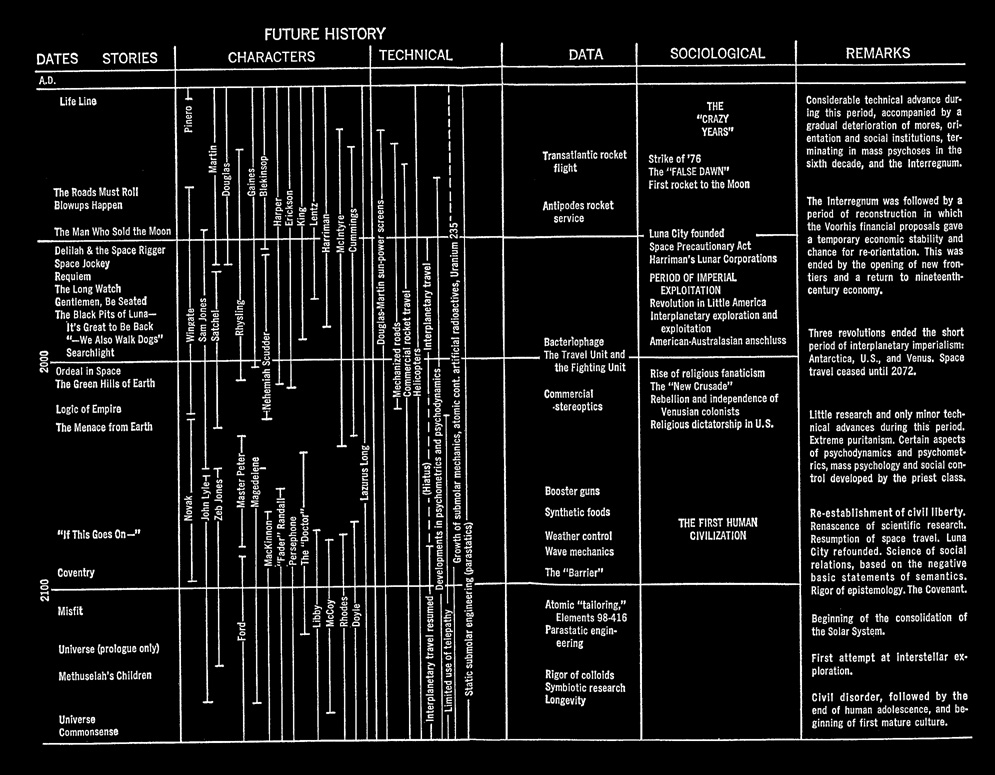
Click to view full size
While our actual technological advances haven’t matched Heinlein’s predictions, you could make a strong case that the sociological column got it right by calling the era from the late-sixties onwards “The Crazy Years”. Samizdata‘s Johnathan Pearce linked to this post by Charles Steele which makes the case quite well:
In his Past Through Tomorrow and other works, Robert A. Heinlein explored a possible future history for homo sapiens. One of things he foresaw was a period at the end of the 20th Century and beginning of the 21st that he called “the Crazy Years,” in which cultural fragmentation and decay in advanced countries generates political and economic decline and social disruption. He was prescient in recognizing what happens when commonly accepted principles such as an individual’s responsibility for self are forgotten and political correctness and multiculturalism run amok. As advancing technology places increasing power in human hands, human ethics fail to keep pace. In Heinlein’s world, humans do manage to navigate these shoals without destroying themselves and eventually do settle on a MYOB sort of libertarian ethic…but only narrowly averting nuclear self-destruction and environmental self-destruction, and not without going through periods of dictatorship as well as societal chaos.
Heinlein’s story isn’t just fiction. In the course of the development of the Soviet SETI program, astrophysicist Nikolai Kardeshev developed a theory of civilizations and what we might look for in trying to detect them. Kardeshev’s work — which has been further developed by others — gives a classification system based on the scale at which a planet-based civilization can harness energy. The lowest level of civilization, Type I, has the capability of harnessing the entirety of the energy of its planet. As a sort of corollary, it’s hypothesized that a species that is approaching Type I mastery potentially goes through a very dangerous period, akin to Heinlein’s “Crazy Years.” Their advanced level of technology gives them power capable of destroying the civilization if misused. If the species fails to develop behaviors, ethics, institutions, etc. that prevent this it can annihilate itself. I’m uncertain how much of this corollary is in Kardeshev’s original contribution, but physicist Michio Kaku suggests that one thing we could look for in SETI is the wreckage of civilizations that failed to make the transition to Type I. And of course, our civilization is our one example, so far, of a civilization entering this transition.
What’s the connection between Heinlein and Kardeshev? Think of just a few examples of the dangers we face today:
- Iranian or Al Qaeda religious fanatics obtaining nuclear weapons…
- An American federal government — especially the executive branch — working to acquire unlimited power, and already apparently having the power to spy on essentially all communications, everywhere…
- A growing segment of the population — some poor and some very rich (think Goldman Sachs) — who live as parasites on the productivity of others while creating nothing of values themselves…
- An intelligentsia that cannot bring itself to condemn Islamism for fear of being seen as insensitive or racist or ethnocentric, but which regularly denounces, in the most hateful terms, anyone who opposes the continued expansion of state power…
- An intelligentsia that praises socialism, hunter-gatherer economies, massive interventionism, anything but the one system that actually works, free market capitalism, a system they bitterly condemn…
- A “press,” our mainstream media, that sees its job as promoting political positions and readily lies when lies serve this goal better than truth, and spouts nonsense the remainder of the time, apparently because reasoned analysis is too hard.
Yes, we’re in the crazy years, for sure.
And yet, in spite of all this, he’s still optimistic about the future.
September 24, 2013
A new “Laundry” story by Charles Stross
Charles Stross writes many things, but what first alerted me to his writing was The Atrocity Archives. TOR.com has a new story called “Equoid” online for your reading pleasure:
Charles Stross’s “Equoid” is a new story in his ongoing “Laundry” series of Lovecraftian secret-agent bureaucratic dark comedies, which has now grown to encompass four novels and several works of short fiction. “The Laundry” is the code name for the secret British governmental agency whose remit is to guard the realm from occult threats from beyond spacetime. Entailing mastery of grimoires and also of various computer operating systems, the work is often nose-bleedingly tedious. As the front-cover copy line for Ace’s edition of The Atrocity Archives noted, “Saving the world is Bob Howard’s job. There are a surprising number of meetings involved.” Previous “Laundry” stories on Tor.com are “Down on the Farm” and the Hugo Award finalist “Overtime.”
Like some other stories published on Tor.com, “Equoid” contains scenes and situations some readers will find upsetting and/or repellent. [—The Editors]
This novella was acquired and edited for Tor.com by senior editor Patrick Nielsen Hayden.
August 22, 2013
Sixties TV – it was different if you were under 12
James Lileks looks at a few Gerry Anderson productions:

Gerry Anderson! You’re going to get everything you need for crackerjack adolescent-satisfying sci-fi: spaceships, shuttlecrafts, computers, control rooms, crisp commanding officers, futuristic gadgets, and a big score. And none of it will work half as well as you hoped. The spaceships will look great, though. The computers will blink and there will be switches, but nothing makes Star Trek Sounds. The control rooms are clean but everyone is talking in a British accent for some reason, like they have their own NASA that’s just as big. The gadgets are okay. The score has a trademark echoey quality you found in soundtracks, particularly British ones, from the late 60s to the early 70s. It should be good! Why isn’t it great?
I’ve pondered that mystery for a long time. Sometimes you have a revelation — hey, the founding concept of “Space: 1999 was really stupid” — or you carp about the details, wondering why the UFO interceptors went hunting with one (1) missile that required a direct hit to be effective, instead of just blowing the hell out of the area. Then you realize it’s not great because it’s all the work of someone who made horribly grinning square-headed puppets, that’s why, and never stopping thinking he was making entertainment for 8 years olds.
[…]
The title theme is here, complete with oddly romantic piano interlude. It’s every Barry Grey piece that ever left me cold, right there. In general I just don’t feel Barry Grey’s music — except for the opening of the “Space 1999” theme before it goes full whacka-chicka, and of course that other theme. Here’s a guy who wrote miles and miles of scores for things like “Supercar,” for heaven’s sake, and he turns around and knocks off the tightest, sharpest theme of the 70s.
Still, Laurie Johnson was better.
August 2, 2013
Omni rises from the ashes
At BoingBoing, Glenn Fleishman talks about the relaunch of Omni magazine:
A few weeks ago, I posed the question here, “Who Owns Omni?“, about the beloved, defunct magazine of the future created and run by Kathy Keeton with significant involvement by her husband Bob Guccione, the founder of Penthouse. The best answer I was able to come up with after talking to past Omni editors and writers, contacting potential current copyright owners, and researching Guccione’s personal bankruptcy and General Media’s more complicated bond default was: nobody.
Almost all of the authors, photographers, and artists whose work appeared in the magazine had signed contracts that granted only short-term rights. The staff writing and other work for hire — owned by the magazine itself — was relatively minimal, and the owner of those rights is to my best efforts currently still unknown.
Next week, however, Omni will be reborn. Not the original, but Omni Reboot: a new online publication that takes its inspiration and direction from the magazine that so many of us grew up on and loved.
While I wasn’t a huge fan of Omni (I preferred Analog), I’m happy to see the old property being revived.
Forbes talks to Warren Ellis
Warren Ellis has a new novella out (that I haven’t read yet) and talks to Alex Knapp about the new work and other topics:
In Dead Pig Collector, the process of disposing of a body is fairly well detailed. How much research did you do for that?
Four or five hours. Believe it or not, a lot of people seem to spend time talking on the internet about getting rid of bodies. And now they’re all on PRISM-generated watchlists. And so am I.
One of the things that’s fascinating about your work is that it explores subcultures that seem like fantasy, but very much exist in real life. I know, for example, a lot of the cultures you explored in Crooked Little Vein are horribly true. What interests you about them?
I think one of the bigger lessons the internet has taught us is that “niche” or “subculture” are a lot bigger than anyone ever thought. And, frankly, if it’s on the internet, the biggest and widest communication and information system in the world, then it’s not really a subculture any more. If it’s accessible by hundreds of millions of people, then it’s as mainstream as it gets. More people visit body modification websites than watch some tv shows, and yet we think of television as the most mainstream, monocultural thing in the world. How can you not be interested in them? They are the shape of the world to come.
[…]
Also infused in a lot of your work is what appears to me anyway to be a deep and abiding love of space travel. What is it about space that fascinates you so much?
Space is the place. We currently keep all our breeding pairs in the same place, which is kind of a stupid way to run a species. Also, it’s full of stuff we haven’t seen yet, which should be impetus enough to go and look.
What do you think about the current state of space travel, especially now with China and now private companies getting into the mix?
I find it all sadly boring. I mean, yes, the Chinese programme looks awfully promising, but it’s just re-running the prime NASA years in fast-forward — doing things we already did, all over again, in a compressed timeframe, with what is probably fairly similar technology. I’m interested to see what they do once they attain the Moon. And, again, the private stuff — Virgin is just finding a new way to replicate Alan Shepard’s sub-orbital lob. That said, Elon Musk’s projects are getting more interesting by the day. I’m starting to wonder if he doesn’t have a full-on James Bond villain long-game scheme. Wouldn’t that be great? Right up until, you know, the orbital death ray platforms.
July 20, 2013
The Angry Nerd comes down on Comic Con weapon checks
July 18, 2013
Firefly Online game announcement
Firefly Online (FFO) is a multi-user, social online role-playing game that will initially be available for smartphones and tablets, including those based on iOS and Android operating systems.
Check out updates and pre-register at www.keepflying.com
From the official site:
Firefly Online is a social role playing game (RPG) based on Firefly, Joss Whedon’s cult-hit television series. Firefly Online (FFO) is currently in development for iOS and Android, and may expand to include additional platforms.
In Firefly Online, players assume the role of a ship captain as they hire a crew and seek out adventures, all the while trading with and competing against the millions of other players to try to survive in the Verse: find a crew, find a job, keep flying.
FFO provides a variety of gameplay activities and systems so that players can fully experience life in the Verse.
- Assume the role of a ship captain — create a crew and customize a ship
- Aim to misbehave in space and planet-side adventures
- Cross-platform player experience across devices (pick-up and play from anywhere)
- Unique social features connecting Firefly fans
- Create a shiny ship and explore the Verse
July 13, 2013
Charles Stross on the inspiration for Saturn’s Children
It’s rather fascinating — especially if you’re also a fan of Robert Heinlein:
Now, I have a love/hate relationship with Robert A. Heinlein’s work. I am not American; much of his world-view is alien to me. I did not grow up with his 1950’s juvenile novels, and I don’t like them much. Some of his work is deeply, irredeemably flawed and should probably be taken out back and shot. (Does anyone have a kind word to say for Sixth Column or Farnham’s Freehold? I’ll try: 6thC was written to an outline supplied by famously racist editor John W. Campbell, at a point when Heinlein needed the money, and he is alleged to have watered down the racism as far as he could; as for FF, here was a privileged white male from California, a notoriously exclusionary state, trying to understand American racism in the pre-Martin Luther King era. And getting it wrong for facepalm values of wrong, so wrong he wasn’t even on the right map … but at least he wasn’t ignoring it.) Ahem. Nevertheless, it’s impossible to ignore Heinlein unless you’re going to ignore all American SF, and as that’s my main market and my main publishers are American, that’s not an option.
So I decided to pick a Heinlein novel and do a homage to it. One of my two favourites would do: that narrowed it to Glory Road (not really an option because: space opera contract) or Friday (problematic, later work showing flashes of earlier brilliance but impossible to read now without much head-clutching or making excuses for the author’s lack of a language with which to tackle issues of racism and child abuse, which is what underpins that book). This made things both easier and harder, because Friday is a late period work — distinctly different from his early and mid-phase novels (although it was something of a return to his mid-period form).
Then everything came together in my head in a blinding flash of enlightenment, thuswise:
I was going to write a late period Heinlein tribute novel, because everybody (I’m looking at you, Scalzi; also John Varley, Spider Robinson, Mike Ford, Steven Gould …) else who does Heinlein tributes does early Heinlein. And if you want to stand out, the best way to do it is to look which way the herd is stampeding in, then go somewhere else.
Heinlein in his dirty-old-man phase seemed to have a nipple obsession. Worse: an obsession with nipples which, as piloerectile tissue, made an implausible noise — “spung!” Thus, the word “spung!” becomes the centerpiece of any successful late-period Heinlein pastiche.
We in the reality-based community are aware that real human nipples do not do “spung”. But under what circumstances might a nipple go “spung”? Well, if it was some sort of pressure-relief valve on a robot, that sound wouldn’t be totally implausible.
Nipples … on a robot. Why would a robot need nipples? The answer seemed obvious: it was a sex robot. A sex robot in the shape of a Heinleinian omni-competent and beautiful yet sexually submissive heroine. (There is nothing politically correct about Heinlein: he was a product of a different age.)
June 24, 2013
Don’t judge a book – especially a science fiction book – by its cover
H/T to Lois McMaster Bujold, who sent this link to her mailing list.


