
Feral Historian
Published 20 Feb 2026American Gods (Neil Gaiman, 2001) is, among other things, a layered examination of the role of mythologies, religion, national identities, and some underlying “American-ness” that bends them all into something new. By necessity this meanders a bit (I’m not going to get into Gaiman’s failings as a human being much) but it gives us a lot to think about.
I mention a couple outside references in here, links below if you want to dig into it.
Lilly Wachowski on the role of the Red Pill in The Matrix: https://screenrant.com/the-matrix-mov…
George Lucas on the Rebellion, and Viet Cong (people often quote the line but miss the context) : • JAMES CAMERON’S STORY OF SCIENCE FICTION |…
00:00 Intro
01:56 The Setup
04:48 Spirit of America
07:57 White and Red
10:50 New Gods and the State
12:51 Author, Intent, and Meaning
(more…)
June 23, 2026
American Gods: Land and Egregores
June 21, 2026
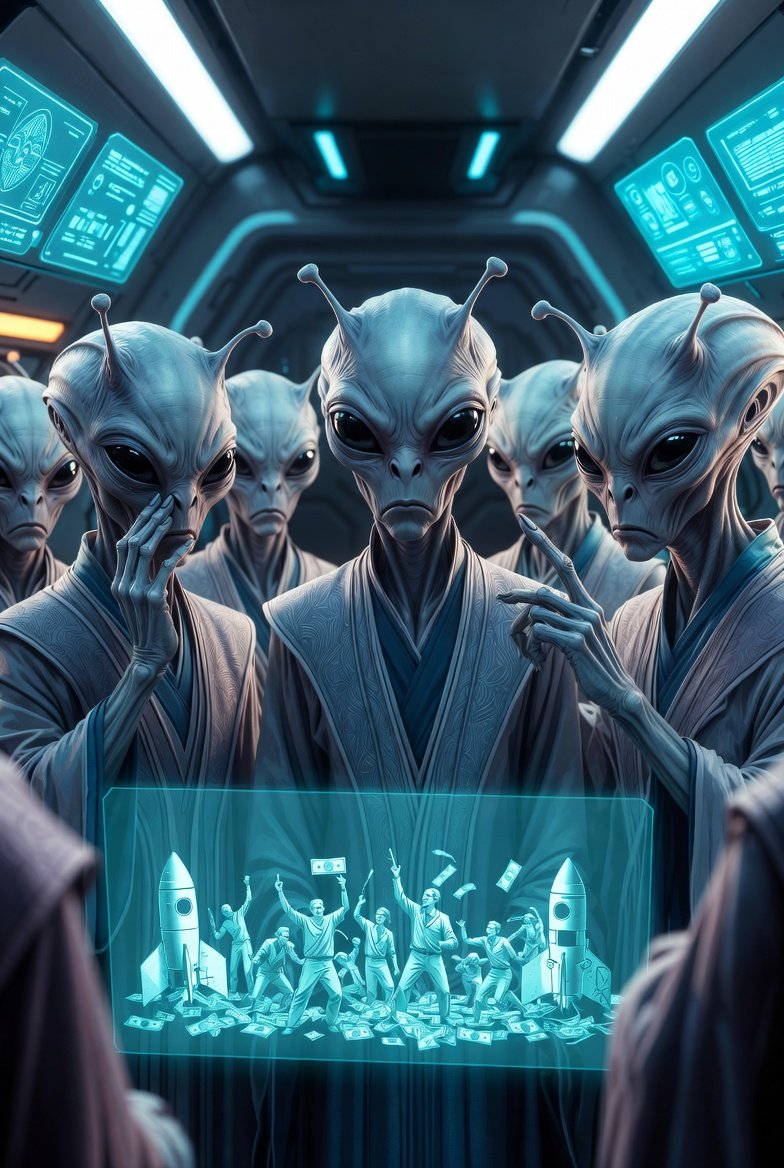
Explaining our failure to expand beyond Earth to an alien
Devon Eriksen pens an ultra-short story in response to Senator Elizabeth Warren’s claim that “we” need to take a lot more money from Elon Musk to benefit “everyone”:
This-individual has an outstanding query for you-individual.
Yes, Dee-six-twenty-four-prime? Ask your question.
When we-collective initialized language-idea-exchange with you-collective, you-collective had no settlements on the surface of other planets in your-collective own star system.
Yet you-collective possessed advanced chemical propulsion technology sufficient to leave your-collective native gravity well. For over a hundred cycles around your-collective star, you-collective possessed this.
Why did you not use it?
Well, all that technology was worth a lot of money.
Value-consideration-tokens, yes. Continue.
So we decided to take it away from the really talented geniuses who built, break it up for parts, sell the parts, and throw a big free stuff party.
A … free stuff party?
Yeah, for like, average dudes. The kind of guys who don’t know calculus or anything. The ones you’d want to have a beer with. We thought we’d buy them some stuff.
Instead of leaving your home planet?
Yeah.
This-individual understands, now. Conclusions have been submitted to collective-thought-matrix. Please line you-collective up in an orderly fashion for processing, classification, and reassignment and/or biomass reclamation.
June 15, 2026
Elysium: Greed and the Crab Trap
Feral Historian
Published 23 Jan 2026Elysium is one of those films I like more for the world it presents than the story it tells. It’s a tale of two worlds, a wealthy break-away civilization in orbit and a slowly dying civilization on Earth. On the surface it’s simplistic, preachy even, but underneath it posits some important questions both by what it tries to do and what it doesn’t even attempt to address.
00:00 Intro
01:18 Healing Magic and Healthcare Access
03:22 Overpopulation and Automation
04:18 Technology in Layers
07:50 Easy Answers to Hard Problems🔹 Patreon | patreon.com/FeralHistorian
🔹 Ko-Fi | ko-fi.com/feralhistorian
🔹 and Merch! | feral-shop.fourthwall.com
Ninti’s Gate – the prologue to Stellar Drift, coming later this year.
🔹 amazon.com/dp/B0CYXH9BWD
June 4, 2026
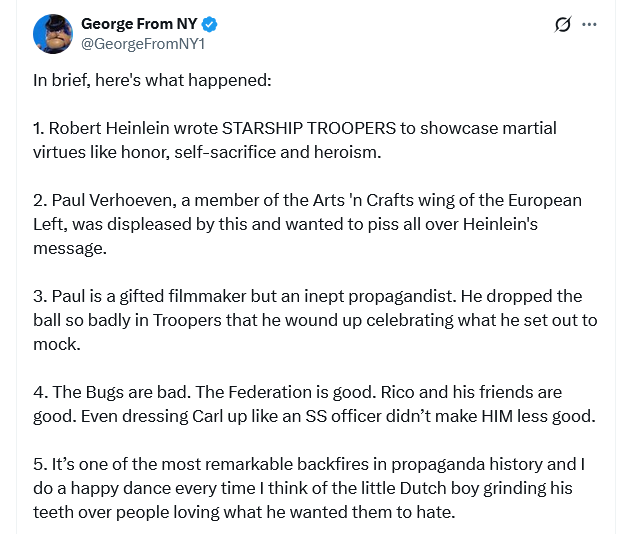
“It’s called Starship Troopers, not The Big War with the Bugs“
On the social media site formerly known as Twitter, Devon Eriksen explains why filmgoers still identify with the humans in Verhoeven’s unfaithful-to-the-story film of Robert A. Heinlein’s Starship Troopers:
Here’s a hint:
It’s called Starship Troopers. Not The Big War with the Bugs.
There’s a reason for that. Heinlein was one of the 20th century’s greatest authors, if not THE greatest, and he was also the 20th century’s greatest philosopher and it’s not even close.
So he didn’t name things by accident.
Starship Troopers isn’t about the war. It isn’t even about war. And it’s certainly not about the fucking bugs.
All that shit is just stage dressing for the story is really about. That’s why the book doesn’t end with defeating the enemy. It ends with Rico meeting his father again, facing future fights together.
Starship Troopers is about the military life, the relationship between armies and the civilizations they serve, and what it means to be a soldier and a man.
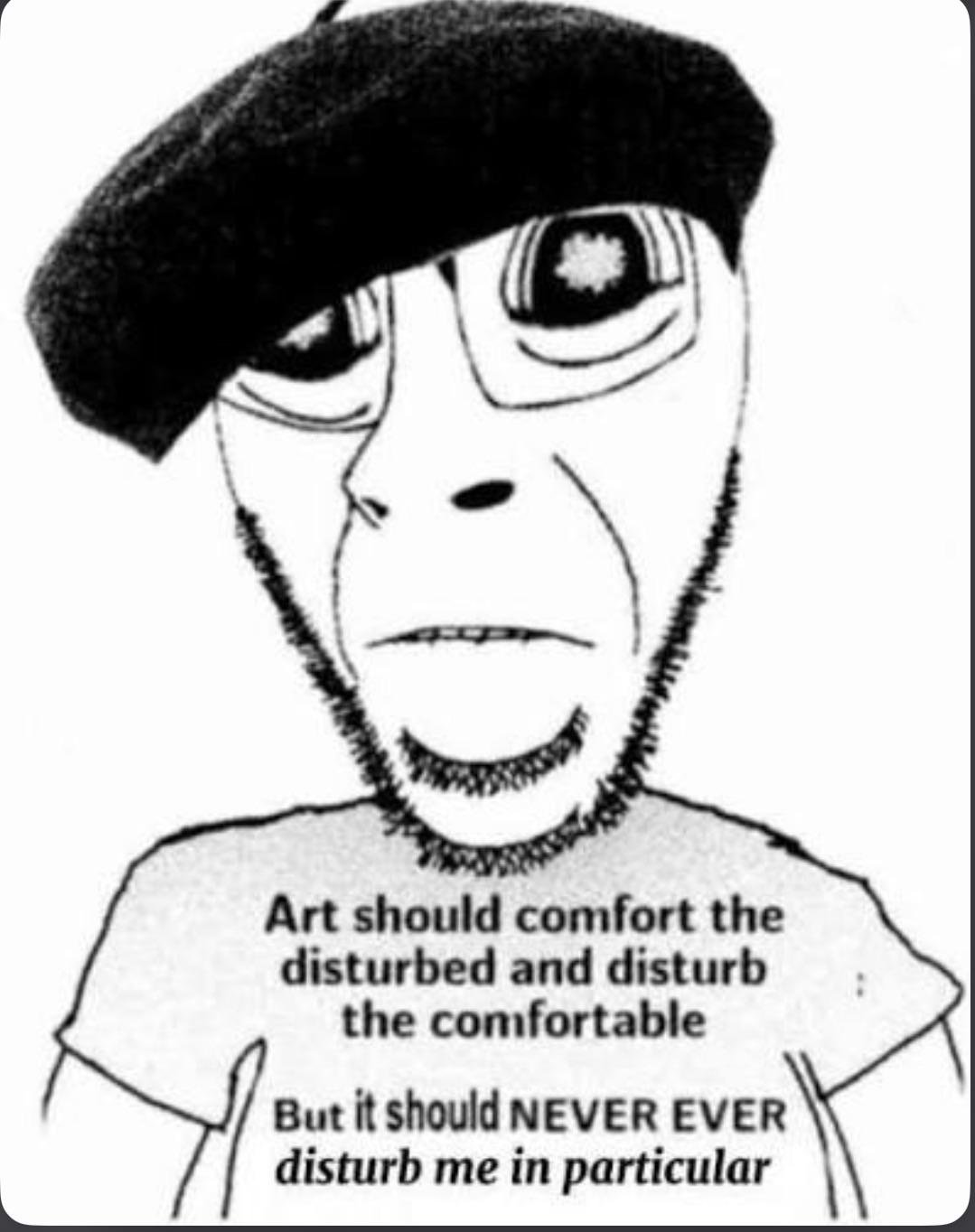
Eurotrash communists failed to get the point, not merely because they have the “media literacy” of a sack of wet hammers, but also because they don’t understand soldiering, civilization, or manhood.
So, yes, Verhoeven tried to make fun of Heinlein and failed miserably because Heinlein was a better storyteller, a better man, and a better human being by a margin so great that the Earth can barely encompass it.
But even though his failed satire makes humanity clearly the good guys, the war clearly righteous, and soldiers clearly cool and heroic, it still doesn’t recapture the actual meaning of Starship Troopers.
Because the real themes were so invisible, so incomprehensible, to Verhoeven that he couldn’t even see them to disagree with.
So enjoy the film for what it turned out to be … a fun, campy, morally unambiguous story of heroes squashing disgusting bugs. Suitable for popcorn consumption.
Then, read more Heinlein.
Update, 6 June: Welcome, Instapundit readers! Have a look around at some of my other posts you may find of interest. I send out a daily summary of posts here through my Substack – https://substack.com/@nicholasrusson that you can subscribe to if you’d like to be informed of new posts in the future.
Sci-Fi and the WWII Mythos Part II : The Political Element
Feral Historian
Published 16 Jan 2026Last time I was focused on cultural aspects, but what about the direct political manifestations today? Is there a resurgence of neo-nazi attitudes or is just an artifact of the ubiquity of digital media preserving everything? Why might those ideas resonate with the young, and how does it fit with my argument that the old myths are breaking down?
00:00 Intro
01:42 Right, Left, and Gen-Z
02:56 Patterns of Force
04:25 Rambling about Economics
05:48 Efficient? No.
06:39 Bifurcation
08:00 Loss of PerspectiveThis one is a direct result of a conversation on the Talking History program on KSMU (I’ll link the episode when goes up) and covers something that came up but wasn’t really addressed well.
(more…)
May 28, 2026
The Day The Earth Stood Still: a Post-WWII War of the Worlds
Feral Historian
Published Jan 9, 2026The Day The Earth Stood Still (1951) is in some ways the most successful translation of the alien invasion story from 19th Century colonial assumptions to those of the post-WWII world. They no longer come to take our land and plunder our resources, but to keep us from threatening their “Rules Based Order” and turn us into a low-fidelity copy of themselves.
00:00 Intro
02:46 Nukes and Norms
06:48 Ultimatum
09:00 Farewell to the Master
11:08 Hello Remake
(more…)
May 23, 2026
“The primary skill of an author is empathy“
On the social media site formerly known as Twitter, Devon Eriksen describes the real skill a fiction author needs to have to produce fully satisfying stories:
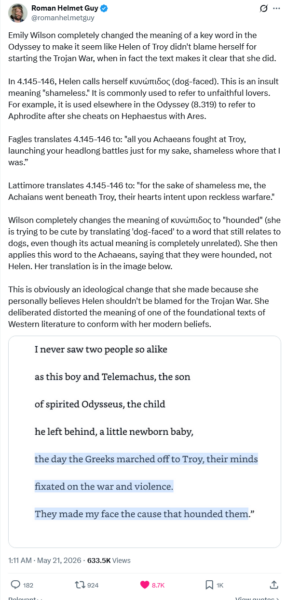
Woke message fiction may be slowly dying, but stories won’t magically get better when it’s dead.
Because there’s a deeper problem.
I found it in a book I’ll call MillenialQuest. That wasn’t its real name, of course. I’m not trying to dunk on some poor soul just for writing a bad book. If I did that, I’d never be stopping.
It was some medieval fantasy thing with a rather likely premise involving a fallen paladin and an army of steampunk centaurs.
But when I opened it up, I quickly realized that every single character, despite living in a world where “horse” was the peak of transportation technology, was a Joss Whedon character wearing a Tolkien skinsuit.
Complete with sarcasm, cutesy little quips, and no emotional self-control whatsoever. Didn’t matter if the character was a professional assassin or a cloistered scholar, he talked, acted, and thought as if he were auditioning for a episode of Buffy the Vampire Slayer.
My first impulse was to be annoyed with the author for disappointing me. But I quickly realized that the problem ran deeper, and the author, annoying as her habits were, was both symptom and victim of a deeper malaise.
The primary skill of an author is empathy.
Now, I don’t mean the “empathy” that socialist twats are constantly talking up, in lectures about how we must all immediately dismantle Western civilization to create infinity third world biomass.
I mean the actual skill of figuring out what other people are thinking and feeling.
To excel at his craft, an author must empathize in two directions at once. Not alternately, but simultaneously. He must empathize with the audience to understand how they will experience what he writes, and he must empathize with characters, to understand how they see the world, and what they would do and say.
Empathy must be learned. And it can be learned in two ways, either by having lots of conversations with people who are as different from you as possible, or by reading books with characters who are also totally unlike you.
Well, we’ve now raised several entire generations who cannot withstand the stress of a real conversation with someone from their own nation who happened to vote for the other idiot on a two-option menu.
And what have those people been watching, listening to, and reading?
Well, Whedonized stories wherein every character is a reskinned version of a white, middle class, left-leaning liberal arts student in a small East Coast private college.
The author of MillenialQuest didn’t set out to write The Message™. Nobody was a purple-haired mixed-race fat wheelchair lesbian, and there weren’t any thinly veiled rants about capitalism or diversity.
Sure, the word “misogynist” was used a bunch, without any apparent awareness of the confused look of incomprehension that your standard medieval knight would respond with.
But so was the word “allergies”. And “expense account”. And “psychology”. And “self-medication”.
No, the core pathology here wasn’t the irrepressible urge to preach the author’s values at all.
It was a complete lack of ability to put her head into someone else’s world view.
To the new breed of author, the 21st century liberal zeitgeist isn’t just the only moral viewpoint, it’s the only imaginable viewpoint.
This is why they think you are evil and crazy if you voted for the other guy. Because they literally have no idea what might have motivated you to do that.
The author of MillenialQuest couldn’t imagine a world where differing responsibilities for men and women are a necessity for survival, rather than a cause for complaint.
She couldn’t imagine how the concept of an expense account would be expressed in a world where peak financial technology is pounding your shiny metal into discs with faces on them.
Emily Wilson can’t understand a woman who would be ashamed of cheating on her husband, or men who would start a war over an insult.
Yes, often it’s deliberate. Often it’s preaching, or venting their own desire to debate with someone whose response they cannot hear.
But the point is, even if and when they are forced, by threat of major film studio bankruptcy, to stop deliberately trying to preach and propagandize, they won’t magically gain the ability to write characters different from themselves.
Empathy is a skill. It has to be learned and then practiced. And most people in the writing game today simply haven’t had the opportunity.
We may be exiting the age of DEI slop, but we are entering the age of just plain slop.
May 8, 2026
The Strugatskys’ The Doomed City and the Soviet Experiment
Feral Historian
Published 12 Dec 2025While The Doomed City isn’t the last book Boris and Arkady Strugatsky wrote, it is arguably the end of their journey from idealism to cynicism with regards to the whole Soviet project and serves as an almost spiritual history of the period. Let’s meander through it to look at some things not covered in a literary review.
00:00 Intro
03:12 New Jobs
04:45 Aside – Facts and Theory
05:42 Laws and Mentors
09:36 The Experiment
10:50 Regime Change
13:25 Aside – Maps
15:45 Status and Power
18:22 The Ground Beneath Our Feet
(more…)
May 1, 2026
“Second Dawn”, Childhood’s End, and the Nuclear Age
Feral Historian
Published 5 Dec 2025A quick look at two Arthur C. Clarke stories from the early 1950s that pair well as allegories for the still-new Cold War fears of the time.
00:00 Intro
03:03 Psychics and Nukes
03:37 “Second Dawn”
09:13 The Phileni
11:50 New World, New DangersAudio note: On the previous vid (Riddick) I used some new tools for post-processing the audio. It was much cleaner, removed almost all the noise … and the response has been entirely negative. It seems people don’t miss the wind and the birds until they’re gone. So I’m back to the old approach of using essentially raw sound.
EDIT: If you’re not seeing a link to the old Childhood’s End video on the pop-up card or the end screen, here’s the link. • Childhood’s End (Youtube Copyright Edit)
🔹 Patreon | patreon.com/FeralHistorian
🔹 Ko-Fi | ko-fi.com/feralhistorian
🔹 and Merch! | feral-shop.fourthwall.com
Still plugging Ninti’s Gate
🔹 amazon.com/dp/B0CYXH9BWD
April 24, 2026
Defending Heinlein and his most controversial novel – Farnham’s Freehold
Grammaticus Books
Published 21 Nov 2025An indepth review of Robert A. Heinlein’s most controversial novel. A novel sometimes referred to as Science Fiction’s most controversial novel, Farnham’s Freehold.
00:00 Intro
02:30 Why I Read Farnham’s Freehold
04:33 The Plot (Spoilers)
12:48 The Critics’ Complaints
21:40 Is it A Fun Read?My Video on Time Enough for Love:
• Heinlein’s MOST CONTROVERSIAL Novel – Time…
Update, 25 April: Welcome, Instapundit readers! Have a look around at some of my other posts you may find of interest. I send out a daily summary of posts here through my Substack – https://substack.com/@nicholasrusson that you can subscribe to if you’d like to be informed of new posts in the future.
April 17, 2026
The Chronicles of Riddick: a Treatise on Political Machinery
Feral Historian
Published 28 Nov 2025The Chronicles of Riddick probably isn’t on anyone’s “top 10 science fiction” list, but it’s a remarkably astute study of how ideologies lead to systems, and how those systems co-opt people within them.
And of course it has a great cast that seems to have had fun with their roles.
00:00 Intro
01:04 Perception of Enemies
03:12 The Underverse
04:59 Plotting and Scheming
07:47 Superposition
08:20 Institutional Inertia
(more…)
March 26, 2026
Plur1bus: First Impressions
Feral Historian
Published 21 Nov 2025EDIT: The sound is bad. I should have known better than to edit it on a laptop in-transit, but here we are.
After a few recommendations I started watching Plur1bus, and a few things strike me two episodes in. Let’s see how off-base I end up looking when the season is done.
Also I bounce off a few points raised by Damien Walter in his recent video on the show, which you can find here: • So. What’s PLUR1BUS all about then?
00:00 Intro
00:45 Mind Virus
02:28 Mrs. Davis and the End of the World
04:18 Mandatory Happiness and Self-Delusion
07:08 Commodification
09:02 Stopping the Machine
(more…)
March 20, 2026
QotD: The lameness and sameness of modern science fiction novels
I’ll confess, though: I almost didn’t read this book. Actually, for several years I didn’t. I was vaguely aware of its existence, but I’d pretty much stopped reading new speculative fiction because I finally admitted to myself that it was pure masochism that kept me beating my head against the wall of newly-published extruded genre product when I had sixty-plus years of Hugo and Nebula nominees to choose from. Sure, every novel will reflect something of its age’s concerns (there’s a lot of nuclear war in those old Hugo winners!), but it’s gotten much worse in the last ten or fifteen years: every book that gets any buzz is so deeply inflected with questions of personal liberation from oppressive structures, so little nuanced and so obsessed with identity and representation, that I find it borderline unreadable. A few books like that, done well — fine, that’s part of life, that’s certainly a kind of story you can tell. But when it’s everything, when it becomes a precondition for publication, you’re left with a tragically denuded sample of the human experience. It’s not that I don’t want to read a book where I disagree with the underlying politics, it’s that an unsubtle obsession with the “correct” politics makes a book boring and cringe. One-dimensionally “right-wing” fiction written in reaction to the contemporary mainstream is just as bad — worse, perhaps, because if done well it’s the sort of thing I would really enjoy.1
Jane Psmith, “REVIEW: The Powers of the Earth, by Travis J.I. Corcoran”, Mr. and Mrs. Psmith’s Bookshelf, 2024-04-29.
- There’s nothing worse than poor execution of an incredible idea, because it means no one else will come along and do the incredible idea right. Austin Grossman’s Crooked, for instance, is Richard Nixon vs. Cosmic Horrors, which is a brilliant premise (yes, the Interstate Highway System is definitely an eldritch sigil designed to protect America, I will not accept any argument) but falls apart on the totally ahistorical version of our 37th President designed to justify making him the “good guy”. The real Nixon is such a fascinating and compelling figure — why not keep him as weird and twitchy and striving as he actually was and have him be the good guy anyway?
Or, say, the Napoleon movie.
March 19, 2026
District 9 and the Story of “Race”
Feral Historian
Published 14 Nov 2025Modern society has become a bit obsessed with the idea of race. District 9 subverts some of these assumptions and points at some of the ways that the entire concept of race is a product of the modern era. This one meanders a bit, but I suppose there’s no way around that.
00:00 Intro
02:45 Meet Wikus
05:42 Subverting Race
08:35 Bacon’s Rebellion and Trans-Racial Wikus
12:32 Let’s Talk About Rhodesia
14:48 Perspectives and Narratives
(more…)
March 8, 2026
Star Trek – Section 31
Feral Historian
Published 7 Nov 2025Star Trek: Deep Space Nine introduced a dark undertone to the optimistic vision of the Federation with Section 31, a secretive organization doing dirty deeds behind the scenes. For some its a much-needed dose of Realpolitik to Trek, for others its a cynical ploy that has no place in Roddenberry’s vision. Either way, Section 31 is one of the most interesting pieces of Star Trek lore.
00:00 Intro
02:20 Backstories
04:09 DS9
06:30 Existential Threats
08:08 In The Pale Moonlight
10:43 Limits of Idealism
12:54 Enterprise


