Quotulatiousness

January 10, 2014

Weekend weather forecast

Filed under: Cancon, Environment, Humour — Tags: , — Nicholas @ 09:27

Scott Feschuk on the weather situation we should expect to encounter this weekend:

On Saturday, the snow and record cold will continue as a trilogy of all-seeing, all-knowing fronts moves in from Mordor and tracks across the region, covering all the lands in darkness, conferring the power of speech on trees and generally lasting about twice as long as it needs to. Although daytime temperatures are expected to hover around -37°, it is forecast that your teenager will nevertheless insist on going out in sneakers and a windbreaker. As if the cold were not depressing enough, Environment Canada also forecasts the imminent end of the limited-time return of the McRib.

Looking ahead to Sunday, the long-term forecast calls for the moon to become as blood, and the sun as black as sackcloth of hair, and lo shall the earth quake and skies part and every mountain and island move out of their places. In addition, Environment Canada forecasts an 80 per cent chance of every star of heaven falling unto the Earth, for the time of Mother Nature’s wrath will be upon us, and who shall be able to stand? Especially with all this freezing rain.

December 20, 2013

QotD: (Almost) Winter in Maine

Filed under: Humour, Quotations, USA — Tags: , , — Nicholas @ 09:44

I love the weather channels. Hair farmers and dime-store Kardashians waving their arms over an imaginary map, talking about WINTER STORM FABIAN or WINTER SEMI-BLIZZARD OSAMA or WINTER ARCTIC DEATHSTORM INGA. The least you could do is explain what the hell I’m suppose to expect on Monday on that forecast there. Is the weather going to be serrated on Monday? Will I be expected to swim laps in some sort of frozen pool? Is frozen angel hair pasta going to be made available to me? What are those squiggly weather lines? Should I make out a will, and make out with my wife one last time on Sunday night?

I got up this morning and it was fifteen below zero, car wouldn’t start, because the car is smarter than a person, and we were still shoveling a foot of “partly cloudy” from the day before. I didn’t really mind, exactly, because I didn’t move to Uppastump Maine expecting palm trees and grass skirts on the babes, but there is one aspect about it that rankled. Listen to me, you weather idiots. It’s not the winter. It won’t be winter for four days or so. The average nighttime temperature here in December is fourteen degrees Fahrenheit. That makes last night thirty bleeping degrees below normal. Thirty degrees is a lot, don’t you think?

Sippican Cottage, “I Was Considering Putting On A Sweater”, Sippican Cottage, 2013-12-17

November 16, 2013

Whatever happened to Chinese “soft power”?

Filed under: China, Pacific, Politics — Tags: , , — Nicholas @ 10:51

James R. Holmes says the Chinese have unequivocally abandoned soft power:

China never ceases to amaze. Not only has the leadership done away with a promising soft-power campaign that was years in the making. It razed its own soft-power edifice to the ground, and salted the ruins so nothing can take root again. Why remains a mystery.

The latest trouble sign came after Typhoon Haiyan slammed into the Philippine Islands over the weekend, claiming at least more than 1,800 lives so far. Professor Mead posted an item marveling at the paltry sum Beijing committed to Philippine disaster relief. Upon reading it, I was sure Mead had omitted two or three zeroes. But sure enough, cross-checking his commentary against a Reuters report shows he had the figure right: US$100,000 in direct aid, and another US$100,000 through the Red Cross. Such token amounts give tokenism a bad name.

Forget smile diplomacy. This is sneer diplomacy. Many observers, myself included, ascribed Chinese inaction following the 2004 Indian Ocean tsunami to immature capability. The PLA hadn’t yet fielded the expeditionary capabilities necessary to render assistance far from Chinese shores. Beijing did little because it could do little. Chinese forces, however, now own disaster-relief assets such as the hospital ship Peace Ark. Yet they remain idle. It’s hard to escape the conclusion that Beijing is withholding help out of pique. Manila, after all, has the temerity to insist that its exclusive economic zone is, well, its exclusive economic zone. Seems political tit-for-tat trumps alleviating human suffering.

[…]

There’s an upside to this from an American standpoint: China has made itself look small and petty, like a skinflint rather than a magnanimous power worthy of regional leadership. This is self-defeating conduct of a high order. Far be it from me to interfere with a strategic competitor intent on shooting himself in the foot. Fire!

August 28, 2013

Hurricane and cyclone paths since 1842

Filed under: Americas, Environment, Pacific, Science — Tags: , , — Nicholas @ 08:59

Wired‘s MapLab has a lovely visualization of both hurricane and cyclone tracks starting with the earliest records in 1842:

Historical Hurricane and Cyclone paths since 1842

This map shows the paths of every hurricane and cyclone detected since 1842. Nearly 12,000 tropical cyclones have been tracked and recorded, and the National Oceanic and Atmospheric Administration keeps them all in a single database. Long-term datasets can be really interesting and scientifically valuable, and this one is undoubtedly both.

In the image above, you can clearly see that more storm tracks have overlapped in the western Pacific ocean and northern Indian ocean. This is largely because of the length of the typhoon season, which basically never stops in the warmer waters there.

The tracks of the earliest storms are based on mariner’s logs and storm records, collected from various countries, agencies and other sources. Reconciling data from these different entities was tough. Most international agencies had their own set of codes for cyclone intensity, and only recorded this information once per day. India was even using different wind thresholds to designate cyclone stages.

June 27, 2013

Calgary’s mayor Naheed Nenshi gets praise from unexpected source

Filed under: Cancon, Government, Media — Tags: , , , , , — Nicholas @ 09:23

The Calgary Sun gets all gushy and enthusiastic over the mayor they usually like to beat up:

No one goes after the mayor of this city harder than we do.

We don’t apologize for that. It’s our job and we like to think we do it louder than most.

But it’s never personal.

So, with that as background, we would like to take this space today to commend Mayor Naheed Nenshi for his amazing leadership under the most trying of circumstances.

He has been a beacon of strength, support and optimism as Calgary battles the affects of the single-biggest disaster to hit our city.

The mayor, as always, has been a great communicator.

Through social media, traditional media and constant briefings, Nenshi has made it his personal undertaking to deliver the most up-to-date information to all Calgarians through all mediums.

June 22, 2013

Three deaths reported in Calgary flooding

Filed under: Cancon, Environment — Tags: , , , — Nicholas @ 10:13

680News rounds up the reports from Calgary, where the Bow River flooded significant portions of the city yesterday:

Officials are now blaming the devastating flooding in southern Alberta for at least three deaths in the province.

An estimated 100,000 people have been evacuated from their homes, with little information available on when they’ll be able to return.

“I’m not in a position right now to be able to give you timings on neighbourhoods that are along the Bow River and when people may be able to return to those homes, but we are slowly getting there,” said Calgary Mayor Naheed Nenshi.

Many also have no idea whether they’ll have a livable home to return to once the floodwaters finally recede.

Experts say that in some areas, that could still be days.

‘Stunning’ is how Prime Minister Stephen Harper described the flooding in southern Alberta, after he boarded a military helicopter in Calgary to get an aerial view.

Calgary has been one of the hardest hit areas in the western province, and the city was something of a ghost-town Saturday.

There was some positive news for those who have been evacuated, with people in at least one Calgary neighbourhood being allowed to return home Saturday.

During the intial reporting, several Edmontonians were poking fun at Calgary’s plight, but the tone changed quickly once the seriousness of the situation became clear:

The traditional Edmonton-Calgary rivalry went by the wayside, with the provincial capital city promising to send 100 of its police officers to help out where needed.

A total of 1,200 Canadian troops and eight military helicopters have been sent to the city to help local emergency crews with evacuations and sandbagging.

Emergency crews from Ontario, meanwhile, were planning to head out as soon as possible.

“The Ontario Red Cross is at this time mobilizing supplies to help shelter thousands of people in Calgary,” the agency’s Mike Morton said.

The power is off in much of the downtown core in Calgary still, with some of the outages done as a precaution, while others as a direct result of the flooding.

Officials say it could be the middle of next week before all of the lights are back on.

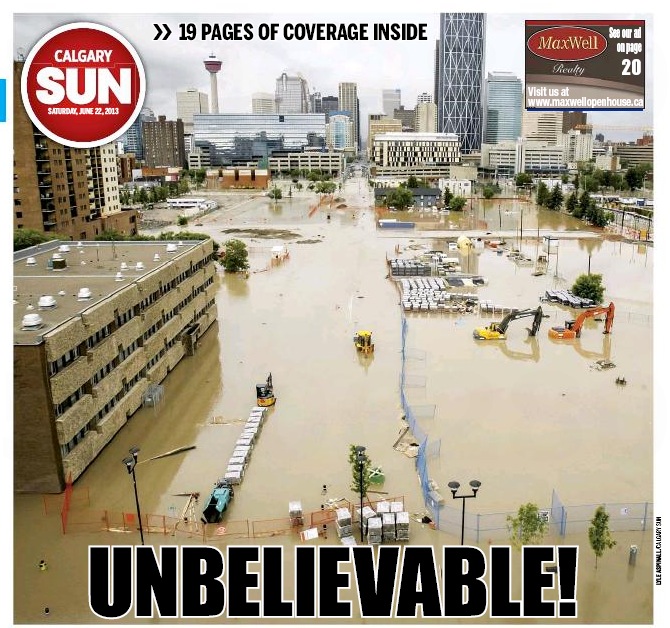
The Calgary Sun‘s front page:

Calgary Sun front page flooding

June 21, 2013

Calgary flooding

Filed under: Cancon, Environment — Tags: , , , — Nicholas @ 10:23

January 24, 2013

Is the media’s love affair with “extreme weather” just an elaborate insurance scam?

Terence Corcoran in the Financial Post:

All it takes these days is a little normal January Canadian cold spell and all of a sudden the nation is plunged into a frenzy of chatter about “extreme weather.” The CBC led the way, aided and abetted by climate alarmists in the Canadian insurance industry, with help from an apparently leaked data point from an Environment Canada report that supposedly will show that Canadian winters are now 3.2C warmer than they used to be. Get it? It’s really cold, but that’s because of climate change, which is making Canada’s winters warmer.

If you find this confusing, well, get used to it. That may even be part of the objective, which, judging by the sudden extreme flood of media reports, seems to be keep Canada’s population agitated about global warming, a cause that has so far failed to ignite voters.

If the theory of climate change doesn’t grab people, maybe “extreme weather” will. The media certainly love it. All News Radio in Toronto now has an “Extreme Weather Centre” that rouses itself every time weather happens — snow storms, cold spells, heat waves, rain, temperature anomalies. Alarmist weather forecasting and reporting is a media staple, but the concept now appears to have reached a new level of hypedom.

[. . .]

The insurance angle was cleverly juxtaposed with a leaked bit of data from an Environment Canada report that will not be released until May. It supposedly will show that Canadian winter temperatures have risen 3.2C since Canada began keeping systematic records in 1948. As a standalone bit of data, not much can be made of it. Even less can be made of it for popular consumption if current temperatures are approaching record cold. How can we have record warm and record cold at the same time?

That’s where “extreme weather” comes in. It’s also where the Canadian insurance industry, through a front group called the Institute for Catastrophic Loss Reduction, is actively promoting extreme weather as a major vehicle for business and policy development. With offices in Toronto and the University of Western Ontario, the institute’s membership is almost exclusively insurance companies, its eight-member board is stacked with five insurance executives, and the executive director is Paul Kovacs, is former head of the Insurance Bureau of Canada.

January 16, 2013

When Kafka met Sandy

Filed under: Bureaucracy, Government, USA — Tags: , , , , , — Nicholas @ 09:53

In the Wall Street Journal, Roger Kimball talks about the experience of trying to put your life back together after a major storm damages your home:

Like many people whose houses were badly damaged by Hurricane Sandy, my family and I have been living in a rented house since the storm. Unlike some whose houses were totalled, we could have repaired things and been home toasting our tootsies by our own fireplace by now. What happened?

Two things: zoning (as in “Twilight Zone”) and FEMA.

Our first exposure to the town zoning authorities came a couple of weeks after Sandy. We’d met with insurance adjusters, contractors and “remediation experts.” We’d had about a foot of Long Island Sound sloshing around the ground floor of our house in Connecticut, and everyone had the same advice: Rip up the floors and subfloors, and tear out anything — wiring, plumbing, insulation, drywall, kitchen cabinets, bookcases — touched by salt water. All of it had to go, and pronto, too, lest mold set in.

Yet it wasn’t until the workmen we hired had ripped apart most of the first floor that the phrase “building permit” first wafted past us. Turns out we needed one. “What, to repair our own house we need a building permit?”

Of course.

Before you could get a building permit, however, you had to be approved by the Zoning Authority. And Zoning — citing FEMA regulations — would force you to bring the house “up to code,” which in many cases meant elevating the house by several feet. Now, elevating your house is very expensive and time consuming — not because of the actual raising, which takes just a day or two, but because of the required permits.

Kafka would have liked the zoning folks. There also is a limit on how high in the sky your house can be. That calculation seems to be a state secret, but it can easily happen that raising your house violates the height requirement. Which means that you can’t raise the house that you must raise if you want to repair it. Got that?

“A paradox, a paradox, a most ingenious paradox. Ha, ha, ha, ha, ha, ha, ha, ha, this paradox.”

H/T to Monty for the link. Monty also has this meditation on bureaucracy:

This is where Leviathan does the most damage, I think. Tyranny is always a danger in centralized governments, but a greater danger is the proliferation and growth of bureaucracies. The rules become ever more Byzantine, ever more contradictory, ever more pointless, and ever more expensive (both to implement and comply with). The bureaucracies themselves achieve a life outside the body politic: they persist, age after age, irrespective of their political origin. Their sole imperative (regardless of their ostensible purpose) is to perpetuate themselves. They are an amoeba, growing to engulf everything they touch — not because they are evil, necessarily, but simply because it’s in their nature to do so. They cannot help themselves. Bureaucracies — lethargic, slow, risk-averse, rules-bound, pedantic, expensive, often causing more harm than good — are perhaps the very worst creation of human society.

January 9, 2013

Australian heatwave attributed to Gaia’s anger at mankind’s sins

Filed under: Australia, Environment, Media — Tags: , , , — Nicholas @ 10:14

Brendan O’Neill surveys the gleeful coverage of Australia’s current weather as a divine retribution by “Mother Nature” for the evils mankind has wrought:

There is something very ugly about the commentary on Australia’s heatwave. There’s almost a palpable sense of glee among some green-leaning commentators that this coal-exporting, climate-change-denying nation is now being punished with fire. The message seems to be that Aussies deserve this scorching weather; they brought the hotness upon themselves through their temerity, through daring to exploit their country’s myriad natural resources and, even worse, daring to question the gospel of climate change.

The casualness with which observers have made a link between Australian people’s behaviour and beliefs and the current heatwave, as if alleged moral turpitude makes the weather, is striking. Even before any serious scientist has had time to assess the nature and origins of the heatwave, one of the Guardian‘s green reporters described the hotness Down Under as further evidence that “global warming is turning the volume of extreme weather up, Spinal Tap-style, to 11″. Taking his cue from the Middle Ages, when weather was also frequently given sentience, treated as the punisher of wicked men, the reporter says climate change, and its enabler climate change denial, is “loading the weather dice”. It is no coincidence, he says, that “the two nations in which the fringe opinions of so-called climate sceptics have been trumpeted most loudly — the US and Australia — have now been hit by record heatwaves and [superstorms]” — because apparently it is “shouting from sceptics” that prevents “clear political action to curb emissions” and which therefore unleashes yet more floods, storms, and presumably locusts at some point in the future.

December 12, 2012

Climatic witchcraft

No offense intended to practitioners of witchcraft intended:

Superstition about the weather in particular is hardly surprising, given the awesome power of nature. Witnessing storms, lightning and even the daily rising and setting of the sun surely induced fear and wonder in primitive cultures. The same fear and wonder are what warmists exploit today in linking weather extremes to global warming.

Scholars tell us that weather superstition often found expression in ritual human sacrifice. The Mayans, for instance, tossed victims into a limestone sinkhole to appease the rain god Chaac.

And it’s only a few centuries since superstition over the climate led to intensive witch hunts and widespread executions, usually by burning, for witchcraft.

University of Chicago economist Emily Oster demonstrated in 2004 that the most active era of witchcraft trials in Europe coincided with the Little Ice Age. Since then, other researchers have argued that chilly weather may have precipitated the Salem witch trials in the 1690s — one of the coldest periods of that epoch.

It was widely believed during the late Middle Ages that witches were capable of controlling the weather with their magic powers, and thus cause storms that could destroy harvests and hobble food production.

[. . .]

Our obsession with weather extremes has reached such heights that it has become a knee-jerk reaction for climate-change alarmists to ascribe any unusual weather event at all to global warming. So they tell us that heat waves, floods, harsh winters, dust storms — even wildfires — are all the result of man-made CO2. But a check of records from, say, the 1930s or the 1950s, when the CO2 level was much lower than now, reveals that such events are nothing new.

Climate-change skeptics might be regarded as modern-day witches because they think that global warming comes from natural forces. However, it’s superstitious alarmists, who believe that extreme weather originates in our CO2 emissions and who have a dread of impending disaster, who are really the witches.

November 22, 2012

Even in a disaster area, the bureaucrats stick to their role

Filed under: Bureaucracy, Food, Health, USA — Tags: , , , , — Nicholas @ 11:49

I had to double-check the URL here to make sure this wasn’t a parody news item from The Onion:

Bobby Eustace, an 11-year veteran with the city’s fire department tells FoxNews.com that on Sunday he and his fellow firefighters from Ladder 27 in the Bronx were issued a notice of violation for not maintaining restaurant standards in a tent set up in Breezy Point, Queens, to feed victims and first responders.

“It’s just a little ridiculous. The inspector came up and asked if we were wearing hairnets. I told him, ‘We have helmets. This is a disaster area,’” Eustace told FoxNews.com. “Then he asked if we had gloves and thermometers [for food]. I said, “Yeah, we have rectal and oral. Which one do you want?’ He wasn’t amused.”

Eustace says that the Health Department worker then checked off a list of violations at the relief tent, including not having an HVAC system and fire extinguisher.

“He told us that he might come back to see if we fixed the violations. But what can we do? We are just going to keep going until a professional catering company can help take over,” Eustace said, adding that firefighters across the city together have been contributing about $800 a day out of their own pockets to feeding victims in areas hit hard by Sandy.

November 19, 2012

Hurricane Sandy, storm surges, and superstition

In sp!ked, Dominic Standish looks at how some recent extreme weather incidents are being attributed to climate change/global warming without sufficient scientific evidence:

Hurricane Sandy brought havoc in the Caribbean, especially Haiti, and caused approximately 60 deaths. Then the storm hit the US east coast; New York experienced exceptional floods and at least 40 people lost their lives. Next, Venice in Italy witnessed high flooding on 11 November, when the city’s tide measurements reached their sixth-highest level for 140 years. No one died from these floods in Venice, but — like Haiti and New York — the economic impact was significant.

Global warming was widely blamed for the flooding, yet in all three cases flooding was principally caused by storm surges. In the Caribbean and America, there was an unfortunate convergence of weather systems creating storm surges. As Hurricane Sandy swirled north in the Atlantic and towards land, a wintry storm headed towards it from the West and cold air was blowing south from the Arctic. After the hurricane devastated parts of the Caribbean, it moved towards the north-east of the US, pushing water up the estuaries of New York into the city. Venice’s floods were unconnected to Hurricane Sandy, but were also caused by high winds creating storm surges pushing water through the three inlets between the sea and the Venetian lagoon towards the city. Subsidence over the past century has made Venice more susceptible to storm surges. Nevertheless, after 70 per cent of Venice was under water on 11 November, Italy’s environment minister, Corrado Clini, insisted that global climate change was to blame.

Although storm surges were the cause of the floods in all three locations, global warming was widely identified as the culprit. Of course, we cannot ignore climate change. The Intergovernmental Panel on Climate Change (IPCC) established in 2007 that there was a global temperature rise of 0.74 degrees Celsius between 1906 and 2005, which added to global sea levels rising by an average rate of 1.8 millimetres per year from 1961. We need to have an open debate about climate change and its relationship with bad weather events. Some argue that climate change has increased hurricanes and storm surges, while others suggest there is insufficient evidence to prove this link. Whether climate change impacts on the frequency and strength of hurricanes remains uncertain, yet global warming has definitely been deployed as a superstitious narrative to close down discussion.

Update: Of course, the storm damage will eventually repaired and the federal government will pay the lion’s share of the costs. This is one of the bigger causes of rising costs due to storm damage along the US coastline: properties that are more exposed to damage keep getting rebuilt. Here’s an example from Dauphin Island, Alabama:

The western end of this Gulf Coast island has proved to be one of the most hazardous places in the country for waterfront property. Since 1979, nearly a dozen hurricanes and large storms have rolled in and knocked down houses, chewed up sewers and water pipes and hurled sand onto the roads.

Yet time and again, checks from Washington have allowed the town to put itself back together.

Across the nation, tens of billions of tax dollars have been spent on subsidizing coastal reconstruction in the aftermath of storms, usually with little consideration of whether it actually makes sense to keep rebuilding in disaster-prone areas. If history is any guide, a large fraction of the federal money allotted to New York, New Jersey and other states recovering from Hurricane Sandy — an amount that could exceed $30 billion — will be used the same way.

Tax money will go toward putting things back as they were, essentially duplicating the vulnerability that existed before the hurricane.

November 9, 2012

FEMA’s embarrassing record

Filed under: Bureaucracy, Media, USA — Tags: , , — Nicholas @ 12:38

Shikha Dalmia on the odd phenomenon that FEMA is just flat-out terrible at doing the job it’s supposed to do — co-ordinating emergency relief efforts — but is still beloved by big-government fans:

Hurricane Sandy hadn’t even touched down when liberals started blowing kisses to FEMA, or Federal Emergency Management Agency, the federal disaster relief agency. A New York Times editorial declared that the impending storm proved that the country needs FEMA-style “Big Government” solutions more than ever. Salon, New Republic and other liberal outfits heartily agreed.

Why do liberals love FEMA so much? Certainly not for its glorious track record. Rather, FEMA has been a great vehicle for expanding the welfare state.

FEMA’s tragic missteps after Katrina earned it well-deserved disgrace. The Times blames those on the Bush administration, whose anti-government philosophy supposedly gutted FEMA. President Obama, the argument goes, straightened things out, and Americans should now “feel lucky” that the agency is there for them. Without it, local and state authorities wouldn’t be able to coordinate where “rescuers should go, where drinking water should be shipped, and how to assist hospitals that have to evacuate.”

So how did the new and improved FEMA perform post-Sandy, a storm for which it had lots of advance warning? Not so well.

It didn’t set up its first relief center until four days after Sandy hit — only to run out of drinking water on the same day. It couldn’t put sufficient boots on the ground to protect Queens residents from roving looters. The Red Cross — on whom FEMA depends for delivering basic goods — left Staten Island stranded for nearly a week, prompting borough President Jim Molinaro to fume that America was not a Third World country. But FEMA’s most egregious gaffe was that it arranged for 24 million gallons of free gas for Sandy’s victims, but most of them couldn’t lay their hands on it.

November 2, 2012

Modern inventory control and Hurricane Sandy

Filed under: Business, Economics, Food, USA — Tags: , , — Nicholas @ 08:53

Unlike major disasters of the past, storm-hit New Jersey and New York City won’t have to face the crippling shortages of food and other essentials in the wake of Hurricane Sandy. The just-in-time food supply chain is proving its versatility yet again:

The day Hurricane Sandy made landfall, the Jersey City, New Jersey, warehouse for food distribution giant Sysco Corp. (SYY) sent out 30,000 cases of food and drinks. Most of the shipments were headed across the Hudson to New York City. On Tuesday, the day after the storm ravaged the city, the warehouse sent out none.

Yet while news of flooding, power outages, downed trees, and other storm-inflicted wreckage abounds, you won’t hear stories of mass starvation in the streets. Food may not be moving in or out of the city, but the data-driven supply chains perfected by some of the world’s biggest companies in the pursuit of profits have become so resilient that even a cataclysm like Sandy registers as little more than a logistical hiccup. While the subways have stopped indefinitely, few in the storm’s path will have to deal with empty shelves for long, if at all.

[. . .]

Wilson says the key adjustment Sysco made ahead of Sandy was to shift shipments to mainly non-perishable goods to ensure customers would have food to last through power outages. The company also prioritized getting orders to institutions that would have to keep large numbers of people fed through the storm, such as hospitals, hotels, airports, shelters, jails, and college campuses. Restaurants will stay near the bottom of the list as the recovery proceeds. But Wilson says the process of getting back to normal won’t drag out. “It’ll be a week or so of business-not-as-usual. But we’ll get back to business-as-usual eventually.”

Large companies like Sysco with nationwide reach and a long history of managing supply chains can adapt quickly to natural disasters because they’ve been there before, and they have the data to show for it. Over the years, as real-time inventory tracking and analysis has become the norm, companies know what people buy before and after disasters. They know how demand has varied between a Gulf Coast hurricane and a New England blizzard. By cross-referencing that granular data with the latest weather predictions, companies can forecast changes in their supply chain needs in parallel with coming storms.

H/T to Charles Stross for the link.

« Newer PostsOlder Posts »

Powered by WordPress