
seangabb
Published 5 Feb 2021[Update 2023-03-02 – Dr. Gabb took down the original posts and re-uploaded them.]
Here is the third lecture, which describes the decay of the Roman Constitution as a result of changes in patterns of land tenure in Italy after the Second Punic War, and as a result of the flood of foreign money into Rome from military victories and war indemnities and bribes.
(more…)
February 28, 2022
Roman Republic to Empire 03 Inequality and Corruption
Comments Off on Roman Republic to Empire 03 Inequality and Corruption
February 24, 2022
I guess the “emergency” is technically over, question mark?
My original headline for this piece was
I can’t believe I’m writing this, but we need to depend on Canada’s Senate to turn down Trudeau’s Emergencies Act
Fortunately, perhaps because Mr. Trudeau realized he might lose the vote in the Senate, he announced earlier today that the government will relinquish the powers granted under the Emergencies Act. The province of Ontario is also rescinding the state of emergency. This makes much of what follows less immediately relevant, but I’m too lazy to delete it I feel it still has some informational value to offer:
I’ve never had much faith in our Senate — and given that most Prime Ministerial appointments to the upper house are given as rewards to former political backroom organizers, bagmen, and the occasional prominent citizen, the role of the Senate in daily life is virtually nil. Now, thanks to a provision of the Emergencies Act, our last chance of prying the undemocratic emergency powers Trudeau has claimed is to have the Senate vote against the use of the act. This is not how the upper house normally operates.
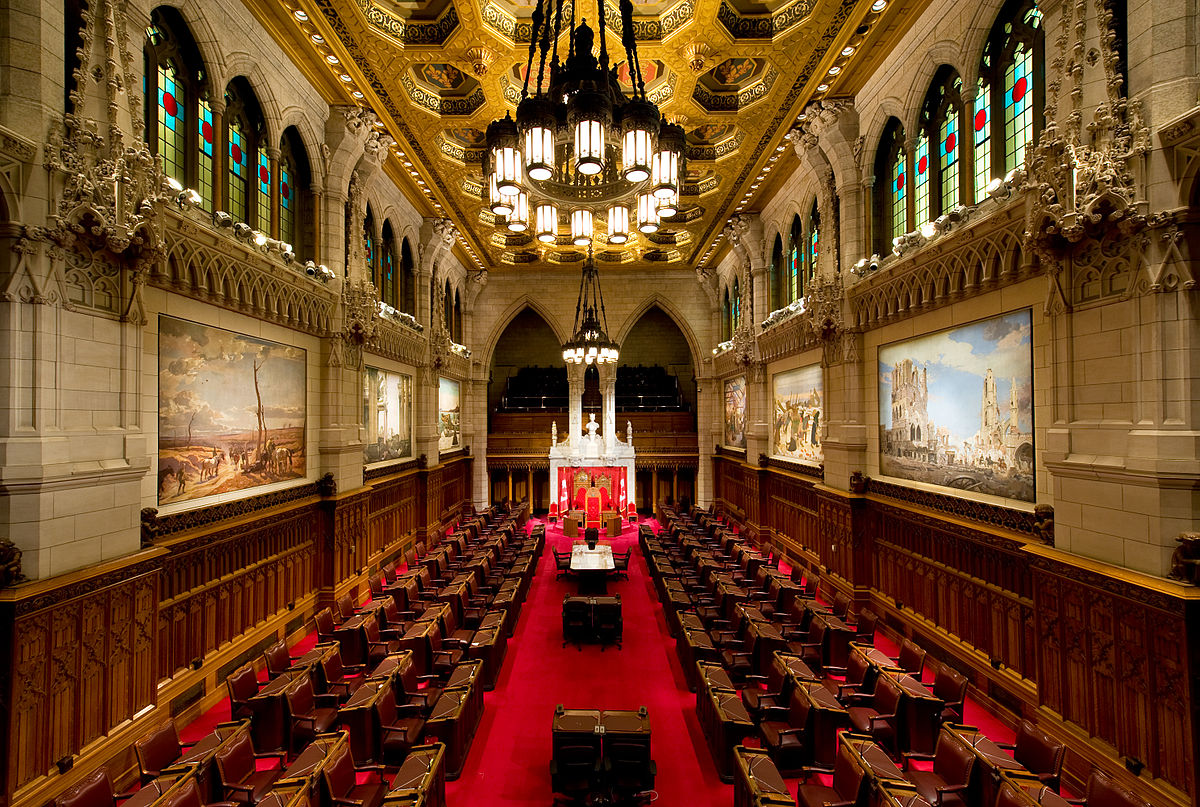
“In the east wing of the Centre Block is the Senate chamber, in which are the thrones for the Canadian monarch and her consort, or for the federal viceroy and his or her consort, and from which either the sovereign or the governor general gives the Speech from the Throne and grants Royal Assent to bills passed by parliament. The senators themselves sit in the chamber, arranged so that those belonging to the governing party are to the right of the Speaker of the Senate and the opposition to the speaker’s left. The overall colour in the Senate chamber is red, seen in the upholstery, carpeting, and draperies, and reflecting the colour scheme of the House of Lords in the United Kingdom.”
Photo and description by Saffron Blaze via Wikimedia Commons.
Even as it enables the government to take such far-reaching actions, the Emergencies Act provides safeguards against abuse. One such safety valve is that the government’s declaration of an emergency has to be approved, in short order, by both the House of Commons and the Senate in order to continue in force. In the Act’s words, “If a motion for confirmation of a declaration of emergency is negatived by either House of Parliament, the declaration, to the extent that it has not previously expired or been revoked, is revoked effective on the day of the negative vote.”
The House of Commons approved the motion to confirm the government’s declaration of emergency on Monday. It is up to the Senate to consider it now. And so, it may be useful to review the principles that govern the role of this much misunderstood and often maligned institution.
The Senate is not a deus ex machina that can rescue us from bad government. The suggestion, put forward by some of the “freedom convoy” leaders, that a constitutional chimera made up of the Senate and the governor general could oust the federal government and redress whatever grievances they came to air was arrant nonsense. For the most part, the Senate’s role in the government of Canada is very limited, and rightly so.
Senators are not elected and, as a result, lack the legitimacy to oppose the will of the House of Commons, whose members (the MPs) are, and the cabinet, led by the prime minister, which is responsible to the House of Commons. When the cabinet proposes that a law should be enacted, and the House of Commons agrees, constitutional propriety (a “constitutional convention”, in the jargon) dictates that the Senate’s role is limited to, at most, making suggestions for improving this law while respecting its general principle.
[…]
Will the Senate act independently? I do not know; I am just a boring law professor, and this question is above my pay grade. But I would like to conclude with an observation about how either answer to this question should make us reflect on the attitude the current prime minister and his predecessor have taken to the Senate.
If the Senate defeats Mr. Trudeau’s government, it will be in part because he cut his ties with what used to be the Liberal caucus there, releasing existing Liberal senators and new appointees to act with greater independence (though, in fairness, senators were always somewhat more independent-minded than MPs; not having to get re-elected does that to one). What may have seen a cost-free symbolic gesture might yet turn out to have been quite consequential.
Conversely, if the Senate ends up siding with the government, this will in part be because there are fewer Conservative senators than one might have expected. The reason for that is that Stephen Harper simply stopped appointing senators, in a fit of pique over the failure of Senate reform plans. That was a dereliction of constitutional duty ― the prime minister must fill Senate vacancies as they arise. And now, if not Mr. Harper himself, then at least many of his erstwhile supporters may come to regret that he did not.
Comments Off on I guess the “emergency” is technically over, question mark?
February 6, 2022
QotD: Marcus Tullius Cicero
Marcus Tullius Cicero was one of the most gifted and successful politicians of his day. Unlike nearly all of his peers in the Roman Senate, his family had not been in Roman politics for generations on generations, but rather was new to it. Cicero’s family was a wealthy one, but hailed from the town of Arpinum, about 60 miles from Rome, making Cicero an outsider to elite Roman politics. He made his name as a legal advocate, rather than (in more typical Roman fashion) as a military man. He was the first of his family to enter the Roman Senate (making him a novus homo or “new man”) and was the first such new man to rise all the way to the consulship (the highest Roman office) in thirty years, which should give some sense of the magnitude of that achievement. Moreover, Cicero had managed to get elected in the first year he was eligible, which would have been a banner achievement even for a member of Rome’s traditional upper-class. During that consulship (63 B.C.), he further distinguished himself by foiling a planned coup centered around the influential figure of Catiline (L. Sergius Catilina).
Cicero was a key politician in the Late Republic, but it was his misfortune that his life was spent in an era where words meant less than weapons. He sided with Pompey against Caesar, but was granted clemency after Pompey’s defeat. He was not involved in Caesar’s assassination – he was still too much an outsider for some of the stuck-up Roman elitists who made up the conspiracy (though he correctly pointed out at the time that leaving Antony alive would be a fatal mistake). In the aftermath of the assassination, he identified (correctly) Antony as the key threat to the Republic and worked to discredit him politically in a devastating series of speeches named the Philippics (in honor of a similar set of speeches made by the Athenian Demosthenes against Philip II of Macedon, father of Alexander). Cicero’s political assault on Antony succeeded – his reputation was ruined and his popularity in Rome never recovered – but it cost Cicero his life when Antony, in league with Octavian, moved into the capital and had Cicero murdered. Cicero’s literary legacy survived him, however, in part because it was useful for Augustus’ own political ends (e.g. Plut. Cic. 49.5-6).
Cicero’s position as the most eloquent orator of the Latin language – and probably its best prose stylist – is largely uncontested. It was his speaking skills – honed in the courts – that made him so politically successful. He was also a prolific writer and a tremendous amount of his writings survive, including both legal and political speeches, private letters, handbooks on oratory, and a set of philosophical works. As anyone who has read Cicero can tell you, he also has a deserved reputation for pride and self-aggrandizement. While many of Cicero’s contemporaries and readers down to the modern era have been impressed by Cicero’s thinking and eloquence, I feel confident in asserting no one – alive or dead – will ever be more impressed by Cicero than Cicero was impressed by himself.
Bret Devereaux, “Collections: A Trip Through Cicero (Natural Law)”, A Collection of Unmitigated Pedantry, 2019-12-12.
Comments Off on QotD: Marcus Tullius Cicero
February 2, 2022
Neil Young revives the PMRC
Jim Treacher invites you on a trip down memory lane to a time when musicians like Neil Young were [gasp!] against censorship:
If you’re Generation X or older, you might be getting flashbacks over this whole “Neil Young vs. Joe Rogan & Spotify” contretemps. On one side, we’ve got a popular public figure who’s expressing his thoughts and opinions, just as America’s Founding Fathers told us we get to do. On the other side, we’ve got a bunch of miserable old fuddy-duddies who want to shut down free speech because they believe it hurts people.
In other words, Neil Young just revived the PMRC.
If you don’t know what the PMRC was and you’re too lazy to google it, here’s the short version:
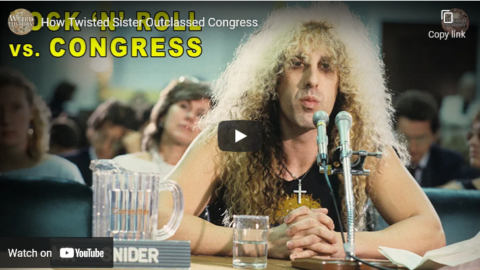
Back in the ’80s, a senator’s wife named Tipper Gore got sick of her kids listening to music she didn’t like, so she started an organization called the Parents Music Resource Center. The PMRC compiled a list of songs they found unacceptable, including “Darling Nikki” by Prince, “We’re Not Gonna Take It” by Twisted Sister, and “She Bop” by Cyndi Lauper. Then Tipper used her political connections to convince the Senate to hold hearings about this supposedly dangerous music.
A lot of Americans decided they liked what popular entertainers were saying, and a handful of busybodies tried to put a stop to it. “If we don’t want to listen to it, nobody should get to listen to it. We need to protect the helpless unwashed masses from themselves!”
Sound familiar?
But then this happened:
If you’ve got a half-hour to spare, you can watch Dee Snider’s entire Senate testimony here. By the time he was done, the PMRC had been exposed for the meddling, hypocritical clowns they were. Their brief moment of relevance was over, at the hands of a guy who looked like Bette Midler transitioning into a Wookie.
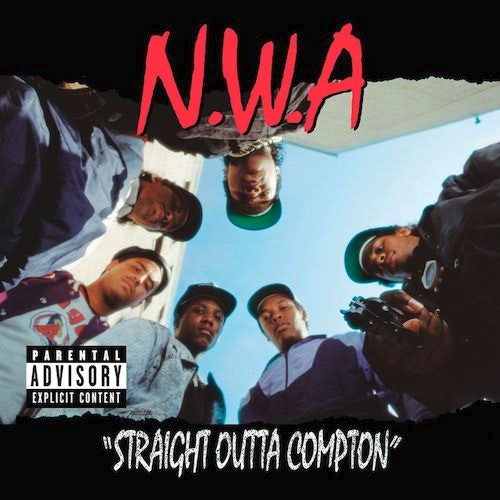
The PMRC did get a consolation prize, though: the “PARENTAL ADVISORY” sticker you can find on a lot of cassettes and CDs from the era. Y’know, the sticker that made kids want to listen to what was inside because their parents wouldn’t like it.
Over the next couple of decades, the PMRC ended up helping a lot of artists sell a lot of records. Like this one:
I remember seeing that CD cover for the first time and thinking, “Damn … this must be awesome.” And it was! If not for Tipper Gore, NWA might not have become superstars and Dr. Dre probably wouldn’t be a near-billionaire now.
Comments Off on Neil Young revives the PMRC
January 7, 2022
Mark Steyn on the Potemkin Congress and the compliant media that enable the farce
With Mark doing a lot more screen time for GB News recently, he doesn’t have as much opportunity to set his thoughts down in written form, so this little paean to the Potemkin parliament at the heart of Washington DC is a rare treat:
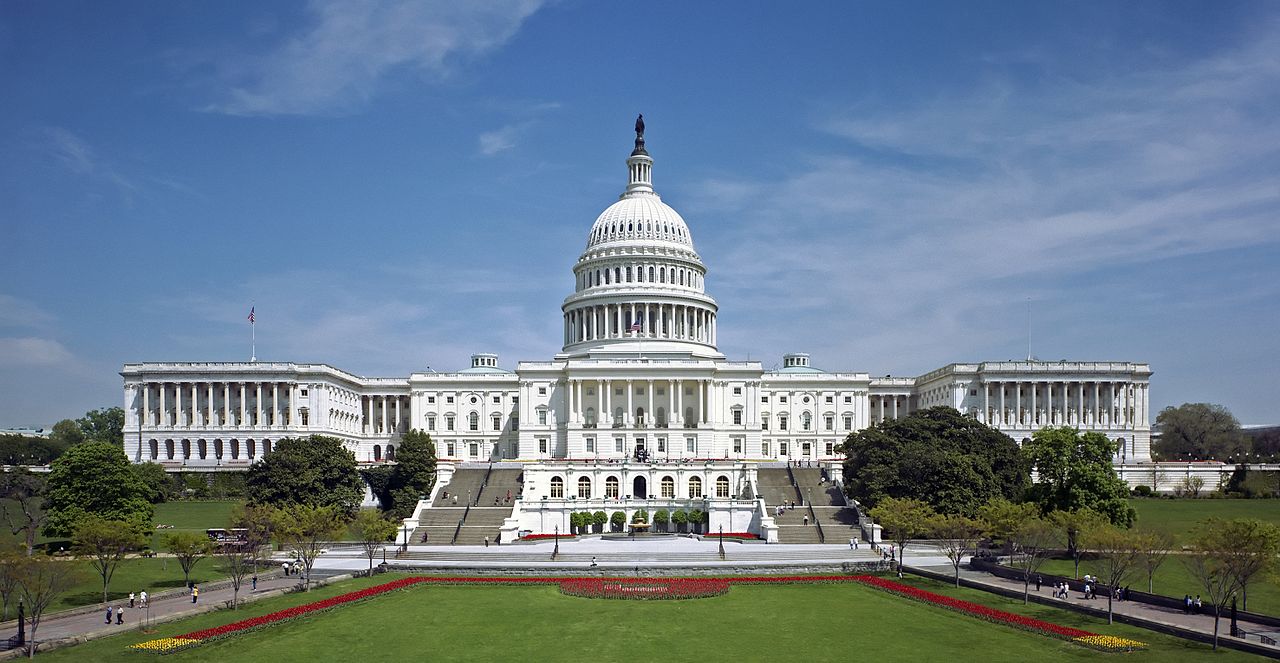
The western front of the United States Capitol. The Neoclassical style building is located in Washington, D.C., on top of Capitol Hill at the east end of the National Mall. The Capitol was designated a National Historic Landmark in 1960.
Photo via Wikimedia Commons.
As I said earlier, I find myself at odds with virtually the entire politico-media class in my reaction to the “storming” of the US Capitol … I was surprised that even politicians and pundits could utter all that eyewash about “the citadel of democracy” and “a light to the world” with a straight face. It’s a citadel of crap, and the lights went out long ago: ask anyone who needs that $600 “relief”.
I despise the United States Congress, and not merely for the weeks I had to spend there during the Clinton impeachment trial: My contempt pre-dates that circus. It dates to the moment I first realized, as a recent arrival to this land, that when Dick Durbin or some such is giving some overwrought speech on a burning issue he is speaking to an entirely empty chamber — because there are no debates, because most of these over-entouraged Emirs of Incumbistan are entirely incapable of debate: See, inter alia, Ed Markey.
But the fact that they might as well be orating in front of the bathroom mirror isn’t why I despise it. It’s that the American media go along with the racket, and there’s only the one pool camera with the fixed tight shot so that you can’t see the joint is deserted and the guy is talking to himself. The wanker press is so protective of its politicians that it’s happy to give the impression that a boob like Markey is Cromwell in the Long Parliament …
That leads easily to the next stage of decay — for why would a Potemkin parliament not degenerate further into a pseudo-legislature? The Covid “relief” bill is 5,593 pages. There is no such thing as a 5,593-page “law” — because no legislator could read it and grasp it. For purposes of comparison, the Government of India Act, which in 1935 was the longest piece of legislation ever drafted in British law and which provided for the government of what are now India, Pakistan and Burma, is 326 pages.
Oh, I’m sure paragons of republican virtue will object that no Indian or Burmese citizen-representatives were involved in that piece of imperial imposition. Well, no American citizen-representatives were involved in the Covid “relief” bill. The legislation was drafted not by legislators, nor by civil servants, nor even by staffers or interns. Instead, a zillion lobbyists wrote their particular carve-outs, and then it got stitched together by some clerk playing the role of Baron von Frankenstein. The “legislators” voted it into law unread, and indeed even unseen, as the Congressional photocopier proved unable to print it: It was a bill without corporeal form, but the yes-men yessed it into law anyway.
Whatever that is, it’s not a republic. As beacons to the world go, stick it where the beacon don’t shine … Whatever Sudan and Chad and Waziristan need, it’s not the US Congress.
Comments Off on Mark Steyn on the Potemkin Congress and the compliant media that enable the farce
October 7, 2021
Alberta’s pantomime election to nominate a Senate candidate that Trudeau can ignore with great relish
In the latest NP Platformed newsletter, Colby Cosh discusses the apparently ongoing non-binding election for Alberta’s next Senate seat:
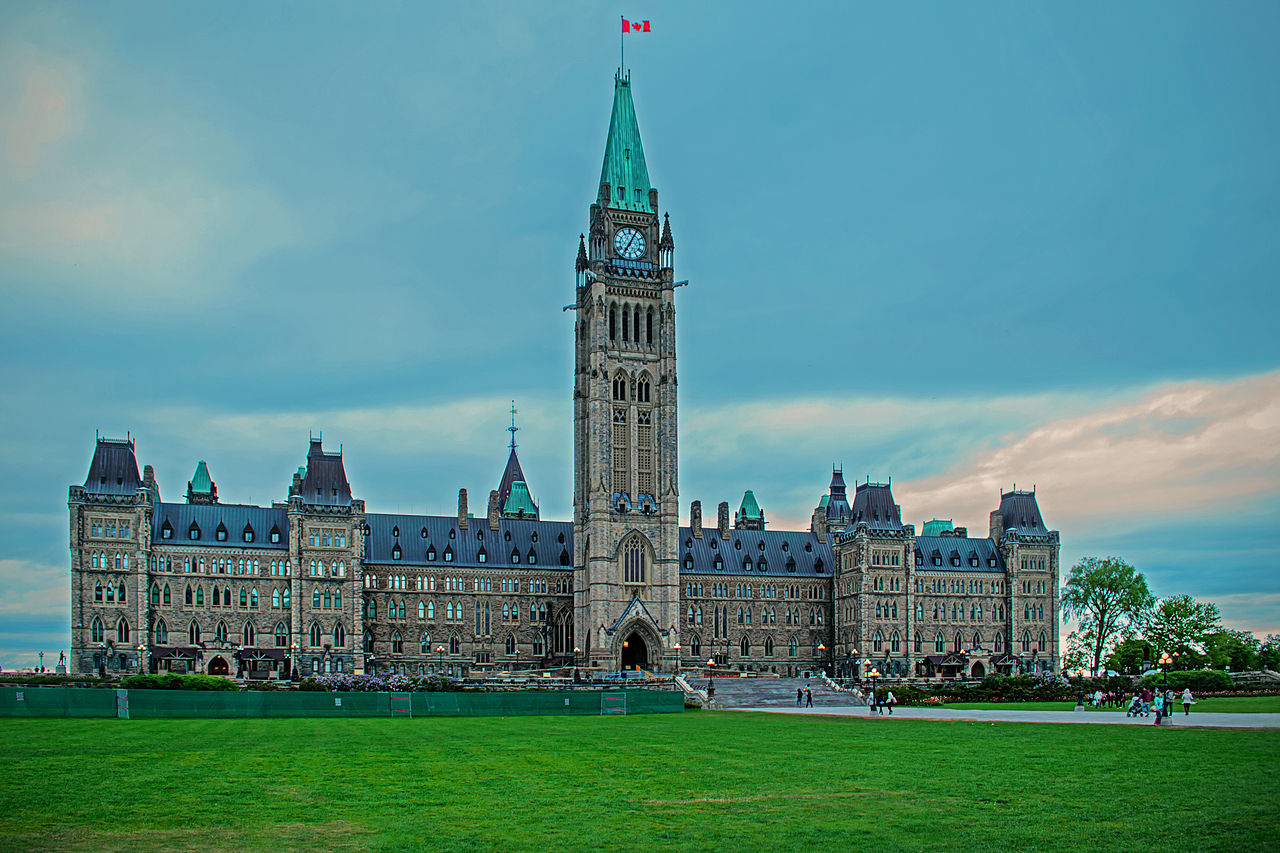
Parliament Hill in Ottawa.
Photo by S. Nameirakpam via Wikimedia Commons.
The prestige of Trudeau’s Independent Advisory Board for Senate Appointments must be maintained at all hazards, which is why the Prime Minister’s Office undertook, a little surprisingly, to provide our Ryan Tumilty with an official response to Alberta’s Senate election. The board, says the voice of the PMO, “evaluates candidates based on public, merit-based criteria”; it was not deemed necessary to finish the sentence with “… unlike the demented, bloodthirsty populace of Alberta, who will presumably just vote for the candidate who can devour the most tar sand at a COVID party.”
For our part, NP Platformed has always been a tad frustrated that smaller political groupings don’t welcome Alberta Senate elections as a chance for a low-stakes, low-cost electoral push toward the limelight. Now that federal and provincial Conservative parties are united, for the moment, 2021’s Senate election has not been accompanied even by the quiet campaigning or the minuscule media attention that the first four elections involved. It is probably to be expected that the three Conservative Party of Canada candidates on the Senate ballot will accumulate enough semi-automatic votes to be nominated.
The Liberals and New Democrats, on an official level, stayed further away from the Senate election process than ever. Duncan Kinney, a totally-independent-from-the-NDP left-wing journalist and fellow of the Broadbent Institute, is appearing on the ballot as part of a sort of none-of-the-above campaign. His entire platform is “this Senate election is illegitimate and stupid, but wouldn’t it be amusing if I won anyhow?” (We’ll take the bait: yes, it would!)
And the People’s party has taken the opportunity to pick three official nominees. If you ask us, the Mad Max party absolutely ought to have hung onto some of what it spent on the federal election and devoted the funds to making a big splash in this one. The TV networks and newspapers would ululate with helpful rage if some PPC creature topped the Senate ballot. Heck, Maxime Bernier has always been able to personally attract big crowds in Alberta. If he had planned ahead and squatted here for six months to meet the residency requirement, he could have run in the Senate election himself.
His proxies probably won’t get anywhere, but we’ll see. There really is an opportunity for a bit of chaos here, since anyone who can break into the top three on this ballot would become an Alberta “senator-in-waiting”. Some of the independent candidates, including former Slave Lake mayor Karina Pillay and former Alberta finance minister Doug Horner, have name recognition that could count for a lot in a low-turnout vote.
Comments Off on Alberta’s pantomime election to nominate a Senate candidate that Trudeau can ignore with great relish
October 5, 2021
Chris Alexander – “The truth is that ‘normal’ in the People’s Republic of China, at least since 1959, has never included the rule of law”
Writing in The Line, Chris Alexander (former Minister of Citizenship and Immigration) explains why attempts to “return to normal” in Canada’s relationship with mainland China are foredoomed to failure:

Yuen Pau Woo was joined in these arguments by senators Peter Boehm and Peter Harder, both seasoned diplomats, who also urged Canada to suspend its judgement with regard to China’s persecution of the Uighurs. This includes the use of concentration camps and forced labour, as well as the repression of language, culture and religion. These are all blatant acts committed with the “intent to destroy, in whole or in part, a national, ethnical, racial or religious group”, as the 1951 Genocide Convention defines this “odious scourge”.
Throughout this unfortunate saga, Beijing has had a Greek chorus of supporters across Canada — mostly from people with well-remunerated corporate or political backgrounds — for the preposterous notion of a “prisoner exchange” that would get relations with China back to “normal”.
In the end, the Senate’s genocide motion failed by a vote of 29 in favour to 33 opposed, with 13 abstentions. China’s Foreign Ministry praised Woo, Boehm and Harder as “people of vision” who had seen through the “despicable schemes of a few anti-China forces”. The “clumsy trick of attacking China for selfish political gains” and “the hype of ‘genocide’ in Xinjiang is unpopular and doomed to fail”, the Foreign Ministry spokesperson crowed.
Had Woo, a former president and CEO of the Asia Pacific Foundation of Canada, and the “two Peters”, both former deputy ministers of foreign affairs, voted in favour, the Senate’s genocide motion would have passed. Instead all three chose, on an issue directly threatening the identity and lives of millions, to take the position of the Communist Party of China over one unanimously endorsed by Canada’s elected House of Commons — all in the empty hope of getting back to “normal” with Beijing.
The truth is that “normal” in the People’s Republic of China, at least since 1959, has never included the rule of law. From China’s ferocious and brutal invasion of Tibet that same year, through the murderous Great Leap Forward ending in 1962, to the decade-long Cultural Revolution up to Mao’s death in 1976 (and beyond), China has been a legal void. Serious judicial reforms never featured in Deng Xiaoping’s economic relaunch. On the contrary, basic rights were decimated, as Tibetan, Mongolian, Uighur and other refugees attest.
According to Freedom House, the current General Secretary of the Chinese Communist Party Xi Jinping’s relentless push for all-encompassing surveillance and censorship has made China the worst environment in the world for internet freedom for the seventh year running. Compliance with such global gag orders is enforced by the CCP’s Orwellian digital panopticon, the notorious United Front Work Department, which seeks to browbeat, buy, corrupt, blackmail, extort or otherwise leverage people and firms with connections to China in support of Xi’s agenda.
Thanks to United Front subterfuge, some prominent Canadians still take China’s side, even as Beijing’s favourability score in Canadian public opinion plummeted to 14 per cent, mirroring a worldwide nosedive for China’s image driven by the two Michaels’ ordeal and Beijing’s “wolf warrior” belligerence.
Comments Off on Chris Alexander – “The truth is that ‘normal’ in the People’s Republic of China, at least since 1959, has never included the rule of law”
July 7, 2021
“Emptied of its resident apparatchiks, Washington would become ‘The Museum State'”
In the latest edition of his newsletter (newsletter@mightyheaton.com), Andrew Heaton considers the pro and con arguments for D.C. statehood:
The western front of the United States Capitol. The Neoclassical style building is located in Washington, D.C., on top of Capitol Hill at the east end of the National Mall. The Capitol was designated a National Historic Landmark in 1960.
Photo via Wikimedia Commons.
The rhetorical pros and cons of DC statehood go like this:
PRO: If we truly believe in “no taxation without representation” and representative government, how can we deprive Washingtonians of their own voting representatives? Bla bla bla racism
CON: The power of the federal government is derived from and balanced by that of the states. To make the federal seat a state in its own right is to create an imperial capital, with too much concentrated power. Bla bla bla dead white guy, Dr. Seuss, veterans
I actually happen to agree with both of these positions. Thus I am an advocate of DC statehood, but predicated on the condition that every federal agency is redistributed to other states — possibly even to Canadian provinces. Congress, the White House, and the Supreme Court can all stay — it’s heavy to lug stacks of marble to Cleveland. The Departments of Education, Commerce, High School Reunions, and so on should be redistributed throughout the country so that every state gets access to cushy, air-conditioned federal pensions.
A similar idea has previously been floated by Mitch Daniels (one of America’s six remaining sane Republicans) and more recently by Josh Hawley and Martha Blackburn (who are not). The biggest Democratic counter to the proposal is that the relocation expenses would be astronomical, making agency redistribution impractical.
While I am always pleasantly startled by a Democrat decrying a massive federal spending hike, redistribution of resources, and a national job creation program on the grounds of practicality and balanced budgets, I think the criticism is less valid in a post-Covid remote worker world. If 90% of the federal government operated remotely in 2020, is there any reason we couldn’t just buy some air conditioned warehouses in Iowa to plop the Department of Agriculture into? While the up-front costs would be considerable, the long-term savings would balance out. Buying a townhouse in Georgetown is roughly as expensive as buying a stadium in Idaho. Redistribute the federal agencies, and we can adjust budgets and the salaries of new hires to reflect that.
Emptied of its resident apparatchiks, Washington would become “The Museum State”. All the cavernous federal agencies could be converted into historical exhibits, art galleries — and if we ever ran out of stuff to display — paintball galleries. (Maybe both?) Two new senators, and Elizabeth Holmes Norton can start voting on stuff.
Comments Off on “Emptied of its resident apparatchiks, Washington would become ‘The Museum State'”
June 23, 2021
Bad legislation rammed through in the small hours of the morning
Michael Geist on how one of the worst pieces of legislation to get extruded from the bowels of the Liberal minority government got pinched off by main force and now sits, steaming, on the docket for the Senate to … well, “rubber stamp” isn’t quite the right phrase but it’s pretty rare for our unelected senators to do anything to benefit ordinary Canadians, so we’re depending on them somehow managing to display an almost supernatural effort to slow down this shitty bill until the end of the session:
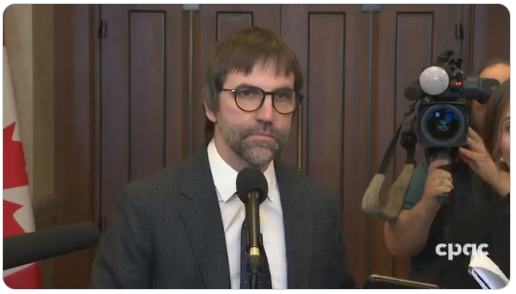
Canadian Heritage Minister Steven Guilbeault, 3 February 2020.
Screencapture from CPAC video.
The Liberal government strategy of multiple gag orders and a “super motion” to limit debate bore fruit last night as Bill C-10 received House of Commons approval at 1:30 am. The Parliamentary process took hours as the government passed multiple motions to cut short debate, re-inserted amendments that had been previously ruled null and void, and rejected a last-ditch attempt to restore the Section 4.1 safeguards for user generated content. The debate included obvious errors from Liberal MPs who were presumably chosen to defend the bill. For example, Julie Dabrusin, the Parliamentary Secretary to the Minister of Canadian Heritage, said that Section 2.1 in Bill C-10 “specifically excludes content uploaded by users.” Only it doesn’t as Dabrusin should know given that 2.1 covers users not content and she was the MP who introduced the amendment at committee to remove Section 4.1, which was the provision that excluded content uploaded by users.
Given the public support from the Bloc for cutting short debate, the outcome last night was never really in doubt. Perhaps the most interesting vote of the night came with a motion from Conservative MP Alain Rayes, which once again called for the re-insertion of Section 4.1. While the motion was defeated with the support of Liberal, NDP, and Bloc MPs, there were several notable exceptions. Liberal MPs Nate-Erskine Smith and Wayne Long both abstained and former Justice Minister (and now independent MP) Jody Wilson-Raybould voted in favour of the motion. The report stage was limited to one hour of debate, which meant that the 23 amendments were again subject to no real debate or discussion. Once the bill passed the report stage, it was on to third and final reading, which was limited to 15 minutes of debate per party. The vote followed just before 1:30 am with the Liberals, NDP, and Bloc once again supporting Bill C-10. Wilson-Raybould joined with the Conservatives in voting against it.
A rational government would comprehend that their pitch that the real purpose of the bill is to “make the web giants pay” is completely undermined by the obvious and deliberate attempt to introduce government censorship of what ordinary Canadians watch on the internet and share through social media. It’s all about the control, not about any imaginary financial windfall from shaking down tech companies for spare change. Why the rush to get it rammed through parliament right now, with so many other rather more pressing concerns at hand?
Comments Off on Bad legislation rammed through in the small hours of the morning
May 10, 2021
They don’t make politicians like Lyndon Johnson anymore … thank goodness
Another of the reader-contributed book reviews at Astral Codex Ten considers the personal history and astounding political career of LBJ, as told by biographer Robert Caro:
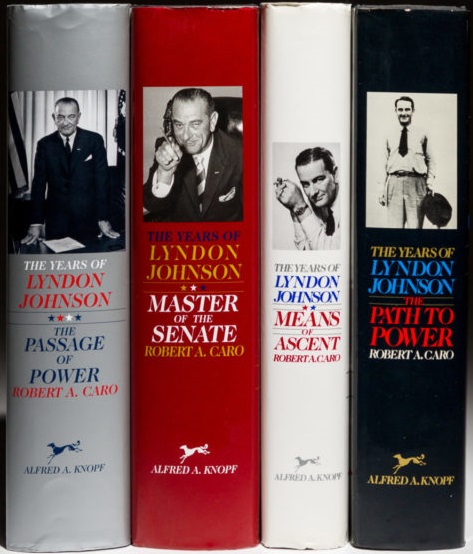
2: LBJ’s guide to amassing power
(i) Seduce older men
(Eww, not like that.) LBJ had a gift for becoming a “professional son” to any powerful man. At college, LBJ sat at professors’ feet and stared at them as if they were God’s gift to the educational system. LBJ constantly ran errands for the college president, Prexy Evans, and wrote glowing editorials about him.
LBJ’s fellow students were not amused. One said:
“Words won’t come to describe how Lyndon acted toward the faculty — how kowtowing he was, how suck-assing he was, how brown-nosing he was.”
But this flattery paid off. Evans put LBJ in charge of the financial aid program. Yes, really. And when other students wrote nasty comments about LBJ in the yearbook (e.g. the time he stole the Student Council elections), Evans ordered professors to cut out those pages with razors.
LBJ would repeat this flattery with President (Franklin) Roosevelt, Speaker Rayburn, and Senator Russell.
(ii) Treat your employees like dirt
LBJ wanted his staff to be absolutely loyal, so he could direct them like chess pieces. He found their weak points — their weight, their divorce — and mercilessly taunted them. I’m not going to describe the crude things he did.
Before his marriage, LBJ treated Lady Bird like an angel; once they were married, he treated her like one of his employees.
[…]
(v) Use money in new and exciting ways
LBJ funneled government contracts to Brown & Root, a construction company. In return, they gave his campaign gobs of money. During the 1948 election, two of his campaign staff ate at a cafe and then accidentally left behind a brown paper bag containing $50,000 in cash (more than $500,000 in today’s money). Luckily no one stole it.
Using all of this money, LBJ was able to make the media say whatever he wanted about his opponent, Coke Stevenson. He hired “missionaries” to hang out in bars and spread rumors about Stevenson. Thousands of federal workers also repeated LBJ’s talking points.
(vi) Cheat
But Stevenson was a storybook character, so money couldn’t defeat him. He simply told the people of Texas that he would continue to do the right thing, and they believed him. LBJ had lost the 1941 Senate election because Pappy O’Daniel had cheated better than he did. Now LBJ would cheat, and he would cheat big.
In 1940s Texas, basically every type of election fraud was real: Dead people voting, county bosses writing down whatever numbers they wanted, Mexicans being hired to cross the border and vote, etc. By buying tens of thousands of votes, LBJ was almost able to close the gap between him and Coke Stevenson. That wasn’t enough, so six days after the election, Luis Salas “found” 200 more votes for LBJ, giving him a margin of victory of 0.01%.
Comments Off on They don’t make politicians like Lyndon Johnson anymore … thank goodness
March 30, 2021
Caesar in Britain II: There and Back Again (54 B.C.E.)
Historia Civilis
Published 21 Mar 2017Patreon | http://historiacivilis.com/patreon
Donate | http://historiacivilis.com/donate
Merch | http://historiacivilis.com/merch
Mailing List | http://historiacivilis.com/mailinglist
Twitter | http://historiacivilis.com/twitter
Website | http://historiacivilis.comMusic is:
“Day Bird,” by Broke For Free
“Drums of the Deep,” by Kevin MacLeod
“Flood,” by Jahzzar

Comments Off on Caesar in Britain II: There and Back Again (54 B.C.E.)
March 29, 2021
Caesar in Britain (55 B.C.E.)
Historia Civilis
Published 22 Feb 2017Patreon | http://historiacivilis.com/patreon
Donate | http://historiacivilis.com/donate
Merch | http://historiacivilis.com/merch
Mailing List | http://historiacivilis.com/mailinglist
Twitter | http://historiacivilis.com/twitter
Website | http://historiacivilis.comMusic is:
“Light Thought var 2,” by Kevin MacLeod
“Bird Day,” by Broke For Free
“Drums of the Deep,” by Kevin MacLeod
“Thinking Music,” by Kevin MacLeod
“Flood,” by Jahzzar
“Hallon,” by Christian Bjoerklund

Comments Off on Caesar in Britain (55 B.C.E.)
November 1, 2020
QotD: Trumbo
And it was. Needless to say, the movie made villains of the conservatives who opposed the Marxist infiltration: people like John Wayne and Hedda Hopper in particular, Wayne because Wayne, and Hopper because she had a son serving in the U.S. Navy during the Korean War. Of course Wayne was made out to be a bully and Hopper a vindictive bitch — and the Senators and Congressmen who haled the Commies in front of the Senate and House Un-American Committee (HUAC) were depicted as ideological purists who saw Communists behind every bush — even though, in the case of Hollywood, there were Commies behind every bush at the time.
Of course, much was made of the fact that being a Communist wasn’t actually illegal (then, and now), and Trumbo made a great show of this being a First Amendment issue — which it was — and how these Commies all wanted to improve America, but of course there were evil right-wingers like Wayne, Joe McCarthy and HUAC harassing them at every turn.
The execution of the traitors Julius and Ethel Rosenberg got a little puff piece in the movie, which didn’t — couldn’t — actually say they weren’t guilty of
treasonespionage, so it was brushed over with the throwaway that it was the first execution for espionage in peacetime, as though peacetime should give espionage a pass. And if that wasn’t enough, the Rosenberg children were paraded around as sympathy magnets — as they still are — because Communists have no problem using children to serve their own purposes.Kim du Toit, “Blacklists Matter”, Splendid Isolation, 2020-07-28.
Comments Off on QotD: Trumbo
October 15, 2020
This is what happens when politicians delegate too much of their powers to the courts
At the Foundation for Economic Education, Lawrence W. Reed recounts the stunning injustice of Soviet “justice”, in the person of Nikolai Krylenko:
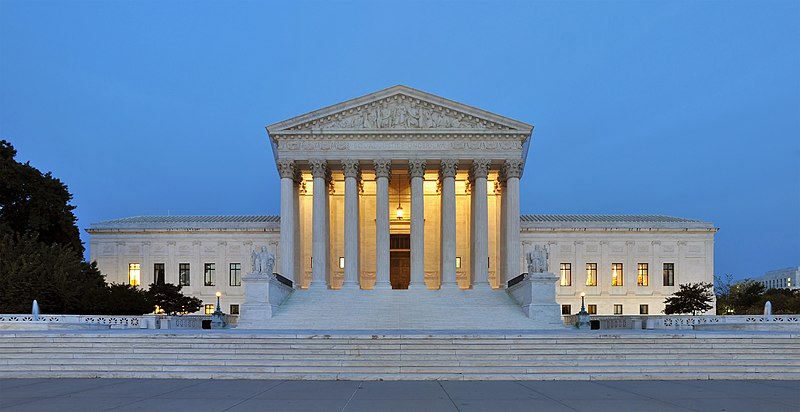
Panorama of the west facade of United States Supreme Court Building at dusk in Washington, D.C., 10 October, 2011.
Photo by Joe Ravi via Wikimedia Commons.
As I watched the first day of hearings on Judge Barrett’s nomination, I was reminded of a largely forgotten Soviet legal theoretician from decades ago. His name was Nikolai Krylenko. Judge Barrett is being given the Krylenko treatment by Democrat senators like Cory Booker and Kamala Harris, meaning this: The only thing that matters is whether she will vote their party line in future cases.
Under the communist dictatorship of Lenin and then Stalin, Krylenko (1885-1938) rose through the Soviet Union’s legal system to become People’s Commissar for Justice and a Prosecutor General. He was a leading practitioner of the theory of “socialist legality,” which held that an accused person’s innocence or guilt depended on that person’s politics (real or imagined). It sounds nuts and indeed, it was. It was the stuff of Orwell’s nightmare, and one of the reasons the Soviet Union thankfully perished of its own poison.
In The Gulag Archipelago, the famous Soviet dissident and Nobel laureate Aleksandr Solzhenitsyn recounted an episode involving Krylenko. Shortly after Lenin’s Bolsheviks assumed power in 1917, an admiral named Shchastny was sentenced by one of the regime’s judges “to be shot within 24 hours.” When some in the courtroom expressed shock, it was Krylenko who responded thusly: “What are you worrying about? Executions have been abolished. But Shchastny is not being executed; he is being shot.”
To Krylenko, the only morality was what served the Party and the State, which of course in the Soviet Union were one and the same. If your politics were not correct, you would be “corrected,” one way or the other. In Richard Pipes’ authoritative book, The Russian Revolution, Krylenko is quoted as exclaiming, “We must execute not only the guilty. Execution of the innocent will impress the masses even more.”
At the Senate hearings for the Barrett nomination, it was apparent the first day that the Judge was being Krylenkoed. Hostile senators pronounced their verdicts before she had uttered a word, and those verdicts had nothing to do with Barrett’s stellar qualifications or keen legal mind. Legal analyst and George Washington University Law School professor Jonathan Turley commented,
What they were suggesting is that they will be voting against her because of what they expected her vote would be in a pending case, and that is a conditional confirmation … Here, the senators seem to be saying, “I’m not even going to listen; I’m going to vote against you because I don’t think you’re going to vote the right way …”
Judge Barrett clearly articulated her judicial philosophy, borne out by the way she has ruled at the US Court of Appeals for the Seventh Circuit: She believes the role of a judge or justice is to follow the Constitution and the law as written, not make stuff up in the service of a political agenda. How ironic that this is a point of fiery contention. Senators who swore an oath to uphold the Constitution and the law hate the guts of a judge who does just that!
Comments Off on This is what happens when politicians delegate too much of their powers to the courts
October 1, 2020
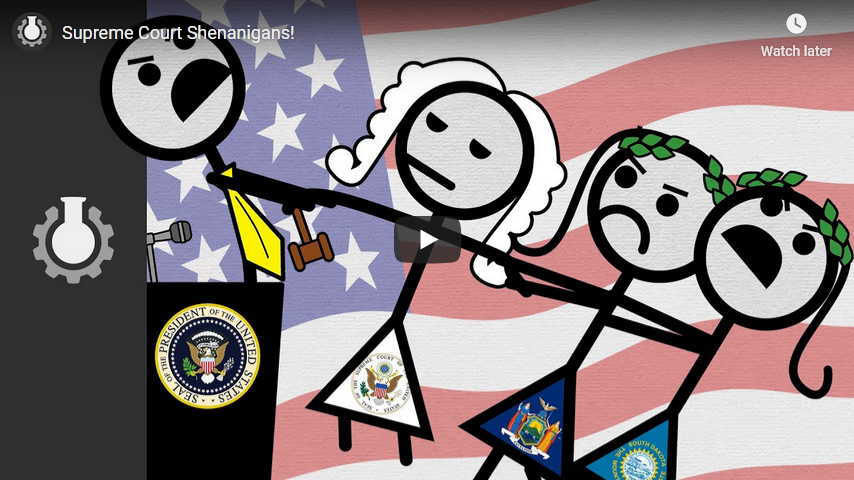
Supreme Court Shenanigans!
CGP Grey
Published 30 Sep 2020
Comments Off on Supreme Court Shenanigans!


